Analysis of Mental Status & Consciousness in Stroke Rehabilitation
VerifiedAdded on 2023/06/10
|8
|2363
|209
Report
AI Summary
This report examines the clinical issue of poor mental status and inappropriate levels of consciousness within stroke rehabilitation centers. It discusses the background of the problem, highlighting the cognitive and memory impairments stroke patients often face, and presents a research question focused on the impact of these issues on patients' quality of life. The relevance and significance of addressing these problems are explored, emphasizing the potential to improve patient outcomes through targeted rehabilitation strategies. A literature review supports the discussion, and the potential impact of the proposed study on the wider community is considered, including benefits for healthcare professionals, families, and society as a whole. The report concludes by emphasizing the importance of stroke rehabilitation in improving cognition, reducing motor impairment, and enhancing the overall quality of life for stroke survivors. The study covers research problem statement, background of the problem, clear statement of research questions, relevance and significance of proposal, literature review and conclusion.
Assessment 2

Paraphrase This Document
Need a fresh take? Get an instant paraphrase of this document with our AI Paraphraser
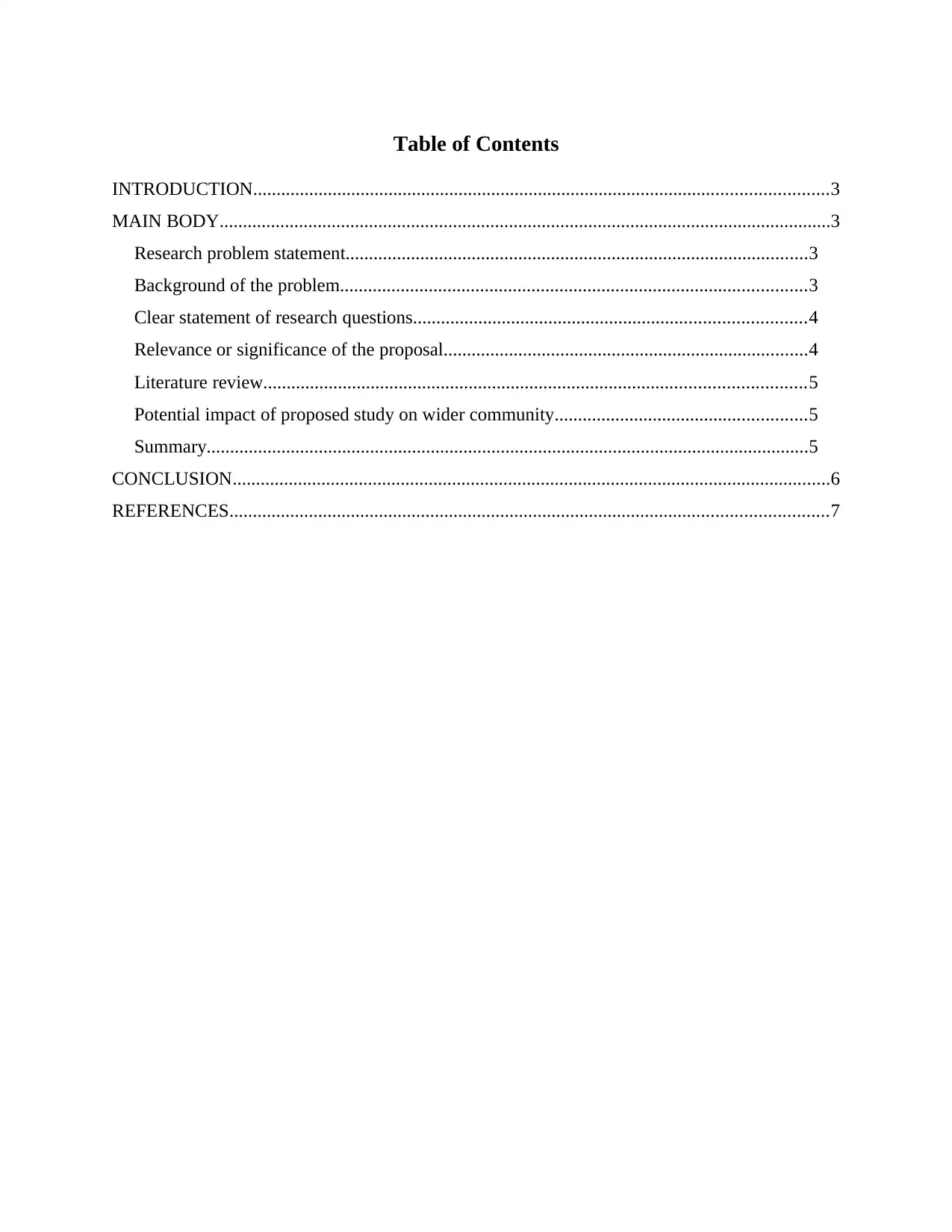
Table of Contents
INTRODUCTION...........................................................................................................................3
MAIN BODY...................................................................................................................................3
Research problem statement...................................................................................................3
Background of the problem....................................................................................................3
Clear statement of research questions....................................................................................4
Relevance or significance of the proposal..............................................................................4
Literature review....................................................................................................................5
Potential impact of proposed study on wider community......................................................5
Summary.................................................................................................................................5
CONCLUSION................................................................................................................................6
REFERENCES................................................................................................................................7
INTRODUCTION...........................................................................................................................3
MAIN BODY...................................................................................................................................3
Research problem statement...................................................................................................3
Background of the problem....................................................................................................3
Clear statement of research questions....................................................................................4
Relevance or significance of the proposal..............................................................................4
Literature review....................................................................................................................5
Potential impact of proposed study on wider community......................................................5
Summary.................................................................................................................................5
CONCLUSION................................................................................................................................6
REFERENCES................................................................................................................................7
INTRODUCTION
Stroke refers to the brain attack which can occurs where blood supply within any part of
brain get blocked due to any reason. This is the one which are associated with blood vessels in
brain get bursts. There may also have chance of damaging or part of brain which can lead to
create lasting brain damage and long-term disability or death (Mazlan et. al., (2021)). High blood
pressure can lead to create high impact and lead to cause stroke and can cause increased risk of
stroke. Stroke rehabilitation refers to providing help to the patient which can be effective and
allow to deliver better and effective response towards the relearn different activities and improve
quality of life. In this, there is discussion about the research problem statement for nursing
clinical issue within speciality practice area. There is discussion about the background of
problem, clear statement about research questions, relevance and significance of proposal,
literature review along with analysis of strength and weaknesses to related problems (Xiaochen
et. al., (2019)).
MAIN BODY
Research problem statement
In this research process, the selected topic as a clinical issue is poor mental status and
inappropriate level of consciousness within stroke rehabilitation department or centres. This is
the problem which causes due to stroke issues. In this, there are many people how face the stroke
issues which lead to create impact on their part of mind where they forget some activity and
skills. This lead to create high impact on their process that can help to improve quality of life.
Due to stroke patient may have impact on their brain part which create difficulty and due to
damaging of brain cells create consciousness issues which need to be regarding and improve the
quality of life which are effective and lead to create high impact on dealing with better care and
impact on their health (Lee et. al., (2018)).
Background of the problem
Stroke has high impact on individual mementoes which can lead to create high impact on
their brain. There are large number of patient who faced difficulty in dealing with better and
effective response towards dealing with better and effective care through improving better
health. There is problem which are associated with impact on brain which leads to loss of
memory (Turner-Stokes et. al., (2021)). There is high impact on patient health where they lost
Stroke refers to the brain attack which can occurs where blood supply within any part of
brain get blocked due to any reason. This is the one which are associated with blood vessels in
brain get bursts. There may also have chance of damaging or part of brain which can lead to
create lasting brain damage and long-term disability or death (Mazlan et. al., (2021)). High blood
pressure can lead to create high impact and lead to cause stroke and can cause increased risk of
stroke. Stroke rehabilitation refers to providing help to the patient which can be effective and
allow to deliver better and effective response towards the relearn different activities and improve
quality of life. In this, there is discussion about the research problem statement for nursing
clinical issue within speciality practice area. There is discussion about the background of
problem, clear statement about research questions, relevance and significance of proposal,
literature review along with analysis of strength and weaknesses to related problems (Xiaochen
et. al., (2019)).
MAIN BODY
Research problem statement
In this research process, the selected topic as a clinical issue is poor mental status and
inappropriate level of consciousness within stroke rehabilitation department or centres. This is
the problem which causes due to stroke issues. In this, there are many people how face the stroke
issues which lead to create impact on their part of mind where they forget some activity and
skills. This lead to create high impact on their process that can help to improve quality of life.
Due to stroke patient may have impact on their brain part which create difficulty and due to
damaging of brain cells create consciousness issues which need to be regarding and improve the
quality of life which are effective and lead to create high impact on dealing with better care and
impact on their health (Lee et. al., (2018)).
Background of the problem
Stroke has high impact on individual mementoes which can lead to create high impact on
their brain. There are large number of patient who faced difficulty in dealing with better and
effective response towards dealing with better and effective care through improving better
health. There is problem which are associated with impact on brain which leads to loss of
memory (Turner-Stokes et. al., (2021)). There is high impact on patient health where they lost
⊘ This is a preview!⊘
Do you want full access?
Subscribe today to unlock all pages.

Trusted by 1+ million students worldwide
their memory due to strake that impact individual cognitive problem which are normal after a
stroke. There can be recovery of cognitive problem where fastest recovery can be within day but
it may last to many years. Due to stroke patient may face loss of memory which can be form of
aphasia, where they suddenly forget words which can lose their ability that may include verbally
communication with others and forgetting stories along with conversations. This can lead to
create high impact on patient life where they may forget about their familiar route and face
difficulty in their daily life (Luconi et. al., (2020)). There are about 30% of the cases in which
patient may lose their memory which are associated with memory impairment that lead to
develop dementia within one year of stroke onset.
Clear statement of research questions
Research question:
What are the impact of poor mental status and inappropriate level of consciousness within stroke
rehabilitation department or centres?
There is high impact of poor mental health status along with inappropriate level of
consciousness that can impact individual health (Wals et. al., (2021)). Stroke lead to create
different problems which are associated with cognitive problem where individual who face the
stroke may forget many things that lead to crate high impact on delivery of better and effective
response towards individual health. Due to poor mental status, it impacts patient quality of life
and they need some care support which make them dependence to others. Due to inappropriate
level of consciousness it also impacts their learning ability where they forget many things in
which they were good and face communication problems which impact their quality of life.
Here, stroke rehabilitation department can be effective and can provide better role in delivery of
effective response towards dealing with better impact (Lannin et. al., (2020)).
Relevance or significance of the proposal
There is relevance of the proposal on society which have impact on individual quality of
living. This is the one where individual may have high impact on their health where people with
stroke problem may have higher change of losing their cognitive ability where through stoke
rehabilitation it enables people to regain their memory and enable them to learn different skills
and activity which can help and improve their learning through increasing their quality of life.
Through this proposal, there is impact on individual life which are associated with people who
faced stroke (Gareev et. al., (2020)). This may include healthcare professional, their family
stroke. There can be recovery of cognitive problem where fastest recovery can be within day but
it may last to many years. Due to stroke patient may face loss of memory which can be form of
aphasia, where they suddenly forget words which can lose their ability that may include verbally
communication with others and forgetting stories along with conversations. This can lead to
create high impact on patient life where they may forget about their familiar route and face
difficulty in their daily life (Luconi et. al., (2020)). There are about 30% of the cases in which
patient may lose their memory which are associated with memory impairment that lead to
develop dementia within one year of stroke onset.
Clear statement of research questions
Research question:
What are the impact of poor mental status and inappropriate level of consciousness within stroke
rehabilitation department or centres?
There is high impact of poor mental health status along with inappropriate level of
consciousness that can impact individual health (Wals et. al., (2021)). Stroke lead to create
different problems which are associated with cognitive problem where individual who face the
stroke may forget many things that lead to crate high impact on delivery of better and effective
response towards individual health. Due to poor mental status, it impacts patient quality of life
and they need some care support which make them dependence to others. Due to inappropriate
level of consciousness it also impacts their learning ability where they forget many things in
which they were good and face communication problems which impact their quality of life.
Here, stroke rehabilitation department can be effective and can provide better role in delivery of
effective response towards dealing with better impact (Lannin et. al., (2020)).
Relevance or significance of the proposal
There is relevance of the proposal on society which have impact on individual quality of
living. This is the one where individual may have high impact on their health where people with
stroke problem may have higher change of losing their cognitive ability where through stoke
rehabilitation it enables people to regain their memory and enable them to learn different skills
and activity which can help and improve their learning through increasing their quality of life.
Through this proposal, there is impact on individual life which are associated with people who
faced stroke (Gareev et. al., (2020)). This may include healthcare professional, their family
Paraphrase This Document
Need a fresh take? Get an instant paraphrase of this document with our AI Paraphraser
member and society. Through this proposal, it can enable patient to get better and effective care
and help to improving their quality of life. This can also have impact on patient health through
caring and support to regain and relearn skills and learning (Ahmad et. al., (2021)).
Literature review
According to Samar, (2016) there are large number of patient who face difficulty after
getting stroke which are associated with causing disability worldwide. Here, individual motor
function gets impact and create mobility issues and some limitation on performing different
activities. This is the one which are associated with impact on life activity which also include
participating in society and professional activities (Ahn et. al., (2019)). Through getting
rehabilitating training, it can help individual to regain and relearn different skills and learning
which is an effective way to reduce the motor impairment within an individual. Due to motor
impairment people are not able to perform different activity which create difficulty in dealing
with different activity that include better and effective response towards the community role.
There is need to take care of effective response towards providing better response in improving
their care and support to improve their quality of life (Carlsson et. al., (2022)).
Potential impact of proposed study on wider community
There is highly impact of loss of cognitive ability on wider society. This can lead to create
impact on their quality of life where known person may also get highly impact due to recognition
problem. People with stoke can loss their recognition ability and forget many skills and things
which lead to create high impact on performing activity. This lead to create issues in the
community where people with stroke may face difficulty in dealing with different activity which
are associated with taking care of their health. Due to forgetting different things and skills create
issues in the society which impact delivery of service and also lowers the quality of life. Here,
patient of stroke problem face difficulty in communication, restricted physical abilities. There is
also some positive aspect that people start to learn about different things and skills where they
may lose their negative habits and can learn positive things that can help in making good society
and community (Zhang et. al., (2020)).
Summary
Stoke can have high impact on individual mind where they may lead to face difficulty due to
loss of cognition problem. This is the one that can impact on living quality of life. There is
and help to improving their quality of life. This can also have impact on patient health through
caring and support to regain and relearn skills and learning (Ahmad et. al., (2021)).
Literature review
According to Samar, (2016) there are large number of patient who face difficulty after
getting stroke which are associated with causing disability worldwide. Here, individual motor
function gets impact and create mobility issues and some limitation on performing different
activities. This is the one which are associated with impact on life activity which also include
participating in society and professional activities (Ahn et. al., (2019)). Through getting
rehabilitating training, it can help individual to regain and relearn different skills and learning
which is an effective way to reduce the motor impairment within an individual. Due to motor
impairment people are not able to perform different activity which create difficulty in dealing
with different activity that include better and effective response towards the community role.
There is need to take care of effective response towards providing better response in improving
their care and support to improve their quality of life (Carlsson et. al., (2022)).
Potential impact of proposed study on wider community
There is highly impact of loss of cognitive ability on wider society. This can lead to create
impact on their quality of life where known person may also get highly impact due to recognition
problem. People with stoke can loss their recognition ability and forget many skills and things
which lead to create high impact on performing activity. This lead to create issues in the
community where people with stroke may face difficulty in dealing with different activity which
are associated with taking care of their health. Due to forgetting different things and skills create
issues in the society which impact delivery of service and also lowers the quality of life. Here,
patient of stroke problem face difficulty in communication, restricted physical abilities. There is
also some positive aspect that people start to learn about different things and skills where they
may lose their negative habits and can learn positive things that can help in making good society
and community (Zhang et. al., (2020)).
Summary
Stoke can have high impact on individual mind where they may lead to face difficulty due to
loss of cognition problem. This is the one that can impact on living quality of life. There is
various impact on individual life where one of main impact that individual need to learn about
commination and performing well which are associated with taking care of better response.
There is different problem faced by individual and through stoke rehabilitation, it can help to
improve the cognition improvement and help in reducing the motor impairment. This can allow
to get improve the quality of life through making them learn about different activity. Stroke
rehabilitation can allow to relearn different activity and enhance the quality of life (Ohata,
(2018)).
CONCLUSION
From the above discussion, it can be concluded that there is high impact of stroke on
individual where memory loss or motor impairment or cognition problem is common. In this
individual is not able to recognise many things and may need to relearn different activities. There
are also impact on dealing with improving quality of life. In this, there is discussion about
research problem statement which are associated with nursing clinical issues within stoke
rehabilitation area. This include background to problem, clear statement regarding research
questions, significance of problem, literature review and analysis of strength and weaknesses to
related problems.
commination and performing well which are associated with taking care of better response.
There is different problem faced by individual and through stoke rehabilitation, it can help to
improve the cognition improvement and help in reducing the motor impairment. This can allow
to get improve the quality of life through making them learn about different activity. Stroke
rehabilitation can allow to relearn different activity and enhance the quality of life (Ohata,
(2018)).
CONCLUSION
From the above discussion, it can be concluded that there is high impact of stroke on
individual where memory loss or motor impairment or cognition problem is common. In this
individual is not able to recognise many things and may need to relearn different activities. There
are also impact on dealing with improving quality of life. In this, there is discussion about
research problem statement which are associated with nursing clinical issues within stoke
rehabilitation area. This include background to problem, clear statement regarding research
questions, significance of problem, literature review and analysis of strength and weaknesses to
related problems.
⊘ This is a preview!⊘
Do you want full access?
Subscribe today to unlock all pages.
Trusted by 1+ million students worldwide
REFERENCES
Books and Journals
Ahmad, A., Mozelius, P., & Ahlin, K. (2021, June). Factors Influencing Acceptance of
Technology-enhanced Speech and Language Relearning for Stroke Survivors-A
Systematic Review. In Proceedings of the 2021 7th International Conference on e-
Society, e-Learning and e-Technologies (pp. 86-91).
Ahn, S., & Hwang, S. (2019). Virtual rehabilitation of upper extremity function and
independence for stoke: A meta-analysis. Journal of exercise rehabilitation, 15(3), 358.
Carlsson, H., Lindgren, I., Rosén, B., Björkman, A., Pessah-Rasmussen, H., & Brogårdh, C.
(2022). Experiences of SENSory Relearning of the UPPer Limb (SENSUPP) after Stroke
and Perceived Effects: A Qualitative Study. International Journal of Environmental
Research and Public Health, 19(6), 3636.
Gareev, B. S., & Kulemin, A. N. (2020). Justification of a New Solution in the Field of Stroke
Rehabilitation. KnE Engineering, 94-99.
Lannin, N. A., Ada, L., English, C., Ratcliffe, J., Faux, S. G., Palit, M., ... & InTENSE Trial
Group. (2020). Effect of additional rehabilitation after botulinum toxin-A on upper limb
activity in chronic stroke: the InTENSE Trial. Stroke, 51(2), 556-562.
Lee, S. I., Adans-Dester, C. P., Grimaldi, M., Dowling, A. V., Horak, P. C., Black-Schaffer, R.
M., ... & Gwin, J. T. (2018). Enabling stroke rehabilitation in home and community
settings: a wearable sensor-based approach for upper-limb motor training. IEEE journal
of translational engineering in health and medicine, 6, 1-11.
Luconi, F., Rochette, A., Grad, R., Hallé, M. C., Chin, D., Habib, B., & Thomas, A. (2020). A
multifaceted continuing professional development intervention to move stroke
rehabilitation guidelines into professional practice: a feasibility study. Topics in Stroke
Rehabilitation, 27(6), 401-441.
Mazlan, S., Rahman, H. A., Kader, B. S. K., Yeong, C. F., & Alhusni, N. A. M. R. (2021).
Multiple Linear Regression in Predicting Motor Assessment Scale of Stroke
Patients. International Journal of Integrated Engineering, 13(6), 330-338.
Ohata, K. (2018). Can a novel rehabilitation robot device change the muscle synergy patterns
during walking in individuals after stroke?. Annals of Physical and Rehabilitation
Medicine, 61, e501.
Turner-Stokes, L., Jacinto, J., Fheodoroff, K., Brashear, A., Maisonobe, P., Lysandropoulos, A.,
& Ashford, S. (2021). Longitudinal goal attainment with integrated upper limb spasticity
management including repeat injections of botulinum toxin A: findings from the
prospective, observational upper limb international spasticity (ULIS-III) cohort
study. Journal of rehabilitation medicine, 53(2).
Walsh, M., Ashford, S., Rose, H., Alfonso, E., Steed, A., & Turner-Stokes, L. (2021). Stratified
management of hemiplegic shoulder pain using an integrated care pathway: an 18-year
clinical cohort analysis. Disability and Rehabilitation, 1-10.
Xiaochen, C., Ping, H., Wenchao, X., Yanqin, Y., & Xuanming, Z. (2019). Human upper limb
motions recognition for stroke rehabilitation with smartphone sensors (No. 920).
EasyChair.
Books and Journals
Ahmad, A., Mozelius, P., & Ahlin, K. (2021, June). Factors Influencing Acceptance of
Technology-enhanced Speech and Language Relearning for Stroke Survivors-A
Systematic Review. In Proceedings of the 2021 7th International Conference on e-
Society, e-Learning and e-Technologies (pp. 86-91).
Ahn, S., & Hwang, S. (2019). Virtual rehabilitation of upper extremity function and
independence for stoke: A meta-analysis. Journal of exercise rehabilitation, 15(3), 358.
Carlsson, H., Lindgren, I., Rosén, B., Björkman, A., Pessah-Rasmussen, H., & Brogårdh, C.
(2022). Experiences of SENSory Relearning of the UPPer Limb (SENSUPP) after Stroke
and Perceived Effects: A Qualitative Study. International Journal of Environmental
Research and Public Health, 19(6), 3636.
Gareev, B. S., & Kulemin, A. N. (2020). Justification of a New Solution in the Field of Stroke
Rehabilitation. KnE Engineering, 94-99.
Lannin, N. A., Ada, L., English, C., Ratcliffe, J., Faux, S. G., Palit, M., ... & InTENSE Trial
Group. (2020). Effect of additional rehabilitation after botulinum toxin-A on upper limb
activity in chronic stroke: the InTENSE Trial. Stroke, 51(2), 556-562.
Lee, S. I., Adans-Dester, C. P., Grimaldi, M., Dowling, A. V., Horak, P. C., Black-Schaffer, R.
M., ... & Gwin, J. T. (2018). Enabling stroke rehabilitation in home and community
settings: a wearable sensor-based approach for upper-limb motor training. IEEE journal
of translational engineering in health and medicine, 6, 1-11.
Luconi, F., Rochette, A., Grad, R., Hallé, M. C., Chin, D., Habib, B., & Thomas, A. (2020). A
multifaceted continuing professional development intervention to move stroke
rehabilitation guidelines into professional practice: a feasibility study. Topics in Stroke
Rehabilitation, 27(6), 401-441.
Mazlan, S., Rahman, H. A., Kader, B. S. K., Yeong, C. F., & Alhusni, N. A. M. R. (2021).
Multiple Linear Regression in Predicting Motor Assessment Scale of Stroke
Patients. International Journal of Integrated Engineering, 13(6), 330-338.
Ohata, K. (2018). Can a novel rehabilitation robot device change the muscle synergy patterns
during walking in individuals after stroke?. Annals of Physical and Rehabilitation
Medicine, 61, e501.
Turner-Stokes, L., Jacinto, J., Fheodoroff, K., Brashear, A., Maisonobe, P., Lysandropoulos, A.,
& Ashford, S. (2021). Longitudinal goal attainment with integrated upper limb spasticity
management including repeat injections of botulinum toxin A: findings from the
prospective, observational upper limb international spasticity (ULIS-III) cohort
study. Journal of rehabilitation medicine, 53(2).
Walsh, M., Ashford, S., Rose, H., Alfonso, E., Steed, A., & Turner-Stokes, L. (2021). Stratified
management of hemiplegic shoulder pain using an integrated care pathway: an 18-year
clinical cohort analysis. Disability and Rehabilitation, 1-10.
Xiaochen, C., Ping, H., Wenchao, X., Yanqin, Y., & Xuanming, Z. (2019). Human upper limb
motions recognition for stroke rehabilitation with smartphone sensors (No. 920).
EasyChair.
Paraphrase This Document
Need a fresh take? Get an instant paraphrase of this document with our AI Paraphraser
Zhang, Q., Schwade, M., Smith, Y., Wood, R., & Young, L. (2020). Exercise-based
interventions for post-stroke social participation: a systematic review and network meta-
analysis. International Journal of Nursing Studies, 111, 103738.
Online
Rehabilitation of Motor Function after Stroke: A Multiple Systematic Review Focused on
Techniques to Stimulate Upper Extremity Recovery (2016), [Online] Available through
<https://www.ncbi.nlm.nih.gov/pmc/articles/PMC5020059/>
interventions for post-stroke social participation: a systematic review and network meta-
analysis. International Journal of Nursing Studies, 111, 103738.
Online
Rehabilitation of Motor Function after Stroke: A Multiple Systematic Review Focused on
Techniques to Stimulate Upper Extremity Recovery (2016), [Online] Available through
<https://www.ncbi.nlm.nih.gov/pmc/articles/PMC5020059/>

1 out of 8


Related Documents


Your All-in-One AI-Powered Toolkit for Academic Success.
+13062052269
info@desklib.com
Available 24*7 on WhatsApp / Email
![[object Object]](/_next/static/media/star-bottom.7253800d.svg)
Unlock your academic potential
Copyright © 2020–2026 A2Z Services. All Rights Reserved. Developed and managed by ZUCOL.