Master of Civil Engineering Project: SHM of NZ Civil Infrastructure

Verified

Added on  2020/03/16

|14
|2413
|108
Report
AI Summary
This report, prepared for a Master of Civil Engineering project, investigates the application of Structural Health Monitoring (SHM) in New Zealand's civil infrastructure. The research focuses on the use of wireless and fiber optic sensors for monitoring the health of structures, including the techniques employed by the New Zealand government and local authorities. It combines a literature review with a survey to highlight challenges in SHM implementation, define opportunities, and establish the challenges faced in the use of sensors. The study explores the advantages of SHM, such as damage detection and condition characterization, and outlines objectives including data collection strategies, asset management understanding, and the development of infrastructure data gathering procedures. The methodology includes data collection through questionnaires, analysis using a five-point ranking system, and hypothesis testing using the p-value approach. The report also includes a budget estimate, a timeframe, and avenues for future research, such as the impact of environmental changes on SHM systems and the development of chemical sensors. The conclusion emphasizes the importance of SHM for ensuring the safety and longevity of infrastructure and highlights the potential for integrating advanced sensing technologies.

Document Page
Running head: STRUCTURAL OBSERVATION OF HEALTH OF CIVIL INFRASTRUCTURE
1
tabler-icon-diamond-filled.svg

Paraphrase This Document

Need a fresh take? Get an instant paraphrase of this document with our AI Paraphraser
Document Page
PUTTING TOGETHER THE FOLLOW UP OF CIVIL INFRASTRUCTURE
2
PUTTING TOGETHER OF CIVIL INFRASTRUCTURE IN NEW ZEALAND
KALPESH BARAD
S5034250, 7001ENG, Master of Civil Engineering/Master of Engineering Project Management.
Monitoring of the structural integrity of civil infrastructure is increasingly done by the use of
structural health monitoring sensors. This research aims at highlighting the techniques set up
by the government of New Zealand and local authorities to monitor the health of structures by
the use of wireless sensors. The main goal of this research is to combine the findings of a
survey to be conducted and a review of various literature in the area of Structural Health
Monitoring (SHM) in New Zealand. It also attempts to highlight the challenges faced in
implementation of SHM, to define the opportunities available in the SHM of civil
infrastructure, and to establish the challenges faced in the use of sensors in SHM of civil
infrastructure
Keywords: Damage detection, structural health monitoring (SHM), Civil infrastructure in
New Zealand
1. Introduction
Civil infrastructure is very fundamental area when it comes to addressing the prosperity of any
society. To keep track of the structural integrity of civil infrastructure, and monitor their overall
performance, SHM systems are put into use.
Document Page
Structural Health monitoring involves the use of intelligent sensors and related technologies to
collect a wide array of data and giving an output that will be used to rate the condition of a
structure or structural element. SHM systems help in the detection of possible damage on civil
infrastructure due to natural hazards, aging, and/ or deterioration. This study aims at investigating
the overall use of sensors for SHM in of asset management, assessment of structural integrity, risk
assessment and scrutinizing of civil infrastructure in this country.
2. Review of the literature
Research has been conducted in the field of damage detection and putting together follow up as
the necessity for careful observation of modern infrastructure gets higher. (Chang, 2006) indicated
that most global health monitoring systems either had trust in the solving of the variations in the
resonant frequencies or movement in the modes of shapes of a arrangement. The process work on
the principle of recognition of these small variations in the structures; even those caused by
temperature variations, moisture changes, and other environmental factors resulted in dynamic
characteristics. This resulted in modifying in the arrangement of dynamic characteristics because
of the reasons other than real damage are considered “noisy” in the arrangement of health
measurements. Due to this, it resulted in the system to take computation that are importantly
greater than those caused by the “noise” for the technique to succeed.
Resulting in an investigated audit a lot, in the councils had an asset for buildings and operational
management plan. However, the investigation also emphasized on the need for an upgrade in the
data collection system. This was echoed, (New Zealand Office of the Auditor General (NZOAG,
2010) by a similar investigation which identified a dire need for improvement of bridge-related
data
3
Document Page
PUTTING TOGETHER THE FOLLOW UP OF CIVIL INFRASTRUCTURE
4
However, what is lacking from past investigation is an coordinated framework and inclusive
for the collection of data. putting in consideration that since a framework for data collection will
have a great impact on infrastructure follow up, SHM software working should be advanced to
manage present repositories and databases used in New Zealand (Chang, Flatau & Liu, 2003).
3. Sensors for SHM
When monitoring the condition and performance of non-homogeneous material like concretes, the
systems used for sensing should be able to collect and record data in small increments with an
allowance for local effects and discontinuities. Therefore, a number of sensing technologies have
been developed. The main ones used in New Zealand includes wireless sensors and fiber optic
sensors.
3.1. Wireless sensors
These are sensors with an autonomous platform for collection of data. They are fitted with strain
gauges that are sensitive to inertial forces induced into the structures. The inertial sensors have a
gyroscope and accelerometer.
Studies are being done in New Zealand to develop embedded wireless sensors to be integrated
into concrete elements for purposes of monitoring the concrete in structures from the beginning
curing phase and following the strength gain of the concrete.
tabler-icon-diamond-filled.svg

Paraphrase This Document

Need a fresh take? Get an instant paraphrase of this document with our AI Paraphraser
Document Page
3.2. Fiber optic sensors
The commonly used type of fiber optic sensor is the discrete point sensors which work by
detecting the strains along localized areas of the construction material. They are ideal for
homogeneous material.
4. Advantages of SHM
SHM is used in the process of damage detection and condition characterization of civil
infrastructure. SHM is used to keep track of the structural integrity of buildings, dams, tunnels,
levees, bridges, wind turbines, and other civil infrastructure. The following are the opportunities
in the SHM technology:
Control of material properties and process of construction
SHM may help in the safety management of infrastructure under construction as incomplete
structures are at risk due to accidents and environmental hazards.
SHM offers the chance for the validation of assumptions made during design with regards to
forces, deflection, displacements, drifts, and reactions during construction.
5. Objectives
The research will use the following objectives:
Develop a strategy that has an interest in civil infrastructure for collection of data and scrutiny,
taking into account the effects involved and significance in the construction sector.
5
Document Page
PUTTING TOGETHER THE FOLLOW UP OF CIVIL INFRASTRUCTURE
6
Determine an in-depth understanding of local and international developments in asset
management and structural health monitoring, including the kind of data necessary to satisfy
the requirements of asset management.
Establish methodologies for data collection that satisfy the various needs of New Zealand
building and infrastructure regulation authorities, including a series of difficulties being faced
by the transport network, and tackling a variety of asset management development levels that
are in existence (Brown, 2006).
Develop an outline for the gathering of infrastructure and building-related data, recognizing
the intended use of the data, and the required degrees of accuracy.
Establish procedures for optimum data instrumentation and collection, including of factors
such as the design, type of construction, materials and their condition and existing data
collection programs
Afford appreciation of practices existing used by national and infrastructure inspectors and
local building. Such an appreciation will facilitate the advancement of a plan for employment
and training of inspectors.
6. Research hypothesis
The research will have the following hypothesis from the literature review;
Structures like dams and buildings are usually monitored by Structural Health Monitoring
(Kothari, 2004).
There is no related inventory for the storage of data brought together from the civil
infrastructure being monitored using the procedure of structural health monitoring.
Document Page
In Europe, USA and Asia Structural Health Monitoring is extensively used to follow up
infrastructure to precisely assess their performance (Chang, Flatau & Liu, 2003).
To enable the performance of infrastructure to work at the best in terms of durability, strength
the data and capacity collected is mostly used in level of service (LOS)
7. Research Methodology
7.1. Data taking and Analysis
Based on hypothesis to be formulated, the main method of data collection will be use of
questionnaire. The questionnaire to be answered will base on the following questions:
1. Structures to be Monitored by SHM
2. Condition Data Collection
3. Level of Service management.
4. Infrastructure inventory information
5. International Practice in SHM
7.1.1. Approach
The above questions will be solved based on the following approach:
1. Every question developed from the hypothesis, one must understand the main purpose of it.
2. Knowing the best practice for the benchmarking of responses
3. Each question must have a ranking as follows, ranging from the most poor to the most best:
a) Very poor
b) poor
7
tabler-icon-diamond-filled.svg

Paraphrase This Document

Need a fresh take? Get an instant paraphrase of this document with our AI Paraphraser
Document Page
PUTTING TOGETHER THE FOLLOW UP OF CIVIL INFRASTRUCTURE
8
c) Fair
d) good
e) Excellent
4. use of comparative weightings for each sub-question will be used in the five-point ranking
system to fit the scores.
7.1.2. Analysis
The response general characterization, plotting of the responses will be obtained from the
questionnaire.
Analyzing the variations within baseline based on baseline responses and data type.
The final presentation results will be obtained into MATLAB models.
7.2. Testing Hypothesis
The p-value approach will be used to test the hypothesis formulated as follows:
The null and alternative hypothesis will be specified using the formulated hypothesis.
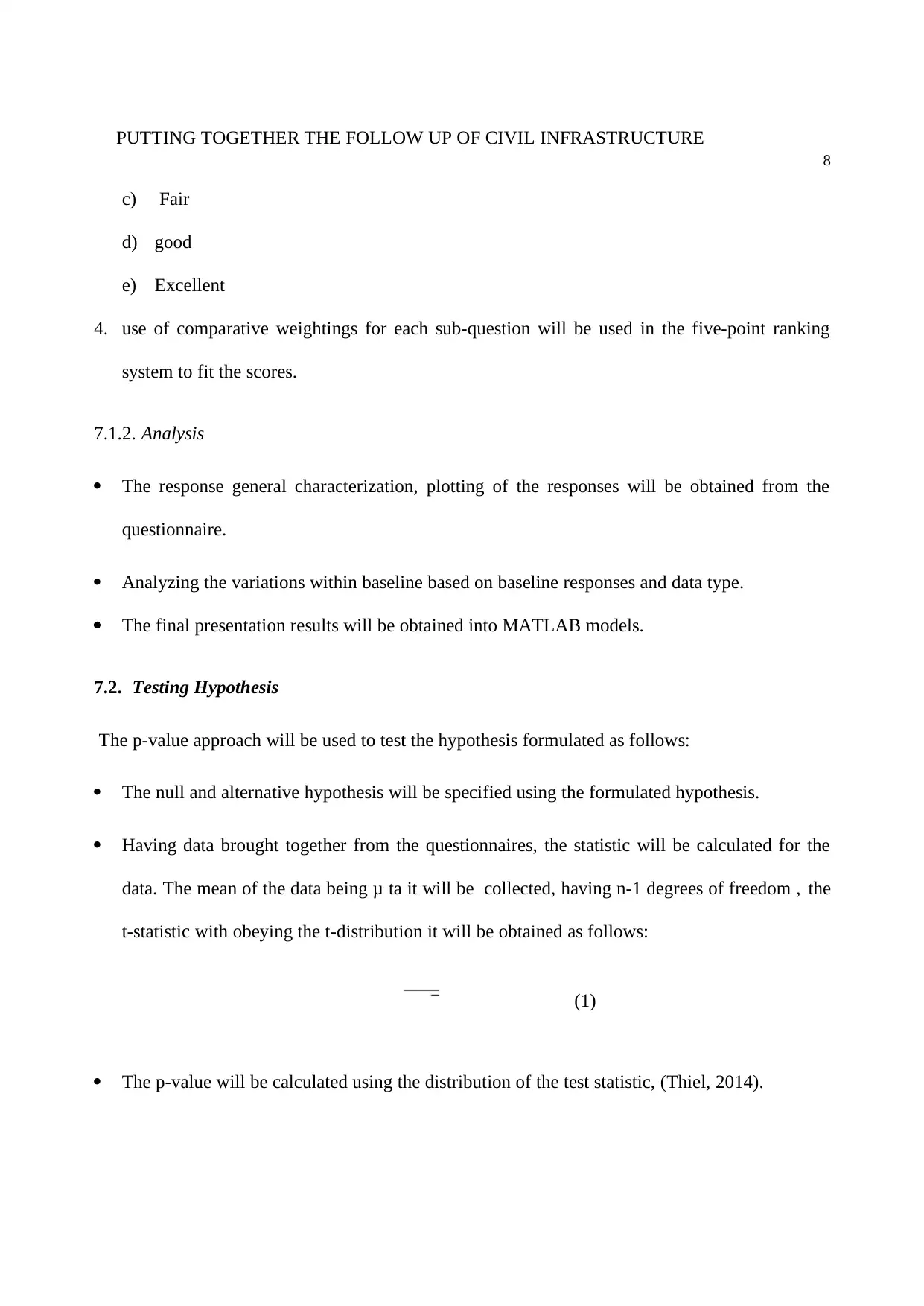
Having data brought together from the questionnaires, the statistic will be calculated for the
data. The mean of the data being μ ta it will be collected, having n-1 degrees of freedom , the
t-statistic with obeying the t-distribution it will be obtained as follows:
(1)
The p-value will be calculated using the distribution of the test statistic, (Thiel, 2014).
Document Page
0.05 The level of significance, α, to be set. Α is to be compared with p-value., it will not be
rejected otherwise the null hypothesis will be rejected If the p-value is less than α (Thiel,
2014).
7.3. Team
The team will consists of five, which will include the following:
Personal supervisor
Maintains and assign responsibilities for the ethical handling of the research which is the
greatest obligation.
Supervise presentation, collection and interpretation of data.
Coordinator of the research
Conducting the research process.
Help in Carrying out analysis of research findings and data processing.
Other staffs
Helps in presentation, analysis and collection of data.
Helps in filling the required documents for the principle.
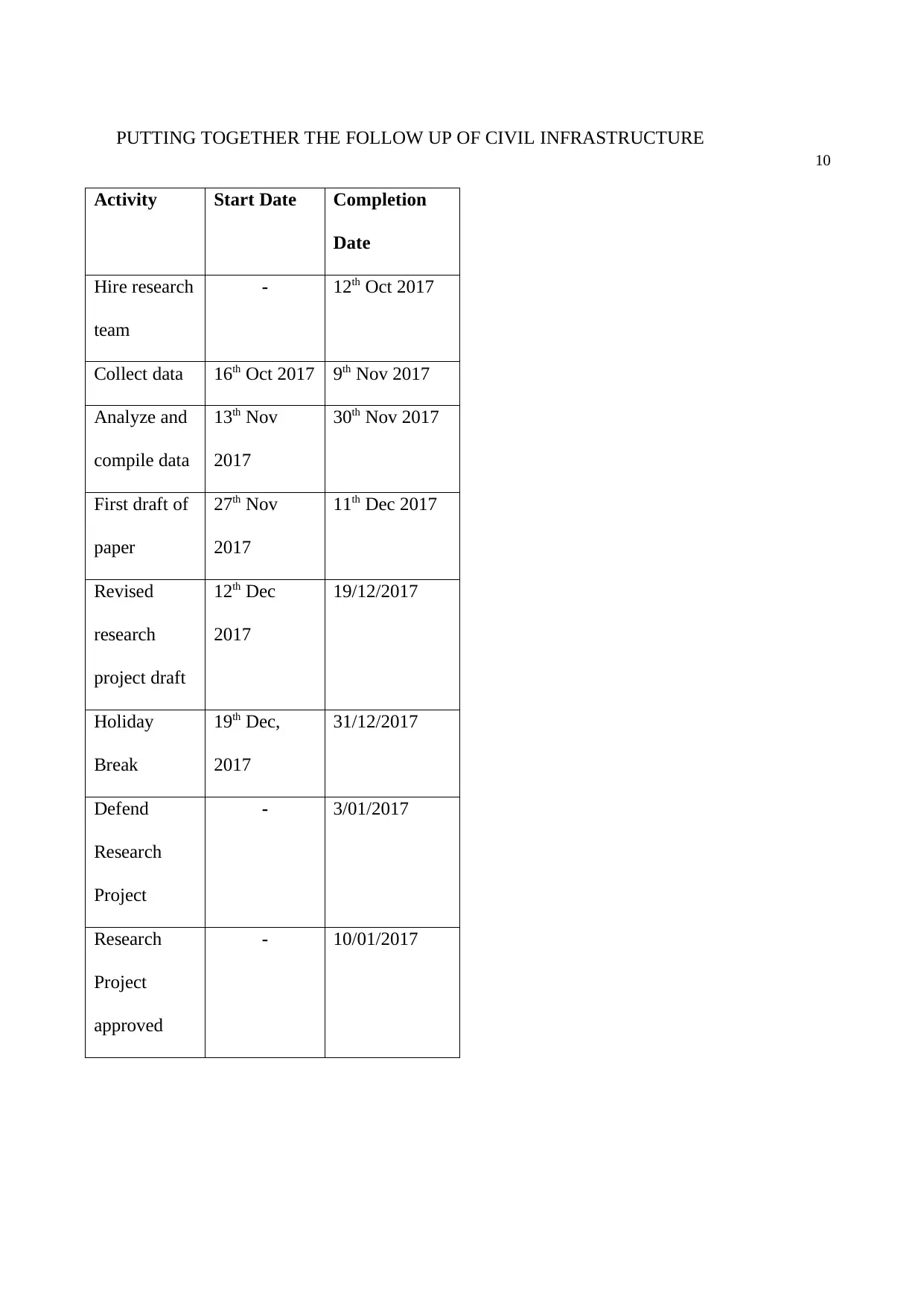
7.4. Timeframe
The time schedule is as shown below;
9
Document Page
PUTTING TOGETHER THE FOLLOW UP OF CIVIL INFRASTRUCTURE
10
Activity Start Date Completion
Date
Hire research
team
- 12th Oct 2017
Collect data 16th Oct 2017 9th Nov 2017
Analyze and
compile data
13th Nov
2017
30th Nov 2017
First draft of
paper
27th Nov
2017
11th Dec 2017
Revised
research
project draft
12th Dec
2017
19/12/2017
Holiday
Break
19th Dec,
2017
31/12/2017
Defend
Research
Project
- 3/01/2017
Research
Project
approved
- 10/01/2017
tabler-icon-diamond-filled.svg

Paraphrase This Document

Need a fresh take? Get an instant paraphrase of this document with our AI Paraphraser
Document Page
7.5. Budget Estimate
A 3-month period of a proposed project budget on a weekly based is as follows:
Cost (NZD)
1. Personnel Salary/week
Personal supervisor (1)
Research coordinator (1)
Other staffs (3)
Amount
550
350
300 X 3
1800
2. Materials
Expenditure
1. Questionnaire printing
Services
1. Other Printing services
2. Questionnaire translation
200
100
200
3. Stationary and equipment 350
4. Other expenses (eg. Travel) 150
Total: $ 2800 per week
8. Avenues for further work
In this paper, the focus has been the various ways in which Structural health monitoring can be
applied in civil infrastructure damage detection. However, there are numbers of avenues to be
11
Document Page
PUTTING TOGETHER THE FOLLOW UP OF CIVIL INFRASTRUCTURE
12
pursued in research to ensure that SHM gains maximum potential in New Zealand. This includes:
As the sensors used in SHM are likely to be influenced by the environmental changes such as
temperature variations and random vibrations during the design period of the civil
infrastructure, a study of the impacts of environmental changes on the performance of SHM
systems.
As sensors will be collecting a vast amount of data, a data collection framework and inventory
needs to be developed. Therefore, further work needs to be done focusing on developing
software functionalities and algorithms to aid in civil infrastructure database and repositories
management.
To incorporate SHM in the monitoring of infrastructure in adverse environments, studies need
to be conducted towards the development of chemical sensors for corrosion, humidity, and
corrosion especially for marine structures and civil infrastructure built in areas with high
Sculpture content.
9. Conclusion
Administered structures are the safest and long-lasting. The ability to measure flows of
information throughout the building is vital in ensuring digital future buildings that utilize
innovation and next-generation monitoring systems. Structural health monitoring is currently an
area of interest as it presents a potential solution for later examination of structures. As the size,
chevron_up_icon
1 out of 14
circle_padding
hide_on_mobile
zoom_out_icon
[object Object]