Legal Analysis: Studebaker v. Nettie's Flower Garden, Inc. Case

Verified

Added on  2019/09/20

|3
|1314
|314
Case Study
AI Summary
This case study analyzes the legal dispute in Studebaker v. Nettie's Flower Garden, Inc. where Judith Studebaker sued Nettie's Flower Garden on the basis of respondeat superior, claiming that James Ferry, the driver of a van that collided with her vehicle, was an employee of Nettie's. The central issue revolves around whether Ferry was an employee or an independent contractor. The court examined the level of control Nettie's had over Ferry, including his delivery territory, required delivery times, and the requirement for him to stop at the downtown shop. The case highlights the distinction between an employee, where the employer has the right to control the worker's conduct, and an independent contractor, who controls their own work. The court's decision will likely hinge on the application of the respondeat superior doctrine, which holds employers liable for the negligent acts of their employees committed within the scope of employment, and the determination of the nature of the relationship between Nettie's and Ferry.
Document Page
STUDEBAKER V NETTIE’S FLOWER’S GARDEN, INC
[Judith Studebaker was injured when a van driven by James Ferry collided with her vehicle. She brought
an action against Nettie ’ s Flower Garden, Inc. (Nettie ’ s), on a respondeat superior theory in the belief
that Ferry was Nettie ’ s employee at the time of the accident. Nettie ’ s defended that Ferry was an
independent contractor, not an employee. From a judgment in favor of Studebaker for $125,000, Nettie
’ s appealed.] CRANDALL, P. J. … … Ferry delivered flowers for Nettie ’ s from its main shop on Grand
Avenue in the City of St. Louis. Ferry was paid, not by the hour, but at a rate of $2.50 to$3.00 per
delivery. If there were no deliveries, he was not paid. He delivered only in an area of St. Louis which
Nettie ’ s designated as his territory. Nettie ’ s required him to make two runs each day: one in the
morning at 9:30 A . M .; one in the afternoon at 1:30 P . M . When he arrived at the shop, he setup his
own route based upon the location of the deliveries in his area. He generally got to work at8:00 A . M .
to prepare for the morning run and at 12:00 P . M . to prepare for the afternoon run. Nettie ’ s also
required Ferry to stop by its shop in downtown St. Louis at St. Louis Centre before noon each day to pick
up items which needed to be transported to the Grand Avenue shop. After this stop, Ferry proceeded to
the Grand Avenue shop for his afternoon run. Nettie ’ s paid Ferry $5.00 for this stop, whether or not
there was anything for him to take to the Grand Avenue shop. Ferry used his own van for the deliveries;
Nettie ’ s required that it be heated and air-conditioned to protect the flowers and plants. Although he
did not wear a uniform, Nettie ’ s directed that Ferry be neat in appearance and that he conduct himself
in a certain manner when on the job. If his behavior or appearance fell below its standards, Nettie ’ s
reprimanded Ferry. Ferry paid his own expenses and received no fringe benefits from Nettie ’ s. On
August 9, 1989, the date of the accident in question, Ferry made his morning run and then his mid-day
stop at the downtown shop at about11:00 A . M . There was nothing for him to transport to the Grand
Avenue shop. After Ferry left the downtown shop, he stopped at a pawn shop to conduct personal
business. He then proceeded to the Grand Avenue shop to prepare for his afternoon run. On the way to
the Grand Avenue shop, at approximately 11:45 A . M ., Ferry ’ s van collided with plaintiff ’ s automobile
Under the doctrine of respondeat superior an employer is liable for those negligent acts or omissions of
his employee which are committed within the scope of his employment … . Liability based on
respondeat superior requires some evidence that a master-servant relationship existed between the
par-ties … . The test to determine if respondeat superior applies to a tort is whether the person sought
to be charged as master had the right or power to control and direct the physical conduct of the other in
the performance of the act … . If there was no right to control there is no liability; for those rendering
services but retaining control over their own movements are not servants … . [Judith Studebaker was
injured when a van driven by James Ferry collided with her vehicle. She brought an action against Nettie
’ s Flower Garden, Inc. (Nettie ’ s), on a respondeat superior theory in the belief that Ferry was Nettie ’ s
employee at the time of the accident. Nettie ’ s defended that Ferry was an independent contractor, not
an employee. From a judgment in favor of Studebaker for$125,000, Nettie ’ s appealed.] CRANDALL, P. J.
Ferry delivered flowers for Nettie ’ s from its main shop on Grand Avenue in the City of St. Louis. Ferry
tabler-icon-diamond-filled.svg

Paraphrase This Document

Need a fresh take? Get an instant paraphrase of this document with our AI Paraphraser
Document Page
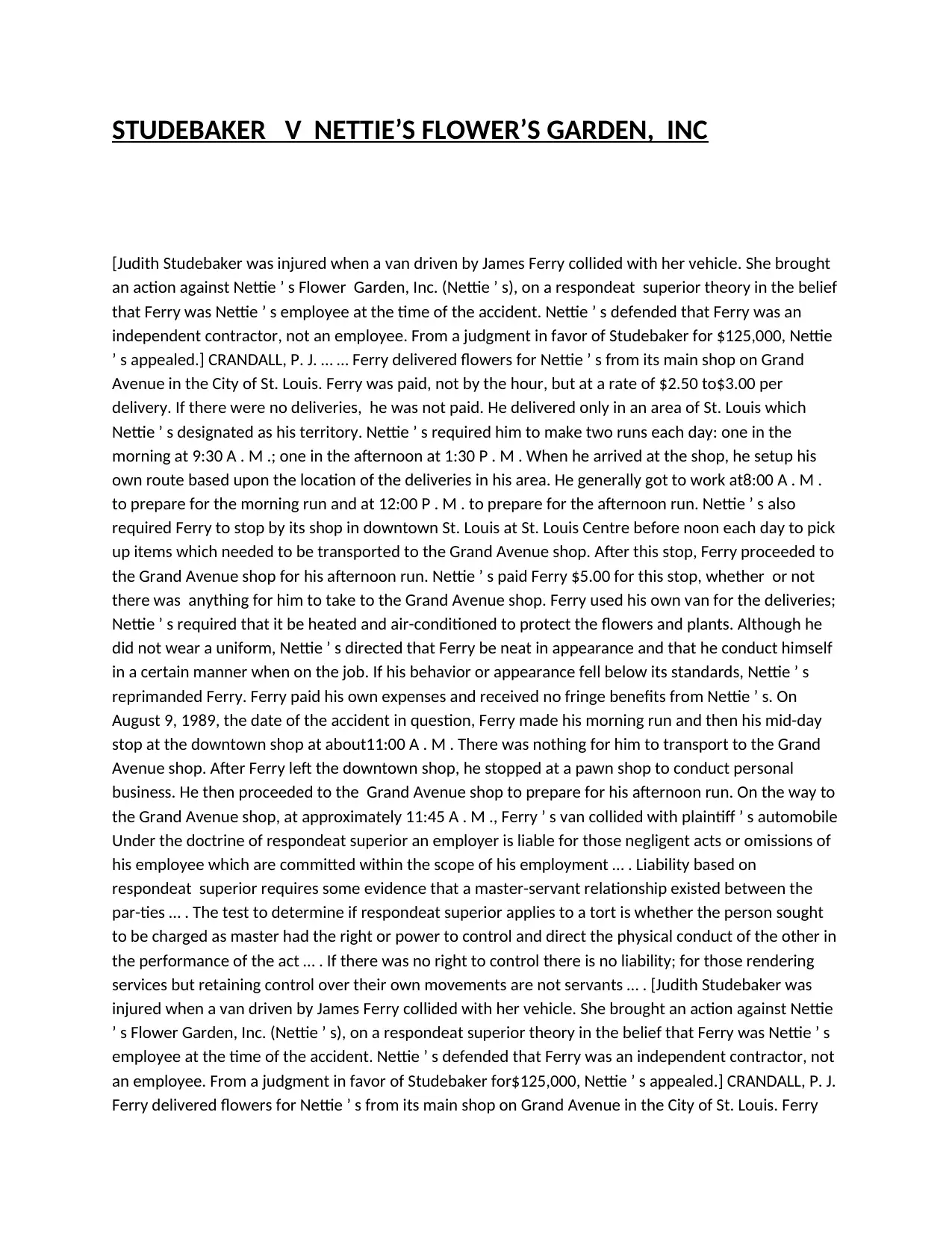
was paid, not by the hour, but at a rate of $2.50 to$3.00 per delivery. If there were no deliveries, he was
not paid. He delivered only in an area of St. Louis which Nettie ’ s designated as his territory. Nettie ’ s
required him to make two runs each day: one in the morning at 9:30 A . M .; one in the afternoon at
1:30 P . M . When he arrived at the shop, he setup his own route based upon the location of the
deliveries in his area. He generally got to work at 8:00 A . M . to prepare for the morning run and at
12:00 P . M . to prepare for the afternoon run. Nettie ’ s also required Ferry to stop by its shop in
downtown St. Louis at St. Louis Centre before noon each day to pick up items which needed to be
transported to the Grand Avenue shop. After this stop, Ferry proceeded to the Grand Avenue shop for
his afternoon run. Nettie ’ s paid Ferry $5.00 for this stop, whether or not there was anything for him to
take to the Grand Avenue shop. Ferry used his own van for the deliveries; Nettie ’ s required that it be
heated and air-conditioned to protect the flowers and plants. Although he did not wear a uniform,
Nettie ’ s directed that Ferry be neat in appearance and that he conduct himself in a certain manner
when on the job. If his behavior or appearance fell below its standards, Nettie ’ s reprimanded Ferry.
Ferry paid his own expenses and received no fringe benefits from Nettie ’ s. On August 9, 1989, the date
of the accident in question, Ferry made his morning run and then his mid-day stop at the downtown
shop at about 11:00 A . M . There was nothing for him to transport to the Grand Avenue shop. After
Ferry left the downtown shop, he stopped at a pawn shop to con-duct personal business. He then
proceeded to the Grand Avenue shop to prepare for his afternoon run. On the way to the Grand Avenue
shop, at approximately 11:45 A . M ., Ferry ’ s van collided with plaintiff ’ s automobile … .Under the
doctrine of respondeat superior an employer is liable for those negligent acts or omissions of his
employee which are committed within the scope of his employment … . Liability based on respondeat
superior requires some evidence that a master-servant relationship existed between the parties … . The
test to determine if respondeat superior applies to a tort is whether the person sought to be charged as
master had the right or power to control and direct the physical conduct of the other in the
performance of the act … . If there was no right to control there is no liability; for those rendering ser-
vices but retaining control over their own movements are not servants … . The master-
Document Page
chevron_up_icon
1 out of 3
circle_padding
hide_on_mobile
zoom_out_icon
[object Object]