Challenges of Implementing Evidence-Based Practice in Nursing
VerifiedAdded on 2020/05/03
|11
|2793
|58
AI Summary
The implementation of Evidence-Based Practice (EBP) in nursing is crucial for improving patient outcomes and care quality. However, numerous challenges impede its successful integration into healthcare settings. Key obstacles include a lack of adequate training and education among nurses, which leads to difficulties in understanding and applying EBP principles effectively. Resource constraints further exacerbate the situation, as limited access to necessary tools and support can hinder practice changes. Resistance to change is another significant barrier; many healthcare professionals are accustomed to traditional practices and may be reluctant to adopt new methods without clear evidence of their benefits. Additionally, communication gaps between multidisciplinary teams can lead to inconsistent application of EBP principles across different departments or units. Addressing these challenges requires comprehensive strategies that encompass improved training programs, better resource allocation, fostering a culture open to change, and enhancing collaboration among healthcare providers.
Running head: EVIDENCE BASED PRACTICE
EVIDENCE BASED PRACTICE
Name of the student:
Name of the university:
Author note:
EVIDENCE BASED PRACTICE
Name of the student:
Name of the university:
Author note:

Paraphrase This Document
Need a fresh take? Get an instant paraphrase of this document with our AI Paraphraser
1
EVIDENCE BASED PRACTICE
The effect of evidence based practices has been reflected across different sectors of
healthcare centers ensuring high quality practice, proper education as well as science. Recent
experts in the field of healthcare are of the opinion that there is a huge importance of evidence
based quality improvement as well as healthcare transformation which will ensure redesigning
care that would be safe, efficient and effective (Dogherty et al., 2013). National experts have
thereby helped nursing professionals by providing multiple direction-setting recommendations
where nurses have already responded to the launch initiatives. This will actually enhance the
valuable contributions that nurses had made, can make or will make to promise the development
of the safest and effective care. Researchers have stated evidence based practice as the process
which involves the conscientious use of best current evidence in making different decisions
about patient care. It is mainly incorporating three important parts (Ubbink, Guyatt & Vermulen,
2013). This is a systematic search as well as a critical appraisal for the most relevant evidence in
order to make correct decisions in solving a clinical issue. The other two are keeping in mind the
patients’ preferences and values and the nurse’s own clinical expertise. However evidence based
practice is not a simple procedure and need to be followed in a systematic procedure in a proper
manner so that the results obtained are not only accurate but also the procedure becomes rapid
and quick to perform (Novak, 2014). Therefore, trainings are required so that students can learn
the techniques for conducting such practice and can meet the true sense of the help provided by
the evidence based techniques. Without training, the steps of conducting the evidence based
research cannot yield successful result and ultimately will result in loss of confidence of the
nurses and chance of effective care by the nurses could never be achieved. After proper training
only, they can be held at the forefront of the EBP implementation. In the present assignment,
importance of effective training for evidence based practice will be discussed along with the
EVIDENCE BASED PRACTICE
The effect of evidence based practices has been reflected across different sectors of
healthcare centers ensuring high quality practice, proper education as well as science. Recent
experts in the field of healthcare are of the opinion that there is a huge importance of evidence
based quality improvement as well as healthcare transformation which will ensure redesigning
care that would be safe, efficient and effective (Dogherty et al., 2013). National experts have
thereby helped nursing professionals by providing multiple direction-setting recommendations
where nurses have already responded to the launch initiatives. This will actually enhance the
valuable contributions that nurses had made, can make or will make to promise the development
of the safest and effective care. Researchers have stated evidence based practice as the process
which involves the conscientious use of best current evidence in making different decisions
about patient care. It is mainly incorporating three important parts (Ubbink, Guyatt & Vermulen,
2013). This is a systematic search as well as a critical appraisal for the most relevant evidence in
order to make correct decisions in solving a clinical issue. The other two are keeping in mind the
patients’ preferences and values and the nurse’s own clinical expertise. However evidence based
practice is not a simple procedure and need to be followed in a systematic procedure in a proper
manner so that the results obtained are not only accurate but also the procedure becomes rapid
and quick to perform (Novak, 2014). Therefore, trainings are required so that students can learn
the techniques for conducting such practice and can meet the true sense of the help provided by
the evidence based techniques. Without training, the steps of conducting the evidence based
research cannot yield successful result and ultimately will result in loss of confidence of the
nurses and chance of effective care by the nurses could never be achieved. After proper training
only, they can be held at the forefront of the EBP implementation. In the present assignment,
importance of effective training for evidence based practice will be discussed along with the
2
EVIDENCE BASED PRACTICE
different barriers that may arise due to improper learning and incapability to apply evidence
based care. It will include 4 nursing standards of NMBA and how they could be met only with
effective training in EBP in nursing.
Some of the barriers that nursing students or new nurses often face while adopting to
EBP practice is the shortage of time. Researchers on this topic are of the opinion that monthly
more than 8000 articles are released in different disciplines of nursing and hence it becomes
impossible to go through a maximum for them to transit their care plan to a new care plan
(Stokke et al., 2014). Hence, proper strategy to refine the searches and following this with the
correct up to date selection by narrowing searches to very few articles is very important which is
often not done by nurses. Hence this process becomes quite hectic for them and also takes a lot
of time (Dozois et al., 2014). Such a huge amount of time, if spent on searching and collecting
evidences, will affect the nurses’ time of caring the patients which in turn will lead to poor
patient satisfaction (Weng et al., 2013). Hence, it is believed that without training, this practice
cannot achieve it main essence. This can be supported by the standard 3 which states the
importance of maintaining the capability of practice. Standard 3.1 says that the nurse needs to
consider and respond “in a timely manner to the health and wellbeing of self and others in
relation to the capability for practice” ("Standard of practice, Nursing and midwifery board of
Australia", 2016). If a nurse here remains busy searching for new evidences and cannot apply
the correct and safest care on time, it would ultimately compromise the main focus of conducting
the EBP.
Another issue which is also faced by the nurses is the lack of confidence of conducting
the researches in the right way and loss of authority for them to change the practice to a new
method of practice. It is found that many nurses complain that they are often not sure of the
EVIDENCE BASED PRACTICE
different barriers that may arise due to improper learning and incapability to apply evidence
based care. It will include 4 nursing standards of NMBA and how they could be met only with
effective training in EBP in nursing.
Some of the barriers that nursing students or new nurses often face while adopting to
EBP practice is the shortage of time. Researchers on this topic are of the opinion that monthly
more than 8000 articles are released in different disciplines of nursing and hence it becomes
impossible to go through a maximum for them to transit their care plan to a new care plan
(Stokke et al., 2014). Hence, proper strategy to refine the searches and following this with the
correct up to date selection by narrowing searches to very few articles is very important which is
often not done by nurses. Hence this process becomes quite hectic for them and also takes a lot
of time (Dozois et al., 2014). Such a huge amount of time, if spent on searching and collecting
evidences, will affect the nurses’ time of caring the patients which in turn will lead to poor
patient satisfaction (Weng et al., 2013). Hence, it is believed that without training, this practice
cannot achieve it main essence. This can be supported by the standard 3 which states the
importance of maintaining the capability of practice. Standard 3.1 says that the nurse needs to
consider and respond “in a timely manner to the health and wellbeing of self and others in
relation to the capability for practice” ("Standard of practice, Nursing and midwifery board of
Australia", 2016). If a nurse here remains busy searching for new evidences and cannot apply
the correct and safest care on time, it would ultimately compromise the main focus of conducting
the EBP.
Another issue which is also faced by the nurses is the lack of confidence of conducting
the researches in the right way and loss of authority for them to change the practice to a new
method of practice. It is found that many nurses complain that they are often not sure of the
⊘ This is a preview!⊘
Do you want full access?
Subscribe today to unlock all pages.

Trusted by 1+ million students worldwide
3
EVIDENCE BASED PRACTICE
proper ways of conducting evidence based practices as their classes in the universities have been
mainly theoretical (Sadeghi et al., 2014). This makes them face difficulty or makes them unsure
that whether they are following the right approach. This apprehensiveness makes them stay away
from conducing new changes and hence try to follow the old traditional nursing interventions.
Moreover due to such confusions in nurses, they are also prevented from implementing new
changes as the nurse leaders do not provide them the authority to take any risks with the patient
health. Therefore training is extremely important to teach them the right technique and manage
to find the best evidence so that they become confident with their tasks (Schimdt & Brown,
2014). This confidence and skilled attribute will help the nurse leaders also to allow them
implement changes in practice when they gain confidence over the student nurses and their new
approaches to patients. Standard 5 states the need to “Develops a plan for nursing practice”.
Proper confidence of the nurse, while conducting EBP is very important as this will lead her in
selecting the evidences which will have the best outcomes on patients. Proper training can ensure
the nurses in maintaining standard 5.2. stating helping them to “collaboratively constructs
nursing practice plans until contingencies, options priorities, goals, actions, outcomes and
timeframes are agreed with the relevant persons” . Training will also ensure that the nurse
has gained the capability to properly search literature and accordingly ensure maintenance of
standard 5.4 “plans and negotiates how practice will be evaluated and the time frame of
engagement,” and also standard 5.5 “coordinates resources effectively and efficiently for
planned actions” ("Standard of practice, Nursing and midwifery board of Australia", 2016).
Several others criteria need to be developed by nurses other than the basic nursing
capabilities which can never be possible without proper training and guidance from experts of
the similar background. Nurses should be helped in aspects like effectively identifying
EVIDENCE BASED PRACTICE
proper ways of conducting evidence based practices as their classes in the universities have been
mainly theoretical (Sadeghi et al., 2014). This makes them face difficulty or makes them unsure
that whether they are following the right approach. This apprehensiveness makes them stay away
from conducing new changes and hence try to follow the old traditional nursing interventions.
Moreover due to such confusions in nurses, they are also prevented from implementing new
changes as the nurse leaders do not provide them the authority to take any risks with the patient
health. Therefore training is extremely important to teach them the right technique and manage
to find the best evidence so that they become confident with their tasks (Schimdt & Brown,
2014). This confidence and skilled attribute will help the nurse leaders also to allow them
implement changes in practice when they gain confidence over the student nurses and their new
approaches to patients. Standard 5 states the need to “Develops a plan for nursing practice”.
Proper confidence of the nurse, while conducting EBP is very important as this will lead her in
selecting the evidences which will have the best outcomes on patients. Proper training can ensure
the nurses in maintaining standard 5.2. stating helping them to “collaboratively constructs
nursing practice plans until contingencies, options priorities, goals, actions, outcomes and
timeframes are agreed with the relevant persons” . Training will also ensure that the nurse
has gained the capability to properly search literature and accordingly ensure maintenance of
standard 5.4 “plans and negotiates how practice will be evaluated and the time frame of
engagement,” and also standard 5.5 “coordinates resources effectively and efficiently for
planned actions” ("Standard of practice, Nursing and midwifery board of Australia", 2016).
Several others criteria need to be developed by nurses other than the basic nursing
capabilities which can never be possible without proper training and guidance from experts of
the similar background. Nurses should be helped in aspects like effectively identifying
Paraphrase This Document
Need a fresh take? Get an instant paraphrase of this document with our AI Paraphraser
4
EVIDENCE BASED PRACTICE
knowledge gaps, formulation of different relevant questions as well as conducting efficient
literature research. They need to have complete idea about the procedure of applying the correct
rules of evidence to determine the validity of the researches (Weaver, Dy & Rosen, 2014). Not
only application of the literature finding is sufficient to handle the patient problem but
appropriately involving the patient in the clinical decision making is also important to ensure
safe and culturally competent care. These can be only achieved by proper guidance by trainers
and teachers (Edmunds et al., 2013). Therefore training of EBP will help the registered nurses to
be aligned with the standard 6 called the “Provides safe, appropriate and responsive quality
nursing practice”. When all the above mentioned attributes will be incorporated by the nurses
after proper guidance by the trainers, nurses can follow the standard 6.1. which states that
“provides comprehensive safe, quality practice to achieve agreed goals and outcomes that
are responsive to the nursing needs of people” ("Standard of practice, Nursing and midwifery
board of Australia", 2016). The better the attributes leant; the better will be their enhancement of
the handling of the EBP procedures and better will be outcome of the patient ensuring high
patient satisfaction.
Another barrier often faced by nurses while implementing evidence based practices
issues in getting accustomed with the statistical procedures, improper understanding of the
technical jargons as well as difficulty in judging the quality of the papers. The last attribute is
exceptionally important an every nurses should develop the capability to understand that the
paper they have selected are authentic or not. Training is therefore extremely important to help
them learn the procedures by which they can select or reject the papers and thereby finalize on
the most authentic ones (Kris et al., 2014). Moreover, training is also very important for them to
develop knowledge about the statistical procedures followed on the papers so that they can
EVIDENCE BASED PRACTICE
knowledge gaps, formulation of different relevant questions as well as conducting efficient
literature research. They need to have complete idea about the procedure of applying the correct
rules of evidence to determine the validity of the researches (Weaver, Dy & Rosen, 2014). Not
only application of the literature finding is sufficient to handle the patient problem but
appropriately involving the patient in the clinical decision making is also important to ensure
safe and culturally competent care. These can be only achieved by proper guidance by trainers
and teachers (Edmunds et al., 2013). Therefore training of EBP will help the registered nurses to
be aligned with the standard 6 called the “Provides safe, appropriate and responsive quality
nursing practice”. When all the above mentioned attributes will be incorporated by the nurses
after proper guidance by the trainers, nurses can follow the standard 6.1. which states that
“provides comprehensive safe, quality practice to achieve agreed goals and outcomes that
are responsive to the nursing needs of people” ("Standard of practice, Nursing and midwifery
board of Australia", 2016). The better the attributes leant; the better will be their enhancement of
the handling of the EBP procedures and better will be outcome of the patient ensuring high
patient satisfaction.
Another barrier often faced by nurses while implementing evidence based practices
issues in getting accustomed with the statistical procedures, improper understanding of the
technical jargons as well as difficulty in judging the quality of the papers. The last attribute is
exceptionally important an every nurses should develop the capability to understand that the
paper they have selected are authentic or not. Training is therefore extremely important to help
them learn the procedures by which they can select or reject the papers and thereby finalize on
the most authentic ones (Kris et al., 2014). Moreover, training is also very important for them to
develop knowledge about the statistical procedures followed on the papers so that they can
5
EVIDENCE BASED PRACTICE
understand how a particular intervention and its efficiency is established by the researchers
(Loveday et al., 2014). This would help the nursing professionals to maintain the standard 1.1
which states “accesses, analyses, and uses the best available evidence, that includes research
findings, for safe, quality practice” ("Standard of practice, Nursing and midwifery board of
Australia", 2016). By properly gaining knowledge, it would help in analyzing and using the best
evidence by rejecting the improper ones for safe quality practice (Greenhalgh, Howick &
Maskarey, 2014).
Therefore, I can stand in the support of the statement that indeed training is very
important to develop the skills of evidence based practice without which nurses will not be able
to conduct proper care. I strongly believe on the necessity of every healthcare centers to establish
strong training teams who would be guiding the nurses in their approaches of EBP. The attempt
to include evidence based practice in the bachelor’s degree in nursing is indeed a good attempt to
incorporate the practice in the real life settings. However, only teaching about the procedures for
effective application of EBP is not enough (Aarons et al., 2015). The healthcare organizations
would be encouraging the nurses to undergo proper training session even in their workplace so
that they can adapt to the culture of evidence based practices while developing care plan for the
patients. Getting adapted to the environment will automatically boost their confidence (Young et
al., 2014). As nurses remain in the forefront while establishing the safest care to increase patient
satisfaction, they should prepare themselves in way where they can ensure that the most recent
innovations, current trends in care, technological advancement, developed ways of handling
healthcare issues and concerns and others are inculcated by them. Therefore nurses are indeed at
the forefront of the EBP practices and they should be properly trained to maintain their
responsibilities.
EVIDENCE BASED PRACTICE
understand how a particular intervention and its efficiency is established by the researchers
(Loveday et al., 2014). This would help the nursing professionals to maintain the standard 1.1
which states “accesses, analyses, and uses the best available evidence, that includes research
findings, for safe, quality practice” ("Standard of practice, Nursing and midwifery board of
Australia", 2016). By properly gaining knowledge, it would help in analyzing and using the best
evidence by rejecting the improper ones for safe quality practice (Greenhalgh, Howick &
Maskarey, 2014).
Therefore, I can stand in the support of the statement that indeed training is very
important to develop the skills of evidence based practice without which nurses will not be able
to conduct proper care. I strongly believe on the necessity of every healthcare centers to establish
strong training teams who would be guiding the nurses in their approaches of EBP. The attempt
to include evidence based practice in the bachelor’s degree in nursing is indeed a good attempt to
incorporate the practice in the real life settings. However, only teaching about the procedures for
effective application of EBP is not enough (Aarons et al., 2015). The healthcare organizations
would be encouraging the nurses to undergo proper training session even in their workplace so
that they can adapt to the culture of evidence based practices while developing care plan for the
patients. Getting adapted to the environment will automatically boost their confidence (Young et
al., 2014). As nurses remain in the forefront while establishing the safest care to increase patient
satisfaction, they should prepare themselves in way where they can ensure that the most recent
innovations, current trends in care, technological advancement, developed ways of handling
healthcare issues and concerns and others are inculcated by them. Therefore nurses are indeed at
the forefront of the EBP practices and they should be properly trained to maintain their
responsibilities.
⊘ This is a preview!⊘
Do you want full access?
Subscribe today to unlock all pages.
Trusted by 1+ million students worldwide
6
EVIDENCE BASED PRACTICE
From the above discussion, it is quite clear that training is necessary for evidence based
practices. Without this, a nurse would not be able to adhere with the recent development in
clinical researches and innovations made in technological advancement in healthcare sectors. As
a result they will never be able to provide the best care. Therefore, not providing the training but
still holding them responsible for giving the best care to patients is not justifiable. Without
training, nurses may face many issues in taking on the EBP approach like improper time
management, incorrect procedures to select proper articles, improper ways to develop knowledge
about the validities, technical terms, statistics and others. Hence, healthcare institutions and
organizations should first give proper trainings and then only they should hold nurses as
forefront of the implementation of the evidences collected in the clinical setting.
EVIDENCE BASED PRACTICE
From the above discussion, it is quite clear that training is necessary for evidence based
practices. Without this, a nurse would not be able to adhere with the recent development in
clinical researches and innovations made in technological advancement in healthcare sectors. As
a result they will never be able to provide the best care. Therefore, not providing the training but
still holding them responsible for giving the best care to patients is not justifiable. Without
training, nurses may face many issues in taking on the EBP approach like improper time
management, incorrect procedures to select proper articles, improper ways to develop knowledge
about the validities, technical terms, statistics and others. Hence, healthcare institutions and
organizations should first give proper trainings and then only they should hold nurses as
forefront of the implementation of the evidences collected in the clinical setting.
Paraphrase This Document
Need a fresh take? Get an instant paraphrase of this document with our AI Paraphraser
7
EVIDENCE BASED PRACTICE
References:
Aarons, G. A., Ehrhart, M. G., Farahnak, L. R., & Hurlburt, M. S. (2015). Leadership and
organizational change for implementation (LOCI): a randomized mixed method pilot
study of a leadership and organization development intervention for evidence-based
practice implementation. Implementation Science, 10(1), 11.
Dogherty, E. J., Harrison, M. B., Graham, I. D., Vandyk, A. D., & Keeping‐Burke, L. (2013).
Turning Knowledge Into Action at the Point‐of‐Care: The Collective Experience of
Nurses Facilitating the Implementation of Evidence‐Based Practice. Worldviews on
Evidence
‐Based Nursing, 10(3), 129-139.
Dozois, D. J., Mikail, S. F., Alden, L. E., Bieling, P. J., Bourgon, G., Clark, D. A., ... & Johnston,
C. (2014). The CPA Presidential Task Force on Evidence-Based Practice of
Psychological Treatments. Canadian Psychology/Psychologie canadienne, 55(3), 153.
Edmunds, J. M., Beidas, R. S., & Kendall, P. C. (2013). Dissemination and implementation of
evidence–based practices: Training and consultation as implementation
strategies. Clinical Psychology: Science and Practice, 20(2), 152-165.
Greenhalgh, T., Howick, J., & Maskrey, N. (2014). Evidence based medicine: a movement in
crisis?. Bmj, 348, g3725.
EVIDENCE BASED PRACTICE
References:
Aarons, G. A., Ehrhart, M. G., Farahnak, L. R., & Hurlburt, M. S. (2015). Leadership and
organizational change for implementation (LOCI): a randomized mixed method pilot
study of a leadership and organization development intervention for evidence-based
practice implementation. Implementation Science, 10(1), 11.
Dogherty, E. J., Harrison, M. B., Graham, I. D., Vandyk, A. D., & Keeping‐Burke, L. (2013).
Turning Knowledge Into Action at the Point‐of‐Care: The Collective Experience of
Nurses Facilitating the Implementation of Evidence‐Based Practice. Worldviews on
Evidence
‐Based Nursing, 10(3), 129-139.
Dozois, D. J., Mikail, S. F., Alden, L. E., Bieling, P. J., Bourgon, G., Clark, D. A., ... & Johnston,
C. (2014). The CPA Presidential Task Force on Evidence-Based Practice of
Psychological Treatments. Canadian Psychology/Psychologie canadienne, 55(3), 153.
Edmunds, J. M., Beidas, R. S., & Kendall, P. C. (2013). Dissemination and implementation of
evidence–based practices: Training and consultation as implementation
strategies. Clinical Psychology: Science and Practice, 20(2), 152-165.
Greenhalgh, T., Howick, J., & Maskrey, N. (2014). Evidence based medicine: a movement in
crisis?. Bmj, 348, g3725.
8
EVIDENCE BASED PRACTICE
Kris-Etherton, P. M., Akabas, S. R., Bales, C. W., Bistrian, B., Braun, L., Edwards, M. S., ... &
Pratt, C. A. (2014). The need to advance nutrition education in the training of health care
professionals and recommended research to evaluate implementation and
effectiveness. The American journal of clinical nutrition, 99(5), 1153S-1166S.
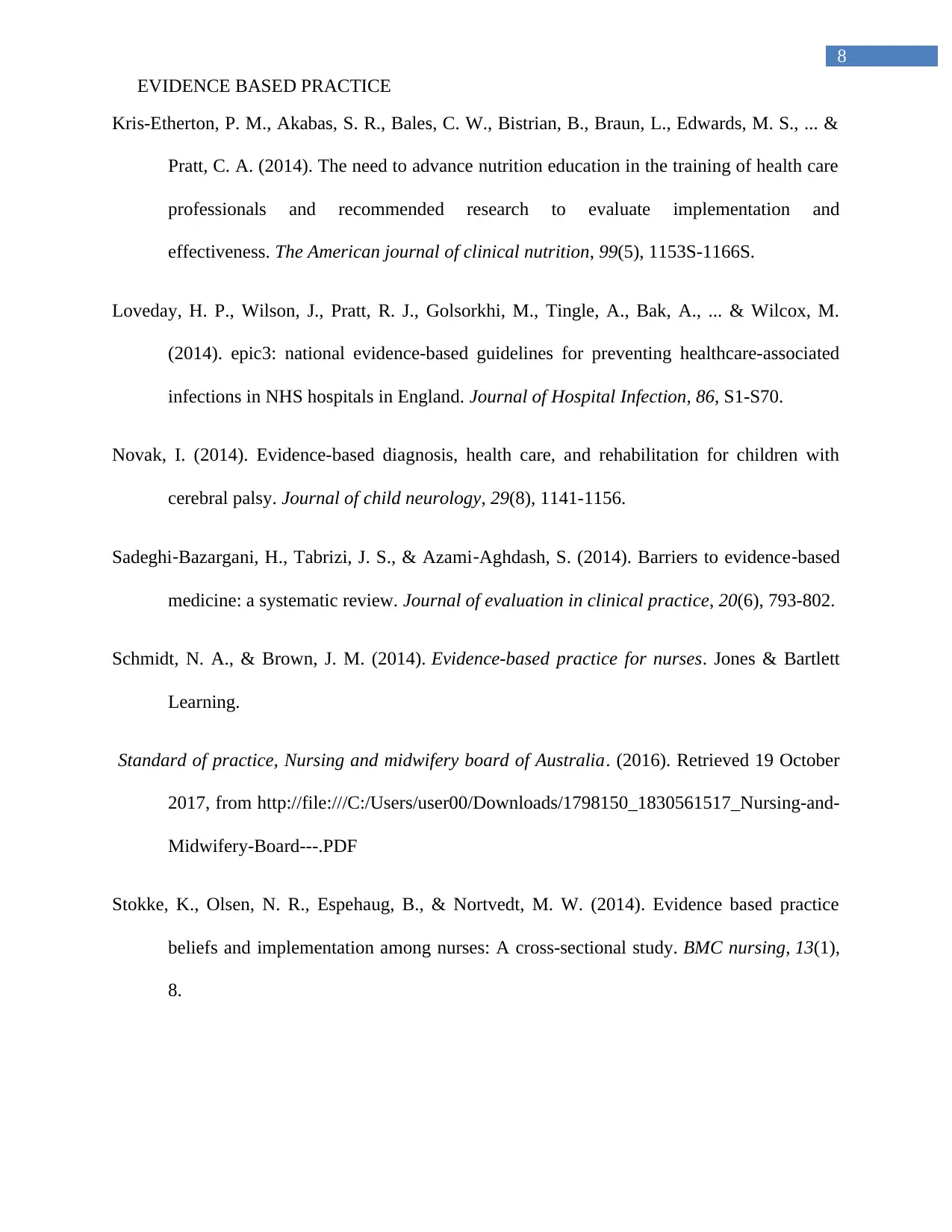
Loveday, H. P., Wilson, J., Pratt, R. J., Golsorkhi, M., Tingle, A., Bak, A., ... & Wilcox, M.
(2014). epic3: national evidence-based guidelines for preventing healthcare-associated
infections in NHS hospitals in England. Journal of Hospital Infection, 86, S1-S70.
Novak, I. (2014). Evidence-based diagnosis, health care, and rehabilitation for children with
cerebral palsy. Journal of child neurology, 29(8), 1141-1156.
Sadeghi‐Bazargani, H., Tabrizi, J. S., & Azami‐Aghdash, S. (2014). Barriers to evidence‐based
medicine: a systematic review. Journal of evaluation in clinical practice, 20(6), 793-802.
Schmidt, N. A., & Brown, J. M. (2014). Evidence-based practice for nurses. Jones & Bartlett
Learning.
Standard of practice, Nursing and midwifery board of Australia. (2016). Retrieved 19 October
2017, from http://file:///C:/Users/user00/Downloads/1798150_1830561517_Nursing-and-
Midwifery-Board---.PDF
Stokke, K., Olsen, N. R., Espehaug, B., & Nortvedt, M. W. (2014). Evidence based practice
beliefs and implementation among nurses: A cross-sectional study. BMC nursing, 13(1),
8.
EVIDENCE BASED PRACTICE
Kris-Etherton, P. M., Akabas, S. R., Bales, C. W., Bistrian, B., Braun, L., Edwards, M. S., ... &
Pratt, C. A. (2014). The need to advance nutrition education in the training of health care
professionals and recommended research to evaluate implementation and
effectiveness. The American journal of clinical nutrition, 99(5), 1153S-1166S.
Loveday, H. P., Wilson, J., Pratt, R. J., Golsorkhi, M., Tingle, A., Bak, A., ... & Wilcox, M.
(2014). epic3: national evidence-based guidelines for preventing healthcare-associated
infections in NHS hospitals in England. Journal of Hospital Infection, 86, S1-S70.
Novak, I. (2014). Evidence-based diagnosis, health care, and rehabilitation for children with
cerebral palsy. Journal of child neurology, 29(8), 1141-1156.
Sadeghi‐Bazargani, H., Tabrizi, J. S., & Azami‐Aghdash, S. (2014). Barriers to evidence‐based
medicine: a systematic review. Journal of evaluation in clinical practice, 20(6), 793-802.
Schmidt, N. A., & Brown, J. M. (2014). Evidence-based practice for nurses. Jones & Bartlett
Learning.
Standard of practice, Nursing and midwifery board of Australia. (2016). Retrieved 19 October
2017, from http://file:///C:/Users/user00/Downloads/1798150_1830561517_Nursing-and-
Midwifery-Board---.PDF
Stokke, K., Olsen, N. R., Espehaug, B., & Nortvedt, M. W. (2014). Evidence based practice
beliefs and implementation among nurses: A cross-sectional study. BMC nursing, 13(1),
8.
⊘ This is a preview!⊘
Do you want full access?
Subscribe today to unlock all pages.
Trusted by 1+ million students worldwide
9
EVIDENCE BASED PRACTICE
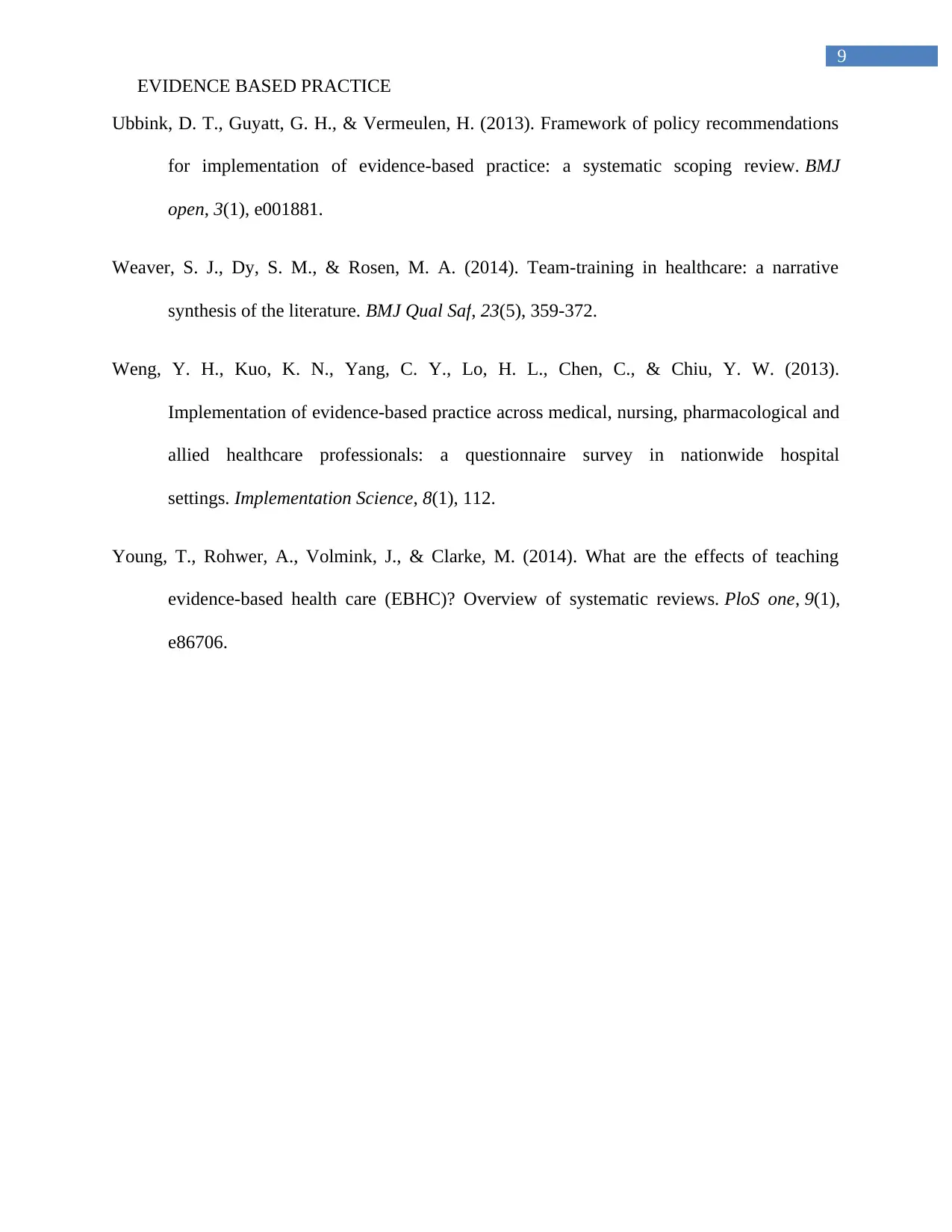
Ubbink, D. T., Guyatt, G. H., & Vermeulen, H. (2013). Framework of policy recommendations
for implementation of evidence-based practice: a systematic scoping review. BMJ
open, 3(1), e001881.
Weaver, S. J., Dy, S. M., & Rosen, M. A. (2014). Team-training in healthcare: a narrative
synthesis of the literature. BMJ Qual Saf, 23(5), 359-372.
Weng, Y. H., Kuo, K. N., Yang, C. Y., Lo, H. L., Chen, C., & Chiu, Y. W. (2013).
Implementation of evidence-based practice across medical, nursing, pharmacological and
allied healthcare professionals: a questionnaire survey in nationwide hospital
settings. Implementation Science, 8(1), 112.
Young, T., Rohwer, A., Volmink, J., & Clarke, M. (2014). What are the effects of teaching
evidence-based health care (EBHC)? Overview of systematic reviews. PloS one, 9(1),
e86706.
EVIDENCE BASED PRACTICE
Ubbink, D. T., Guyatt, G. H., & Vermeulen, H. (2013). Framework of policy recommendations
for implementation of evidence-based practice: a systematic scoping review. BMJ
open, 3(1), e001881.
Weaver, S. J., Dy, S. M., & Rosen, M. A. (2014). Team-training in healthcare: a narrative
synthesis of the literature. BMJ Qual Saf, 23(5), 359-372.
Weng, Y. H., Kuo, K. N., Yang, C. Y., Lo, H. L., Chen, C., & Chiu, Y. W. (2013).
Implementation of evidence-based practice across medical, nursing, pharmacological and
allied healthcare professionals: a questionnaire survey in nationwide hospital
settings. Implementation Science, 8(1), 112.
Young, T., Rohwer, A., Volmink, J., & Clarke, M. (2014). What are the effects of teaching
evidence-based health care (EBHC)? Overview of systematic reviews. PloS one, 9(1),
e86706.
Paraphrase This Document
Need a fresh take? Get an instant paraphrase of this document with our AI Paraphraser

10
EVIDENCE BASED PRACTICE
EVIDENCE BASED PRACTICE

1 out of 11


Related Documents


Your All-in-One AI-Powered Toolkit for Academic Success.
+13062052269
info@desklib.com
Available 24*7 on WhatsApp / Email
![[object Object]](/_next/static/media/star-bottom.7253800d.svg)
Unlock your academic potential
Copyright © 2020–2026 A2Z Services. All Rights Reserved. Developed and managed by ZUCOL.