Narrative Therapy: Strengths, Limitations, Sensitivity, and Future
VerifiedAdded on 2020/05/01
|10
|2577
|71
Essay
AI Summary
This essay provides a comprehensive overview of narrative therapy, a counseling approach that emphasizes separating individuals from their mental health issues to empower them to reshape their life stories. It explores the strengths of this therapy, such as its non-judgmental stance and client-centered approach, highlighting how it helps clients reinterpret their past and view their issues from a more positive perspective. The essay also acknowledges the limitations, including the lack of extensive research and potential challenges for certain clients. Furthermore, it emphasizes the importance of racial, cultural, religious, and gender sensitivity in narrative therapy, discussing how therapists can navigate cultural differences to provide effective care. The essay concludes by discussing the future implications of narrative therapy, advocating for further research and its integration with other therapeutic approaches to enhance its effectiveness and broaden its application in mental health practice.

Running Head: NARRATIVE THERAPY 1
NARRATIVE THERAPY
Student’s Name
Course
Professor’s Name
University
Date
NARRATIVE THERAPY
Student’s Name
Course
Professor’s Name
University
Date

Paraphrase This Document
Need a fresh take? Get an instant paraphrase of this document with our AI Paraphraser
NARRATIVE THERAPY 2
Narrative therapy
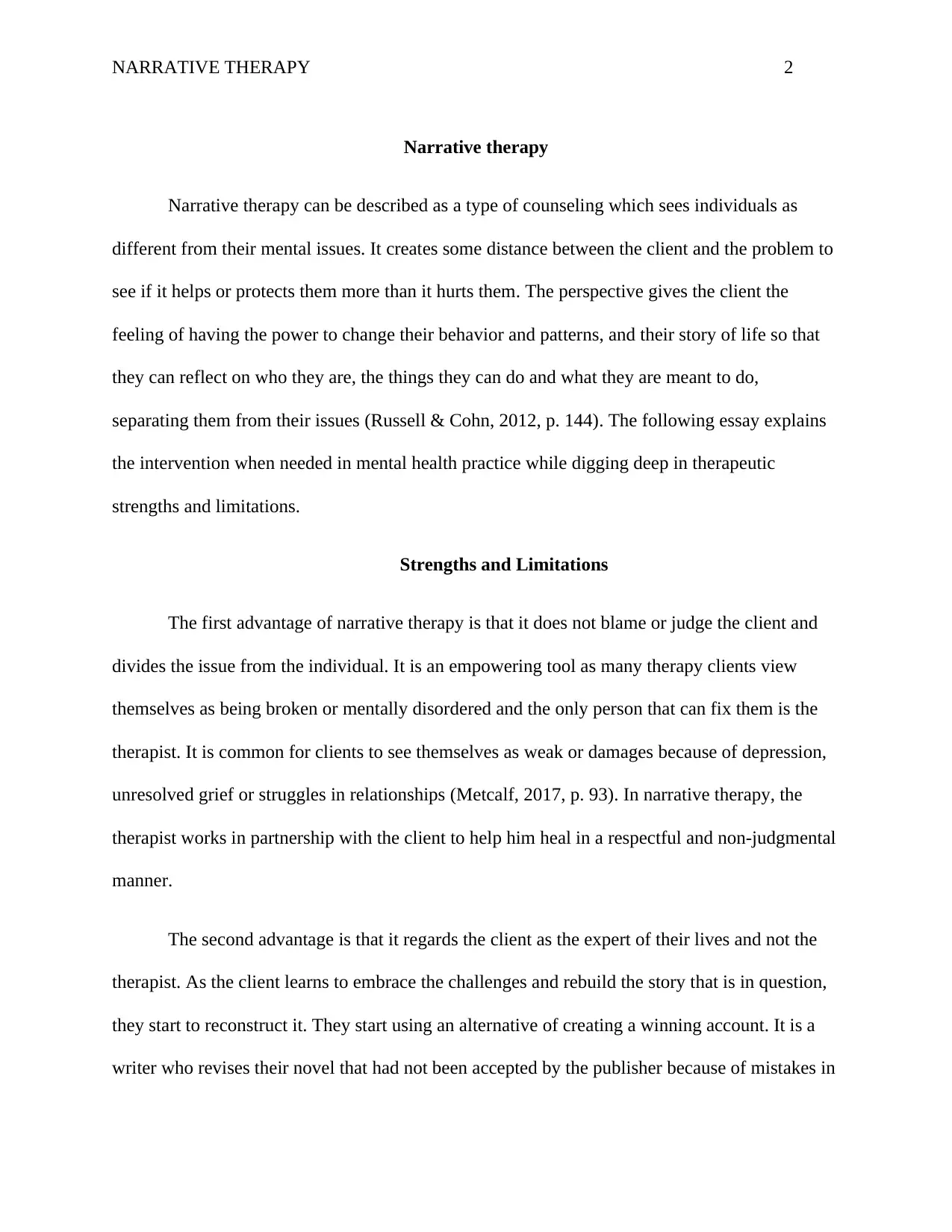
Narrative therapy can be described as a type of counseling which sees individuals as
different from their mental issues. It creates some distance between the client and the problem to
see if it helps or protects them more than it hurts them. The perspective gives the client the
feeling of having the power to change their behavior and patterns, and their story of life so that
they can reflect on who they are, the things they can do and what they are meant to do,
separating them from their issues (Russell & Cohn, 2012, p. 144). The following essay explains
the intervention when needed in mental health practice while digging deep in therapeutic
strengths and limitations.
Strengths and Limitations
The first advantage of narrative therapy is that it does not blame or judge the client and
divides the issue from the individual. It is an empowering tool as many therapy clients view
themselves as being broken or mentally disordered and the only person that can fix them is the
therapist. It is common for clients to see themselves as weak or damages because of depression,
unresolved grief or struggles in relationships (Metcalf, 2017, p. 93). In narrative therapy, the
therapist works in partnership with the client to help him heal in a respectful and non-judgmental
manner.
The second advantage is that it regards the client as the expert of their lives and not the
therapist. As the client learns to embrace the challenges and rebuild the story that is in question,
they start to reconstruct it. They start using an alternative of creating a winning account. It is a
writer who revises their novel that had not been accepted by the publisher because of mistakes in
Narrative therapy
Narrative therapy can be described as a type of counseling which sees individuals as
different from their mental issues. It creates some distance between the client and the problem to
see if it helps or protects them more than it hurts them. The perspective gives the client the
feeling of having the power to change their behavior and patterns, and their story of life so that
they can reflect on who they are, the things they can do and what they are meant to do,
separating them from their issues (Russell & Cohn, 2012, p. 144). The following essay explains
the intervention when needed in mental health practice while digging deep in therapeutic
strengths and limitations.
Strengths and Limitations
The first advantage of narrative therapy is that it does not blame or judge the client and
divides the issue from the individual. It is an empowering tool as many therapy clients view
themselves as being broken or mentally disordered and the only person that can fix them is the
therapist. It is common for clients to see themselves as weak or damages because of depression,
unresolved grief or struggles in relationships (Metcalf, 2017, p. 93). In narrative therapy, the
therapist works in partnership with the client to help him heal in a respectful and non-judgmental
manner.
The second advantage is that it regards the client as the expert of their lives and not the
therapist. As the client learns to embrace the challenges and rebuild the story that is in question,
they start to reconstruct it. They start using an alternative of creating a winning account. It is a
writer who revises their novel that had not been accepted by the publisher because of mistakes in
NARRATIVE THERAPY 3
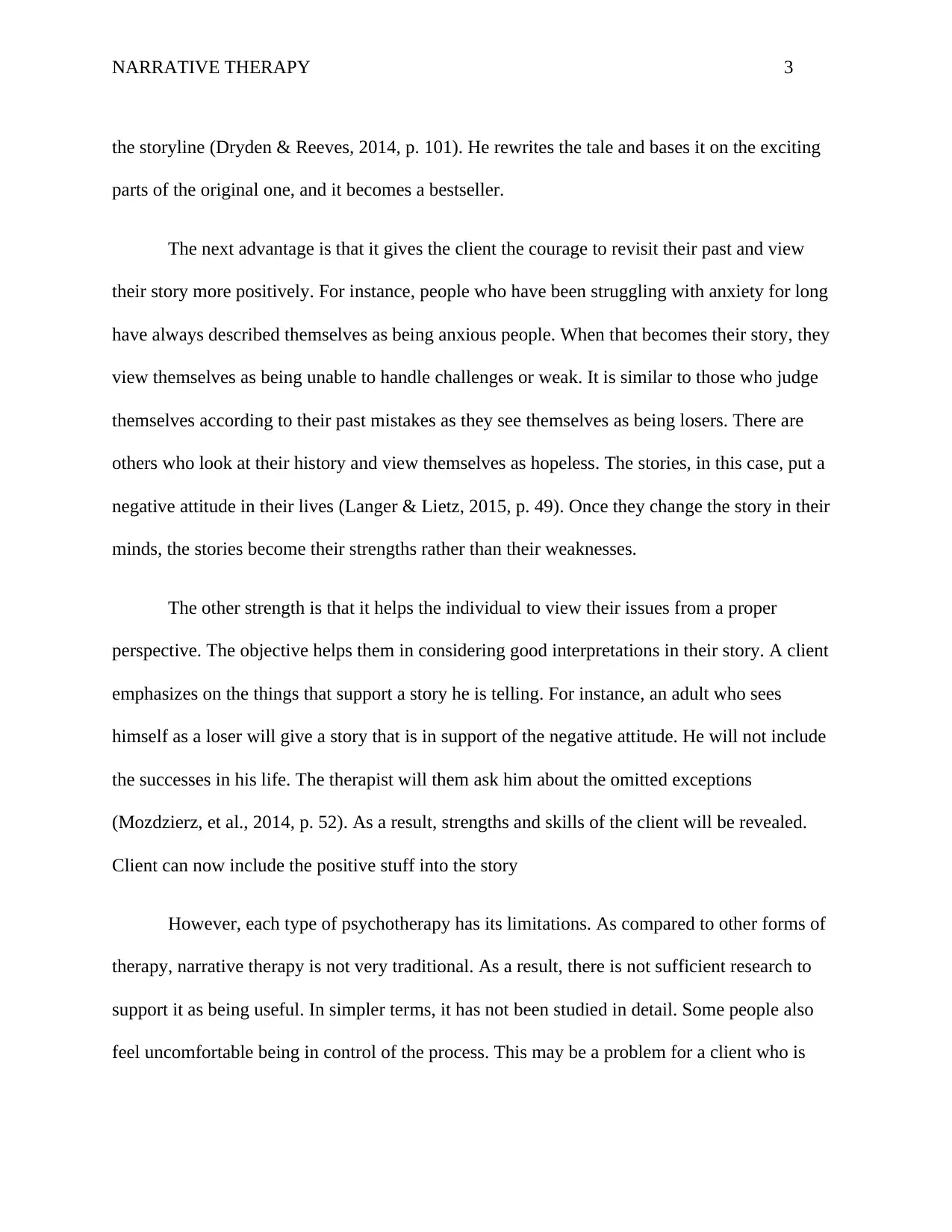
the storyline (Dryden & Reeves, 2014, p. 101). He rewrites the tale and bases it on the exciting
parts of the original one, and it becomes a bestseller.
The next advantage is that it gives the client the courage to revisit their past and view
their story more positively. For instance, people who have been struggling with anxiety for long
have always described themselves as being anxious people. When that becomes their story, they
view themselves as being unable to handle challenges or weak. It is similar to those who judge
themselves according to their past mistakes as they see themselves as being losers. There are
others who look at their history and view themselves as hopeless. The stories, in this case, put a
negative attitude in their lives (Langer & Lietz, 2015, p. 49). Once they change the story in their
minds, the stories become their strengths rather than their weaknesses.
The other strength is that it helps the individual to view their issues from a proper
perspective. The objective helps them in considering good interpretations in their story. A client
emphasizes on the things that support a story he is telling. For instance, an adult who sees
himself as a loser will give a story that is in support of the negative attitude. He will not include
the successes in his life. The therapist will them ask him about the omitted exceptions
(Mozdzierz, et al., 2014, p. 52). As a result, strengths and skills of the client will be revealed.
Client can now include the positive stuff into the story
However, each type of psychotherapy has its limitations. As compared to other forms of
therapy, narrative therapy is not very traditional. As a result, there is not sufficient research to
support it as being useful. In simpler terms, it has not been studied in detail. Some people also
feel uncomfortable being in control of the process. This may be a problem for a client who is
the storyline (Dryden & Reeves, 2014, p. 101). He rewrites the tale and bases it on the exciting
parts of the original one, and it becomes a bestseller.
The next advantage is that it gives the client the courage to revisit their past and view
their story more positively. For instance, people who have been struggling with anxiety for long
have always described themselves as being anxious people. When that becomes their story, they
view themselves as being unable to handle challenges or weak. It is similar to those who judge
themselves according to their past mistakes as they see themselves as being losers. There are
others who look at their history and view themselves as hopeless. The stories, in this case, put a
negative attitude in their lives (Langer & Lietz, 2015, p. 49). Once they change the story in their
minds, the stories become their strengths rather than their weaknesses.
The other strength is that it helps the individual to view their issues from a proper
perspective. The objective helps them in considering good interpretations in their story. A client
emphasizes on the things that support a story he is telling. For instance, an adult who sees
himself as a loser will give a story that is in support of the negative attitude. He will not include
the successes in his life. The therapist will them ask him about the omitted exceptions
(Mozdzierz, et al., 2014, p. 52). As a result, strengths and skills of the client will be revealed.
Client can now include the positive stuff into the story
However, each type of psychotherapy has its limitations. As compared to other forms of
therapy, narrative therapy is not very traditional. As a result, there is not sufficient research to
support it as being useful. In simpler terms, it has not been studied in detail. Some people also
feel uncomfortable being in control of the process. This may be a problem for a client who is
⊘ This is a preview!⊘
Do you want full access?
Subscribe today to unlock all pages.

Trusted by 1+ million students worldwide
NARRATIVE THERAPY 4
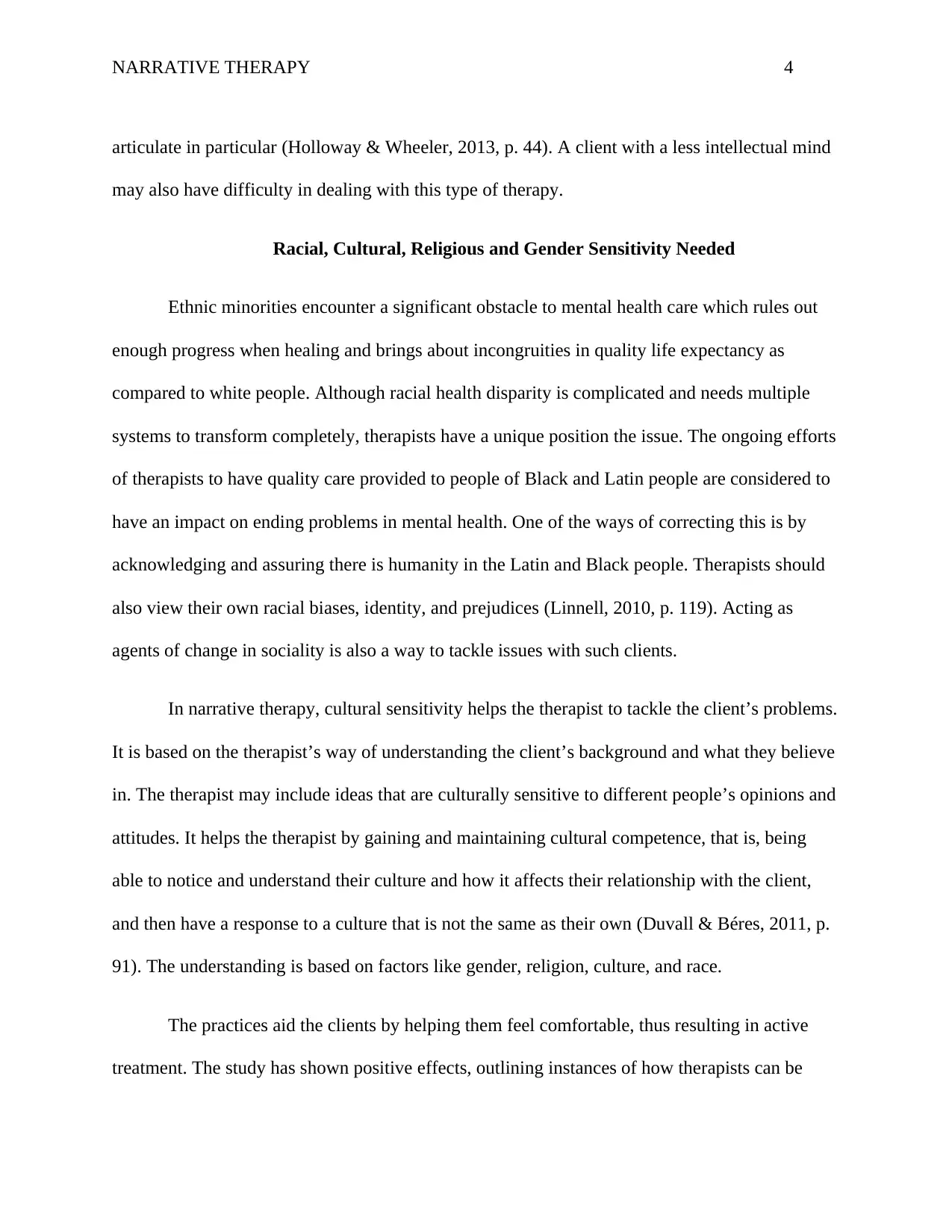
articulate in particular (Holloway & Wheeler, 2013, p. 44). A client with a less intellectual mind
may also have difficulty in dealing with this type of therapy.
Racial, Cultural, Religious and Gender Sensitivity Needed
Ethnic minorities encounter a significant obstacle to mental health care which rules out
enough progress when healing and brings about incongruities in quality life expectancy as
compared to white people. Although racial health disparity is complicated and needs multiple
systems to transform completely, therapists have a unique position the issue. The ongoing efforts
of therapists to have quality care provided to people of Black and Latin people are considered to
have an impact on ending problems in mental health. One of the ways of correcting this is by
acknowledging and assuring there is humanity in the Latin and Black people. Therapists should
also view their own racial biases, identity, and prejudices (Linnell, 2010, p. 119). Acting as
agents of change in sociality is also a way to tackle issues with such clients.
In narrative therapy, cultural sensitivity helps the therapist to tackle the client’s problems.
It is based on the therapist’s way of understanding the client’s background and what they believe
in. The therapist may include ideas that are culturally sensitive to different people’s opinions and
attitudes. It helps the therapist by gaining and maintaining cultural competence, that is, being
able to notice and understand their culture and how it affects their relationship with the client,
and then have a response to a culture that is not the same as their own (Duvall & Béres, 2011, p.
91). The understanding is based on factors like gender, religion, culture, and race.
The practices aid the clients by helping them feel comfortable, thus resulting in active
treatment. The study has shown positive effects, outlining instances of how therapists can be
articulate in particular (Holloway & Wheeler, 2013, p. 44). A client with a less intellectual mind
may also have difficulty in dealing with this type of therapy.
Racial, Cultural, Religious and Gender Sensitivity Needed
Ethnic minorities encounter a significant obstacle to mental health care which rules out
enough progress when healing and brings about incongruities in quality life expectancy as
compared to white people. Although racial health disparity is complicated and needs multiple
systems to transform completely, therapists have a unique position the issue. The ongoing efforts
of therapists to have quality care provided to people of Black and Latin people are considered to
have an impact on ending problems in mental health. One of the ways of correcting this is by
acknowledging and assuring there is humanity in the Latin and Black people. Therapists should
also view their own racial biases, identity, and prejudices (Linnell, 2010, p. 119). Acting as
agents of change in sociality is also a way to tackle issues with such clients.
In narrative therapy, cultural sensitivity helps the therapist to tackle the client’s problems.
It is based on the therapist’s way of understanding the client’s background and what they believe
in. The therapist may include ideas that are culturally sensitive to different people’s opinions and
attitudes. It helps the therapist by gaining and maintaining cultural competence, that is, being
able to notice and understand their culture and how it affects their relationship with the client,
and then have a response to a culture that is not the same as their own (Duvall & Béres, 2011, p.
91). The understanding is based on factors like gender, religion, culture, and race.
The practices aid the clients by helping them feel comfortable, thus resulting in active
treatment. The study has shown positive effects, outlining instances of how therapists can be
Paraphrase This Document
Need a fresh take? Get an instant paraphrase of this document with our AI Paraphraser
NARRATIVE THERAPY 5
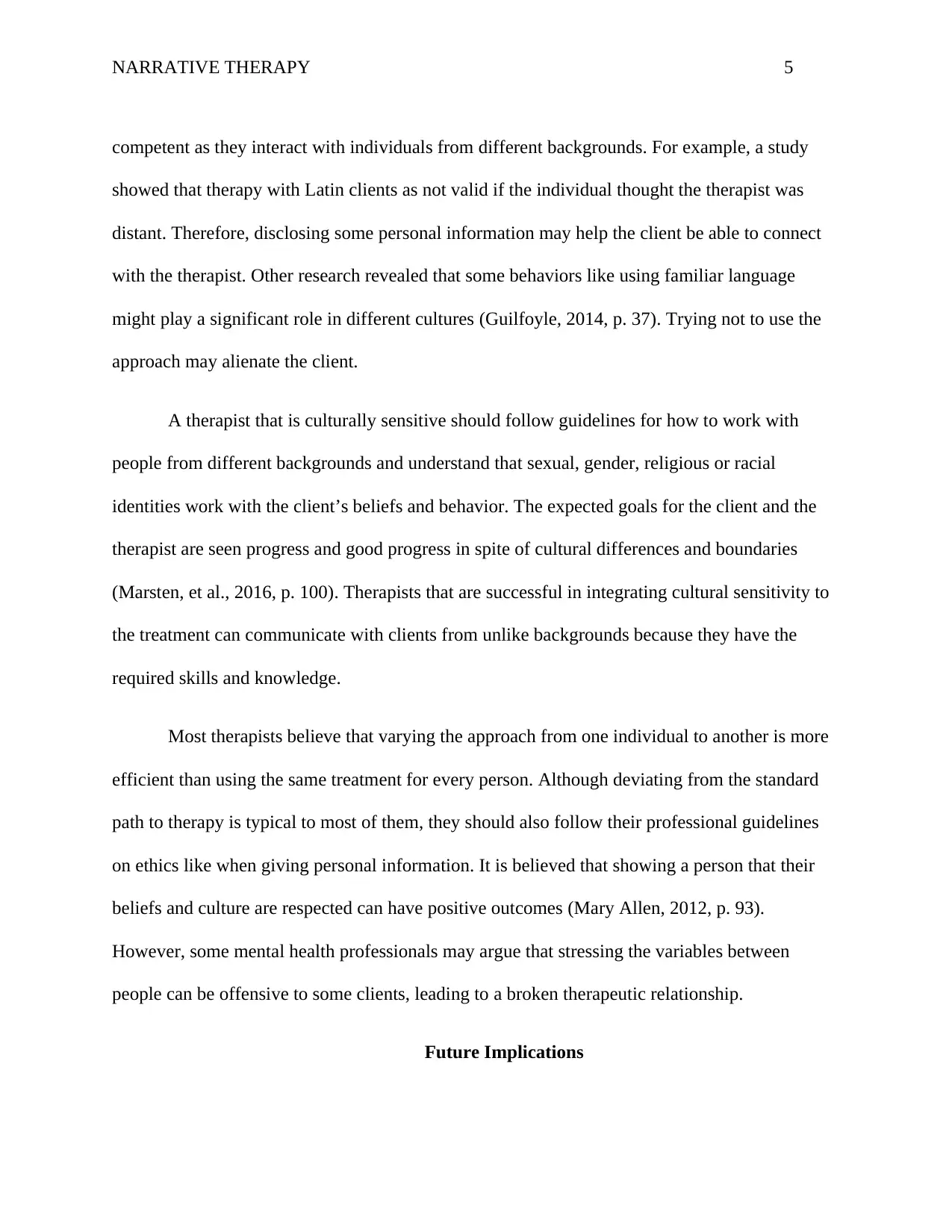
competent as they interact with individuals from different backgrounds. For example, a study
showed that therapy with Latin clients as not valid if the individual thought the therapist was
distant. Therefore, disclosing some personal information may help the client be able to connect
with the therapist. Other research revealed that some behaviors like using familiar language
might play a significant role in different cultures (Guilfoyle, 2014, p. 37). Trying not to use the
approach may alienate the client.
A therapist that is culturally sensitive should follow guidelines for how to work with
people from different backgrounds and understand that sexual, gender, religious or racial
identities work with the client’s beliefs and behavior. The expected goals for the client and the
therapist are seen progress and good progress in spite of cultural differences and boundaries
(Marsten, et al., 2016, p. 100). Therapists that are successful in integrating cultural sensitivity to
the treatment can communicate with clients from unlike backgrounds because they have the
required skills and knowledge.
Most therapists believe that varying the approach from one individual to another is more
efficient than using the same treatment for every person. Although deviating from the standard
path to therapy is typical to most of them, they should also follow their professional guidelines
on ethics like when giving personal information. It is believed that showing a person that their
beliefs and culture are respected can have positive outcomes (Mary Allen, 2012, p. 93).
However, some mental health professionals may argue that stressing the variables between
people can be offensive to some clients, leading to a broken therapeutic relationship.
Future Implications
competent as they interact with individuals from different backgrounds. For example, a study
showed that therapy with Latin clients as not valid if the individual thought the therapist was
distant. Therefore, disclosing some personal information may help the client be able to connect
with the therapist. Other research revealed that some behaviors like using familiar language
might play a significant role in different cultures (Guilfoyle, 2014, p. 37). Trying not to use the
approach may alienate the client.
A therapist that is culturally sensitive should follow guidelines for how to work with
people from different backgrounds and understand that sexual, gender, religious or racial
identities work with the client’s beliefs and behavior. The expected goals for the client and the
therapist are seen progress and good progress in spite of cultural differences and boundaries
(Marsten, et al., 2016, p. 100). Therapists that are successful in integrating cultural sensitivity to
the treatment can communicate with clients from unlike backgrounds because they have the
required skills and knowledge.
Most therapists believe that varying the approach from one individual to another is more
efficient than using the same treatment for every person. Although deviating from the standard
path to therapy is typical to most of them, they should also follow their professional guidelines
on ethics like when giving personal information. It is believed that showing a person that their
beliefs and culture are respected can have positive outcomes (Mary Allen, 2012, p. 93).
However, some mental health professionals may argue that stressing the variables between
people can be offensive to some clients, leading to a broken therapeutic relationship.
Future Implications
NARRATIVE THERAPY 6
A Strong argument is being made for efforts of studying narrative therapy in the future.
Research has shown that some specific approaches in subsequent treatment are more important
than others. However, there is still room for more research to be conducted to understand the
main factors contributing to the approach (Dickerson, 2016, p. 84). But it is safe to say that the
little research that has been done has proved that narrative therapy is adequate, and there is more
room for further study.
As past exploration has shown, narrative therapy has mind frame that has a purpose and a
deliberate discourse method that helps individuals to think about their issues in unique ways. By
studying subsequent treatment in detail, more data will be created to show how it can treat
clients, but also include therapeutic effects that will widen ways like relationships the research
can also facilitate how one understands interactions between the therapist and the client.
Narrative therapy can bolster specific aspects of a therapeutic relationship in a way that is
not yet in research. Examples may include reducing the problems to discuss, making the client
feel less defective and building self-esteem (Flaskas, et al., 2015, p. 64). Also, connecting
narrative therapy with other types of treatment can give a standard for other health professionals
to look for its therapeutic qualities.
It plainly appears that narrative therapy has not been discussed in detail in the research
literature. It has therefore been proposed that there is a need for evaluation of essential qualities
of subsequent treatment. Furthermore, it is recommended that narrative practices can be the
initial step in the approach for several reasons: The first goal is that there is research that already
exists that has, to some degree, studied narrative therapy use. Secondly, some of the studies state
that sequential therapy has effects on issues and clients. Thirdly, it is an essential approach to
A Strong argument is being made for efforts of studying narrative therapy in the future.
Research has shown that some specific approaches in subsequent treatment are more important
than others. However, there is still room for more research to be conducted to understand the
main factors contributing to the approach (Dickerson, 2016, p. 84). But it is safe to say that the
little research that has been done has proved that narrative therapy is adequate, and there is more
room for further study.
As past exploration has shown, narrative therapy has mind frame that has a purpose and a
deliberate discourse method that helps individuals to think about their issues in unique ways. By
studying subsequent treatment in detail, more data will be created to show how it can treat
clients, but also include therapeutic effects that will widen ways like relationships the research
can also facilitate how one understands interactions between the therapist and the client.
Narrative therapy can bolster specific aspects of a therapeutic relationship in a way that is
not yet in research. Examples may include reducing the problems to discuss, making the client
feel less defective and building self-esteem (Flaskas, et al., 2015, p. 64). Also, connecting
narrative therapy with other types of treatment can give a standard for other health professionals
to look for its therapeutic qualities.
It plainly appears that narrative therapy has not been discussed in detail in the research
literature. It has therefore been proposed that there is a need for evaluation of essential qualities
of subsequent treatment. Furthermore, it is recommended that narrative practices can be the
initial step in the approach for several reasons: The first goal is that there is research that already
exists that has, to some degree, studied narrative therapy use. Secondly, some of the studies state
that sequential therapy has effects on issues and clients. Thirdly, it is an essential approach to
⊘ This is a preview!⊘
Do you want full access?
Subscribe today to unlock all pages.
Trusted by 1+ million students worldwide
NARRATIVE THERAPY 7
treatment. Research that highlights the therapeutic qualities of sequential therapy can be of
benefit in not only it but would also implicate the acceptance of the type of treatment (Rose,
2012, p. 53). For example, research on subsequent treatment can elaborate on the good qualities
that are associated with putting much thought to the approach.
It is also essential to put more effort to divide narrative therapy into more specific groups
to accurately evaluate the quality of the treatment. As research has shown, the study efforts have
researched subsequent therapy in general. Even if useful, they have failed to focus on the quality
models that may be helpful to clients (Béres, 2014., p. 89) . Therefore, more investigation needs
to be done in narrative therapy.
Narrative therapy research has witnessed various obstacles. However, the barriers have
invited researchers to work on narrative principles as they try to evolve the methodology. The
efforts usually get involved with explorations through research. Research projects can be
incorporated in a qualitative manner that shows the themes that are of good quality (White, 2016,
pp. 184-185). Emergent issues in studies can put aside to develop an evident theory about the
outcome that is positive.
In conclusion, things that happen in a person’s life are seen as stories in narrative therapy.
Some of the stories seem to affect the person that others. The ones that affect the person come
from adverse events and can mold the individual’s identity. With this effect, therapists see a
person’s life as filled with possibilities that are yet to be seen. The professional does not act as
the expert because every person is the expert of his own life. The correct environment for mental
health can be when therapy engages the minority in their context. Anything that works against
that will not work efficiently. While narrative therapists usually consult with the clients about the
treatment. Research that highlights the therapeutic qualities of sequential therapy can be of
benefit in not only it but would also implicate the acceptance of the type of treatment (Rose,
2012, p. 53). For example, research on subsequent treatment can elaborate on the good qualities
that are associated with putting much thought to the approach.
It is also essential to put more effort to divide narrative therapy into more specific groups
to accurately evaluate the quality of the treatment. As research has shown, the study efforts have
researched subsequent therapy in general. Even if useful, they have failed to focus on the quality
models that may be helpful to clients (Béres, 2014., p. 89) . Therefore, more investigation needs
to be done in narrative therapy.
Narrative therapy research has witnessed various obstacles. However, the barriers have
invited researchers to work on narrative principles as they try to evolve the methodology. The
efforts usually get involved with explorations through research. Research projects can be
incorporated in a qualitative manner that shows the themes that are of good quality (White, 2016,
pp. 184-185). Emergent issues in studies can put aside to develop an evident theory about the
outcome that is positive.
In conclusion, things that happen in a person’s life are seen as stories in narrative therapy.
Some of the stories seem to affect the person that others. The ones that affect the person come
from adverse events and can mold the individual’s identity. With this effect, therapists see a
person’s life as filled with possibilities that are yet to be seen. The professional does not act as
the expert because every person is the expert of his own life. The correct environment for mental
health can be when therapy engages the minority in their context. Anything that works against
that will not work efficiently. While narrative therapists usually consult with the clients about the
Paraphrase This Document
Need a fresh take? Get an instant paraphrase of this document with our AI Paraphraser

NARRATIVE THERAPY 8
treatment and other practices, more studies need to be conducted to document the accounts in a
research format method. Such projects can be able to help in narrative therapy by making sure
that the therapist approach does not take over from reports of what would have been helpful in
the process of treatment. Current literature has revealed that narrative treatment forms some
effects on clients. Having the ability to understand the implications is an excellent research goal
for narrative therapists and other professionals.
treatment and other practices, more studies need to be conducted to document the accounts in a
research format method. Such projects can be able to help in narrative therapy by making sure
that the therapist approach does not take over from reports of what would have been helpful in
the process of treatment. Current literature has revealed that narrative treatment forms some
effects on clients. Having the ability to understand the implications is an excellent research goal
for narrative therapists and other professionals.
NARRATIVE THERAPY 9
References
Béres, L., 2014.. The narrative practitioner. Basingstoke, Hampshire: Palgrave Macmillan.
Dickerson, V., 2016. Poststructural and Narrative Thinking in Family Therapy. Cham : Springer
International Publishing.
Dryden, W. & Reeves, A., 2014. The handbook of individual therapy. Los Angeles: SAGE.
Duvall, J. & Béres, L., 2011. Innovations in narrative therapy : connecting practice, training,
and research. New York: W.W. Norton.
Flaskas, C., McCarthy, I. & Sheehan, J., 2015. Hope and despair in narrative and family therapy
: adversity, forgiveness and reconciliation. London ; New York: Routledge.
Guilfoyle, M., 2014. The person in narrative therapy : a post-structural, Foucauldian account.
Basingstoke: Palgrave Macmillan.
Holloway, I. & Wheeler, S., 2013. Qualitative Research in Nursing and Healthcare.. Chicester:
Wiley.
Langer, C. L. & Lietz, C. A., 2015. Applying theory to generalist social work practice : a case
study approach. Hoboken, New Jersey : John Wiley & Sons, Inc.
Linnell, S., 2010. Art psychotherapy & narrative therapy : an account of practitioner research.
[Sharjah, U.A.E.]: Bentham Science Publishers.
Marsten, D., Epston, D. & Markham, L., 2016. Narrative therapy in wonderland : connecting
with children's imaginative know-how. New York: W.W. Norton & Company.
Mary Allen, (. w., 2012. Narrative therapy for women experiencing domestic violence :
supporting women's transitions from abuse to safety. London: Jessica Kingsley Publishers.
Metcalf, L., 2017. Solution focused narrative therapy. New York, NY: Springer Publishing
Company.
Mozdzierz, G. J., Peluso, P. R. & Lisiecki, J., 2014. Principles of counseling and
psychotherapy : learning the essential domains and nonlinear thinking of master practitioners.
New York : Routledge.
Rose, R., 2012. Life story therapy with traumatized children : a model for practice. London ;
Philadelphia : Jessica Kingsley Publishers.
References
Béres, L., 2014.. The narrative practitioner. Basingstoke, Hampshire: Palgrave Macmillan.
Dickerson, V., 2016. Poststructural and Narrative Thinking in Family Therapy. Cham : Springer
International Publishing.
Dryden, W. & Reeves, A., 2014. The handbook of individual therapy. Los Angeles: SAGE.
Duvall, J. & Béres, L., 2011. Innovations in narrative therapy : connecting practice, training,
and research. New York: W.W. Norton.
Flaskas, C., McCarthy, I. & Sheehan, J., 2015. Hope and despair in narrative and family therapy
: adversity, forgiveness and reconciliation. London ; New York: Routledge.
Guilfoyle, M., 2014. The person in narrative therapy : a post-structural, Foucauldian account.
Basingstoke: Palgrave Macmillan.
Holloway, I. & Wheeler, S., 2013. Qualitative Research in Nursing and Healthcare.. Chicester:
Wiley.
Langer, C. L. & Lietz, C. A., 2015. Applying theory to generalist social work practice : a case
study approach. Hoboken, New Jersey : John Wiley & Sons, Inc.
Linnell, S., 2010. Art psychotherapy & narrative therapy : an account of practitioner research.
[Sharjah, U.A.E.]: Bentham Science Publishers.
Marsten, D., Epston, D. & Markham, L., 2016. Narrative therapy in wonderland : connecting
with children's imaginative know-how. New York: W.W. Norton & Company.
Mary Allen, (. w., 2012. Narrative therapy for women experiencing domestic violence :
supporting women's transitions from abuse to safety. London: Jessica Kingsley Publishers.
Metcalf, L., 2017. Solution focused narrative therapy. New York, NY: Springer Publishing
Company.
Mozdzierz, G. J., Peluso, P. R. & Lisiecki, J., 2014. Principles of counseling and
psychotherapy : learning the essential domains and nonlinear thinking of master practitioners.
New York : Routledge.
Rose, R., 2012. Life story therapy with traumatized children : a model for practice. London ;
Philadelphia : Jessica Kingsley Publishers.
⊘ This is a preview!⊘
Do you want full access?
Subscribe today to unlock all pages.
Trusted by 1+ million students worldwide

NARRATIVE THERAPY 10
Russell, J. & Cohn, R., 2012. Narrative therapy. Edinburgh: Lennex Corp.
White, M., 2016. Narrative therapy classics. Adelaide, South Australia: Dulwich Centre
Publications.
Russell, J. & Cohn, R., 2012. Narrative therapy. Edinburgh: Lennex Corp.
White, M., 2016. Narrative therapy classics. Adelaide, South Australia: Dulwich Centre
Publications.

1 out of 10


Related Documents


Your All-in-One AI-Powered Toolkit for Academic Success.
+13062052269
info@desklib.com
Available 24*7 on WhatsApp / Email
![[object Object]](/_next/static/media/star-bottom.7253800d.svg)
Unlock your academic potential
Copyright © 2020–2026 A2Z Services. All Rights Reserved. Developed and managed by ZUCOL.