Economics Assignment: Concepts, Analysis, and Policies
VerifiedAdded on 2020/02/03
|8
|2436
|187
Homework Assignment
AI Summary
This economics assignment delves into various core concepts. It begins by analyzing cost structures and profit maximization for a firm. The assignment then explores the impact of a flood on bottled water prices and the effects of anti-price gouging laws. It further examines the pricing decisions of a monopolist, specifically addressing deadweight loss and the rationale behind Qantaslink's pricing on a monopoly route. Finally, the assignment evaluates the effectiveness of cigarette taxes as a policy tool to reduce smoking, comparing it to alternative policies like price floors and education campaigns, and arguing for the inelastic nature of cigarette demand. The conclusion emphasizes the importance of government policies in influencing market behavior and promoting societal welfare.
CONCEPT OF ECONOMICS
1
1

Paraphrase This Document
Need a fresh take? Get an instant paraphrase of this document with our AI Paraphraser
TABLE OF CONTENTS
INTRODUCTION ..........................................................................................................................3
Question 1....................................................................................................................................3
Question 2....................................................................................................................................4
a) Expected effect of the flood on the price of bottled water.......................................................4
b) Effects of an anti price gouging law........................................................................................4
Question 3....................................................................................................................................4
a) Pricing decision of monopolist and deadweight loss of monopoly.........................................4
b) Explaining why Qantaslink to charge prices higher than competitive level on the monopoly
route.............................................................................................................................................5
Question 4....................................................................................................................................5
CONCLUSION ...............................................................................................................................7
REFERENCES................................................................................................................................8
2
INTRODUCTION ..........................................................................................................................3
Question 1....................................................................................................................................3
Question 2....................................................................................................................................4
a) Expected effect of the flood on the price of bottled water.......................................................4
b) Effects of an anti price gouging law........................................................................................4
Question 3....................................................................................................................................4
a) Pricing decision of monopolist and deadweight loss of monopoly.........................................4
b) Explaining why Qantaslink to charge prices higher than competitive level on the monopoly
route.............................................................................................................................................5
Question 4....................................................................................................................................5
CONCLUSION ...............................................................................................................................7
REFERENCES................................................................................................................................8
2
INTRODUCTION
The term economics is regarded as the social science that is concerned with describing as
well as analyzing the production, distribution as well as consumption of the goods and services.
The focus of economics is on behavior as well as interactions of the economic agent and the
manner in which economies perform (De Jong, 2013). Economics is concerned with the
condition wherein choices are being made in relation with the use of scarce resources, when to
utilize them and the purpose of using. In other words economics is related with studying the
choices in the situation of scarcity. In the present study the concept of economics have been
discussed. The study includes application of the key economic concepts to organization and
economic decision making. Further it covers the main issues faced by economic and business
managers within 21 century. It makes evaluation of the instruments of microeconomic policy.
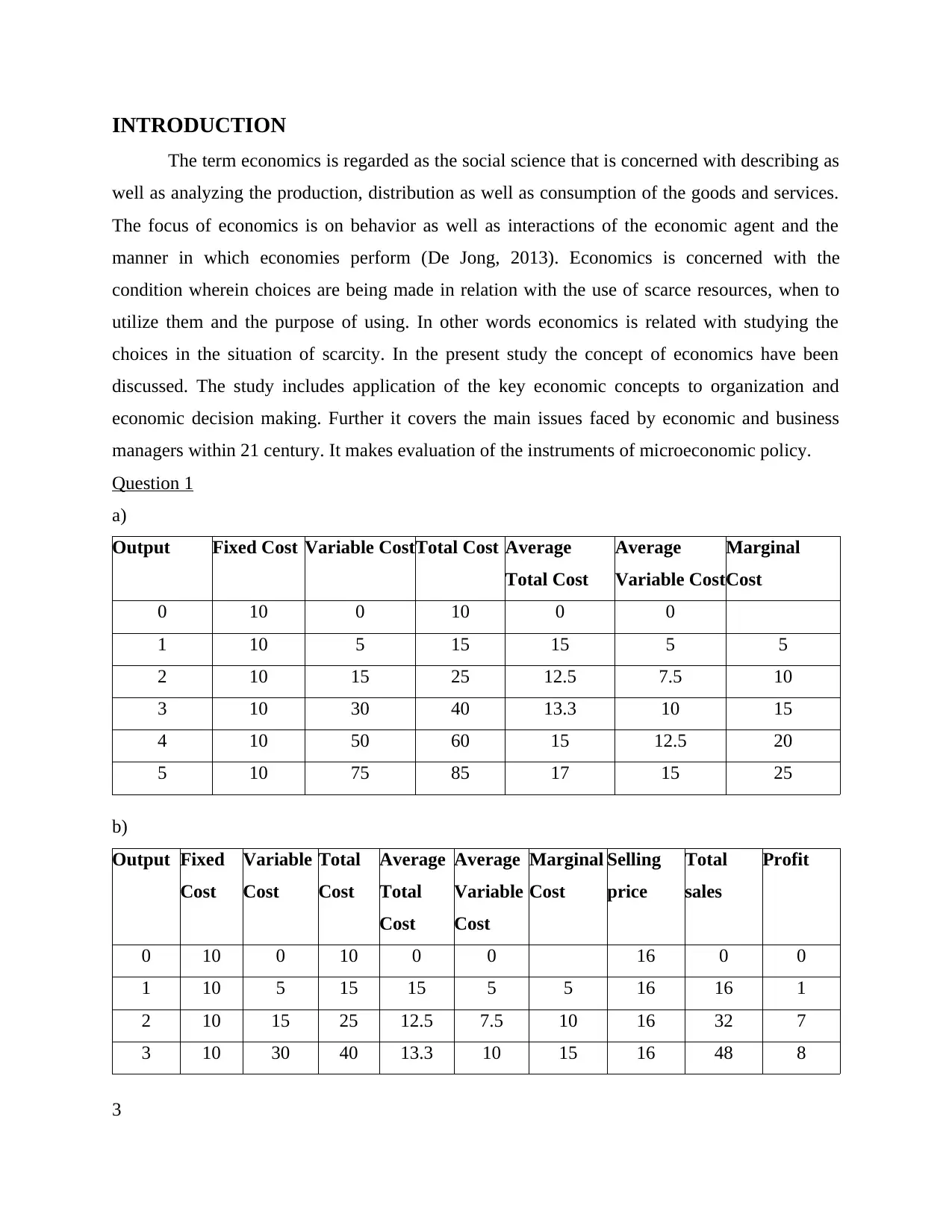
Question 1
a)
Output Fixed Cost Variable CostTotal Cost Average
Total Cost
Average
Variable Cost
Marginal
Cost
0 10 0 10 0 0
1 10 5 15 15 5 5
2 10 15 25 12.5 7.5 10
3 10 30 40 13.3 10 15
4 10 50 60 15 12.5 20
5 10 75 85 17 15 25
b)
Output Fixed
Cost
Variable
Cost
Total
Cost
Average
Total
Cost
Average
Variable
Cost
Marginal
Cost
Selling
price
Total
sales
Profit
0 10 0 10 0 0 16 0 0
1 10 5 15 15 5 5 16 16 1
2 10 15 25 12.5 7.5 10 16 32 7
3 10 30 40 13.3 10 15 16 48 8
3
The term economics is regarded as the social science that is concerned with describing as
well as analyzing the production, distribution as well as consumption of the goods and services.
The focus of economics is on behavior as well as interactions of the economic agent and the
manner in which economies perform (De Jong, 2013). Economics is concerned with the
condition wherein choices are being made in relation with the use of scarce resources, when to
utilize them and the purpose of using. In other words economics is related with studying the
choices in the situation of scarcity. In the present study the concept of economics have been
discussed. The study includes application of the key economic concepts to organization and
economic decision making. Further it covers the main issues faced by economic and business
managers within 21 century. It makes evaluation of the instruments of microeconomic policy.
Question 1
a)
Output Fixed Cost Variable CostTotal Cost Average
Total Cost
Average
Variable Cost
Marginal
Cost
0 10 0 10 0 0
1 10 5 15 15 5 5
2 10 15 25 12.5 7.5 10
3 10 30 40 13.3 10 15
4 10 50 60 15 12.5 20
5 10 75 85 17 15 25
b)
Output Fixed
Cost
Variable
Cost
Total
Cost
Average
Total
Cost
Average
Variable
Cost
Marginal
Cost
Selling
price
Total
sales
Profit
0 10 0 10 0 0 16 0 0
1 10 5 15 15 5 5 16 16 1
2 10 15 25 12.5 7.5 10 16 32 7
3 10 30 40 13.3 10 15 16 48 8
3
⊘ This is a preview!⊘
Do you want full access?
Subscribe today to unlock all pages.

Trusted by 1+ million students worldwide
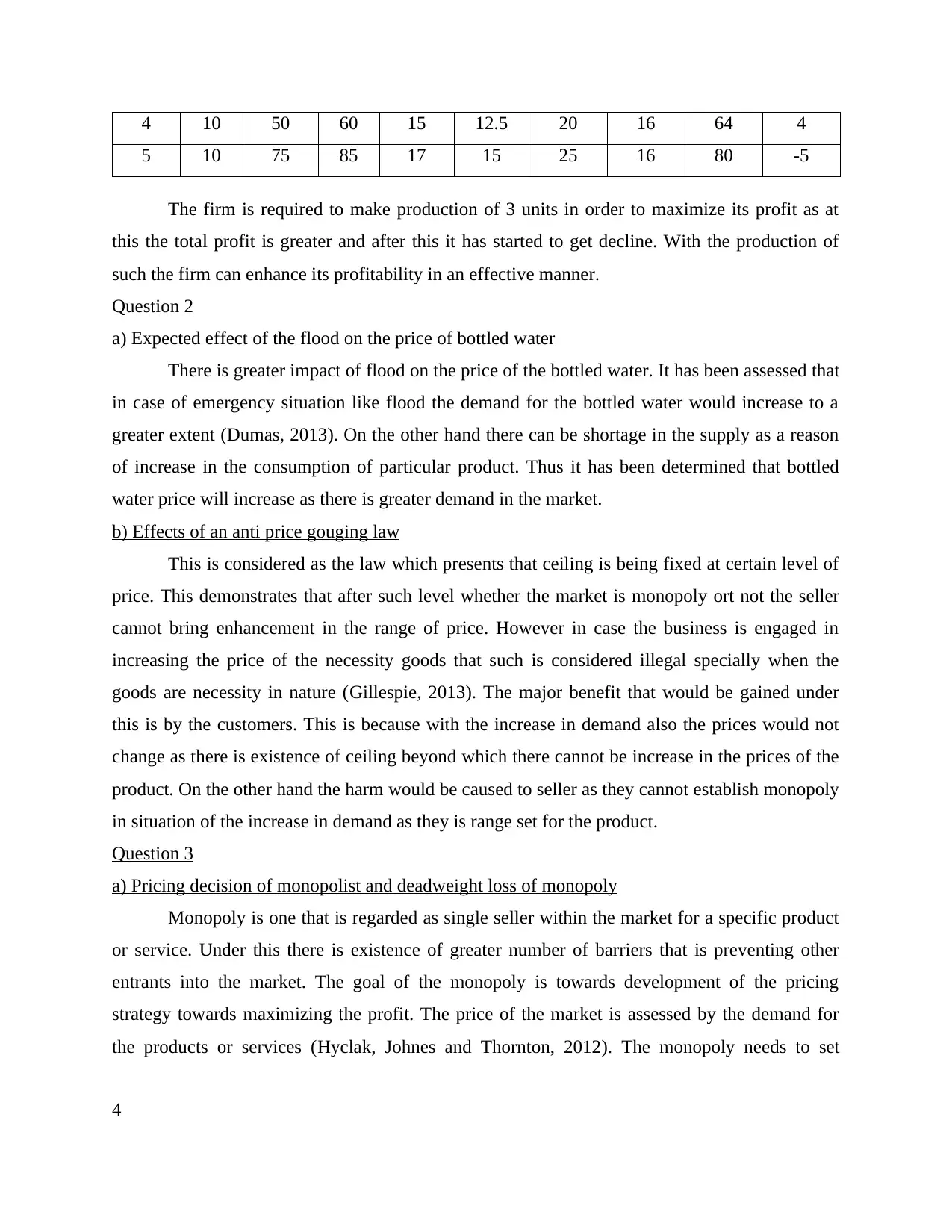
4 10 50 60 15 12.5 20 16 64 4
5 10 75 85 17 15 25 16 80 -5
The firm is required to make production of 3 units in order to maximize its profit as at
this the total profit is greater and after this it has started to get decline. With the production of
such the firm can enhance its profitability in an effective manner.
Question 2
a) Expected effect of the flood on the price of bottled water
There is greater impact of flood on the price of the bottled water. It has been assessed that
in case of emergency situation like flood the demand for the bottled water would increase to a
greater extent (Dumas, 2013). On the other hand there can be shortage in the supply as a reason
of increase in the consumption of particular product. Thus it has been determined that bottled
water price will increase as there is greater demand in the market.
b) Effects of an anti price gouging law
This is considered as the law which presents that ceiling is being fixed at certain level of
price. This demonstrates that after such level whether the market is monopoly ort not the seller
cannot bring enhancement in the range of price. However in case the business is engaged in
increasing the price of the necessity goods that such is considered illegal specially when the
goods are necessity in nature (Gillespie, 2013). The major benefit that would be gained under
this is by the customers. This is because with the increase in demand also the prices would not
change as there is existence of ceiling beyond which there cannot be increase in the prices of the
product. On the other hand the harm would be caused to seller as they cannot establish monopoly
in situation of the increase in demand as they is range set for the product.
Question 3
a) Pricing decision of monopolist and deadweight loss of monopoly
Monopoly is one that is regarded as single seller within the market for a specific product
or service. Under this there is existence of greater number of barriers that is preventing other
entrants into the market. The goal of the monopoly is towards development of the pricing
strategy towards maximizing the profit. The price of the market is assessed by the demand for
the products or services (Hyclak, Johnes and Thornton, 2012). The monopoly needs to set
4
5 10 75 85 17 15 25 16 80 -5
The firm is required to make production of 3 units in order to maximize its profit as at
this the total profit is greater and after this it has started to get decline. With the production of
such the firm can enhance its profitability in an effective manner.
Question 2
a) Expected effect of the flood on the price of bottled water
There is greater impact of flood on the price of the bottled water. It has been assessed that
in case of emergency situation like flood the demand for the bottled water would increase to a
greater extent (Dumas, 2013). On the other hand there can be shortage in the supply as a reason
of increase in the consumption of particular product. Thus it has been determined that bottled
water price will increase as there is greater demand in the market.
b) Effects of an anti price gouging law
This is considered as the law which presents that ceiling is being fixed at certain level of
price. This demonstrates that after such level whether the market is monopoly ort not the seller
cannot bring enhancement in the range of price. However in case the business is engaged in
increasing the price of the necessity goods that such is considered illegal specially when the
goods are necessity in nature (Gillespie, 2013). The major benefit that would be gained under
this is by the customers. This is because with the increase in demand also the prices would not
change as there is existence of ceiling beyond which there cannot be increase in the prices of the
product. On the other hand the harm would be caused to seller as they cannot establish monopoly
in situation of the increase in demand as they is range set for the product.
Question 3
a) Pricing decision of monopolist and deadweight loss of monopoly
Monopoly is one that is regarded as single seller within the market for a specific product
or service. Under this there is existence of greater number of barriers that is preventing other
entrants into the market. The goal of the monopoly is towards development of the pricing
strategy towards maximizing the profit. The price of the market is assessed by the demand for
the products or services (Hyclak, Johnes and Thornton, 2012). The monopoly needs to set
4
Paraphrase This Document
Need a fresh take? Get an instant paraphrase of this document with our AI Paraphraser
highest prices as possible and wants to sell all the goods that are being manufactured. It is
important that monopoly make determination of the correct output level for maximizing the
profit. Monopoly possess the benefit over the other structure of market in making determination
of the prices wherein the consumers cannot effectively carry out exchange of the products for
comparable one from local provider. For instance, there is no comparable substitute in case of
electricity.
Within economics the deadweight loss is referred to as the loss of economic efficiency
that takes place when the equilibrium for the products and services is not attained or cannot be
achieved (Kurzban and et.al., 2013). There is presence of certain causes related with deadweight
loss. One of them is associated with monopoly pricing, externalities, taxes or subsidies. The term
deadweight loss is also referred as the excess burden of monopoly or taxation.
b) Explaining why Qantaslink to charge prices higher than competitive level on the monopoly
route
As per the given scenario Qantaslink is the only provider of service between Sydney as
well as Toowoomba's Brisbane West Wellcamp Airport. The Qantaslink can charge higher price
as it is making sale in the market that is monopoly. This reflects that there is lack of sellers in the
market and thus Qantaslink possess freedom to set its own prices. Thus this demonstrates that
higher prices would be charged (Lin and Prince, 2013). The mining industry routes within
Australia are also considered as one that possess monopoly. These are likely to increase the price
to a significant level as they have monopoly in the market.
Question 4
In accordance with the case provided that several government across the globe have made
implementation of heavy taxes on cigarettes and other tobacco products for the sake of reducing
the number of smokers.
Tax can reduce sales of cigarettes
It has been assessed that there is greater impact of increase in tax on cigarettes in
reducing the sales. With the enhancement in tax rates there is fall in the demand. Though this can
have smaller impact as the demand is price inelastic. There is addiction among the people in
relation to such and there is absence of close substitute in case of such product. It has been
assessed that increase in taxes is considered as the sound policy that is executed by the
5
important that monopoly make determination of the correct output level for maximizing the
profit. Monopoly possess the benefit over the other structure of market in making determination
of the prices wherein the consumers cannot effectively carry out exchange of the products for
comparable one from local provider. For instance, there is no comparable substitute in case of
electricity.
Within economics the deadweight loss is referred to as the loss of economic efficiency
that takes place when the equilibrium for the products and services is not attained or cannot be
achieved (Kurzban and et.al., 2013). There is presence of certain causes related with deadweight
loss. One of them is associated with monopoly pricing, externalities, taxes or subsidies. The term
deadweight loss is also referred as the excess burden of monopoly or taxation.
b) Explaining why Qantaslink to charge prices higher than competitive level on the monopoly
route
As per the given scenario Qantaslink is the only provider of service between Sydney as
well as Toowoomba's Brisbane West Wellcamp Airport. The Qantaslink can charge higher price
as it is making sale in the market that is monopoly. This reflects that there is lack of sellers in the
market and thus Qantaslink possess freedom to set its own prices. Thus this demonstrates that
higher prices would be charged (Lin and Prince, 2013). The mining industry routes within
Australia are also considered as one that possess monopoly. These are likely to increase the price
to a significant level as they have monopoly in the market.
Question 4
In accordance with the case provided that several government across the globe have made
implementation of heavy taxes on cigarettes and other tobacco products for the sake of reducing
the number of smokers.
Tax can reduce sales of cigarettes
It has been assessed that there is greater impact of increase in tax on cigarettes in
reducing the sales. With the enhancement in tax rates there is fall in the demand. Though this can
have smaller impact as the demand is price inelastic. There is addiction among the people in
relation to such and there is absence of close substitute in case of such product. It has been
assessed that increase in taxes is considered as the sound policy that is executed by the
5
government in comparison with the policy associated with advertising ban which has no impact
in reducing the number of smokers (Mas-Colell, 2014). The major aim of decreasing the
consumption of the cigarette through increasing the rate of taxes is to minimize the ill effects of
cigarettes smoking among the smokers. This cannot alone result in minimizing the smokers but
there can be some other factors imposed by the government regarding such.
Demand for cigarettes elastic or inelastic
In general terms it has been identified that when the prices of the product increase then
the demand for the particular product declines to a greater extent. Such rules is not applicable in
case of cigarette as it is continued to be in higher demand no matter how much there is increase
in the prices. The demand for cigarettes is inelastic. The price elasticity related with demand
measures the sensitivity of the consumer to changes in the prices. It is being stated that the
demand for necessities is inelastic. However in case of luxurious product the demand is elastic.
Along with this when there is presence of close substitute the demand is elastic. Cigarette is the
exception to such (Schön and Konrad, 2012). Demand for such product is inelastic. The demand
of the cigarette to a greater extent is dependent on the increase in the rate of taxes. With the
increase in taxes the prices of the cigarettes packet would also enhance. If in situation the
consumers determines that prices have increased too much then they would reduce the
consumption of the cigarettes at least in the shoter course of time. Moreover it can be stated that
consumers would continue to feed the addiction they possess by the means of looking at the
substitutes.
Comparing tax to alternative policies like price floor or education campaign
There is presence of certain other alternative policies apart from taxes that is price floor
or education campaign that can effect the demand of the cigarettes. It has assessed that with
education campaign there can be increase or decrease in the number of smokers. This is because
with this it is not necessary that ever person gets equally motivated. Thus such might or may not
influence the demand of the cigarettes among the number of smokers. On the other hand it has
been assessed that price floor is one that can be set below the free equilibrium price. A price
floor is regarded as the lowest legal price at which the commodity can be sold. This is being used
by the regulatory authority in order to enhance prevention of the prices from being getting too
low (Summers, 2014). This can be effective in case of cigarettes as with this the prices of
6
in reducing the number of smokers (Mas-Colell, 2014). The major aim of decreasing the
consumption of the cigarette through increasing the rate of taxes is to minimize the ill effects of
cigarettes smoking among the smokers. This cannot alone result in minimizing the smokers but
there can be some other factors imposed by the government regarding such.
Demand for cigarettes elastic or inelastic
In general terms it has been identified that when the prices of the product increase then
the demand for the particular product declines to a greater extent. Such rules is not applicable in
case of cigarette as it is continued to be in higher demand no matter how much there is increase
in the prices. The demand for cigarettes is inelastic. The price elasticity related with demand
measures the sensitivity of the consumer to changes in the prices. It is being stated that the
demand for necessities is inelastic. However in case of luxurious product the demand is elastic.
Along with this when there is presence of close substitute the demand is elastic. Cigarette is the
exception to such (Schön and Konrad, 2012). Demand for such product is inelastic. The demand
of the cigarette to a greater extent is dependent on the increase in the rate of taxes. With the
increase in taxes the prices of the cigarettes packet would also enhance. If in situation the
consumers determines that prices have increased too much then they would reduce the
consumption of the cigarettes at least in the shoter course of time. Moreover it can be stated that
consumers would continue to feed the addiction they possess by the means of looking at the
substitutes.
Comparing tax to alternative policies like price floor or education campaign
There is presence of certain other alternative policies apart from taxes that is price floor
or education campaign that can effect the demand of the cigarettes. It has assessed that with
education campaign there can be increase or decrease in the number of smokers. This is because
with this it is not necessary that ever person gets equally motivated. Thus such might or may not
influence the demand of the cigarettes among the number of smokers. On the other hand it has
been assessed that price floor is one that can be set below the free equilibrium price. A price
floor is regarded as the lowest legal price at which the commodity can be sold. This is being used
by the regulatory authority in order to enhance prevention of the prices from being getting too
low (Summers, 2014). This can be effective in case of cigarettes as with this the prices of
6
⊘ This is a preview!⊘
Do you want full access?
Subscribe today to unlock all pages.
Trusted by 1+ million students worldwide
cigarettes cannot get much low thus the number of smokers can be reduced to certain extent.
When making comparison of tax with both the factors the role of tax is much effective in
reducing the number of smokers in comparison with price floor or education campaign as such
there is uncertainty that such factors would lessen demand for the cigarettes in the market.
Effectiveness of cigarette tax as policy in reduction of number of smokers
Formulating cigarette tax policy is effective as it results in increasing the prices of
cigarette and similarly reduces the number of smokers. Hence, government need to bring certain
actions so that it helps in overcoming the issues faced by them in terms of raising the prices or
imposing taxes on such products. It possess major benefits in terms of understanding the bad
impact of cigarette smoking and thus raising the risk of health problems. Thus, due to increase in
taxes results in decreasing the number of smokers or tobacco consumption. Increased taxes is
considered as effective measure for reducing smoking among youth and thus it helps in saving
various lives (Vasant, 2012). Also, such initiative of government helps in providing health
benefits to consumers and thus results in decreasing the number of smokers. It also helps in
improving health and raise revenues,. It is proven as a strategy to reduce smoking and extend
lives in relation to safeguard people from death.
CONCLUSION
It can be concluded from the present study that economics is study of mankind the
ordinary business of life. It has been inferred from the present study that demand for cigarettes in
inelastic. Along with this assessment has been made that with the increase in tax for cigarettes its
consumption among the smokers can be reduced to a significant level. Thus the ill effect can be
minimized as well. There is greater importance for the government to impose various policies
that reduce the number of smokers as such results increasing welfare among the society to a
greater extent. On the other hand it has inferred that in case of flood the demand for the bottled
water would rise. Further there will be increase in the price of the product as well. The major aim
of decreasing the consumption of the cigarette through increasing the rate of taxes is to minimize
the ill effects of cigarettes smoking among the smokers. This cannot alone result in minimizing
the smokers but there can be some other factors imposed by the government regarding such.
7
When making comparison of tax with both the factors the role of tax is much effective in
reducing the number of smokers in comparison with price floor or education campaign as such
there is uncertainty that such factors would lessen demand for the cigarettes in the market.
Effectiveness of cigarette tax as policy in reduction of number of smokers
Formulating cigarette tax policy is effective as it results in increasing the prices of
cigarette and similarly reduces the number of smokers. Hence, government need to bring certain
actions so that it helps in overcoming the issues faced by them in terms of raising the prices or
imposing taxes on such products. It possess major benefits in terms of understanding the bad
impact of cigarette smoking and thus raising the risk of health problems. Thus, due to increase in
taxes results in decreasing the number of smokers or tobacco consumption. Increased taxes is
considered as effective measure for reducing smoking among youth and thus it helps in saving
various lives (Vasant, 2012). Also, such initiative of government helps in providing health
benefits to consumers and thus results in decreasing the number of smokers. It also helps in
improving health and raise revenues,. It is proven as a strategy to reduce smoking and extend
lives in relation to safeguard people from death.
CONCLUSION
It can be concluded from the present study that economics is study of mankind the
ordinary business of life. It has been inferred from the present study that demand for cigarettes in
inelastic. Along with this assessment has been made that with the increase in tax for cigarettes its
consumption among the smokers can be reduced to a significant level. Thus the ill effect can be
minimized as well. There is greater importance for the government to impose various policies
that reduce the number of smokers as such results increasing welfare among the society to a
greater extent. On the other hand it has inferred that in case of flood the demand for the bottled
water would rise. Further there will be increase in the price of the product as well. The major aim
of decreasing the consumption of the cigarette through increasing the rate of taxes is to minimize
the ill effects of cigarettes smoking among the smokers. This cannot alone result in minimizing
the smokers but there can be some other factors imposed by the government regarding such.
7
Paraphrase This Document
Need a fresh take? Get an instant paraphrase of this document with our AI Paraphraser
REFERENCES
Journals and Books
De Jong, E., 2013. Culture and economics: on values, economics and international business.
Routledge.
Dumas, B. A. B., 2013. Financial Securities: market equilibrium and pricing methods. Springer.
Gillespie, A., 2013. Business economics. Oxford University Press.
Hyclak, T., Johnes, G. and Thornton, R., 2012. Fundamentals of labor economics. Nelson
Education.
Kurzban, R. and et.al., 2013. An opportunity cost model of subjective effort and task
performance. Behavioral and Brain Sciences. 36(06). pp.661-679.
Lin, C. Y. C. and Prince, L., 2013. Gasoline price volatility and the elasticity of demand for
gasoline. Energy Economics. 38. pp.111-117.
Mas-Colell, A., 2014. Noncooperative approaches to the theory of perfect competition.
Academic Press.
Schön, W. and Konrad, K.A. Eds., 2012. Fundamentals of international transfer pricing in law
and economics (Vol. 1). Springer Science & Business Media.
Summers, L.H., 2014. US economic prospects: Secular stagnation, hysteresis, and the zero lower
bound. Business Economics. 49(2). pp.65-73.
Vasant, P. M. ed., 2012. Meta-heuristics optimization algorithms in engineering, business,
economics, and finance. IGI Global.
8
Journals and Books
De Jong, E., 2013. Culture and economics: on values, economics and international business.
Routledge.
Dumas, B. A. B., 2013. Financial Securities: market equilibrium and pricing methods. Springer.
Gillespie, A., 2013. Business economics. Oxford University Press.
Hyclak, T., Johnes, G. and Thornton, R., 2012. Fundamentals of labor economics. Nelson
Education.
Kurzban, R. and et.al., 2013. An opportunity cost model of subjective effort and task
performance. Behavioral and Brain Sciences. 36(06). pp.661-679.
Lin, C. Y. C. and Prince, L., 2013. Gasoline price volatility and the elasticity of demand for
gasoline. Energy Economics. 38. pp.111-117.
Mas-Colell, A., 2014. Noncooperative approaches to the theory of perfect competition.
Academic Press.
Schön, W. and Konrad, K.A. Eds., 2012. Fundamentals of international transfer pricing in law
and economics (Vol. 1). Springer Science & Business Media.
Summers, L.H., 2014. US economic prospects: Secular stagnation, hysteresis, and the zero lower
bound. Business Economics. 49(2). pp.65-73.
Vasant, P. M. ed., 2012. Meta-heuristics optimization algorithms in engineering, business,
economics, and finance. IGI Global.
8

1 out of 8


Related Documents


Your All-in-One AI-Powered Toolkit for Academic Success.
+13062052269
info@desklib.com
Available 24*7 on WhatsApp / Email
![[object Object]](/_next/static/media/star-bottom.7253800d.svg)
Unlock your academic potential
Copyright © 2020–2025 A2Z Services. All Rights Reserved. Developed and managed by ZUCOL.