Management Accounting Report: Financial Problem Response & Techniques
VerifiedAdded on 2020/02/03
|21
|5286
|38
Report
AI Summary
This report provides a detailed analysis of management accounting principles and their application within the retail sector, using M&S Ltd. as a case study. It covers key aspects such as management accounting systems, including cost accounting, inventory management, job-costing, and price-optimizing systems. The report delves into different methods used for management accounting reporting, including job cost reports, inventory management reports, operating budget reports, and accounts receivable reports. Furthermore, it examines the calculation of costs, comparing and contrasting marginal and absorption costing methods, with accompanying calculations and income statements. The report also discusses the advantages and disadvantages of budgets for budgetary control, along with planning tools and forecasting techniques. Finally, it explores how management accounting can be used to respond to financial problems, offering a comprehensive overview of the subject.
MANAGEMENT ACCOUNTING

Paraphrase This Document
Need a fresh take? Get an instant paraphrase of this document with our AI Paraphraser
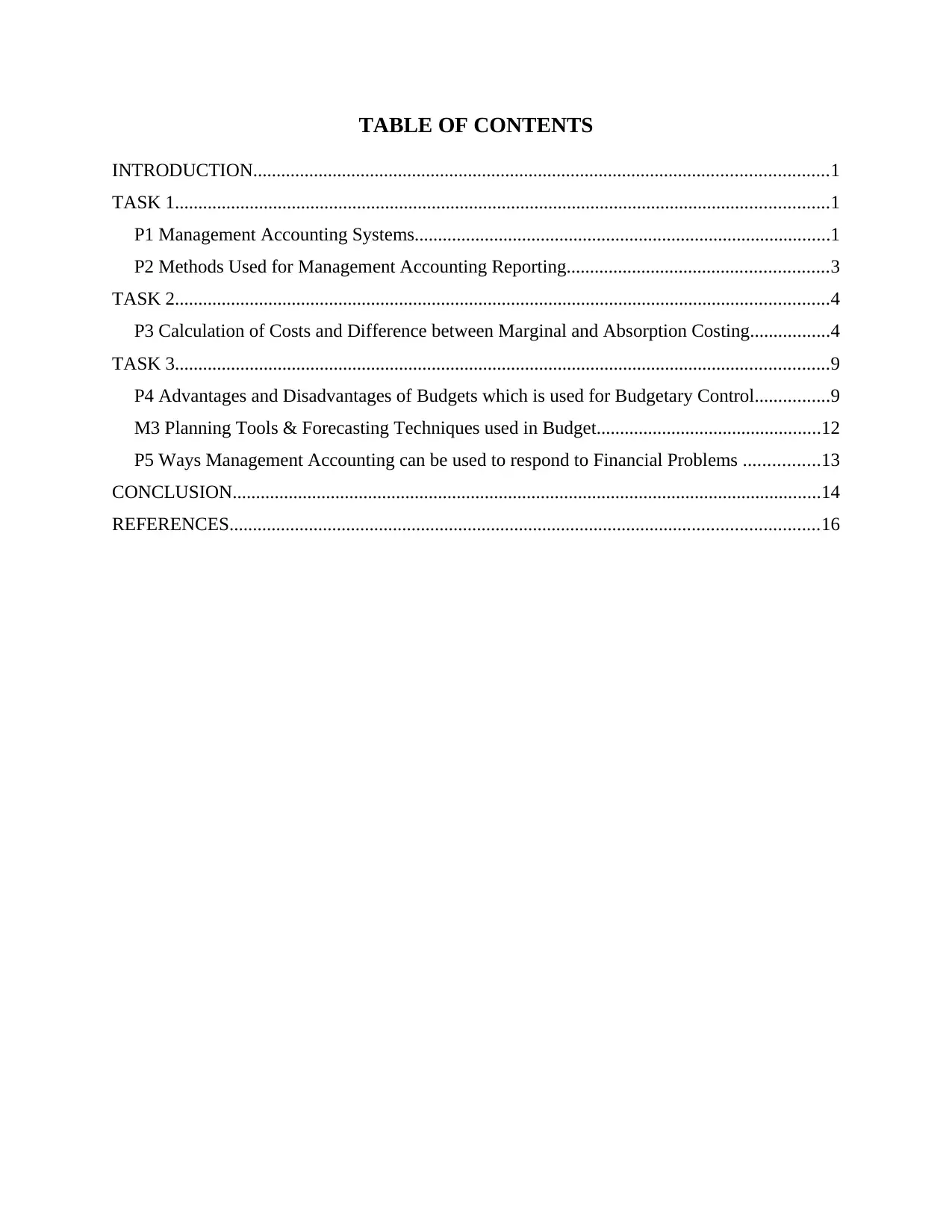
TABLE OF CONTENTS
INTRODUCTION...........................................................................................................................1
TASK 1............................................................................................................................................1
P1 Management Accounting Systems.........................................................................................1
P2 Methods Used for Management Accounting Reporting........................................................3
TASK 2............................................................................................................................................4
P3 Calculation of Costs and Difference between Marginal and Absorption Costing.................4
TASK 3............................................................................................................................................9
P4 Advantages and Disadvantages of Budgets which is used for Budgetary Control................9
M3 Planning Tools & Forecasting Techniques used in Budget................................................12
P5 Ways Management Accounting can be used to respond to Financial Problems ................13
CONCLUSION..............................................................................................................................14
REFERENCES..............................................................................................................................16
INTRODUCTION...........................................................................................................................1
TASK 1............................................................................................................................................1
P1 Management Accounting Systems.........................................................................................1
P2 Methods Used for Management Accounting Reporting........................................................3
TASK 2............................................................................................................................................4
P3 Calculation of Costs and Difference between Marginal and Absorption Costing.................4
TASK 3............................................................................................................................................9
P4 Advantages and Disadvantages of Budgets which is used for Budgetary Control................9
M3 Planning Tools & Forecasting Techniques used in Budget................................................12
P5 Ways Management Accounting can be used to respond to Financial Problems ................13
CONCLUSION..............................................................................................................................14
REFERENCES..............................................................................................................................16
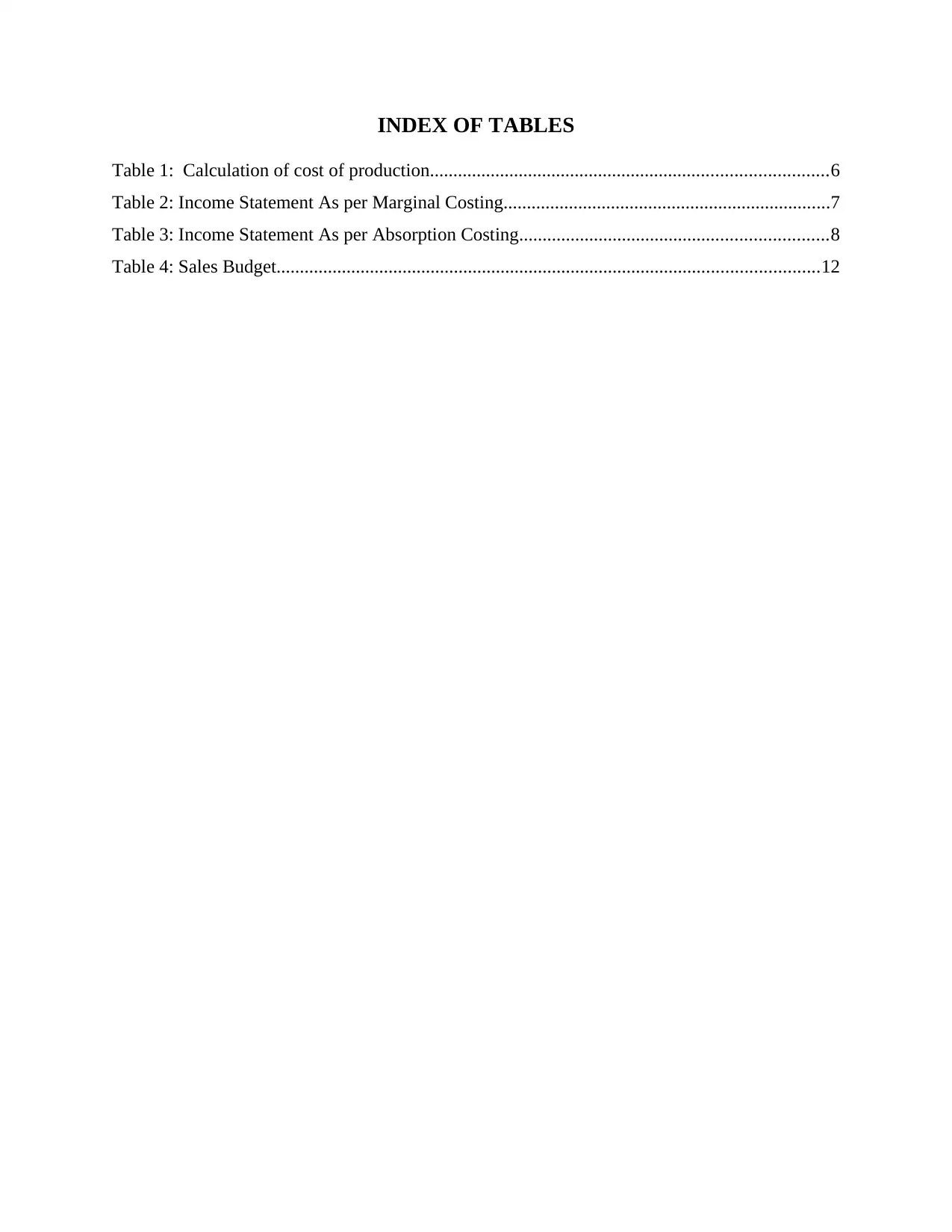
INDEX OF TABLES
Table 1: Calculation of cost of production.....................................................................................6
Table 2: Income Statement As per Marginal Costing......................................................................7
Table 3: Income Statement As per Absorption Costing..................................................................8
Table 4: Sales Budget....................................................................................................................12
Table 1: Calculation of cost of production.....................................................................................6
Table 2: Income Statement As per Marginal Costing......................................................................7
Table 3: Income Statement As per Absorption Costing..................................................................8
Table 4: Sales Budget....................................................................................................................12
⊘ This is a preview!⊘
Do you want full access?
Subscribe today to unlock all pages.

Trusted by 1+ million students worldwide

ILLUSTRATION INDEX
Illustration 1: Cash budget for organisation...................................................................................11
Illustration 1: Cash budget for organisation...................................................................................11
Paraphrase This Document
Need a fresh take? Get an instant paraphrase of this document with our AI Paraphraser
INTRODUCTION
Management accounting is key in developing a business as a whole. When it is talked
about management accounting, there also some discussions about cost and financial accounting
because they both are the part of management accounting(Bryer, 2013). Managers need to
evaluate the performance of the particular plant considering the performance of various costs
into it then here comes the role of cost accounting in which various costs helps a mangers to
make decisions on the working of the plant. In management accounting recording, classification,
evaluation and interpretation of data take place.
Same is in the case of financial accounting as well here financial matters are discussed so
that managers can strategically use those data and then can make necessary decisions in order to
make fruitful decisions which can impact the company in a positive way. In this report various
management techniques and its implication plus how a management accounting is carried out in
the retail sector is undertaken with point of view of providing an insight on management
accounting practices in an organization(A. Hammad, Jusoh and Ghozali, 2013). The company
taken here is M & S Ltd. which is doing business in retail sector.
TASK 1
P1 Management Accounting Systems
For the purpose of study abc company here is undertaken because as world is moving fast
retail sector is developing too and thus the increase in retail industry practices in the recent times
it is important to take an analysis of the retail management techniques and how they handle the
pressure of decision making and controlling. Since they have to deal every day with lots of
inventory in order to keep attracting customers towards their retail outlets. Thus, different
aspects of management accounting for decision making regarding effective business operations
can understand through this report.
This approach is nothing but the process of evaluating the operations of business of
different departments(A. Hammad, Jusoh and Ghozali, 2013). However, it is considered as a
process for analysing, interpreting and sharing information related to business operations for
used by the managers in due course of the organizational workings. Management accounting is
combination of financial accounting and cost accounting. Though it is some what different from
both of the said accounting. That's why management accounting is more preferred over different
1
Management accounting is key in developing a business as a whole. When it is talked
about management accounting, there also some discussions about cost and financial accounting
because they both are the part of management accounting(Bryer, 2013). Managers need to
evaluate the performance of the particular plant considering the performance of various costs
into it then here comes the role of cost accounting in which various costs helps a mangers to
make decisions on the working of the plant. In management accounting recording, classification,
evaluation and interpretation of data take place.
Same is in the case of financial accounting as well here financial matters are discussed so
that managers can strategically use those data and then can make necessary decisions in order to
make fruitful decisions which can impact the company in a positive way. In this report various
management techniques and its implication plus how a management accounting is carried out in
the retail sector is undertaken with point of view of providing an insight on management
accounting practices in an organization(A. Hammad, Jusoh and Ghozali, 2013). The company
taken here is M & S Ltd. which is doing business in retail sector.
TASK 1
P1 Management Accounting Systems
For the purpose of study abc company here is undertaken because as world is moving fast
retail sector is developing too and thus the increase in retail industry practices in the recent times
it is important to take an analysis of the retail management techniques and how they handle the
pressure of decision making and controlling. Since they have to deal every day with lots of
inventory in order to keep attracting customers towards their retail outlets. Thus, different
aspects of management accounting for decision making regarding effective business operations
can understand through this report.
This approach is nothing but the process of evaluating the operations of business of
different departments(A. Hammad, Jusoh and Ghozali, 2013). However, it is considered as a
process for analysing, interpreting and sharing information related to business operations for
used by the managers in due course of the organizational workings. Management accounting is
combination of financial accounting and cost accounting. Though it is some what different from
both of the said accounting. That's why management accounting is more preferred over different
1
types of accounting. Management accounting has wider coverage area of the organization. This
accounting technique is beneficial to generate ideas for optimum utilization of organizational
resources to support managers in their task and through it the managers wants to enhance both
the customer and shareholder value. Their are different objectives and benefits of management
accounting and they are:
It facilitates Organizational Planning in which selection of best alternatives take place.
M.A used to keep a monitoring and control over the organizational activities.
Performance Measurement is the key towards achieving the vision and mission of the
organization and thus M.A helps in that(Myrelid and Olhager, 2015).
Through management accounting a manager is able to make sound strategies and
decisions.
Management accounting Systems is kind of an information system which facilitate a
manager in making sound decisions and create value for the company. The information provided
in this is based on ad hoc and fulfill both the short-term as well long-term needs of management.
There are different systems which managers take into account for better understanding and they
are:1. Cost Accounting System: abc company have a practice of using this system very often
because in this system the cost of goods and services as well as the cost of different
departments is taken into consideration to know actually how much the expenses are.
This accounting system provides a detailed cost data which helps the management of abc
to control its operations and plan for the future(Du and Taylor, 2013). It is one of the
most effective system to creating balance between production and distribution system of
the organization adequately.2. Inventory Management System: It is one of the main source to manage inventories of the
entity and improving its liquidity position. In this regard, managers analyses all
inventories and further make decisions for its effectiveness. Including this, it also employ
and undertakes this type of system into recording to implement all action plans in proper
time.
2
accounting technique is beneficial to generate ideas for optimum utilization of organizational
resources to support managers in their task and through it the managers wants to enhance both
the customer and shareholder value. Their are different objectives and benefits of management
accounting and they are:
It facilitates Organizational Planning in which selection of best alternatives take place.
M.A used to keep a monitoring and control over the organizational activities.
Performance Measurement is the key towards achieving the vision and mission of the
organization and thus M.A helps in that(Myrelid and Olhager, 2015).
Through management accounting a manager is able to make sound strategies and
decisions.
Management accounting Systems is kind of an information system which facilitate a
manager in making sound decisions and create value for the company. The information provided
in this is based on ad hoc and fulfill both the short-term as well long-term needs of management.
There are different systems which managers take into account for better understanding and they
are:1. Cost Accounting System: abc company have a practice of using this system very often
because in this system the cost of goods and services as well as the cost of different
departments is taken into consideration to know actually how much the expenses are.
This accounting system provides a detailed cost data which helps the management of abc
to control its operations and plan for the future(Du and Taylor, 2013). It is one of the
most effective system to creating balance between production and distribution system of
the organization adequately.2. Inventory Management System: It is one of the main source to manage inventories of the
entity and improving its liquidity position. In this regard, managers analyses all
inventories and further make decisions for its effectiveness. Including this, it also employ
and undertakes this type of system into recording to implement all action plans in proper
time.
2
⊘ This is a preview!⊘
Do you want full access?
Subscribe today to unlock all pages.
Trusted by 1+ million students worldwide
3. Job-costing Systems: Under this management accounting system, costs incurred for
manufacturing of products are analysed that affects its production effectively. That means
for fulfilling requirements of all customers regarding set of product produced by entity.
Here firstly the customer makes the order as per his liking and then a company prepares
him the product(Ghasemi and et.al, 2016). It is appropriate technique to reach out
customers' expectations and satisfying them with product services provided by
organization.
4. Price-Optimizing Systems: It is best tool for optimizing price and cost effectiveness to
produce goods and services provided by entity (Hopper, 2013). In accordance to this,
several tools are applied for setting price regarding business operations also impacts on
profitability of organisation. In this system different customer groups are taken into
consideration as per their income levels so that pricing decisions can be made as per the
purchasing powers.
P2 Methods Used for Management Accounting Reporting
Management accounting reporting can be understood as the reporting of operations of the
businesses which makes or helps management of organizations to make decisions which
remains vital for the operations of the company. It is considered that preparing and maintaining
report presents different business operations which is analyzed for decision-making process
(Smith, Brännström and Jansson, 2015). The reports are of different types in management
accounting which contain different information's related to different operations and the data
collected in this reports is from financial and non-financial sources and facilitate in decision-
making. There are different reports and they are:
Job Cost Reports: This report shows how much cost has been incurred in particular
period by the organization to carry out the operations. In this report usually the cost is
matched with an estimate of revenue to draw conclusions on the profitability of the
company. It is helpful to analyse higher earning area and costs incurred for
manufacturing of products. Therefore, preparing job cost report is analyzed for further
business operations.
Inventory Management Reports: Preparing and maintaining this report is suitable to
manage all inventories of the organisation as well generating ideas for improving its
3
manufacturing of products are analysed that affects its production effectively. That means
for fulfilling requirements of all customers regarding set of product produced by entity.
Here firstly the customer makes the order as per his liking and then a company prepares
him the product(Ghasemi and et.al, 2016). It is appropriate technique to reach out
customers' expectations and satisfying them with product services provided by
organization.
4. Price-Optimizing Systems: It is best tool for optimizing price and cost effectiveness to
produce goods and services provided by entity (Hopper, 2013). In accordance to this,
several tools are applied for setting price regarding business operations also impacts on
profitability of organisation. In this system different customer groups are taken into
consideration as per their income levels so that pricing decisions can be made as per the
purchasing powers.
P2 Methods Used for Management Accounting Reporting
Management accounting reporting can be understood as the reporting of operations of the
businesses which makes or helps management of organizations to make decisions which
remains vital for the operations of the company. It is considered that preparing and maintaining
report presents different business operations which is analyzed for decision-making process
(Smith, Brännström and Jansson, 2015). The reports are of different types in management
accounting which contain different information's related to different operations and the data
collected in this reports is from financial and non-financial sources and facilitate in decision-
making. There are different reports and they are:
Job Cost Reports: This report shows how much cost has been incurred in particular
period by the organization to carry out the operations. In this report usually the cost is
matched with an estimate of revenue to draw conclusions on the profitability of the
company. It is helpful to analyse higher earning area and costs incurred for
manufacturing of products. Therefore, preparing job cost report is analyzed for further
business operations.
Inventory Management Reports: Preparing and maintaining this report is suitable to
manage all inventories of the organisation as well generating ideas for improving its
3
Paraphrase This Document
Need a fresh take? Get an instant paraphrase of this document with our AI Paraphraser
liquidity. Including this, it also helps in maintaining the levels of inventory in the
situations of immediate needs(Orelli, Padovani and Katsikas, 2016). These reports
generally include items such as inventory waste, O/H costs, Labor costs, etc.
Operating Budget Report: Operating reports will help abc to make decisions on the
performance as a whole and each department has to enable monitoring and proper control
costs of operations. Through these reports every individual employee is tracked in terms
of his performance and thus by the help of budget reports is easy for management to
calculate the incentives of employees.
Accounts Receivable Reports: This report is vital tool which enables managers to
manage cash transactions in the organization with relation to credit it offers to customers.
The report identify the problem related to collection process and it facilitate in making
necessary regulations or rules for further operations. It also enables accounts departments
to look at old debts(Orelli, Padovani and Katsikas, 2016).
TASK 2
P3 Calculation of Costs and Difference between Marginal and Absorption Costing
Price determination is one the essential tool for cost effectiveness and proper
management of production and distribution system of the organisation. It is used to measure the
cost which is incurred in a particular period for activities that are being performed in an
organization. An inappropriate cost identification will affects abc in a negative and a major way
(Luft, 2016). There are different costs which is used in management accounting and they are:
opportunity costs, sunk costs, Direct expenses and Overheads. For price determination process,
various costing methods are used such as; marginal, absorption, activity based costing and so on.
However, in all of these methods, preparing income statement from marginal and absorption
costing can understand as below:
Marginal Costing: Under this costing method, for evaluating net profit, gross profit of
the entity is deducted with expenditures incurred on variable operations only. Therefore, it is
suitable for short term decision making process and preparing strategies for reducing issues
occur in the entity. However, proper ideas are generated for further decision making and
implementing activities for its improvement effectively. The name itself suggest that cost which
has established by incurring one additional unit of output.
4
situations of immediate needs(Orelli, Padovani and Katsikas, 2016). These reports
generally include items such as inventory waste, O/H costs, Labor costs, etc.
Operating Budget Report: Operating reports will help abc to make decisions on the
performance as a whole and each department has to enable monitoring and proper control
costs of operations. Through these reports every individual employee is tracked in terms
of his performance and thus by the help of budget reports is easy for management to
calculate the incentives of employees.
Accounts Receivable Reports: This report is vital tool which enables managers to
manage cash transactions in the organization with relation to credit it offers to customers.
The report identify the problem related to collection process and it facilitate in making
necessary regulations or rules for further operations. It also enables accounts departments
to look at old debts(Orelli, Padovani and Katsikas, 2016).
TASK 2
P3 Calculation of Costs and Difference between Marginal and Absorption Costing
Price determination is one the essential tool for cost effectiveness and proper
management of production and distribution system of the organisation. It is used to measure the
cost which is incurred in a particular period for activities that are being performed in an
organization. An inappropriate cost identification will affects abc in a negative and a major way
(Luft, 2016). There are different costs which is used in management accounting and they are:
opportunity costs, sunk costs, Direct expenses and Overheads. For price determination process,
various costing methods are used such as; marginal, absorption, activity based costing and so on.
However, in all of these methods, preparing income statement from marginal and absorption
costing can understand as below:
Marginal Costing: Under this costing method, for evaluating net profit, gross profit of
the entity is deducted with expenditures incurred on variable operations only. Therefore, it is
suitable for short term decision making process and preparing strategies for reducing issues
occur in the entity. However, proper ideas are generated for further decision making and
implementing activities for its improvement effectively. The name itself suggest that cost which
has established by incurring one additional unit of output.
4
Advantages:
1. No allocation & apportionment of cost.
2. No over and under absorption of the cost.
3. Here, product cost and variable cost is equal because in marginal costing there is no fixed
cost involved(Luft, 2016).
4. In this process, profit is considered as dependent variable for selling and production
system of goods.
5. Helpful for short term decision-making process to achieve organisation's effectiveness
and managing all business operations efficiently.
6. It is useful for cost effectiveness regarding producing goods and services produced by
entity.
Disadvantages:
1. Difficulty in splitting two cost incurred on variable cost and fixed expenses.
2. For net calculating net profit, gross profit is deducted with additional overhead expenses
only therefore accurate financial position of entity does not obtained.
3. Sales cost is difficult to attain because of variable and fixed cost issues .
In Order to make calculations first, we have to take out various other costs for Knowing
the profit. Thus so as a part of the process Certain workings have been taken out to make things
clear and the workings are:
Working 1
Fixed Production O/H Absorption Rate = 1,800/600
= 3/unit
Working 2
Calculation of cost of production
Table 1: Calculation of cost of production
Particulars Marginal Absorption
5
1. No allocation & apportionment of cost.
2. No over and under absorption of the cost.
3. Here, product cost and variable cost is equal because in marginal costing there is no fixed
cost involved(Luft, 2016).
4. In this process, profit is considered as dependent variable for selling and production
system of goods.
5. Helpful for short term decision-making process to achieve organisation's effectiveness
and managing all business operations efficiently.
6. It is useful for cost effectiveness regarding producing goods and services produced by
entity.
Disadvantages:
1. Difficulty in splitting two cost incurred on variable cost and fixed expenses.
2. For net calculating net profit, gross profit is deducted with additional overhead expenses
only therefore accurate financial position of entity does not obtained.
3. Sales cost is difficult to attain because of variable and fixed cost issues .
In Order to make calculations first, we have to take out various other costs for Knowing
the profit. Thus so as a part of the process Certain workings have been taken out to make things
clear and the workings are:
Working 1
Fixed Production O/H Absorption Rate = 1,800/600
= 3/unit
Working 2
Calculation of cost of production
Table 1: Calculation of cost of production
Particulars Marginal Absorption
5
⊘ This is a preview!⊘
Do you want full access?
Subscribe today to unlock all pages.
Trusted by 1+ million students worldwide
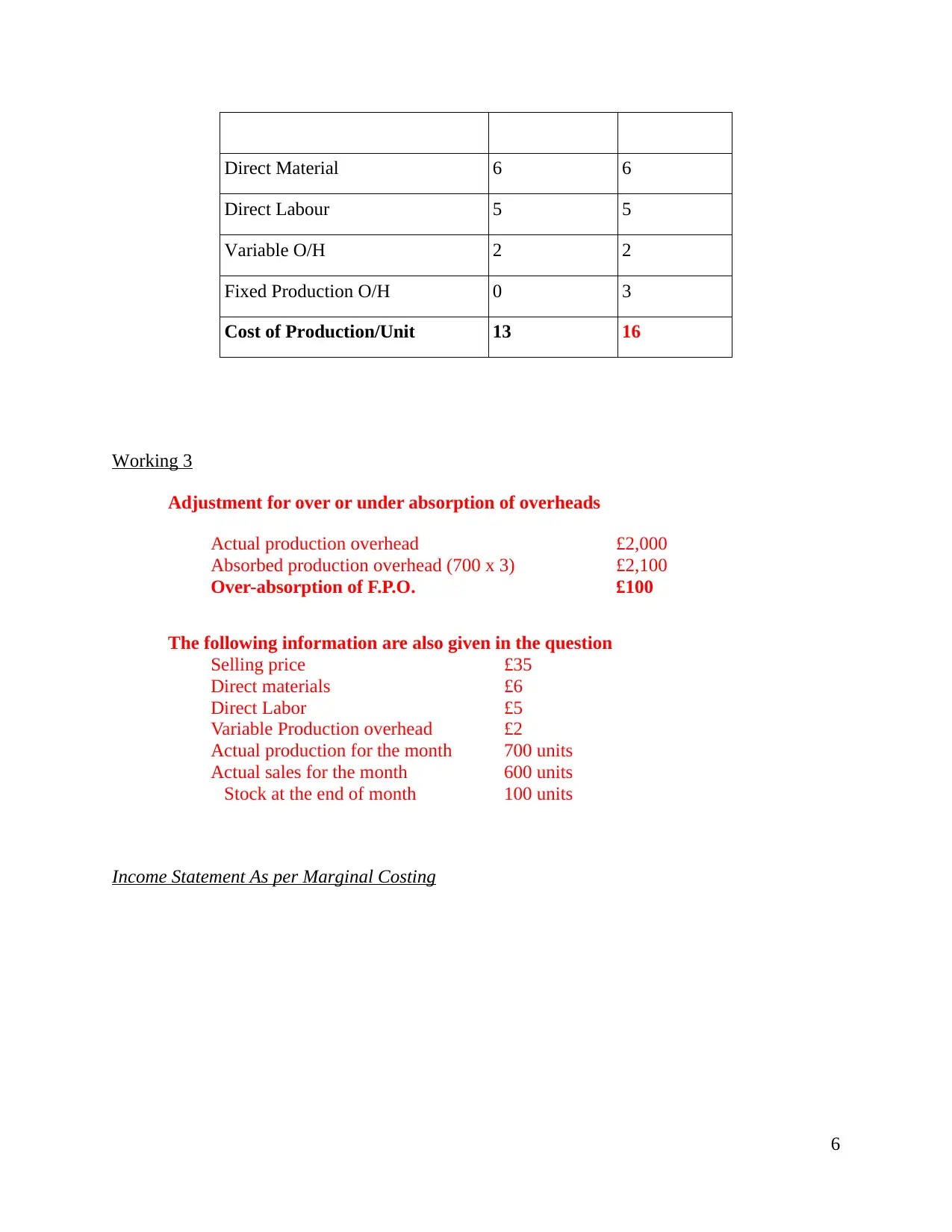
Direct Material 6 6
Direct Labour 5 5
Variable O/H 2 2
Fixed Production O/H 0 3
Cost of Production/Unit 13 16
Working 3
Adjustment for over or under absorption of overheads
Actual production overhead £2,000
Absorbed production overhead (700 x 3) £2,100
Over-absorption of F.P.O. £100
The following information are also given in the question
Selling price £35
Direct materials £6
Direct Labor £5
Variable Production overhead £2
Actual production for the month 700 units
Actual sales for the month 600 units
Stock at the end of month 100 units
Income Statement As per Marginal Costing
6
Direct Labour 5 5
Variable O/H 2 2
Fixed Production O/H 0 3
Cost of Production/Unit 13 16
Working 3
Adjustment for over or under absorption of overheads
Actual production overhead £2,000
Absorbed production overhead (700 x 3) £2,100
Over-absorption of F.P.O. £100
The following information are also given in the question
Selling price £35
Direct materials £6
Direct Labor £5
Variable Production overhead £2
Actual production for the month 700 units
Actual sales for the month 600 units
Stock at the end of month 100 units
Income Statement As per Marginal Costing
6
Paraphrase This Document
Need a fresh take? Get an instant paraphrase of this document with our AI Paraphraser
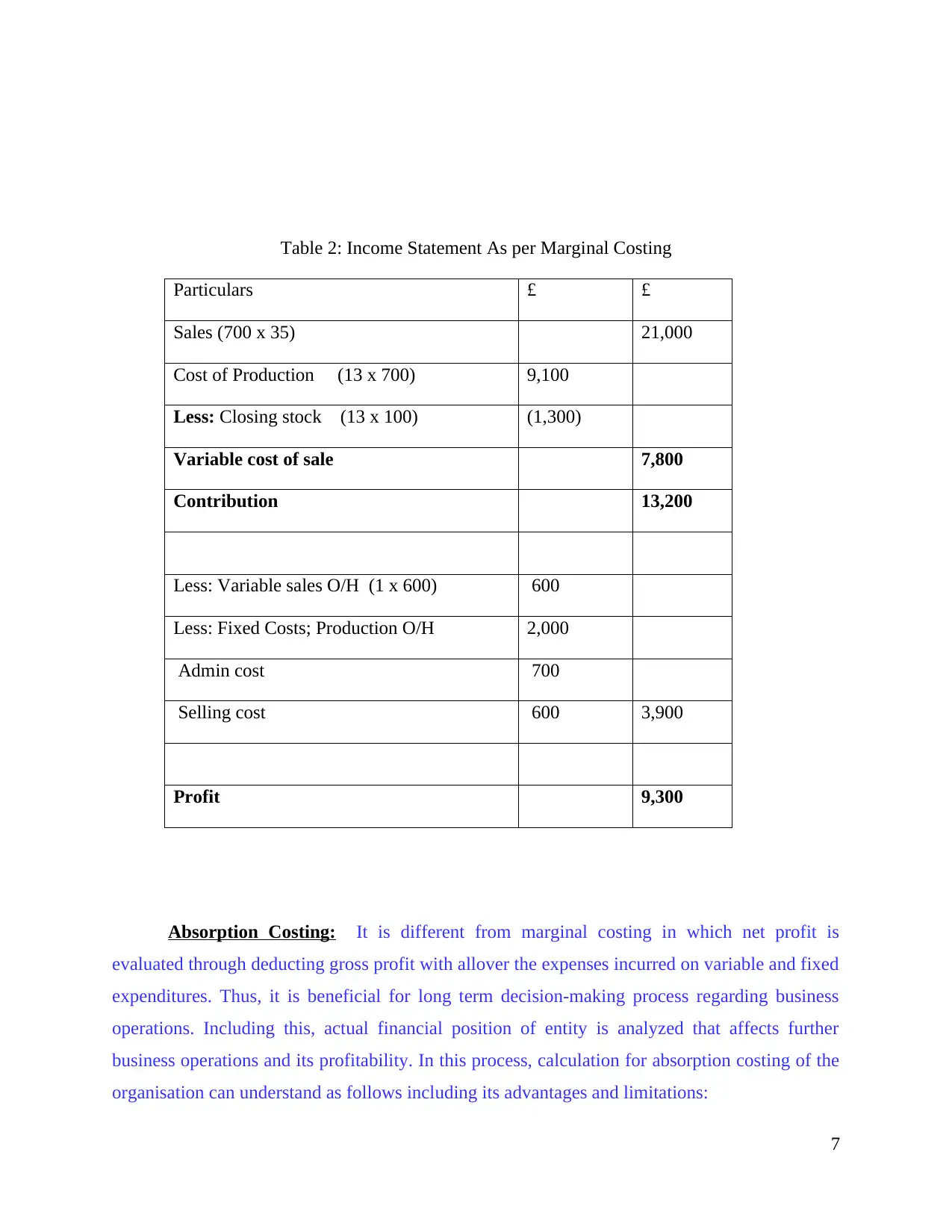
Table 2: Income Statement As per Marginal Costing
Particulars £ £
Sales (700 x 35) 21,000
Cost of Production (13 x 700) 9,100
Less: Closing stock (13 x 100) (1,300)
Variable cost of sale 7,800
Contribution 13,200
Less: Variable sales O/H (1 x 600) 600
Less: Fixed Costs; Production O/H 2,000
Admin cost 700
Selling cost 600 3,900
Profit 9,300
Absorption Costing: It is different from marginal costing in which net profit is
evaluated through deducting gross profit with allover the expenses incurred on variable and fixed
expenditures. Thus, it is beneficial for long term decision-making process regarding business
operations. Including this, actual financial position of entity is analyzed that affects further
business operations and its profitability. In this process, calculation for absorption costing of the
organisation can understand as follows including its advantages and limitations:
7
Particulars £ £
Sales (700 x 35) 21,000
Cost of Production (13 x 700) 9,100
Less: Closing stock (13 x 100) (1,300)
Variable cost of sale 7,800
Contribution 13,200
Less: Variable sales O/H (1 x 600) 600
Less: Fixed Costs; Production O/H 2,000
Admin cost 700
Selling cost 600 3,900
Profit 9,300
Absorption Costing: It is different from marginal costing in which net profit is
evaluated through deducting gross profit with allover the expenses incurred on variable and fixed
expenditures. Thus, it is beneficial for long term decision-making process regarding business
operations. Including this, actual financial position of entity is analyzed that affects further
business operations and its profitability. In this process, calculation for absorption costing of the
organisation can understand as follows including its advantages and limitations:
7
Advantages:1. Under absorption costing method, competitive selling price is evaluated for long term
decision-making process.2. It is helpful for optimum utilization of resources and fund efficiently (Aouni, McGillis
and Abdulkarim, 2015).3. Cost is charged in an efficient manner to the product.4. This costing is emphasis for business operations for long time periodicity.
Disadvantages:
1. Cost apportionment is not easy to implement.
2. Over and under absorbed cost should be included at the year end. It should not be
included directly.
3. Profits is affected by the volumes of production.
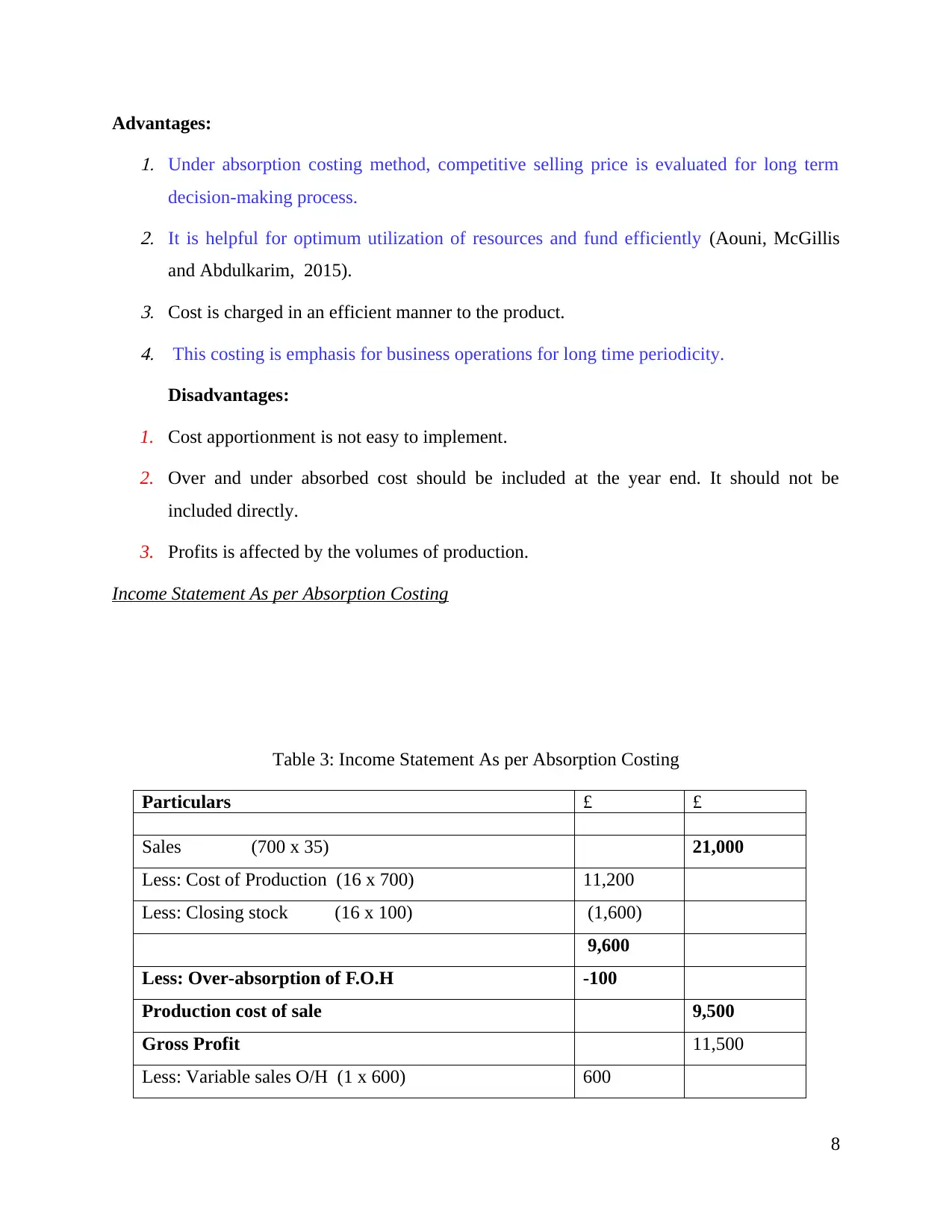
Income Statement As per Absorption Costing
Table 3: Income Statement As per Absorption Costing
Particulars £ £
Sales (700 x 35) 21,000
Less: Cost of Production (16 x 700) 11,200
Less: Closing stock (16 x 100) (1,600)
9,600
Less: Over-absorption of F.O.H -100
Production cost of sale 9,500
Gross Profit 11,500
Less: Variable sales O/H (1 x 600) 600
8
decision-making process.2. It is helpful for optimum utilization of resources and fund efficiently (Aouni, McGillis
and Abdulkarim, 2015).3. Cost is charged in an efficient manner to the product.4. This costing is emphasis for business operations for long time periodicity.
Disadvantages:
1. Cost apportionment is not easy to implement.
2. Over and under absorbed cost should be included at the year end. It should not be
included directly.
3. Profits is affected by the volumes of production.
Income Statement As per Absorption Costing
Table 3: Income Statement As per Absorption Costing
Particulars £ £
Sales (700 x 35) 21,000
Less: Cost of Production (16 x 700) 11,200
Less: Closing stock (16 x 100) (1,600)
9,600
Less: Over-absorption of F.O.H -100
Production cost of sale 9,500
Gross Profit 11,500
Less: Variable sales O/H (1 x 600) 600
8
⊘ This is a preview!⊘
Do you want full access?
Subscribe today to unlock all pages.
Trusted by 1+ million students worldwide

1 out of 21


Related Documents


Your All-in-One AI-Powered Toolkit for Academic Success.
+13062052269
info@desklib.com
Available 24*7 on WhatsApp / Email
![[object Object]](/_next/static/media/star-bottom.7253800d.svg)
Unlock your academic potential
Copyright © 2020–2026 A2Z Services. All Rights Reserved. Developed and managed by ZUCOL.