Sainsbury's: International Marketing, Subcultures, & Hofstede Analysis
VerifiedAdded on 2023/06/15
|11
|3940
|383
Report
AI Summary
This report explores international marketing principles with a focus on Sainsbury's, a major UK supermarket chain, and its global expansion strategies. It emphasizes the importance of understanding subcultures and their impact on international marketing success, utilizing Hofstede's cultural dimensions theory to analyze cultural differences. The report defines subcultures and their relevance in meeting specific consumer needs and perceptions, highlighting how Hofstede's dimensions (power distance, individualism vs. collectivism, masculinity vs. femininity, uncertainty avoidance, long-term orientation, and indulgence vs. restraint) influence marketing activities. A comparative analysis of South Africa and the United Kingdom, using Hofstede's dimensions, provides insights into cultural differences that Sainsbury's must consider when expanding internationally, including power index and individualism. The report concludes by underscoring the necessity of adapting marketing strategies to align with cultural nuances and consumer behaviors in different regions to maximize revenue and brand image.
International Marketing

Paraphrase This Document
Need a fresh take? Get an instant paraphrase of this document with our AI Paraphraser
TABLE OF CONTENTS
INTRODUCTION...........................................................................................................................3
MAIN BODY...................................................................................................................................3
Cultural and international market....................................................................................................3
PART A.......................................................................................................................................3
Defining the subculture................................................................................................................3
PART-B.......................................................................................................................................7
Applying Hofstede dimension between South Africa and United kingdom................................7
CONCLUSION..............................................................................................................................10
REFERENCES..............................................................................................................................12
INTRODUCTION...........................................................................................................................3
MAIN BODY...................................................................................................................................3
Cultural and international market....................................................................................................3
PART A.......................................................................................................................................3
Defining the subculture................................................................................................................3
PART-B.......................................................................................................................................7
Applying Hofstede dimension between South Africa and United kingdom................................7
CONCLUSION..............................................................................................................................10
REFERENCES..............................................................................................................................12
INTRODUCTION.
International marketing is related to marketing principles that are made to satisfy some
particular needs and wants of the specified group across various regions and countries. The
present report is based Sainsbury that is the largest chain of supermarkets in United Kingdom
and sells variety of goods across various regions. Further, the report will identify the importance
of sub culture that determines the market for the company that wishes to conduct operations
globally. Moreover, the importance of such international marketing through analysing various
factors of subculture using the Hofstede dimension theory will also be covered under this report.
Lastly, comparison of two different countries' will also be done through Hofstede theory so that
international strategies could be done effectively.
MAIN BODY.
Cultural and international market.
PART A
Defining the subculture.
A subculture is group of people that are within larger culture that have something in
common. Further, such commonalities could be either based on political beliefs or religious
sentiments. Also, subcultures are important part of any group as they are based on specific
characteristics (Leonidou and et.al., 2018). These are important in case of international
marketing as it helps in meeting the specific needs, motivation and perception of the people by
identifying the special attributes that are possessed by that group over a certain period. This way
any firm would be able to minimize the losses while expanding into any of the international
region by meeting the demands in the best manner. Moreover, subculture helps in developing
proper marketing activities. Moreover, this could be understood very well through the Hofstede
cultural dimension theory that is based on identifying the effects of society culture on certain
values of the firm.
This theory has the certain dimension that are helpful for any firm to ensure successful
operations in the long run. The higher power distance index in this model believes that the rules
are clearly laid down and established by the government and hence all the products need to be
sold out following the strict norms of that country (Poulis , 2020). Further, subcultures in this
type would not be ready to purchase those goods that are restricted in the country by laws.
International marketing is related to marketing principles that are made to satisfy some
particular needs and wants of the specified group across various regions and countries. The
present report is based Sainsbury that is the largest chain of supermarkets in United Kingdom
and sells variety of goods across various regions. Further, the report will identify the importance
of sub culture that determines the market for the company that wishes to conduct operations
globally. Moreover, the importance of such international marketing through analysing various
factors of subculture using the Hofstede dimension theory will also be covered under this report.
Lastly, comparison of two different countries' will also be done through Hofstede theory so that
international strategies could be done effectively.
MAIN BODY.
Cultural and international market.
PART A
Defining the subculture.
A subculture is group of people that are within larger culture that have something in
common. Further, such commonalities could be either based on political beliefs or religious
sentiments. Also, subcultures are important part of any group as they are based on specific
characteristics (Leonidou and et.al., 2018). These are important in case of international
marketing as it helps in meeting the specific needs, motivation and perception of the people by
identifying the special attributes that are possessed by that group over a certain period. This way
any firm would be able to minimize the losses while expanding into any of the international
region by meeting the demands in the best manner. Moreover, subculture helps in developing
proper marketing activities. Moreover, this could be understood very well through the Hofstede
cultural dimension theory that is based on identifying the effects of society culture on certain
values of the firm.
This theory has the certain dimension that are helpful for any firm to ensure successful
operations in the long run. The higher power distance index in this model believes that the rules
are clearly laid down and established by the government and hence all the products need to be
sold out following the strict norms of that country (Poulis , 2020). Further, subcultures in this
type would not be ready to purchase those goods that are restricted in the country by laws.
⊘ This is a preview!⊘
Do you want full access?
Subscribe today to unlock all pages.

Trusted by 1+ million students worldwide
Hence, only those goods could be sold effectively that does not have any kind of restrictions in
its trade and manufacturing. The next dimension under this is individualism and collectivism that
defines the way the people are influenced by particular group. Also, it is seen that in most of the
collectivism cases that people are more loyal towards each other and thus sales of the firm could
be highly affected if not carefully analysed before entering into the market. Other one in this is
the masculinity vs femininity dimension that describes that either the society is power, passion
and material driver or else it is based on factors such as trust, love, loyalty etc.(Amankwah-
Amoah, Boso and Debrah, 2018). Thus, when any marketing is done in the country where there
is intense competition than the firm need to identify the sources through which new products can
be introduced in the market that are not (similar) than those that are already existing that country
otherwise people would switch to other options that are available in the market. Further, if there
is more caring and love factor in any country than the firm would be easily able to introduce
substitutes in the such cultures with the little changes in attributes of the product and developing
effective marketing techniques.
Other dimension is the uncertainty avoidance where higher index means that people are
not ready to take certain challenges in form of any outside sources and thus avoid intervention of
any unknown event (Baack, Czarnecka and Baack, 2018). Also, a lower degree in this factor
means that sub culture in any country is ready to take the future threats in the form of any outside
party interference so that new goods and services could be experienced. Further, the long term
orientation and short term dimension in the Hofstede could be defined as country where it is
ready to take step forward from the current position so that level of prosperity could be achieved
in the future while in case of short term the country aims to develop goals so that it could be
achieved in very limited time frame. Thus, in case of the company that wishing to conduct its
operations outside the host (country) than it need to take care of the vision of the country so that
projects could be made accordingly (Solberg, 2017). Last in the dimension of the Hofstede is
indulgence vs restraint that means that indulgence society allows the people to consume variety
of goods that are according to their needs while in case of restraint it means that society impose
certain restrictions through developing strict social norms. Thus, those firms would not be able to
grow in the best manner when subcultures existing within that country are not allowed to
consume things that are based on their choices and preferences.
its trade and manufacturing. The next dimension under this is individualism and collectivism that
defines the way the people are influenced by particular group. Also, it is seen that in most of the
collectivism cases that people are more loyal towards each other and thus sales of the firm could
be highly affected if not carefully analysed before entering into the market. Other one in this is
the masculinity vs femininity dimension that describes that either the society is power, passion
and material driver or else it is based on factors such as trust, love, loyalty etc.(Amankwah-
Amoah, Boso and Debrah, 2018). Thus, when any marketing is done in the country where there
is intense competition than the firm need to identify the sources through which new products can
be introduced in the market that are not (similar) than those that are already existing that country
otherwise people would switch to other options that are available in the market. Further, if there
is more caring and love factor in any country than the firm would be easily able to introduce
substitutes in the such cultures with the little changes in attributes of the product and developing
effective marketing techniques.
Other dimension is the uncertainty avoidance where higher index means that people are
not ready to take certain challenges in form of any outside sources and thus avoid intervention of
any unknown event (Baack, Czarnecka and Baack, 2018). Also, a lower degree in this factor
means that sub culture in any country is ready to take the future threats in the form of any outside
party interference so that new goods and services could be experienced. Further, the long term
orientation and short term dimension in the Hofstede could be defined as country where it is
ready to take step forward from the current position so that level of prosperity could be achieved
in the future while in case of short term the country aims to develop goals so that it could be
achieved in very limited time frame. Thus, in case of the company that wishing to conduct its
operations outside the host (country) than it need to take care of the vision of the country so that
projects could be made accordingly (Solberg, 2017). Last in the dimension of the Hofstede is
indulgence vs restraint that means that indulgence society allows the people to consume variety
of goods that are according to their needs while in case of restraint it means that society impose
certain restrictions through developing strict social norms. Thus, those firms would not be able to
grow in the best manner when subcultures existing within that country are not allowed to
consume things that are based on their choices and preferences.
Paraphrase This Document
Need a fresh take? Get an instant paraphrase of this document with our AI Paraphraser
Furthermore, it is seen that international marketing is very crucial for any company to generate
maximum revenues and brand image all around the world. For this purpose various dimension
are very important to be taken into consideration so that marketing policies can be made
accordingly. Also, a set pattern is followed by various countries so that consumer behaviour
could be easily identified using the appropriate tools by the company that wish to sell it goods in
the market (Lu, Scholz and Nguyen, 2018). Moreover, the company need to closely identified the
required marketing skills that will attract the maximum number of potential subgroups in the
targeted market so that better relationship could be developed. International marketing is very
good as it allows various countries to come closer through better cooperation and understanding.
Further, it is important tool of development and growth for those companies that wishes to
introduce new product lines in existing system. To avoid the risk factor involved in procuring
various raw material required to carry out activities in the target market the companies could
achieve either through joint ventures, collaboration, licencing or any other method so that time
and cost could also be saved.
Also, subculture in any country could be in the form of age, country of birth,
backgrounds, social class etc. For example : Group of rich class people in the country will
purchase only those goods that are of high premium value and brand so best of the quality could
be gained while in case of the middle class people will be attracted more to those services that
are good both in terms of quality, quantity and also having the price value of money (Zeneli,
Czinkota and Knight, 2018). Another example of religious sub culture could be through burger
king ad that displayed the crescent moon through image of eaten burger in days of Ramadan.
Thus, it helps in increasing the sales of the company through targeting the market very well.
Further, it is seen that while targeting the subculture the firm need to take into
consideration the language that is also very important factor to sell the goods effectively. Also, it
is seen that for one subgroup the sentence might mean differently while in other group it is
totally different (Gomes, Sousa and Vendrell-Herrero, 2019). For example: In some cultures,
nodding of head means YES while in other subgroups it might mean as NO. Also, international
market consists of various features such as having different legal systems that follow different
practices, market characteristics that are due to change in the environment factors, demands and
control etc., monetary systems that helps in identifying the exchange value for the goods and
procedures and documentation that is required to carry out the operation in the target market.
maximum revenues and brand image all around the world. For this purpose various dimension
are very important to be taken into consideration so that marketing policies can be made
accordingly. Also, a set pattern is followed by various countries so that consumer behaviour
could be easily identified using the appropriate tools by the company that wish to sell it goods in
the market (Lu, Scholz and Nguyen, 2018). Moreover, the company need to closely identified the
required marketing skills that will attract the maximum number of potential subgroups in the
targeted market so that better relationship could be developed. International marketing is very
good as it allows various countries to come closer through better cooperation and understanding.
Further, it is important tool of development and growth for those companies that wishes to
introduce new product lines in existing system. To avoid the risk factor involved in procuring
various raw material required to carry out activities in the target market the companies could
achieve either through joint ventures, collaboration, licencing or any other method so that time
and cost could also be saved.
Also, subculture in any country could be in the form of age, country of birth,
backgrounds, social class etc. For example : Group of rich class people in the country will
purchase only those goods that are of high premium value and brand so best of the quality could
be gained while in case of the middle class people will be attracted more to those services that
are good both in terms of quality, quantity and also having the price value of money (Zeneli,
Czinkota and Knight, 2018). Another example of religious sub culture could be through burger
king ad that displayed the crescent moon through image of eaten burger in days of Ramadan.
Thus, it helps in increasing the sales of the company through targeting the market very well.
Further, it is seen that while targeting the subculture the firm need to take into
consideration the language that is also very important factor to sell the goods effectively. Also, it
is seen that for one subgroup the sentence might mean differently while in other group it is
totally different (Gomes, Sousa and Vendrell-Herrero, 2019). For example: In some cultures,
nodding of head means YES while in other subgroups it might mean as NO. Also, international
market consists of various features such as having different legal systems that follow different
practices, market characteristics that are due to change in the environment factors, demands and
control etc., monetary systems that helps in identifying the exchange value for the goods and
procedures and documentation that is required to carry out the operation in the target market.
Hence, the firm along with identifying the wants of the subcultures also need to consider all
these factors' so that there are no problems in the future for undertaking any kind of activities.
Other factors that make the subcultures are material culture, social institutions, belief
system, aesthetics, language and many more. Such cultures help in easy identification of the
marketing activities so that the workers in the company are not offended and conflicts could be
reduced to greater extent when any kind of change is implemented at the workplace as all the
employees are already aware of type of the culture they are working in targeted market.
Moreover, a deep understanding of the subculture would allow the firm to promote the goods to
its target audience in systematic manner (Hofstede insights, 2021). Further, the company that is
entering into the global market also adjust the products that are different from that of the host
country so that specific expectations could be met easily. For instance Mc Donald strategy while
entering into the Indian market was to remove all the dishes from the menu that consist of pork
and beef as large population in the Indian market were least interested in consumption of food
items made from such products.
Thus, it can be said that any country could not remain homogenous for longer period of
the time and thus it is impossible for any firm to cater the needs of all the people living in that
country. Hence, according to the goals and operations of the business a proper research need to
be conducted by the firm when decided to work globally so that maximum benefits could be
derived.
PART-B.
Applying Hofstede dimension between South Africa and United kingdom.
these factors' so that there are no problems in the future for undertaking any kind of activities.
Other factors that make the subcultures are material culture, social institutions, belief
system, aesthetics, language and many more. Such cultures help in easy identification of the
marketing activities so that the workers in the company are not offended and conflicts could be
reduced to greater extent when any kind of change is implemented at the workplace as all the
employees are already aware of type of the culture they are working in targeted market.
Moreover, a deep understanding of the subculture would allow the firm to promote the goods to
its target audience in systematic manner (Hofstede insights, 2021). Further, the company that is
entering into the global market also adjust the products that are different from that of the host
country so that specific expectations could be met easily. For instance Mc Donald strategy while
entering into the Indian market was to remove all the dishes from the menu that consist of pork
and beef as large population in the Indian market were least interested in consumption of food
items made from such products.
Thus, it can be said that any country could not remain homogenous for longer period of
the time and thus it is impossible for any firm to cater the needs of all the people living in that
country. Hence, according to the goals and operations of the business a proper research need to
be conducted by the firm when decided to work globally so that maximum benefits could be
derived.
PART-B.
Applying Hofstede dimension between South Africa and United kingdom.
⊘ This is a preview!⊘
Do you want full access?
Subscribe today to unlock all pages.
Trusted by 1+ million students worldwide
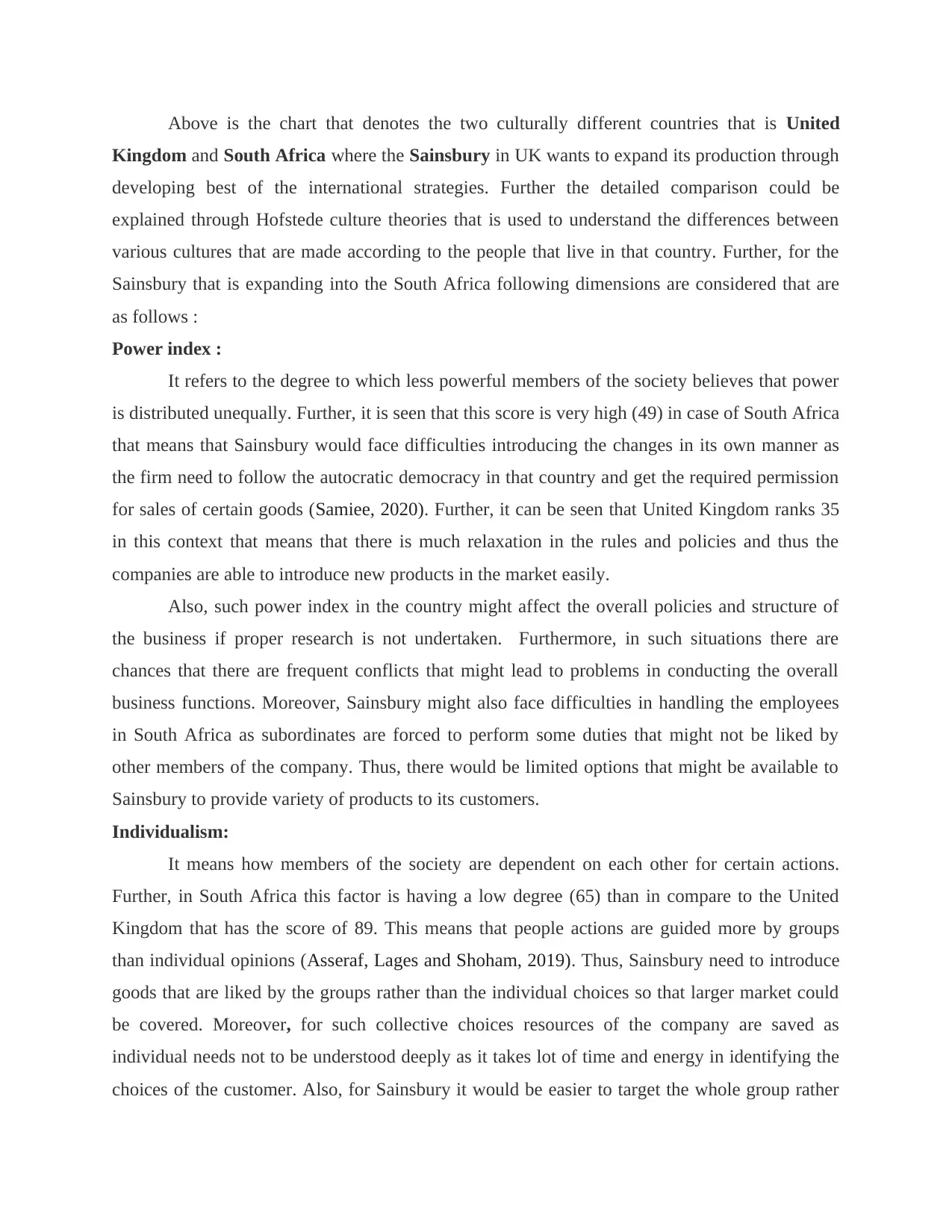
Above is the chart that denotes the two culturally different countries that is United
Kingdom and South Africa where the Sainsbury in UK wants to expand its production through
developing best of the international strategies. Further the detailed comparison could be
explained through Hofstede culture theories that is used to understand the differences between
various cultures that are made according to the people that live in that country. Further, for the
Sainsbury that is expanding into the South Africa following dimensions are considered that are
as follows :
Power index :
It refers to the degree to which less powerful members of the society believes that power
is distributed unequally. Further, it is seen that this score is very high (49) in case of South Africa
that means that Sainsbury would face difficulties introducing the changes in its own manner as
the firm need to follow the autocratic democracy in that country and get the required permission
for sales of certain goods (Samiee, 2020). Further, it can be seen that United Kingdom ranks 35
in this context that means that there is much relaxation in the rules and policies and thus the
companies are able to introduce new products in the market easily.
Also, such power index in the country might affect the overall policies and structure of
the business if proper research is not undertaken. Furthermore, in such situations there are
chances that there are frequent conflicts that might lead to problems in conducting the overall
business functions. Moreover, Sainsbury might also face difficulties in handling the employees
in South Africa as subordinates are forced to perform some duties that might not be liked by
other members of the company. Thus, there would be limited options that might be available to
Sainsbury to provide variety of products to its customers.
Individualism:
It means how members of the society are dependent on each other for certain actions.
Further, in South Africa this factor is having a low degree (65) than in compare to the United
Kingdom that has the score of 89. This means that people actions are guided more by groups
than individual opinions (Asseraf, Lages and Shoham, 2019). Thus, Sainsbury need to introduce
goods that are liked by the groups rather than the individual choices so that larger market could
be covered. Moreover, for such collective choices resources of the company are saved as
individual needs not to be understood deeply as it takes lot of time and energy in identifying the
choices of the customer. Also, for Sainsbury it would be easier to target the whole group rather
Kingdom and South Africa where the Sainsbury in UK wants to expand its production through
developing best of the international strategies. Further the detailed comparison could be
explained through Hofstede culture theories that is used to understand the differences between
various cultures that are made according to the people that live in that country. Further, for the
Sainsbury that is expanding into the South Africa following dimensions are considered that are
as follows :
Power index :
It refers to the degree to which less powerful members of the society believes that power
is distributed unequally. Further, it is seen that this score is very high (49) in case of South Africa
that means that Sainsbury would face difficulties introducing the changes in its own manner as
the firm need to follow the autocratic democracy in that country and get the required permission
for sales of certain goods (Samiee, 2020). Further, it can be seen that United Kingdom ranks 35
in this context that means that there is much relaxation in the rules and policies and thus the
companies are able to introduce new products in the market easily.
Also, such power index in the country might affect the overall policies and structure of
the business if proper research is not undertaken. Furthermore, in such situations there are
chances that there are frequent conflicts that might lead to problems in conducting the overall
business functions. Moreover, Sainsbury might also face difficulties in handling the employees
in South Africa as subordinates are forced to perform some duties that might not be liked by
other members of the company. Thus, there would be limited options that might be available to
Sainsbury to provide variety of products to its customers.
Individualism:
It means how members of the society are dependent on each other for certain actions.
Further, in South Africa this factor is having a low degree (65) than in compare to the United
Kingdom that has the score of 89. This means that people actions are guided more by groups
than individual opinions (Asseraf, Lages and Shoham, 2019). Thus, Sainsbury need to introduce
goods that are liked by the groups rather than the individual choices so that larger market could
be covered. Moreover, for such collective choices resources of the company are saved as
individual needs not to be understood deeply as it takes lot of time and energy in identifying the
choices of the customer. Also, for Sainsbury it would be easier to target the whole group rather
Paraphrase This Document
Need a fresh take? Get an instant paraphrase of this document with our AI Paraphraser
than individual need as goods can be manufactured in bulk. Further, in collective needs products
having fewer attributes could also be sold quickly as it is consumed by large masses. However, if
Sainsbury is unable to identify the proper needs of these groups than there might be cases of
losses and fewer revenues would be gathered.
Masculinity:
This dimension in the Hofstede theory identifies the amount of competition, success and
achievement factor that is prevailing in any country. Further, it can be clearly seen in from the
above chart that South Africa degree is 63 that is almost same as in case of United states. Thus,
there are dominant values that are present in the society and for Sainsbury to be success special
techniques need to be developed so that competitive edge could be gained for the quoted firm.
Masculinity comes with the following features which includes gender roles, assertive and wealth
building whereas the feminist have the following features which are fluid gender roles, modest,
nurturing and concerned with quality of life (Huang and Crotts, 2019). A high score (Masculine)
indicates that the society will have impact on the factors like competition, achievements ans
success. A low score feminine indicates the dominant values in the society are caring for others.
The issue in this dimension is that which thing motivates the people in order to be the best in the
masculinity and liking what you do in the feminist.
At 66 Britain is the Masculine society that is highly based on the success. In comparison
to the feminist culture such as Scandinavian countries, people in the United Kingdom work and
live there and they have the clear performance ambition. If the country is having more
masculinity and company is working effectively on the feminist that will not be effective so the
cited company must focus on this dimension.
Uncertainty Avoidance:
This dimension of the Hofstede culture deals that the society has not known about the
happening in the future. It covers the extent to which uncertainty and confusion is tolerated
(Bissessar, 2018). This dimension considers that how the unknown situations and unexpected
events are dealt with. The high uncertainty index shows the low tolerance for uncertainty,
confusion and risk-taking. The unknown situations can be solved through strict rules and
regulations. The low uncertainty avoidance index shows the high tolerance for confusion,
uncertainty and risk-taking (Gallego-Álvarez and Pucheta-Martínez, 2021). It can also be refers
to the extent to which the members of the different culture feel threatened by confusing and
having fewer attributes could also be sold quickly as it is consumed by large masses. However, if
Sainsbury is unable to identify the proper needs of these groups than there might be cases of
losses and fewer revenues would be gathered.
Masculinity:
This dimension in the Hofstede theory identifies the amount of competition, success and
achievement factor that is prevailing in any country. Further, it can be clearly seen in from the
above chart that South Africa degree is 63 that is almost same as in case of United states. Thus,
there are dominant values that are present in the society and for Sainsbury to be success special
techniques need to be developed so that competitive edge could be gained for the quoted firm.
Masculinity comes with the following features which includes gender roles, assertive and wealth
building whereas the feminist have the following features which are fluid gender roles, modest,
nurturing and concerned with quality of life (Huang and Crotts, 2019). A high score (Masculine)
indicates that the society will have impact on the factors like competition, achievements ans
success. A low score feminine indicates the dominant values in the society are caring for others.
The issue in this dimension is that which thing motivates the people in order to be the best in the
masculinity and liking what you do in the feminist.
At 66 Britain is the Masculine society that is highly based on the success. In comparison
to the feminist culture such as Scandinavian countries, people in the United Kingdom work and
live there and they have the clear performance ambition. If the country is having more
masculinity and company is working effectively on the feminist that will not be effective so the
cited company must focus on this dimension.
Uncertainty Avoidance:
This dimension of the Hofstede culture deals that the society has not known about the
happening in the future. It covers the extent to which uncertainty and confusion is tolerated
(Bissessar, 2018). This dimension considers that how the unknown situations and unexpected
events are dealt with. The high uncertainty index shows the low tolerance for uncertainty,
confusion and risk-taking. The unknown situations can be solved through strict rules and
regulations. The low uncertainty avoidance index shows the high tolerance for confusion,
uncertainty and risk-taking (Gallego-Álvarez and Pucheta-Martínez, 2021). It can also be refers
to the extent to which the members of the different culture feel threatened by confusing and
unknown situations and to overcome this they have created some beliefs in order to avoid these
situations.
South Africa score the 49 on this above stated dimension and thus it has the low
preference for avoiding the uncertainty and risk-taking. The low uncertainty avoidance index
used to maintain the good and relaxed attitude in the society. The societies showing the low
uncertainty avoidance index believes that there will be fewer rules and regulations and if they are
so confusing or does not work they should be changed. Schedules must be flexible and the
person must do hard work whenever necessary .
At 35 the United Kingdom has the low score on the Uncertainty Avoidance index which
means the country is happy for not knowing what the new day brings and do work along with the
day. The low UAI country are comfortable in the confusing situations . There are not more rules
and regulations in the British society this makes to have the less avoidance and ambiguity in the
country. So, the company must focus on this dimension in order to trade their business in the
international market.
Long term orientation:
The long term vs short term orientation shows and considers that up to which the society
views its time horizon. Long-term orientation focuses on the future in order to achieve the long-
term success (Pelau and Pop, 2018). It basically focuses on the persistence, perseverance and
long-term growth. This dimension shows that how the country has to maintain its links with the
past in order to deal with the present and future challenges. The short-term orientation shows the
near future and helps to achieve the short-term success on emphasizing on the present situations
(Vollero and et.al., 2020). This orientation focuses on getting the quick results and respect for
tradition. With the score of 51 in this dimension, a dominant preference in the British culture
cannot be determined.
Indulgence:
The indulgence vs. restraint dimension of the culture model considers the tendency for
the society to fulfil its needs and desires. This dimension revolves around that how the societies
can control their desires (Hofstede’s Cultural Dimensions Theory, 2021). Indulgence shows that the
society allows the free gratification in order to enjoy life and have fun. Restraint shows that
society does not allow the free gratification in order to enjoy the life and have fun.
situations.
South Africa score the 49 on this above stated dimension and thus it has the low
preference for avoiding the uncertainty and risk-taking. The low uncertainty avoidance index
used to maintain the good and relaxed attitude in the society. The societies showing the low
uncertainty avoidance index believes that there will be fewer rules and regulations and if they are
so confusing or does not work they should be changed. Schedules must be flexible and the
person must do hard work whenever necessary .
At 35 the United Kingdom has the low score on the Uncertainty Avoidance index which
means the country is happy for not knowing what the new day brings and do work along with the
day. The low UAI country are comfortable in the confusing situations . There are not more rules
and regulations in the British society this makes to have the less avoidance and ambiguity in the
country. So, the company must focus on this dimension in order to trade their business in the
international market.
Long term orientation:
The long term vs short term orientation shows and considers that up to which the society
views its time horizon. Long-term orientation focuses on the future in order to achieve the long-
term success (Pelau and Pop, 2018). It basically focuses on the persistence, perseverance and
long-term growth. This dimension shows that how the country has to maintain its links with the
past in order to deal with the present and future challenges. The short-term orientation shows the
near future and helps to achieve the short-term success on emphasizing on the present situations
(Vollero and et.al., 2020). This orientation focuses on getting the quick results and respect for
tradition. With the score of 51 in this dimension, a dominant preference in the British culture
cannot be determined.
Indulgence:
The indulgence vs. restraint dimension of the culture model considers the tendency for
the society to fulfil its needs and desires. This dimension revolves around that how the societies
can control their desires (Hofstede’s Cultural Dimensions Theory, 2021). Indulgence shows that the
society allows the free gratification in order to enjoy life and have fun. Restraint shows that
society does not allow the free gratification in order to enjoy the life and have fun.
⊘ This is a preview!⊘
Do you want full access?
Subscribe today to unlock all pages.
Trusted by 1+ million students worldwide
Having the high score of 63 it is so clear that South Africa has a culture indulgence.
People in the societies are having high culture indulgence which shows that they are happy and
enjoying their life and having fun. This shows the positive attitude have the tendency regarding
the optimism. This shows that it has a higher degree of importance on the leisure time, which
means they can spend money as they wish.
A high score of 69 shows that the culture of the British is that which can be classified as
indulgence. The people in the society are classified by having the high score in this dimension
which shows the willingness to realize the desires and needs of the person in order to enjoy life
and have fun. This basically shows the positive attitude and have the tendency regarding the
optimism. This also shows that it has a higher degree of importance on the leisure time and act as
that they can spend the money as they wish.
CONCLUSION
From the above study it is summarized the importance of sub culture that determines the
market for the company that wishes to conduct operations globally. Moreover, the importance of
such international marketing through analysing various factors of subculture using the Hofstede
dimension theory is also described in this report. This theory has the certain dimension that are
helpful for any firm to ensure successful operations in the long run which are described in the
report. At last, this report evaluates, comparison of two different countries that is United
Kingdom and South Africa that will also be done through Hofstede theory which includes the
various dimension such as power index, Individualism, Masculinity, long-term orientation,
uncertainty avoidance index and indulgence.
People in the societies are having high culture indulgence which shows that they are happy and
enjoying their life and having fun. This shows the positive attitude have the tendency regarding
the optimism. This shows that it has a higher degree of importance on the leisure time, which
means they can spend money as they wish.
A high score of 69 shows that the culture of the British is that which can be classified as
indulgence. The people in the society are classified by having the high score in this dimension
which shows the willingness to realize the desires and needs of the person in order to enjoy life
and have fun. This basically shows the positive attitude and have the tendency regarding the
optimism. This also shows that it has a higher degree of importance on the leisure time and act as
that they can spend the money as they wish.
CONCLUSION
From the above study it is summarized the importance of sub culture that determines the
market for the company that wishes to conduct operations globally. Moreover, the importance of
such international marketing through analysing various factors of subculture using the Hofstede
dimension theory is also described in this report. This theory has the certain dimension that are
helpful for any firm to ensure successful operations in the long run which are described in the
report. At last, this report evaluates, comparison of two different countries that is United
Kingdom and South Africa that will also be done through Hofstede theory which includes the
various dimension such as power index, Individualism, Masculinity, long-term orientation,
uncertainty avoidance index and indulgence.
Paraphrase This Document
Need a fresh take? Get an instant paraphrase of this document with our AI Paraphraser
REFERENCES
Books and journals
Amankwah-Amoah, J., Boso, N. and Debrah, Y. A., 2018. Africa rising in an emerging world:
an international marketing perspective. International Marketing Review.
Asseraf, Y., Lages, L. F. and Shoham, A., 2019. Assessing the drivers and impact of
international marketing agility. International Marketing Review.
Baack, D. W., Czarnecka, B. and Baack, D., 2018. International marketing. Sage.
Bissessar, C., 2018. An application of Hofstede’s cultural dimension among female educational
leaders. Education sciences. 8(2). p.77.
Gallego-Álvarez, I. and Pucheta-Martínez, M. C., 2021. Hofstede’s cultural dimensions and
R&D intensity as an innovation strategy: a view from different institutional
contexts. Eurasian Business Review. 11(2). pp.191-220.
Gomes, E., Sousa, C. and Vendrell-Herrero, F., 2019. International marketing agility. Emerald
Publishing Limited.
Huang, S. S. and Crotts, J., 2019. Relationships between Hofstede's cultural dimensions and
tourist satisfaction: A cross-country cross-sample examination. Tourism management.
72. pp.232-241.
Leonidou, L. C. and et.al., 2018. International marketing research: A state-of-the-art review and
the way forward. Advances in global marketing. pp.3-33.
Lu, V. N., Scholz, B. and Nguyen, L. T., 2018. Work integrated learning in international
marketing: Student insights. Australasian Marketing Journal (AMJ). 26(2). pp.132-139.
Pelau, C. and Pop, N. A., 2018. Implications for the energy policy derived from the relation
between the cultural dimensions of Hofstede's model and the consumption of renewable
energies. Energy Policy. 118. pp.160-168.
Poulis, K., 2020. Punctuated epistemology in international marketing strategy: A Whiteheadian
remedy. Marketing Theory. 20(3). pp.363-384.
Samiee, S., 2020. International marketing and the internet: a research overview and the path
forward. International Marketing Review.
Solberg, C. A., 2017. International Marketing: Strategy development and implementation.
Routledge.
Vollero, A. and et.al., 2020. Hoftsede's cultural dimensions and corporate social responsibility in
online communication: Are they independent constructs?. Corporate Social
Responsibility and Environmental Management. 27(1). pp.53-64.
Zeneli, V., Czinkota, M. R. and Knight, G., 2018. Terrorism, competitiveness, and international
marketing: an empirical investigation. International Journal of Emerging Markets.
Online.
Hofstede insights. 2021. [Online]. Available
through:<https://www.hofstede-insights.com/country-comparison/south-africa,the-uk/>.
Hofstede’s Cultural Dimensions Theory. 2021. [Online]. Available through:
<https://corporatefinanceinstitute.com/resources/knowledge/other/hofstedes-cultural-dimensions-
theory/>
Books and journals
Amankwah-Amoah, J., Boso, N. and Debrah, Y. A., 2018. Africa rising in an emerging world:
an international marketing perspective. International Marketing Review.
Asseraf, Y., Lages, L. F. and Shoham, A., 2019. Assessing the drivers and impact of
international marketing agility. International Marketing Review.
Baack, D. W., Czarnecka, B. and Baack, D., 2018. International marketing. Sage.
Bissessar, C., 2018. An application of Hofstede’s cultural dimension among female educational
leaders. Education sciences. 8(2). p.77.
Gallego-Álvarez, I. and Pucheta-Martínez, M. C., 2021. Hofstede’s cultural dimensions and
R&D intensity as an innovation strategy: a view from different institutional
contexts. Eurasian Business Review. 11(2). pp.191-220.
Gomes, E., Sousa, C. and Vendrell-Herrero, F., 2019. International marketing agility. Emerald
Publishing Limited.
Huang, S. S. and Crotts, J., 2019. Relationships between Hofstede's cultural dimensions and
tourist satisfaction: A cross-country cross-sample examination. Tourism management.
72. pp.232-241.
Leonidou, L. C. and et.al., 2018. International marketing research: A state-of-the-art review and
the way forward. Advances in global marketing. pp.3-33.
Lu, V. N., Scholz, B. and Nguyen, L. T., 2018. Work integrated learning in international
marketing: Student insights. Australasian Marketing Journal (AMJ). 26(2). pp.132-139.
Pelau, C. and Pop, N. A., 2018. Implications for the energy policy derived from the relation
between the cultural dimensions of Hofstede's model and the consumption of renewable
energies. Energy Policy. 118. pp.160-168.
Poulis, K., 2020. Punctuated epistemology in international marketing strategy: A Whiteheadian
remedy. Marketing Theory. 20(3). pp.363-384.
Samiee, S., 2020. International marketing and the internet: a research overview and the path
forward. International Marketing Review.
Solberg, C. A., 2017. International Marketing: Strategy development and implementation.
Routledge.
Vollero, A. and et.al., 2020. Hoftsede's cultural dimensions and corporate social responsibility in
online communication: Are they independent constructs?. Corporate Social
Responsibility and Environmental Management. 27(1). pp.53-64.
Zeneli, V., Czinkota, M. R. and Knight, G., 2018. Terrorism, competitiveness, and international
marketing: an empirical investigation. International Journal of Emerging Markets.
Online.
Hofstede insights. 2021. [Online]. Available
through:<https://www.hofstede-insights.com/country-comparison/south-africa,the-uk/>.
Hofstede’s Cultural Dimensions Theory. 2021. [Online]. Available through:
<https://corporatefinanceinstitute.com/resources/knowledge/other/hofstedes-cultural-dimensions-
theory/>

1 out of 11


Related Documents


Your All-in-One AI-Powered Toolkit for Academic Success.
+13062052269
info@desklib.com
Available 24*7 on WhatsApp / Email
![[object Object]](/_next/static/media/star-bottom.7253800d.svg)
Unlock your academic potential
Copyright © 2020–2026 A2Z Services. All Rights Reserved. Developed and managed by ZUCOL.