Traffic Intersection Control System using State Machine Design

Verified

Added on  2023/03/29

|4
|717
|136
Project
AI Summary
This project solution outlines the design and implementation of a traffic intersection control system using a state machine. The project considers an intersection of two roads with pedestrian crossings, managed by traffic lights. The system incorporates four states: cars on the East-West (EW) road, cars on the North-South (NS) road, pedestrians crossing EW, and pedestrians crossing NS. The traffic lights are controlled using binary encoding for RED, AMBER, GREEN, and WALK signals. Input is received from car and pedestrian call buttons. The solution details the hardware connections, including I/O pin assignments for lights and buttons, and uses timers to manage the duration of each state. The project aims to optimize traffic flow and safety by effectively controlling vehicle and pedestrian movement at the intersection, referencing existing research on traffic management and software modeling.
Document Page
Subject name & Number:
Project title: Traffic Intersection
Lab supervisor’s name:
Lab session time:
Group Member names:
Date of submission:
tabler-icon-diamond-filled.svg

Paraphrase This Document

Need a fresh take? Get an instant paraphrase of this document with our AI Paraphraser
Document Page
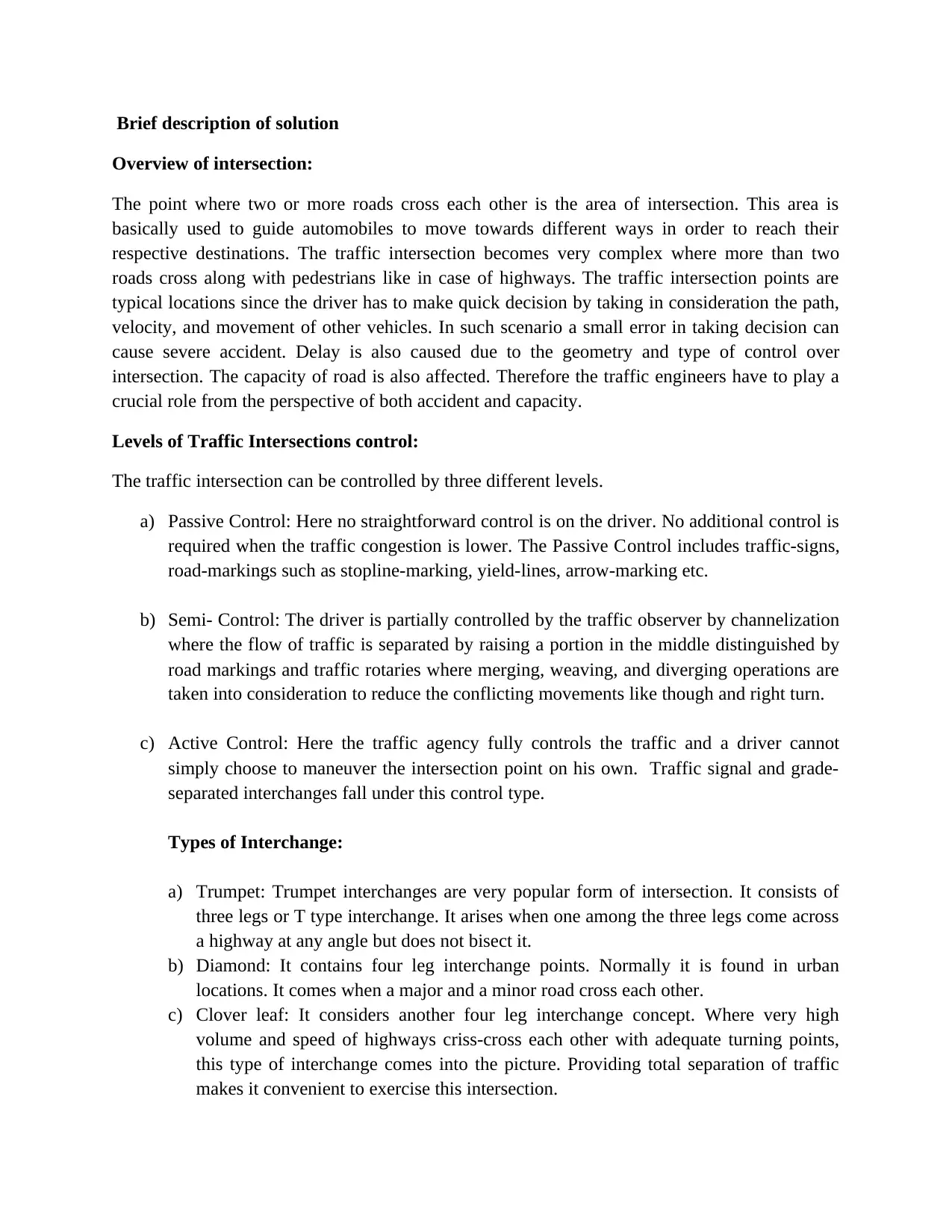
Brief description of solution
Overview of intersection:
The point where two or more roads cross each other is the area of intersection. This area is
basically used to guide automobiles to move towards different ways in order to reach their
respective destinations. The traffic intersection becomes very complex where more than two
roads cross along with pedestrians like in case of highways. The traffic intersection points are
typical locations since the driver has to make quick decision by taking in consideration the path,
velocity, and movement of other vehicles. In such scenario a small error in taking decision can
cause severe accident. Delay is also caused due to the geometry and type of control over
intersection. The capacity of road is also affected. Therefore the traffic engineers have to play a
crucial role from the perspective of both accident and capacity.
Levels of Traffic Intersections control:
The traffic intersection can be controlled by three different levels.
a) Passive Control: Here no straightforward control is on the driver. No additional control is
required when the traffic congestion is lower. The Passive Control includes traffic-signs,
road-markings such as stopline-marking, yield-lines, arrow-marking etc.
b) Semi- Control: The driver is partially controlled by the traffic observer by channelization
where the flow of traffic is separated by raising a portion in the middle distinguished by
road markings and traffic rotaries where merging, weaving, and diverging operations are
taken into consideration to reduce the conflicting movements like though and right turn.
c) Active Control: Here the traffic agency fully controls the traffic and a driver cannot
simply choose to maneuver the intersection point on his own. Traffic signal and grade-
separated interchanges fall under this control type.
Types of Interchange:
a) Trumpet: Trumpet interchanges are very popular form of intersection. It consists of
three legs or T type interchange. It arises when one among the three legs come across
a highway at any angle but does not bisect it.
b) Diamond: It contains four leg interchange points. Normally it is found in urban
locations. It comes when a major and a minor road cross each other.
c) Clover leaf: It considers another four leg interchange concept. Where very high
volume and speed of highways criss-cross each other with adequate turning points,
this type of interchange comes into the picture. Providing total separation of traffic
makes it convenient to exercise this intersection.
Document Page
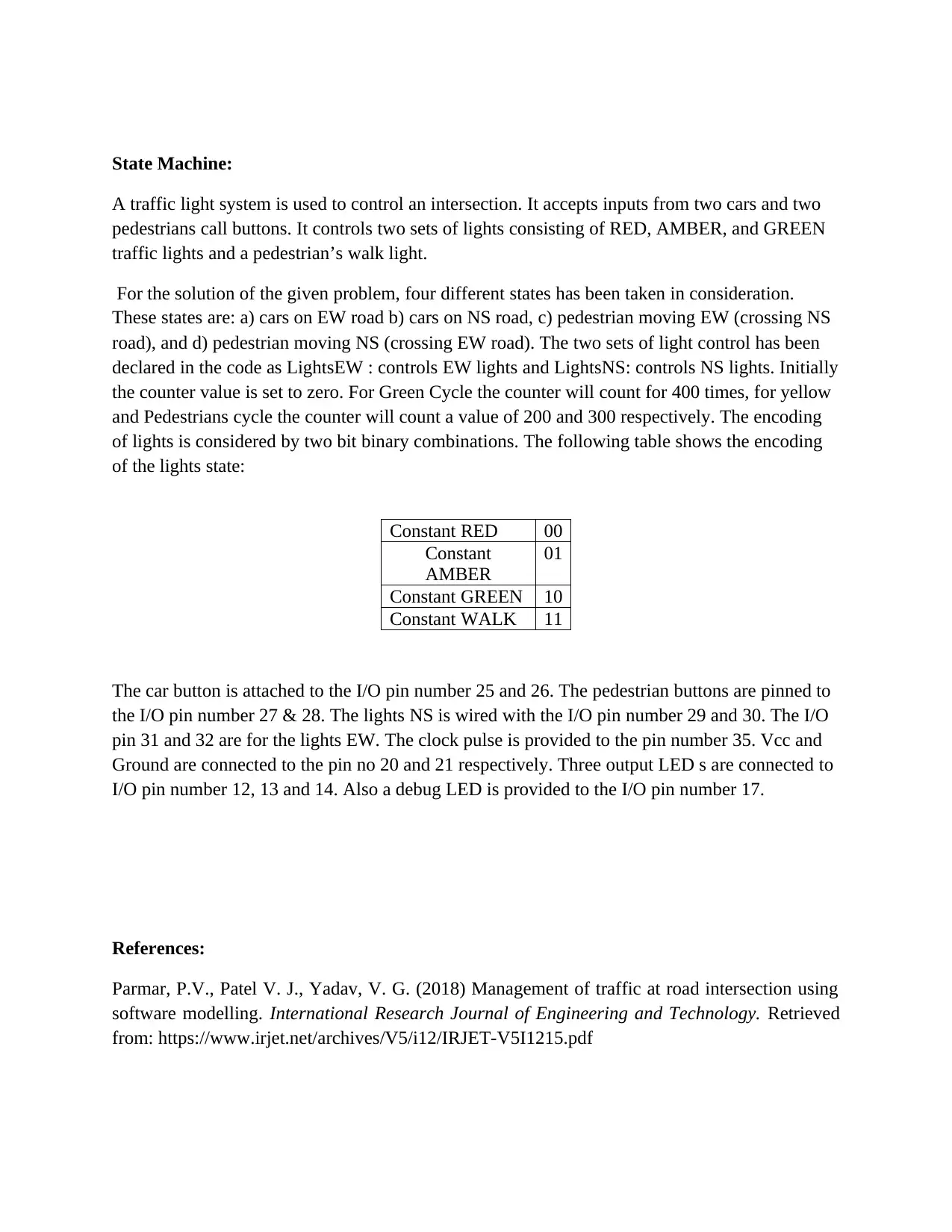
State Machine:
A traffic light system is used to control an intersection. It accepts inputs from two cars and two
pedestrians call buttons. It controls two sets of lights consisting of RED, AMBER, and GREEN
traffic lights and a pedestrian’s walk light.
For the solution of the given problem, four different states has been taken in consideration.
These states are: a) cars on EW road b) cars on NS road, c) pedestrian moving EW (crossing NS
road), and d) pedestrian moving NS (crossing EW road). The two sets of light control has been
declared in the code as LightsEW : controls EW lights and LightsNS: controls NS lights. Initially
the counter value is set to zero. For Green Cycle the counter will count for 400 times, for yellow
and Pedestrians cycle the counter will count a value of 200 and 300 respectively. The encoding
of lights is considered by two bit binary combinations. The following table shows the encoding
of the lights state:
The car button is attached to the I/O pin number 25 and 26. The pedestrian buttons are pinned to
the I/O pin number 27 & 28. The lights NS is wired with the I/O pin number 29 and 30. The I/O
pin 31 and 32 are for the lights EW. The clock pulse is provided to the pin number 35. Vcc and
Ground are connected to the pin no 20 and 21 respectively. Three output LED s are connected to
I/O pin number 12, 13 and 14. Also a debug LED is provided to the I/O pin number 17.
References:
Parmar, P.V., Patel V. J., Yadav, V. G. (2018) Management of traffic at road intersection using
software modelling. International Research Journal of Engineering and Technology. Retrieved
from: https://www.irjet.net/archives/V5/i12/IRJET-V5I1215.pdf
Constant RED 00
Constant
AMBER
01
Constant GREEN 10
Constant WALK 11
Document Page
chevron_up_icon
1 out of 4
circle_padding
hide_on_mobile
zoom_out_icon
[object Object]