Effective Communication & Sustainability: Managerial Priorities at ABC
VerifiedAdded on 2023/06/12
|11
|2776
|265
Essay
AI Summary
This essay explores the critical role of effective communication for managers in achieving organizational sustainability, focusing on the case study of ABC Company. It highlights the aspects of communication related to sustainability, including the communication of corporate social responsibility (CSR) activities and the sustainability of an organization's communication efforts. The essay further discusses the negative consequences of communication gaps, such as coordination barriers, reduced morale, decreased productivity, and hidden innovation. It recommends defining CSR goals, conducting research, setting key metrics, engaging employees, tracking expenses, and building relationships with other companies involved in CSR. The conclusion emphasizes the importance of managers in promoting employee engagement, facilitating training and development programs, and communicating with stakeholders to enhance CSR activities and foster a learning environment.
Running head: SUSTAINABLE COMMUNICATION
“Why Managers should make Effective Communication a Priority”?
[Sustainable Communication]
Name of the student:
Name of the university:
Author note:
“Why Managers should make Effective Communication a Priority”?
[Sustainable Communication]
Name of the student:
Name of the university:
Author note:

Paraphrase This Document
Need a fresh take? Get an instant paraphrase of this document with our AI Paraphraser
1SUSTAINABLE COMMUNICATION
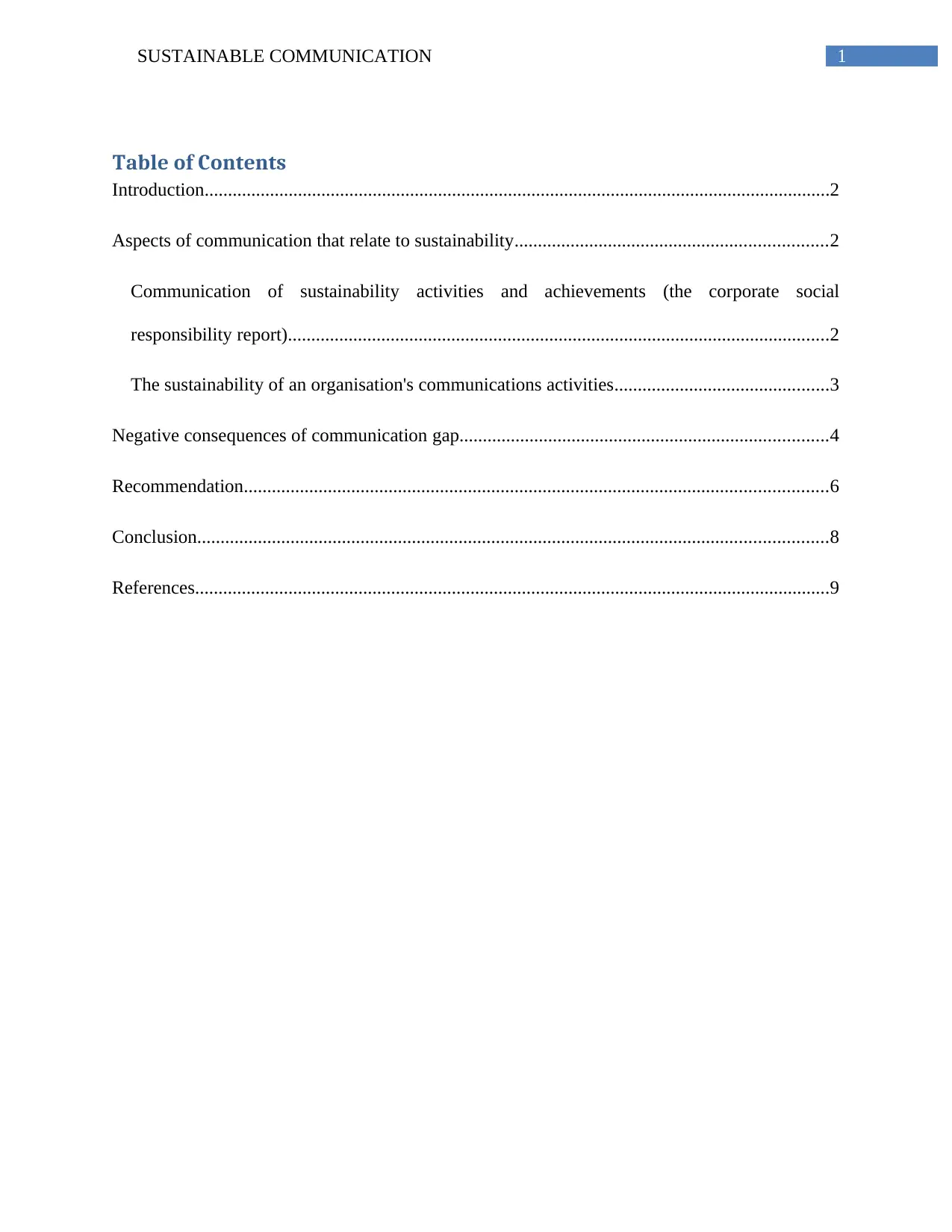
Table of Contents
Introduction......................................................................................................................................2
Aspects of communication that relate to sustainability...................................................................2
Communication of sustainability activities and achievements (the corporate social
responsibility report)....................................................................................................................2
The sustainability of an organisation's communications activities..............................................3
Negative consequences of communication gap...............................................................................4
Recommendation.............................................................................................................................6
Conclusion.......................................................................................................................................8
References........................................................................................................................................9
Table of Contents
Introduction......................................................................................................................................2
Aspects of communication that relate to sustainability...................................................................2
Communication of sustainability activities and achievements (the corporate social
responsibility report)....................................................................................................................2
The sustainability of an organisation's communications activities..............................................3
Negative consequences of communication gap...............................................................................4
Recommendation.............................................................................................................................6
Conclusion.......................................................................................................................................8
References........................................................................................................................................9
2SUSTAINABLE COMMUNICATION
Introduction
Communication is a requirement at the organisational level between the officials,
employees and employees & managers. Maintenance of employee alienation with the
organisational goals and objectives is difficult without an effective facilitation of communication
at the organisational level. Managers can play a very critical role in this regards by effectively
maintaining the timely strategies to make the difference and also attempting to remove the
barriers to the feasible extent (Kim 2014). However, this becomes difficult for a fact that
managers are needed to take care of varieties of employees in regards to their cultural and work
related behaviour. This study aims to address the same issue in context to the case study
organisation ABC Company.
Aspects of communication that relate to sustainability
Communication of sustainability activities and achievements (the corporate social
responsibility report)
Consumers are becoming increasingly aware of environmental factors like the factors
which are good or bad for the environment. Media has played an important role in making
people aware of it. People nowadays spend their much of time on the internet which is another
source of knowing the environmental facts. Due to such awareness, the customer perspective of a
good brand has now changed. Now, a good brand is the one which is highly engaged and
involved in social acts. Social acts are more specifically known as customer social responsibility
(Chaudhri 2016). Company with higher scores in corporate social responsibility have more
values to people.
Introduction
Communication is a requirement at the organisational level between the officials,
employees and employees & managers. Maintenance of employee alienation with the
organisational goals and objectives is difficult without an effective facilitation of communication
at the organisational level. Managers can play a very critical role in this regards by effectively
maintaining the timely strategies to make the difference and also attempting to remove the
barriers to the feasible extent (Kim 2014). However, this becomes difficult for a fact that
managers are needed to take care of varieties of employees in regards to their cultural and work
related behaviour. This study aims to address the same issue in context to the case study
organisation ABC Company.
Aspects of communication that relate to sustainability
Communication of sustainability activities and achievements (the corporate social
responsibility report)
Consumers are becoming increasingly aware of environmental factors like the factors
which are good or bad for the environment. Media has played an important role in making
people aware of it. People nowadays spend their much of time on the internet which is another
source of knowing the environmental facts. Due to such awareness, the customer perspective of a
good brand has now changed. Now, a good brand is the one which is highly engaged and
involved in social acts. Social acts are more specifically known as customer social responsibility
(Chaudhri 2016). Company with higher scores in corporate social responsibility have more
values to people.
⊘ This is a preview!⊘
Do you want full access?
Subscribe today to unlock all pages.

Trusted by 1+ million students worldwide
3SUSTAINABLE COMMUNICATION
Theoretical perspective: There is a theory known as the triple bottom line approach
which governs the importance to fulfil the three Ps of people, profit and planet. People are the
employees and the other stakeholders (Slack, Corlett and Morris 2015). An organisation with
better employee engagement program and customer service standard are regarded with high
values. Profit in this regards is the financial aspect which is important from the organisational
perspective. A check on financial performance in every quarter of a fiscal year is a look out of
firms. Firms with profitable venture are more valuable from the perspective of shareholders. The
planet is the last element of the theory which demands a careful approach from firms towards the
environmental betterment. Common people are specifically concerned with the environmental
aspects. It means that firms are now held responsible for the environmental disruption. This is
why firms are now becoming increasingly aggressive for CSR works.
The sustainability of an organisation's communications activities
The case study organisation is ABC Company which has shown its keen interest in
finding solutions for why managers need to give priorities to effective communication. The
sustainability of an organisation like the case study organisation is attainable through its effective
participation in social causes. The list of such activities is very long; however, a few of such are
charitable works, helping a community, giving donations and reducing its carbon footprint
contribution (Campopiano and De Massis 2015). Carbon footprint is a big concern for public,
government and the company. It is very difficult indeed to reduce the carbon footprint as it
requires a thorough analysis of the system, effective measures of the condition and a significant
counter with suitable strategies. The organisational sustainability report can be shared from CSR
report of the company and the written communication. The CSR report gives a detail of the
company’s performance in regards to social and environmental responsibilities. On the other
Theoretical perspective: There is a theory known as the triple bottom line approach
which governs the importance to fulfil the three Ps of people, profit and planet. People are the
employees and the other stakeholders (Slack, Corlett and Morris 2015). An organisation with
better employee engagement program and customer service standard are regarded with high
values. Profit in this regards is the financial aspect which is important from the organisational
perspective. A check on financial performance in every quarter of a fiscal year is a look out of
firms. Firms with profitable venture are more valuable from the perspective of shareholders. The
planet is the last element of the theory which demands a careful approach from firms towards the
environmental betterment. Common people are specifically concerned with the environmental
aspects. It means that firms are now held responsible for the environmental disruption. This is
why firms are now becoming increasingly aggressive for CSR works.
The sustainability of an organisation's communications activities
The case study organisation is ABC Company which has shown its keen interest in
finding solutions for why managers need to give priorities to effective communication. The
sustainability of an organisation like the case study organisation is attainable through its effective
participation in social causes. The list of such activities is very long; however, a few of such are
charitable works, helping a community, giving donations and reducing its carbon footprint
contribution (Campopiano and De Massis 2015). Carbon footprint is a big concern for public,
government and the company. It is very difficult indeed to reduce the carbon footprint as it
requires a thorough analysis of the system, effective measures of the condition and a significant
counter with suitable strategies. The organisational sustainability report can be shared from CSR
report of the company and the written communication. The CSR report gives a detail of the
company’s performance in regards to social and environmental responsibilities. On the other
Paraphrase This Document
Need a fresh take? Get an instant paraphrase of this document with our AI Paraphraser
4SUSTAINABLE COMMUNICATION
hand, a press release is a good way to communicate with the target people in both the negative
and positive aspect of the business. Positive aspects include but are not limited to like company’s
success, a noteworthy social act and a remarkable CSR performance. Negative aspects include
like criticism from public government or employees (Saeidi et al. 2015).
Written communication: A written communication is all such communication that is
evident in papers or mails. Organisations may have certain ways to involve in written
communication. A press release is one of such ways using which organisations can involve in an
indirect conversation with the target audience (Wickert Scherer and Spence 2016).
Negative consequences of communication gap
Communication gap is common at the workplace where managers are not able to promote
and facilitate an effective organisational communication. Communication gap can create a lot of
operation related issues such as delay in project, improper handling of a case, communicating
change and others. Following is the list of negative consequences of communication gap:
Coordination barriers: Communication gap can be an issue while establishing a two-way
communication between employees. This is very common with the company which operates in
more than one branch. In most occasions, the different branches have just one option to facilitate
the communication and that is the organisational based communication. Such communication is
manageable through variety of communication modes such as emailing, calls, Skype calls and
others. These are the basic modes of communication; however, it is the tendency in employees
that most of them are very casual and do not pay attention to their responsibilities. It is the
manager’s responsibilities that CSR related activities are effectively explained to employees.
hand, a press release is a good way to communicate with the target people in both the negative
and positive aspect of the business. Positive aspects include but are not limited to like company’s
success, a noteworthy social act and a remarkable CSR performance. Negative aspects include
like criticism from public government or employees (Saeidi et al. 2015).
Written communication: A written communication is all such communication that is
evident in papers or mails. Organisations may have certain ways to involve in written
communication. A press release is one of such ways using which organisations can involve in an
indirect conversation with the target audience (Wickert Scherer and Spence 2016).
Negative consequences of communication gap
Communication gap is common at the workplace where managers are not able to promote
and facilitate an effective organisational communication. Communication gap can create a lot of
operation related issues such as delay in project, improper handling of a case, communicating
change and others. Following is the list of negative consequences of communication gap:
Coordination barriers: Communication gap can be an issue while establishing a two-way
communication between employees. This is very common with the company which operates in
more than one branch. In most occasions, the different branches have just one option to facilitate
the communication and that is the organisational based communication. Such communication is
manageable through variety of communication modes such as emailing, calls, Skype calls and
others. These are the basic modes of communication; however, it is the tendency in employees
that most of them are very casual and do not pay attention to their responsibilities. It is the
manager’s responsibilities that CSR related activities are effectively explained to employees.
5SUSTAINABLE COMMUNICATION
This is necessary because unless and until employees are not aligned with the operational
objectives, they will not understand the importance of CSR (Jizi et al. 2014).
Reduced morale: Lack of communication can cause a lot of issues. This can even be the
reason for reduced morale in employees in case they need an assistance; however, not able to get
it due to the communication gap. It can also be frustrating to the management as they may be
expecting a call from employees; however, poor response from employees might hinder the
progress. Projects can also be delayed due to the communication gap between employees at the
different branches of the company. In such workplace where things are easily missed and there is
no punctuality of work also, few of employees might not feel like sustaining the job (Lock and
Seele 2016). It is very difficult to teach every single employee on how to work as a unit for CSR.
However, it is very much fairer and easier to teach them the etiquettes of the workplace.
Reduced productivity: A communication gap can also cause a reduction in productivity.
This happens because most of the time is consumed in searching the useful resources, the
important people and much. Employees are given the tools like the portals; however, the
interface is not very user-friendly and consumes a lot of time to respond to the queries which are
entered. Employees must have the technologies which could reduce the time of searching for
resources. If such things are possible then the CSR related activities will be much fairer at the
organisational level.
Hidden innovation: Innovation remains hidden unless and until employees are given the
opportunities and trust to explore their ideas or brainstorm the ideas. If this happens, creativity
will float around the organisational hierarchy and innovation will happen. It is the
responsibilities of managers that they use the suitable strategies to promote an effective
This is necessary because unless and until employees are not aligned with the operational
objectives, they will not understand the importance of CSR (Jizi et al. 2014).
Reduced morale: Lack of communication can cause a lot of issues. This can even be the
reason for reduced morale in employees in case they need an assistance; however, not able to get
it due to the communication gap. It can also be frustrating to the management as they may be
expecting a call from employees; however, poor response from employees might hinder the
progress. Projects can also be delayed due to the communication gap between employees at the
different branches of the company. In such workplace where things are easily missed and there is
no punctuality of work also, few of employees might not feel like sustaining the job (Lock and
Seele 2016). It is very difficult to teach every single employee on how to work as a unit for CSR.
However, it is very much fairer and easier to teach them the etiquettes of the workplace.
Reduced productivity: A communication gap can also cause a reduction in productivity.
This happens because most of the time is consumed in searching the useful resources, the
important people and much. Employees are given the tools like the portals; however, the
interface is not very user-friendly and consumes a lot of time to respond to the queries which are
entered. Employees must have the technologies which could reduce the time of searching for
resources. If such things are possible then the CSR related activities will be much fairer at the
organisational level.
Hidden innovation: Innovation remains hidden unless and until employees are given the
opportunities and trust to explore their ideas or brainstorm the ideas. If this happens, creativity
will float around the organisational hierarchy and innovation will happen. It is the
responsibilities of managers that they use the suitable strategies to promote an effective
⊘ This is a preview!⊘
Do you want full access?
Subscribe today to unlock all pages.
Trusted by 1+ million students worldwide
6SUSTAINABLE COMMUNICATION
communication at the workplace. This is doable with the help of effective tools and techniques.
CSR performance can be reported or made publically available with a PDF document and a press
release (Chomvilailuk and Butcher 2016). However, employee engagement program is utterly
required to raise the awareness for CSR works and to train employees on how to accomplish the
tasks. Some of the CRS works are not just related to community development and the charitable
causes, it is rather related to the more widen aspect of the operation. For example, a car making
company targets the reduction of greenhouse gas emission through bringing the upgraded models
or also introducing the technological innovation such as the use of hybrid cars (Razak et al.
2014). Such innovation is produced when employees are aligned with the organisational goals
and objectives.
Recommendation
In the above section, it was explained that an improper talent management at the
organisational level and an uninvolved management causes a bigger destruction. Hence, to
promote the CSR works at the organisational level, it is important to follow a few of the ways.
First and foremost, it is important to define the corporate social responsibility for the company.
There must be the clear goals and the objectives as well. This is also important because different
industries will have different responsibilities to serve. The next important step will be to conduct
the extensive research works on the concepts around the corporate social responsibility. This will
require a few resources to seek the help from. This can be sorted out by taking the reference from
the World Business Council for Sustainable Development. Another reference site can be the
Global Reporting Initiative. These two resources can be used to be updated with the latest CSR
reports (Aguinis and Glavas 2017).
communication at the workplace. This is doable with the help of effective tools and techniques.
CSR performance can be reported or made publically available with a PDF document and a press
release (Chomvilailuk and Butcher 2016). However, employee engagement program is utterly
required to raise the awareness for CSR works and to train employees on how to accomplish the
tasks. Some of the CRS works are not just related to community development and the charitable
causes, it is rather related to the more widen aspect of the operation. For example, a car making
company targets the reduction of greenhouse gas emission through bringing the upgraded models
or also introducing the technological innovation such as the use of hybrid cars (Razak et al.
2014). Such innovation is produced when employees are aligned with the organisational goals
and objectives.
Recommendation
In the above section, it was explained that an improper talent management at the
organisational level and an uninvolved management causes a bigger destruction. Hence, to
promote the CSR works at the organisational level, it is important to follow a few of the ways.
First and foremost, it is important to define the corporate social responsibility for the company.
There must be the clear goals and the objectives as well. This is also important because different
industries will have different responsibilities to serve. The next important step will be to conduct
the extensive research works on the concepts around the corporate social responsibility. This will
require a few resources to seek the help from. This can be sorted out by taking the reference from
the World Business Council for Sustainable Development. Another reference site can be the
Global Reporting Initiative. These two resources can be used to be updated with the latest CSR
reports (Aguinis and Glavas 2017).
Paraphrase This Document
Need a fresh take? Get an instant paraphrase of this document with our AI Paraphraser
7SUSTAINABLE COMMUNICATION
There is also the need for setting the key metrics for CSR activities. This will help to
measure the success and will also allow monitoring the progress. The key metrics may be but not
limited to such as work hours per month for a particular activity, comparison with other
companies and investments required for the activity. It is also important that employees are
engaged with their work and are also the socially responsible people. Unless and until employees
are not attached to it, the CSR performance can never improve. It is also necessary to keep an
account of the associated expenses, so that, annual reports in the fiscal year is maintained.
Moreover, company is only accountable to its shareholders. Communication is a key in
promoting the culture for CSR. This is required to communicate with employees. This is also
required to communicate with the other stakeholders. Such communication will most importantly
attract many donations, crowdfunding and others. Private firms will also come closer to the
company. This will not just give the publicity but will also provide the required monetary values
for the CSR works (Mason and Simmons 2014).
Establishing a pro-active relationship with companies that are already into accomplishing
the CSR activities will also be the key to the success. This will help to learn the more effective
ways of handling the CSR activities. The ABC Company and the likes will grow in knowledge
management and employees will be in regular touch with the educative contents on CSR
(Boulouta and Pitelis 2014). Finally, training and development are essential to the success. This
will help employees to learn the ways to effectively manage the CSR activities. Training will
keep on educating the modified or added elements of CSR. The development program will
provide the opportunity for employees to learn as they will be professionally groomed with CSR
expertise and will also bring a few modifications to the existing knowledge management.
There is also the need for setting the key metrics for CSR activities. This will help to
measure the success and will also allow monitoring the progress. The key metrics may be but not
limited to such as work hours per month for a particular activity, comparison with other
companies and investments required for the activity. It is also important that employees are
engaged with their work and are also the socially responsible people. Unless and until employees
are not attached to it, the CSR performance can never improve. It is also necessary to keep an
account of the associated expenses, so that, annual reports in the fiscal year is maintained.
Moreover, company is only accountable to its shareholders. Communication is a key in
promoting the culture for CSR. This is required to communicate with employees. This is also
required to communicate with the other stakeholders. Such communication will most importantly
attract many donations, crowdfunding and others. Private firms will also come closer to the
company. This will not just give the publicity but will also provide the required monetary values
for the CSR works (Mason and Simmons 2014).
Establishing a pro-active relationship with companies that are already into accomplishing
the CSR activities will also be the key to the success. This will help to learn the more effective
ways of handling the CSR activities. The ABC Company and the likes will grow in knowledge
management and employees will be in regular touch with the educative contents on CSR
(Boulouta and Pitelis 2014). Finally, training and development are essential to the success. This
will help employees to learn the ways to effectively manage the CSR activities. Training will
keep on educating the modified or added elements of CSR. The development program will
provide the opportunity for employees to learn as they will be professionally groomed with CSR
expertise and will also bring a few modifications to the existing knowledge management.
8SUSTAINABLE COMMUNICATION
Moreover, the learning process will be many smoothers and the knowledge management will be
enhanced (Boulouta and Pitelis 2014).
Conclusion
Therefore, ABC Company needs to work hard in order to prevent the communication
gap. Contribution from managers will be of high importance in regards to employee engagement,
facilitation of training & development program, access to other private firms that already do the
CSR works, communicating to the media & the public and more. Crowdfunding and donations is
a requirement which grows bigger in its significance with the CSR activities move further.
Managers will be responsible for establishing the effective communication with crowdfunding
teams and the donators. Training & development program is recommended as there is a need for
employee engagement program. Training will allow employees to understand the different
updates on CSR. This is required also to maintain the learning environment. Moreover, the
development program is also necessary for grooming the employees and encourages them to be
the skilled professions.
Moreover, the learning process will be many smoothers and the knowledge management will be
enhanced (Boulouta and Pitelis 2014).
Conclusion
Therefore, ABC Company needs to work hard in order to prevent the communication
gap. Contribution from managers will be of high importance in regards to employee engagement,
facilitation of training & development program, access to other private firms that already do the
CSR works, communicating to the media & the public and more. Crowdfunding and donations is
a requirement which grows bigger in its significance with the CSR activities move further.
Managers will be responsible for establishing the effective communication with crowdfunding
teams and the donators. Training & development program is recommended as there is a need for
employee engagement program. Training will allow employees to understand the different
updates on CSR. This is required also to maintain the learning environment. Moreover, the
development program is also necessary for grooming the employees and encourages them to be
the skilled professions.
⊘ This is a preview!⊘
Do you want full access?
Subscribe today to unlock all pages.
Trusted by 1+ million students worldwide
9SUSTAINABLE COMMUNICATION
References
Aguinis, H. and Glavas, A., 2017. On corporate social responsibility, sensemaking, and the
search for meaningfulness through work. Journal of Management, p.0149206317691575.
Boulouta, I. and Pitelis, C.N., 2014. Who needs CSR? The impact of corporate social
responsibility on national competitiveness. Journal of business ethics, 119(3), pp.349-364.
Campopiano, G. and De Massis, A., 2015. Corporate social responsibility reporting: A content
analysis in family and non-family firms. Journal of Business Ethics, 129(3), pp.511-534.
Chaudhri, V., 2016. Corporate social responsibility and the communication imperative:
Perspectives from CSR managers. International Journal of Business Communication, 53(4),
pp.419-442.
Chomvilailuk, R. and Butcher, K., 2016. Evaluating the effect of corporate social responsibility
communication on mobile telephone customers. Journal of Retailing and Consumer Services, 33,
pp.164-170.
Jizi, M.I., Salama, A., Dixon, R. and Stratling, R., 2014. Corporate governance and corporate
social responsibility disclosure: Evidence from the US banking sector. Journal of Business
Ethics, 125(4), pp.601-615.
Kim, Y., 2014. Strategic communication of corporate social responsibility (CSR): Effects of
stated motives and corporate reputation on stakeholder responses. Public Relations
Review, 40(5), pp.838-840.
References
Aguinis, H. and Glavas, A., 2017. On corporate social responsibility, sensemaking, and the
search for meaningfulness through work. Journal of Management, p.0149206317691575.
Boulouta, I. and Pitelis, C.N., 2014. Who needs CSR? The impact of corporate social
responsibility on national competitiveness. Journal of business ethics, 119(3), pp.349-364.
Campopiano, G. and De Massis, A., 2015. Corporate social responsibility reporting: A content
analysis in family and non-family firms. Journal of Business Ethics, 129(3), pp.511-534.
Chaudhri, V., 2016. Corporate social responsibility and the communication imperative:
Perspectives from CSR managers. International Journal of Business Communication, 53(4),
pp.419-442.
Chomvilailuk, R. and Butcher, K., 2016. Evaluating the effect of corporate social responsibility
communication on mobile telephone customers. Journal of Retailing and Consumer Services, 33,
pp.164-170.
Jizi, M.I., Salama, A., Dixon, R. and Stratling, R., 2014. Corporate governance and corporate
social responsibility disclosure: Evidence from the US banking sector. Journal of Business
Ethics, 125(4), pp.601-615.
Kim, Y., 2014. Strategic communication of corporate social responsibility (CSR): Effects of
stated motives and corporate reputation on stakeholder responses. Public Relations
Review, 40(5), pp.838-840.
Paraphrase This Document
Need a fresh take? Get an instant paraphrase of this document with our AI Paraphraser
10SUSTAINABLE COMMUNICATION
Lock, I. and Seele, P., 2016. The credibility of CSR (corporate social responsibility) reports in
Europe. Evidence from a quantitative content analysis in 11 countries. Journal of Cleaner
Production, 122, pp.186-200.
Mason, C. and Simmons, J., 2014. Embedding corporate social responsibility in corporate
governance: A stakeholder systems approach. Journal of Business Ethics, 119(1), pp.77-86.
Razak, M.I., Yusof, A.M., Mashahadi, F., Alias, Z. and Othman, M.Z., 2014. Intention To
Purchase Hybrid Cars in Malaysia An Overview. International Journal of Economics,
Commerce and Management, 2(10), pp.1-13.
Saeidi, S.P., Sofian, S., Saeidi, P., Saeidi, S.P. and Saaeidi, S.A., 2015. How does corporate
social responsibility contribute to firm financial performance? The mediating role of competitive
advantage, reputation, and customer satisfaction. Journal of Business Research, 68(2), pp.341-
350.
Slack, R.E., Corlett, S. and Morris, R., 2015. Exploring employee engagement with (corporate)
social responsibility: A social exchange perspective on organisational participation. Journal of
Business Ethics, 127(3), pp.537-548.
Wickert, C., Scherer, A.G. and Spence, L.J., 2016. Walking and talking corporate social
responsibility: Implications of firm size and organizational cost. Journal of Management
Studies, 53(7), pp.1169-1196.
Lock, I. and Seele, P., 2016. The credibility of CSR (corporate social responsibility) reports in
Europe. Evidence from a quantitative content analysis in 11 countries. Journal of Cleaner
Production, 122, pp.186-200.
Mason, C. and Simmons, J., 2014. Embedding corporate social responsibility in corporate
governance: A stakeholder systems approach. Journal of Business Ethics, 119(1), pp.77-86.
Razak, M.I., Yusof, A.M., Mashahadi, F., Alias, Z. and Othman, M.Z., 2014. Intention To
Purchase Hybrid Cars in Malaysia An Overview. International Journal of Economics,
Commerce and Management, 2(10), pp.1-13.
Saeidi, S.P., Sofian, S., Saeidi, P., Saeidi, S.P. and Saaeidi, S.A., 2015. How does corporate
social responsibility contribute to firm financial performance? The mediating role of competitive
advantage, reputation, and customer satisfaction. Journal of Business Research, 68(2), pp.341-
350.
Slack, R.E., Corlett, S. and Morris, R., 2015. Exploring employee engagement with (corporate)
social responsibility: A social exchange perspective on organisational participation. Journal of
Business Ethics, 127(3), pp.537-548.
Wickert, C., Scherer, A.G. and Spence, L.J., 2016. Walking and talking corporate social
responsibility: Implications of firm size and organizational cost. Journal of Management
Studies, 53(7), pp.1169-1196.

1 out of 11


Related Documents


Your All-in-One AI-Powered Toolkit for Academic Success.
+13062052269
info@desklib.com
Available 24*7 on WhatsApp / Email
![[object Object]](/_next/static/media/star-bottom.7253800d.svg)
Unlock your academic potential
Copyright © 2020–2026 A2Z Services. All Rights Reserved. Developed and managed by ZUCOL.