Sustainable Tourism Development Report: Qatar Analysis
VerifiedAdded on 2020/10/05
|13
|3597
|320
Report
AI Summary
This report provides a comprehensive analysis of sustainable tourism development in Qatar, addressing various aspects such as stakeholder roles, planning processes, and methods for measuring tourist impact. The report examines the essential elements of a sustainable tourism plan, benefits for stakeholders, advantages and disadvantages of public-private partnerships, and characteristics of tourism development planning at different levels. It further explores the significance of interactive planning systems in tourism development, different methods for measuring tourist impact, and issues in sustainability. Conflicts within the tourism sector and strategies for their resolution, including interpersonal relations and host-guest relationships, are also discussed. The report also addresses the balance between demand and supply in the tourism sector and the ethical issues faced by the industry. Finally, the report concludes with future development recommendations for sustainable tourism in Qatar.
Sustainable Tourism
Development
Development

Paraphrase This Document
Need a fresh take? Get an instant paraphrase of this document with our AI Paraphraser
TABLE OF CONTENTS
INTRODUCTION...........................................................................................................................3
LEAFLET....................................................................................................................................3
P 1.1.............................................................................................................................................4
P 1.2.............................................................................................................................................4
TASK 2............................................................................................................................................5
P 2.1.............................................................................................................................................5
P 2.2 Process and significance of interactive planning system in tourism development process:
.....................................................................................................................................................6
P 2.3 Different methods to measuring tourist impact..................................................................7
TASK 3............................................................................................................................................8
Covered in ppt..............................................................................................................................8
TASK 4............................................................................................................................................8
Covered in Article........................................................................................................................8
TASK 5..........................................................................................................................................10
P 5.1...........................................................................................................................................10
P 5.2...........................................................................................................................................11
CONCLUSION..............................................................................................................................12
REFERENCES..............................................................................................................................14
INTRODUCTION...........................................................................................................................3
LEAFLET....................................................................................................................................3
P 1.1.............................................................................................................................................4
P 1.2.............................................................................................................................................4
TASK 2............................................................................................................................................5
P 2.1.............................................................................................................................................5
P 2.2 Process and significance of interactive planning system in tourism development process:
.....................................................................................................................................................6
P 2.3 Different methods to measuring tourist impact..................................................................7
TASK 3............................................................................................................................................8
Covered in ppt..............................................................................................................................8
TASK 4............................................................................................................................................8
Covered in Article........................................................................................................................8
TASK 5..........................................................................................................................................10
P 5.1...........................................................................................................................................10
P 5.2...........................................................................................................................................11
CONCLUSION..............................................................................................................................12
REFERENCES..............................................................................................................................14
INTRODUCTION
Sustainable tourism helps in establishing a suitable balance between different social,
environments of development in context of tourism. Sustainable tourism is the concept where a
tourist visited a place in order to make an impact on the environment, society, economy .In
context of making a sustainable tourism development plan in QATAR, the main essential
elements which is concerned in this sustainability. The present report will help in understanding
the sustainable tourism plan in Qatar. The present report will help in understanding the benefits
to the shareholders from the tourism development planning. In addition to this, the report will
also demonstrate the advantage and disadvantage of partnership in publos and private sectors.
Further, the report will help in understanding the characteristics of tourism developmemet
planning at different level. The report will than discuss the different process and significance of
interactive planning system in tourism development process. Furthermore, the report will help in
understanding the different methods that are used in measuring the tourist impact There are
different issues and complexities generated in the sustainability of tourism development which is
also described. The report will also discuss different issues between developing companies and
emerging destination in tourism sector. At last, the future development in destination is discussed
with the recommendations.
TASK 1
LEAFLET
Sustainable tourism helps in establishing a suitable balance between different social,
environments of development in context of tourism. Sustainable tourism is the concept where a
tourist visited a place in order to make an impact on the environment, society, economy .In
context of making a sustainable tourism development plan in QATAR, the main essential
elements which is concerned in this sustainability. The present report will help in understanding
the sustainable tourism plan in Qatar. The present report will help in understanding the benefits
to the shareholders from the tourism development planning. In addition to this, the report will
also demonstrate the advantage and disadvantage of partnership in publos and private sectors.
Further, the report will help in understanding the characteristics of tourism developmemet
planning at different level. The report will than discuss the different process and significance of
interactive planning system in tourism development process. Furthermore, the report will help in
understanding the different methods that are used in measuring the tourist impact There are
different issues and complexities generated in the sustainability of tourism development which is
also described. The report will also discuss different issues between developing companies and
emerging destination in tourism sector. At last, the future development in destination is discussed
with the recommendations.
TASK 1
LEAFLET
⊘ This is a preview!⊘
Do you want full access?
Subscribe today to unlock all pages.

Trusted by 1+ million students worldwide
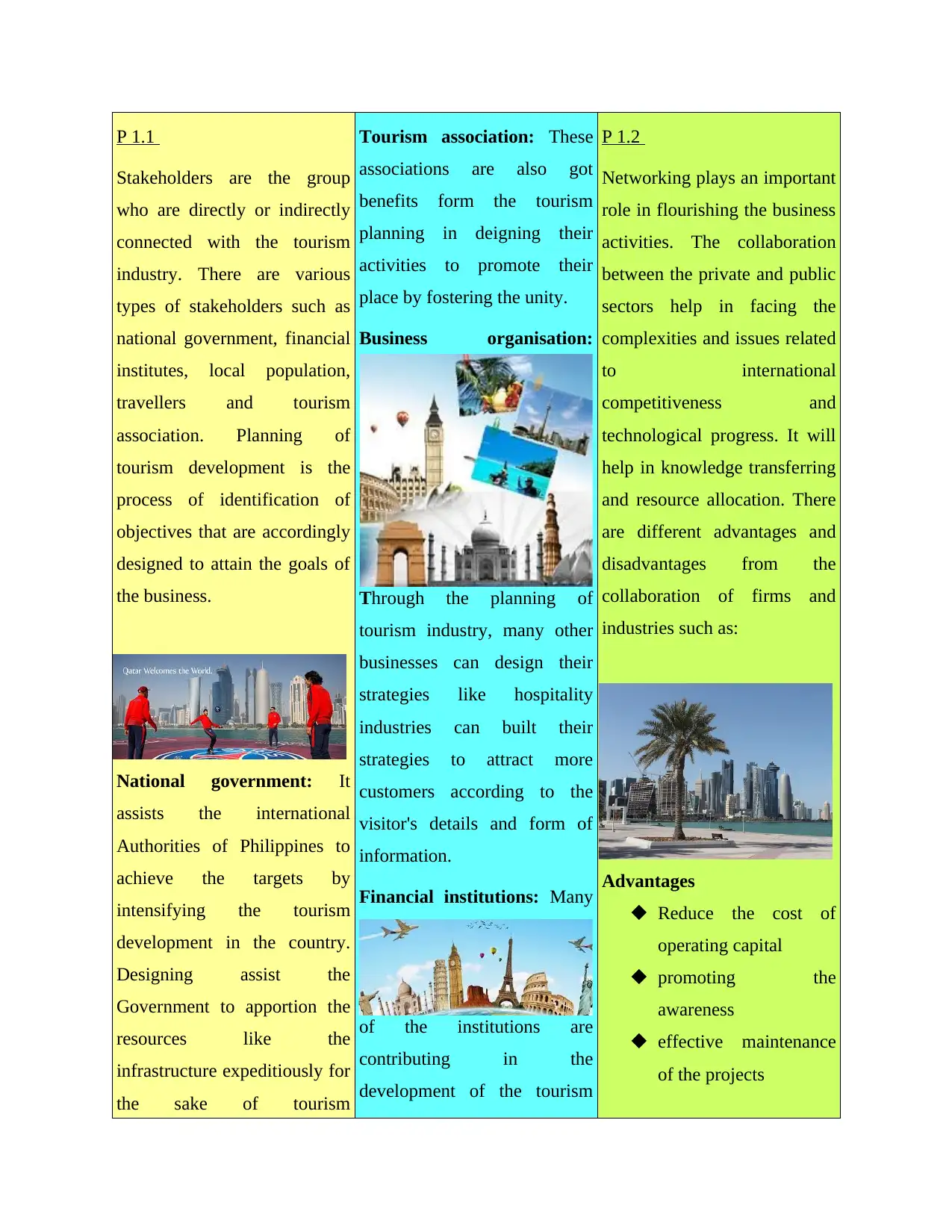
P 1.1
Stakeholders are the group
who are directly or indirectly
connected with the tourism
industry. There are various
types of stakeholders such as
national government, financial
institutes, local population,
travellers and tourism
association. Planning of
tourism development is the
process of identification of
objectives that are accordingly
designed to attain the goals of
the business.
National government: It
assists the international
Authorities of Philippines to
achieve the targets by
intensifying the tourism
development in the country.
Designing assist the
Government to apportion the
resources like the
infrastructure expeditiously for
the sake of tourism
Tourism association: These
associations are also got
benefits form the tourism
planning in deigning their
activities to promote their
place by fostering the unity.
Business organisation:
Through the planning of
tourism industry, many other
businesses can design their
strategies like hospitality
industries can built their
strategies to attract more
customers according to the
visitor's details and form of
information.
Financial institutions: Many
of the institutions are
contributing in the
development of the tourism
P 1.2
Networking plays an important
role in flourishing the business
activities. The collaboration
between the private and public
sectors help in facing the
complexities and issues related
to international
competitiveness and
technological progress. It will
help in knowledge transferring
and resource allocation. There
are different advantages and
disadvantages from the
collaboration of firms and
industries such as:
Advantages
Reduce the cost of
operating capital
promoting the
awareness
effective maintenance
of the projects
Stakeholders are the group
who are directly or indirectly
connected with the tourism
industry. There are various
types of stakeholders such as
national government, financial
institutes, local population,
travellers and tourism
association. Planning of
tourism development is the
process of identification of
objectives that are accordingly
designed to attain the goals of
the business.
National government: It
assists the international
Authorities of Philippines to
achieve the targets by
intensifying the tourism
development in the country.
Designing assist the
Government to apportion the
resources like the
infrastructure expeditiously for
the sake of tourism
Tourism association: These
associations are also got
benefits form the tourism
planning in deigning their
activities to promote their
place by fostering the unity.
Business organisation:
Through the planning of
tourism industry, many other
businesses can design their
strategies like hospitality
industries can built their
strategies to attract more
customers according to the
visitor's details and form of
information.
Financial institutions: Many
of the institutions are
contributing in the
development of the tourism
P 1.2
Networking plays an important
role in flourishing the business
activities. The collaboration
between the private and public
sectors help in facing the
complexities and issues related
to international
competitiveness and
technological progress. It will
help in knowledge transferring
and resource allocation. There
are different advantages and
disadvantages from the
collaboration of firms and
industries such as:
Advantages
Reduce the cost of
operating capital
promoting the
awareness
effective maintenance
of the projects
Paraphrase This Document
Need a fresh take? Get an instant paraphrase of this document with our AI Paraphraser
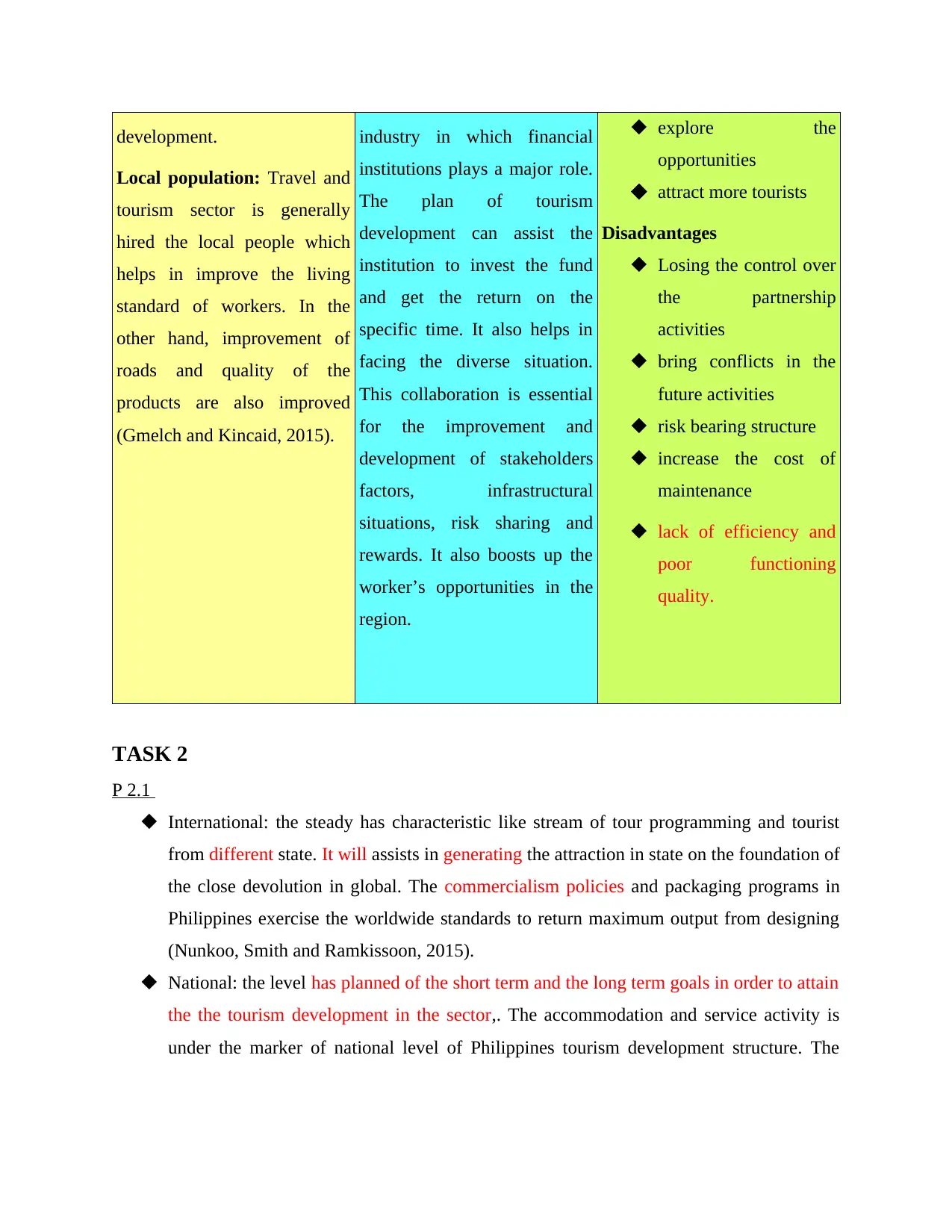
development.
Local population: Travel and
tourism sector is generally
hired the local people which
helps in improve the living
standard of workers. In the
other hand, improvement of
roads and quality of the
products are also improved
(Gmelch and Kincaid, 2015).
industry in which financial
institutions plays a major role.
The plan of tourism
development can assist the
institution to invest the fund
and get the return on the
specific time. It also helps in
facing the diverse situation.
This collaboration is essential
for the improvement and
development of stakeholders
factors, infrastructural
situations, risk sharing and
rewards. It also boosts up the
worker’s opportunities in the
region.
explore the
opportunities
attract more tourists
Disadvantages
Losing the control over
the partnership
activities
bring conflicts in the
future activities
risk bearing structure
increase the cost of
maintenance
lack of efficiency and
poor functioning
quality.
TASK 2
P 2.1
International: the steady has characteristic like stream of tour programming and tourist
from different state. It will assists in generating the attraction in state on the foundation of
the close devolution in global. The commercialism policies and packaging programs in
Philippines exercise the worldwide standards to return maximum output from designing
(Nunkoo, Smith and Ramkissoon, 2015).
National: the level has planned of the short term and the long term goals in order to attain
the the tourism development in the sector,. The accommodation and service activity is
under the marker of national level of Philippines tourism development structure. The
Local population: Travel and
tourism sector is generally
hired the local people which
helps in improve the living
standard of workers. In the
other hand, improvement of
roads and quality of the
products are also improved
(Gmelch and Kincaid, 2015).
industry in which financial
institutions plays a major role.
The plan of tourism
development can assist the
institution to invest the fund
and get the return on the
specific time. It also helps in
facing the diverse situation.
This collaboration is essential
for the improvement and
development of stakeholders
factors, infrastructural
situations, risk sharing and
rewards. It also boosts up the
worker’s opportunities in the
region.
explore the
opportunities
attract more tourists
Disadvantages
Losing the control over
the partnership
activities
bring conflicts in the
future activities
risk bearing structure
increase the cost of
maintenance
lack of efficiency and
poor functioning
quality.
TASK 2
P 2.1
International: the steady has characteristic like stream of tour programming and tourist
from different state. It will assists in generating the attraction in state on the foundation of
the close devolution in global. The commercialism policies and packaging programs in
Philippines exercise the worldwide standards to return maximum output from designing
(Nunkoo, Smith and Ramkissoon, 2015).
National: the level has planned of the short term and the long term goals in order to attain
the the tourism development in the sector,. The accommodation and service activity is
under the marker of national level of Philippines tourism development structure. The
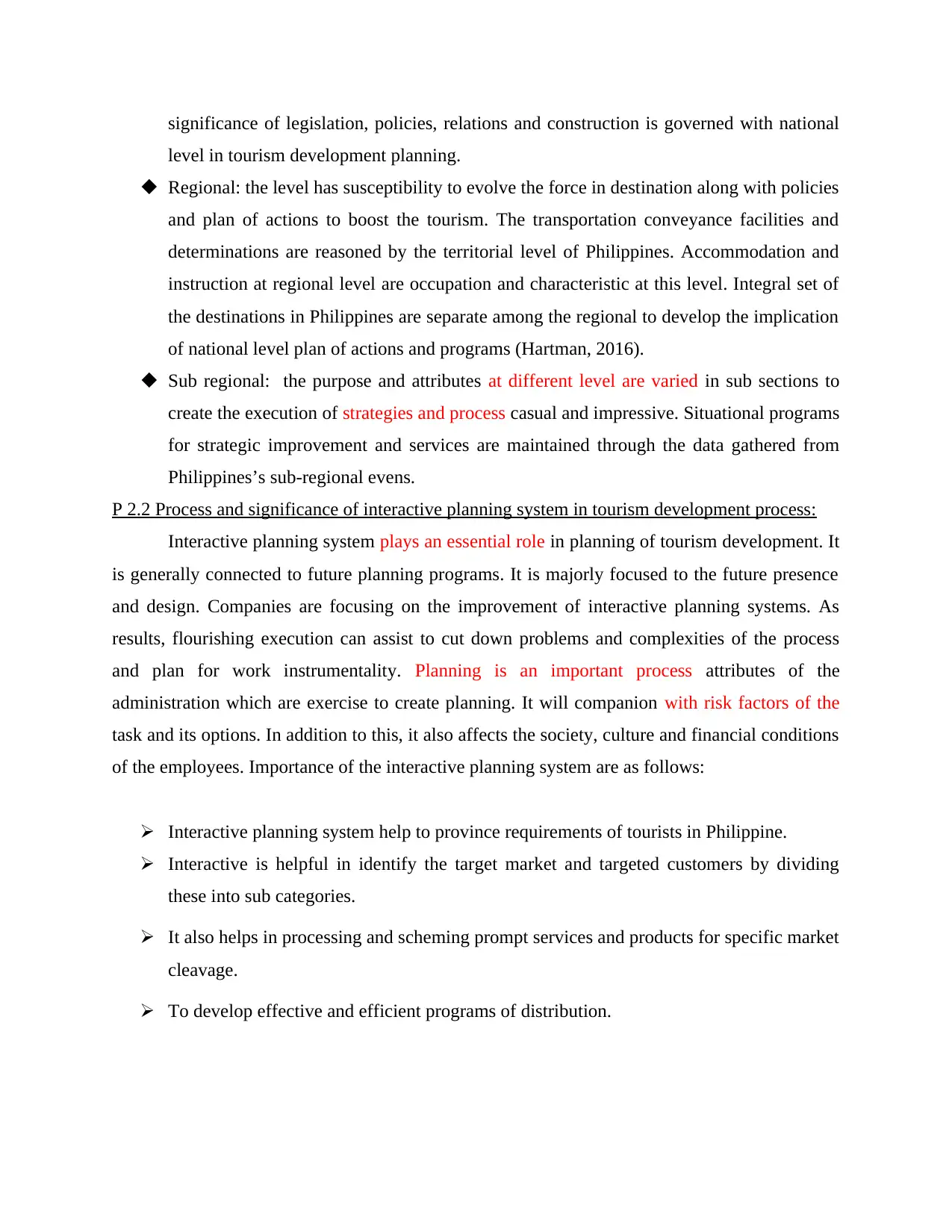
significance of legislation, policies, relations and construction is governed with national
level in tourism development planning.
Regional: the level has susceptibility to evolve the force in destination along with policies
and plan of actions to boost the tourism. The transportation conveyance facilities and
determinations are reasoned by the territorial level of Philippines. Accommodation and
instruction at regional level are occupation and characteristic at this level. Integral set of
the destinations in Philippines are separate among the regional to develop the implication
of national level plan of actions and programs (Hartman, 2016).
Sub regional: the purpose and attributes at different level are varied in sub sections to
create the execution of strategies and process casual and impressive. Situational programs
for strategic improvement and services are maintained through the data gathered from
Philippines’s sub-regional evens.
P 2.2 Process and significance of interactive planning system in tourism development process:
Interactive planning system plays an essential role in planning of tourism development. It
is generally connected to future planning programs. It is majorly focused to the future presence
and design. Companies are focusing on the improvement of interactive planning systems. As
results, flourishing execution can assist to cut down problems and complexities of the process
and plan for work instrumentality. Planning is an important process attributes of the
administration which are exercise to create planning. It will companion with risk factors of the
task and its options. In addition to this, it also affects the society, culture and financial conditions
of the employees. Importance of the interactive planning system are as follows:
Interactive planning system help to province requirements of tourists in Philippine.
Interactive is helpful in identify the target market and targeted customers by dividing
these into sub categories.
It also helps in processing and scheming prompt services and products for specific market
cleavage.
To develop effective and efficient programs of distribution.
level in tourism development planning.
Regional: the level has susceptibility to evolve the force in destination along with policies
and plan of actions to boost the tourism. The transportation conveyance facilities and
determinations are reasoned by the territorial level of Philippines. Accommodation and
instruction at regional level are occupation and characteristic at this level. Integral set of
the destinations in Philippines are separate among the regional to develop the implication
of national level plan of actions and programs (Hartman, 2016).
Sub regional: the purpose and attributes at different level are varied in sub sections to
create the execution of strategies and process casual and impressive. Situational programs
for strategic improvement and services are maintained through the data gathered from
Philippines’s sub-regional evens.
P 2.2 Process and significance of interactive planning system in tourism development process:
Interactive planning system plays an essential role in planning of tourism development. It
is generally connected to future planning programs. It is majorly focused to the future presence
and design. Companies are focusing on the improvement of interactive planning systems. As
results, flourishing execution can assist to cut down problems and complexities of the process
and plan for work instrumentality. Planning is an important process attributes of the
administration which are exercise to create planning. It will companion with risk factors of the
task and its options. In addition to this, it also affects the society, culture and financial conditions
of the employees. Importance of the interactive planning system are as follows:
Interactive planning system help to province requirements of tourists in Philippine.
Interactive is helpful in identify the target market and targeted customers by dividing
these into sub categories.
It also helps in processing and scheming prompt services and products for specific market
cleavage.
To develop effective and efficient programs of distribution.
⊘ This is a preview!⊘
Do you want full access?
Subscribe today to unlock all pages.
Trusted by 1+ million students worldwide
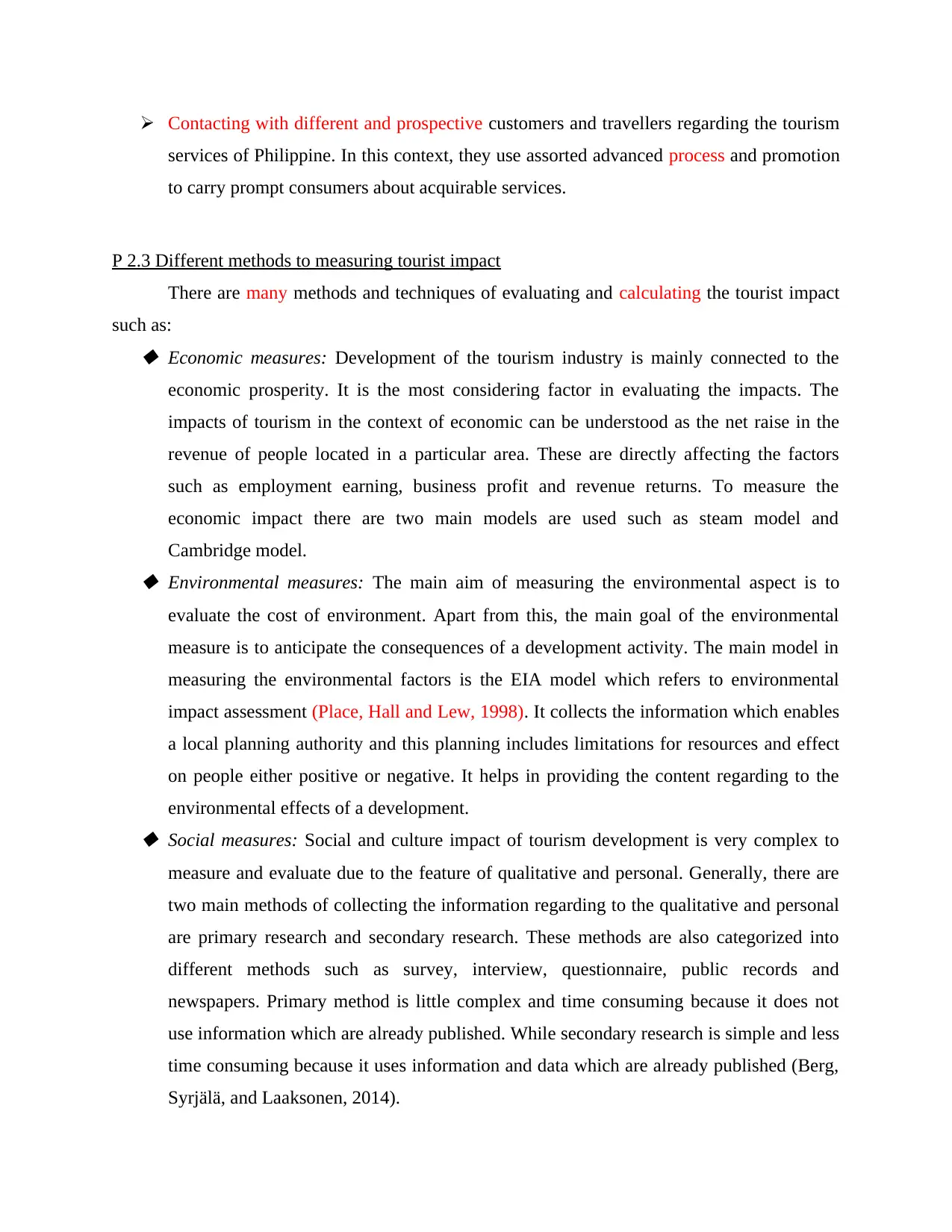
Contacting with different and prospective customers and travellers regarding the tourism
services of Philippine. In this context, they use assorted advanced process and promotion
to carry prompt consumers about acquirable services.
P 2.3 Different methods to measuring tourist impact
There are many methods and techniques of evaluating and calculating the tourist impact
such as: Economic measures: Development of the tourism industry is mainly connected to the
economic prosperity. It is the most considering factor in evaluating the impacts. The
impacts of tourism in the context of economic can be understood as the net raise in the
revenue of people located in a particular area. These are directly affecting the factors
such as employment earning, business profit and revenue returns. To measure the
economic impact there are two main models are used such as steam model and
Cambridge model. Environmental measures: The main aim of measuring the environmental aspect is to
evaluate the cost of environment. Apart from this, the main goal of the environmental
measure is to anticipate the consequences of a development activity. The main model in
measuring the environmental factors is the EIA model which refers to environmental
impact assessment (Place, Hall and Lew, 1998). It collects the information which enables
a local planning authority and this planning includes limitations for resources and effect
on people either positive or negative. It helps in providing the content regarding to the
environmental effects of a development. Social measures: Social and culture impact of tourism development is very complex to
measure and evaluate due to the feature of qualitative and personal. Generally, there are
two main methods of collecting the information regarding to the qualitative and personal
are primary research and secondary research. These methods are also categorized into
different methods such as survey, interview, questionnaire, public records and
newspapers. Primary method is little complex and time consuming because it does not
use information which are already published. While secondary research is simple and less
time consuming because it uses information and data which are already published (Berg,
Syrjälä, and Laaksonen, 2014).
services of Philippine. In this context, they use assorted advanced process and promotion
to carry prompt consumers about acquirable services.
P 2.3 Different methods to measuring tourist impact
There are many methods and techniques of evaluating and calculating the tourist impact
such as: Economic measures: Development of the tourism industry is mainly connected to the
economic prosperity. It is the most considering factor in evaluating the impacts. The
impacts of tourism in the context of economic can be understood as the net raise in the
revenue of people located in a particular area. These are directly affecting the factors
such as employment earning, business profit and revenue returns. To measure the
economic impact there are two main models are used such as steam model and
Cambridge model. Environmental measures: The main aim of measuring the environmental aspect is to
evaluate the cost of environment. Apart from this, the main goal of the environmental
measure is to anticipate the consequences of a development activity. The main model in
measuring the environmental factors is the EIA model which refers to environmental
impact assessment (Place, Hall and Lew, 1998). It collects the information which enables
a local planning authority and this planning includes limitations for resources and effect
on people either positive or negative. It helps in providing the content regarding to the
environmental effects of a development. Social measures: Social and culture impact of tourism development is very complex to
measure and evaluate due to the feature of qualitative and personal. Generally, there are
two main methods of collecting the information regarding to the qualitative and personal
are primary research and secondary research. These methods are also categorized into
different methods such as survey, interview, questionnaire, public records and
newspapers. Primary method is little complex and time consuming because it does not
use information which are already published. While secondary research is simple and less
time consuming because it uses information and data which are already published (Berg,
Syrjälä, and Laaksonen, 2014).
Paraphrase This Document
Need a fresh take? Get an instant paraphrase of this document with our AI Paraphraser
TASK 3
Covered in ppt.
TASK 4
Covered in Article
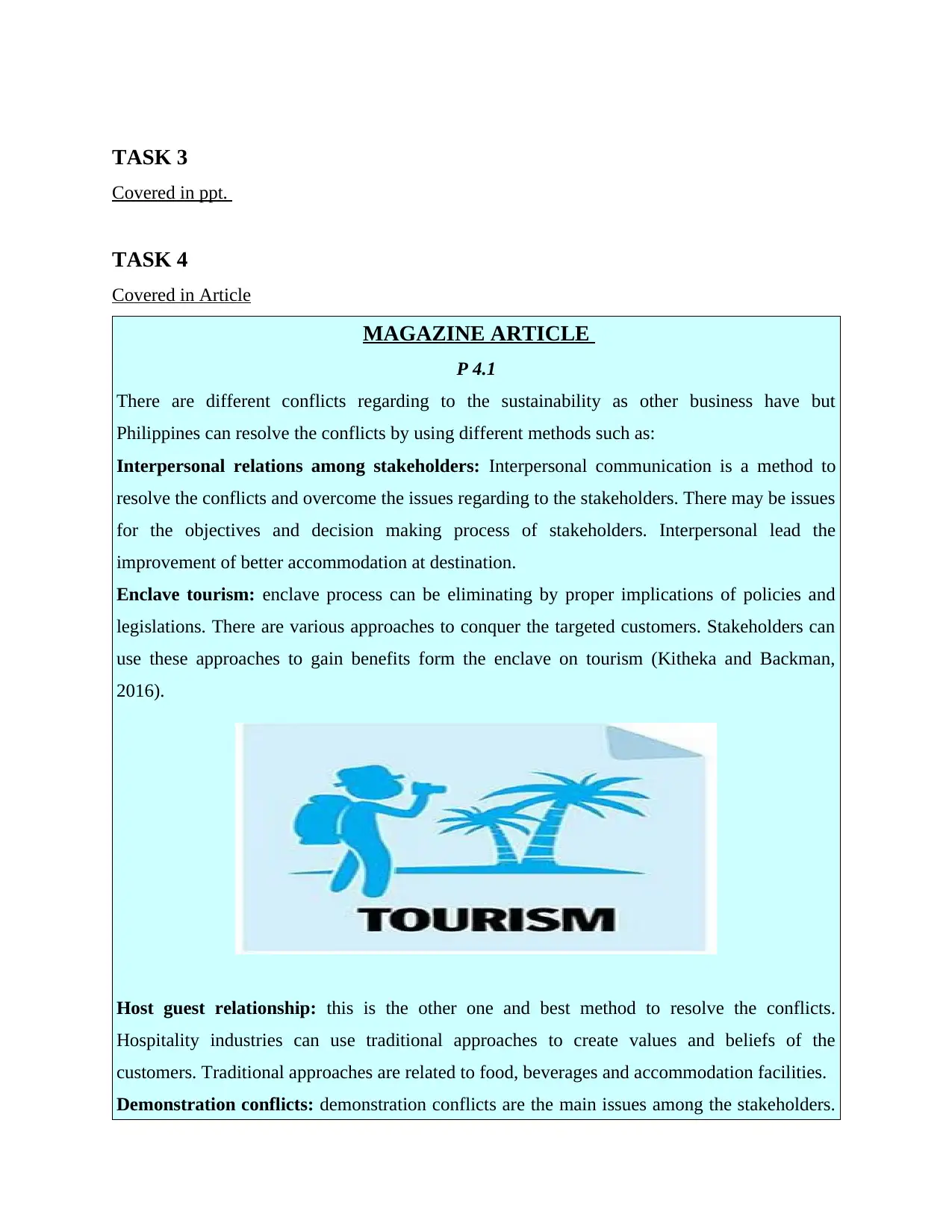
MAGAZINE ARTICLE
P 4.1
There are different conflicts regarding to the sustainability as other business have but
Philippines can resolve the conflicts by using different methods such as:
Interpersonal relations among stakeholders: Interpersonal communication is a method to
resolve the conflicts and overcome the issues regarding to the stakeholders. There may be issues
for the objectives and decision making process of stakeholders. Interpersonal lead the
improvement of better accommodation at destination.
Enclave tourism: enclave process can be eliminating by proper implications of policies and
legislations. There are various approaches to conquer the targeted customers. Stakeholders can
use these approaches to gain benefits form the enclave on tourism (Kitheka and Backman,
2016).
Host guest relationship: this is the other one and best method to resolve the conflicts.
Hospitality industries can use traditional approaches to create values and beliefs of the
customers. Traditional approaches are related to food, beverages and accommodation facilities.
Demonstration conflicts: demonstration conflicts are the main issues among the stakeholders.
Covered in ppt.
TASK 4
Covered in Article
MAGAZINE ARTICLE
P 4.1
There are different conflicts regarding to the sustainability as other business have but
Philippines can resolve the conflicts by using different methods such as:
Interpersonal relations among stakeholders: Interpersonal communication is a method to
resolve the conflicts and overcome the issues regarding to the stakeholders. There may be issues
for the objectives and decision making process of stakeholders. Interpersonal lead the
improvement of better accommodation at destination.
Enclave tourism: enclave process can be eliminating by proper implications of policies and
legislations. There are various approaches to conquer the targeted customers. Stakeholders can
use these approaches to gain benefits form the enclave on tourism (Kitheka and Backman,
2016).
Host guest relationship: this is the other one and best method to resolve the conflicts.
Hospitality industries can use traditional approaches to create values and beliefs of the
customers. Traditional approaches are related to food, beverages and accommodation facilities.
Demonstration conflicts: demonstration conflicts are the main issues among the stakeholders.
The communication and collaboration can overcome the issues and complexities regarding to
the conflicts of interest among stakeholders.
Acculturation: issues may be due to acculturation as well. Variation in cultures and
environment are the main factors in creating issues. Therefore, the procedure of cultural
neutralisation is needed to meet the agonistic benefits and to lead the future well-being
alteration.
P 4.2
The balance between the demand and supply is needed to accomplish the tour operators in the
travel and tourism sector. Supply refers to ambit the clients with coveted goods and service in
specific time. The laws of supply appearance that the growth of prices at destinations and
tourism services also enhancing the ouput of the services from the vendor. In this style, supply
in tourism is outlined as the procedure to market possession, services and goods to be utilize or
acquisition by the travellers and also utilized in travel of the tourists. The supply of the services
and products in tourism of Philippines is settled on the balanced use of supply and demand
laws. Generally, supply involved the service regarding to the structure as transportation,
telecommunication and accommodation.
As the main issues are regarding to the interest level of stakeholders so it is necessary to
maintain the balance between demand and supply. To meet the demand level, supply is required
to be consider to promote the economic development. Furthermore, by maintaining the balance
company can achieve more profitability margin with maintain the position in competitive
market. These both factors are opposite to each other’s. As if demand will increase than supply
of the products and services will also be increased and if supply will increase than it does not
mean that demand will also increase.
the conflicts of interest among stakeholders.
Acculturation: issues may be due to acculturation as well. Variation in cultures and
environment are the main factors in creating issues. Therefore, the procedure of cultural
neutralisation is needed to meet the agonistic benefits and to lead the future well-being
alteration.
P 4.2
The balance between the demand and supply is needed to accomplish the tour operators in the
travel and tourism sector. Supply refers to ambit the clients with coveted goods and service in
specific time. The laws of supply appearance that the growth of prices at destinations and
tourism services also enhancing the ouput of the services from the vendor. In this style, supply
in tourism is outlined as the procedure to market possession, services and goods to be utilize or
acquisition by the travellers and also utilized in travel of the tourists. The supply of the services
and products in tourism of Philippines is settled on the balanced use of supply and demand
laws. Generally, supply involved the service regarding to the structure as transportation,
telecommunication and accommodation.
As the main issues are regarding to the interest level of stakeholders so it is necessary to
maintain the balance between demand and supply. To meet the demand level, supply is required
to be consider to promote the economic development. Furthermore, by maintaining the balance
company can achieve more profitability margin with maintain the position in competitive
market. These both factors are opposite to each other’s. As if demand will increase than supply
of the products and services will also be increased and if supply will increase than it does not
mean that demand will also increase.
⊘ This is a preview!⊘
Do you want full access?
Subscribe today to unlock all pages.
Trusted by 1+ million students worldwide
P 4.3
There are different morale and ethical issues faced by the tourism industry. Different
morals and issues regarding the ethical issues that are enclave the tourism of businesses are as
follows:
Local assemblage has no welfare much from the enclave tourism as they have very
limited approach which controlled whole sphere to the improvement of the tourism.
Other moral and ethical issues is that location of dominance democracy sustain much of
governmental ferment, ferocity and danger of tourist’s declaration.
The local community gets a little benefits from the development of the tourists.
It also includes some other issues such as illegal activities, cultural aspects, restriction in
accessibility and environmental damages (Gmelch and Kincaid, 2015.).
TASK 5
P 5.1
IMPACTS QATAR BHUTAN
Environment As per the current case study
of QATAR there are different
environmental factors which
cause issues in the growth and
expand of the structure it
includes climate, weather,
pollution and climate changes.
Environment factors are the
mostly affected the activities
of the business. Availability of
goods, workplace efficiency
and environmental related laws
are the main factors which
affect the emerging destination
of BHUTAN.
There are different morale and ethical issues faced by the tourism industry. Different
morals and issues regarding the ethical issues that are enclave the tourism of businesses are as
follows:
Local assemblage has no welfare much from the enclave tourism as they have very
limited approach which controlled whole sphere to the improvement of the tourism.
Other moral and ethical issues is that location of dominance democracy sustain much of
governmental ferment, ferocity and danger of tourist’s declaration.
The local community gets a little benefits from the development of the tourists.
It also includes some other issues such as illegal activities, cultural aspects, restriction in
accessibility and environmental damages (Gmelch and Kincaid, 2015.).
TASK 5
P 5.1
IMPACTS QATAR BHUTAN
Environment As per the current case study
of QATAR there are different
environmental factors which
cause issues in the growth and
expand of the structure it
includes climate, weather,
pollution and climate changes.
Environment factors are the
mostly affected the activities
of the business. Availability of
goods, workplace efficiency
and environmental related laws
are the main factors which
affect the emerging destination
of BHUTAN.
Paraphrase This Document
Need a fresh take? Get an instant paraphrase of this document with our AI Paraphraser
Economical After the environmental
factors, economic factors are
secondary mostly affected
factors It includes interest
rates, exchange rates, recession
and inflation rate.
Economic changes affect the
structural activity in positive
and negative manner both. It
considered taxes and demand
or supply changes.
Social There are different social
aspects which create various
issues regarding to the
performance level of a
structure It includes age
distribution, population growth
rate, religious and beliefs.
These factors also affected the
destination of BHUTAN as
well. It considered
employment levels, income
statistics, career trends and
social conventions (Cater,
1993).
Political Political are the factors which
contribute in economic growth
as well as restrict the
operational performance It
includes government stability
and leadership, tax regulations
and corruption levels.
These are also primarily
affected the emerging trends of
destination It considered
stability of neighbours,
employment and operational
laws, trade reforms and
bureaucracy issues.
Legal It considered consumer law,
copyright law, trademark law
and fraud law.
It involves different laws that
are related to health, safety and
import and exports related
laws.
P 5.2
Sustainable development can be said as the plan ehich are in the ways by which a
company can overcome the negative impacts and increase the positive impacts. There are
different factors which affect the business such as economical, technical, legal, political and
environmental. The main cause of negative impact is stakeholders. These are the factors which
mainly affect the business in negative manner. So it is recommended to the business is to involve
factors, economic factors are
secondary mostly affected
factors It includes interest
rates, exchange rates, recession
and inflation rate.
Economic changes affect the
structural activity in positive
and negative manner both. It
considered taxes and demand
or supply changes.
Social There are different social
aspects which create various
issues regarding to the
performance level of a
structure It includes age
distribution, population growth
rate, religious and beliefs.
These factors also affected the
destination of BHUTAN as
well. It considered
employment levels, income
statistics, career trends and
social conventions (Cater,
1993).
Political Political are the factors which
contribute in economic growth
as well as restrict the
operational performance It
includes government stability
and leadership, tax regulations
and corruption levels.
These are also primarily
affected the emerging trends of
destination It considered
stability of neighbours,
employment and operational
laws, trade reforms and
bureaucracy issues.
Legal It considered consumer law,
copyright law, trademark law
and fraud law.
It involves different laws that
are related to health, safety and
import and exports related
laws.
P 5.2
Sustainable development can be said as the plan ehich are in the ways by which a
company can overcome the negative impacts and increase the positive impacts. There are
different factors which affect the business such as economical, technical, legal, political and
environmental. The main cause of negative impact is stakeholders. These are the factors which
mainly affect the business in negative manner. So it is recommended to the business is to involve
all the stakeholders while planning the tourism development. By sustainable usage of limited
resources company can achieve the success and gain profits. The stableness in the financial gain
opportunities and also to assured the surroundings is required to be reasoned in the Sustainable
Development plan (Kaján, 2014). The three leading spheres that are required to be focus are as
follows:
Environmental: If a company focused on the environmental factors like wastage of
water and other resources, it can overcome the negative impacts of these factors.
Sustainable usage of resources will help in environmental growth by the increasing the
awareness.
Social: By involving all workers in the decision making process will help in overcome
the negative impacts of social as well. There are different factors regarding social which
affect the business activities such as Gender equality, proscription of the child labour,
protection to the women are the steps of improving the social impacts.
Economic: The economic condition of the state is attendant with the occupation, ability
improvement and earning capacity. The Authorities need to chalk out a program to use
the abroad acceptance effectively in those states for the improvement of the livelihood
(Berg, Syrjälä and Laaksonen, 2014).
CONCLUSION
By summing up the above report, it can be concluded that there are several factors of
tourism industry which assist to sustainability in the planning process of the tourism. In this
context, tourism improvement designing consist cultural factors in Philippine. The report has
also concluded the advantages from the preparation of interest level of assorted stakeholder
within the enterprise. Moreover, it also considered various techniques and approaches which
assist to standard business of the tourists. the report has concluded, the various impact that are on
the social economic development. Furthermore, the report has also enclosed factors that helped
in stopping to attainment of sustainable improvement. In addition to this, environmental
condition helps in changing and surroundings different forces that are affecting the tourism
business.
In addition to this, the report has included the different methods in resolving the tourism.
The present report has also concluded different processes that every organization can attain
success from assorted activities. In this context, commercial enterprises use determination,
resources company can achieve the success and gain profits. The stableness in the financial gain
opportunities and also to assured the surroundings is required to be reasoned in the Sustainable
Development plan (Kaján, 2014). The three leading spheres that are required to be focus are as
follows:
Environmental: If a company focused on the environmental factors like wastage of
water and other resources, it can overcome the negative impacts of these factors.
Sustainable usage of resources will help in environmental growth by the increasing the
awareness.
Social: By involving all workers in the decision making process will help in overcome
the negative impacts of social as well. There are different factors regarding social which
affect the business activities such as Gender equality, proscription of the child labour,
protection to the women are the steps of improving the social impacts.
Economic: The economic condition of the state is attendant with the occupation, ability
improvement and earning capacity. The Authorities need to chalk out a program to use
the abroad acceptance effectively in those states for the improvement of the livelihood
(Berg, Syrjälä and Laaksonen, 2014).
CONCLUSION
By summing up the above report, it can be concluded that there are several factors of
tourism industry which assist to sustainability in the planning process of the tourism. In this
context, tourism improvement designing consist cultural factors in Philippine. The report has
also concluded the advantages from the preparation of interest level of assorted stakeholder
within the enterprise. Moreover, it also considered various techniques and approaches which
assist to standard business of the tourists. the report has concluded, the various impact that are on
the social economic development. Furthermore, the report has also enclosed factors that helped
in stopping to attainment of sustainable improvement. In addition to this, environmental
condition helps in changing and surroundings different forces that are affecting the tourism
business.
In addition to this, the report has included the different methods in resolving the tourism.
The present report has also concluded different processes that every organization can attain
success from assorted activities. In this context, commercial enterprises use determination,
⊘ This is a preview!⊘
Do you want full access?
Subscribe today to unlock all pages.
Trusted by 1+ million students worldwide

1 out of 13


Related Documents


Your All-in-One AI-Powered Toolkit for Academic Success.
+13062052269
info@desklib.com
Available 24*7 on WhatsApp / Email
![[object Object]](/_next/static/media/star-bottom.7253800d.svg)
Unlock your academic potential
Copyright © 2020–2026 A2Z Services. All Rights Reserved. Developed and managed by ZUCOL.