Sustainable Value Creation: Mutualistic-Local Ownership Report
VerifiedAdded on 2023/06/04
|14
|2664
|187
Report
AI Summary
This report focuses on sustainable value creation, emphasizing its importance for economic and social growth, and environmental benefits. It explores the implementation of sustainable business models across different industries, addressing issues and challenges. The report includes a business sustainability typology to help readers understand the different aspects of sustainable value creation. The research methodology involves both qualitative and quantitative approaches, including interviews and group assignments to gather data. The report also considers ethical aspects and a detailed time horizon for the research phases. The literature review covers various theories and concepts related to sustainable value creation, including the role of stakeholders and the challenges faced by sustainable enterprises. The report highlights the importance of strategic logics, stakeholder value, and risk mitigation strategies. The conclusion summarizes the key findings and implications of the research.
SUSTAINABLE VALUE CREATION
Sustainable Value Creation: A case study approach to mutualistic-local ownership business models
Name of the Student:
Name of the University:
Author Note:
Sustainable Value Creation: A case study approach to mutualistic-local ownership business models
Name of the Student:
Name of the University:
Author Note:

Paraphrase This Document
Need a fresh take? Get an instant paraphrase of this document with our AI Paraphraser
1SUSTAINABLE VALUE CREATION
Executive Summary
The chief objective of the paper is to focus on the sustainability value creation which is very
much important for all the different types of industries as it provides growth both in economic
sector as well as the social sector. The environmental aspects which most of the business
corporations fails to follows can be focused if those corporations successfully implement this
business model in their system. The issues and challenges related to the incorporation of this
business model are described in this paper, along with that this paper also includes a business
sustainability typology which will be very much important for the readers of this document to
understand the different aspects of sustainable value creation.
Strict guidelines will be followed during the primary and the secondary type of data collection.
All the participants will be allowed to express their opinion about this topic without any external
pressure. The time horizon of this research will be helpful in understanding the time taken during
each phase of this research paper.
Executive Summary
The chief objective of the paper is to focus on the sustainability value creation which is very
much important for all the different types of industries as it provides growth both in economic
sector as well as the social sector. The environmental aspects which most of the business
corporations fails to follows can be focused if those corporations successfully implement this
business model in their system. The issues and challenges related to the incorporation of this
business model are described in this paper, along with that this paper also includes a business
sustainability typology which will be very much important for the readers of this document to
understand the different aspects of sustainable value creation.
Strict guidelines will be followed during the primary and the secondary type of data collection.
All the participants will be allowed to express their opinion about this topic without any external
pressure. The time horizon of this research will be helpful in understanding the time taken during
each phase of this research paper.
2SUSTAINABLE VALUE CREATION
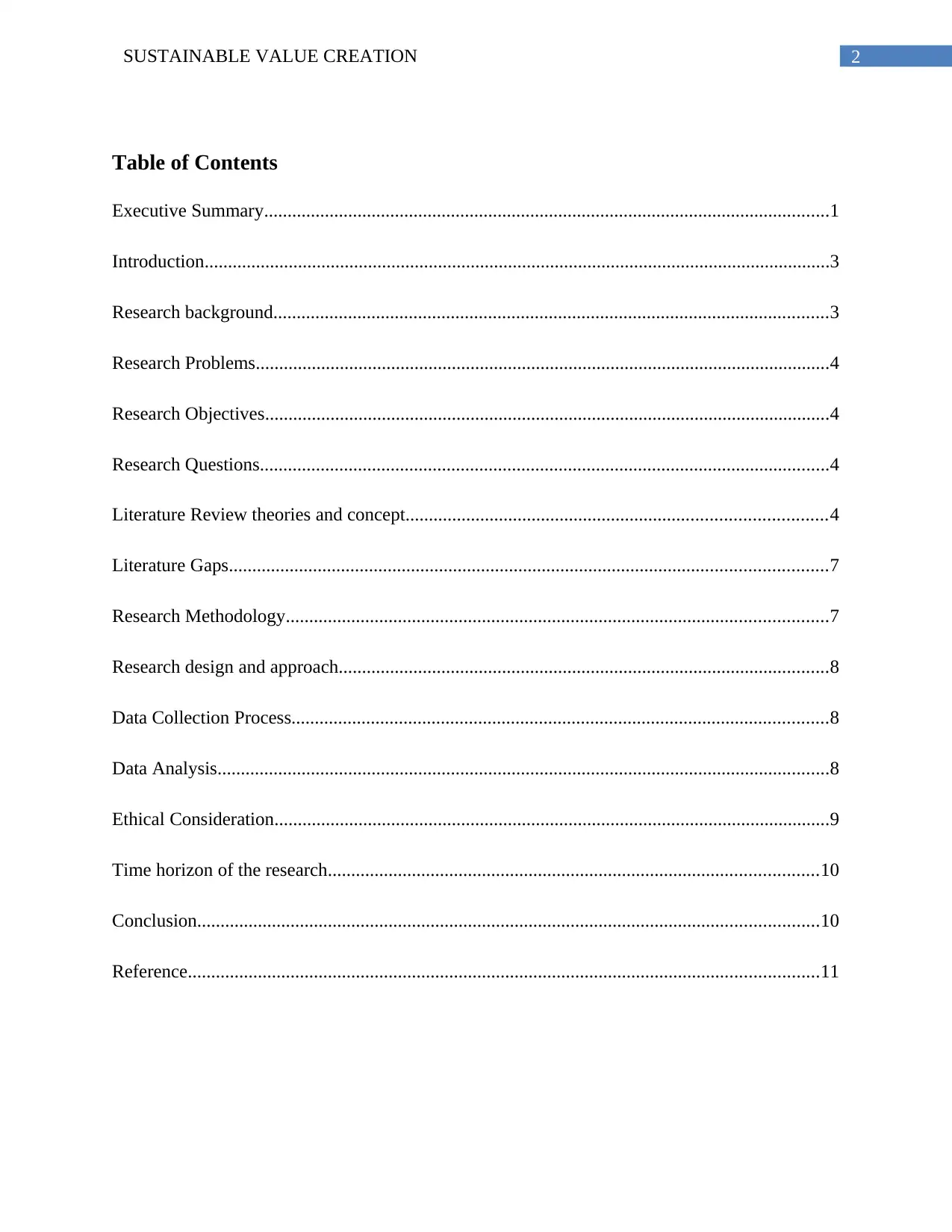
Table of Contents
Executive Summary.........................................................................................................................1
Introduction......................................................................................................................................3
Research background.......................................................................................................................3
Research Problems...........................................................................................................................4
Research Objectives.........................................................................................................................4
Research Questions..........................................................................................................................4
Literature Review theories and concept..........................................................................................4
Literature Gaps................................................................................................................................7
Research Methodology....................................................................................................................7
Research design and approach.........................................................................................................8
Data Collection Process...................................................................................................................8
Data Analysis...................................................................................................................................8
Ethical Consideration.......................................................................................................................9
Time horizon of the research.........................................................................................................10
Conclusion.....................................................................................................................................10
Reference.......................................................................................................................................11
Table of Contents
Executive Summary.........................................................................................................................1
Introduction......................................................................................................................................3
Research background.......................................................................................................................3
Research Problems...........................................................................................................................4
Research Objectives.........................................................................................................................4
Research Questions..........................................................................................................................4
Literature Review theories and concept..........................................................................................4
Literature Gaps................................................................................................................................7
Research Methodology....................................................................................................................7
Research design and approach.........................................................................................................8
Data Collection Process...................................................................................................................8
Data Analysis...................................................................................................................................8
Ethical Consideration.......................................................................................................................9
Time horizon of the research.........................................................................................................10
Conclusion.....................................................................................................................................10
Reference.......................................................................................................................................11
⊘ This is a preview!⊘
Do you want full access?
Subscribe today to unlock all pages.

Trusted by 1+ million students worldwide
3SUSTAINABLE VALUE CREATION
Introduction
The prime determination of this paper will be to focus on sustainable value creation as it
provides economic growth, social growth and also considers the environmental benefits. As the
name suggests the sustainable value creation is defined as the process which is followed by the
industries to maintain an alteration in a stable manner. The investments, manipulation of all the
available resources, technological development are the essential aspects of sustainable value
creation. The needs and the aspirations of the stakeholders associated with the enterprises are
also considered as an important factor in a sustainable enterprise. The ability of the future
generations is not compromised in sustainable enterprises (Upward and Jones 2016). It is a much
secured practice compared to the other business models. However, there are different issues and
complexities associated with the role of the stakeholders in a sustainable environment which is
the main concern of this research paper.
Research background
The growth of the sustainable business model was initiated right after the fall of
communism, the results produced by Capitalism was not entirely positive as there was a huge
difference between the rich and the poor, at the same time the environmental degradation started
rapidly. The imbalance in society and the environmental aspect is the prime reason behind the
rise of global sustainability. The concept of the sustainable enterprise was not clear in its initial
stages among the corporations who have already implemented it (Geissdoerfer et al. 2017).
There will be different complexities associated with the implementation of the sustainable
environment. The values for the shareholders will be increasing every day in the sustainable
Introduction
The prime determination of this paper will be to focus on sustainable value creation as it
provides economic growth, social growth and also considers the environmental benefits. As the
name suggests the sustainable value creation is defined as the process which is followed by the
industries to maintain an alteration in a stable manner. The investments, manipulation of all the
available resources, technological development are the essential aspects of sustainable value
creation. The needs and the aspirations of the stakeholders associated with the enterprises are
also considered as an important factor in a sustainable enterprise. The ability of the future
generations is not compromised in sustainable enterprises (Upward and Jones 2016). It is a much
secured practice compared to the other business models. However, there are different issues and
complexities associated with the role of the stakeholders in a sustainable environment which is
the main concern of this research paper.
Research background
The growth of the sustainable business model was initiated right after the fall of
communism, the results produced by Capitalism was not entirely positive as there was a huge
difference between the rich and the poor, at the same time the environmental degradation started
rapidly. The imbalance in society and the environmental aspect is the prime reason behind the
rise of global sustainability. The concept of the sustainable enterprise was not clear in its initial
stages among the corporations who have already implemented it (Geissdoerfer et al. 2017).
There will be different complexities associated with the implementation of the sustainable
environment. The values for the shareholders will be increasing every day in the sustainable
Paraphrase This Document
Need a fresh take? Get an instant paraphrase of this document with our AI Paraphraser
4SUSTAINABLE VALUE CREATION
world. Strategic logics are needed to be designed and implemented in those business
organizations.
Research Problems
The increasing value of the shareholders of the business organization during the
implementation of the sustainable value such as the skills and capabilities of the employees
working on the business organizations and the floor managers of each department of the business
corporation who works on the growth path and legitimacy of the rules and regulations of the
corporations are the prime source of concern for the sustainable enterprises.
Research Objectives
The chief objective of this research document is to evaluate the effectiveness and
usability of the sustainable value creation business model (Louche and Idowu, 2017). There are
different aspects considering the value of the shareholder in a sustainable business environment
which is proposed in this paper so that the existing challenges related to the application of
sustainable practices can be effectively minimized.
Research Questions
o What are the present and future aspects of sustainable value creation?
o What are the issue and challenges faced by sustainable business organizations?
o Who are the global drivers of sustainability?
Literature Review theories and concept
As discussed by Laszlo and Zhexembayeva (2017), embedded sustainability is a very
important aspect of a sustainable business. The authors of this resource focused on the future of
world. Strategic logics are needed to be designed and implemented in those business
organizations.
Research Problems
The increasing value of the shareholders of the business organization during the
implementation of the sustainable value such as the skills and capabilities of the employees
working on the business organizations and the floor managers of each department of the business
corporation who works on the growth path and legitimacy of the rules and regulations of the
corporations are the prime source of concern for the sustainable enterprises.
Research Objectives
The chief objective of this research document is to evaluate the effectiveness and
usability of the sustainable value creation business model (Louche and Idowu, 2017). There are
different aspects considering the value of the shareholder in a sustainable business environment
which is proposed in this paper so that the existing challenges related to the application of
sustainable practices can be effectively minimized.
Research Questions
o What are the present and future aspects of sustainable value creation?
o What are the issue and challenges faced by sustainable business organizations?
o Who are the global drivers of sustainability?
Literature Review theories and concept
As discussed by Laszlo and Zhexembayeva (2017), embedded sustainability is a very
important aspect of a sustainable business. The authors of this resource focused on the future of
5SUSTAINABLE VALUE CREATION
sustainability and also the value creation. The writers stated about the increasing demand of the
shareholder value in his resource. The resource focused on both stakeholders of the business as
well as the shareholders of the business as they are solely responsible for the growth and
development of the sustainable business environment. The author of this resource also stated
about the complexities associated with the application of sustainable value creation such as the
tradeoffs and the added costs. The authors of this resource also help in understanding the social
and the environmental aspect of the sustainable business and also recommended plans for the
effective utilization of the available resources. The resource helps in understanding the
increasing demand of the shareholders of a sustainable business, the impact of the increasing
value can be realized with the help of this resource. The other complexities associated with a
sustainable business such as the additional costs involved are also stated in this resource
As discussed by Fussler, Cramer and Van der Vegt (2017), there are different
competencies in a sustainable enterprise which are needed to be focused in order to avoid the
business losses and the role of the strategists during the adverse business conditions is also
described in this resource which be helpful to the corporations who are planning to implement
sustainable value creation on their working environment. The effectiveness of the change
management plan is also discussed vividly in this resource which directs the readers of this
document to understand the importance of the impact of the internal stakeholders in sustainable
value creation.
According to Dyllick and Muff (2016), the clarification of the meaning of sustainable
value creation is one of the main risk mitigation steps of the sustainable enterprise. The authors
of this resource proposed a typology which is evaluated in a detailed way in the resource. The
resource can be effectively used to know the exact role and responsibilities of the stakeholders of
sustainability and also the value creation. The writers stated about the increasing demand of the
shareholder value in his resource. The resource focused on both stakeholders of the business as
well as the shareholders of the business as they are solely responsible for the growth and
development of the sustainable business environment. The author of this resource also stated
about the complexities associated with the application of sustainable value creation such as the
tradeoffs and the added costs. The authors of this resource also help in understanding the social
and the environmental aspect of the sustainable business and also recommended plans for the
effective utilization of the available resources. The resource helps in understanding the
increasing demand of the shareholders of a sustainable business, the impact of the increasing
value can be realized with the help of this resource. The other complexities associated with a
sustainable business such as the additional costs involved are also stated in this resource
As discussed by Fussler, Cramer and Van der Vegt (2017), there are different
competencies in a sustainable enterprise which are needed to be focused in order to avoid the
business losses and the role of the strategists during the adverse business conditions is also
described in this resource which be helpful to the corporations who are planning to implement
sustainable value creation on their working environment. The effectiveness of the change
management plan is also discussed vividly in this resource which directs the readers of this
document to understand the importance of the impact of the internal stakeholders in sustainable
value creation.
According to Dyllick and Muff (2016), the clarification of the meaning of sustainable
value creation is one of the main risk mitigation steps of the sustainable enterprise. The authors
of this resource proposed a typology which is evaluated in a detailed way in the resource. The
resource can be effectively used to know the exact role and responsibilities of the stakeholders of
⊘ This is a preview!⊘
Do you want full access?
Subscribe today to unlock all pages.
Trusted by 1+ million students worldwide
6SUSTAINABLE VALUE CREATION
sustainable enterprise. This resource is helpful in understanding the risk mitigation strategies of
the sustainable enterprises. The resource can direct the readers about the impact of the risk
mitigation strategies as the business conditions keeps on changing with time. The resource
directs the readers of this document about the difference between the enterprises who have not
yet implemented a sustainable business environment with an enterprise which have successfully
implemented a sustainable environment. The impact of sustainable value creation is well
understood with the help of this resource. The other exciting feature of this resource is the
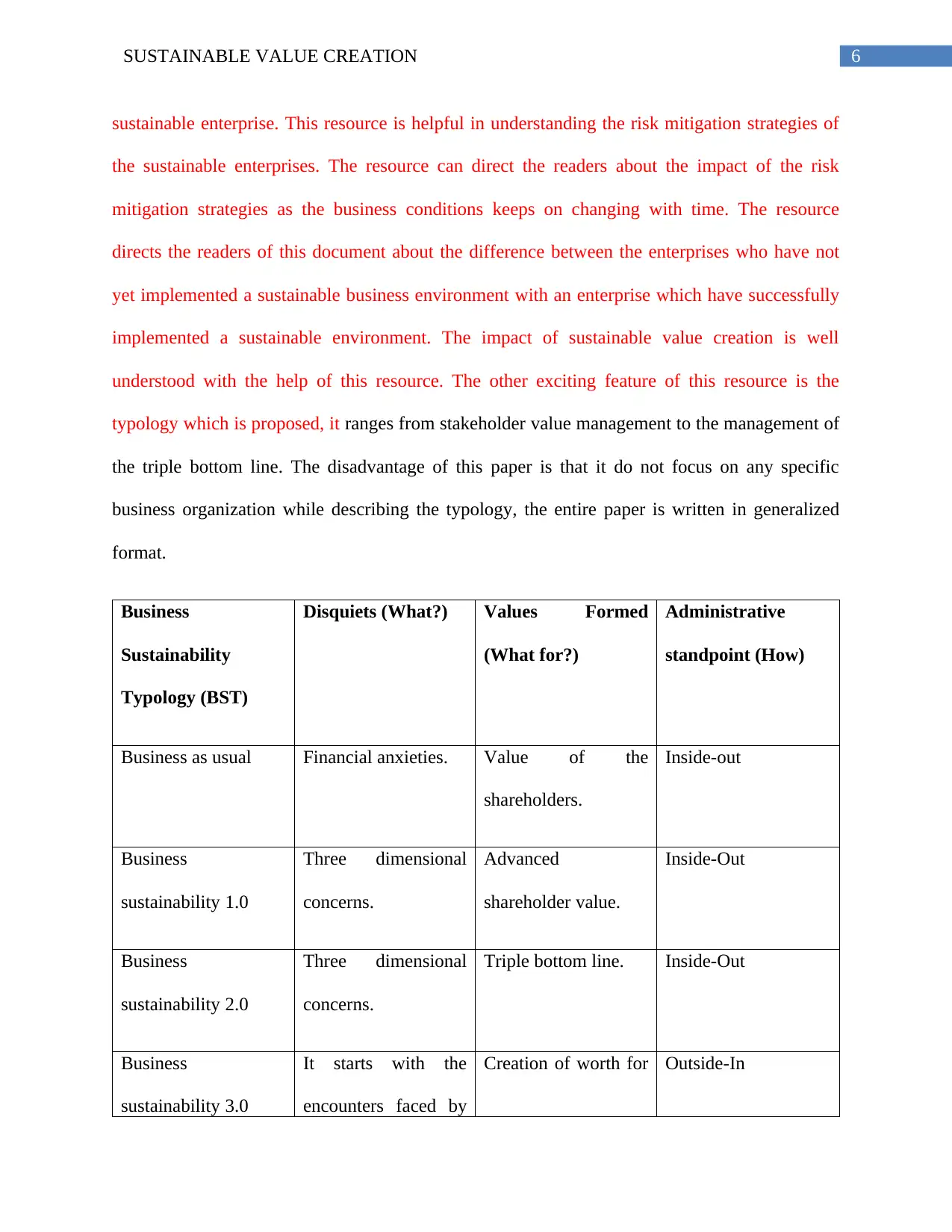
typology which is proposed, it ranges from stakeholder value management to the management of
the triple bottom line. The disadvantage of this paper is that it do not focus on any specific
business organization while describing the typology, the entire paper is written in generalized
format.
Business
Sustainability
Typology (BST)
Disquiets (What?) Values Formed
(What for?)
Administrative
standpoint (How)
Business as usual Financial anxieties. Value of the
shareholders.
Inside-out
Business
sustainability 1.0
Three dimensional
concerns.
Advanced
shareholder value.
Inside-Out
Business
sustainability 2.0
Three dimensional
concerns.
Triple bottom line. Inside-Out
Business
sustainability 3.0
It starts with the
encounters faced by
Creation of worth for Outside-In
sustainable enterprise. This resource is helpful in understanding the risk mitigation strategies of
the sustainable enterprises. The resource can direct the readers about the impact of the risk
mitigation strategies as the business conditions keeps on changing with time. The resource
directs the readers of this document about the difference between the enterprises who have not
yet implemented a sustainable business environment with an enterprise which have successfully
implemented a sustainable environment. The impact of sustainable value creation is well
understood with the help of this resource. The other exciting feature of this resource is the
typology which is proposed, it ranges from stakeholder value management to the management of
the triple bottom line. The disadvantage of this paper is that it do not focus on any specific
business organization while describing the typology, the entire paper is written in generalized
format.
Business
Sustainability
Typology (BST)
Disquiets (What?) Values Formed
(What for?)
Administrative
standpoint (How)
Business as usual Financial anxieties. Value of the
shareholders.
Inside-out
Business
sustainability 1.0
Three dimensional
concerns.
Advanced
shareholder value.
Inside-Out
Business
sustainability 2.0
Three dimensional
concerns.
Triple bottom line. Inside-Out
Business
sustainability 3.0
It starts with the
encounters faced by
Creation of worth for Outside-In
Paraphrase This Document
Need a fresh take? Get an instant paraphrase of this document with our AI Paraphraser
7SUSTAINABLE VALUE CREATION
sustainable value
creation.
the shared goods.
The key shifts
involved
1st shift: Broadening
of the business
concern.
2nd shift: Expanding
the value created.
3rd shift: Changing
the perspective
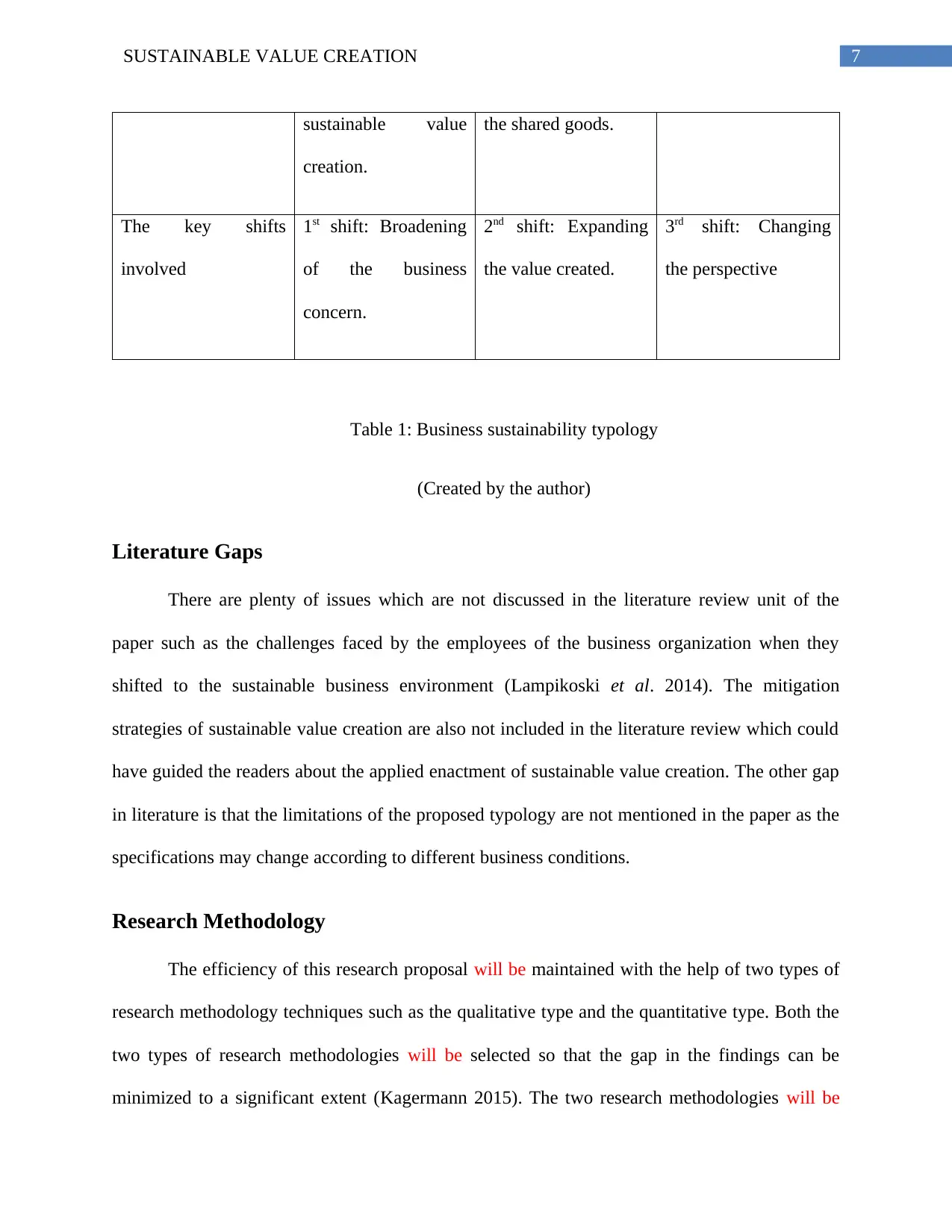
Table 1: Business sustainability typology
(Created by the author)
Literature Gaps
There are plenty of issues which are not discussed in the literature review unit of the
paper such as the challenges faced by the employees of the business organization when they
shifted to the sustainable business environment (Lampikoski et al. 2014). The mitigation
strategies of sustainable value creation are also not included in the literature review which could
have guided the readers about the applied enactment of sustainable value creation. The other gap
in literature is that the limitations of the proposed typology are not mentioned in the paper as the
specifications may change according to different business conditions.
Research Methodology
The efficiency of this research proposal will be maintained with the help of two types of
research methodology techniques such as the qualitative type and the quantitative type. Both the
two types of research methodologies will be selected so that the gap in the findings can be
minimized to a significant extent (Kagermann 2015). The two research methodologies will be
sustainable value
creation.
the shared goods.
The key shifts
involved
1st shift: Broadening
of the business
concern.
2nd shift: Expanding
the value created.
3rd shift: Changing
the perspective
Table 1: Business sustainability typology
(Created by the author)
Literature Gaps
There are plenty of issues which are not discussed in the literature review unit of the
paper such as the challenges faced by the employees of the business organization when they
shifted to the sustainable business environment (Lampikoski et al. 2014). The mitigation
strategies of sustainable value creation are also not included in the literature review which could
have guided the readers about the applied enactment of sustainable value creation. The other gap
in literature is that the limitations of the proposed typology are not mentioned in the paper as the
specifications may change according to different business conditions.
Research Methodology
The efficiency of this research proposal will be maintained with the help of two types of
research methodology techniques such as the qualitative type and the quantitative type. Both the
two types of research methodologies will be selected so that the gap in the findings can be
minimized to a significant extent (Kagermann 2015). The two research methodologies will be
8SUSTAINABLE VALUE CREATION
conducted in a professional approach; the interview will be conducted on two individuals of
different organization which have successfully implemented by the sustainable value creation.
The group assignment will be including a group of ten employees of various organizations which
have already implemented this business model as well as the organizations which are planning to
implement this business model in their working environment.
Research design and approach
The research methodology techniques will be implemented in such a way that each type
has its own uniqueness considering the point of view of the social aspects as well as the
environmental aspects (Galpin, Whitttington and Bell 2015). The two experienced individuals
will be sharing their knowledge about the sustainability value changes as well as the working
principals of the business corporation for which they work for. The phenomenon of sustainability
will be very much clear during the evaluation of the findings for the research methodology.
Data Collection Process
The data collection processes that will be used in this research paper is both primary data
collection method with the help of questionnaires and secondary data collection method from the
peer reviewed journals and articles (Visser and Kymal 2015). The two kinds of data collection
techniques chosen for this research proposal will help in understanding the importance of this
business model in a descriptive way.
Data Analysis
The collected data from the two types such as primary type and the secondary type data
collection shall be helpful in understanding the role of sustainable value creation in the
mutualistic local ownership business model (Reverte 2015). The collected data will be helpful in
conducted in a professional approach; the interview will be conducted on two individuals of
different organization which have successfully implemented by the sustainable value creation.
The group assignment will be including a group of ten employees of various organizations which
have already implemented this business model as well as the organizations which are planning to
implement this business model in their working environment.
Research design and approach
The research methodology techniques will be implemented in such a way that each type
has its own uniqueness considering the point of view of the social aspects as well as the
environmental aspects (Galpin, Whitttington and Bell 2015). The two experienced individuals
will be sharing their knowledge about the sustainability value changes as well as the working
principals of the business corporation for which they work for. The phenomenon of sustainability
will be very much clear during the evaluation of the findings for the research methodology.
Data Collection Process
The data collection processes that will be used in this research paper is both primary data
collection method with the help of questionnaires and secondary data collection method from the
peer reviewed journals and articles (Visser and Kymal 2015). The two kinds of data collection
techniques chosen for this research proposal will help in understanding the importance of this
business model in a descriptive way.
Data Analysis
The collected data from the two types such as primary type and the secondary type data
collection shall be helpful in understanding the role of sustainable value creation in the
mutualistic local ownership business model (Reverte 2015). The collected data will be helpful in
⊘ This is a preview!⊘
Do you want full access?
Subscribe today to unlock all pages.
Trusted by 1+ million students worldwide
9SUSTAINABLE VALUE CREATION
realizing that there are plenty of complexities associated with the successful implementation of
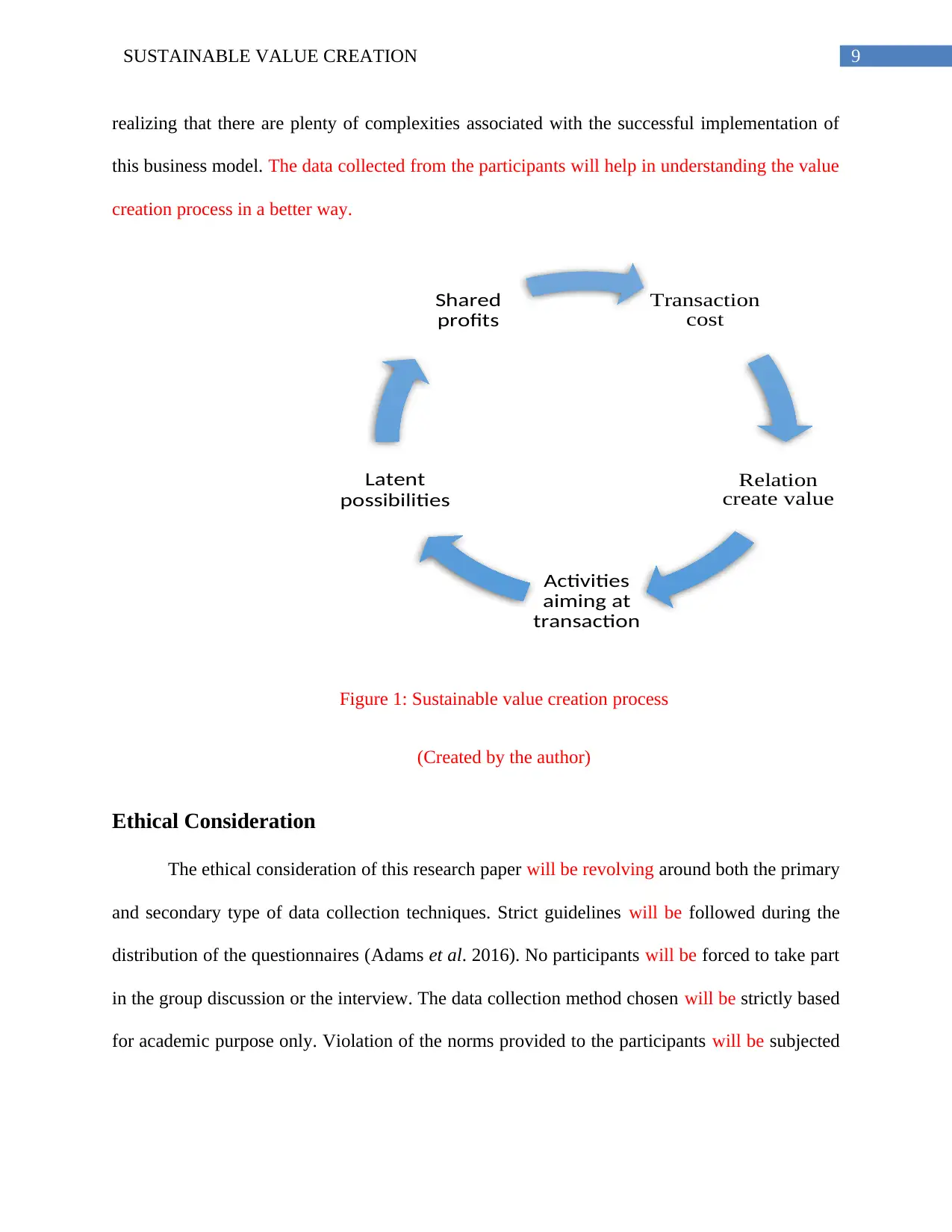
this business model. The data collected from the participants will help in understanding the value
creation process in a better way.
Figure 1: Sustainable value creation process
(Created by the author)
Ethical Consideration
The ethical consideration of this research paper will be revolving around both the primary
and secondary type of data collection techniques. Strict guidelines will be followed during the
distribution of the questionnaires (Adams et al. 2016). No participants will be forced to take part
in the group discussion or the interview. The data collection method chosen will be strictly based
for academic purpose only. Violation of the norms provided to the participants will be subjected
Transaction
cost
Relation
create value
Activities
aiming at
transaction
Latent
possibilities
Shared
profits
realizing that there are plenty of complexities associated with the successful implementation of
this business model. The data collected from the participants will help in understanding the value
creation process in a better way.
Figure 1: Sustainable value creation process
(Created by the author)
Ethical Consideration
The ethical consideration of this research paper will be revolving around both the primary
and secondary type of data collection techniques. Strict guidelines will be followed during the
distribution of the questionnaires (Adams et al. 2016). No participants will be forced to take part
in the group discussion or the interview. The data collection method chosen will be strictly based
for academic purpose only. Violation of the norms provided to the participants will be subjected
Transaction
cost
Relation
create value
Activities
aiming at
transaction
Latent
possibilities
Shared
profits
Paraphrase This Document
Need a fresh take? Get an instant paraphrase of this document with our AI Paraphraser
10SUSTAINABLE VALUE CREATION
to legal proceedings. The secondary research will be conducted on the peer reviewed articles was
done in such a way so that plagiarism is avoided to a significant extent.
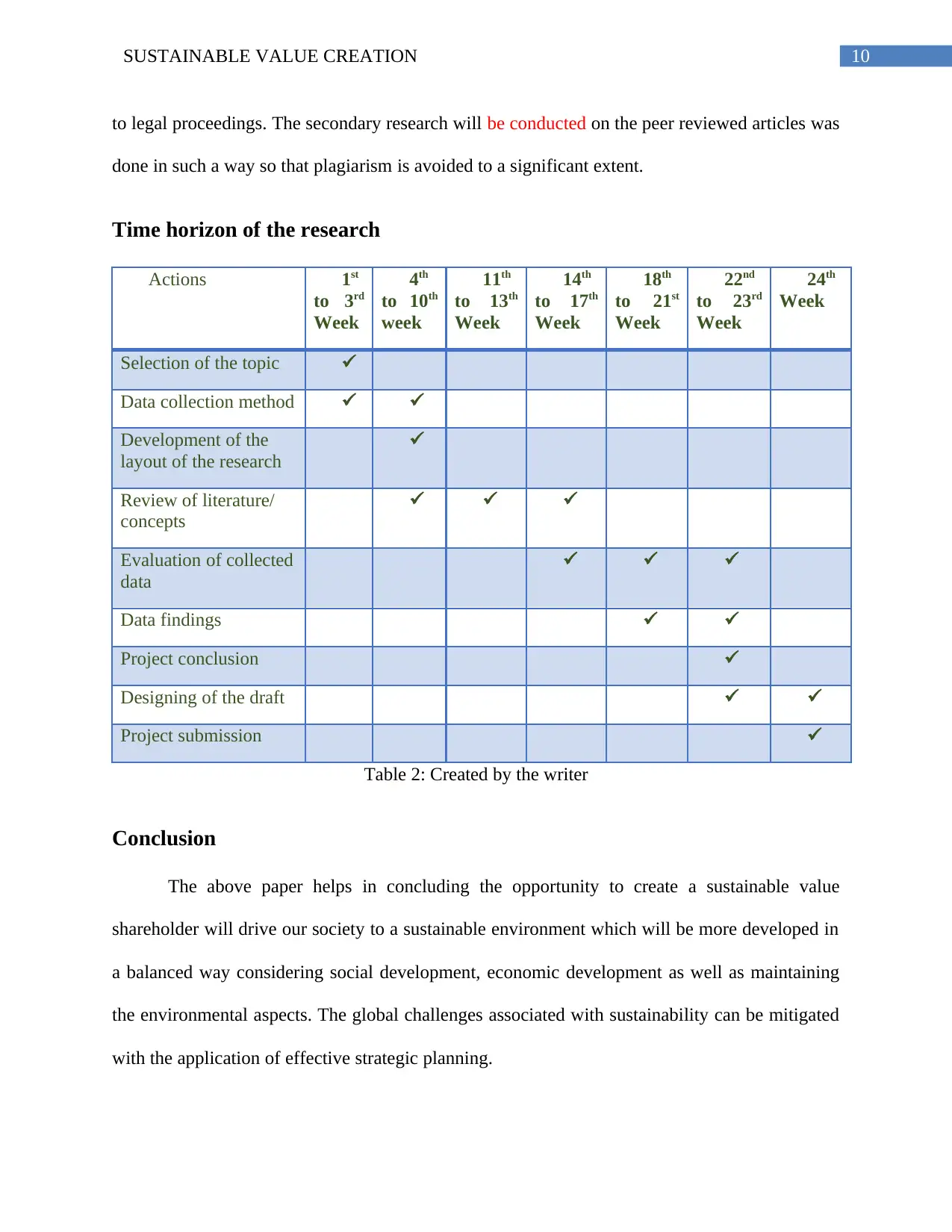
Time horizon of the research
Actions 1st
to 3rd
Week
4th
to 10th
week
11th
to 13th
Week
14th
to 17th
Week
18th
to 21st
Week
22nd
to 23rd
Week
24th
Week
Selection of the topic
Data collection method
Development of the
layout of the research
Review of literature/
concepts
Evaluation of collected
data
Data findings
Project conclusion
Designing of the draft
Project submission
Table 2: Created by the writer
Conclusion
The above paper helps in concluding the opportunity to create a sustainable value
shareholder will drive our society to a sustainable environment which will be more developed in
a balanced way considering social development, economic development as well as maintaining
the environmental aspects. The global challenges associated with sustainability can be mitigated
with the application of effective strategic planning.
to legal proceedings. The secondary research will be conducted on the peer reviewed articles was
done in such a way so that plagiarism is avoided to a significant extent.
Time horizon of the research
Actions 1st
to 3rd
Week
4th
to 10th
week
11th
to 13th
Week
14th
to 17th
Week
18th
to 21st
Week
22nd
to 23rd
Week
24th
Week
Selection of the topic
Data collection method
Development of the
layout of the research
Review of literature/
concepts
Evaluation of collected
data
Data findings
Project conclusion
Designing of the draft
Project submission
Table 2: Created by the writer
Conclusion
The above paper helps in concluding the opportunity to create a sustainable value
shareholder will drive our society to a sustainable environment which will be more developed in
a balanced way considering social development, economic development as well as maintaining
the environmental aspects. The global challenges associated with sustainability can be mitigated
with the application of effective strategic planning.

11SUSTAINABLE VALUE CREATION
⊘ This is a preview!⊘
Do you want full access?
Subscribe today to unlock all pages.
Trusted by 1+ million students worldwide

1 out of 14


Related Documents


Your All-in-One AI-Powered Toolkit for Academic Success.
+13062052269
info@desklib.com
Available 24*7 on WhatsApp / Email
![[object Object]](/_next/static/media/star-bottom.7253800d.svg)
Unlock your academic potential
Copyright © 2020–2026 A2Z Services. All Rights Reserved. Developed and managed by ZUCOL.