ENGL 102 - Comparing Symbolism and Irony in Two Short Stories

Verified

Added on  2023/06/03

|8
|1505
|250
Essay
AI Summary
This essay provides a comparative analysis of Shirley Jackson's 'The Lottery' and D.H. Lawrence's 'The Rocking-Horse Winner,' focusing on their use of symbolism and irony. It examines how Jackson critiques archaic traditions through ironic elements like the lottery's title, the opening description, and character names, alongside symbols such as the black box and stones. Similarly, the essay explores Lawrence's cautionary tale against greed, highlighting the irony of the rocking horse and Christian motifs to underscore the tragic consequences of materialism. The analysis concludes that both stories employ symbolism and irony to convey potent messages about the dangers of clinging to outdated practices and the destructive nature of avarice, offering a detailed interpretation of these literary devices within the context of the two short stories.
Document Page
Running head: English Essay
English Essay
Name of the Student
Name of the University
Author Note
tabler-icon-diamond-filled.svg

Paraphrase This Document

Need a fresh take? Get an instant paraphrase of this document with our AI Paraphraser
Document Page
1ENGLISH ESSAY
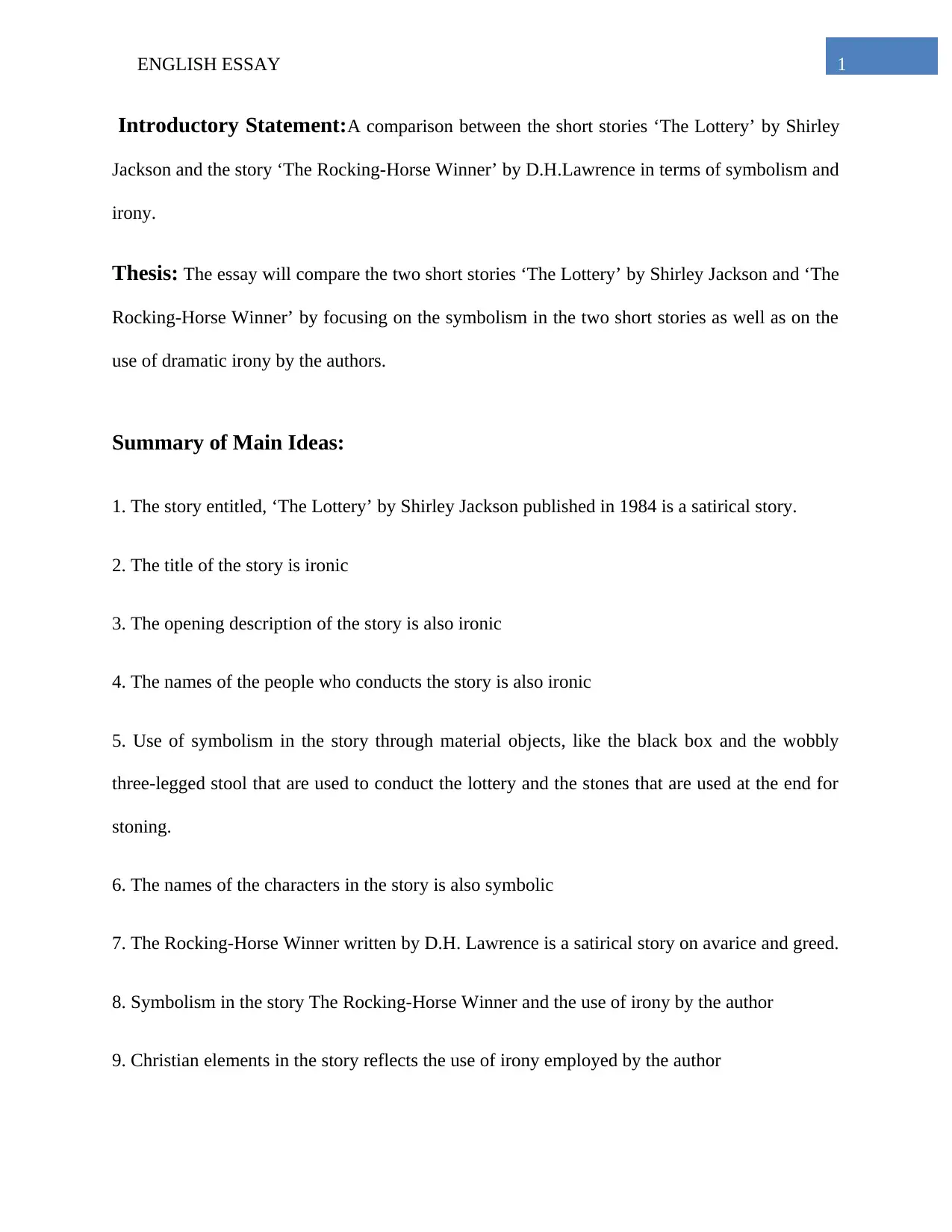
Introductory Statement:A comparison between the short stories ‘The Lottery’ by Shirley
Jackson and the story ‘The Rocking-Horse Winner’ by D.H.Lawrence in terms of symbolism and
irony.
Thesis: The essay will compare the two short stories ‘The Lottery’ by Shirley Jackson and ‘The
Rocking-Horse Winner’ by focusing on the symbolism in the two short stories as well as on the
use of dramatic irony by the authors.
Summary of Main Ideas:
1. The story entitled, ‘The Lottery’ by Shirley Jackson published in 1984 is a satirical story.
2. The title of the story is ironic
3. The opening description of the story is also ironic
4. The names of the people who conducts the story is also ironic
5. Use of symbolism in the story through material objects, like the black box and the wobbly
three-legged stool that are used to conduct the lottery and the stones that are used at the end for
stoning.
6. The names of the characters in the story is also symbolic
7. The Rocking-Horse Winner written by D.H. Lawrence is a satirical story on avarice and greed.
8. Symbolism in the story The Rocking-Horse Winner and the use of irony by the author
9. Christian elements in the story reflects the use of irony employed by the author
Document Page
2ENGLISH ESSAY
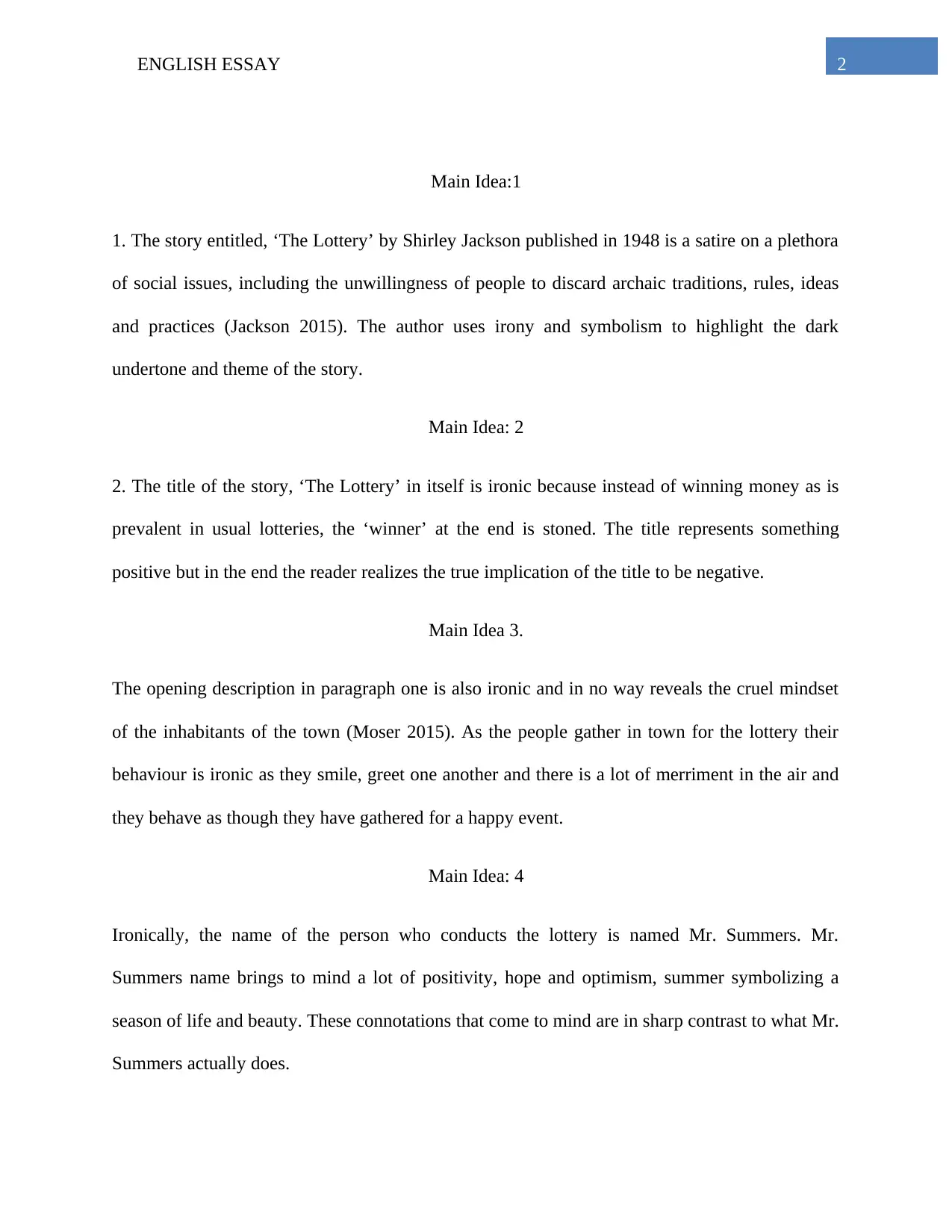
Main Idea:1
1. The story entitled, ‘The Lottery’ by Shirley Jackson published in 1948 is a satire on a plethora
of social issues, including the unwillingness of people to discard archaic traditions, rules, ideas
and practices (Jackson 2015). The author uses irony and symbolism to highlight the dark
undertone and theme of the story.
Main Idea: 2
2. The title of the story, ‘The Lottery’ in itself is ironic because instead of winning money as is
prevalent in usual lotteries, the ‘winner’ at the end is stoned. The title represents something
positive but in the end the reader realizes the true implication of the title to be negative.
Main Idea 3.
The opening description in paragraph one is also ironic and in no way reveals the cruel mindset
of the inhabitants of the town (Moser 2015). As the people gather in town for the lottery their
behaviour is ironic as they smile, greet one another and there is a lot of merriment in the air and
they behave as though they have gathered for a happy event.
Main Idea: 4
Ironically, the name of the person who conducts the lottery is named Mr. Summers. Mr.
Summers name brings to mind a lot of positivity, hope and optimism, summer symbolizing a
season of life and beauty. These connotations that come to mind are in sharp contrast to what Mr.
Summers actually does.
Document Page
3ENGLISH ESSAY
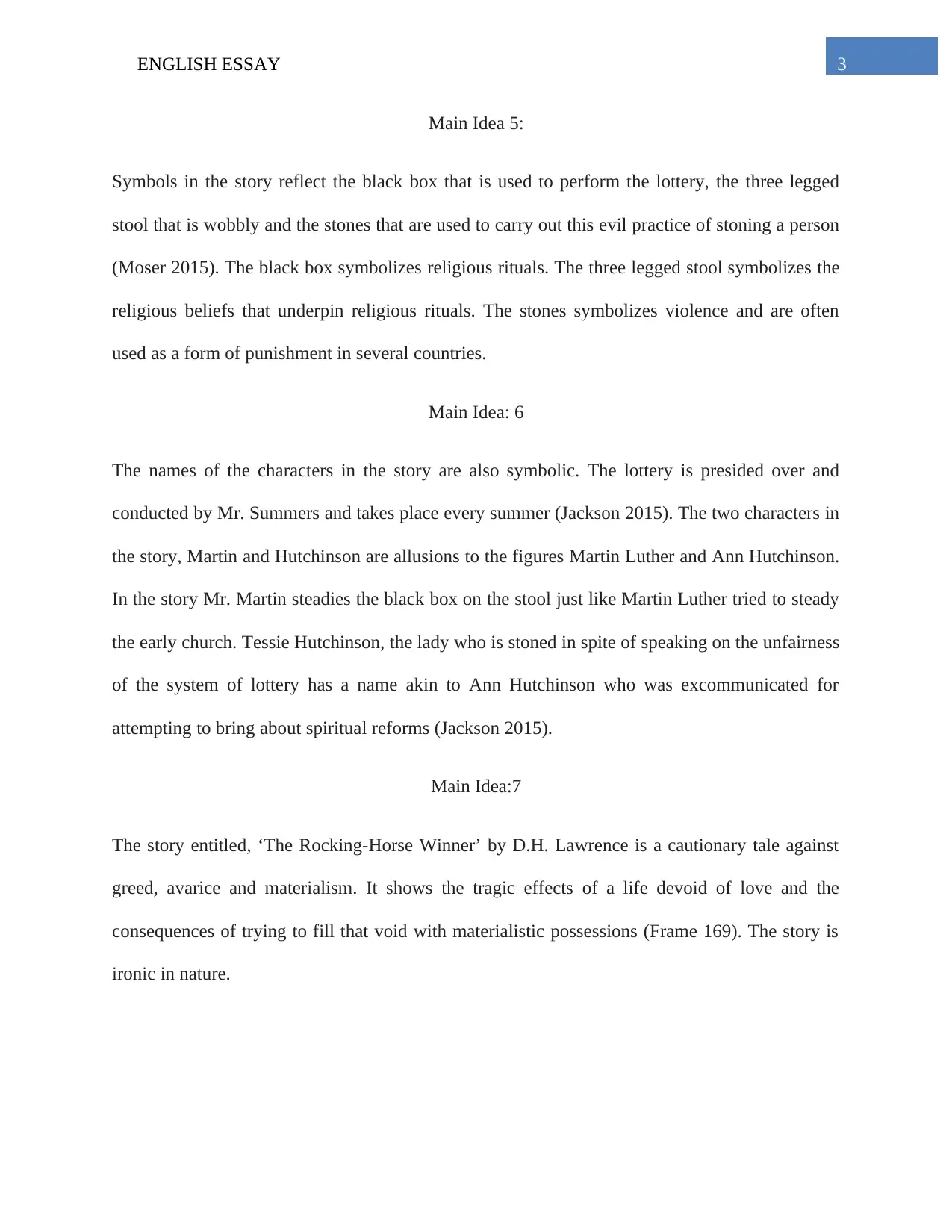
Main Idea 5:
Symbols in the story reflect the black box that is used to perform the lottery, the three legged
stool that is wobbly and the stones that are used to carry out this evil practice of stoning a person
(Moser 2015). The black box symbolizes religious rituals. The three legged stool symbolizes the
religious beliefs that underpin religious rituals. The stones symbolizes violence and are often
used as a form of punishment in several countries.
Main Idea: 6
The names of the characters in the story are also symbolic. The lottery is presided over and
conducted by Mr. Summers and takes place every summer (Jackson 2015). The two characters in
the story, Martin and Hutchinson are allusions to the figures Martin Luther and Ann Hutchinson.
In the story Mr. Martin steadies the black box on the stool just like Martin Luther tried to steady
the early church. Tessie Hutchinson, the lady who is stoned in spite of speaking on the unfairness
of the system of lottery has a name akin to Ann Hutchinson who was excommunicated for
attempting to bring about spiritual reforms (Jackson 2015).
Main Idea:7
The story entitled, ‘The Rocking-Horse Winner’ by D.H. Lawrence is a cautionary tale against
greed, avarice and materialism. It shows the tragic effects of a life devoid of love and the
consequences of trying to fill that void with materialistic possessions (Frame 169). The story is
ironic in nature.
tabler-icon-diamond-filled.svg

Paraphrase This Document

Need a fresh take? Get an instant paraphrase of this document with our AI Paraphraser
Document Page
4ENGLISH ESSAY
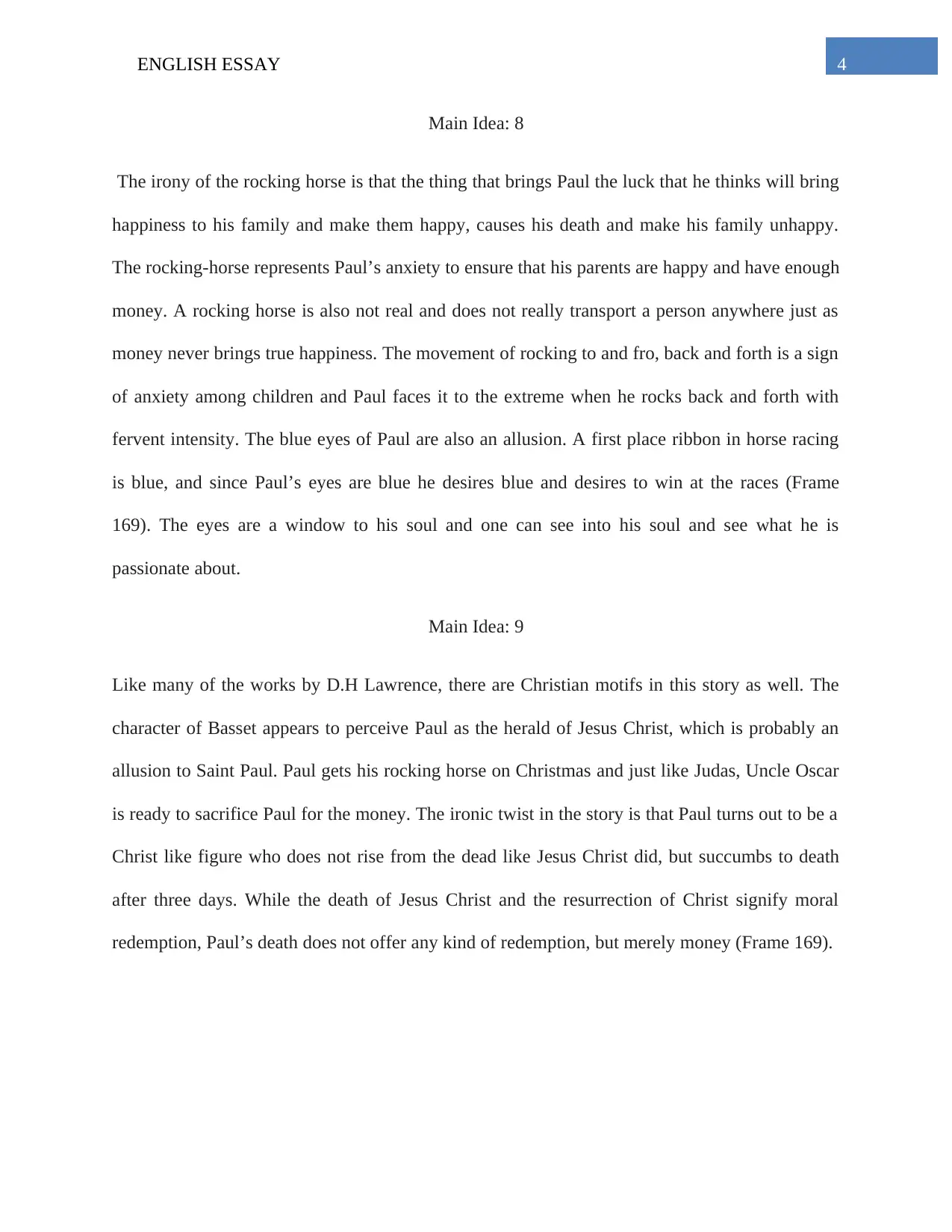
Main Idea: 8
The irony of the rocking horse is that the thing that brings Paul the luck that he thinks will bring
happiness to his family and make them happy, causes his death and make his family unhappy.
The rocking-horse represents Paul’s anxiety to ensure that his parents are happy and have enough
money. A rocking horse is also not real and does not really transport a person anywhere just as
money never brings true happiness. The movement of rocking to and fro, back and forth is a sign
of anxiety among children and Paul faces it to the extreme when he rocks back and forth with
fervent intensity. The blue eyes of Paul are also an allusion. A first place ribbon in horse racing
is blue, and since Paul’s eyes are blue he desires blue and desires to win at the races (Frame
169). The eyes are a window to his soul and one can see into his soul and see what he is
passionate about.
Main Idea: 9
Like many of the works by D.H Lawrence, there are Christian motifs in this story as well. The
character of Basset appears to perceive Paul as the herald of Jesus Christ, which is probably an
allusion to Saint Paul. Paul gets his rocking horse on Christmas and just like Judas, Uncle Oscar
is ready to sacrifice Paul for the money. The ironic twist in the story is that Paul turns out to be a
Christ like figure who does not rise from the dead like Jesus Christ did, but succumbs to death
after three days. While the death of Jesus Christ and the resurrection of Christ signify moral
redemption, Paul’s death does not offer any kind of redemption, but merely money (Frame 169).
Document Page
5ENGLISH ESSAY
Conclusion
Restatement of the argument: Thus, both stories are satirical short stories embedded with
symbolism. While the first story shows the futility of holding on to barbaric archaic traditions
which results in the loss of life, the second story shows the futility of avarice, greed and
materialism that pervades in society that results in the loss of life
Significance of main points: Symbolism and dramatic irony prevails throughout the stories
and in the first story, it highlights the futility of preserving archaic and barbaric rules and
traditions, while the second story is a cautionary tale against avarice, greed and materialism.
Concluding Statement: In conclusion, one can say that one should not be barbaric in nature
and learn to respect others. One should also not be guided by greed and avarice.
Document Page
6ENGLISH ESSAY
REFERENCES:
BAĞLAMA, Sercan Hamza. "The Ideological Structure in “The Rocking-Horse Winner”: Evils
of Modernism and Consumerism." ANGLISTICUM. Journal of the Association
for Anglo-American Studies 2.4 (2016): 24-33.
Frame, Rachel. "The Greed Epidemic." tarboard (2015): 169.
İnal, Hilal, and Abdulkadir Cakir. "Story-based vocabulary teaching." Procedia-Social and
Behavioral Sciences 98 (2014): 675-679.
Jackson, Shirley. Life among the Savages. Penguin, 2015.
Moser, Elizabeth. "Comparing Contemporary Dystopian Novels with Canonical Classics in the
Classroom." (2015).
Sheldon, Tyler. "EG 794 Dr. Colson May 12, 2015 Leaving Dishes in the Sink: An Analysis of."
(2015).
tabler-icon-diamond-filled.svg

Paraphrase This Document

Need a fresh take? Get an instant paraphrase of this document with our AI Paraphraser
Document Page
7ENGLISH ESSAY
Syam, Essy, and Raja Syamsidar. "The Elements of Paganism as Reflected in Shirley Jackson’s
“The Lottery”." IOP Conference Series: Earth and Environmental Science. Vol.
175. No. 1. IOP Publishing, 2018.
Ufuk, E. G. E. "DH Lawrence'ın “Rocking-Horse Winner” ve “Things” Üzerine Bir
Yorum." DTCF Dergisi 38.1-2 (2017).
chevron_up_icon
1 out of 8
circle_padding
hide_on_mobile
zoom_out_icon
[object Object]