System Architecture and Integration Report - University Name, Semester

Verified

Added on  2022/08/22

|4
|551
|29
Report
AI Summary
This report focuses on system architecture and integration, delving into the types of data involved, including data consolidation, data propagation, and data virtualization. It examines the security concerns associated with system integration, such as the use of non-traditional data and potential insider threats. The report also explores quality assurance tools and test strategies, including test management tools like Mantis Bug Tracker, functional testing tools like Selenium, and performance testing tools like Siasta Cloud and Load Runner. The report references relevant sources to support its findings and analysis. This report is useful for students seeking to understand the various elements of system integration.

Document Page
Running head: SYSTEM ARCHITECTURE AND INTEGRATION
System Architecture and Integration
Name of Student-
Name of University-
Author’s Note-
tabler-icon-diamond-filled.svg

Paraphrase This Document

Need a fresh take? Get an instant paraphrase of this document with our AI Paraphraser
Document Page
1SYSTEM ARCHITECTURE AND INTEGRATION
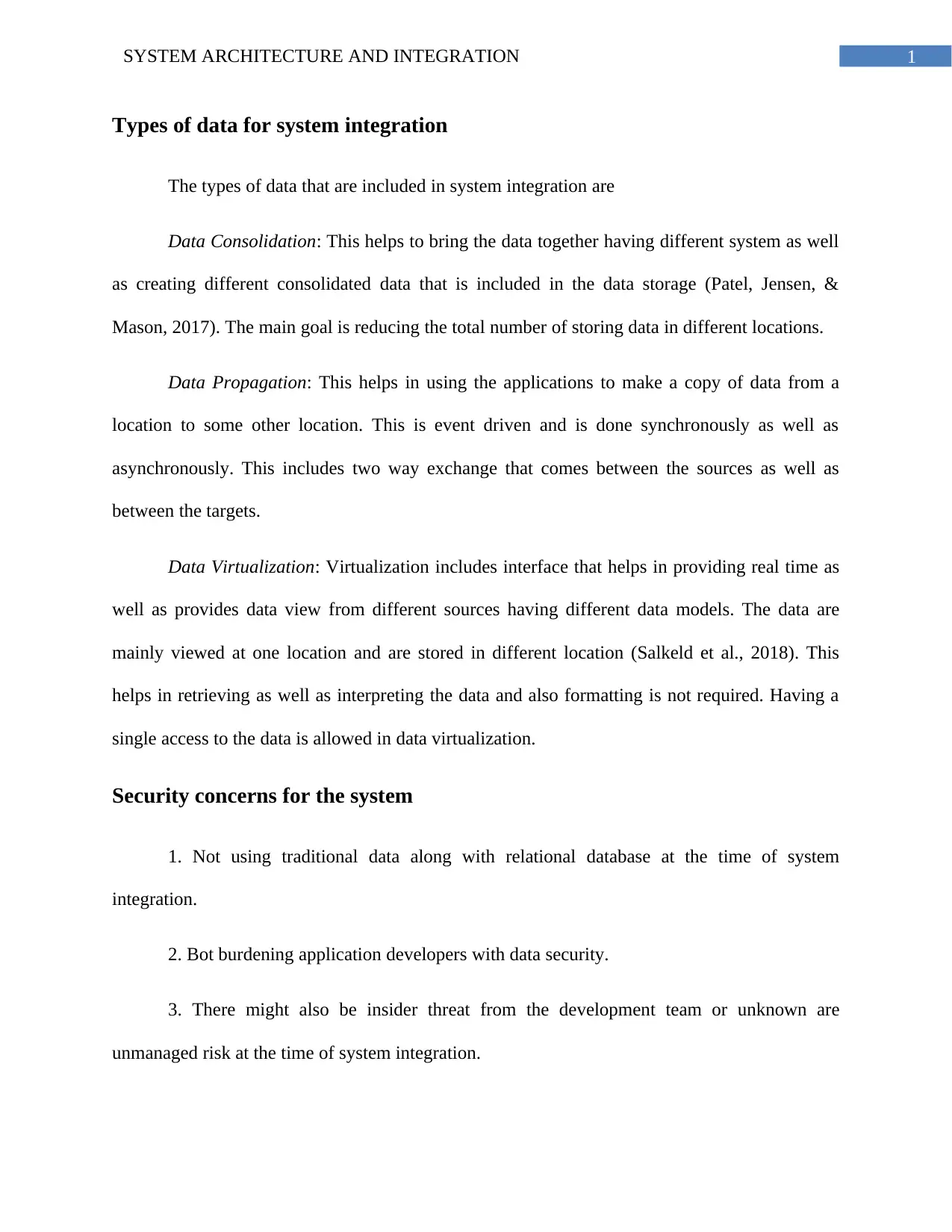
Types of data for system integration
The types of data that are included in system integration are
Data Consolidation: This helps to bring the data together having different system as well
as creating different consolidated data that is included in the data storage (Patel, Jensen, &
Mason, 2017). The main goal is reducing the total number of storing data in different locations.
Data Propagation: This helps in using the applications to make a copy of data from a
location to some other location. This is event driven and is done synchronously as well as
asynchronously. This includes two way exchange that comes between the sources as well as
between the targets.
Data Virtualization: Virtualization includes interface that helps in providing real time as
well as provides data view from different sources having different data models. The data are
mainly viewed at one location and are stored in different location (Salkeld et al., 2018). This
helps in retrieving as well as interpreting the data and also formatting is not required. Having a
single access to the data is allowed in data virtualization.
Security concerns for the system
1. Not using traditional data along with relational database at the time of system
integration.
2. Bot burdening application developers with data security.
3. There might also be insider threat from the development team or unknown are
unmanaged risk at the time of system integration.
Document Page
2SYSTEM ARCHITECTURE AND INTEGRATION
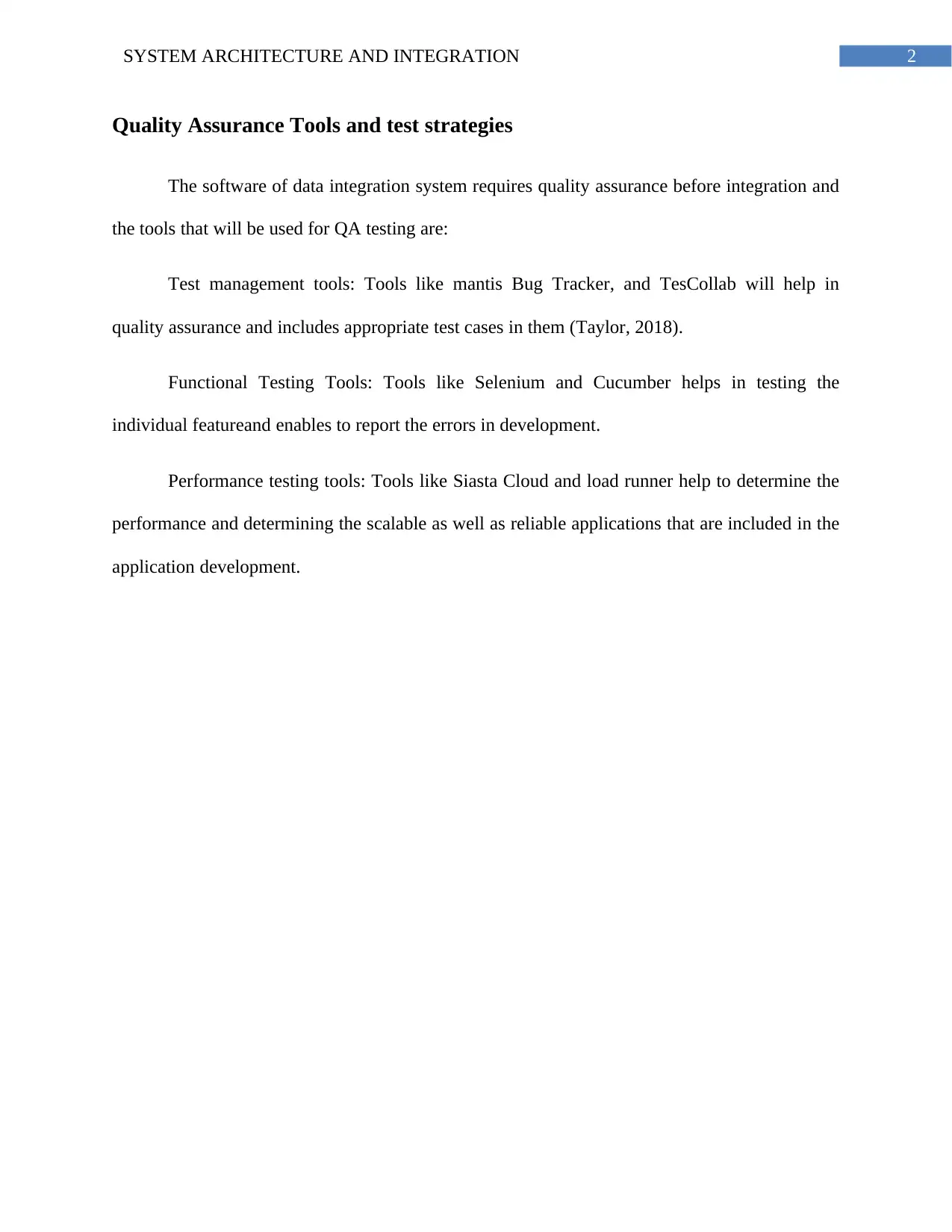
Quality Assurance Tools and test strategies
The software of data integration system requires quality assurance before integration and
the tools that will be used for QA testing are:
Test management tools: Tools like mantis Bug Tracker, and TesCollab will help in
quality assurance and includes appropriate test cases in them (Taylor, 2018).
Functional Testing Tools: Tools like Selenium and Cucumber helps in testing the
individual featureand enables to report the errors in development.
Performance testing tools: Tools like Siasta Cloud and load runner help to determine the
performance and determining the scalable as well as reliable applications that are included in the
application development.
Document Page
3SYSTEM ARCHITECTURE AND INTEGRATION
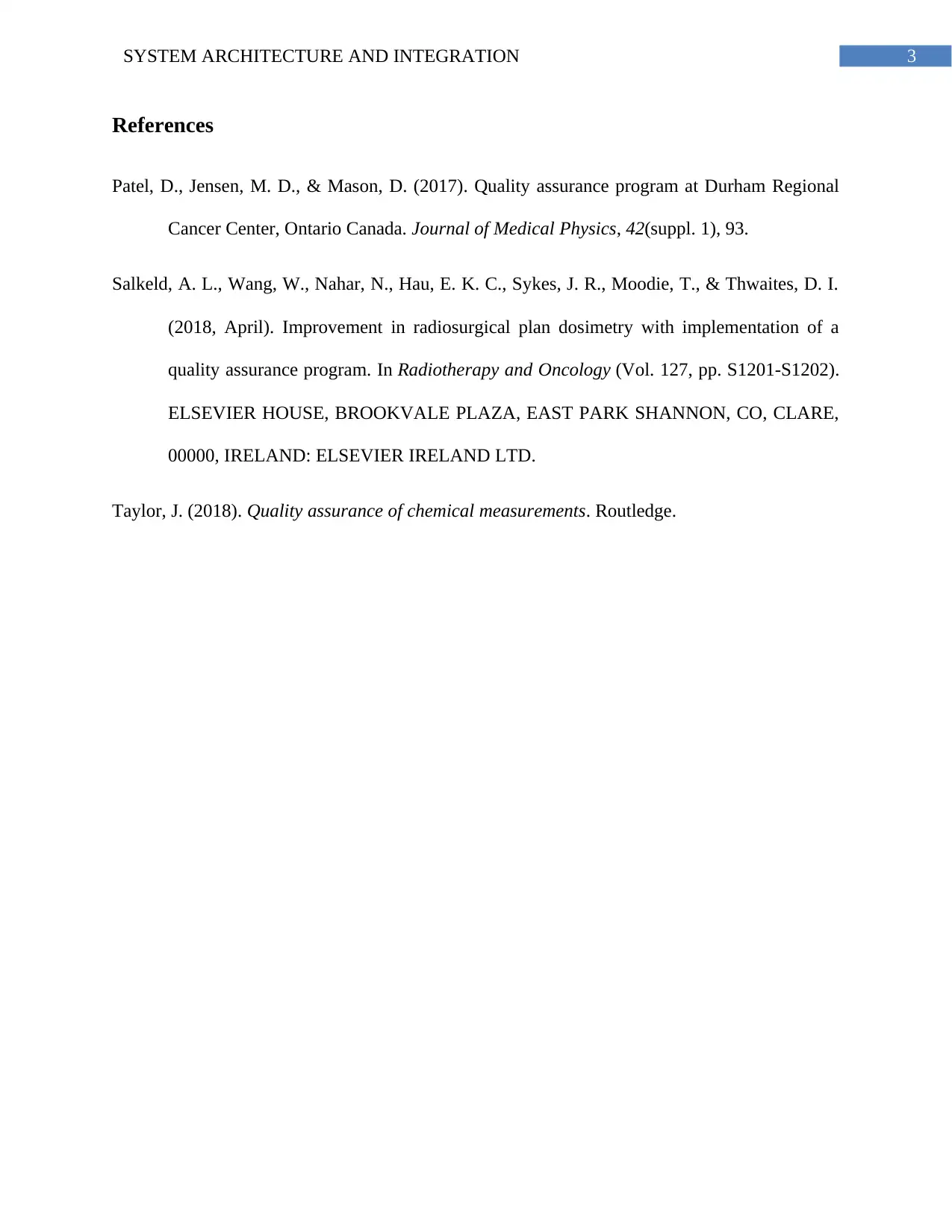
References
Patel, D., Jensen, M. D., & Mason, D. (2017). Quality assurance program at Durham Regional
Cancer Center, Ontario Canada. Journal of Medical Physics, 42(suppl. 1), 93.
Salkeld, A. L., Wang, W., Nahar, N., Hau, E. K. C., Sykes, J. R., Moodie, T., & Thwaites, D. I.
(2018, April). Improvement in radiosurgical plan dosimetry with implementation of a
quality assurance program. In Radiotherapy and Oncology (Vol. 127, pp. S1201-S1202).
ELSEVIER HOUSE, BROOKVALE PLAZA, EAST PARK SHANNON, CO, CLARE,
00000, IRELAND: ELSEVIER IRELAND LTD.
Taylor, J. (2018). Quality assurance of chemical measurements. Routledge.
chevron_up_icon
1 out of 4
circle_padding
hide_on_mobile
zoom_out_icon
[object Object]