System Development Report: Analysis of Warehouse Management System
VerifiedAdded on  2022/08/27
|19
|2973
|25
Report
AI Summary
This report provides a comprehensive analysis of system development, specifically focusing on warehouse management systems. It begins with an introduction to the importance of efficient logistical processes and warehouse operations, followed by a detailed examination of warehouse management systems, including their life cycle activities such as system planning, analysis, design, development, integration, and implementation. The report then delves into various system development models, namely the Waterfall, Spiral, and Vee models, outlining their characteristics and life cycle phases. A case study is presented, addressing the current challenges of an outdated attendance system and proposing a new, robust system. The report includes a feasibility study, operational requirements, and system maintenance considerations. Technical performance measures, top-level and maintainability requirements, and supportability factors are also discussed. Furthermore, the report incorporates a functional flow block diagram to illustrate the system's operational flow and utilizes the soft systems method to analyze problems faced during technology implementation, offering recommendations for improvement. The conclusion summarizes the key findings and insights gained from the analysis.
System development 1
Name of the Course
Name of Student
Professor
State
Date
Name of the Course
Name of Student
Professor
State
Date
Paraphrase This Document
Need a fresh take? Get an instant paraphrase of this document with our AI Paraphraser

System development 2
Contents
Introduction......................................................................................................................................2
Warehouse management system......................................................................................................2
Life cycle activities..........................................................................................................................3
Waterfall model...........................................................................................................................4
Spiral model.................................................................................................................................5
Vee model....................................................................................................................................6
Current situation..............................................................................................................................8
Feasibility study...........................................................................................................................8
Basic operational requirements....................................................................................................8
System maintenance....................................................................................................................9
critical technical performance measures..........................................................................................9
Top-level requirements..............................................................................................................10
System maintainability requirements....................................................................................10
Supportability factors.............................................................................................................10
Functional flow block diagram......................................................................................................11
Analysis of problems faced by organizations during technology implementation in the
organization using soft systems method........................................................................................12
Recommendations......................................................................................................................15
Conclusion.....................................................................................................................................15
Contents
Introduction......................................................................................................................................2
Warehouse management system......................................................................................................2
Life cycle activities..........................................................................................................................3
Waterfall model...........................................................................................................................4
Spiral model.................................................................................................................................5
Vee model....................................................................................................................................6
Current situation..............................................................................................................................8
Feasibility study...........................................................................................................................8
Basic operational requirements....................................................................................................8
System maintenance....................................................................................................................9
critical technical performance measures..........................................................................................9
Top-level requirements..............................................................................................................10
System maintainability requirements....................................................................................10
Supportability factors.............................................................................................................10
Functional flow block diagram......................................................................................................11
Analysis of problems faced by organizations during technology implementation in the
organization using soft systems method........................................................................................12
Recommendations......................................................................................................................15
Conclusion.....................................................................................................................................15

System development 3
References......................................................................................................................................16
⊘ This is a preview!⊘
Do you want full access?
Subscribe today to unlock all pages.

Trusted by 1+ million students worldwide

System development 4
Introduction
Proper management of logistical processes and the warehouse involves a detailed process of
effectively organizing and implementing and efficient operation. In most organizations, the
process involves uninterrupted flow of work from the beginning of the supply chain process to
the end with the aim of fulfilling the customer requirements. The most suitable and practical way
of managing a supply chain operation effectively is identifying the pre-existing problems and
finding ways of addressing them (Baruffaldi, Accorsi, and Manzini, 2019). This paper has
identified a warehouse problem and a system was used in solving the problem. Further, various
models have been critically discussed.
Warehouse management system
The warehouse management system is a design software and processes that aid an organization
in controlling and administering various warehouse operations from the period goods are
received in the warehouse until they are dispatched for delivery to the customer. Activities that
are controlled using this system include inventory picking process, warehouse auditing, and
overall inventory management (Ivgantius and Andry, 2019). Developing a warehouse
management system undergoes various life cycle from the time it is designed until full operations
of the system is realized. The following are the life cycle phases experienced by the development
and operationalization of this system.
System planning- the main objective of this phase is to determine the scope of the problem the
system will solve and the possible solutions that will be provided. Some of the resources
considered in this phase are financial costs, the time required, human resources, as well as the
overall benefits of the system to the warehouse, which is found in this phase.
Introduction
Proper management of logistical processes and the warehouse involves a detailed process of
effectively organizing and implementing and efficient operation. In most organizations, the
process involves uninterrupted flow of work from the beginning of the supply chain process to
the end with the aim of fulfilling the customer requirements. The most suitable and practical way
of managing a supply chain operation effectively is identifying the pre-existing problems and
finding ways of addressing them (Baruffaldi, Accorsi, and Manzini, 2019). This paper has
identified a warehouse problem and a system was used in solving the problem. Further, various
models have been critically discussed.
Warehouse management system
The warehouse management system is a design software and processes that aid an organization
in controlling and administering various warehouse operations from the period goods are
received in the warehouse until they are dispatched for delivery to the customer. Activities that
are controlled using this system include inventory picking process, warehouse auditing, and
overall inventory management (Ivgantius and Andry, 2019). Developing a warehouse
management system undergoes various life cycle from the time it is designed until full operations
of the system is realized. The following are the life cycle phases experienced by the development
and operationalization of this system.
System planning- the main objective of this phase is to determine the scope of the problem the
system will solve and the possible solutions that will be provided. Some of the resources
considered in this phase are financial costs, the time required, human resources, as well as the
overall benefits of the system to the warehouse, which is found in this phase.
Paraphrase This Document
Need a fresh take? Get an instant paraphrase of this document with our AI Paraphraser

System development 5
Extensive system analysis and its requirements- the team developing the system consider the
functionality function of the system and the solutions required to be provided by the project
(Zhao, Chen, and Niu, 2019). The group also analyzed the various needs of the system
application in the warehouse and ensured the expectations are met.
Designing of the system- the phase describes the system details, all the required specifications,
operations, and features that will meet its functional requirements.
System development phase- it marks the initiation stage of the system development process. It
signifies the commencement of production. It is also characterized by the system's installation
and change.
System integration and testing- the combination of the system into the normal operations of the
warehouse and its trial are done in this phase. It is usually conducted by the quality assurance
team (Kapuria, Hi-Tech Robotic Systemz Ltd, 2019). The testing is done to establish if the
system design meets the overall needs of the warehouse.
Implementation phase- program coding is conducted, and the system is put into production by
incorporating the data from the current system using a direct cutover.
System operationalization and maintenance- the warehouse management fine-tunes the system to
boost overall performance if it is required.
Life cycle activities
The creation of a system model requires an inadept analysis of the model, which has to undergo
various cycles of system development, referred to as life cycle activities (Saxena 2019). Various
models exhibit life cycle activities, and some of them are discussed below;
Extensive system analysis and its requirements- the team developing the system consider the
functionality function of the system and the solutions required to be provided by the project
(Zhao, Chen, and Niu, 2019). The group also analyzed the various needs of the system
application in the warehouse and ensured the expectations are met.
Designing of the system- the phase describes the system details, all the required specifications,
operations, and features that will meet its functional requirements.
System development phase- it marks the initiation stage of the system development process. It
signifies the commencement of production. It is also characterized by the system's installation
and change.
System integration and testing- the combination of the system into the normal operations of the
warehouse and its trial are done in this phase. It is usually conducted by the quality assurance
team (Kapuria, Hi-Tech Robotic Systemz Ltd, 2019). The testing is done to establish if the
system design meets the overall needs of the warehouse.
Implementation phase- program coding is conducted, and the system is put into production by
incorporating the data from the current system using a direct cutover.
System operationalization and maintenance- the warehouse management fine-tunes the system to
boost overall performance if it is required.
Life cycle activities
The creation of a system model requires an inadept analysis of the model, which has to undergo
various cycles of system development, referred to as life cycle activities (Saxena 2019). Various
models exhibit life cycle activities, and some of them are discussed below;

System development 6
Waterfall model
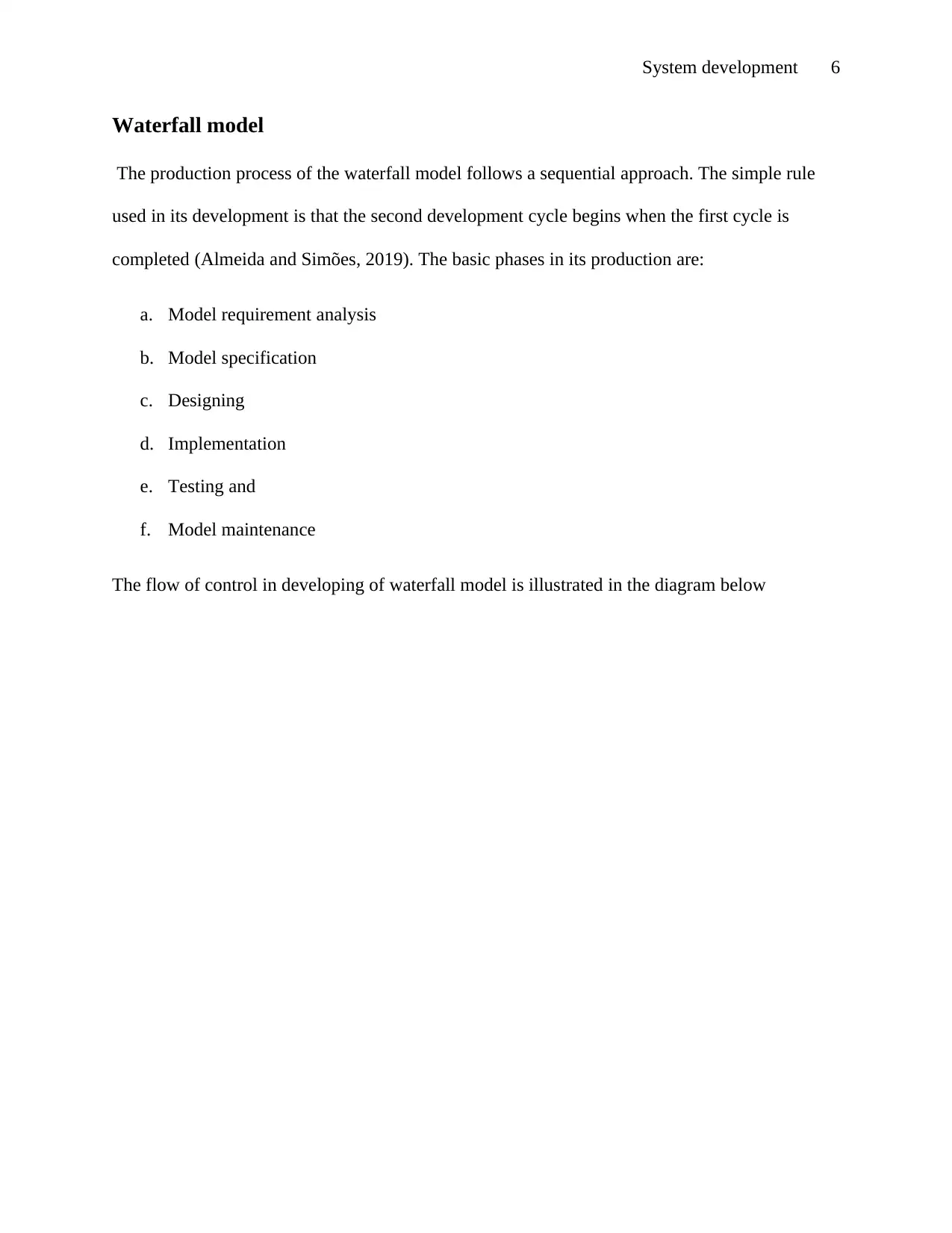
The production process of the waterfall model follows a sequential approach. The simple rule
used in its development is that the second development cycle begins when the first cycle is
completed (Almeida and Simões, 2019). The basic phases in its production are:
a. Model requirement analysis
b. Model specification
c. Designing
d. Implementation
e. Testing and
f. Model maintenance
The flow of control in developing of waterfall model is illustrated in the diagram below
Waterfall model
The production process of the waterfall model follows a sequential approach. The simple rule
used in its development is that the second development cycle begins when the first cycle is
completed (Almeida and Simões, 2019). The basic phases in its production are:
a. Model requirement analysis
b. Model specification
c. Designing
d. Implementation
e. Testing and
f. Model maintenance
The flow of control in developing of waterfall model is illustrated in the diagram below
⊘ This is a preview!⊘
Do you want full access?
Subscribe today to unlock all pages.

Trusted by 1+ million students worldwide

System development 7
Spiral model
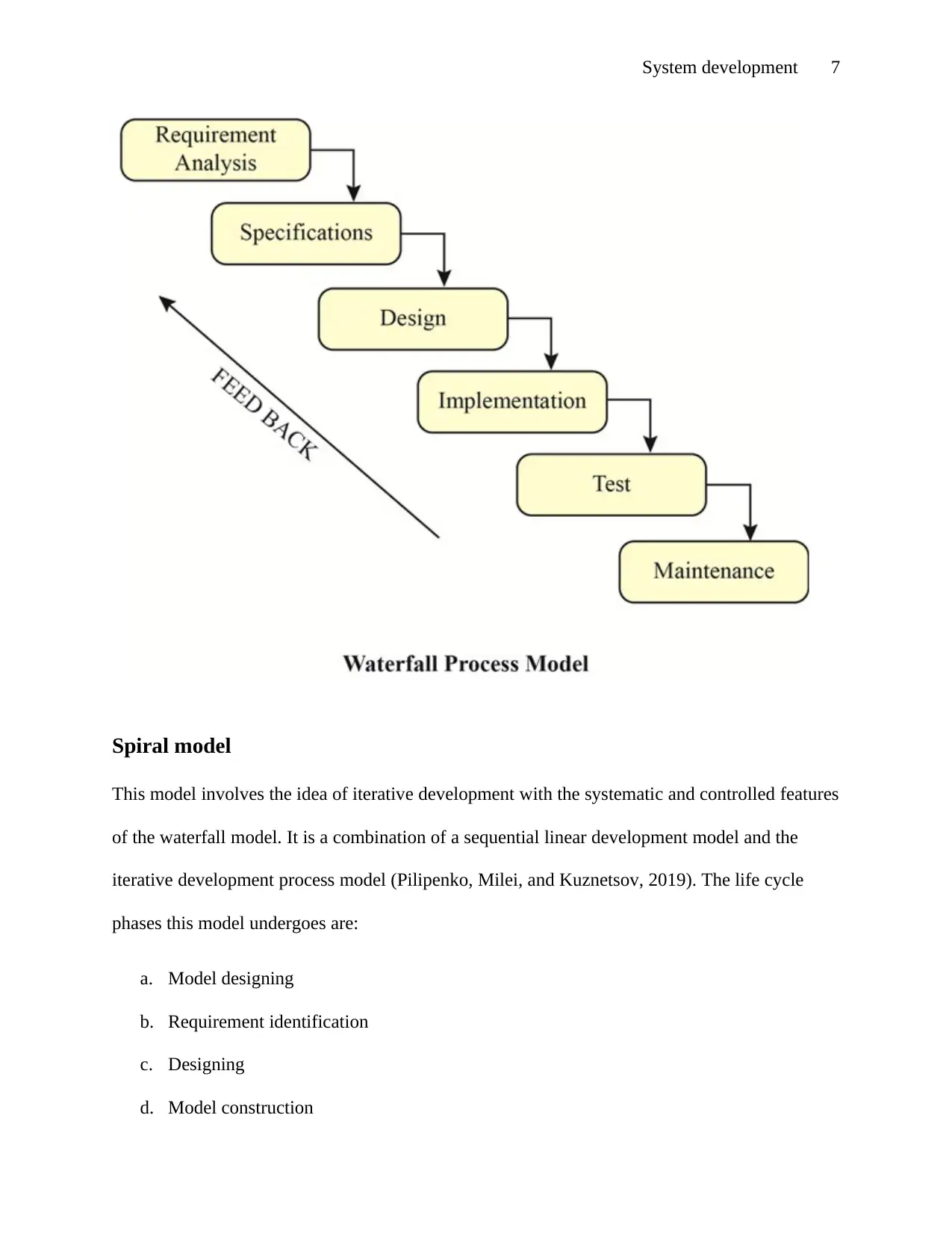
This model involves the idea of iterative development with the systematic and controlled features
of the waterfall model. It is a combination of a sequential linear development model and the
iterative development process model (Pilipenko, Milei, and Kuznetsov, 2019). The life cycle
phases this model undergoes are:
a. Model designing
b. Requirement identification
c. Designing
d. Model construction
Spiral model
This model involves the idea of iterative development with the systematic and controlled features
of the waterfall model. It is a combination of a sequential linear development model and the
iterative development process model (Pilipenko, Milei, and Kuznetsov, 2019). The life cycle
phases this model undergoes are:
a. Model designing
b. Requirement identification
c. Designing
d. Model construction
Paraphrase This Document
Need a fresh take? Get an instant paraphrase of this document with our AI Paraphraser

System development 8
e. Risk evaluation
f. Model application
The flow of activities is illustrated in the diagram below
Vee model
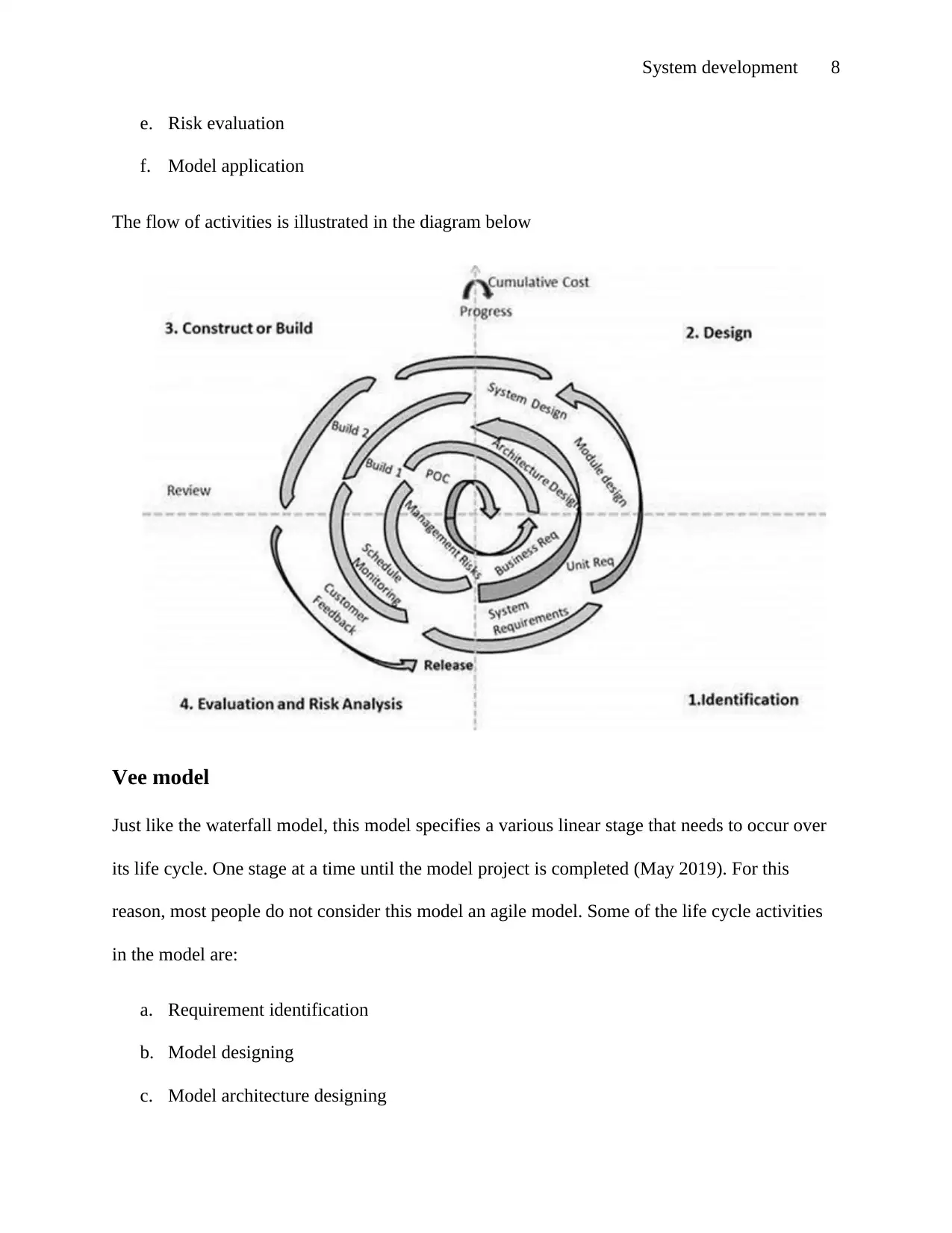
Just like the waterfall model, this model specifies a various linear stage that needs to occur over
its life cycle. One stage at a time until the model project is completed (May 2019). For this
reason, most people do not consider this model an agile model. Some of the life cycle activities
in the model are:
a. Requirement identification
b. Model designing
c. Model architecture designing
e. Risk evaluation
f. Model application
The flow of activities is illustrated in the diagram below
Vee model
Just like the waterfall model, this model specifies a various linear stage that needs to occur over
its life cycle. One stage at a time until the model project is completed (May 2019). For this
reason, most people do not consider this model an agile model. Some of the life cycle activities
in the model are:
a. Requirement identification
b. Model designing
c. Model architecture designing

System development 9
d. Module design
e. Model coding/implementation
f. Model unit testing
g. Integration testing
h. System testing
i. Acceptance testing
The flow of activities is shown in the diagram below
For this project, I choose a waterfall model since it simple to develop as well as an agile model
that will simplify various operations in the organization.
The specific issue is the management and monitoring of the Card punching attendance system,
which is not a robust attending system in the firm. We would like to design an effective
attendance system that is robust a will be efficient in business management and monitoring.
d. Module design
e. Model coding/implementation
f. Model unit testing
g. Integration testing
h. System testing
i. Acceptance testing
The flow of activities is shown in the diagram below
For this project, I choose a waterfall model since it simple to develop as well as an agile model
that will simplify various operations in the organization.
The specific issue is the management and monitoring of the Card punching attendance system,
which is not a robust attending system in the firm. We would like to design an effective
attendance system that is robust a will be efficient in business management and monitoring.
⊘ This is a preview!⊘
Do you want full access?
Subscribe today to unlock all pages.

Trusted by 1+ million students worldwide

System development 10
Current situation
The attendance system used in the firm is an outdated system that has not been able to keep track
on the employee' attendance effectively. Most of the employees forget to clock in or sign out, or
in some instances, the report extended hours which they are unable to account. Some of the
coworkers are used to sign in for their colleagues, which have led to the development of buddy-
punching culture in the firm. Human resource managers have also been making numerous
mistakes as a result of the inefficiencies of the current attendance monitoring system. This has
led to miscalculations of employee pay and the actual hours worked by the employee. It has led
to reduced engagement as a result of distrust among staff members.
Feasibility study
The feasibility study of the system development after the aims of the project is determined. A
broad scope of possible solutions, which are capable of indicating the possible outline of the new
system. The feasibility study involved imagination and creativity in creating a broad possible
solution. New ways were thought of in generating new ideas in creating an efficient attendance
monitoring system (Grenci and Hull, 2020). No particular detailed analysis was conducted
during the study. The study was done to provide enough information that is useful in making
reasonable system estimates relating to the resources required and how the system will fit in the
firm.
Basic operational requirements
The new attendance monitoring will have the following basic functional requirements;
a. Managers and staff members should be able to login into the system using a password
and unique username
Current situation
The attendance system used in the firm is an outdated system that has not been able to keep track
on the employee' attendance effectively. Most of the employees forget to clock in or sign out, or
in some instances, the report extended hours which they are unable to account. Some of the
coworkers are used to sign in for their colleagues, which have led to the development of buddy-
punching culture in the firm. Human resource managers have also been making numerous
mistakes as a result of the inefficiencies of the current attendance monitoring system. This has
led to miscalculations of employee pay and the actual hours worked by the employee. It has led
to reduced engagement as a result of distrust among staff members.
Feasibility study
The feasibility study of the system development after the aims of the project is determined. A
broad scope of possible solutions, which are capable of indicating the possible outline of the new
system. The feasibility study involved imagination and creativity in creating a broad possible
solution. New ways were thought of in generating new ideas in creating an efficient attendance
monitoring system (Grenci and Hull, 2020). No particular detailed analysis was conducted
during the study. The study was done to provide enough information that is useful in making
reasonable system estimates relating to the resources required and how the system will fit in the
firm.
Basic operational requirements
The new attendance monitoring will have the following basic functional requirements;
a. Managers and staff members should be able to login into the system using a password
and unique username
Paraphrase This Document
Need a fresh take? Get an instant paraphrase of this document with our AI Paraphraser

System development 11
b. The system admin should be able to add all staff into the system, departments, tasks, and
leaves
c. System admin to check on attendance and gate the require reports
d. System attendees to provide all the required details during the registration
System maintenance
Maintenance of the new system will be a continuous process that will encompass a variety of
activities, which include documentation updates, error designing, user support updates, and
testing the data. For maintenance convenience, the system will be managed in a perfective
maintenance strategy (Ashby, Blessner, and Olson, 2019). The maintenance process will include
the addition of new programs and introducing necessary modifications that will ensure optimum
performance.
critical technical performance measures
the following are some of the essential technical performance measures that will be observed to
realize the operational requirement of the system
a. System speed
b. Accuracy
c. Reliability
d. Human factors
e. System response time
f. Complexity
b. The system admin should be able to add all staff into the system, departments, tasks, and
leaves
c. System admin to check on attendance and gate the require reports
d. System attendees to provide all the required details during the registration
System maintenance
Maintenance of the new system will be a continuous process that will encompass a variety of
activities, which include documentation updates, error designing, user support updates, and
testing the data. For maintenance convenience, the system will be managed in a perfective
maintenance strategy (Ashby, Blessner, and Olson, 2019). The maintenance process will include
the addition of new programs and introducing necessary modifications that will ensure optimum
performance.
critical technical performance measures
the following are some of the essential technical performance measures that will be observed to
realize the operational requirement of the system
a. System speed
b. Accuracy
c. Reliability
d. Human factors
e. System response time
f. Complexity

System development 12
Top-level requirements
With the current focus on the system speed and flexibility, the new attendance monitoring
system will have the following as high-level requirements during its development (Chen, Xu,
Zuo, Wu, Jiaqiang, Wang, Zhang, and Lu, 2019)
a. Proper integration into other existing systems in the firm
b. Improved flexibility
c. Reduction of errors and oversight processes
System maintainability requirements
To properly maintain the attendance monitoring system, the following are the required process to
be observed by the concerned members in the organization;
a. Ensure that the system maintenance process is scheduled regularly
b. Think holistically in addressing the software stacks. The management must keep tabs
with the relevant updates regarding the system at all times
c. Reviewing maintained urgency: it is vital to make sure a proper analysis is thoroughly
done on all the fixes required. Reviewing the list of repairs will be valuable in identifying
the most urgent ones that need to be fixed.
d. Test the system updates: test the approved updates on the non-production situation
replica.
e. Replicate the process in the production environment.
Supportability factors
a. The business environment; decides the available resources and the type of system the
organization requires.
Top-level requirements
With the current focus on the system speed and flexibility, the new attendance monitoring
system will have the following as high-level requirements during its development (Chen, Xu,
Zuo, Wu, Jiaqiang, Wang, Zhang, and Lu, 2019)
a. Proper integration into other existing systems in the firm
b. Improved flexibility
c. Reduction of errors and oversight processes
System maintainability requirements
To properly maintain the attendance monitoring system, the following are the required process to
be observed by the concerned members in the organization;
a. Ensure that the system maintenance process is scheduled regularly
b. Think holistically in addressing the software stacks. The management must keep tabs
with the relevant updates regarding the system at all times
c. Reviewing maintained urgency: it is vital to make sure a proper analysis is thoroughly
done on all the fixes required. Reviewing the list of repairs will be valuable in identifying
the most urgent ones that need to be fixed.
d. Test the system updates: test the approved updates on the non-production situation
replica.
e. Replicate the process in the production environment.
Supportability factors
a. The business environment; decides the available resources and the type of system the
organization requires.
⊘ This is a preview!⊘
Do you want full access?
Subscribe today to unlock all pages.

Trusted by 1+ million students worldwide
1 out of 19
Related Documents
Your All-in-One AI-Powered Toolkit for Academic Success.
 +13062052269
info@desklib.com
Available 24*7 on WhatsApp / Email
Unlock your academic potential
Copyright © 2020–2026 A2Z Services. All Rights Reserved. Developed and managed by ZUCOL.