Social Work Terminal Assessment Case Study Analysis

Verified

Added on  2023/05/30

|6
|1402
|474
Case Study
AI Summary
This case study analyzes Roberto's situation, who is experiencing anxiety due to financial and emotional hardships. It applies the systems theory to understand his behavior within his family and environment, emphasizing interconnected systems. The assessment proposes family therapy, particularly structural family therapy and Family Mode Deactivation Therapy (FMDT), to address family dynamics, power structures, and Roberto's core beliefs. The study outlines steps for monitoring progress, evaluating social work practice, and crisis intervention. The case study also details the termination process, ensuring a positive and supportive conclusion. The culture-gram provides a visual representation of Roberto's background and influences.

Document Page
Running head: TERMINAL ASSESSMENT
Case study
Name of the Student
Name of the University
Author Note
tabler-icon-diamond-filled.svg

Paraphrase This Document

Need a fresh take? Get an instant paraphrase of this document with our AI Paraphraser
Document Page
1TERMINAL ASSESSMENT
Introduction
An analysis of the case study suggests that Roberto is in need of social help due to the
his anxiety that is triggered by the financial and emotional turmoil that he and his family
members have to endure. This part of the assignment will discuss the case study in relation to
social work theories and propose recommendations for the same.
Theory selected
The systems theory is most suitable for explaining the case scenario. The theory
describes human behavior in relation to a complex and multifaceted system and is based on
the whole notion that an effective system is largely dependent and grounded on the individual
needs, expectations, rewards, and attributes of the people who reside in the system. In other
words, every system is defined by its spatial and chronological limits, bounded and swayed
by its environment, designated by its construction and drive or nature and articulated in its
functioning (Turner, 2017). Thus, the parents, school, friends, economic position, and home
environment plays an important role in the way an individual will think and act. The same
can be applied to the case scenario where a troubled childhood, lack of financial resources, no
knowledge on the parentage, sufferings faced by mother, and the unlawful activities which
the siblings had been exposed to resulted in growing anxiety in Roberto.
Certain systems that are self-adapting and self-learning, help in inculcating a positive
adaptation and growth in a person and also allows the individual to get adjusted with
surrounding environment (Koffarnus et al., 2013). However, the troubled time that Roberto,
his mother and siblings had to face in the early years created a long-lasting impact on his
mind and made him more susceptible to psychological issues, despite his optimism of making
a difference (Neal & Neal, 2013). Hence, this theory will help in explaining Roberto’s
Document Page
2TERMINAL ASSESSMENT
behavior in the form of an intersection of the impacts of several interconnected systems, and
emphasizes on the need of evaluating him in the presence of his family, and not in isolation.
Monitor progress
Family therapy will be implemented to understand the relationship, roles, and
dynamics that exist within his family and how the family history and contemporary
conditions affect the members therein. Structural family therapy will be implemented for
assessing the power dynamics, existing within the family unit. The role of each family
member will be analyzed. Following an examination of family hierarchy evidences that
suggest that all members, especially Roberto is exerting accurate amount of power will
determine success of the intervention (Lindblad-Goldberg & Northey, 2013). Efforts in
Roberto to empower each of his family member will also help in monitoring his progress.
This can be achieved by establishing respect between all the members. The Family Mode
Deactivation Therapy (FMDT) will also be implemented with the help of CBT, mindfulness,
and acceptance and commitment therapy (Swart & Apsche, 2014). Efforts demonstrated by
Roberto to nullify and get rid of his core beliefs such as, fear about his mother and siblings.
Hence, initiatives taken by Roberto to realign his reservations and anxiety about his future
and the family will suggest that the interventions have been effective in combating the
situation (Sexton & Lebow, 2015).
Evaluating work with client
Evaluation of self-practice will encompass engaging in face-to-face interviews for
developing a purposeful conversation with the client Roberto. Hence, efforts taken by self to
focus on the needs, problems, and preferences of Roberto will demonstrate an effective social
work practice. The role of a social worker also makes it a prerequisite to work towards
improving the quality of life and wellbeing of all clients, through direct practice (Becvar &
Becvar, 2017). Crisis intervention steps that are able to help the Torres family that has been
Document Page
3TERMINAL ASSESSMENT
affected by poverty, unemployment, lack of education and social disadvantages will help in
reaching out to the people who require social assistance. Being a social worker would also
require manifestation of wide knowledge on human development and behavior, as well as
cultural, social, and economic attributes and the conducts in which they interrelate
(Hilsenroth, 2017). Hence, taking efforts to fight for equality and social justice of the Puerto
Ricans would be an essential step, in order to enhance the wellbeing and quality of life of the
individuals in need. Apart from reducing Roberto’s anxiety, assistance will also be provided
to him for employment referral, social security and education for his family members.
Terminate
Termination with the client would occur at an instance when Roberto is able to get rid
of his anxious thoughts and begins activities to help him family overcome their troubles.
Termination of psychotherapy sessions is often considered as a difficult procedure. Although
most social work relationships end mutually, certain aspects must be taken into consideration
during termination (Swift & Greenberg, 2015). Termination would begin by discussing that it
is a good time to end the sessions, following which if Roberto provides his consent, a data
and time will be chosen to end it. The intended goals and progress towards them will be
extensively discussed with the client. The client will also be asked to write out any frustration
or anger that he faces, after knowing about the termination. He will also be provided with an
opportunity to ask questions on relapse of the symptoms, consultation, or referral services.
Conclusion
To conclude, final session will be held face-to-face and ended on a hopeful and
positive relationship. However, Roberto would be rest assured that if he needs to come back
to the service in future, a good social worker be awaiting him.
tabler-icon-diamond-filled.svg

Paraphrase This Document

Need a fresh take? Get an instant paraphrase of this document with our AI Paraphraser
Document Page
4TERMINAL ASSESSMENT
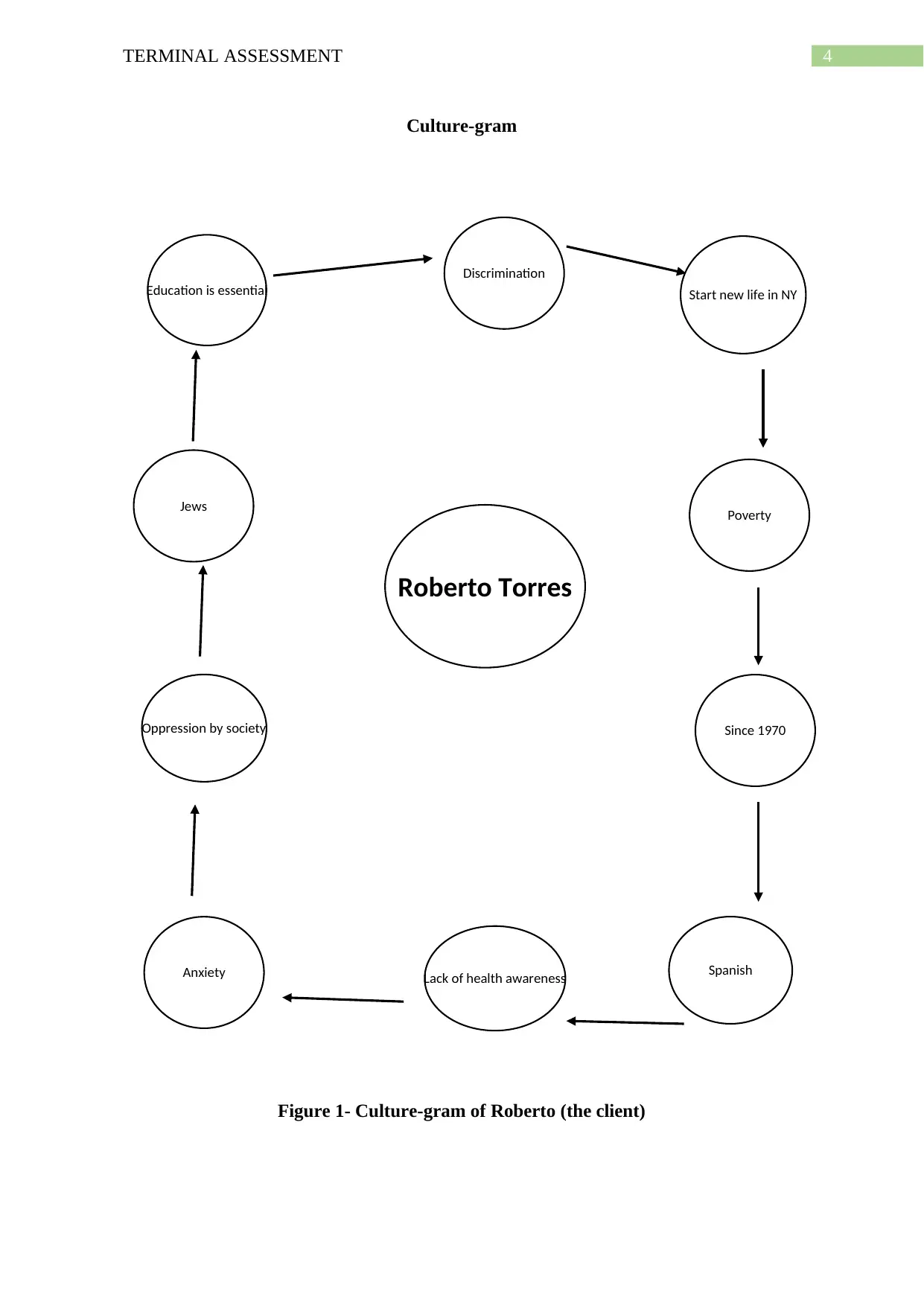
Roberto Torres
Education is essential
Jews
Oppression by society
Discrimination
Poverty
Since 1970
Spanish
Lack of health awareness
Start new life in NY
Anxiety
Culture-gram
Figure 1- Culture-gram of Roberto (the client)
Document Page
5TERMINAL ASSESSMENT
References
Becvar, R. J., & Becvar, D. S. (2017). Systems theory and family therapy: A primer. Rowman
& Littlefield.
Hilsenroth, M. J. (2017). An introduction to the special issue on psychotherapy
termination. Psychotherapy, 54(1), 1.
Koffarnus, M. N., Jarmolowicz, D. P., Mueller, E. T., & Bickel, W. K. (2013). Changing
delay discounting in the light of the competing neurobehavioral decision systems
theory: a review. Journal of the experimental analysis of behavior, 99(1), 32-57.
Lindblad-Goldberg, M., & Northey, W. F. (2013). Ecosystemic structural family therapy:
Theoretical and clinical foundations. Contemporary Family Therapy, 35(1), 147-160.
Neal, J. W., & Neal, Z. P. (2013). Nested or networked? Future directions for ecological
systems theory. Social Development, 22(4), 722-737.
Sexton, T. L., & Lebow, J. (Eds.). (2015). Handbook of family therapy. Routledge.
Swart, J., & Apsche, J. (2014). Family mode deactivation therapy (FMDT) mediation
analysis. International Journal of Behavioral Consultation and Therapy, 9(1), 1.
Swift, J. K., & Greenberg, R. P. (2015). Premature termination in psychotherapy: Strategies
for engaging clients and improving outcomes. American Psychological Association.
Turner, F. J. (2017). Social work treatment: Interlocking theoretical approaches. Oxford
University Press.
chevron_up_icon
1 out of 6
circle_padding
hide_on_mobile
zoom_out_icon
[object Object]