Analyzing Wal-Mart's E-commerce Strategies for the Future of Retail

Verified

Added on  2020/03/28

|6
|1320
|29
Report
AI Summary
This report examines the future of retail, particularly focusing on Wal-Mart's adaptation to the rise of e-commerce. It begins with an introduction to the changing retail landscape and the impact of online shopping. The report then analyzes Wal-Mart's current operations in the e-commerce market, comparing its performance to industry leaders like Amazon.com and highlighting the challenges it faces. Key points of discussion include the differences in consumer behavior between retail and e-commerce environments, emphasizing the importance of experience in retail. The report suggests strategies for Wal-Mart to become more effective with internet technology, such as integrating Wi-Fi and interactive customer experiences. Recommendations focus on creating a more social and experience-driven environment to compete with online retailers. The report concludes with a call for large-scale alterations to the physical setting of retail to enable digital adoption. References to relevant academic sources are also included.

Document Page
tabler-icon-diamond-filled.svg

Paraphrase This Document

Need a fresh take? Get an instant paraphrase of this document with our AI Paraphraser
Document Page
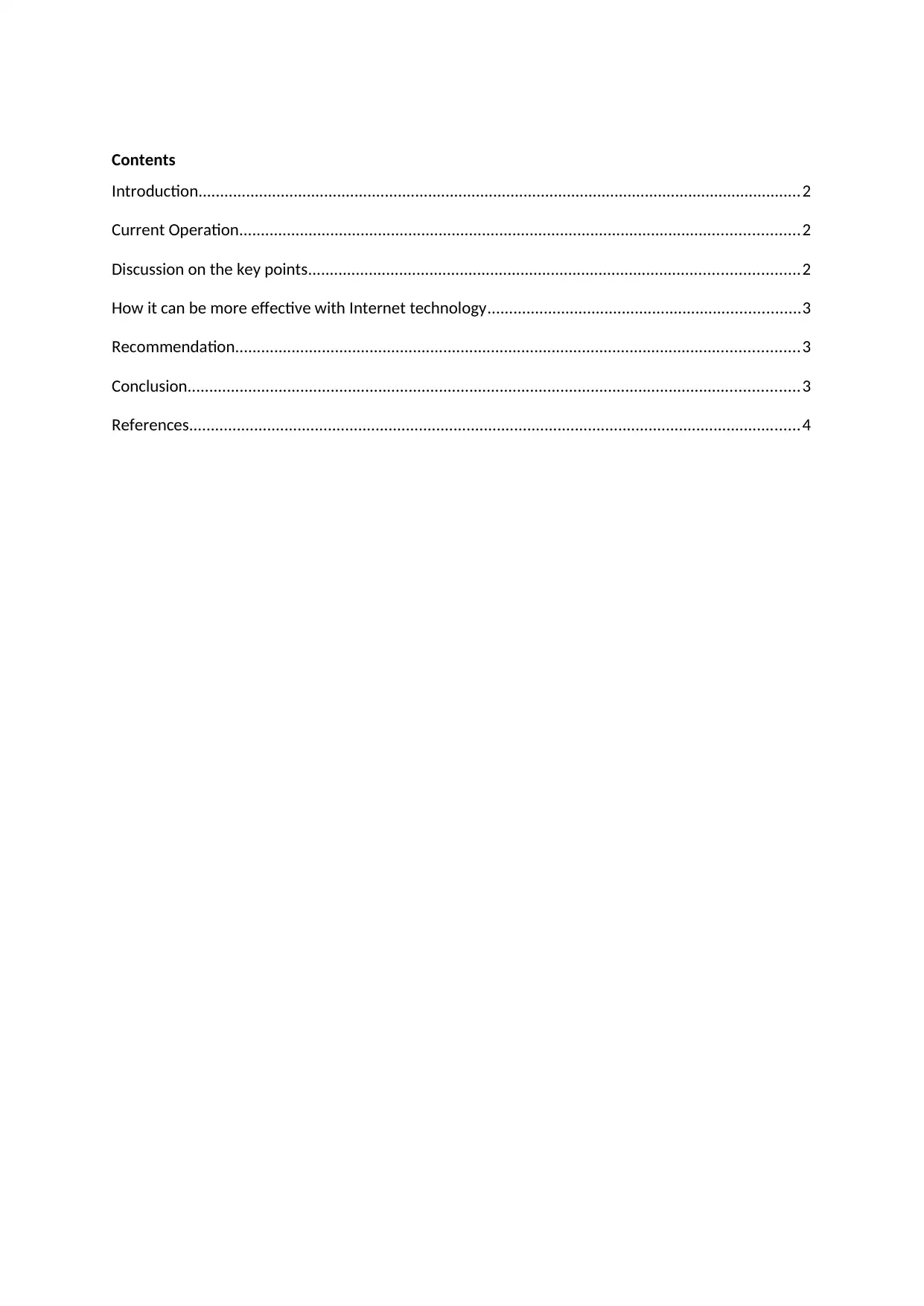
Contents
Introduction...........................................................................................................................................2
Current Operation.................................................................................................................................2
Discussion on the key points.................................................................................................................2
How it can be more effective with Internet technology........................................................................3
Recommendation..................................................................................................................................3
Conclusion.............................................................................................................................................3
References.............................................................................................................................................4
Document Page
Introduction
With the advent of ecommerce, the future of retail markets looks bleak. Though shopping has
become a human need, transforming into a form of social ritual over the years, with the increase of
online shopping, it has been observed that when compared to the marked increase of profits in the
online market, the retail market falls heavily short and lags behind to a point that threatens its
existence. This has led to the introduction of ecommerce schemes in many major retail chains,
including Wal-Mart (Wolk and Skiera, 2009). The term ‘pure retail is dead’ is slowly arising in the
minds of the experts and the statistics are clearly pointing towards this devastating future of retail
markets.
Current Operation
According to Kasiri and Ericson (2016), Currently, Wal-Mart, the giant of the retailing market, has
begun to make its mark in the ecommerce market since 2011. It is estimated that the growth of sales
in the ecommerce market will reach $22.049 trillion, a 6% growth from the previous year and that if
the rates continues, the ecommerce sales will top $27 trillion in 2020. However since the
introduction of ecommerce in Wal-Mart, the company has underperformed online. Despite having a
larger sale base than most ecommerce companies, Amazon.com, an ecommerce giant, saw an
increase of 27% in its retail sales in North America and 24% internationally, while Wal-Mart
continues to have a slow increase of 15% year after year (Weltevrenden and Boschma, 2008).
Discussion on the key points
The difference in retail market and ecommerce has been estimated in the different mindset that the
consumers go through during a transaction process (Kumar, 2016). Ecommerce markets provide
convenience and competitive along with the theme of availability by providing anything we want,
wherever we want and whenever we want. On the other hand, retail markets focuses on providing
an ‘experience’ to the consumer, that makes it beneficial for them to test a product, socialize in the
marketplace, and create a social marketing platform to lead to a sale (Zhou, Dai & Zhang, 2007). This
is the reason why it is still seen that many new releases, consumers tend to appear in the retail
market, socialize and purchase without resorting to a much more convenient ecommerce market.
Document Page
How it can be more effective with Internet technology
Wal-Mart has already started investing in an ecommerce market to hold its position as not only one
of the major retailing chains in the global market, but also a strong player in the world of
ecommerce (Bellman, Lohse & Johnson, 2000). However, due to its late entry in the ecommerce
world, the position of Wal-Mart is falling short before the giants of ecommerce like Amazon and
Ebay who are still ruling the online marketing world. However, if the future of the retail markets
needs to be held, it should merge with the digital world and make its store more experience friendly,
thus enabling Wi-Fi technology in stores and inducing customers to participate in product release
programmes, in self-customization programmes (Wirtz, Schilke and Ullrich, 2010).
Recommendation
Retail markets should not search for new channels to increase their sales, nor should they compete
to be the cheapest but rather they should start taking some serious efforts to make an environment
conducive of marketing socialization, making the distribution of ‘experience’ their main goal. Thus,
they should use interactive mechanism where customers are put into an environment where they
could try new products, play with the products, review their social networking sites, and even
customize their own products in the store (Zhou, Dai & Zhang , 2007).
Conclusion
Retailing has been an important part in the development of the market economy of the world. Now
that it’s floundering under the pressure from the new form of market facilitated by the internet,
there is a necessity to make some large scale alterations to the physical setting of the retail market
and enable the market to adopt digitalization fast.
tabler-icon-diamond-filled.svg

Paraphrase This Document

Need a fresh take? Get an instant paraphrase of this document with our AI Paraphraser
Document Page
References
Bellman, S., Lohse, G.L & Johnson, E.J., 2000, ‘Predictors of Online Buying Behavior’, Communications
of the ACM (Association for Computing Machinery), Vol. 42, No, 12: 32-38 [online].
http://www.cscanada.net/index.php/css/article/download/1087/1106 [Accessed 19th
September 2017].
Kasiri, N. and Ericson, G.S., 2016, ‘Beyond operational efficiency in retail: Rfid's tactical and strategic
implications International Conference on Intellectual Capital and Knowledge Management
and Organisational Learning, 136-142 [online]. Accessed from:
https://search.proquest.com/openview/7f0483924466f5184a645d4596365fd3/1?pq-
origsite=gscholar&cbl=1796420 [Accessed 19th September 2017]
Kumar, S., 2016, ‘Impact of Information Technology on E-Commerce in India’, International Journal
of Advanced Research in Computer Science, 7.6 [online]. Available from:
https://search.proquest.com/openview/d9e2c4883acc8f4f38e11ab0984d62ce/1?pq-
origsite=gscholar&cbl=1606379 [Accessed 20th September 2017]
Weltevrenden, J. W. & Boschma, R.A., 2008, ‘Internet strategies and the performance of Dutch
retailers’ , Journal of Retailing & Consumer Services, 15, pp. 163-178 [online]. Accessed from:
https://www.google.co.in/url?
sa=t&rct=j&q=&esrc=s&source=web&cd=3&cad=rja&uact=8&ved=0ahUKEwjrzaHw-
bbWAhWIMo8KHZ7qAu8QFggzMAI&url=http%3A%2F%2Foro.open.ac.uk
%2F24815%2F2%2F88C00795.pdf&usg=AFQjCNEn6ZLb-w0NNJ1syEdoW0lqSkBQnQ
[Accessed 20th September 2017]
Wirtz, B.W., Schilke, O. & Ullrich, S., 2010, ‘Strategic Development of Business Models:: Implications
of the Web 2.0 for Creating Value on the Internet’ Long Range Planning [in press], pps 19
[online]. Available from: https://www.google.co.in/url?
sa=t&rct=j&q=&esrc=s&source=web&cd=2&cad=rja&uact=8&ved=0ahUKEwiM9reL-
bbWAhXGRY8KHQBmDm4QFggvMAE&url=http%3A%2F%2Fisiarticles.com%2Fbundles
%2FArticle%2Fpre%2Fpdf%2F7685.pdf&usg=AFQjCNHpE2N0iW18ad5E_sDjdAAYt37DMw
[Accessed 20 September 2017]
Wolk, A. & Skiera, B., 2009, ‘Antecedents and consequences of Internet channel performance’,
Journal of Retailing & Consumer Services, 16, pp. 163-173 [online]. Available from
Document Page
https://www.google.co.in/url?
sa=t&rct=j&q=&esrc=s&source=web&cd=6&cad=rja&uact=8&ved=0ahUKEwjk8ZnD-
rbWAhUGuo8KHT4QAIEQFgg3MAU&url=http%3A%2F%2Fwww.toknowpress.net%2FISBN
%2F978-961-6914-16-1%2Fpapers%2FML16-
022.pdf&usg=AFQjCNFOXK5Dh64RO3i3OjHV4PAUAIL38w [Accessed 19th September 2017]
Zhou, L., Dai, L & Zhang, D., 2007, ‘Online Shopping Acceptance Model – A Critical Survey of
Consumer Factors in Online Shopping’, Journal of Electronic Commerce Research, Vol. 8, No.
1:41-62 [online. Available from: https://www.google.co.in/url?
sa=t&rct=j&q=&esrc=s&source=web&cd=1&cad=rja&uact=8&ved=0ahUKEwiFpZmb-
rbWAhUZT48KHcT5BX0QFggnMAA&url=http%3A%2F%2Fojs.jecr.org%2Fjecr%2Fsites
%2Fdefault%2Ffiles%2F08_1_p04.pdf&usg=AFQjCNHgo0ww6SDKJyMEYOeDzyJ1AUKg2A
[Accessed 20th September 2017]
chevron_up_icon
1 out of 6
circle_padding
hide_on_mobile
zoom_out_icon
[object Object]