Critical Reflective Report on Canvas Tools and PDP
VerifiedAdded on 2021/08/16
|13
|3049
|28
Report
AI Summary
This report critically examines self-assessment tools available within the Canvas platform, focusing on their application in personal and professional development. The report delves into the Belbin Team Role model, the MC RAE BIG 5 Personality Questionnaire, SWOT analysis, and reflective learning, evaluating their strengths, weaknesses, and potential for enhancing individual growth and team dynamics. A significant portion of the report is dedicated to outlining a Personal Development Plan (PDP), which includes identifying goals, setting timelines, conducting personal analyses using SWOT, and formulating an actionable plan to achieve specific objectives, such as completing an MBA, developing leadership skills, and contributing to company goals. The PDP incorporates SMART goals and utilizes the insights gained from the Canvas tools to inform strategies for improvement and career advancement, particularly focusing on the role of a software Senior Quality Assurance Lead. The report concludes by emphasizing the value of these tools and the PDP in fostering personal growth and achieving business objectives. The report is contributed by a student to be published on the website Desklib. Desklib is a platform which provides all the necessary AI based study tools for students.
Task 2: Using the self-assessment tools in Canvas, provide a critical
reflective report of the tools and an outline Personal Development
Plan
1. Introduction to the personal development plan (PDP)
The process of identifying needs of education, settings goals accordingly, start activities to
address the learning needs and produce evidence to confirm that new knowledge and skills
have been achieved is called as Personal Development Plan. (Adair and Allen, 2003) Personal
Development Plan develops long-term carrier goals and showing a path on how to achieve
them. To identify what exactly to do to achieve goals, the initial step should be to identify the
current situation. This can be achieved by using classic business tools such as SWOT analysis
and PEST analysis. Manktelow (2014).
Personal Development Plan also can be defined as a tool used to asses employees in an
organization. (Brown, 1995; McMullan et al., 2003). PDP can serve two main purposes namely
professional development and certification. (Smith & Tillema, 2001). The authors also
mentioned that professional development would be sustained if the PDP used voluntarily.
However, some other researchers made a point that employees did not get the use of PDP unless
it is mandatory. (Bunker & Leggett, 2004). As an assessment tool PDP influence in the
development as below (McMullan et al., 2003; Redman, 1994; Seng & Seng, 1996)
Summary of the skills the employee had and future skills that he plans to gain.
Should be a plan that employee himself should create incorporated with his supervisor
It could be used as a basis when appraising the employee by his supervisor.
Acts as a decision-making tool to plan training needs and evaluating the sustainability of a
promotion.
According to Knowles (1975), PDP suites well with adult learning. PDP supports a self-driven
way of learning therefore employees take responsibility for his own learning. (Lyons & Evans,
1997). Employees evaluate their learning results, further analyze what are the learning needs,
settings goals of learning and selecting proper tasks of learning. (Kicken, et al, 2008). PDP
allows employees to use their past experiences for learning. Experience can be valuable
knowledge that employees gained. That knowledge can be brought into the surface by using
reflective report of the tools and an outline Personal Development
Plan
1. Introduction to the personal development plan (PDP)
The process of identifying needs of education, settings goals accordingly, start activities to
address the learning needs and produce evidence to confirm that new knowledge and skills
have been achieved is called as Personal Development Plan. (Adair and Allen, 2003) Personal
Development Plan develops long-term carrier goals and showing a path on how to achieve
them. To identify what exactly to do to achieve goals, the initial step should be to identify the
current situation. This can be achieved by using classic business tools such as SWOT analysis
and PEST analysis. Manktelow (2014).
Personal Development Plan also can be defined as a tool used to asses employees in an
organization. (Brown, 1995; McMullan et al., 2003). PDP can serve two main purposes namely
professional development and certification. (Smith & Tillema, 2001). The authors also
mentioned that professional development would be sustained if the PDP used voluntarily.
However, some other researchers made a point that employees did not get the use of PDP unless
it is mandatory. (Bunker & Leggett, 2004). As an assessment tool PDP influence in the
development as below (McMullan et al., 2003; Redman, 1994; Seng & Seng, 1996)
Summary of the skills the employee had and future skills that he plans to gain.
Should be a plan that employee himself should create incorporated with his supervisor
It could be used as a basis when appraising the employee by his supervisor.
Acts as a decision-making tool to plan training needs and evaluating the sustainability of a
promotion.
According to Knowles (1975), PDP suites well with adult learning. PDP supports a self-driven
way of learning therefore employees take responsibility for his own learning. (Lyons & Evans,
1997). Employees evaluate their learning results, further analyze what are the learning needs,
settings goals of learning and selecting proper tasks of learning. (Kicken, et al, 2008). PDP
allows employees to use their past experiences for learning. Experience can be valuable
knowledge that employees gained. That knowledge can be brought into the surface by using

Paraphrase This Document
Need a fresh take? Get an instant paraphrase of this document with our AI Paraphraser
the reflection of the experience. Alsop (2002) defines reflections as: “the images of our
experiences, revisited for learning”.
2. Critical reflective report on tools in Canvas.
Below are the tools identified in the Canvas.
Belbin Team Role model
MC RAE BIG 5 Personality Questionnaire.
SWOT Analysis
Reflective learning
2.1 Belbin Team Role model
Successful teamwork has become an important concern in most companies. The team role
model developed by Belbin and his team (1981) has identified eight roles based on the behavior
characteristics of each team member has. The ninth role was added in 1993 and currently, the
model consists of nine team roles. Defined team roles are Plant, Co-Ordinator, Evaluator,
Implementer, Completer, Resource investigator, shaper, team worker, and specialist. The role
is defined based on six factors. Personality, mental ability, current values and motivation, field
constraints, experience, and role learning.
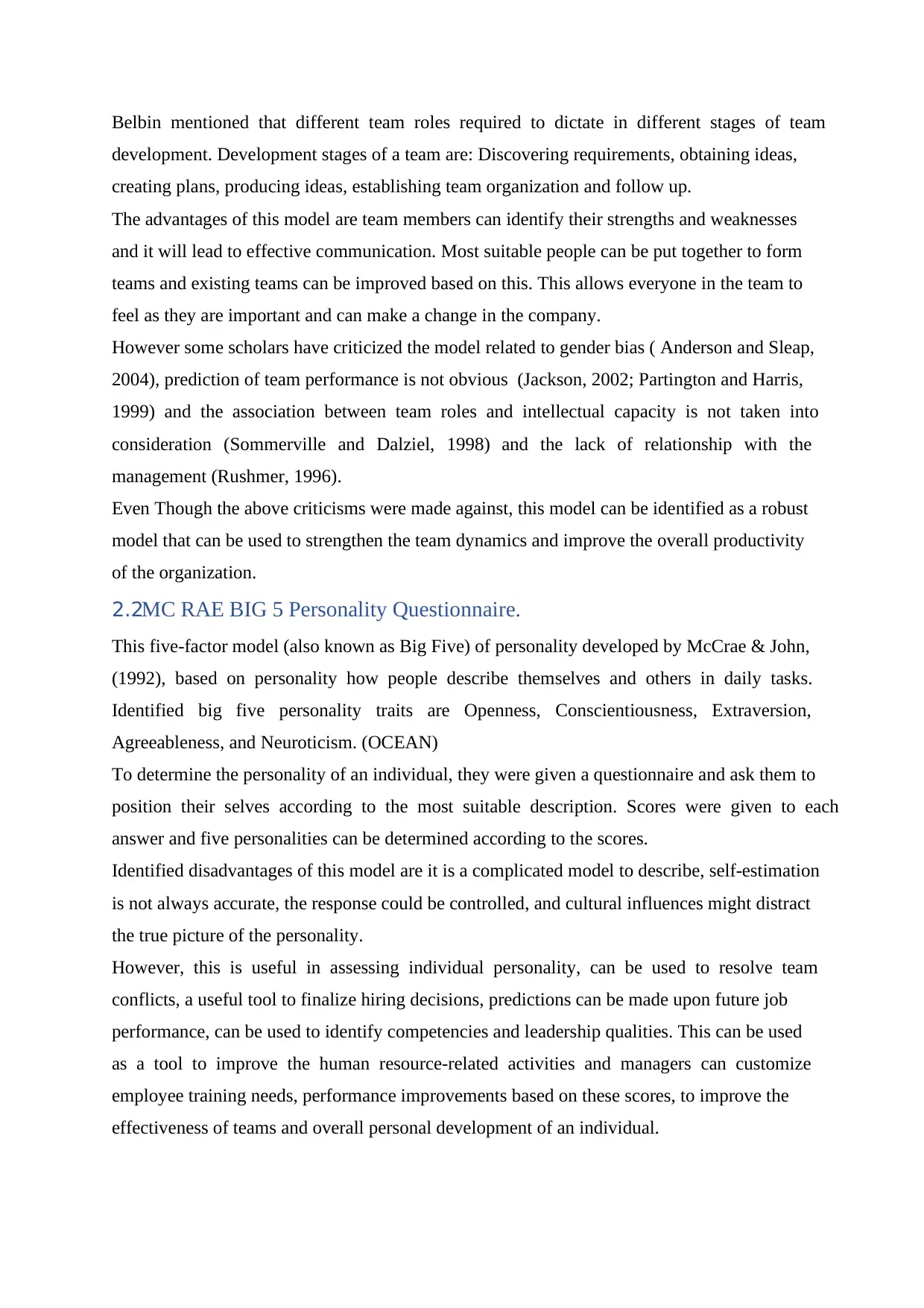
Each role has identified its strengths and weaknesses as displayed below.
Table 01: Strengths and weaknesses of each role
experiences, revisited for learning”.
2. Critical reflective report on tools in Canvas.
Below are the tools identified in the Canvas.
Belbin Team Role model
MC RAE BIG 5 Personality Questionnaire.
SWOT Analysis
Reflective learning
2.1 Belbin Team Role model
Successful teamwork has become an important concern in most companies. The team role
model developed by Belbin and his team (1981) has identified eight roles based on the behavior
characteristics of each team member has. The ninth role was added in 1993 and currently, the
model consists of nine team roles. Defined team roles are Plant, Co-Ordinator, Evaluator,
Implementer, Completer, Resource investigator, shaper, team worker, and specialist. The role
is defined based on six factors. Personality, mental ability, current values and motivation, field
constraints, experience, and role learning.
Each role has identified its strengths and weaknesses as displayed below.
Table 01: Strengths and weaknesses of each role
Belbin mentioned that different team roles required to dictate in different stages of team
development. Development stages of a team are: Discovering requirements, obtaining ideas,
creating plans, producing ideas, establishing team organization and follow up.
The advantages of this model are team members can identify their strengths and weaknesses
and it will lead to effective communication. Most suitable people can be put together to form
teams and existing teams can be improved based on this. This allows everyone in the team to
feel as they are important and can make a change in the company.
However some scholars have criticized the model related to gender bias ( Anderson and Sleap,
2004), prediction of team performance is not obvious (Jackson, 2002; Partington and Harris,
1999) and the association between team roles and intellectual capacity is not taken into
consideration (Sommerville and Dalziel, 1998) and the lack of relationship with the
management (Rushmer, 1996).
Even Though the above criticisms were made against, this model can be identified as a robust
model that can be used to strengthen the team dynamics and improve the overall productivity
of the organization.
2.2MC RAE BIG 5 Personality Questionnaire.
This five-factor model (also known as Big Five) of personality developed by McCrae & John,
(1992), based on personality how people describe themselves and others in daily tasks.
Identified big five personality traits are Openness, Conscientiousness, Extraversion,
Agreeableness, and Neuroticism. (OCEAN)
To determine the personality of an individual, they were given a questionnaire and ask them to
position their selves according to the most suitable description. Scores were given to each
answer and five personalities can be determined according to the scores.
Identified disadvantages of this model are it is a complicated model to describe, self-estimation
is not always accurate, the response could be controlled, and cultural influences might distract
the true picture of the personality.
However, this is useful in assessing individual personality, can be used to resolve team
conflicts, a useful tool to finalize hiring decisions, predictions can be made upon future job
performance, can be used to identify competencies and leadership qualities. This can be used
as a tool to improve the human resource-related activities and managers can customize
employee training needs, performance improvements based on these scores, to improve the
effectiveness of teams and overall personal development of an individual.
development. Development stages of a team are: Discovering requirements, obtaining ideas,
creating plans, producing ideas, establishing team organization and follow up.
The advantages of this model are team members can identify their strengths and weaknesses
and it will lead to effective communication. Most suitable people can be put together to form
teams and existing teams can be improved based on this. This allows everyone in the team to
feel as they are important and can make a change in the company.
However some scholars have criticized the model related to gender bias ( Anderson and Sleap,
2004), prediction of team performance is not obvious (Jackson, 2002; Partington and Harris,
1999) and the association between team roles and intellectual capacity is not taken into
consideration (Sommerville and Dalziel, 1998) and the lack of relationship with the
management (Rushmer, 1996).
Even Though the above criticisms were made against, this model can be identified as a robust
model that can be used to strengthen the team dynamics and improve the overall productivity
of the organization.
2.2MC RAE BIG 5 Personality Questionnaire.
This five-factor model (also known as Big Five) of personality developed by McCrae & John,
(1992), based on personality how people describe themselves and others in daily tasks.
Identified big five personality traits are Openness, Conscientiousness, Extraversion,
Agreeableness, and Neuroticism. (OCEAN)
To determine the personality of an individual, they were given a questionnaire and ask them to
position their selves according to the most suitable description. Scores were given to each
answer and five personalities can be determined according to the scores.
Identified disadvantages of this model are it is a complicated model to describe, self-estimation
is not always accurate, the response could be controlled, and cultural influences might distract
the true picture of the personality.
However, this is useful in assessing individual personality, can be used to resolve team
conflicts, a useful tool to finalize hiring decisions, predictions can be made upon future job
performance, can be used to identify competencies and leadership qualities. This can be used
as a tool to improve the human resource-related activities and managers can customize
employee training needs, performance improvements based on these scores, to improve the
effectiveness of teams and overall personal development of an individual.
⊘ This is a preview!⊘
Do you want full access?
Subscribe today to unlock all pages.

Trusted by 1+ million students worldwide
2.3 SWOT Analysis
Professor K. Andrews (1963) used the acronym SWOT to describe the terms Strengths,
Weaknesses, Opportunities, and Threats. This has been widely used in strategic planning in
organizations around the world. Application of SWOT analysis also useful in individual
personal development which enables to evaluate internal, external strengths for achieving goals
and opportunities and threats to improving himself. Actions can be developed according to the
analysis of results. Measurements can be used to develop the strengths, overcome weaknesses,
and use opportunities to avoid threats. Depending on the analysis the personal development
could plan strategically to achieve personal goals.
There are several advantages can be identified in conducting a personal SWOT analysis. It
supports identifying the current state of where the individual stands, supports to develop
strategies to reach goals, identified opportunities can be used to overcome weaknesses,
determine corrective actions to conquer weaknesses and is time and cost-effective. (Emiliyaa,
Nataliab and Olegc, 2017)
Even though it has several advantages some implications also can be identified. It does not
provide a mechanism to rank the importance of one factor vs other, so it is hard to determine
the impact of the factors. Since it is a one-dimensional model it cannot identify the impact
made by the combination of factors. SWOT analysis involves subjective measurements among
individuals. Therefore the decisions made upon this might not be reliable.
(Coles.kennesaw.edu, 2020)
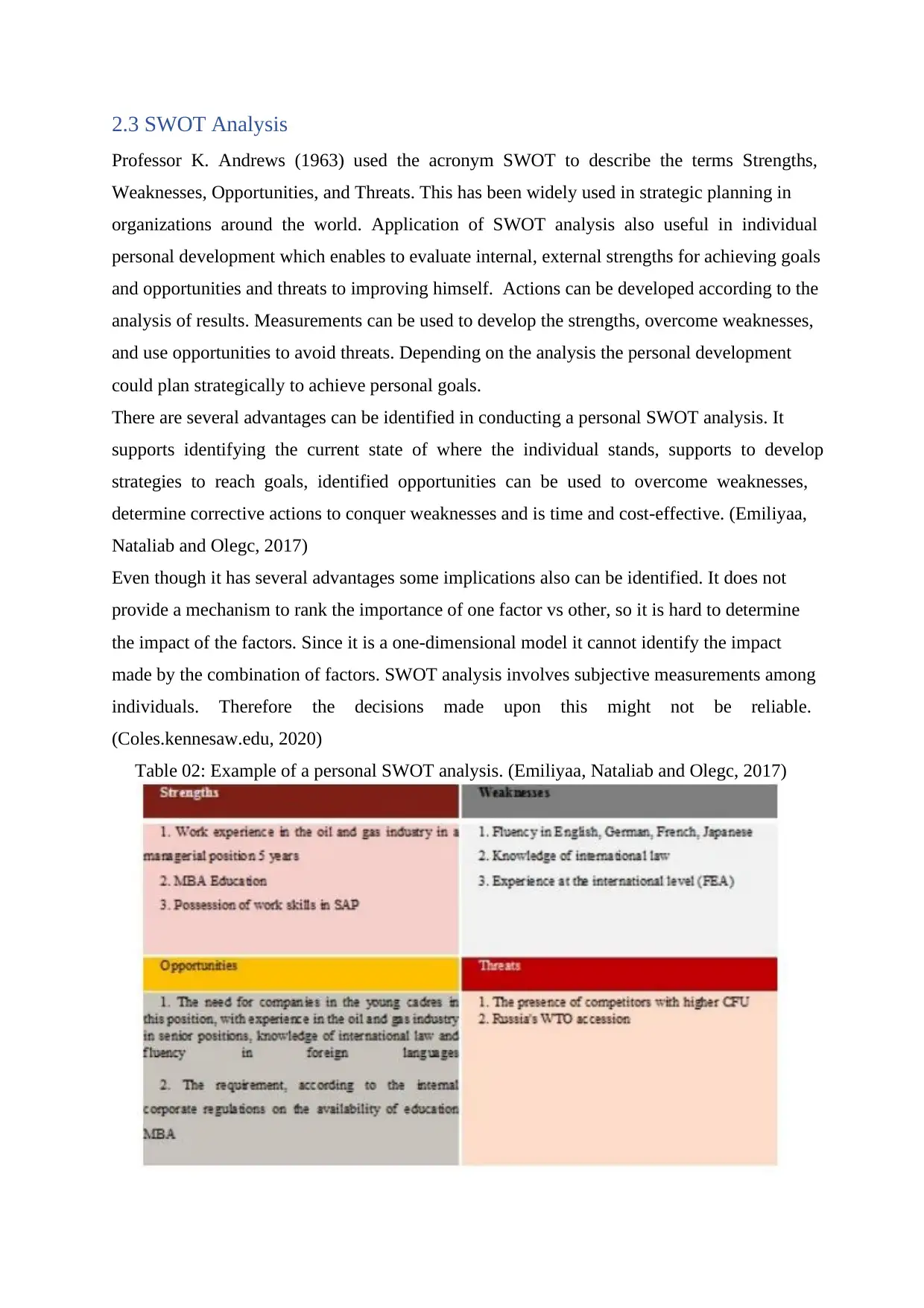
Table 02: Example of a personal SWOT analysis. (Emiliyaa, Nataliab and Olegc, 2017)
Professor K. Andrews (1963) used the acronym SWOT to describe the terms Strengths,
Weaknesses, Opportunities, and Threats. This has been widely used in strategic planning in
organizations around the world. Application of SWOT analysis also useful in individual
personal development which enables to evaluate internal, external strengths for achieving goals
and opportunities and threats to improving himself. Actions can be developed according to the
analysis of results. Measurements can be used to develop the strengths, overcome weaknesses,
and use opportunities to avoid threats. Depending on the analysis the personal development
could plan strategically to achieve personal goals.
There are several advantages can be identified in conducting a personal SWOT analysis. It
supports identifying the current state of where the individual stands, supports to develop
strategies to reach goals, identified opportunities can be used to overcome weaknesses,
determine corrective actions to conquer weaknesses and is time and cost-effective. (Emiliyaa,
Nataliab and Olegc, 2017)
Even though it has several advantages some implications also can be identified. It does not
provide a mechanism to rank the importance of one factor vs other, so it is hard to determine
the impact of the factors. Since it is a one-dimensional model it cannot identify the impact
made by the combination of factors. SWOT analysis involves subjective measurements among
individuals. Therefore the decisions made upon this might not be reliable.
(Coles.kennesaw.edu, 2020)
Table 02: Example of a personal SWOT analysis. (Emiliyaa, Nataliab and Olegc, 2017)
Paraphrase This Document
Need a fresh take? Get an instant paraphrase of this document with our AI Paraphraser
2.4 Reflective learning
Reflective learning is a purposeful process of accepting what we will call “cycles of inquiry”.
The reflection leads to action and cycle between action and reflection. It will result in doing
things differently and can reflect on what will happen next. (Ramsey, 2006)
Some of the limitations that can be identified in reflective learning are the difficulty of
understanding, an individual might feel uncomfortable to evaluate and challenge their own
procedure, might cause confusion on determining which experiences to reflect upon and time-
consuming.
Yet this tool could be used to enhance personal development in many ways. It helps to improve
the common sense, so the existing knowledge can be used to generate new ideas, make
assumptions more specific, it encourages individuals to learn new skills, understand new
concepts relating them to experience, helps to develop a critical evaluation of past learning
experiences. (Jonnie Jill, 2020)
3. Personal development plan
3.1 Outline of a personal development plan
When achieving certain goals, having a detailed plan is crucial. There are different ways of
implementing a personal development plan. However, it contains some common basic steps
below.
1. Identify and prioritize goals
2. Setup a timeline
3. Personal analysis to Identify strengths and weaknesses
4. Action plan
1. Identify goals and prioritize goals with a timeline
As a team leader, it is essential to asses myself identify my leadership style, strengths,
weaknesses and required action plan to overcome flaws we and improve capabilities. I seek to
advance my next level of leadership into the corporate management team within the coming
years. To achieve these goals the PDP would be a great tool. It would help me to identify my
performance areas and improvements needed. PDF will guide me to understand my leadership
style, get feedback from teammates and resolve skill gap issues of team members.
Reflective learning is a purposeful process of accepting what we will call “cycles of inquiry”.
The reflection leads to action and cycle between action and reflection. It will result in doing
things differently and can reflect on what will happen next. (Ramsey, 2006)
Some of the limitations that can be identified in reflective learning are the difficulty of
understanding, an individual might feel uncomfortable to evaluate and challenge their own
procedure, might cause confusion on determining which experiences to reflect upon and time-
consuming.
Yet this tool could be used to enhance personal development in many ways. It helps to improve
the common sense, so the existing knowledge can be used to generate new ideas, make
assumptions more specific, it encourages individuals to learn new skills, understand new
concepts relating them to experience, helps to develop a critical evaluation of past learning
experiences. (Jonnie Jill, 2020)
3. Personal development plan
3.1 Outline of a personal development plan
When achieving certain goals, having a detailed plan is crucial. There are different ways of
implementing a personal development plan. However, it contains some common basic steps
below.
1. Identify and prioritize goals
2. Setup a timeline
3. Personal analysis to Identify strengths and weaknesses
4. Action plan
1. Identify goals and prioritize goals with a timeline
As a team leader, it is essential to asses myself identify my leadership style, strengths,
weaknesses and required action plan to overcome flaws we and improve capabilities. I seek to
advance my next level of leadership into the corporate management team within the coming
years. To achieve these goals the PDP would be a great tool. It would help me to identify my
performance areas and improvements needed. PDF will guide me to understand my leadership
style, get feedback from teammates and resolve skill gap issues of team members.
The first step is to identify goals for the next two years. Goals should be Specific, Measurable,
Attainable, Relevant and Time-bound. (SMART)
Goals for the next 2 years:
Completing the MBA
Further develop leadership skills and qualities in formulating directions for sub-
ordinates and peers – End of the year 2020
Contribute more towards to achieve company goals – End of the year 2020
Widen my understanding of leadership and join into Corporate Leadership Team –
End of the year 2021
2. Personal analysis to Identify strengths and weaknesses
I am a software Senior Quality Assurance Lead handling a team of 14 engineers in a Small –
medium-size software engineering organization. To achieve the above-mentioned goals, it is
essential to identify my strengths, weaknesses, and opportunities to grow. And as well as team
member’s personalities and their skills.
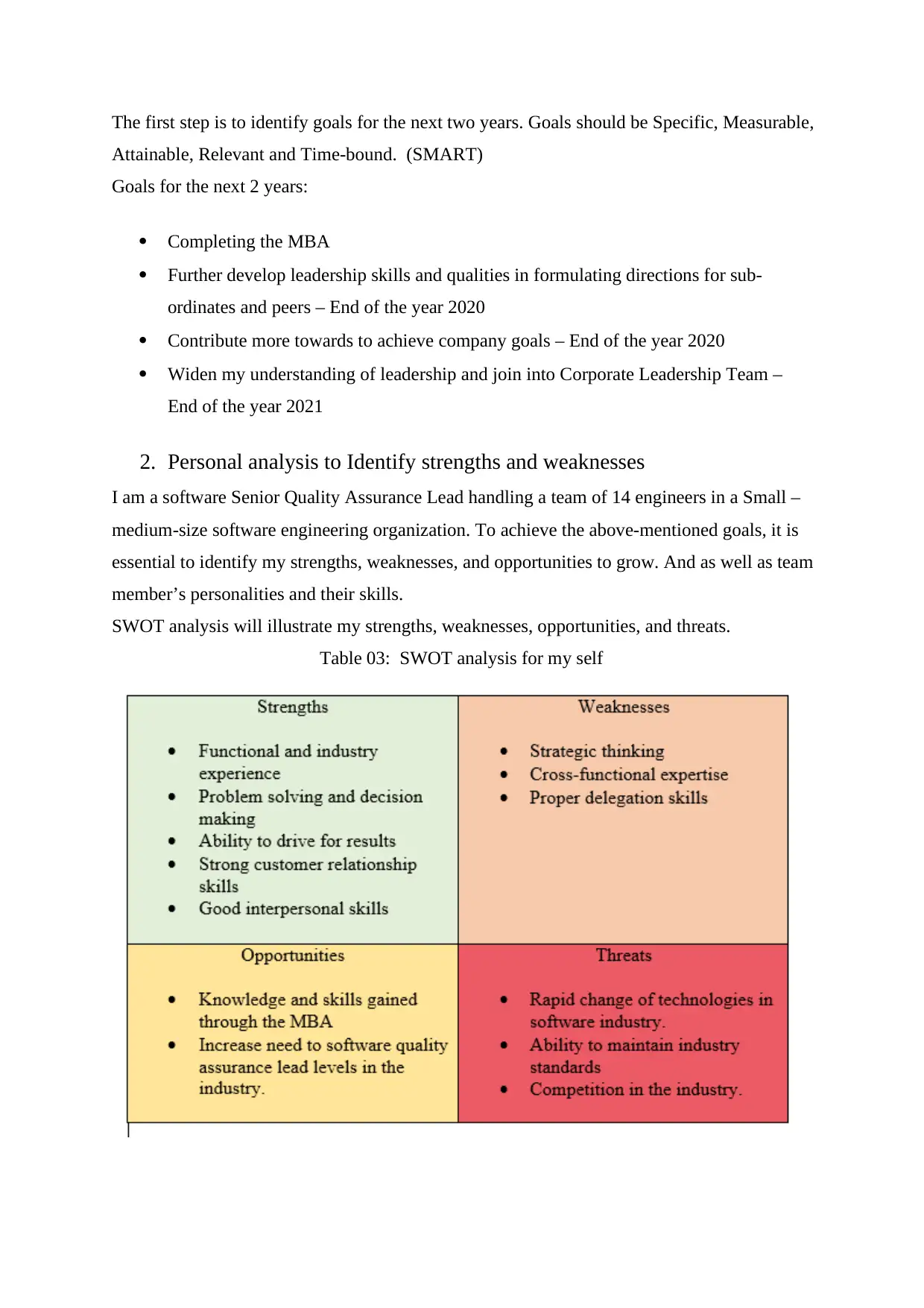
SWOT analysis will illustrate my strengths, weaknesses, opportunities, and threats.
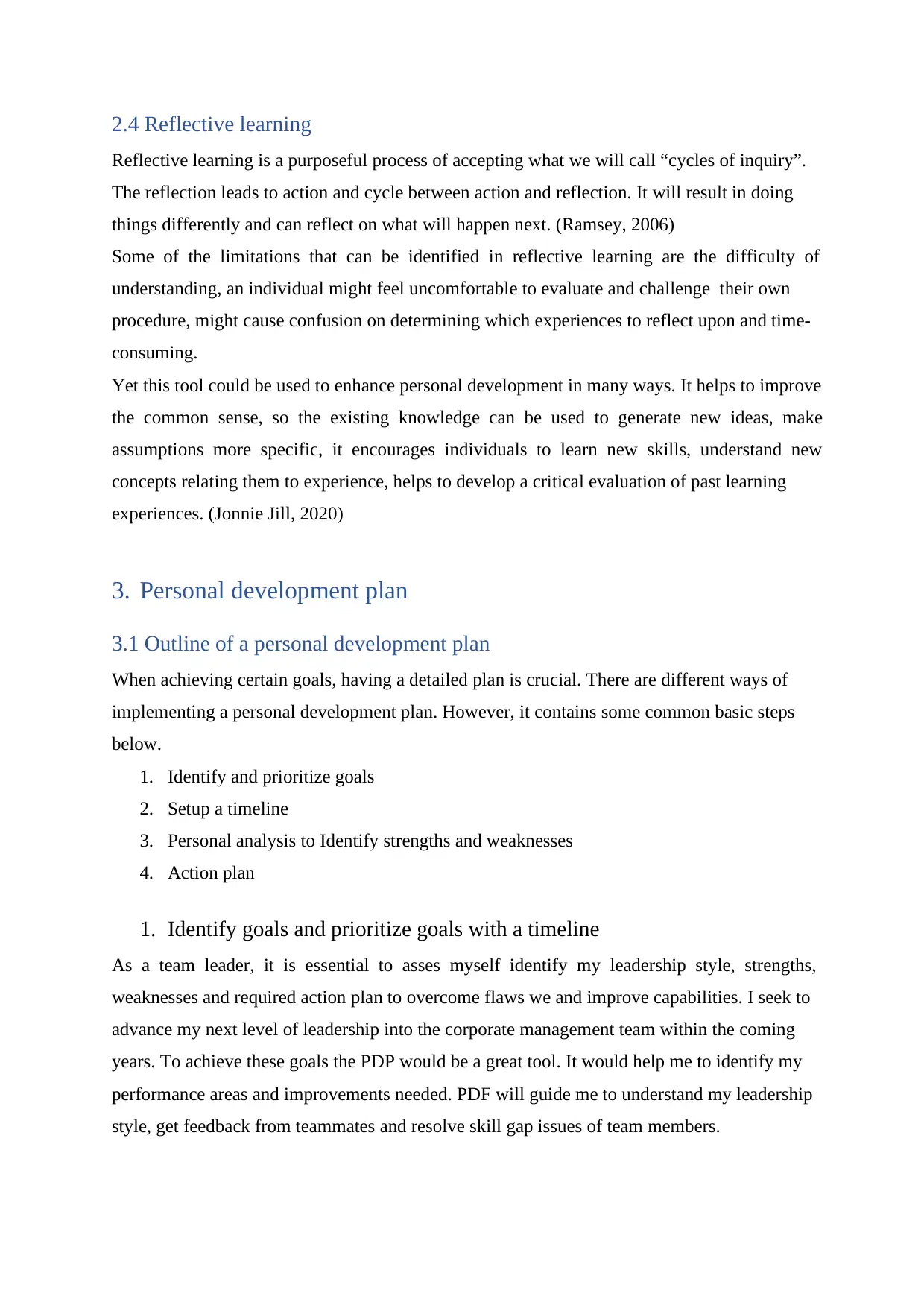
Table 03: SWOT analysis for my self
Attainable, Relevant and Time-bound. (SMART)
Goals for the next 2 years:
Completing the MBA
Further develop leadership skills and qualities in formulating directions for sub-
ordinates and peers – End of the year 2020
Contribute more towards to achieve company goals – End of the year 2020
Widen my understanding of leadership and join into Corporate Leadership Team –
End of the year 2021
2. Personal analysis to Identify strengths and weaknesses
I am a software Senior Quality Assurance Lead handling a team of 14 engineers in a Small –
medium-size software engineering organization. To achieve the above-mentioned goals, it is
essential to identify my strengths, weaknesses, and opportunities to grow. And as well as team
member’s personalities and their skills.
SWOT analysis will illustrate my strengths, weaknesses, opportunities, and threats.
Table 03: SWOT analysis for my self
⊘ This is a preview!⊘
Do you want full access?
Subscribe today to unlock all pages.
Trusted by 1+ million students worldwide
Belbin team role
This will enable me to set up balanced teams based on their behavior, choosing the right people
to do the right tasks, impartial in making team decisions, make decisions confidently when
involving with people. As a team lead it would help to be a more people-oriented person, well-
equipped to help the team to maximize their potential, for resolving team conflicts and for
better engagement of the team.
According to the role models described here, I can identify myself as a Completer- Finisher.
Which describes as a person who is persuading towards the completion of tasks thoroughly and
perfectly and pays attention to detail a lot. They describe as perfectionists but weaknesses are
anxious and issues in the delegation of tasks.
MC Rae big 5 personality questionnaire.
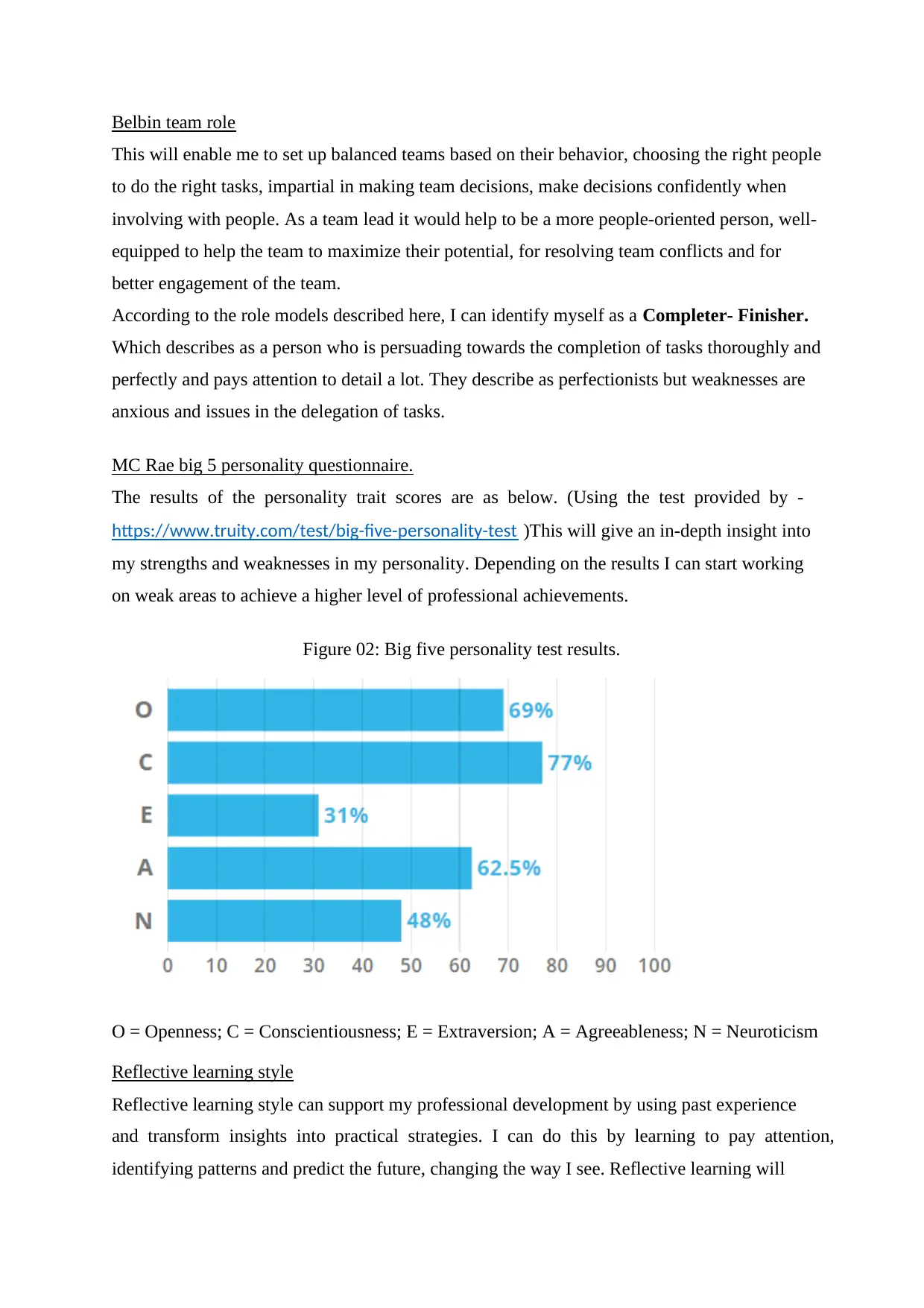
The results of the personality trait scores are as below. (Using the test provided by -
https://www.truity.com/test/big-five-personality-test )This will give an in-depth insight into
my strengths and weaknesses in my personality. Depending on the results I can start working
on weak areas to achieve a higher level of professional achievements.
Figure 02: Big five personality test results.
O = Openness; C = Conscientiousness; E = Extraversion; A = Agreeableness; N = Neuroticism
Reflective learning style
Reflective learning style can support my professional development by using past experience
and transform insights into practical strategies. I can do this by learning to pay attention,
identifying patterns and predict the future, changing the way I see. Reflective learning will
This will enable me to set up balanced teams based on their behavior, choosing the right people
to do the right tasks, impartial in making team decisions, make decisions confidently when
involving with people. As a team lead it would help to be a more people-oriented person, well-
equipped to help the team to maximize their potential, for resolving team conflicts and for
better engagement of the team.
According to the role models described here, I can identify myself as a Completer- Finisher.
Which describes as a person who is persuading towards the completion of tasks thoroughly and
perfectly and pays attention to detail a lot. They describe as perfectionists but weaknesses are
anxious and issues in the delegation of tasks.
MC Rae big 5 personality questionnaire.
The results of the personality trait scores are as below. (Using the test provided by -
https://www.truity.com/test/big-five-personality-test )This will give an in-depth insight into
my strengths and weaknesses in my personality. Depending on the results I can start working
on weak areas to achieve a higher level of professional achievements.
Figure 02: Big five personality test results.
O = Openness; C = Conscientiousness; E = Extraversion; A = Agreeableness; N = Neuroticism
Reflective learning style
Reflective learning style can support my professional development by using past experience
and transform insights into practical strategies. I can do this by learning to pay attention,
identifying patterns and predict the future, changing the way I see. Reflective learning will
Paraphrase This Document
Need a fresh take? Get an instant paraphrase of this document with our AI Paraphraser
enable me to increment the wider perspective of learning and to see the holistic picture. This
will help me to understand my team, the management, customers and avoid making the same
mistake again. Which will enable to shape my career to a managerial position.
3. Action plan
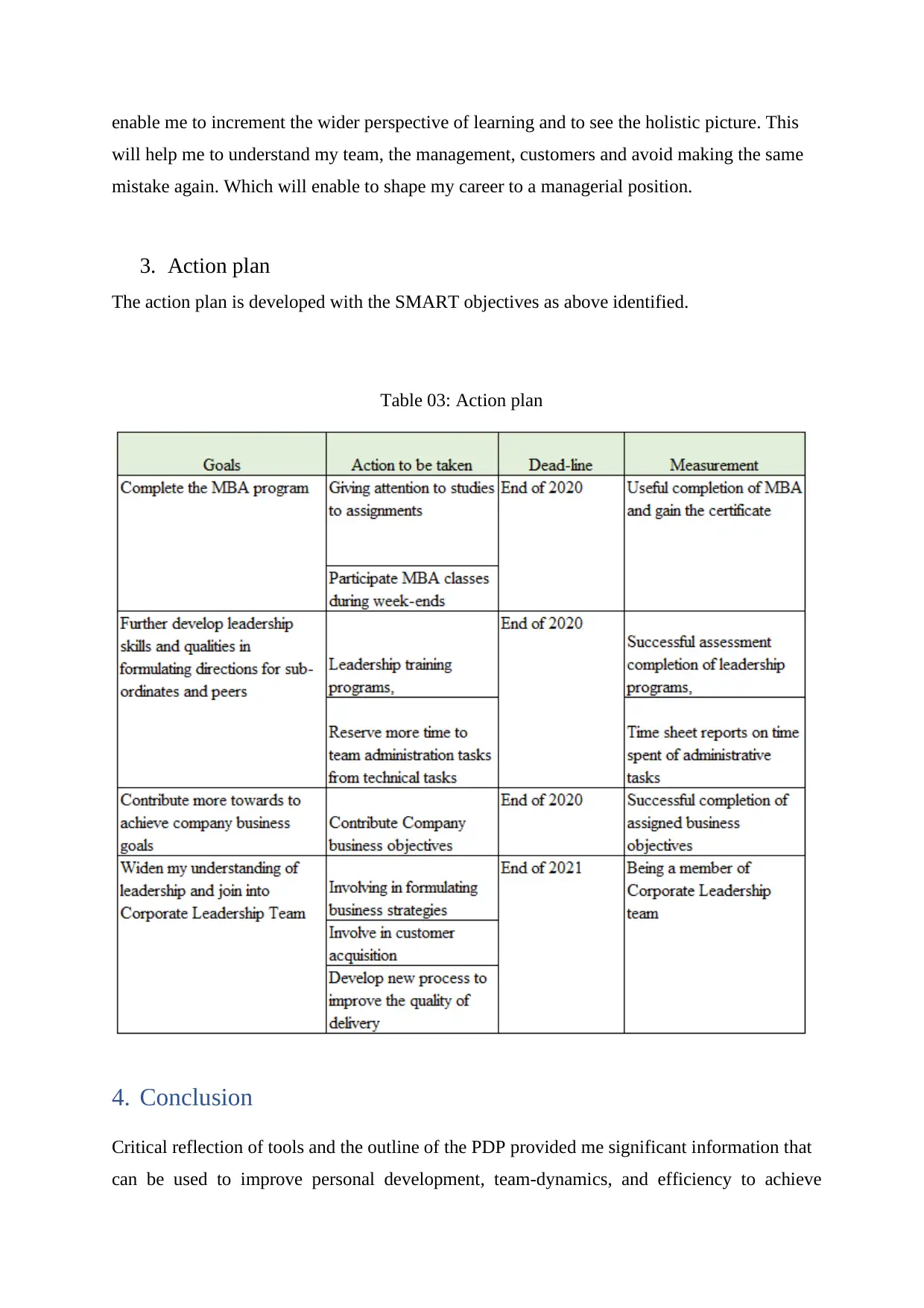
The action plan is developed with the SMART objectives as above identified.
Table 03: Action plan
4. Conclusion
Critical reflection of tools and the outline of the PDP provided me significant information that
can be used to improve personal development, team-dynamics, and efficiency to achieve
will help me to understand my team, the management, customers and avoid making the same
mistake again. Which will enable to shape my career to a managerial position.
3. Action plan
The action plan is developed with the SMART objectives as above identified.
Table 03: Action plan
4. Conclusion
Critical reflection of tools and the outline of the PDP provided me significant information that
can be used to improve personal development, team-dynamics, and efficiency to achieve
company business goals. The outline of the PDP helped me to understand my current status
and future improvement needs to achieve professional goals.
References
Adair, J. and Allen, M. (2003). The concise time management and personal development.
London: Thorogood.
Alsop, A. (2002). Portfolios: Portraits of our professional lives. British Journal of
Occupational Therapy, 65 (5), 201-206.
Anderson, N. and Sleap, S. (2004). ‘An evaluation of gender differences on the Belbin Team
Role SelfPerception Inventory’. Journal of Occupational and Organizational Psychology, 77,
429–37.
Beck, R.J., Livne, N.L., & Bear, S.L. (2005). Teachers' self-assessment of the effects of
formative and summative electronic portfolios on professional development. European
Journal of Teacher Education, 28, 221-244
Belbin, M. (1981). Management Teams, Why They Succeed or Fail. London: Heinemann.
Belbin, M. (1993a). Team Roles at Work. Oxford: Butterworth-Heinemann
Brown, R. (1995). Portfolio development and profiling for nurses, 2nd edn. Lancaster: Quay
Publications.
Bunker, A., & Leggett, M. (2004). Being wise about teaching portfolios: Exploring the
barriers to their development and maintenance
Coles.kennesaw.edu. (2020). [online] Available at:
https://coles.kennesaw.edu/advising/docs/BUSA-4150-The-Personal-SWOT-Analysis.pdf
[Accessed 22 Feb. 2020].
and future improvement needs to achieve professional goals.
References
Adair, J. and Allen, M. (2003). The concise time management and personal development.
London: Thorogood.
Alsop, A. (2002). Portfolios: Portraits of our professional lives. British Journal of
Occupational Therapy, 65 (5), 201-206.
Anderson, N. and Sleap, S. (2004). ‘An evaluation of gender differences on the Belbin Team
Role SelfPerception Inventory’. Journal of Occupational and Organizational Psychology, 77,
429–37.
Beck, R.J., Livne, N.L., & Bear, S.L. (2005). Teachers' self-assessment of the effects of
formative and summative electronic portfolios on professional development. European
Journal of Teacher Education, 28, 221-244
Belbin, M. (1981). Management Teams, Why They Succeed or Fail. London: Heinemann.
Belbin, M. (1993a). Team Roles at Work. Oxford: Butterworth-Heinemann
Brown, R. (1995). Portfolio development and profiling for nurses, 2nd edn. Lancaster: Quay
Publications.
Bunker, A., & Leggett, M. (2004). Being wise about teaching portfolios: Exploring the
barriers to their development and maintenance
Coles.kennesaw.edu. (2020). [online] Available at:
https://coles.kennesaw.edu/advising/docs/BUSA-4150-The-Personal-SWOT-Analysis.pdf
[Accessed 22 Feb. 2020].
⊘ This is a preview!⊘
Do you want full access?
Subscribe today to unlock all pages.
Trusted by 1+ million students worldwide
Emiliyaa, P., Nataliab, V. and Olegc, A. (2017). SWOT-Analysis as a Tool to Achieve a
State of Personal Well-being. Future Academy, pp.549 - 555.
Jackson, C. (2002). ‘Predicting team performance from a learning process model’. Journal of
Managerial Psychology, 17, 6–13
Johnston, M., & Thomas, M. (2005). Riding the wave of administrator accountability: A
portfolio approach. Journal of Educational Administration, 43 (4), 368-386.
Jonnie Jill, P. (2020). E-Journaling: Achieving Interactive Education Online. [online]
Available at: https://er.educause.edu/articles/2005/1/ejournaling-achieving-interactive-
education-online [Accessed 22 Feb. 2020].
Kicken, W., Brand-Gruwel, S., van Merriënboer, J., Slot, W. (2008). Design and evaluation
of a development portfolio: How to improve students’ self-directed learning skills.
Instructional Science, 37,453-473
Knowles, M. (1975). Self-directed learning: A guide for learners and teachers. Chicago:
Follet.
Lyons, N., & Evans, L. (1997). Portfolio: A tool for self-directed learning at work. Paper
presented at the Self-directed Learning: Past and Future Symposium (Montreal, Quebec,
Canada, September 1997).
McMullan, M., Endacott, R., Gray, M.A., Jasper, M., Miller, C.M.L., Scholes, J., & Webb, C.
(2003). Portfolios and assessment of competence: A review of the literature. Journal of
Advanced Nursing, 41,
Partington, D. and Harris, H. (1999). ‘Team role balance and team performance: an empirical
study’. Journal of Management Development, 18, 694–701
Ramsey, C. (2006). Introducing reflective learning. [Place of publication not identified]:
Open University.
Redman, W. (1994). Portfolios for development: A guide for trainers and managers. London:
Kogan Page.
State of Personal Well-being. Future Academy, pp.549 - 555.
Jackson, C. (2002). ‘Predicting team performance from a learning process model’. Journal of
Managerial Psychology, 17, 6–13
Johnston, M., & Thomas, M. (2005). Riding the wave of administrator accountability: A
portfolio approach. Journal of Educational Administration, 43 (4), 368-386.
Jonnie Jill, P. (2020). E-Journaling: Achieving Interactive Education Online. [online]
Available at: https://er.educause.edu/articles/2005/1/ejournaling-achieving-interactive-
education-online [Accessed 22 Feb. 2020].
Kicken, W., Brand-Gruwel, S., van Merriënboer, J., Slot, W. (2008). Design and evaluation
of a development portfolio: How to improve students’ self-directed learning skills.
Instructional Science, 37,453-473
Knowles, M. (1975). Self-directed learning: A guide for learners and teachers. Chicago:
Follet.
Lyons, N., & Evans, L. (1997). Portfolio: A tool for self-directed learning at work. Paper
presented at the Self-directed Learning: Past and Future Symposium (Montreal, Quebec,
Canada, September 1997).
McMullan, M., Endacott, R., Gray, M.A., Jasper, M., Miller, C.M.L., Scholes, J., & Webb, C.
(2003). Portfolios and assessment of competence: A review of the literature. Journal of
Advanced Nursing, 41,
Partington, D. and Harris, H. (1999). ‘Team role balance and team performance: an empirical
study’. Journal of Management Development, 18, 694–701
Ramsey, C. (2006). Introducing reflective learning. [Place of publication not identified]:
Open University.
Redman, W. (1994). Portfolios for development: A guide for trainers and managers. London:
Kogan Page.
Paraphrase This Document
Need a fresh take? Get an instant paraphrase of this document with our AI Paraphraser
Rushmer, R. (1996). ‘Is Belbin’s Shaper really TMS’s thruster-organizer? An empirical
investigation into the correspondence between the Belbin and TMS team role models’.
Leadership and Organization Development Journal, 17, 20–6.
Seng, S.H., & Seng, T.O. (1996). Reflective teaching and the portfolio approach in early
childhood staff development. Paper presented at the Joint Conference of the Educational
Research Association of Singapore and the Australian Association for Research in Education.
Singapore, 25-29 November 1996
Smith, K., & Tillema, H. (1998). Evaluating portfolio use as a learning tool for professionals.
Scandinavian Journal of Educational Research, 42, 193-205.
Sommerville, J. and Dalziel, S. (1998). ‘Project teambuilding – the applicability of Belbin’s
team-role self-perception inventory’. International Journal of Project Management, 16, 165–
71.
investigation into the correspondence between the Belbin and TMS team role models’.
Leadership and Organization Development Journal, 17, 20–6.
Seng, S.H., & Seng, T.O. (1996). Reflective teaching and the portfolio approach in early
childhood staff development. Paper presented at the Joint Conference of the Educational
Research Association of Singapore and the Australian Association for Research in Education.
Singapore, 25-29 November 1996
Smith, K., & Tillema, H. (1998). Evaluating portfolio use as a learning tool for professionals.
Scandinavian Journal of Educational Research, 42, 193-205.
Sommerville, J. and Dalziel, S. (1998). ‘Project teambuilding – the applicability of Belbin’s
team-role self-perception inventory’. International Journal of Project Management, 16, 165–
71.

⊘ This is a preview!⊘
Do you want full access?
Subscribe today to unlock all pages.
Trusted by 1+ million students worldwide

1 out of 13


Related Documents


Your All-in-One AI-Powered Toolkit for Academic Success.
+13062052269
info@desklib.com
Available 24*7 on WhatsApp / Email
![[object Object]](/_next/static/media/star-bottom.7253800d.svg)
Unlock your academic potential
Copyright © 2020–2026 A2Z Services. All Rights Reserved. Developed and managed by ZUCOL.