Business Intelligence and Queensland Health Systems Report
VerifiedAdded on 2019/10/08
|4
|1221
|291
Report
AI Summary
This report provides a comprehensive analysis of Business Intelligence (BI), exploring its definition, role in providing a competitive advantage within contemporary organizations, and the impact of data mining and analytics on decision-making, using a retail loyalty card example. Furthermore, the report delves into the Queensland Health systems implementation failure, identifying factors contributing to the project's issues by classifying them within the System Development Lifecycle. It then offers recommendations on how to manage and overcome deficiencies in systems analysis to improve future implementations. The report is designed for a local accounting firm, offering guidance on BI and systems implementation, including the use of data analysis tools, and data mining.
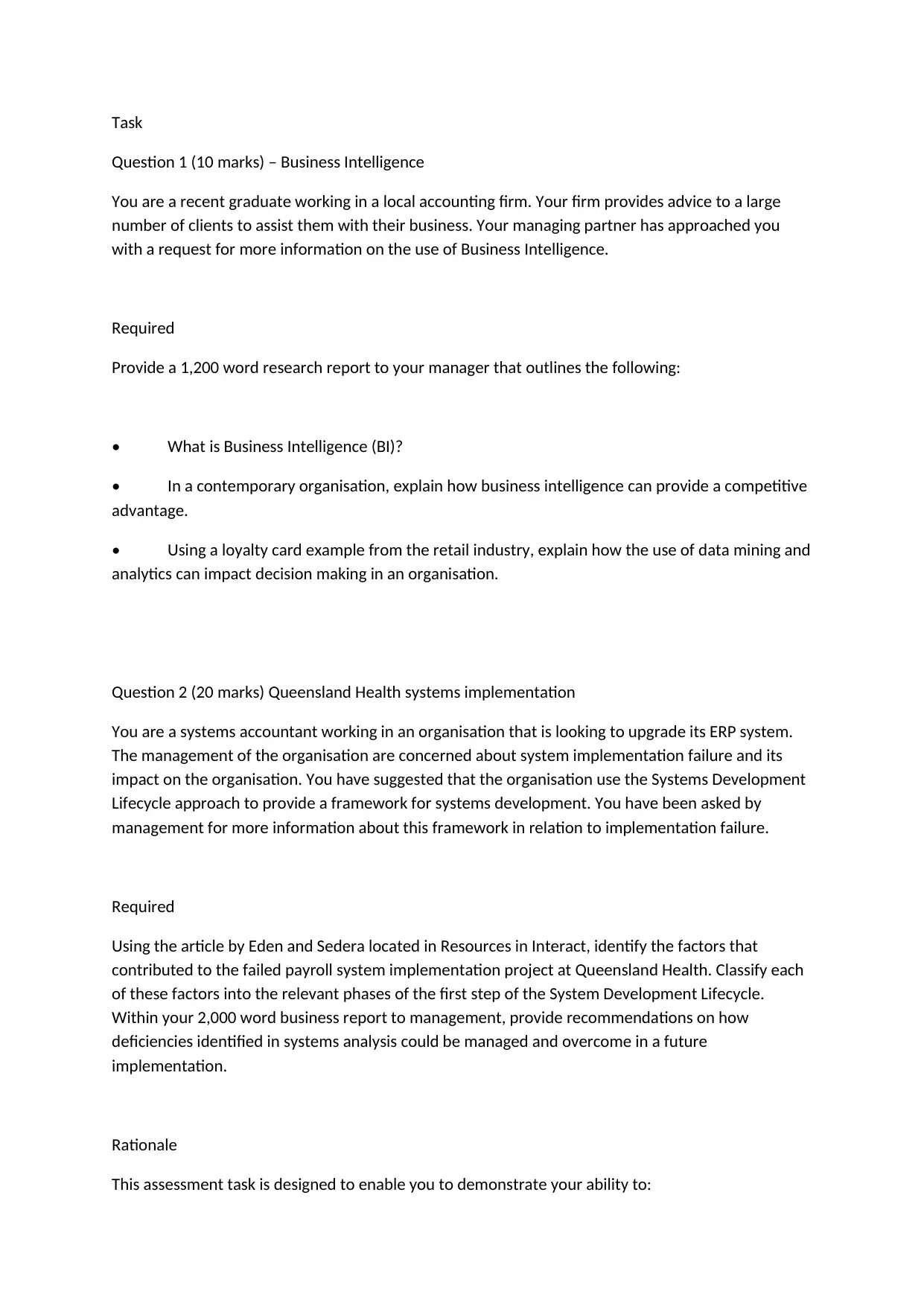
Task
Question 1 (10 marks) – Business Intelligence
You are a recent graduate working in a local accounting firm. Your firm provides advice to a large
number of clients to assist them with their business. Your managing partner has approached you
with a request for more information on the use of Business Intelligence.
Required
Provide a 1,200 word research report to your manager that outlines the following:
• What is Business Intelligence (BI)?
• In a contemporary organisation, explain how business intelligence can provide a competitive
advantage.
• Using a loyalty card example from the retail industry, explain how the use of data mining and
analytics can impact decision making in an organisation.
Question 2 (20 marks) Queensland Health systems implementation
You are a systems accountant working in an organisation that is looking to upgrade its ERP system.
The management of the organisation are concerned about system implementation failure and its
impact on the organisation. You have suggested that the organisation use the Systems Development
Lifecycle approach to provide a framework for systems development. You have been asked by
management for more information about this framework in relation to implementation failure.
Required
Using the article by Eden and Sedera located in Resources in Interact, identify the factors that
contributed to the failed payroll system implementation project at Queensland Health. Classify each
of these factors into the relevant phases of the first step of the System Development Lifecycle.
Within your 2,000 word business report to management, provide recommendations on how
deficiencies identified in systems analysis could be managed and overcome in a future
implementation.
Rationale
This assessment task is designed to enable you to demonstrate your ability to:
Question 1 (10 marks) – Business Intelligence
You are a recent graduate working in a local accounting firm. Your firm provides advice to a large
number of clients to assist them with their business. Your managing partner has approached you
with a request for more information on the use of Business Intelligence.
Required
Provide a 1,200 word research report to your manager that outlines the following:
• What is Business Intelligence (BI)?
• In a contemporary organisation, explain how business intelligence can provide a competitive
advantage.
• Using a loyalty card example from the retail industry, explain how the use of data mining and
analytics can impact decision making in an organisation.
Question 2 (20 marks) Queensland Health systems implementation
You are a systems accountant working in an organisation that is looking to upgrade its ERP system.
The management of the organisation are concerned about system implementation failure and its
impact on the organisation. You have suggested that the organisation use the Systems Development
Lifecycle approach to provide a framework for systems development. You have been asked by
management for more information about this framework in relation to implementation failure.
Required
Using the article by Eden and Sedera located in Resources in Interact, identify the factors that
contributed to the failed payroll system implementation project at Queensland Health. Classify each
of these factors into the relevant phases of the first step of the System Development Lifecycle.
Within your 2,000 word business report to management, provide recommendations on how
deficiencies identified in systems analysis could be managed and overcome in a future
implementation.
Rationale
This assessment task is designed to enable you to demonstrate your ability to:
Paraphrase This Document
Need a fresh take? Get an instant paraphrase of this document with our AI Paraphraser

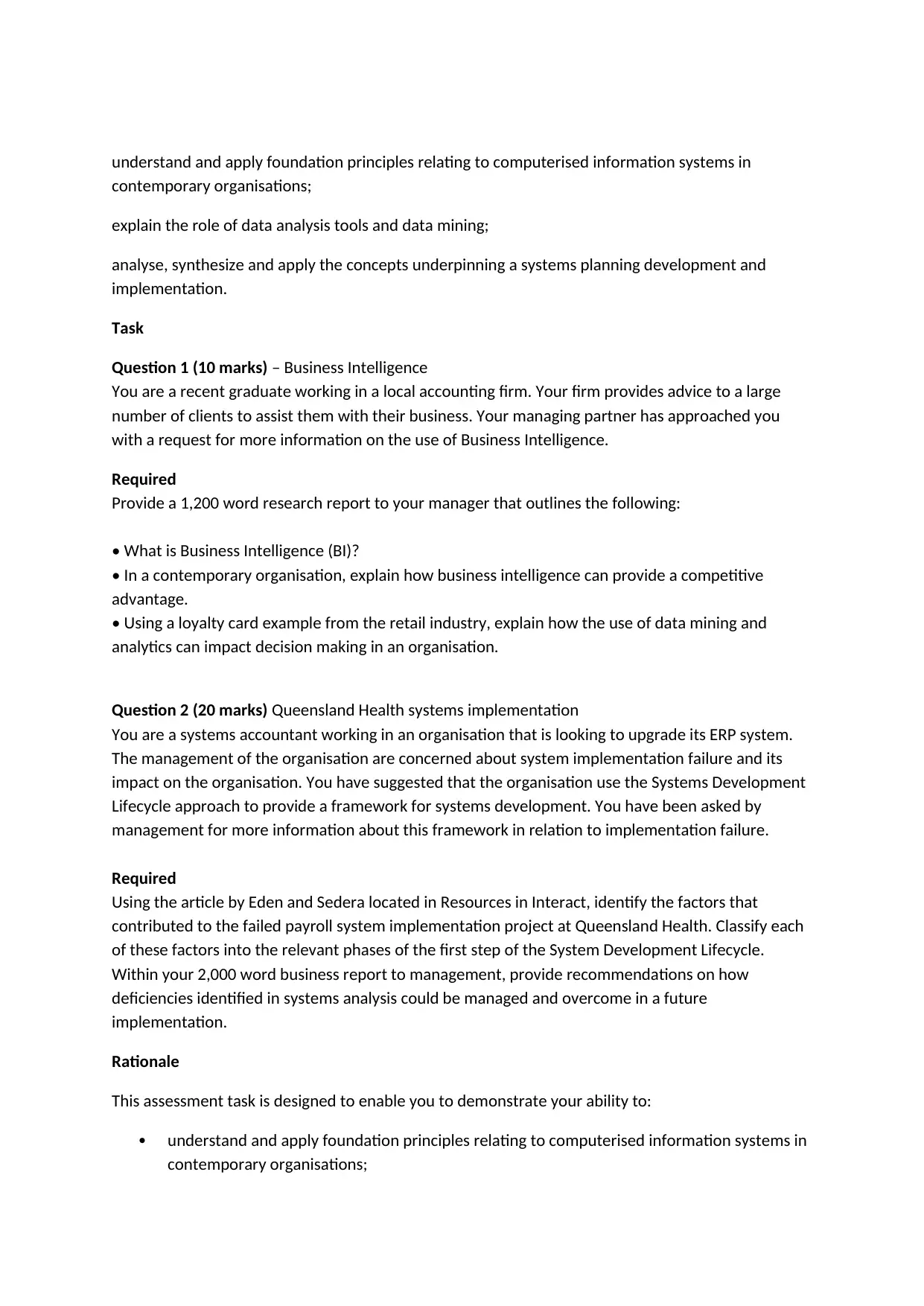
understand and apply foundation principles relating to computerised information systems in
contemporary organisations;
explain the role of data analysis tools and data mining;
analyse, synthesize and apply the concepts underpinning a systems planning development and
implementation.
Task
Question 1 (10 marks) – Business Intelligence
You are a recent graduate working in a local accounting firm. Your firm provides advice to a large
number of clients to assist them with their business. Your managing partner has approached you
with a request for more information on the use of Business Intelligence.
Required
Provide a 1,200 word research report to your manager that outlines the following:
• What is Business Intelligence (BI)?
• In a contemporary organisation, explain how business intelligence can provide a competitive
advantage.
• Using a loyalty card example from the retail industry, explain how the use of data mining and
analytics can impact decision making in an organisation.
Question 2 (20 marks) Queensland Health systems implementation
You are a systems accountant working in an organisation that is looking to upgrade its ERP system.
The management of the organisation are concerned about system implementation failure and its
impact on the organisation. You have suggested that the organisation use the Systems Development
Lifecycle approach to provide a framework for systems development. You have been asked by
management for more information about this framework in relation to implementation failure.
Required
Using the article by Eden and Sedera located in Resources in Interact, identify the factors that
contributed to the failed payroll system implementation project at Queensland Health. Classify each
of these factors into the relevant phases of the first step of the System Development Lifecycle.
Within your 2,000 word business report to management, provide recommendations on how
deficiencies identified in systems analysis could be managed and overcome in a future
implementation.
Rationale
This assessment task is designed to enable you to demonstrate your ability to:
understand and apply foundation principles relating to computerised information systems in
contemporary organisations;
explain the role of data analysis tools and data mining;
analyse, synthesize and apply the concepts underpinning a systems planning development and
implementation.
Task
Question 1 (10 marks) – Business Intelligence
You are a recent graduate working in a local accounting firm. Your firm provides advice to a large
number of clients to assist them with their business. Your managing partner has approached you
with a request for more information on the use of Business Intelligence.
Required
Provide a 1,200 word research report to your manager that outlines the following:
• What is Business Intelligence (BI)?
• In a contemporary organisation, explain how business intelligence can provide a competitive
advantage.
• Using a loyalty card example from the retail industry, explain how the use of data mining and
analytics can impact decision making in an organisation.
Question 2 (20 marks) Queensland Health systems implementation
You are a systems accountant working in an organisation that is looking to upgrade its ERP system.
The management of the organisation are concerned about system implementation failure and its
impact on the organisation. You have suggested that the organisation use the Systems Development
Lifecycle approach to provide a framework for systems development. You have been asked by
management for more information about this framework in relation to implementation failure.
Required
Using the article by Eden and Sedera located in Resources in Interact, identify the factors that
contributed to the failed payroll system implementation project at Queensland Health. Classify each
of these factors into the relevant phases of the first step of the System Development Lifecycle.
Within your 2,000 word business report to management, provide recommendations on how
deficiencies identified in systems analysis could be managed and overcome in a future
implementation.
Rationale
This assessment task is designed to enable you to demonstrate your ability to:
understand and apply foundation principles relating to computerised information systems in
contemporary organisations;

explain the role of data analysis tools and data mining;
analyse, synthesize and apply the concepts underpinning a systems planning development
and implementation.
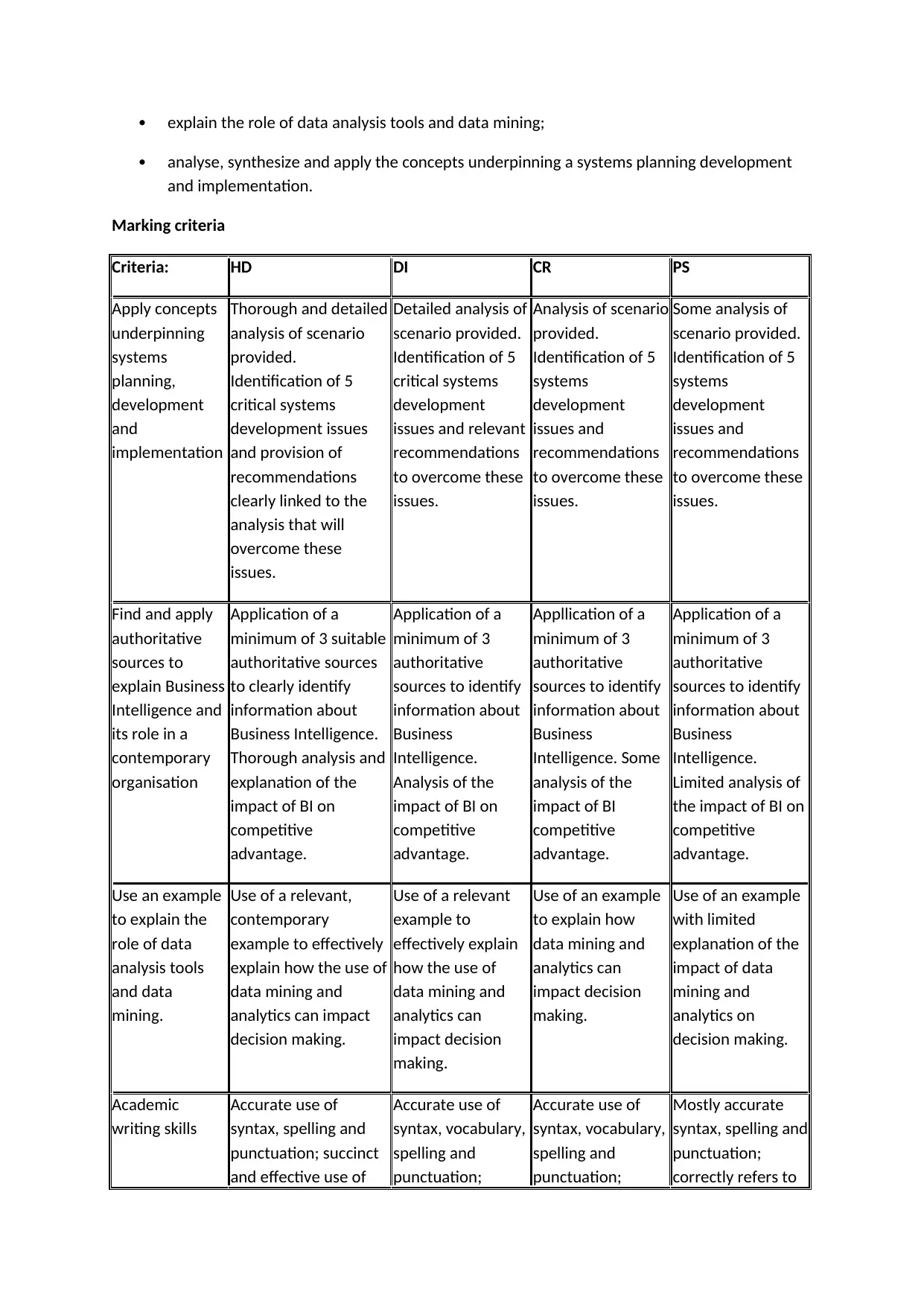
Marking criteria
Criteria: HD DI CR PS
Apply concepts
underpinning
systems
planning,
development
and
implementation
Thorough and detailed
analysis of scenario
provided.
Identification of 5
critical systems
development issues
and provision of
recommendations
clearly linked to the
analysis that will
overcome these
issues.
Detailed analysis of
scenario provided.
Identification of 5
critical systems
development
issues and relevant
recommendations
to overcome these
issues.
Analysis of scenario
provided.
Identification of 5
systems
development
issues and
recommendations
to overcome these
issues.
Some analysis of
scenario provided.
Identification of 5
systems
development
issues and
recommendations
to overcome these
issues.
Find and apply
authoritative
sources to
explain Business
Intelligence and
its role in a
contemporary
organisation
Application of a
minimum of 3 suitable
authoritative sources
to clearly identify
information about
Business Intelligence.
Thorough analysis and
explanation of the
impact of BI on
competitive
advantage.
Application of a
minimum of 3
authoritative
sources to identify
information about
Business
Intelligence.
Analysis of the
impact of BI on
competitive
advantage.
Appllication of a
minimum of 3
authoritative
sources to identify
information about
Business
Intelligence. Some
analysis of the
impact of BI
competitive
advantage.
Application of a
minimum of 3
authoritative
sources to identify
information about
Business
Intelligence.
Limited analysis of
the impact of BI on
competitive
advantage.
Use an example
to explain the
role of data
analysis tools
and data
mining.
Use of a relevant,
contemporary
example to effectively
explain how the use of
data mining and
analytics can impact
decision making.
Use of a relevant
example to
effectively explain
how the use of
data mining and
analytics can
impact decision
making.
Use of an example
to explain how
data mining and
analytics can
impact decision
making.
Use of an example
with limited
explanation of the
impact of data
mining and
analytics on
decision making.
Academic
writing skills
Accurate use of
syntax, spelling and
punctuation; succinct
and effective use of
Accurate use of
syntax, vocabulary,
spelling and
punctuation;
Accurate use of
syntax, vocabulary,
spelling and
punctuation;
Mostly accurate
syntax, spelling and
punctuation;
correctly refers to
analyse, synthesize and apply the concepts underpinning a systems planning development
and implementation.
Marking criteria
Criteria: HD DI CR PS
Apply concepts
underpinning
systems
planning,
development
and
implementation
Thorough and detailed
analysis of scenario
provided.
Identification of 5
critical systems
development issues
and provision of
recommendations
clearly linked to the
analysis that will
overcome these
issues.
Detailed analysis of
scenario provided.
Identification of 5
critical systems
development
issues and relevant
recommendations
to overcome these
issues.
Analysis of scenario
provided.
Identification of 5
systems
development
issues and
recommendations
to overcome these
issues.
Some analysis of
scenario provided.
Identification of 5
systems
development
issues and
recommendations
to overcome these
issues.
Find and apply
authoritative
sources to
explain Business
Intelligence and
its role in a
contemporary
organisation
Application of a
minimum of 3 suitable
authoritative sources
to clearly identify
information about
Business Intelligence.
Thorough analysis and
explanation of the
impact of BI on
competitive
advantage.
Application of a
minimum of 3
authoritative
sources to identify
information about
Business
Intelligence.
Analysis of the
impact of BI on
competitive
advantage.
Appllication of a
minimum of 3
authoritative
sources to identify
information about
Business
Intelligence. Some
analysis of the
impact of BI
competitive
advantage.
Application of a
minimum of 3
authoritative
sources to identify
information about
Business
Intelligence.
Limited analysis of
the impact of BI on
competitive
advantage.
Use an example
to explain the
role of data
analysis tools
and data
mining.
Use of a relevant,
contemporary
example to effectively
explain how the use of
data mining and
analytics can impact
decision making.
Use of a relevant
example to
effectively explain
how the use of
data mining and
analytics can
impact decision
making.
Use of an example
to explain how
data mining and
analytics can
impact decision
making.
Use of an example
with limited
explanation of the
impact of data
mining and
analytics on
decision making.
Academic
writing skills
Accurate use of
syntax, spelling and
punctuation; succinct
and effective use of
Accurate use of
syntax, vocabulary,
spelling and
punctuation;
Accurate use of
syntax, vocabulary,
spelling and
punctuation;
Mostly accurate
syntax, spelling and
punctuation;
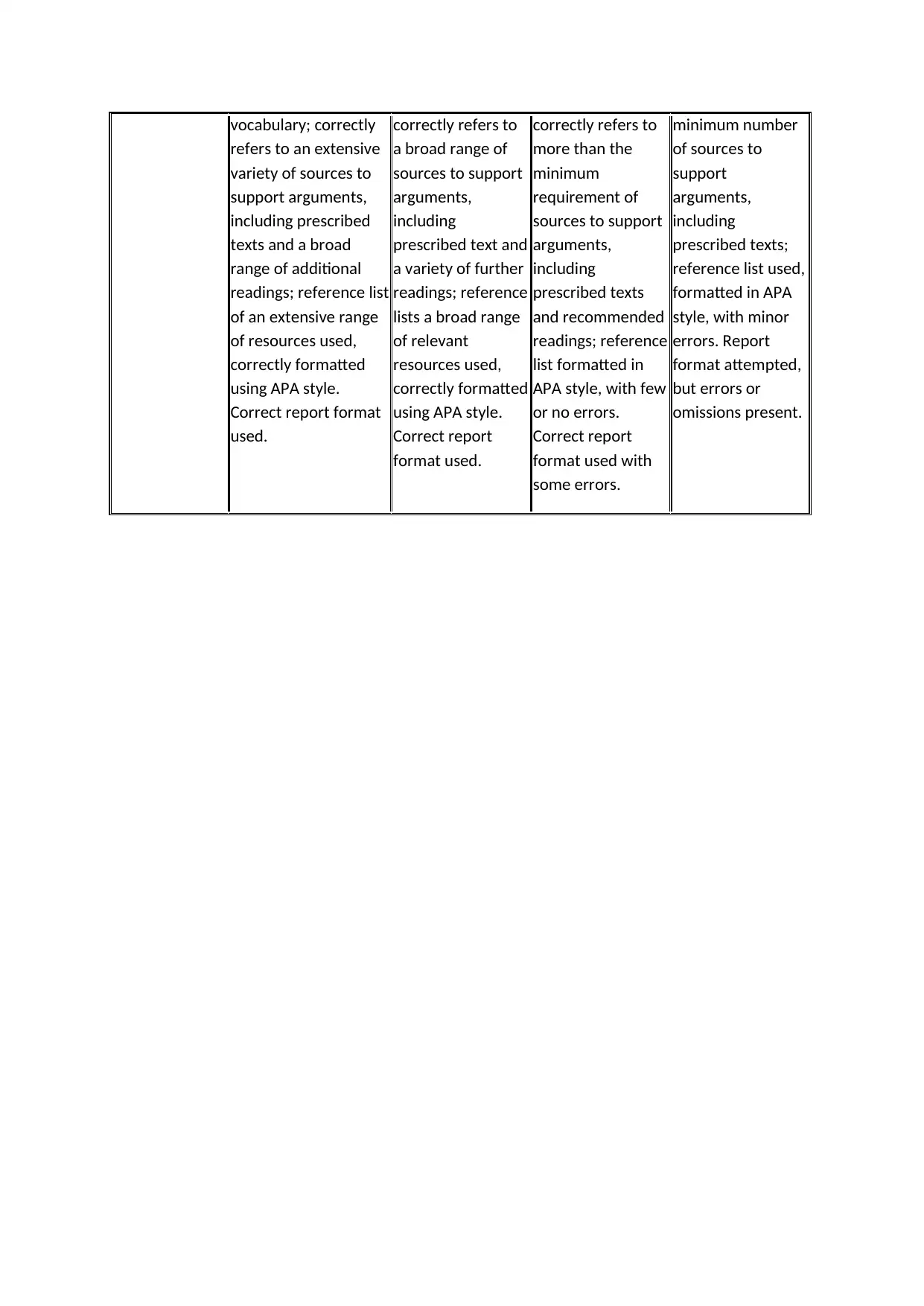
correctly refers to
⊘ This is a preview!⊘
Do you want full access?
Subscribe today to unlock all pages.

Trusted by 1+ million students worldwide

vocabulary; correctly
refers to an extensive
variety of sources to
support arguments,
including prescribed
texts and a broad
range of additional
readings; reference list
of an extensive range
of resources used,
correctly formatted
using APA style.
Correct report format
used.
correctly refers to
a broad range of
sources to support
arguments,
including
prescribed text and
a variety of further
readings; reference
lists a broad range
of relevant
resources used,
correctly formatted
using APA style.
Correct report
format used.
correctly refers to
more than the
minimum
requirement of
sources to support
arguments,
including
prescribed texts
and recommended
readings; reference
list formatted in
APA style, with few
or no errors.
Correct report
format used with
some errors.
minimum number
of sources to
support
arguments,
including
prescribed texts;
reference list used,
formatted in APA
style, with minor
errors. Report
format attempted,
but errors or
omissions present.
refers to an extensive
variety of sources to
support arguments,
including prescribed
texts and a broad
range of additional
readings; reference list
of an extensive range
of resources used,
correctly formatted
using APA style.
Correct report format
used.
correctly refers to
a broad range of
sources to support
arguments,
including
prescribed text and
a variety of further
readings; reference
lists a broad range
of relevant
resources used,
correctly formatted
using APA style.
Correct report
format used.
correctly refers to
more than the
minimum
requirement of
sources to support
arguments,
including
prescribed texts
and recommended
readings; reference
list formatted in
APA style, with few
or no errors.
Correct report
format used with
some errors.
minimum number
of sources to
support
arguments,
including
prescribed texts;
reference list used,
formatted in APA
style, with minor
errors. Report
format attempted,
but errors or
omissions present.
1 out of 4
Related Documents
Your All-in-One AI-Powered Toolkit for Academic Success.
+13062052269
info@desklib.com
Available 24*7 on WhatsApp / Email
Unlock your academic potential
Copyright © 2020–2026 A2Z Services. All Rights Reserved. Developed and managed by ZUCOL.