Tax Report Project: Partnership and Corporate Tax Analysis

Verified

Added on  2022/08/27

|12
|1372
|38
Report
AI Summary
This report analyzes the tax implications for the Rock Ages, LLC, a partnership, and compares it to corporate tax structures. The report includes a letter to a partner, Ryan Ross, explaining the Schedule K-1 and its impact on his individual tax return, detailing the treatment of business income, guaranteed payments, capital losses, and other relevant items. It emphasizes the need for professional tax assistance and the importance of timely filing. The report then contrasts partnership and corporate tax returns, highlighting differences in taxation, liability, profit allocation, and dividend payments. It explains the 'pass-through' taxation mechanism for LLCs and its similarities to corporate structures. Finally, the report offers recommendations for Rock Ages, LLC, including adhering to tax deadlines, minimizing capital losses, and properly utilizing the tax pass-through mechanism. The report covers the use of Form 1065, Schedule K-1 and Form 1120.

Document Page
Running head: TAX 1
Tax Report Project
Name
Institution
tabler-icon-diamond-filled.svg

Paraphrase This Document

Need a fresh take? Get an instant paraphrase of this document with our AI Paraphraser
Document Page
TAX 2
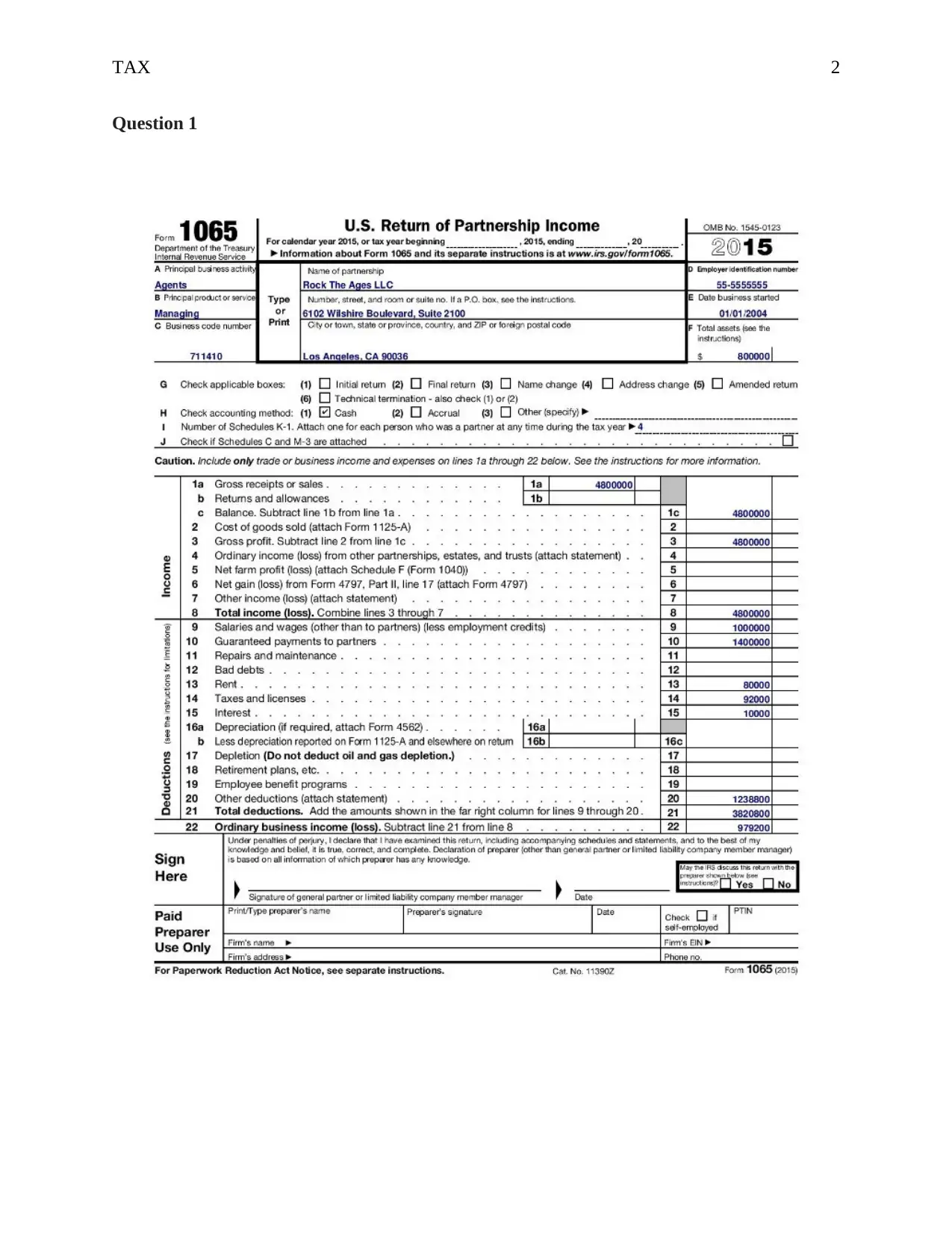
Question 1
Document Page
TAX 3
Document Page
TAX 4
tabler-icon-diamond-filled.svg

Paraphrase This Document

Need a fresh take? Get an instant paraphrase of this document with our AI Paraphraser
Document Page
TAX 5
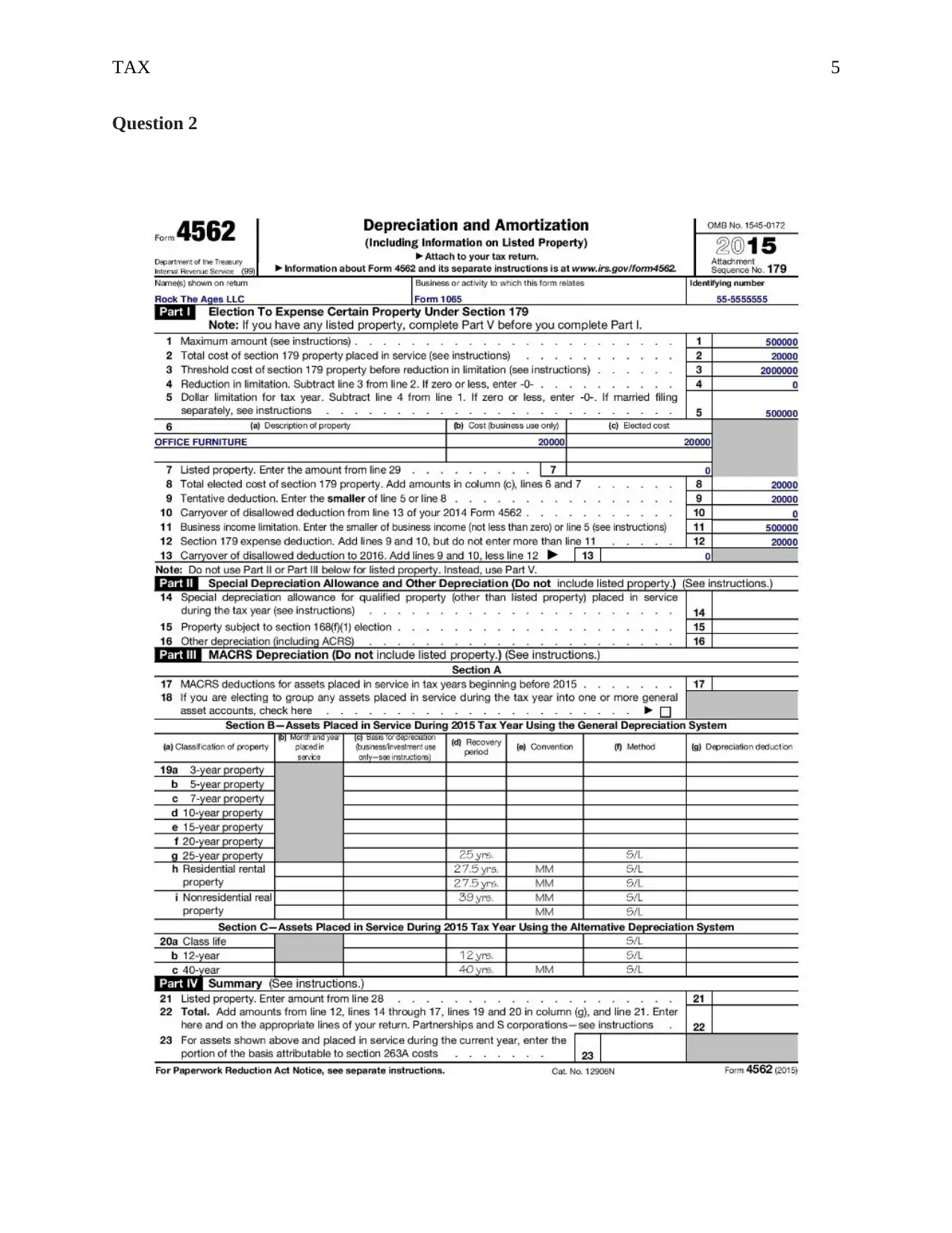
Question 2
Document Page
TAX 6
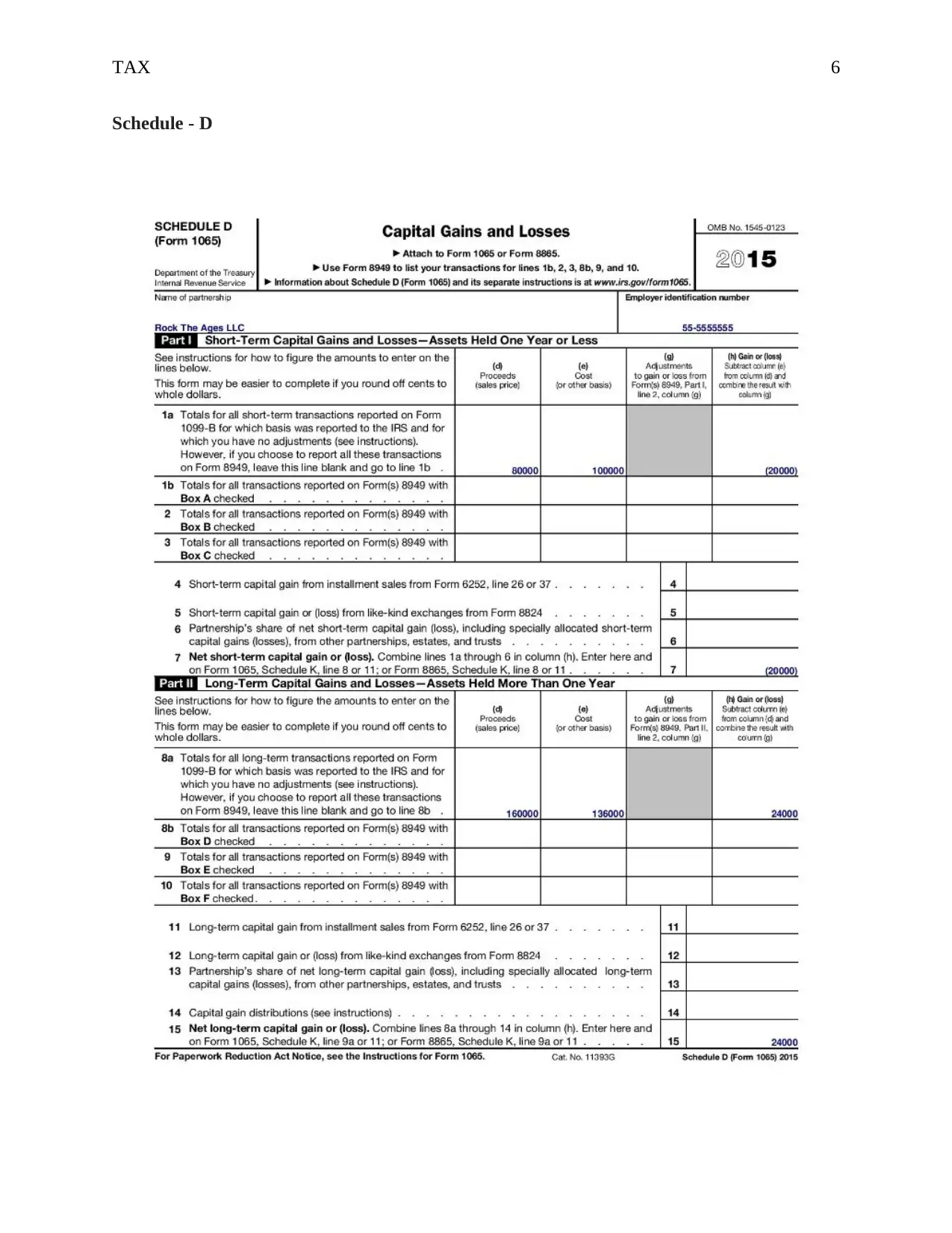
Schedule - D
Document Page
TAX 7
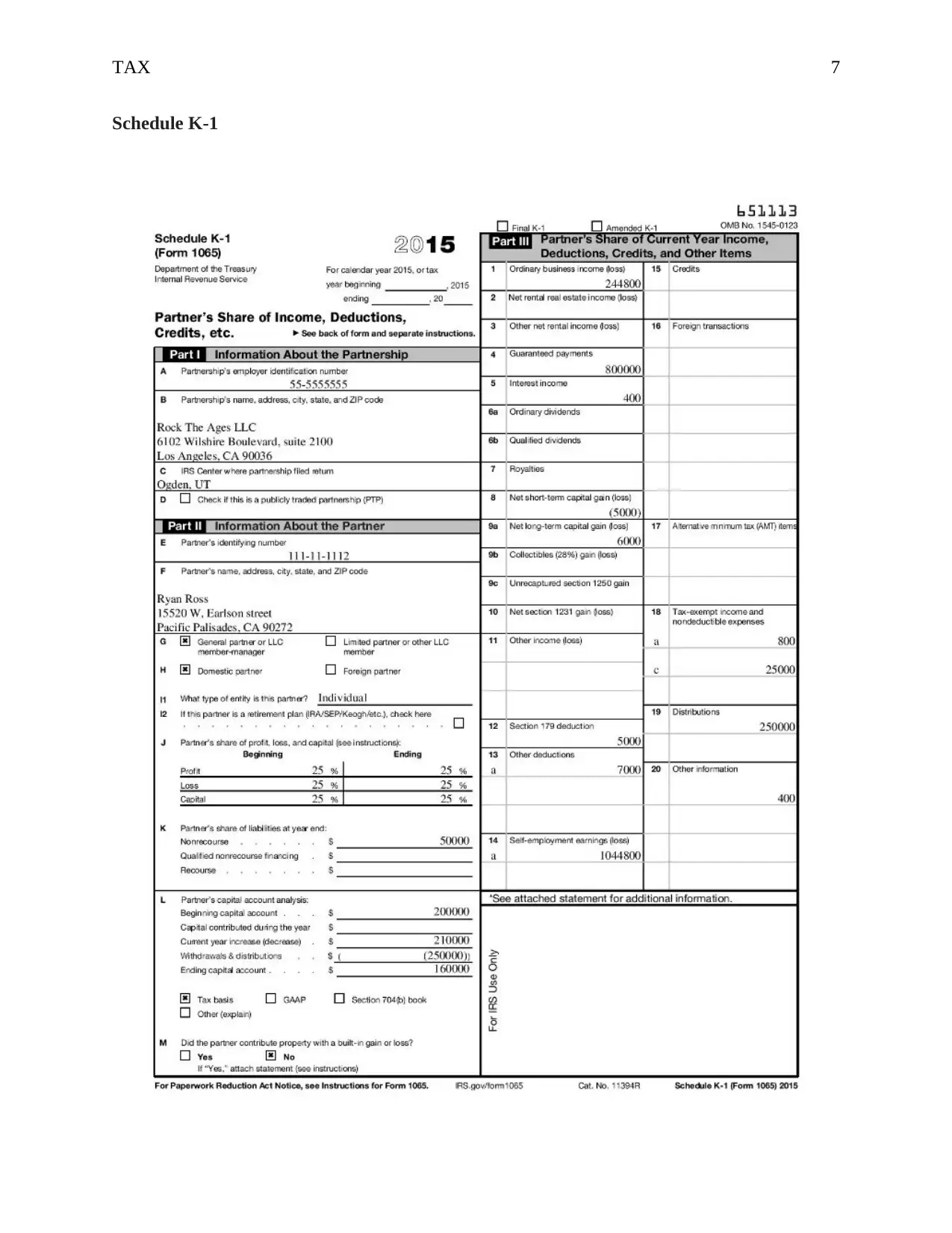
Schedule K-1
tabler-icon-diamond-filled.svg

Paraphrase This Document

Need a fresh take? Get an instant paraphrase of this document with our AI Paraphraser
Document Page
TAX 8
Question 3
A letter to Ryan Ross (111-11-112)
Hello Ryan,
Refer to the attached Schedule K-1 which shows each member’s share in the LLL Federal
ID number 55-5555555. From the schedule K-1, the business income was found to be $244800
which reflected the ordinary business income. However, increase in the shareholders’ capital
affected your guaranteed payment which stood at $800000. This is reflected from the net short-
term capital loss experienced that stood at $5000 and net long capital loss at $6000. Since in the
LLL shareholding company you both own equal shares i.e. 25% of the business, it therefore
reflect that out of the total loss or gain that the business experienced would be equally distributed
among you. As a result, you should make an attempt to do the following with the information
given in the Schedule K-1 on your tax return;
o When filling your tax return, make sure you include all the dividends, deductions, gains,
and losses as reported on the schedule K-1 and form 1065. It therefore means that each
and every partner must fill their form 1065 before filling the schedule K-1 to help in
filling the tax return.
o Since calculation of the partner’s share in each Schedule K-1 item is complex and time
consuming, we therefore recommend that you hire a tax expert to be helping you filling it
so that you don’t be late to fill your tax return.
o The guaranteed payment which stood at $800000 is non-taxable from the partnership
account since it reflects your own earnings apart from the LLC partnership gain or loss
Document Page
TAX 9
made during the year end. As a result, make sure to exclude it when filling your tax
return so that you don’t do double tax return.
o When filling the tax return, you will have an exception of tax totaling to $800 and
$25000 which will not be including in the tax return. These include the income earned in
the partnership and the nondeductible expenses.
o The ordinary business income that stands at $244800 will be incorporated in the tax
return filled by end March 15th as shown in form 1065. This will help to provide
information on the exact individual earning as a percentage. Each member’s capital at the
beginning was also analyzed to be $200000 which provides that as a partner, you will
have to fill the tax return inclusive of the total capital at the beginning as shown in the
form 1065.
o The interest income earned from your capital that stood at $400 should be included in the
tax return when filling the returns. As a result, the general tax return should not be filled
later than date 15 March as it might lead to an individual or partners’ tax late penalty
since the entire Schedule K-1 from both the partners must be attached with the form 1065
when filling the tax return.
o The withdrawal and distributors earning stood at $250000 which is extremely higher
compared to the earnings made in the LLL partnership. As a result, you should advise
your partners so that both the withdrawals and the distributors’ expenses are reduced in
order to increase the ending capital from $16000.
Your earlier action on the above information will help you during the final filling of the tax
return which falls not later than 15th March this financial year.
Document Page
TAX 10
Regards
Question 4
Similarities and the Differences between a Partnership Return and Corporate tax Return
1120
In a corporate tax return, the taxes must be paid at the corporate level which is separate
from the owner’s earnings. It therefore results in to double taxation since the owners of the
corporate will have to pay for the individual taxes unlike a partnership return which does only
single tax return from the schedule K-1 description. Limited partnership return only protects its
limited members from business debts and claims while in the corporate tax return, there must be
a mechanism that protects all the corporate members thus increasing tax collected from the
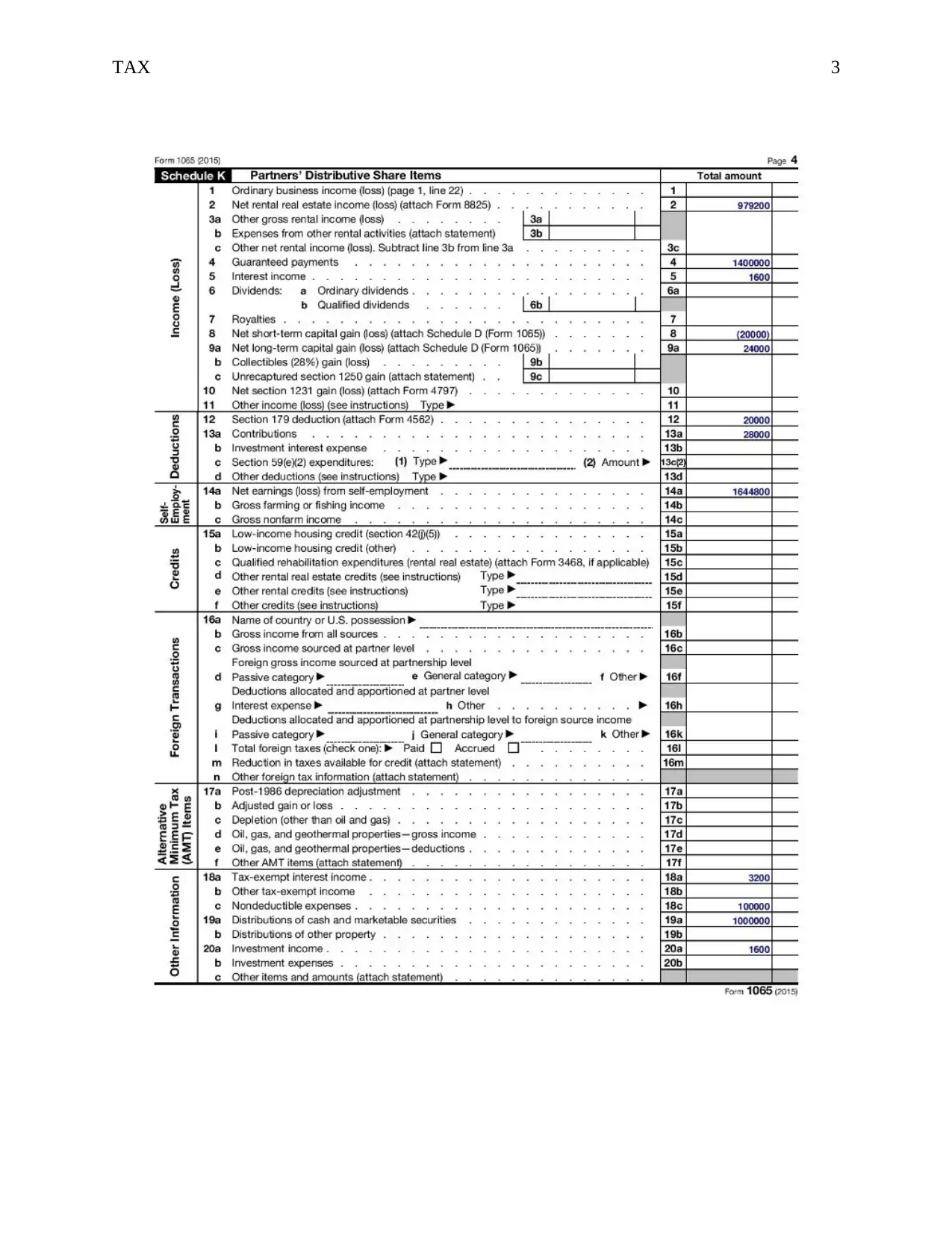
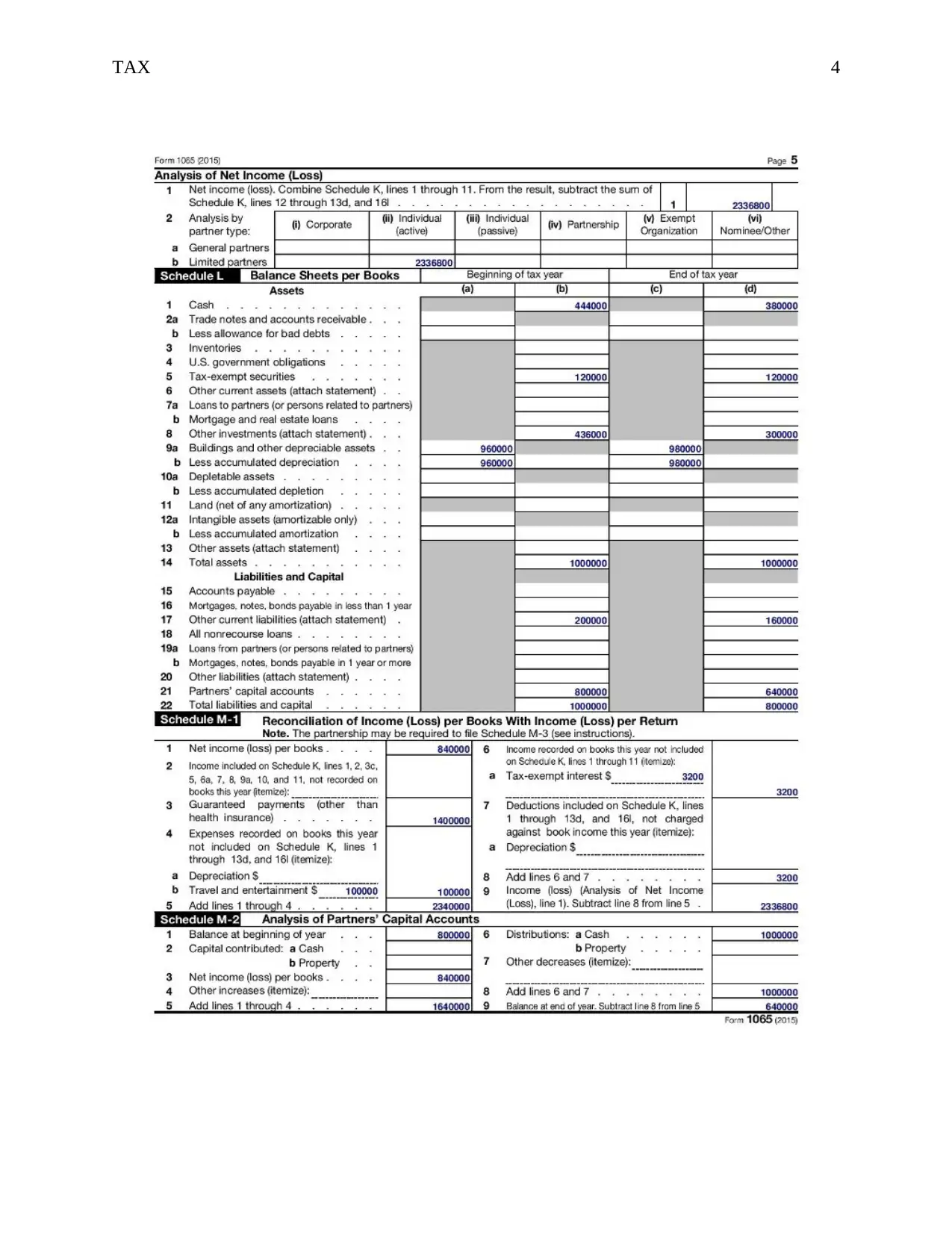
corporate by the government. From the form 1065 page 1 to 5, it can be confirmed that
partnership returns of the LLLCs usually share the profits and losses equally at 25% each.
However, in the corporate return, there is a mechanism to decide how to allocate the business
profits and losses depending on the major shareholders.
Partnership does tax filling on form 1065, but there is no taxes due by the business since
each partner is entitled to schedule K-1 that helps to allocate profits and losses shared among the
partners. As a result, the LLC may decide to be taxed as a corporate or on individual basis unlike
the corporate return which must fill form 1120 for the general business. In addition, there is
difference in liability of owners between corporate and partnership returns. In partnership return,
owners are legally liable for the debts of the business in case a partner fails to pay back the debts.
However, in corporate return, there is no collective legal responsibility i.e. in case of dissolution
tabler-icon-diamond-filled.svg

Paraphrase This Document

Need a fresh take? Get an instant paraphrase of this document with our AI Paraphraser
Document Page
TAX 11
of the business, shareholders are not held responsible for the debts but individual members will
have to pay for the debts. In terms of dividends payment, shareholders in corporate business do
not pay taxes on corporate profits but pay taxes on profits distributed at the dividend levels. This
is unlike the partners’ return where each member must pay tax at the individual distributed
profits which is the same as the profit made on the partners business.
In the partners business i.e. the LL, there is a separation of business from the owners just
like the corporate business. In partners’ tax return, form 1065 is used to fill the partnership
income and form 1040 for the individual income tax return which shows differences in the
business from an individual owner. LLCs have a ‘pass through taxation’ mechanism showing
that at the business level, there is no payment of taxes. However, income and losses are reported
on the personal tax return due to be paid at the individual level as shown in Schedule K-1. This
similarity is applicable to the corporate business where form 1120 which acts as income return
and 1040 for individual income tax return is filled. It is therefore subjected to ‘pass-through’ tax
mechanism which except it from double taxation like the partnership business.
Mechanisms of Partnership Tax Return and its Significance to the Rock Ages, LLC
For planning purposes, Rock Ages, LLC should submit its form 1065 latest March 15
every year in order to meet the tax return deadline. In addition, since the Rock Ages, LLC is a
partnership with a tax pass through mechanism where each member has 25% shares, each
member will be required to pay individual tax before the federal income tax due date. At the
same time, each partner will be required to fill in Schedule K-1 which allows them to report
share of incomes, credits, deductions, and partnership information on their personal tax return.
Document Page
TAX 12
Rock Ages, LLC should revise its net short and long term capital loss which stands at
$5000 and $6000 respectively on individual basis. Since these are taxes which apply on profits
from the sale of the assets held on short and long term basis, the Rock Ages, LLC should opt to
minimize holding unprofitable assets that only leads to business loss when taxed.
chevron_up_icon
1 out of 12
circle_padding
hide_on_mobile
zoom_out_icon
[object Object]