Taxation Law HA3042 T1 2018: Case Study on Income, Benefits & CGT
VerifiedAdded on 2023/06/11
|9
|2327
|318
Case Study
AI Summary
This case study provides a comprehensive analysis of various taxation scenarios, including the taxability of income from personal exertion, the calculation of car fringe benefits using the statutory formula, and the assessment of income related to loans between family members. It further delves into capital gains tax implications, examining scenarios involving property improvements and sales, including sales to family members and the implications for companies versus individuals. The analysis incorporates relevant Australian tax practices and regulations, offering a detailed understanding of tax computation in diverse situations. Desklib provides access to similar solved assignments and study resources for students.

Taxation
Tax analysis
Tax analysis

Paraphrase This Document
Need a fresh take? Get an instant paraphrase of this document with our AI Paraphraser
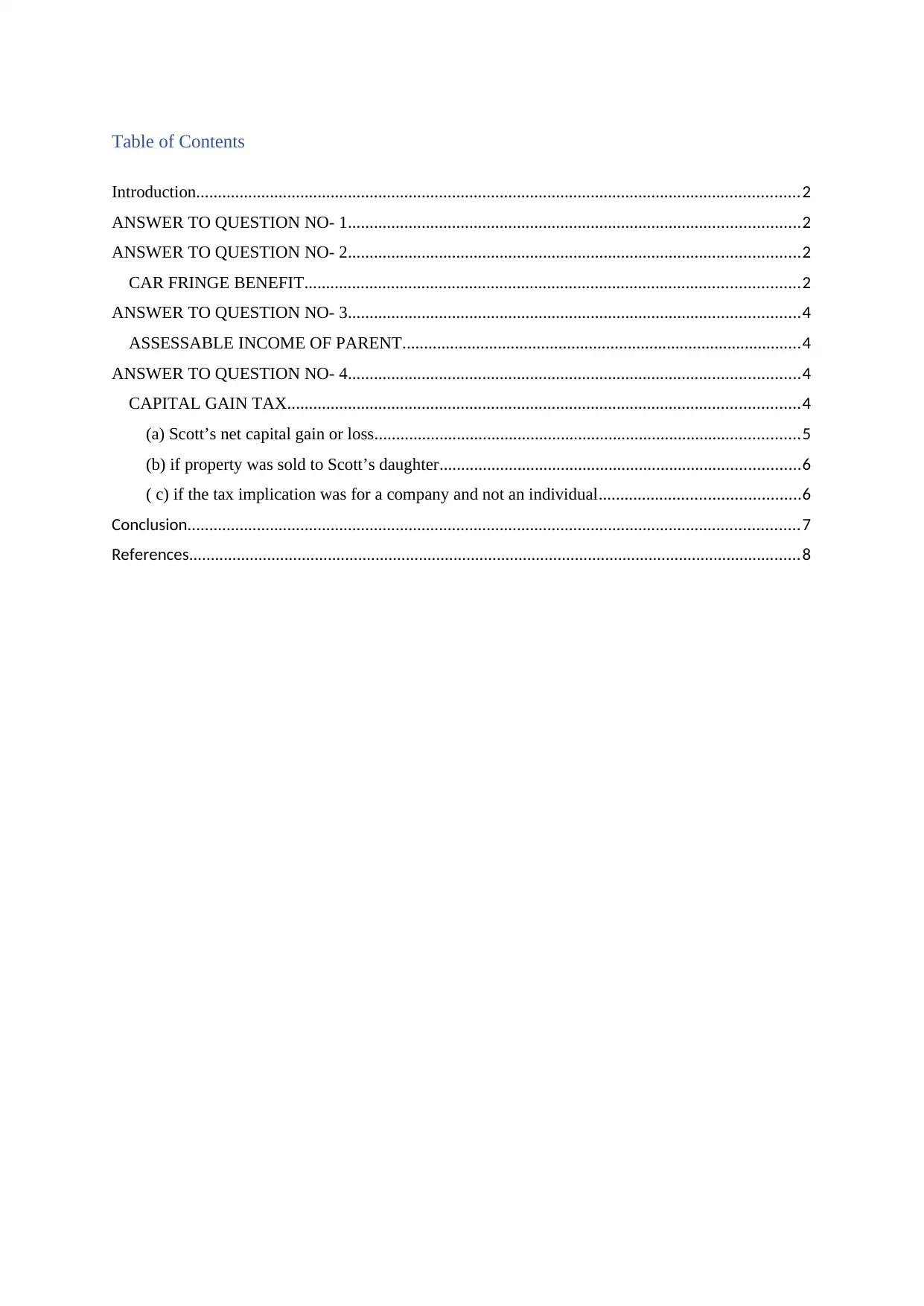
Table of Contents
Introduction...........................................................................................................................................2
ANSWER TO QUESTION NO- 1........................................................................................................2
ANSWER TO QUESTION NO- 2........................................................................................................2
CAR FRINGE BENEFIT..................................................................................................................2
ANSWER TO QUESTION NO- 3........................................................................................................4
ASSESSABLE INCOME OF PARENT............................................................................................4
ANSWER TO QUESTION NO- 4........................................................................................................4
CAPITAL GAIN TAX......................................................................................................................4
(a) Scott’s net capital gain or loss..................................................................................................5
(b) if property was sold to Scott’s daughter...................................................................................6
( c) if the tax implication was for a company and not an individual..............................................6
Conclusion.............................................................................................................................................7
References.............................................................................................................................................8
Introduction...........................................................................................................................................2
ANSWER TO QUESTION NO- 1........................................................................................................2
ANSWER TO QUESTION NO- 2........................................................................................................2
CAR FRINGE BENEFIT..................................................................................................................2
ANSWER TO QUESTION NO- 3........................................................................................................4
ASSESSABLE INCOME OF PARENT............................................................................................4
ANSWER TO QUESTION NO- 4........................................................................................................4
CAPITAL GAIN TAX......................................................................................................................4
(a) Scott’s net capital gain or loss..................................................................................................5
(b) if property was sold to Scott’s daughter...................................................................................6
( c) if the tax implication was for a company and not an individual..............................................6
Conclusion.............................................................................................................................................7
References.............................................................................................................................................8
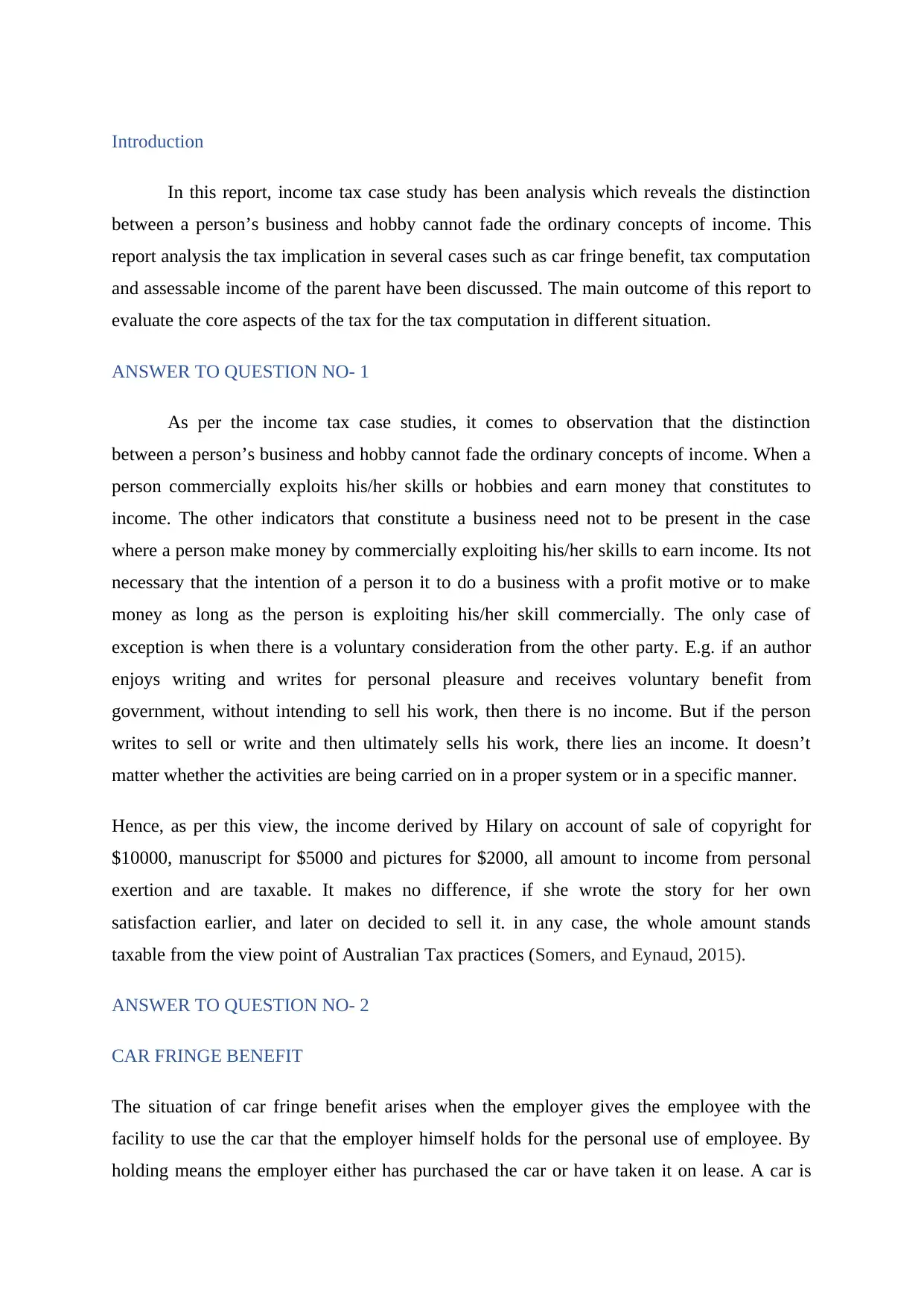
Introduction
In this report, income tax case study has been analysis which reveals the distinction
between a person’s business and hobby cannot fade the ordinary concepts of income. This
report analysis the tax implication in several cases such as car fringe benefit, tax computation
and assessable income of the parent have been discussed. The main outcome of this report to
evaluate the core aspects of the tax for the tax computation in different situation.
ANSWER TO QUESTION NO- 1
As per the income tax case studies, it comes to observation that the distinction
between a person’s business and hobby cannot fade the ordinary concepts of income. When a
person commercially exploits his/her skills or hobbies and earn money that constitutes to
income. The other indicators that constitute a business need not to be present in the case
where a person make money by commercially exploiting his/her skills to earn income. Its not
necessary that the intention of a person it to do a business with a profit motive or to make
money as long as the person is exploiting his/her skill commercially. The only case of
exception is when there is a voluntary consideration from the other party. E.g. if an author
enjoys writing and writes for personal pleasure and receives voluntary benefit from
government, without intending to sell his work, then there is no income. But if the person
writes to sell or write and then ultimately sells his work, there lies an income. It doesn’t
matter whether the activities are being carried on in a proper system or in a specific manner.
Hence, as per this view, the income derived by Hilary on account of sale of copyright for
$10000, manuscript for $5000 and pictures for $2000, all amount to income from personal
exertion and are taxable. It makes no difference, if she wrote the story for her own
satisfaction earlier, and later on decided to sell it. in any case, the whole amount stands
taxable from the view point of Australian Tax practices (Somers, and Eynaud, 2015).
ANSWER TO QUESTION NO- 2
CAR FRINGE BENEFIT
The situation of car fringe benefit arises when the employer gives the employee with the
facility to use the car that the employer himself holds for the personal use of employee. By
holding means the employer either has purchased the car or have taken it on lease. A car is
In this report, income tax case study has been analysis which reveals the distinction
between a person’s business and hobby cannot fade the ordinary concepts of income. This
report analysis the tax implication in several cases such as car fringe benefit, tax computation
and assessable income of the parent have been discussed. The main outcome of this report to
evaluate the core aspects of the tax for the tax computation in different situation.
ANSWER TO QUESTION NO- 1
As per the income tax case studies, it comes to observation that the distinction
between a person’s business and hobby cannot fade the ordinary concepts of income. When a
person commercially exploits his/her skills or hobbies and earn money that constitutes to
income. The other indicators that constitute a business need not to be present in the case
where a person make money by commercially exploiting his/her skills to earn income. Its not
necessary that the intention of a person it to do a business with a profit motive or to make
money as long as the person is exploiting his/her skill commercially. The only case of
exception is when there is a voluntary consideration from the other party. E.g. if an author
enjoys writing and writes for personal pleasure and receives voluntary benefit from
government, without intending to sell his work, then there is no income. But if the person
writes to sell or write and then ultimately sells his work, there lies an income. It doesn’t
matter whether the activities are being carried on in a proper system or in a specific manner.
Hence, as per this view, the income derived by Hilary on account of sale of copyright for
$10000, manuscript for $5000 and pictures for $2000, all amount to income from personal
exertion and are taxable. It makes no difference, if she wrote the story for her own
satisfaction earlier, and later on decided to sell it. in any case, the whole amount stands
taxable from the view point of Australian Tax practices (Somers, and Eynaud, 2015).
ANSWER TO QUESTION NO- 2
CAR FRINGE BENEFIT
The situation of car fringe benefit arises when the employer gives the employee with the
facility to use the car that the employer himself holds for the personal use of employee. By
holding means the employer either has purchased the car or have taken it on lease. A car is
⊘ This is a preview!⊘
Do you want full access?
Subscribe today to unlock all pages.

Trusted by 1+ million students worldwide
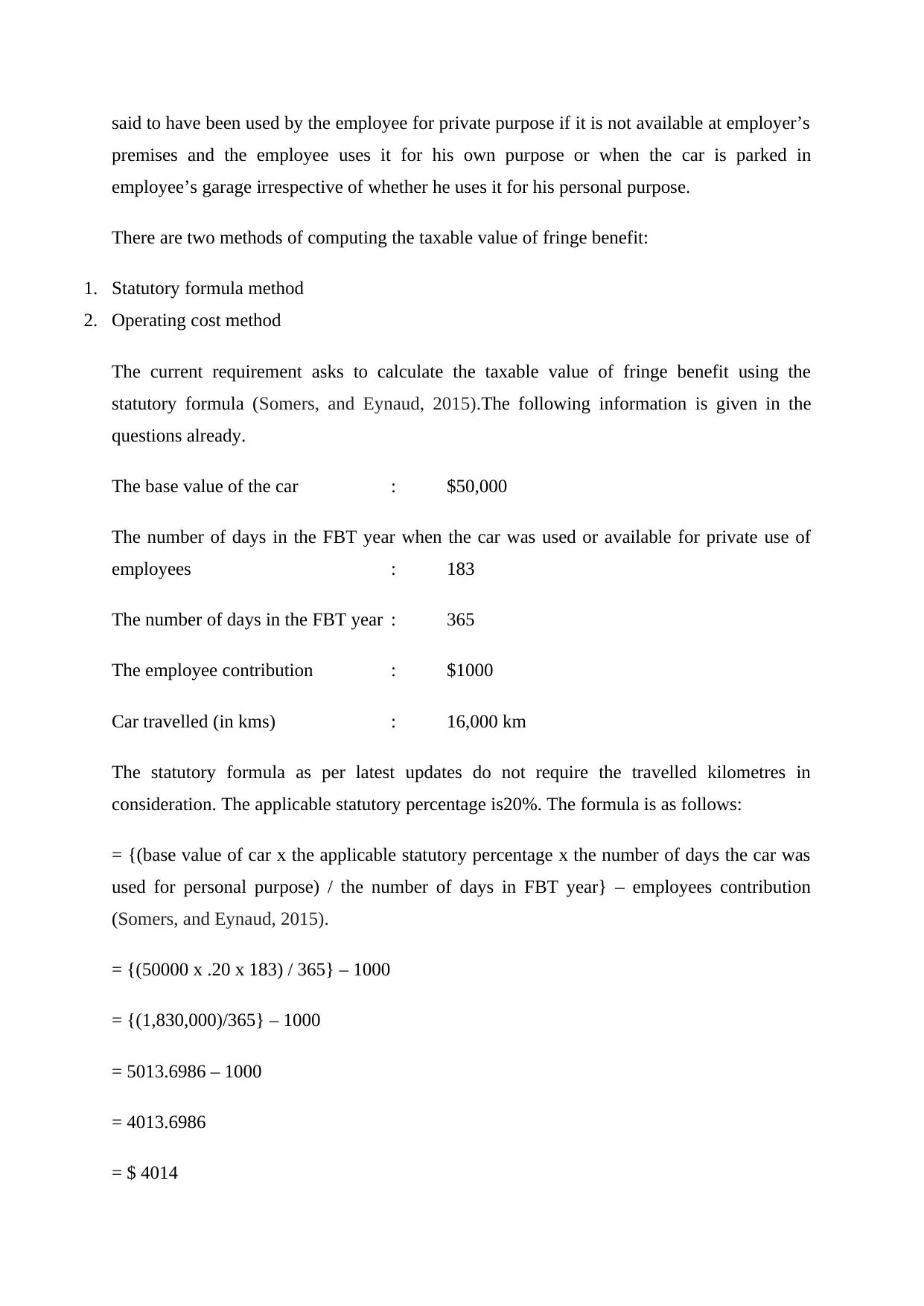
said to have been used by the employee for private purpose if it is not available at employer’s
premises and the employee uses it for his own purpose or when the car is parked in
employee’s garage irrespective of whether he uses it for his personal purpose.
There are two methods of computing the taxable value of fringe benefit:
1. Statutory formula method
2. Operating cost method
The current requirement asks to calculate the taxable value of fringe benefit using the
statutory formula (Somers, and Eynaud, 2015).The following information is given in the
questions already.
The base value of the car : $50,000
The number of days in the FBT year when the car was used or available for private use of
employees : 183
The number of days in the FBT year : 365
The employee contribution : $1000
Car travelled (in kms) : 16,000 km
The statutory formula as per latest updates do not require the travelled kilometres in
consideration. The applicable statutory percentage is20%. The formula is as follows:
= {(base value of car x the applicable statutory percentage x the number of days the car was
used for personal purpose) / the number of days in FBT year} – employees contribution
(Somers, and Eynaud, 2015).
= {(50000 x .20 x 183) / 365} – 1000
= {(1,830,000)/365} – 1000
= 5013.6986 – 1000
= 4013.6986
= $ 4014
premises and the employee uses it for his own purpose or when the car is parked in
employee’s garage irrespective of whether he uses it for his personal purpose.
There are two methods of computing the taxable value of fringe benefit:
1. Statutory formula method
2. Operating cost method
The current requirement asks to calculate the taxable value of fringe benefit using the
statutory formula (Somers, and Eynaud, 2015).The following information is given in the
questions already.
The base value of the car : $50,000
The number of days in the FBT year when the car was used or available for private use of
employees : 183
The number of days in the FBT year : 365
The employee contribution : $1000
Car travelled (in kms) : 16,000 km
The statutory formula as per latest updates do not require the travelled kilometres in
consideration. The applicable statutory percentage is20%. The formula is as follows:
= {(base value of car x the applicable statutory percentage x the number of days the car was
used for personal purpose) / the number of days in FBT year} – employees contribution
(Somers, and Eynaud, 2015).
= {(50000 x .20 x 183) / 365} – 1000
= {(1,830,000)/365} – 1000
= 5013.6986 – 1000
= 4013.6986
= $ 4014
Paraphrase This Document
Need a fresh take? Get an instant paraphrase of this document with our AI Paraphraser
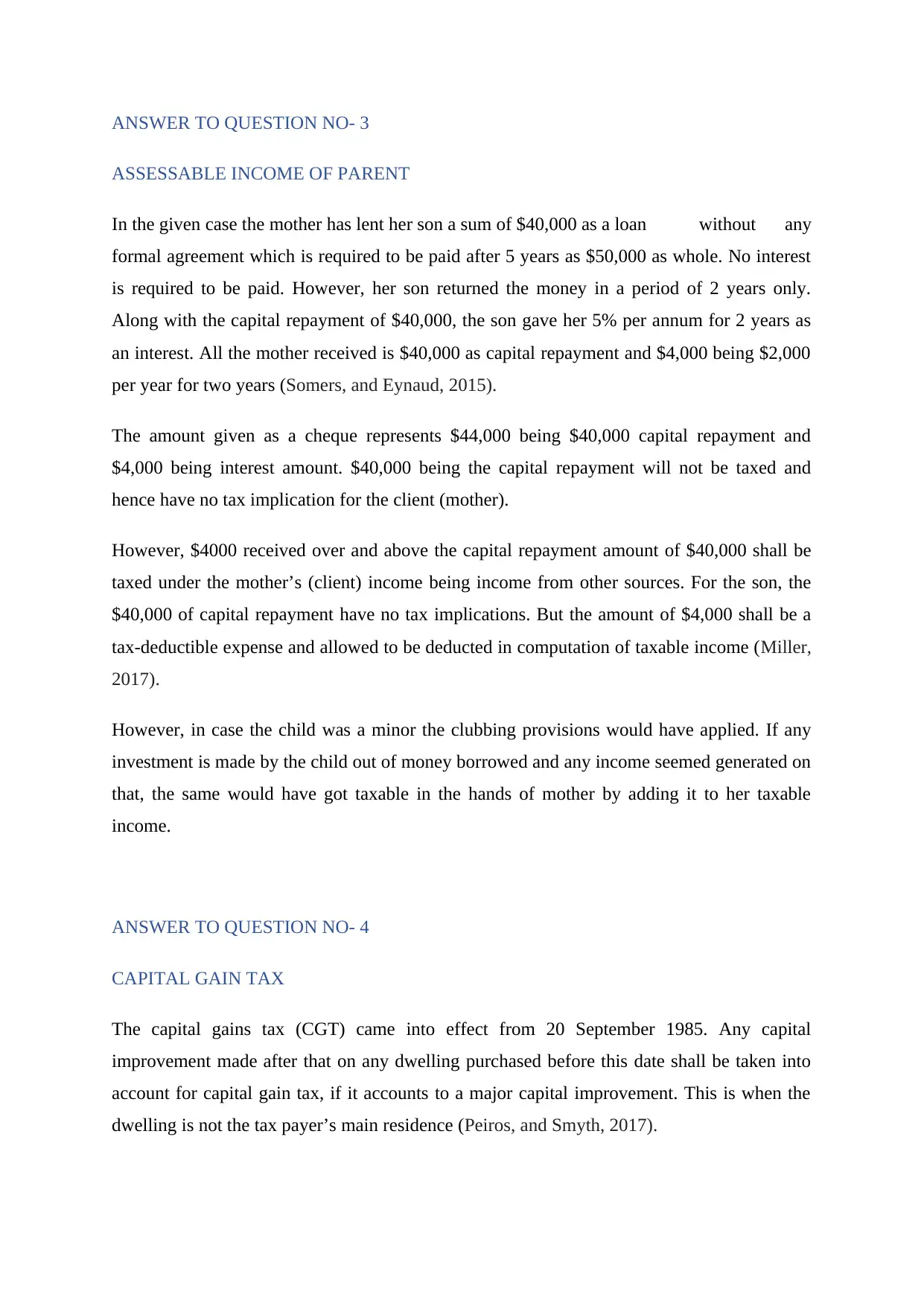
ANSWER TO QUESTION NO- 3
ASSESSABLE INCOME OF PARENT
In the given case the mother has lent her son a sum of $40,000 as a loan without any
formal agreement which is required to be paid after 5 years as $50,000 as whole. No interest
is required to be paid. However, her son returned the money in a period of 2 years only.
Along with the capital repayment of $40,000, the son gave her 5% per annum for 2 years as
an interest. All the mother received is $40,000 as capital repayment and $4,000 being $2,000
per year for two years (Somers, and Eynaud, 2015).
The amount given as a cheque represents $44,000 being $40,000 capital repayment and
$4,000 being interest amount. $40,000 being the capital repayment will not be taxed and
hence have no tax implication for the client (mother).
However, $4000 received over and above the capital repayment amount of $40,000 shall be
taxed under the mother’s (client) income being income from other sources. For the son, the
$40,000 of capital repayment have no tax implications. But the amount of $4,000 shall be a
tax-deductible expense and allowed to be deducted in computation of taxable income (Miller,
2017).
However, in case the child was a minor the clubbing provisions would have applied. If any
investment is made by the child out of money borrowed and any income seemed generated on
that, the same would have got taxable in the hands of mother by adding it to her taxable
income.
ANSWER TO QUESTION NO- 4
CAPITAL GAIN TAX
The capital gains tax (CGT) came into effect from 20 September 1985. Any capital
improvement made after that on any dwelling purchased before this date shall be taken into
account for capital gain tax, if it accounts to a major capital improvement. This is when the
dwelling is not the tax payer’s main residence (Peiros, and Smyth, 2017).
ASSESSABLE INCOME OF PARENT
In the given case the mother has lent her son a sum of $40,000 as a loan without any
formal agreement which is required to be paid after 5 years as $50,000 as whole. No interest
is required to be paid. However, her son returned the money in a period of 2 years only.
Along with the capital repayment of $40,000, the son gave her 5% per annum for 2 years as
an interest. All the mother received is $40,000 as capital repayment and $4,000 being $2,000
per year for two years (Somers, and Eynaud, 2015).
The amount given as a cheque represents $44,000 being $40,000 capital repayment and
$4,000 being interest amount. $40,000 being the capital repayment will not be taxed and
hence have no tax implication for the client (mother).
However, $4000 received over and above the capital repayment amount of $40,000 shall be
taxed under the mother’s (client) income being income from other sources. For the son, the
$40,000 of capital repayment have no tax implications. But the amount of $4,000 shall be a
tax-deductible expense and allowed to be deducted in computation of taxable income (Miller,
2017).
However, in case the child was a minor the clubbing provisions would have applied. If any
investment is made by the child out of money borrowed and any income seemed generated on
that, the same would have got taxable in the hands of mother by adding it to her taxable
income.
ANSWER TO QUESTION NO- 4
CAPITAL GAIN TAX
The capital gains tax (CGT) came into effect from 20 September 1985. Any capital
improvement made after that on any dwelling purchased before this date shall be taken into
account for capital gain tax, if it accounts to a major capital improvement. This is when the
dwelling is not the tax payer’s main residence (Peiros, and Smyth, 2017).
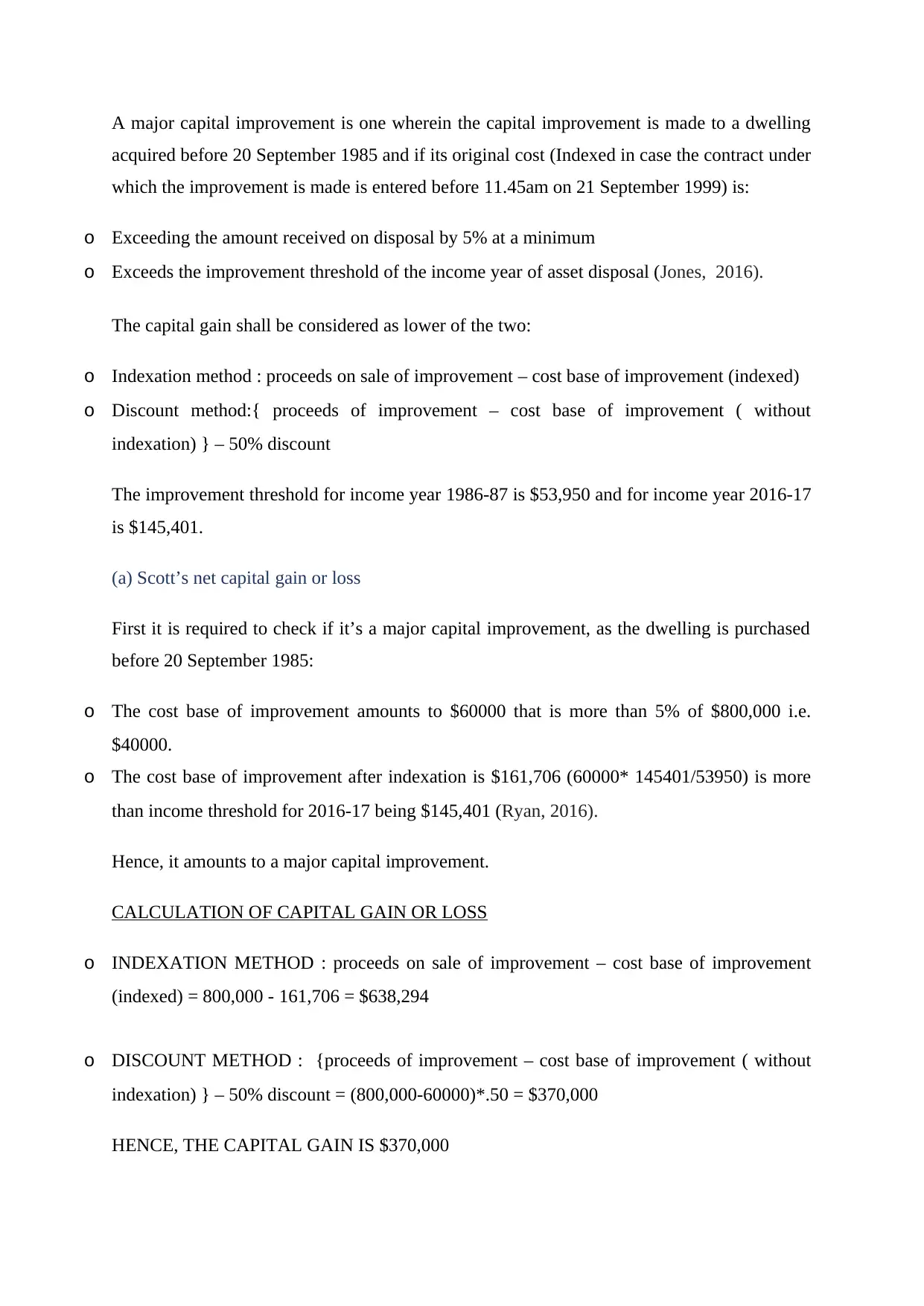
A major capital improvement is one wherein the capital improvement is made to a dwelling
acquired before 20 September 1985 and if its original cost (Indexed in case the contract under
which the improvement is made is entered before 11.45am on 21 September 1999) is:
o Exceeding the amount received on disposal by 5% at a minimum
o Exceeds the improvement threshold of the income year of asset disposal (Jones, 2016).
The capital gain shall be considered as lower of the two:
o Indexation method : proceeds on sale of improvement – cost base of improvement (indexed)
o Discount method:{ proceeds of improvement – cost base of improvement ( without
indexation) } – 50% discount
The improvement threshold for income year 1986-87 is $53,950 and for income year 2016-17
is $145,401.
(a) Scott’s net capital gain or loss
First it is required to check if it’s a major capital improvement, as the dwelling is purchased
before 20 September 1985:
o The cost base of improvement amounts to $60000 that is more than 5% of $800,000 i.e.
$40000.
o The cost base of improvement after indexation is $161,706 (60000* 145401/53950) is more
than income threshold for 2016-17 being $145,401 (Ryan, 2016).
Hence, it amounts to a major capital improvement.
CALCULATION OF CAPITAL GAIN OR LOSS
o INDEXATION METHOD : proceeds on sale of improvement – cost base of improvement
(indexed) = 800,000 - 161,706 = $638,294
o DISCOUNT METHOD : {proceeds of improvement – cost base of improvement ( without
indexation) } – 50% discount = (800,000-60000)*.50 = $370,000
HENCE, THE CAPITAL GAIN IS $370,000
acquired before 20 September 1985 and if its original cost (Indexed in case the contract under
which the improvement is made is entered before 11.45am on 21 September 1999) is:
o Exceeding the amount received on disposal by 5% at a minimum
o Exceeds the improvement threshold of the income year of asset disposal (Jones, 2016).
The capital gain shall be considered as lower of the two:
o Indexation method : proceeds on sale of improvement – cost base of improvement (indexed)
o Discount method:{ proceeds of improvement – cost base of improvement ( without
indexation) } – 50% discount
The improvement threshold for income year 1986-87 is $53,950 and for income year 2016-17
is $145,401.
(a) Scott’s net capital gain or loss
First it is required to check if it’s a major capital improvement, as the dwelling is purchased
before 20 September 1985:
o The cost base of improvement amounts to $60000 that is more than 5% of $800,000 i.e.
$40000.
o The cost base of improvement after indexation is $161,706 (60000* 145401/53950) is more
than income threshold for 2016-17 being $145,401 (Ryan, 2016).
Hence, it amounts to a major capital improvement.
CALCULATION OF CAPITAL GAIN OR LOSS
o INDEXATION METHOD : proceeds on sale of improvement – cost base of improvement
(indexed) = 800,000 - 161,706 = $638,294
o DISCOUNT METHOD : {proceeds of improvement – cost base of improvement ( without
indexation) } – 50% discount = (800,000-60000)*.50 = $370,000
HENCE, THE CAPITAL GAIN IS $370,000
⊘ This is a preview!⊘
Do you want full access?
Subscribe today to unlock all pages.
Trusted by 1+ million students worldwide
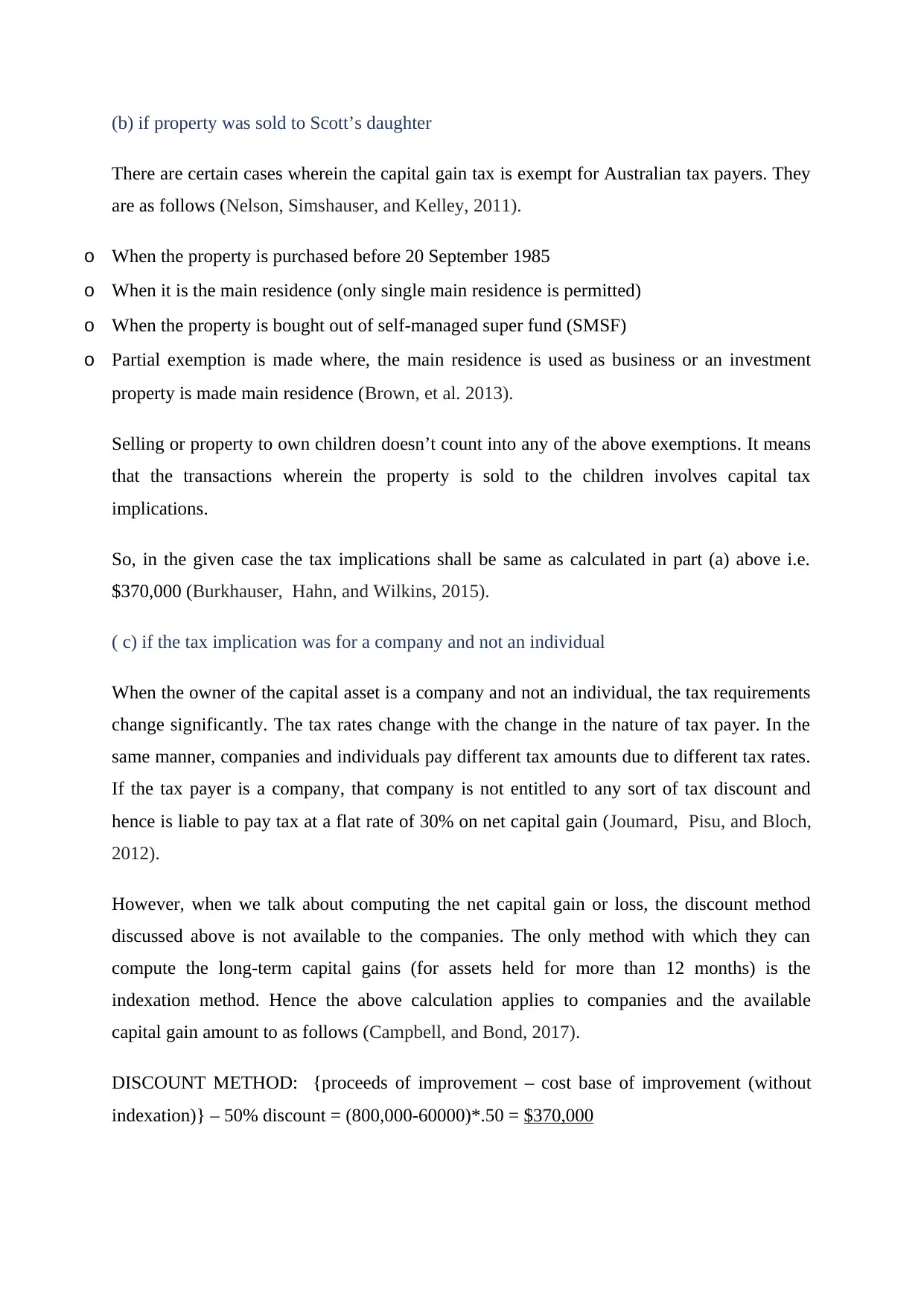
(b) if property was sold to Scott’s daughter
There are certain cases wherein the capital gain tax is exempt for Australian tax payers. They
are as follows (Nelson, Simshauser, and Kelley, 2011).
o When the property is purchased before 20 September 1985
o When it is the main residence (only single main residence is permitted)
o When the property is bought out of self-managed super fund (SMSF)
o Partial exemption is made where, the main residence is used as business or an investment
property is made main residence (Brown, et al. 2013).
Selling or property to own children doesn’t count into any of the above exemptions. It means
that the transactions wherein the property is sold to the children involves capital tax
implications.
So, in the given case the tax implications shall be same as calculated in part (a) above i.e.
$370,000 (Burkhauser, Hahn, and Wilkins, 2015).
( c) if the tax implication was for a company and not an individual
When the owner of the capital asset is a company and not an individual, the tax requirements
change significantly. The tax rates change with the change in the nature of tax payer. In the
same manner, companies and individuals pay different tax amounts due to different tax rates.
If the tax payer is a company, that company is not entitled to any sort of tax discount and
hence is liable to pay tax at a flat rate of 30% on net capital gain (Joumard, Pisu, and Bloch,
2012).
However, when we talk about computing the net capital gain or loss, the discount method
discussed above is not available to the companies. The only method with which they can
compute the long-term capital gains (for assets held for more than 12 months) is the
indexation method. Hence the above calculation applies to companies and the available
capital gain amount to as follows (Campbell, and Bond, 2017).
DISCOUNT METHOD: {proceeds of improvement – cost base of improvement (without
indexation)} – 50% discount = (800,000-60000)*.50 = $370,000
There are certain cases wherein the capital gain tax is exempt for Australian tax payers. They
are as follows (Nelson, Simshauser, and Kelley, 2011).
o When the property is purchased before 20 September 1985
o When it is the main residence (only single main residence is permitted)
o When the property is bought out of self-managed super fund (SMSF)
o Partial exemption is made where, the main residence is used as business or an investment
property is made main residence (Brown, et al. 2013).
Selling or property to own children doesn’t count into any of the above exemptions. It means
that the transactions wherein the property is sold to the children involves capital tax
implications.
So, in the given case the tax implications shall be same as calculated in part (a) above i.e.
$370,000 (Burkhauser, Hahn, and Wilkins, 2015).
( c) if the tax implication was for a company and not an individual
When the owner of the capital asset is a company and not an individual, the tax requirements
change significantly. The tax rates change with the change in the nature of tax payer. In the
same manner, companies and individuals pay different tax amounts due to different tax rates.
If the tax payer is a company, that company is not entitled to any sort of tax discount and
hence is liable to pay tax at a flat rate of 30% on net capital gain (Joumard, Pisu, and Bloch,
2012).
However, when we talk about computing the net capital gain or loss, the discount method
discussed above is not available to the companies. The only method with which they can
compute the long-term capital gains (for assets held for more than 12 months) is the
indexation method. Hence the above calculation applies to companies and the available
capital gain amount to as follows (Campbell, and Bond, 2017).
DISCOUNT METHOD: {proceeds of improvement – cost base of improvement (without
indexation)} – 50% discount = (800,000-60000)*.50 = $370,000
Paraphrase This Document
Need a fresh take? Get an instant paraphrase of this document with our AI Paraphraser
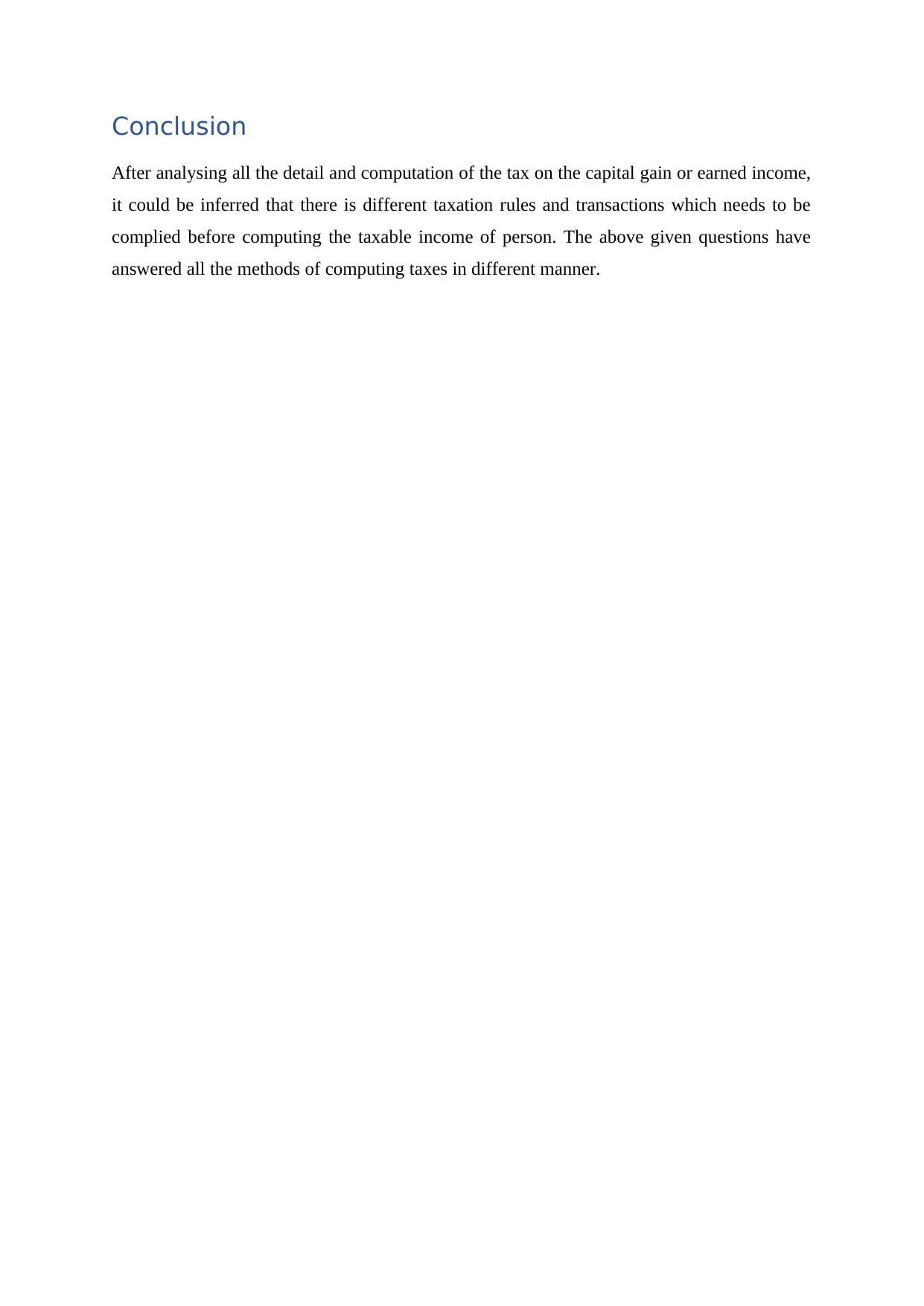
Conclusion
After analysing all the detail and computation of the tax on the capital gain or earned income,
it could be inferred that there is different taxation rules and transactions which needs to be
complied before computing the taxable income of person. The above given questions have
answered all the methods of computing taxes in different manner.
After analysing all the detail and computation of the tax on the capital gain or earned income,
it could be inferred that there is different taxation rules and transactions which needs to be
complied before computing the taxable income of person. The above given questions have
answered all the methods of computing taxes in different manner.
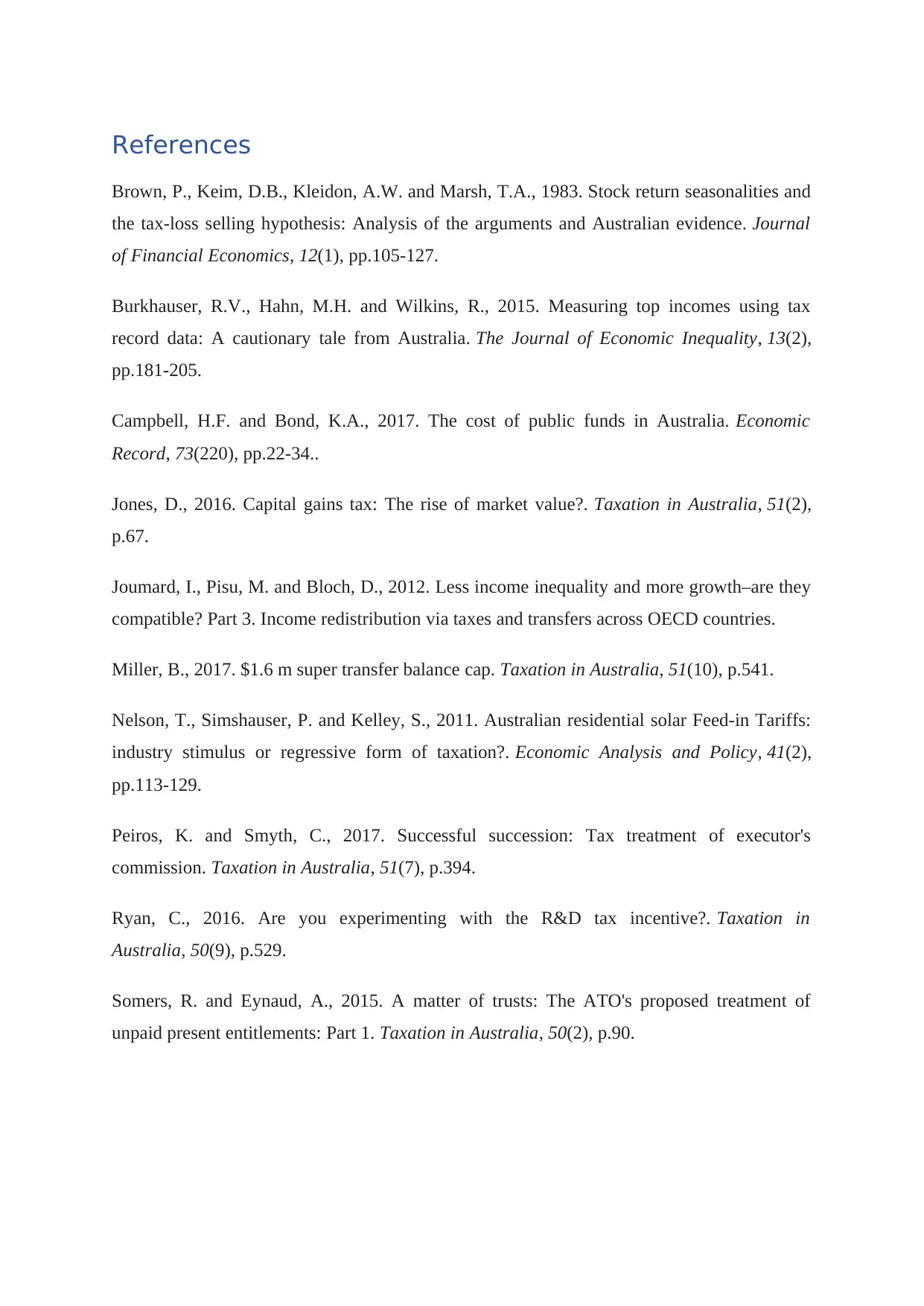
References
Brown, P., Keim, D.B., Kleidon, A.W. and Marsh, T.A., 1983. Stock return seasonalities and
the tax-loss selling hypothesis: Analysis of the arguments and Australian evidence. Journal
of Financial Economics, 12(1), pp.105-127.
Burkhauser, R.V., Hahn, M.H. and Wilkins, R., 2015. Measuring top incomes using tax
record data: A cautionary tale from Australia. The Journal of Economic Inequality, 13(2),
pp.181-205.
Campbell, H.F. and Bond, K.A., 2017. The cost of public funds in Australia. Economic
Record, 73(220), pp.22-34..
Jones, D., 2016. Capital gains tax: The rise of market value?. Taxation in Australia, 51(2),
p.67.
Joumard, I., Pisu, M. and Bloch, D., 2012. Less income inequality and more growth–are they
compatible? Part 3. Income redistribution via taxes and transfers across OECD countries.
Miller, B., 2017. $1.6 m super transfer balance cap. Taxation in Australia, 51(10), p.541.
Nelson, T., Simshauser, P. and Kelley, S., 2011. Australian residential solar Feed-in Tariffs:
industry stimulus or regressive form of taxation?. Economic Analysis and Policy, 41(2),
pp.113-129.
Peiros, K. and Smyth, C., 2017. Successful succession: Tax treatment of executor's
commission. Taxation in Australia, 51(7), p.394.
Ryan, C., 2016. Are you experimenting with the R&D tax incentive?. Taxation in
Australia, 50(9), p.529.
Somers, R. and Eynaud, A., 2015. A matter of trusts: The ATO's proposed treatment of
unpaid present entitlements: Part 1. Taxation in Australia, 50(2), p.90.
Brown, P., Keim, D.B., Kleidon, A.W. and Marsh, T.A., 1983. Stock return seasonalities and
the tax-loss selling hypothesis: Analysis of the arguments and Australian evidence. Journal
of Financial Economics, 12(1), pp.105-127.
Burkhauser, R.V., Hahn, M.H. and Wilkins, R., 2015. Measuring top incomes using tax
record data: A cautionary tale from Australia. The Journal of Economic Inequality, 13(2),
pp.181-205.
Campbell, H.F. and Bond, K.A., 2017. The cost of public funds in Australia. Economic
Record, 73(220), pp.22-34..
Jones, D., 2016. Capital gains tax: The rise of market value?. Taxation in Australia, 51(2),
p.67.
Joumard, I., Pisu, M. and Bloch, D., 2012. Less income inequality and more growth–are they
compatible? Part 3. Income redistribution via taxes and transfers across OECD countries.
Miller, B., 2017. $1.6 m super transfer balance cap. Taxation in Australia, 51(10), p.541.
Nelson, T., Simshauser, P. and Kelley, S., 2011. Australian residential solar Feed-in Tariffs:
industry stimulus or regressive form of taxation?. Economic Analysis and Policy, 41(2),
pp.113-129.
Peiros, K. and Smyth, C., 2017. Successful succession: Tax treatment of executor's
commission. Taxation in Australia, 51(7), p.394.
Ryan, C., 2016. Are you experimenting with the R&D tax incentive?. Taxation in
Australia, 50(9), p.529.
Somers, R. and Eynaud, A., 2015. A matter of trusts: The ATO's proposed treatment of
unpaid present entitlements: Part 1. Taxation in Australia, 50(2), p.90.
⊘ This is a preview!⊘
Do you want full access?
Subscribe today to unlock all pages.
Trusted by 1+ million students worldwide

1 out of 9


Related Documents


Your All-in-One AI-Powered Toolkit for Academic Success.
+13062052269
info@desklib.com
Available 24*7 on WhatsApp / Email
![[object Object]](/_next/static/media/star-bottom.7253800d.svg)
Unlock your academic potential
Copyright © 2020–2026 A2Z Services. All Rights Reserved. Developed and managed by ZUCOL.