Singapore Taxation: Income Tax Computation, Analysis - Catering Firm
VerifiedAdded on 2023/06/08
|9
|1746
|276
Report
AI Summary
This report provides a comprehensive analysis of income tax computation for a food catering business in Singapore, adhering to the country's taxation laws. It addresses key aspects such as the taxability of various income sources, including net profit, rental income, interest, and foreign dividends. The report also discusses allowable deductions, pre-incorporation expenses, and the implications of the Portable Medical Benefits Scheme (PMBS). Furthermore, it includes a detailed tax computation statement, covering non-taxable income, non-deductible expenses, capital allowances, and donations, ultimately determining the chargeable income and net tax payable. The report also explores tax exemptions on share transfers and evaluates the tax implications of reimbursing employee transportation costs versus providing a transportation allowance. This document, available on Desklib, serves as a valuable resource for students seeking solved assignments and study materials.

Running head: TAX
Tax
Name of the Student:
Name of the University:
Authors Note:
Tax
Name of the Student:
Name of the University:
Authors Note:
Paraphrase This Document
Need a fresh take? Get an instant paraphrase of this document with our AI Paraphraser

1TAX
Table of Contents
Answer to Question A:...............................................................................................................2
Answer to question B:................................................................................................................3
Answer to question c:.................................................................................................................5
Answer to question d:.................................................................................................................6
Reference....................................................................................................................................8
Table of Contents
Answer to Question A:...............................................................................................................2
Answer to question B:................................................................................................................3
Answer to question c:.................................................................................................................5
Answer to question d:.................................................................................................................6
Reference....................................................................................................................................8

2TAX
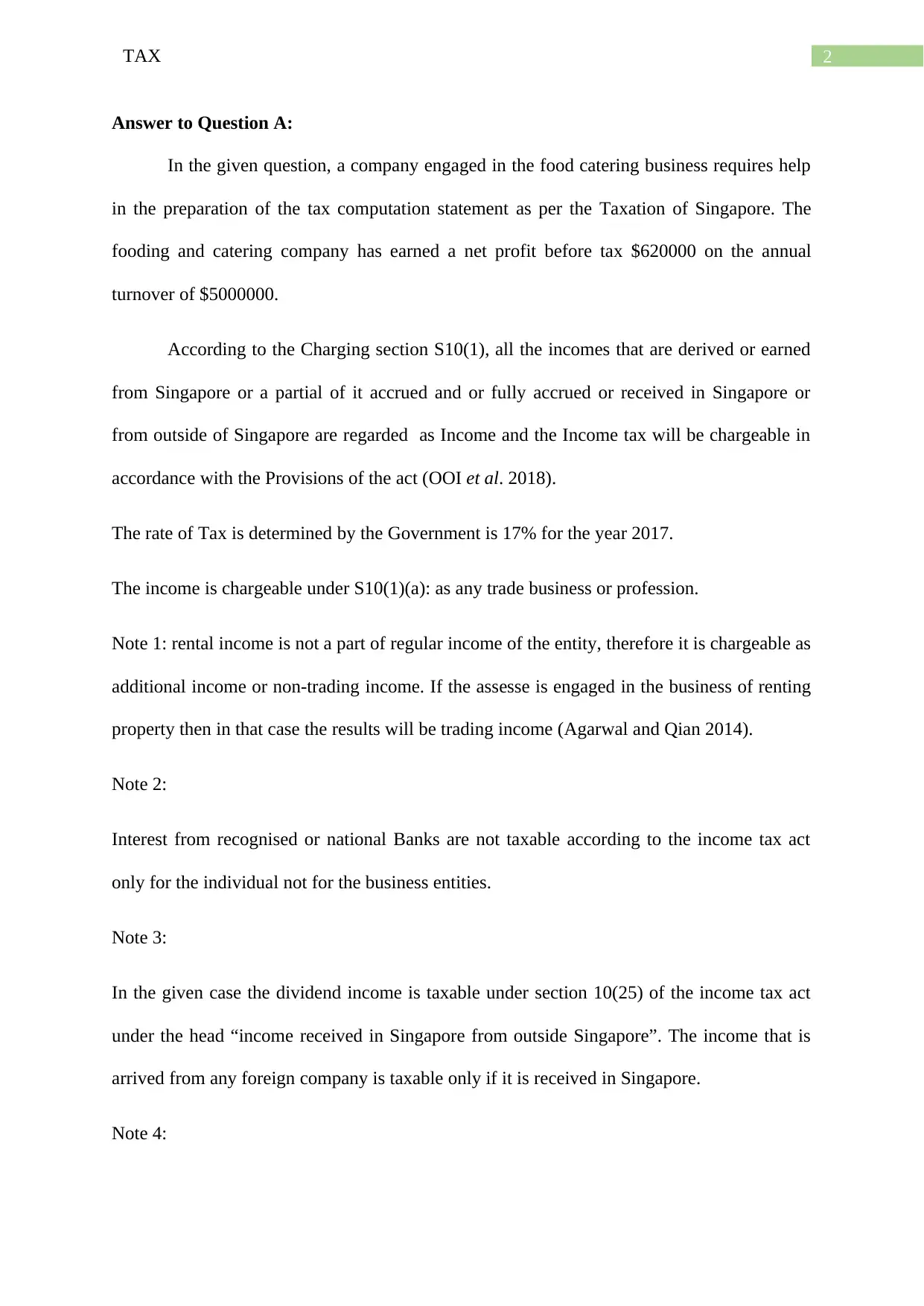
Answer to Question A:
In the given question, a company engaged in the food catering business requires help
in the preparation of the tax computation statement as per the Taxation of Singapore. The
fooding and catering company has earned a net profit before tax $620000 on the annual
turnover of $5000000.
According to the Charging section S10(1), all the incomes that are derived or earned
from Singapore or a partial of it accrued and or fully accrued or received in Singapore or
from outside of Singapore are regarded as Income and the Income tax will be chargeable in
accordance with the Provisions of the act (OOI et al. 2018).
The rate of Tax is determined by the Government is 17% for the year 2017.
The income is chargeable under S10(1)(a): as any trade business or profession.
Note 1: rental income is not a part of regular income of the entity, therefore it is chargeable as
additional income or non-trading income. If the assesse is engaged in the business of renting
property then in that case the results will be trading income (Agarwal and Qian 2014).
Note 2:
Interest from recognised or national Banks are not taxable according to the income tax act
only for the individual not for the business entities.
Note 3:
In the given case the dividend income is taxable under section 10(25) of the income tax act
under the head “income received in Singapore from outside Singapore”. The income that is
arrived from any foreign company is taxable only if it is received in Singapore.
Note 4:
Answer to Question A:
In the given question, a company engaged in the food catering business requires help
in the preparation of the tax computation statement as per the Taxation of Singapore. The
fooding and catering company has earned a net profit before tax $620000 on the annual
turnover of $5000000.
According to the Charging section S10(1), all the incomes that are derived or earned
from Singapore or a partial of it accrued and or fully accrued or received in Singapore or
from outside of Singapore are regarded as Income and the Income tax will be chargeable in
accordance with the Provisions of the act (OOI et al. 2018).
The rate of Tax is determined by the Government is 17% for the year 2017.
The income is chargeable under S10(1)(a): as any trade business or profession.
Note 1: rental income is not a part of regular income of the entity, therefore it is chargeable as
additional income or non-trading income. If the assesse is engaged in the business of renting
property then in that case the results will be trading income (Agarwal and Qian 2014).
Note 2:
Interest from recognised or national Banks are not taxable according to the income tax act
only for the individual not for the business entities.
Note 3:
In the given case the dividend income is taxable under section 10(25) of the income tax act
under the head “income received in Singapore from outside Singapore”. The income that is
arrived from any foreign company is taxable only if it is received in Singapore.
Note 4:
⊘ This is a preview!⊘
Do you want full access?
Subscribe today to unlock all pages.

Trusted by 1+ million students worldwide

3TAX
The grant is taken as the special deduction and subtracted from the profits.
Note 5:
All the expenses relation to the Annual direct expenses related to excess office space rented
out. Depreciation Legal fees Staff salaries, bonus and CPF. Reimbursement of staff taxi
claims due to overtime work including $2,000 for use of Uber car Hire purchase interest on
new company van Medical insurance premium The company has implemented the Portable
Medical Benefits Scheme (PMBS) are not a part of the tax computation rather they are
required to be considered in the net profit calculations (Markle 2016).
Note 6:
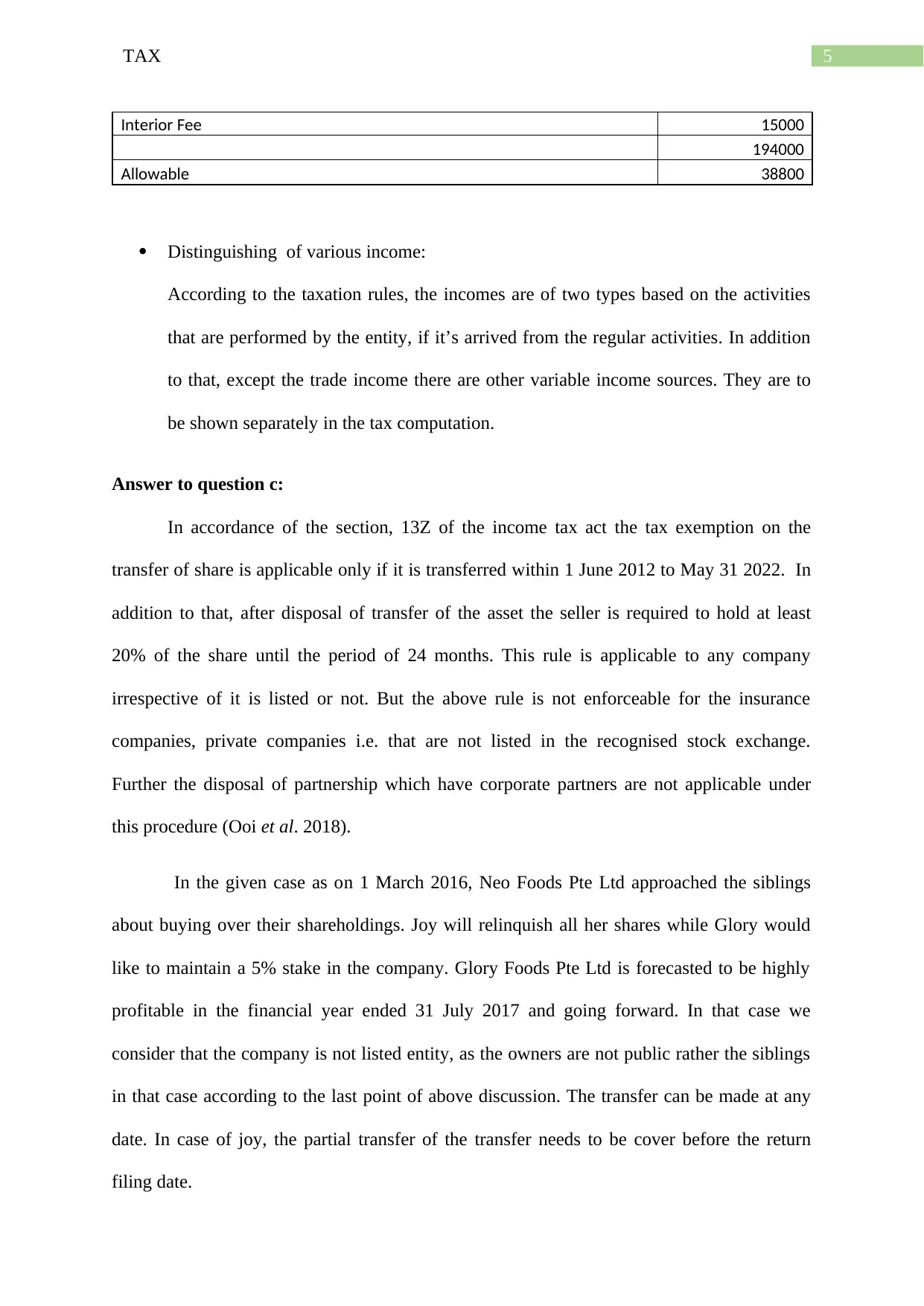
The pre incorporation expenses that are spend by the company in the year 2015 will be
amortise over 5 years term. The total expenditure is $194000; the allowable term is over the
five years. In that case the deduction that is allowed by the Income Tax Act is 38000 for the
financial year 2017.
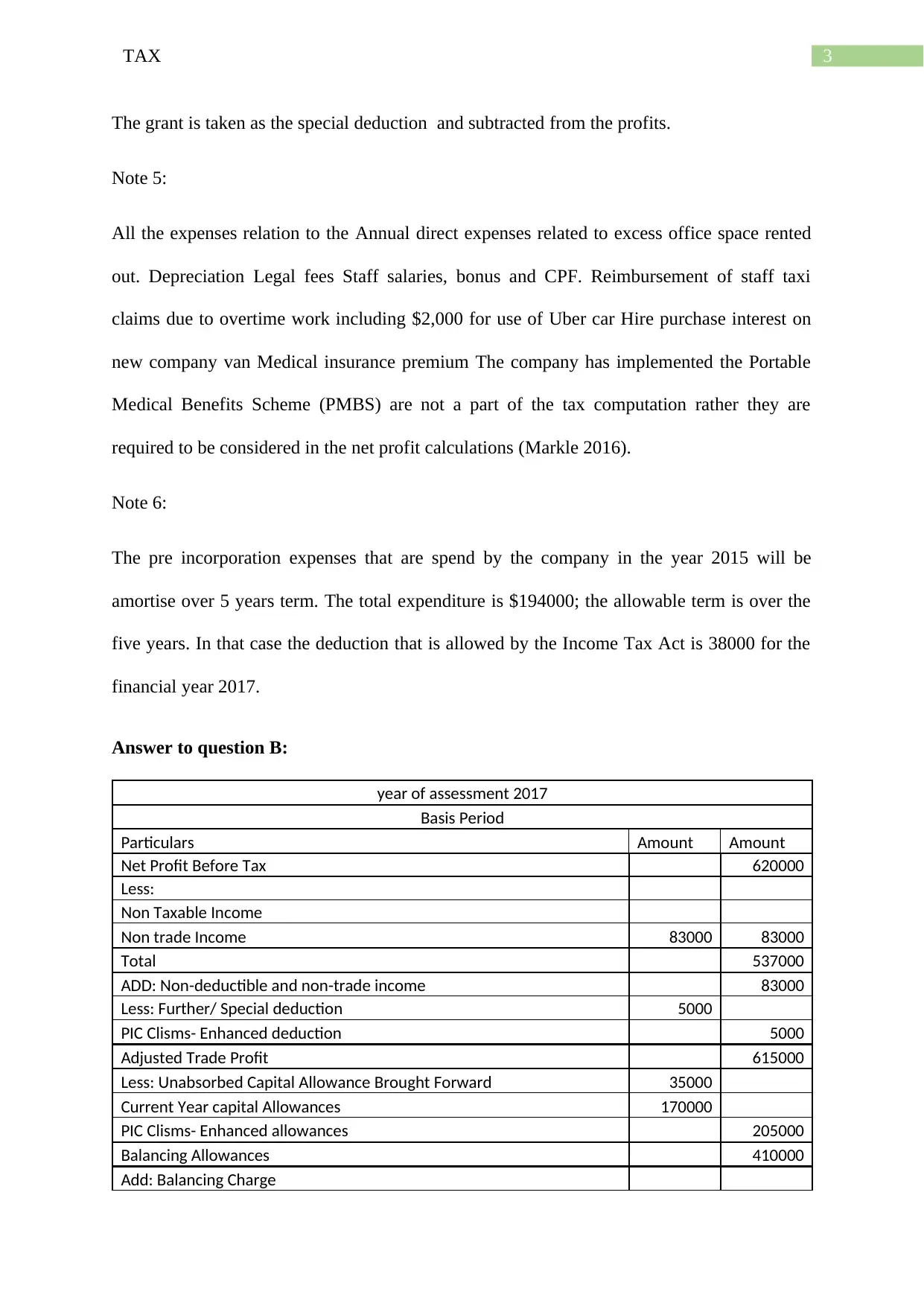
Answer to question B:
year of assessment 2017
Basis Period
Particulars Amount Amount
Net Profit Before Tax 620000
Less:
Non Taxable Income
Non trade Income 83000 83000
Total 537000
ADD: Non-deductible and non-trade income 83000
Less: Further/ Special deduction 5000
PIC Clisms- Enhanced deduction 5000
Adjusted Trade Profit 615000
Less: Unabsorbed Capital Allowance Brought Forward 35000
Current Year capital Allowances 170000
PIC Clisms- Enhanced allowances 205000
Balancing Allowances 410000
Add: Balancing Charge
The grant is taken as the special deduction and subtracted from the profits.
Note 5:
All the expenses relation to the Annual direct expenses related to excess office space rented
out. Depreciation Legal fees Staff salaries, bonus and CPF. Reimbursement of staff taxi
claims due to overtime work including $2,000 for use of Uber car Hire purchase interest on
new company van Medical insurance premium The company has implemented the Portable
Medical Benefits Scheme (PMBS) are not a part of the tax computation rather they are
required to be considered in the net profit calculations (Markle 2016).
Note 6:
The pre incorporation expenses that are spend by the company in the year 2015 will be
amortise over 5 years term. The total expenditure is $194000; the allowable term is over the
five years. In that case the deduction that is allowed by the Income Tax Act is 38000 for the
financial year 2017.
Answer to question B:
year of assessment 2017
Basis Period
Particulars Amount Amount
Net Profit Before Tax 620000
Less:
Non Taxable Income
Non trade Income 83000 83000
Total 537000
ADD: Non-deductible and non-trade income 83000
Less: Further/ Special deduction 5000
PIC Clisms- Enhanced deduction 5000
Adjusted Trade Profit 615000
Less: Unabsorbed Capital Allowance Brought Forward 35000
Current Year capital Allowances 170000
PIC Clisms- Enhanced allowances 205000
Balancing Allowances 410000
Add: Balancing Charge
Paraphrase This Document
Need a fresh take? Get an instant paraphrase of this document with our AI Paraphraser

4TAX
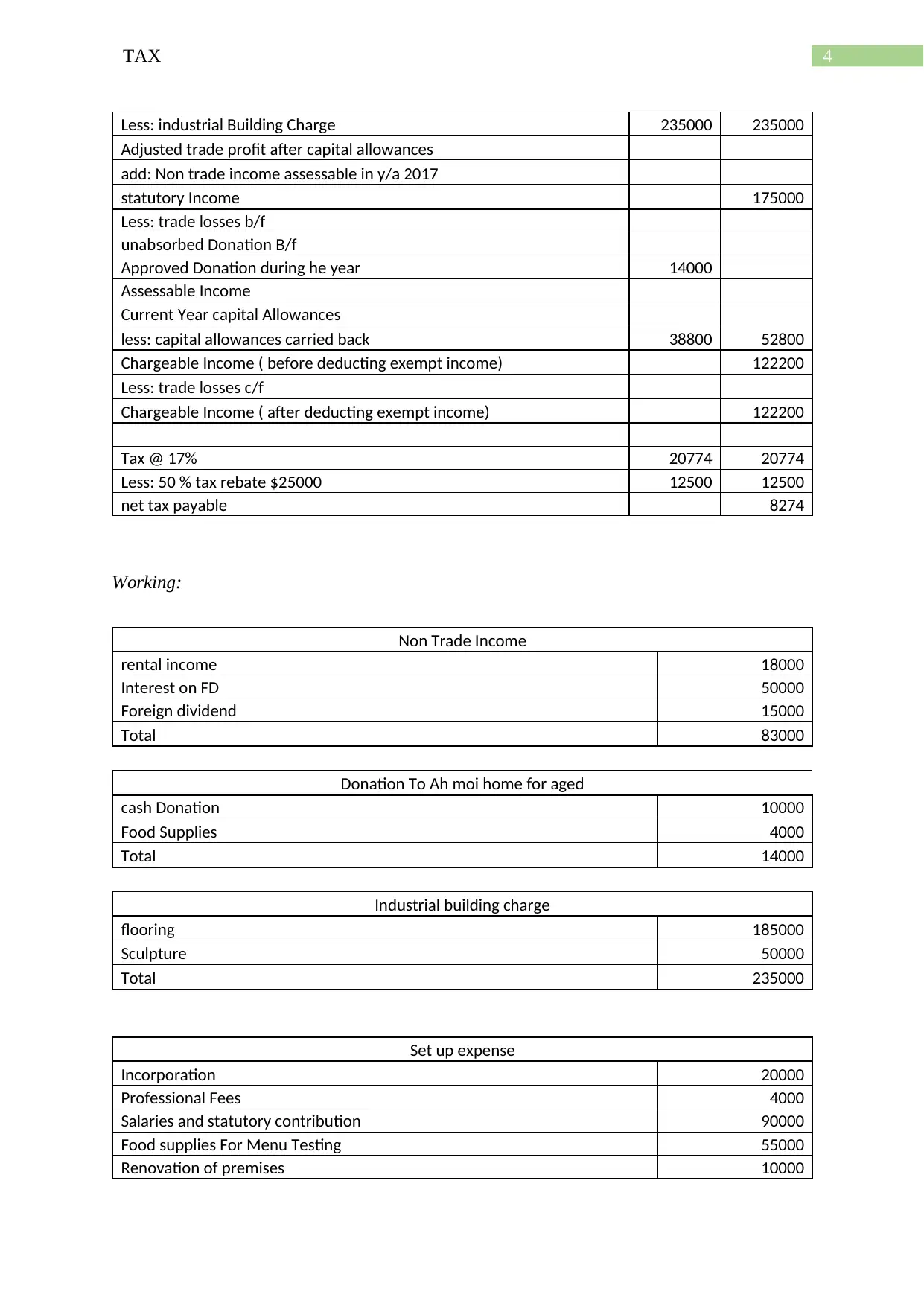
Less: industrial Building Charge 235000 235000
Adjusted trade profit after capital allowances
add: Non trade income assessable in y/a 2017
statutory Income 175000
Less: trade losses b/f
unabsorbed Donation B/f
Approved Donation during he year 14000
Assessable Income
Current Year capital Allowances
less: capital allowances carried back 38800 52800
Chargeable Income ( before deducting exempt income) 122200
Less: trade losses c/f
Chargeable Income ( after deducting exempt income) 122200
Tax @ 17% 20774 20774
Less: 50 % tax rebate $25000 12500 12500
net tax payable 8274
Working:
Non Trade Income
rental income 18000
Interest on FD 50000
Foreign dividend 15000
Total 83000
Donation To Ah moi home for aged
cash Donation 10000
Food Supplies 4000
Total 14000
Industrial building charge
flooring 185000
Sculpture 50000
Total 235000
Set up expense
Incorporation 20000
Professional Fees 4000
Salaries and statutory contribution 90000
Food supplies For Menu Testing 55000
Renovation of premises 10000
Less: industrial Building Charge 235000 235000
Adjusted trade profit after capital allowances
add: Non trade income assessable in y/a 2017
statutory Income 175000
Less: trade losses b/f
unabsorbed Donation B/f
Approved Donation during he year 14000
Assessable Income
Current Year capital Allowances
less: capital allowances carried back 38800 52800
Chargeable Income ( before deducting exempt income) 122200
Less: trade losses c/f
Chargeable Income ( after deducting exempt income) 122200
Tax @ 17% 20774 20774
Less: 50 % tax rebate $25000 12500 12500
net tax payable 8274
Working:
Non Trade Income
rental income 18000
Interest on FD 50000
Foreign dividend 15000
Total 83000
Donation To Ah moi home for aged
cash Donation 10000
Food Supplies 4000
Total 14000
Industrial building charge
flooring 185000
Sculpture 50000
Total 235000
Set up expense
Incorporation 20000
Professional Fees 4000
Salaries and statutory contribution 90000
Food supplies For Menu Testing 55000
Renovation of premises 10000

5TAX
Interior Fee 15000
194000
Allowable 38800
Distinguishing of various income:
According to the taxation rules, the incomes are of two types based on the activities
that are performed by the entity, if it’s arrived from the regular activities. In addition
to that, except the trade income there are other variable income sources. They are to
be shown separately in the tax computation.
Answer to question c:
In accordance of the section, 13Z of the income tax act the tax exemption on the
transfer of share is applicable only if it is transferred within 1 June 2012 to May 31 2022. In
addition to that, after disposal of transfer of the asset the seller is required to hold at least
20% of the share until the period of 24 months. This rule is applicable to any company
irrespective of it is listed or not. But the above rule is not enforceable for the insurance
companies, private companies i.e. that are not listed in the recognised stock exchange.
Further the disposal of partnership which have corporate partners are not applicable under
this procedure (Ooi et al. 2018).
In the given case as on 1 March 2016, Neo Foods Pte Ltd approached the siblings
about buying over their shareholdings. Joy will relinquish all her shares while Glory would
like to maintain a 5% stake in the company. Glory Foods Pte Ltd is forecasted to be highly
profitable in the financial year ended 31 July 2017 and going forward. In that case we
consider that the company is not listed entity, as the owners are not public rather the siblings
in that case according to the last point of above discussion. The transfer can be made at any
date. In case of joy, the partial transfer of the transfer needs to be cover before the return
filing date.
Interior Fee 15000
194000
Allowable 38800
Distinguishing of various income:
According to the taxation rules, the incomes are of two types based on the activities
that are performed by the entity, if it’s arrived from the regular activities. In addition
to that, except the trade income there are other variable income sources. They are to
be shown separately in the tax computation.
Answer to question c:
In accordance of the section, 13Z of the income tax act the tax exemption on the
transfer of share is applicable only if it is transferred within 1 June 2012 to May 31 2022. In
addition to that, after disposal of transfer of the asset the seller is required to hold at least
20% of the share until the period of 24 months. This rule is applicable to any company
irrespective of it is listed or not. But the above rule is not enforceable for the insurance
companies, private companies i.e. that are not listed in the recognised stock exchange.
Further the disposal of partnership which have corporate partners are not applicable under
this procedure (Ooi et al. 2018).
In the given case as on 1 March 2016, Neo Foods Pte Ltd approached the siblings
about buying over their shareholdings. Joy will relinquish all her shares while Glory would
like to maintain a 5% stake in the company. Glory Foods Pte Ltd is forecasted to be highly
profitable in the financial year ended 31 July 2017 and going forward. In that case we
consider that the company is not listed entity, as the owners are not public rather the siblings
in that case according to the last point of above discussion. The transfer can be made at any
date. In case of joy, the partial transfer of the transfer needs to be cover before the return
filing date.
⊘ This is a preview!⊘
Do you want full access?
Subscribe today to unlock all pages.

Trusted by 1+ million students worldwide

6TAX
Answer to question d:
Introduction:
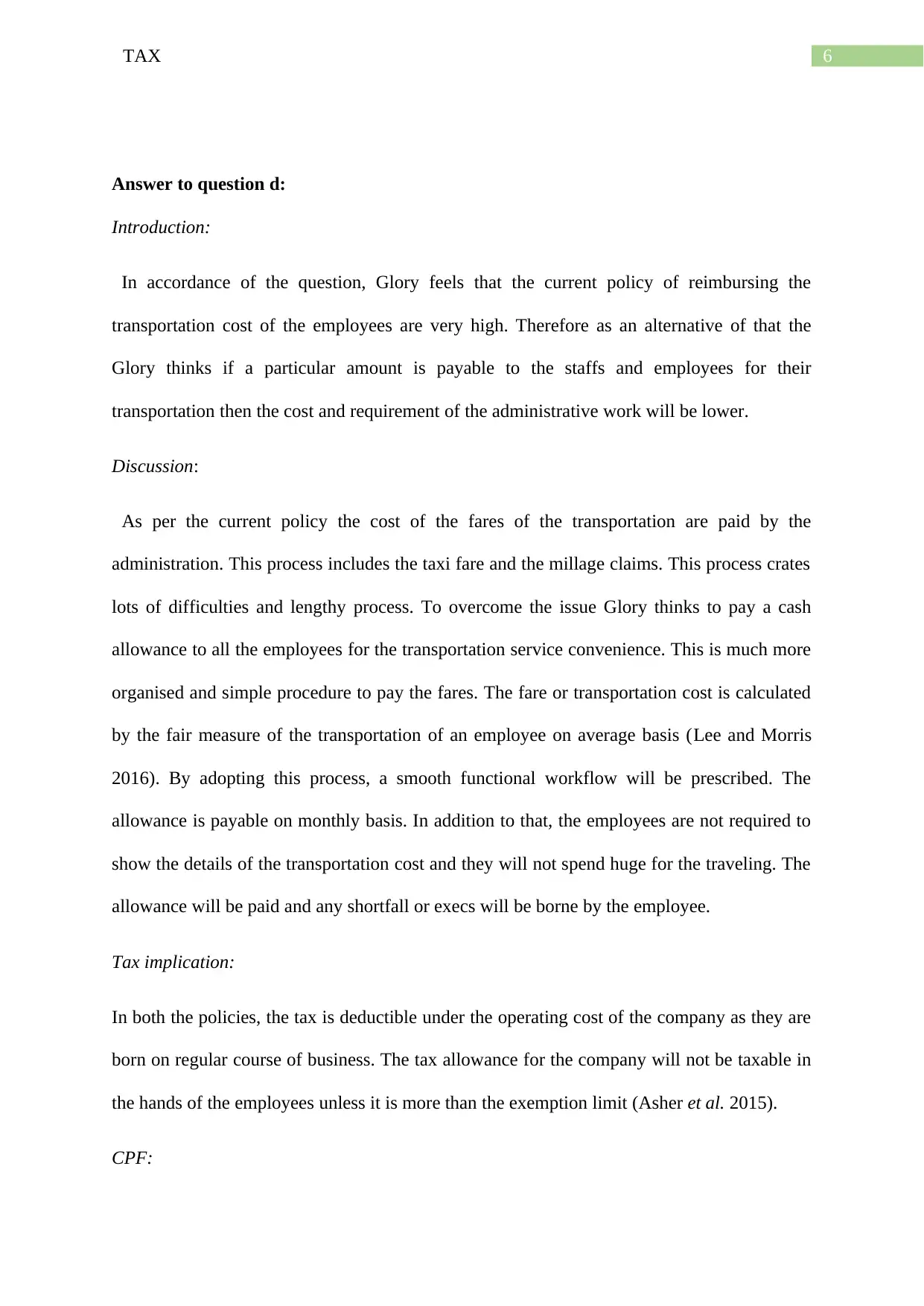
In accordance of the question, Glory feels that the current policy of reimbursing the
transportation cost of the employees are very high. Therefore as an alternative of that the
Glory thinks if a particular amount is payable to the staffs and employees for their
transportation then the cost and requirement of the administrative work will be lower.
Discussion:
As per the current policy the cost of the fares of the transportation are paid by the
administration. This process includes the taxi fare and the millage claims. This process crates
lots of difficulties and lengthy process. To overcome the issue Glory thinks to pay a cash
allowance to all the employees for the transportation service convenience. This is much more
organised and simple procedure to pay the fares. The fare or transportation cost is calculated
by the fair measure of the transportation of an employee on average basis (Lee and Morris
2016). By adopting this process, a smooth functional workflow will be prescribed. The
allowance is payable on monthly basis. In addition to that, the employees are not required to
show the details of the transportation cost and they will not spend huge for the traveling. The
allowance will be paid and any shortfall or execs will be borne by the employee.
Tax implication:
In both the policies, the tax is deductible under the operating cost of the company as they are
born on regular course of business. The tax allowance for the company will not be taxable in
the hands of the employees unless it is more than the exemption limit (Asher et al. 2015).
CPF:
Answer to question d:
Introduction:
In accordance of the question, Glory feels that the current policy of reimbursing the
transportation cost of the employees are very high. Therefore as an alternative of that the
Glory thinks if a particular amount is payable to the staffs and employees for their
transportation then the cost and requirement of the administrative work will be lower.
Discussion:
As per the current policy the cost of the fares of the transportation are paid by the
administration. This process includes the taxi fare and the millage claims. This process crates
lots of difficulties and lengthy process. To overcome the issue Glory thinks to pay a cash
allowance to all the employees for the transportation service convenience. This is much more
organised and simple procedure to pay the fares. The fare or transportation cost is calculated
by the fair measure of the transportation of an employee on average basis (Lee and Morris
2016). By adopting this process, a smooth functional workflow will be prescribed. The
allowance is payable on monthly basis. In addition to that, the employees are not required to
show the details of the transportation cost and they will not spend huge for the traveling. The
allowance will be paid and any shortfall or execs will be borne by the employee.
Tax implication:
In both the policies, the tax is deductible under the operating cost of the company as they are
born on regular course of business. The tax allowance for the company will not be taxable in
the hands of the employees unless it is more than the exemption limit (Asher et al. 2015).
CPF:
Paraphrase This Document
Need a fresh take? Get an instant paraphrase of this document with our AI Paraphraser

7TAX
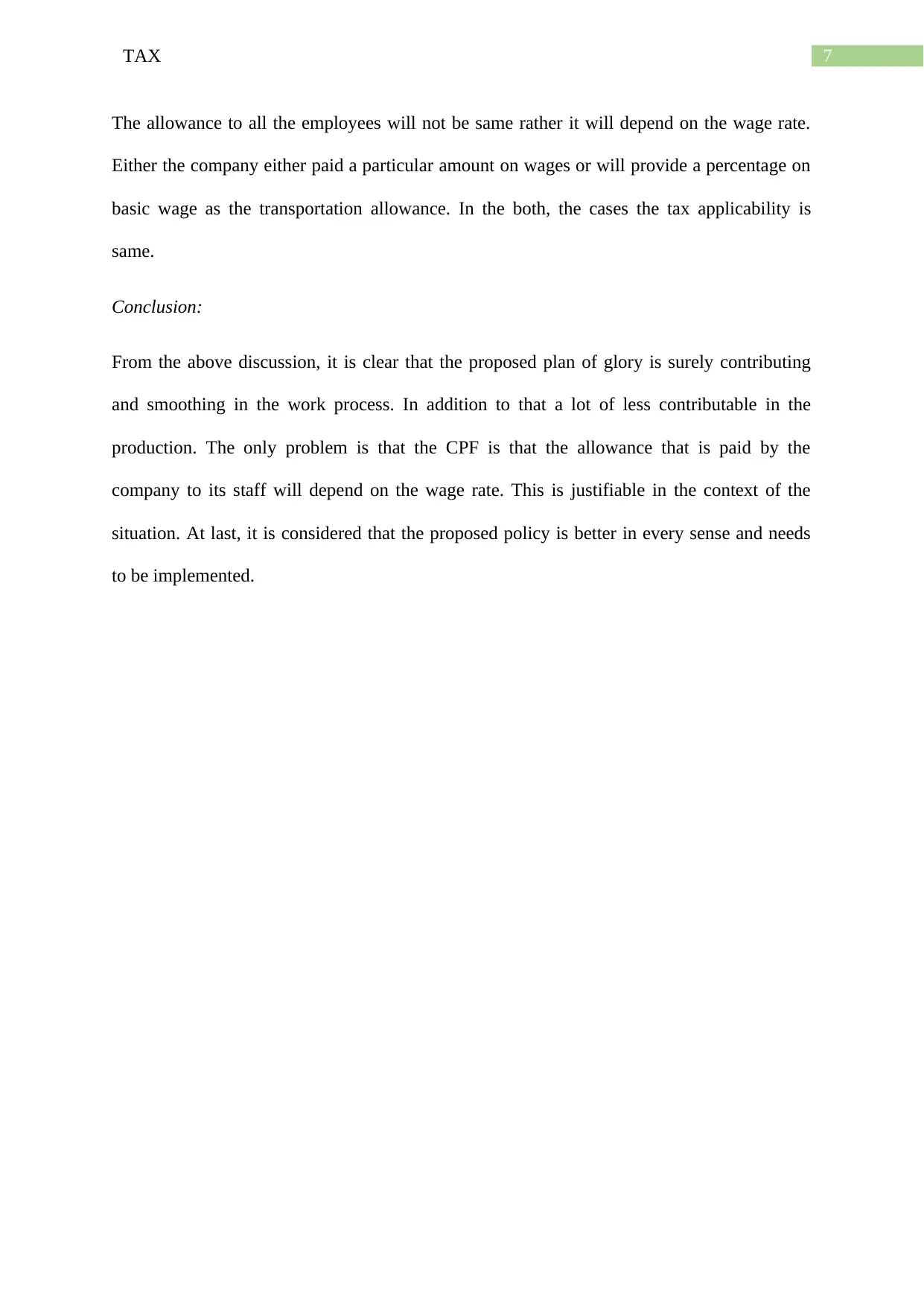
The allowance to all the employees will not be same rather it will depend on the wage rate.
Either the company either paid a particular amount on wages or will provide a percentage on
basic wage as the transportation allowance. In the both, the cases the tax applicability is
same.
Conclusion:
From the above discussion, it is clear that the proposed plan of glory is surely contributing
and smoothing in the work process. In addition to that a lot of less contributable in the
production. The only problem is that the CPF is that the allowance that is paid by the
company to its staff will depend on the wage rate. This is justifiable in the context of the
situation. At last, it is considered that the proposed policy is better in every sense and needs
to be implemented.
The allowance to all the employees will not be same rather it will depend on the wage rate.
Either the company either paid a particular amount on wages or will provide a percentage on
basic wage as the transportation allowance. In the both, the cases the tax applicability is
same.
Conclusion:
From the above discussion, it is clear that the proposed plan of glory is surely contributing
and smoothing in the work process. In addition to that a lot of less contributable in the
production. The only problem is that the CPF is that the allowance that is paid by the
company to its staff will depend on the wage rate. This is justifiable in the context of the
situation. At last, it is considered that the proposed policy is better in every sense and needs
to be implemented.

8TAX
Reference
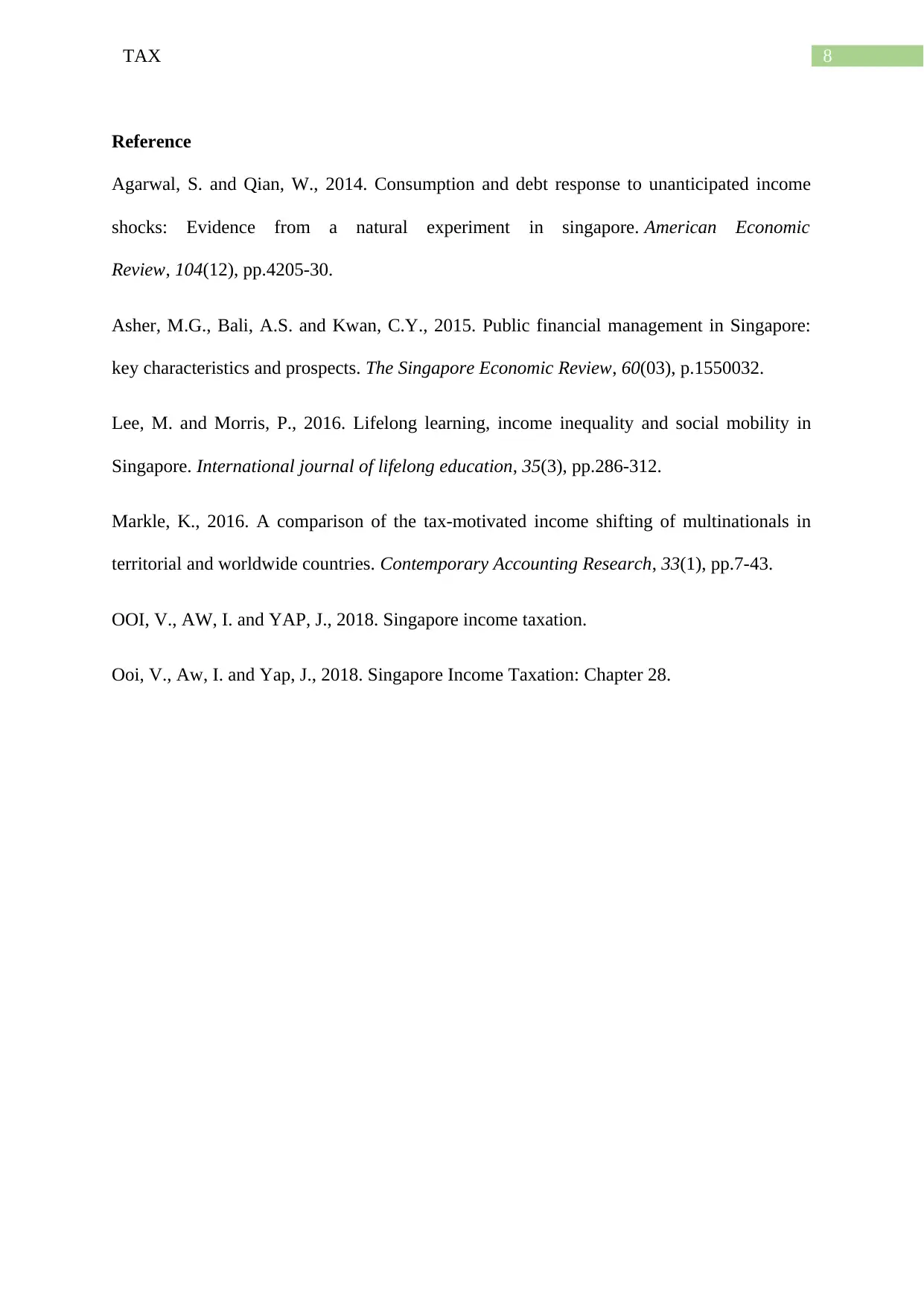
Agarwal, S. and Qian, W., 2014. Consumption and debt response to unanticipated income
shocks: Evidence from a natural experiment in singapore. American Economic
Review, 104(12), pp.4205-30.
Asher, M.G., Bali, A.S. and Kwan, C.Y., 2015. Public financial management in Singapore:
key characteristics and prospects. The Singapore Economic Review, 60(03), p.1550032.
Lee, M. and Morris, P., 2016. Lifelong learning, income inequality and social mobility in
Singapore. International journal of lifelong education, 35(3), pp.286-312.
Markle, K., 2016. A comparison of the tax‐motivated income shifting of multinationals in
territorial and worldwide countries. Contemporary Accounting Research, 33(1), pp.7-43.
OOI, V., AW, I. and YAP, J., 2018. Singapore income taxation.
Ooi, V., Aw, I. and Yap, J., 2018. Singapore Income Taxation: Chapter 28.
Reference
Agarwal, S. and Qian, W., 2014. Consumption and debt response to unanticipated income
shocks: Evidence from a natural experiment in singapore. American Economic
Review, 104(12), pp.4205-30.
Asher, M.G., Bali, A.S. and Kwan, C.Y., 2015. Public financial management in Singapore:
key characteristics and prospects. The Singapore Economic Review, 60(03), p.1550032.
Lee, M. and Morris, P., 2016. Lifelong learning, income inequality and social mobility in
Singapore. International journal of lifelong education, 35(3), pp.286-312.
Markle, K., 2016. A comparison of the tax‐motivated income shifting of multinationals in
territorial and worldwide countries. Contemporary Accounting Research, 33(1), pp.7-43.
OOI, V., AW, I. and YAP, J., 2018. Singapore income taxation.
Ooi, V., Aw, I. and Yap, J., 2018. Singapore Income Taxation: Chapter 28.
⊘ This is a preview!⊘
Do you want full access?
Subscribe today to unlock all pages.

Trusted by 1+ million students worldwide
1 out of 9
Related Documents
Your All-in-One AI-Powered Toolkit for Academic Success.
+13062052269
info@desklib.com
Available 24*7 on WhatsApp / Email
Unlock your academic potential
Copyright © 2020–2025 A2Z Services. All Rights Reserved. Developed and managed by ZUCOL.