Taxation Report: Analysis of Adrian and Denis's Tax Issues
VerifiedAdded on 2020/05/28
|18
|2991
|85
Report
AI Summary
This report addresses the tax issues faced by Adrian and Denis, offering advice and guidance on various taxation matters. It examines Denis's tax residency, considering his time spent in Ireland and the implications for his income tax obligations. The report details the tax compliance requirements for Irish rental income, including allowable expenses and capital allowances. It also explores Adrian's business, including capital allowances on plant, the rules for business commencement, and the tax treatment of a proposed partnership. Furthermore, it covers VAT registration and the VAT treatment for sales, providing a comprehensive overview of the relevant tax laws and regulations.

Running head: TAXATION
Taxation
Name of the Student:
Name of the University:
Authors Note:
Taxation
Name of the Student:
Name of the University:
Authors Note:

Paraphrase This Document
Need a fresh take? Get an instant paraphrase of this document with our AI Paraphraser
1TAXATION
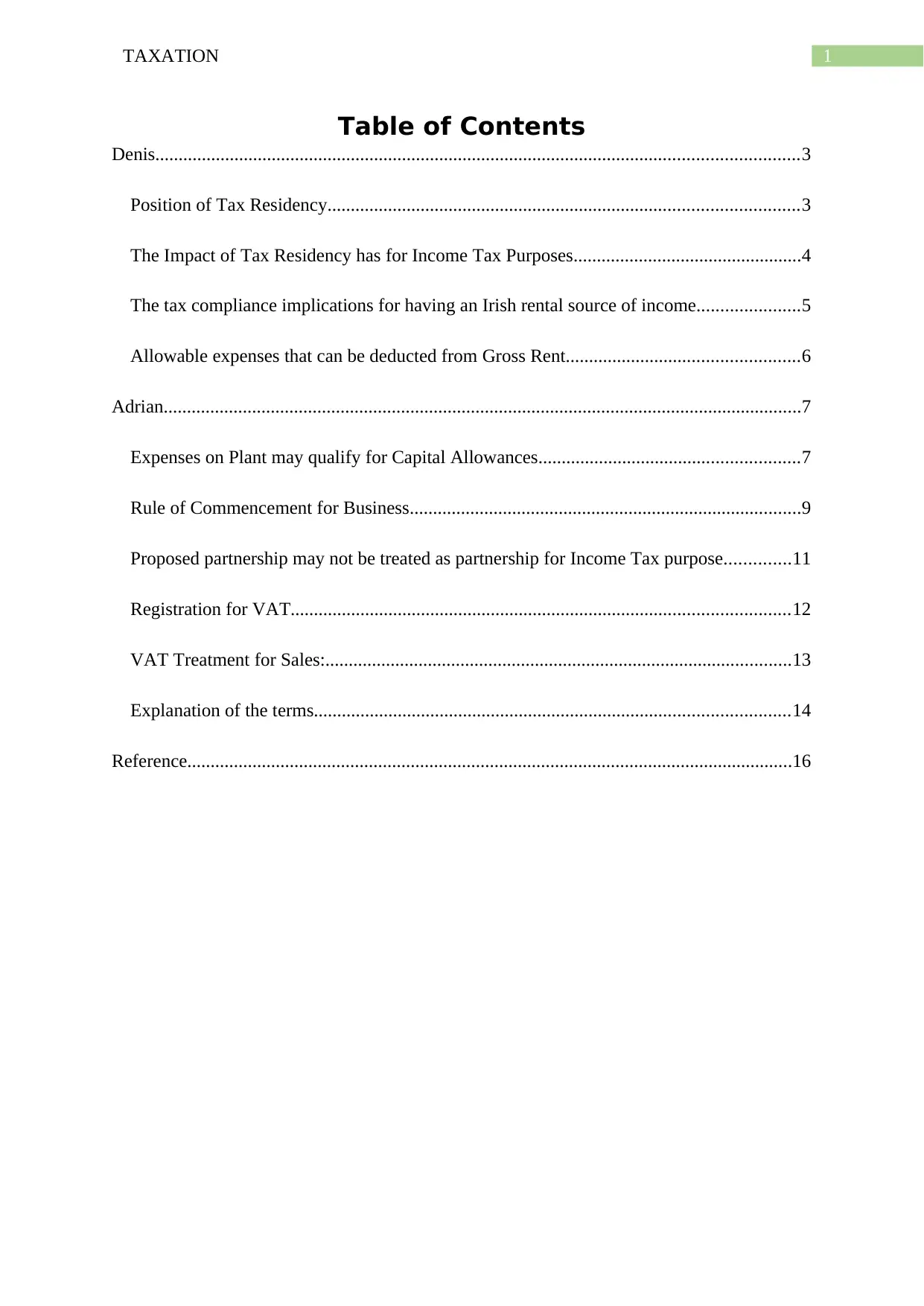
Table of Contents
Denis..........................................................................................................................................3
Position of Tax Residency.....................................................................................................3
The Impact of Tax Residency has for Income Tax Purposes.................................................4
The tax compliance implications for having an Irish rental source of income......................5
Allowable expenses that can be deducted from Gross Rent..................................................6
Adrian.........................................................................................................................................7
Expenses on Plant may qualify for Capital Allowances........................................................7
Rule of Commencement for Business....................................................................................9
Proposed partnership may not be treated as partnership for Income Tax purpose..............11
Registration for VAT...........................................................................................................12
VAT Treatment for Sales:....................................................................................................13
Explanation of the terms......................................................................................................14
Reference..................................................................................................................................16
Table of Contents
Denis..........................................................................................................................................3
Position of Tax Residency.....................................................................................................3
The Impact of Tax Residency has for Income Tax Purposes.................................................4
The tax compliance implications for having an Irish rental source of income......................5
Allowable expenses that can be deducted from Gross Rent..................................................6
Adrian.........................................................................................................................................7
Expenses on Plant may qualify for Capital Allowances........................................................7
Rule of Commencement for Business....................................................................................9
Proposed partnership may not be treated as partnership for Income Tax purpose..............11
Registration for VAT...........................................................................................................12
VAT Treatment for Sales:....................................................................................................13
Explanation of the terms......................................................................................................14
Reference..................................................................................................................................16
2TAXATION
To
Adrian
Subject: Addressing of issues related to Tax
This letter in intended to address the tax issues faced by Adrian and Denis. The
primary objective of the letter is offering adequate advice and guidance related to the taxation
issues that was brought up in the latest meeting.
To
Adrian
Subject: Addressing of issues related to Tax
This letter in intended to address the tax issues faced by Adrian and Denis. The
primary objective of the letter is offering adequate advice and guidance related to the taxation
issues that was brought up in the latest meeting.
⊘ This is a preview!⊘
Do you want full access?
Subscribe today to unlock all pages.

Trusted by 1+ million students worldwide
3TAXATION
Denis
Position of Tax Residency
On all profit, gains or properties income tax is applicable which is also stated under
section 12 of the Tax Consolidation Act 1997. The fact that whether the person has a
permanent home or is a resident of Ireland is considered when determining the tax liability.
Whether a taxpayer is a resident or not can be known by the guidelines laid in the Section 819
of the Consolidation Act 1997 (Callan et al. 2014). These provisions are:
For more than 183 days in a year, the taxpayer must have resided in Ireland;
Together in the last and current year, the taxpayer must have resided in Ireland for
more than 280 days, including a minimum stay of 30 days in every year.
Apart from this, it is also stated under section 820 of the Tax Consolidation Act 1997, that
a person will be considered as an ordinary resident if he/ she resides in the country for 3
successive years. Once the individual becomes the non-resident of Ireland for 3 successive
years, then the individual will no longer considered as an ordinarily resident.
In the current case, on 1st July 2015, Denis left Ireland. The below provided
calculation shows the number of days stayed by Denis in Ireland. It is observed that in 2015,
he has stayed for 181 days whereas he has stayed for the entire year in 2015. Thus, it clarifies
that Denis has fulfilled the secondary residency test by staying more than 280 days together
with the previous year and hence Denis will be considered as a resident of Ireland for 2015.
In the year 2016 and 2017, Denis has not satisfied any provisions and thus he is considered as
non-resident. Nevertheless, Denis will be sustained to be regarded as an ordinary resident.
Denis
Position of Tax Residency
On all profit, gains or properties income tax is applicable which is also stated under
section 12 of the Tax Consolidation Act 1997. The fact that whether the person has a
permanent home or is a resident of Ireland is considered when determining the tax liability.
Whether a taxpayer is a resident or not can be known by the guidelines laid in the Section 819
of the Consolidation Act 1997 (Callan et al. 2014). These provisions are:
For more than 183 days in a year, the taxpayer must have resided in Ireland;
Together in the last and current year, the taxpayer must have resided in Ireland for
more than 280 days, including a minimum stay of 30 days in every year.
Apart from this, it is also stated under section 820 of the Tax Consolidation Act 1997, that
a person will be considered as an ordinary resident if he/ she resides in the country for 3
successive years. Once the individual becomes the non-resident of Ireland for 3 successive
years, then the individual will no longer considered as an ordinarily resident.
In the current case, on 1st July 2015, Denis left Ireland. The below provided
calculation shows the number of days stayed by Denis in Ireland. It is observed that in 2015,
he has stayed for 181 days whereas he has stayed for the entire year in 2015. Thus, it clarifies
that Denis has fulfilled the secondary residency test by staying more than 280 days together
with the previous year and hence Denis will be considered as a resident of Ireland for 2015.
In the year 2016 and 2017, Denis has not satisfied any provisions and thus he is considered as
non-resident. Nevertheless, Denis will be sustained to be regarded as an ordinary resident.
Paraphrase This Document
Need a fresh take? Get an instant paraphrase of this document with our AI Paraphraser
4TAXATION
The Impact of Tax Residency has for Income Tax Purposes
If, for the purpose of taxation, an individual is a non-resident then he/ she shall pay
tax on such income that has occurred in Ireland. If any duties of the foreign employment are
undertaken in Ireland, then such income will also be subject to payment of taxation (Dukelow
2015).
An individual will be liable to pay tax on income earned worldwide except the
following, if that person is an ordinarily resident.
Incomes which are earned from such trade or profession that are not undertaken in
Ireland;
Income earned from employment or offices are non-taxable in Ireland whose duties
are carried out outside the country;
Income of foreign nature below €3,810 is not taxable.
Thus as it was observed in the current case that Denis, in 2015 was considered as a
resident and hence all his income will be subject to taxation. However, in the year 2016 and
2017, the above stated rules are applicable to Denis as he is a non-resident but an ordinarily
resident of Ireland.
The Impact of Tax Residency has for Income Tax Purposes
If, for the purpose of taxation, an individual is a non-resident then he/ she shall pay
tax on such income that has occurred in Ireland. If any duties of the foreign employment are
undertaken in Ireland, then such income will also be subject to payment of taxation (Dukelow
2015).
An individual will be liable to pay tax on income earned worldwide except the
following, if that person is an ordinarily resident.
Incomes which are earned from such trade or profession that are not undertaken in
Ireland;
Income earned from employment or offices are non-taxable in Ireland whose duties
are carried out outside the country;
Income of foreign nature below €3,810 is not taxable.
Thus as it was observed in the current case that Denis, in 2015 was considered as a
resident and hence all his income will be subject to taxation. However, in the year 2016 and
2017, the above stated rules are applicable to Denis as he is a non-resident but an ordinarily
resident of Ireland.
5TAXATION
The tax compliance implications for having an Irish rental source of income
Any income earned as a rent of residential or commercial property is taxable. Hence,
the owner of such property earning rent is liable to pay tax annually.
While Denis left for Canada, he has a residential property that was rented out. Therefore,
in order to become a landlord for the first time, there are few essential steps which Denis
must bear in his mind.
After completion of the TR1 Form, the property must be registered with the revenue
as landlord.
It is also very crucial to maintain every records properly.
If the landlord is non-resident, 20% of the amount due shall be deducted by the tenant
which is required to be remitted to the revenue department. At the end of the year, the tenant
on behalf of the landlord is required to complete Form R185 (Markle 2016).
The tax compliance implications for having an Irish rental source of income
Any income earned as a rent of residential or commercial property is taxable. Hence,
the owner of such property earning rent is liable to pay tax annually.
While Denis left for Canada, he has a residential property that was rented out. Therefore,
in order to become a landlord for the first time, there are few essential steps which Denis
must bear in his mind.
After completion of the TR1 Form, the property must be registered with the revenue
as landlord.
It is also very crucial to maintain every records properly.
If the landlord is non-resident, 20% of the amount due shall be deducted by the tenant
which is required to be remitted to the revenue department. At the end of the year, the tenant
on behalf of the landlord is required to complete Form R185 (Markle 2016).
⊘ This is a preview!⊘
Do you want full access?
Subscribe today to unlock all pages.
Trusted by 1+ million students worldwide
6TAXATION
Allowable expenses that can be deducted from Gross Rent
Few expenditures are claimed against the income earned as rent. Those are stated
below:
Expenses of nature such as insurance, repairs, maintenance, property management
expenses and few other expenses are permitted as deductible.
Expenses paid in the form of rates to the local authority.
Such expenses are also permitted as deductible which are expenses relating to interest
on the amount of money borrowed for the purpose of improvement, repair or
replacement of property.
Annually, the capital allowance on the incurred cost at a rate of 12.5% can be claimed
as deduction.
Interest related to mortgage paid between the time of renting out for the first time and the
purchase of the property is not allowed to be claimed as deductible. Moreover, it must be kept
in mind that only 75% of the total interest paid can be permitted as deductible. Nevertheless,
80% of the mortgage interest that is paid in 2017 is allowed as deduction (Hanley 2015).
Allowable expenses that can be deducted from Gross Rent
Few expenditures are claimed against the income earned as rent. Those are stated
below:
Expenses of nature such as insurance, repairs, maintenance, property management
expenses and few other expenses are permitted as deductible.
Expenses paid in the form of rates to the local authority.
Such expenses are also permitted as deductible which are expenses relating to interest
on the amount of money borrowed for the purpose of improvement, repair or
replacement of property.
Annually, the capital allowance on the incurred cost at a rate of 12.5% can be claimed
as deduction.
Interest related to mortgage paid between the time of renting out for the first time and the
purchase of the property is not allowed to be claimed as deductible. Moreover, it must be kept
in mind that only 75% of the total interest paid can be permitted as deductible. Nevertheless,
80% of the mortgage interest that is paid in 2017 is allowed as deduction (Hanley 2015).
Paraphrase This Document
Need a fresh take? Get an instant paraphrase of this document with our AI Paraphraser
7TAXATION
Adrian
Expenses on Plant may qualify for Capital Allowances
Fixed Assets depreciation are not subject to deduction for taxation purpose in Ireland.
Thus at the time of computing taxable profits, fixed assets depreciations cannot be appealed
as deduction.
Allowances relating to wear and tear at a rate of 12.5% is offered for expenses on
machinery and plant that are used in the business that are mentioned under section 284 of the
Tax Consolidation Act 1997. Many court cases have touched the subject of whether the
expenses relating to plant should be allowed as capital allowances. Below are the instances of
two such cases each (Collins 2014).
Cases where taxpayers were allowed to obtain capital allowances
JARROLD V JOHN GOOD & SONS Ltd. (1963)
A portable portion was utilised to fix in the ceiling and on the floor of the office in
this case. By the ordinary maintenance staffs, the relocation of the portion was carried out
and that was fit to be utilised in other buildings. It was held by the court that it can be allowed
as capital allowances as the portion was of a plant.
COOKE v BEACH STATION CARVANS Ltd. (1947)
A swimming pool was being developed by a caravan part operator in this case which
was also declared as safe for the use of visitors. As it was utilised for business or trade
purposes, thus the swimming pool was considered as a plant by the court. Hence, the
expenses incurred by the caravan owner for constructing the pool was permitted to claim as
allowance of capital nature (Hardiman and MacCarthaigh 2017).
Adrian
Expenses on Plant may qualify for Capital Allowances
Fixed Assets depreciation are not subject to deduction for taxation purpose in Ireland.
Thus at the time of computing taxable profits, fixed assets depreciations cannot be appealed
as deduction.
Allowances relating to wear and tear at a rate of 12.5% is offered for expenses on
machinery and plant that are used in the business that are mentioned under section 284 of the
Tax Consolidation Act 1997. Many court cases have touched the subject of whether the
expenses relating to plant should be allowed as capital allowances. Below are the instances of
two such cases each (Collins 2014).
Cases where taxpayers were allowed to obtain capital allowances
JARROLD V JOHN GOOD & SONS Ltd. (1963)
A portable portion was utilised to fix in the ceiling and on the floor of the office in
this case. By the ordinary maintenance staffs, the relocation of the portion was carried out
and that was fit to be utilised in other buildings. It was held by the court that it can be allowed
as capital allowances as the portion was of a plant.
COOKE v BEACH STATION CARVANS Ltd. (1947)
A swimming pool was being developed by a caravan part operator in this case which
was also declared as safe for the use of visitors. As it was utilised for business or trade
purposes, thus the swimming pool was considered as a plant by the court. Hence, the
expenses incurred by the caravan owner for constructing the pool was permitted to claim as
allowance of capital nature (Hardiman and MacCarthaigh 2017).
8TAXATION
Cases where taxpayers were rejected to obtain capital allowances
ANCHOR INTERNATIONAL Ltd. V CIR (2003)
An artificial football pitch not being a plant, thus, expenses related to construction of
such pitch was not allowed as allowable capital allowances by the court.
McMILLIN (Mrs. ME) V HMRC COMMISSIONERS (2011)
The taxpayer for the purpose of windows, stone floors, decorating and painting was
not allowed to claim deduction for capital allowances in this case. As these are the portions of
a building and hence it cannot be claimed as capital allowances was stated by the court.
Cases where taxpayers were rejected to obtain capital allowances
ANCHOR INTERNATIONAL Ltd. V CIR (2003)
An artificial football pitch not being a plant, thus, expenses related to construction of
such pitch was not allowed as allowable capital allowances by the court.
McMILLIN (Mrs. ME) V HMRC COMMISSIONERS (2011)
The taxpayer for the purpose of windows, stone floors, decorating and painting was
not allowed to claim deduction for capital allowances in this case. As these are the portions of
a building and hence it cannot be claimed as capital allowances was stated by the court.
⊘ This is a preview!⊘
Do you want full access?
Subscribe today to unlock all pages.
Trusted by 1+ million students worldwide
9TAXATION
Rule of Commencement for Business
At the beginning of any profession or trade, at its basis of assessment, there are
several rules that are applicable to it as provided by the Income Tax Commencement Rule
1998/99. Special arrangements that are applicable for determination of profits that must be
charged to tax is stated in case of Case I and Case II profits. Section 65 and Section 66 of the
Tax Consolidation Act 1997 governs such rules (Egger et al. 2015).
The assessment for taxation purpose is carried out based on profits earned from the
beginning of business until 31st December, in the year of commencement.
On the number of accounting period that ended during the year, the assessment
depends in the 2nd year. Assessment also depends on the duration of the assessment period
apart from this. The taxpayer will be assessable for profits of the later of the date of
accounting if in excess of one accounting period ends in the 2nd year. The computation of
taxable profits will be on the basis of profit till the amount to which accounts are being made
if there exist only one accounting period that ended during the 2nd assessment year which is
more than 12 months.
In the 3rd year, based on 12 month profit ending in the period the assessment is
conducted which is provided under section 65 of the Tax Consolidation Act 1997.
It is planned by Adrian to commence business on 01-11-17 and to close account on
31st October each year in this case. Therefore the profits with respect to the period of 12
months are:
Year ended 31/10/2018 = €50000.
Year ended 31/10/2019 = €30000
First tax year ending 31/12/17
Rule of Commencement for Business
At the beginning of any profession or trade, at its basis of assessment, there are
several rules that are applicable to it as provided by the Income Tax Commencement Rule
1998/99. Special arrangements that are applicable for determination of profits that must be
charged to tax is stated in case of Case I and Case II profits. Section 65 and Section 66 of the
Tax Consolidation Act 1997 governs such rules (Egger et al. 2015).
The assessment for taxation purpose is carried out based on profits earned from the
beginning of business until 31st December, in the year of commencement.
On the number of accounting period that ended during the year, the assessment
depends in the 2nd year. Assessment also depends on the duration of the assessment period
apart from this. The taxpayer will be assessable for profits of the later of the date of
accounting if in excess of one accounting period ends in the 2nd year. The computation of
taxable profits will be on the basis of profit till the amount to which accounts are being made
if there exist only one accounting period that ended during the 2nd assessment year which is
more than 12 months.
In the 3rd year, based on 12 month profit ending in the period the assessment is
conducted which is provided under section 65 of the Tax Consolidation Act 1997.
It is planned by Adrian to commence business on 01-11-17 and to close account on
31st October each year in this case. Therefore the profits with respect to the period of 12
months are:
Year ended 31/10/2018 = €50000.
Year ended 31/10/2019 = €30000
First tax year ending 31/12/17
Paraphrase This Document
Need a fresh take? Get an instant paraphrase of this document with our AI Paraphraser
10TAXATION
Assessable profit= (50000/12X2) = €8333
Second tax year 31/12/2018
Assessable profit = (50000/12*10) + (30000/12*2) = €46667.
Third tax Year 31/12/2019
Assessable Profit = (30000/12*10) = €25000.
Assessable profit= (50000/12X2) = €8333
Second tax year 31/12/2018
Assessable profit = (50000/12*10) + (30000/12*2) = €46667.
Third tax Year 31/12/2019
Assessable Profit = (30000/12*10) = €25000.
11TAXATION
Proposed partnership may not be treated as partnership for Income Tax purpose
Partnership is defined as a relationship among two person for undertaking business for
profit motives under section 1(2) of the Partnership Act 1890. Taxation for business purpose
are mentioned under section 1007 to 1013 of the TCA 1997. It can be observed in case of
McCarthaigh v Daly [1985] IR 73 and Inspector of Taxes v Cafolla & Co [1949] IR 210
that for considering a business as a partnership, the same must be formed as partnership only.
Hence, as partnership is only proposed and not formed, thus it cannot be granted as
partnership for taxation purpose in this case (Bird et al. 2015).
Proposed partnership may not be treated as partnership for Income Tax purpose
Partnership is defined as a relationship among two person for undertaking business for
profit motives under section 1(2) of the Partnership Act 1890. Taxation for business purpose
are mentioned under section 1007 to 1013 of the TCA 1997. It can be observed in case of
McCarthaigh v Daly [1985] IR 73 and Inspector of Taxes v Cafolla & Co [1949] IR 210
that for considering a business as a partnership, the same must be formed as partnership only.
Hence, as partnership is only proposed and not formed, thus it cannot be granted as
partnership for taxation purpose in this case (Bird et al. 2015).
⊘ This is a preview!⊘
Do you want full access?
Subscribe today to unlock all pages.
Trusted by 1+ million students worldwide

1 out of 18


Related Documents


Your All-in-One AI-Powered Toolkit for Academic Success.
+13062052269
info@desklib.com
Available 24*7 on WhatsApp / Email
![[object Object]](/_next/static/media/star-bottom.7253800d.svg)
Unlock your academic potential
Copyright © 2020–2026 A2Z Services. All Rights Reserved. Developed and managed by ZUCOL.