LAW19034: Taxation Law and Practice Assignment - Term 2, 2018
VerifiedAdded on 2023/06/09
|11
|2479
|233
Homework Assignment
AI Summary
This assignment solution addresses a case study involving Arnold and Bob Jones, brothers who operate a farm. The solution begins with a computation of the Franking Credit Account for Jones Brother Pty Ltd, detailing PAYG instalments, receipts, and distributions. It then provides a statement calculating income from livestock trading, including receipts, expenses, and net income, alongside a valuation of livestock. Furthermore, the solution computes the assessable and taxable income for Bob Jones, considering income from livestock and employment. The assignment also explores the small business restructure rollover, explaining its application to the transfer of farm assets to a unit trust. Finally, the solution discusses the use of trusts for investment and business purposes, and the tax implications for beneficiaries and trustees, particularly in Arnold's plan to establish a trust for his sons.
Running head: TAXATION LAW AND PRACTICE
Taxation Law and Practice
Name of the Student
Name of the University
Authors Note
Course ID
Taxation Law and Practice
Name of the Student
Name of the University
Authors Note
Course ID

Paraphrase This Document
Need a fresh take? Get an instant paraphrase of this document with our AI Paraphraser
1TAXATION LAW AND PRACTICE
Table of Contents
Answer to question A:................................................................................................................2
Computation of Franking Credit Account..................................................................................2
Answer to question B:................................................................................................................3
Computation of Live Stock Trading Account............................................................................3
Computation of Assessable Income for Bob Jones....................................................................5
Answer to question C:................................................................................................................6
Answer to question D:................................................................................................................7
Table of Contents
Answer to question A:................................................................................................................2
Computation of Franking Credit Account..................................................................................2
Answer to question B:................................................................................................................3
Computation of Live Stock Trading Account............................................................................3
Computation of Assessable Income for Bob Jones....................................................................5
Answer to question C:................................................................................................................6
Answer to question D:................................................................................................................7
2TAXATION LAW AND PRACTICE
Answer to question A:
Computation of Franking Credit Account
In the Books of Jones Brother Pty Ltd
Franking Account For the year ended 30 June 2018
Date Description Dr Cr Balance
01-07-2017 Balance Forward
$
-
21-10-2017 PAYG Payment Instalment $ 25,000.00
$
25,000.00
10-09-2017 Receipt from Gross Pty Ltd $ 1,200.00
$
26,200.00
21-09-2017 Payment of Annual tax Instalment
$
35,000.00
$ -
8,800.00
01-01-2018
Receipt of distribution from
Brown Cows Pty Ltd $ 1,400.00
$ -
7,400.00
01-04-2018 Distribution to Shareholders
$
24,000.00
30-06-2018 Franking Deficit
$ -
31,400.00
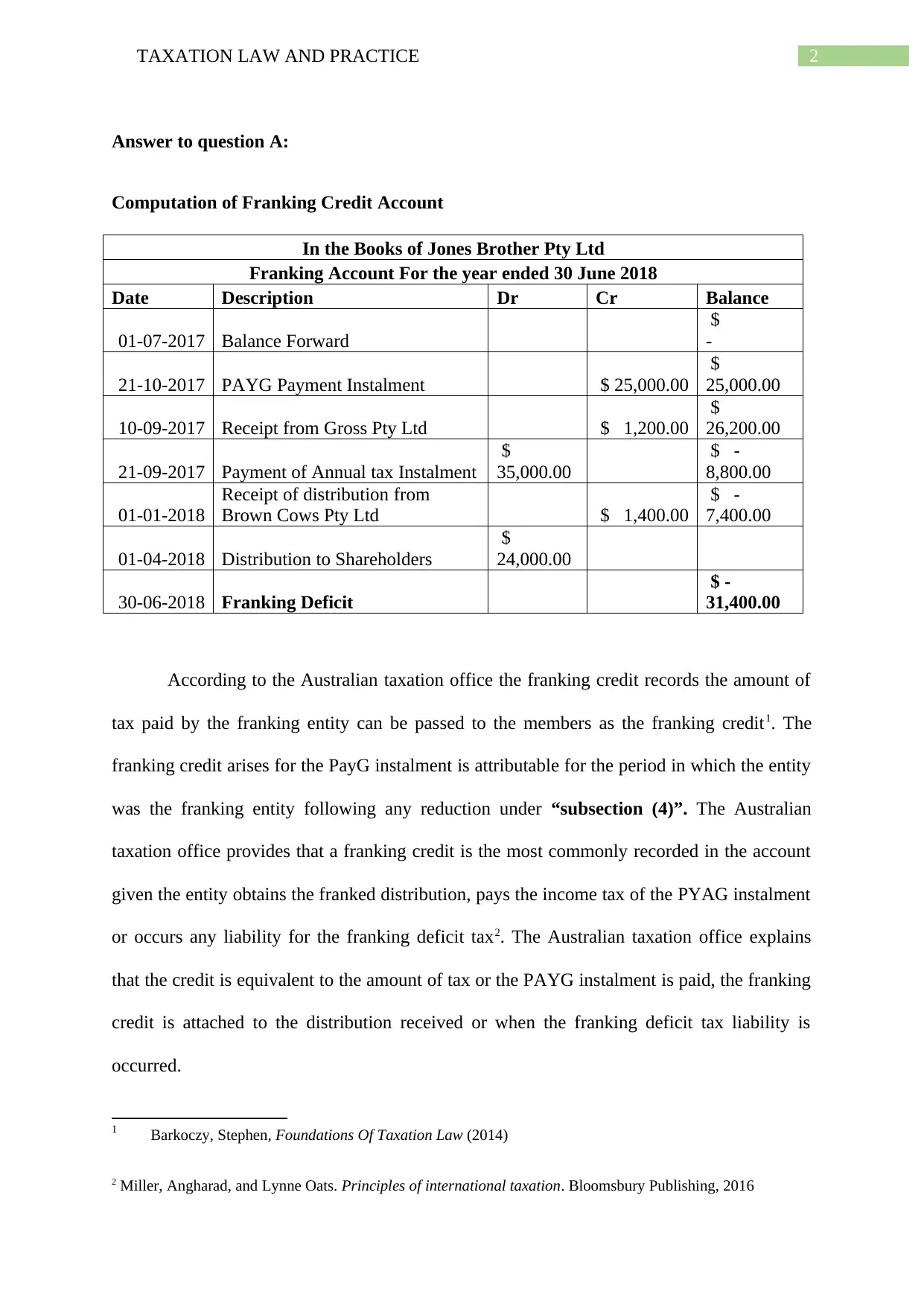
According to the Australian taxation office the franking credit records the amount of
tax paid by the franking entity can be passed to the members as the franking credit1. The
franking credit arises for the PayG instalment is attributable for the period in which the entity
was the franking entity following any reduction under “subsection (4)”. The Australian
taxation office provides that a franking credit is the most commonly recorded in the account
given the entity obtains the franked distribution, pays the income tax of the PYAG instalment
or occurs any liability for the franking deficit tax2. The Australian taxation office explains
that the credit is equivalent to the amount of tax or the PAYG instalment is paid, the franking
credit is attached to the distribution received or when the franking deficit tax liability is
occurred.
1 Barkoczy, Stephen, Foundations Of Taxation Law (2014)
2 Miller, Angharad, and Lynne Oats. Principles of international taxation. Bloomsbury Publishing, 2016
Answer to question A:
Computation of Franking Credit Account
In the Books of Jones Brother Pty Ltd
Franking Account For the year ended 30 June 2018
Date Description Dr Cr Balance
01-07-2017 Balance Forward
$
-
21-10-2017 PAYG Payment Instalment $ 25,000.00
$
25,000.00
10-09-2017 Receipt from Gross Pty Ltd $ 1,200.00
$
26,200.00
21-09-2017 Payment of Annual tax Instalment
$
35,000.00
$ -
8,800.00
01-01-2018
Receipt of distribution from
Brown Cows Pty Ltd $ 1,400.00
$ -
7,400.00
01-04-2018 Distribution to Shareholders
$
24,000.00
30-06-2018 Franking Deficit
$ -
31,400.00
According to the Australian taxation office the franking credit records the amount of
tax paid by the franking entity can be passed to the members as the franking credit1. The
franking credit arises for the PayG instalment is attributable for the period in which the entity
was the franking entity following any reduction under “subsection (4)”. The Australian
taxation office provides that a franking credit is the most commonly recorded in the account
given the entity obtains the franked distribution, pays the income tax of the PYAG instalment
or occurs any liability for the franking deficit tax2. The Australian taxation office explains
that the credit is equivalent to the amount of tax or the PAYG instalment is paid, the franking
credit is attached to the distribution received or when the franking deficit tax liability is
occurred.
1 Barkoczy, Stephen, Foundations Of Taxation Law (2014)
2 Miller, Angharad, and Lynne Oats. Principles of international taxation. Bloomsbury Publishing, 2016
⊘ This is a preview!⊘
Do you want full access?
Subscribe today to unlock all pages.

Trusted by 1+ million students worldwide
3TAXATION LAW AND PRACTICE
Similarly, for Jones Brother Pty Ltd the company paid the PAYG instalment on 21st
October 2017 therefore, the sum of $25,000 will be considered as credit and should be
recorded under credit side of the franked account. The credit represents the equivalent
amount of the tax of the PAYG instalment that is paid.
Similarly, for Jones Brother Pty Ltd the company paid the PAYG instalment on 21st
October 2017 therefore, the sum of $25,000 will be considered as credit and should be
recorded under credit side of the franked account. The credit represents the equivalent
amount of the tax of the PAYG instalment that is paid.
Paraphrase This Document
Need a fresh take? Get an instant paraphrase of this document with our AI Paraphraser
4TAXATION LAW AND PRACTICE
According to the Australian taxation office where the income tax liability is only paid
partially, franking credits would not originate from the sum that remains outstanding3. Any
form of partial payments that was made in the direction of outstanding activity statement
liabilities would be allocated in accordance with the policy4.
Under “section 204-15 of the ITAA 1997” a franking credit originates for the entity
when a franking debit is specified under the “subsection 201-15”5. The franking credit
received from Grass Pty Ltd for Jones Brother Pty Ltd would be recorded under the credit
side. As evident from the above stated computation the franking credit account for the Jones
Brother Pty Ltd recorded a deficit balance. This franking credit account is in deficit at a
particular time because the amount of franking credit has gone past the sum of franking
credits.
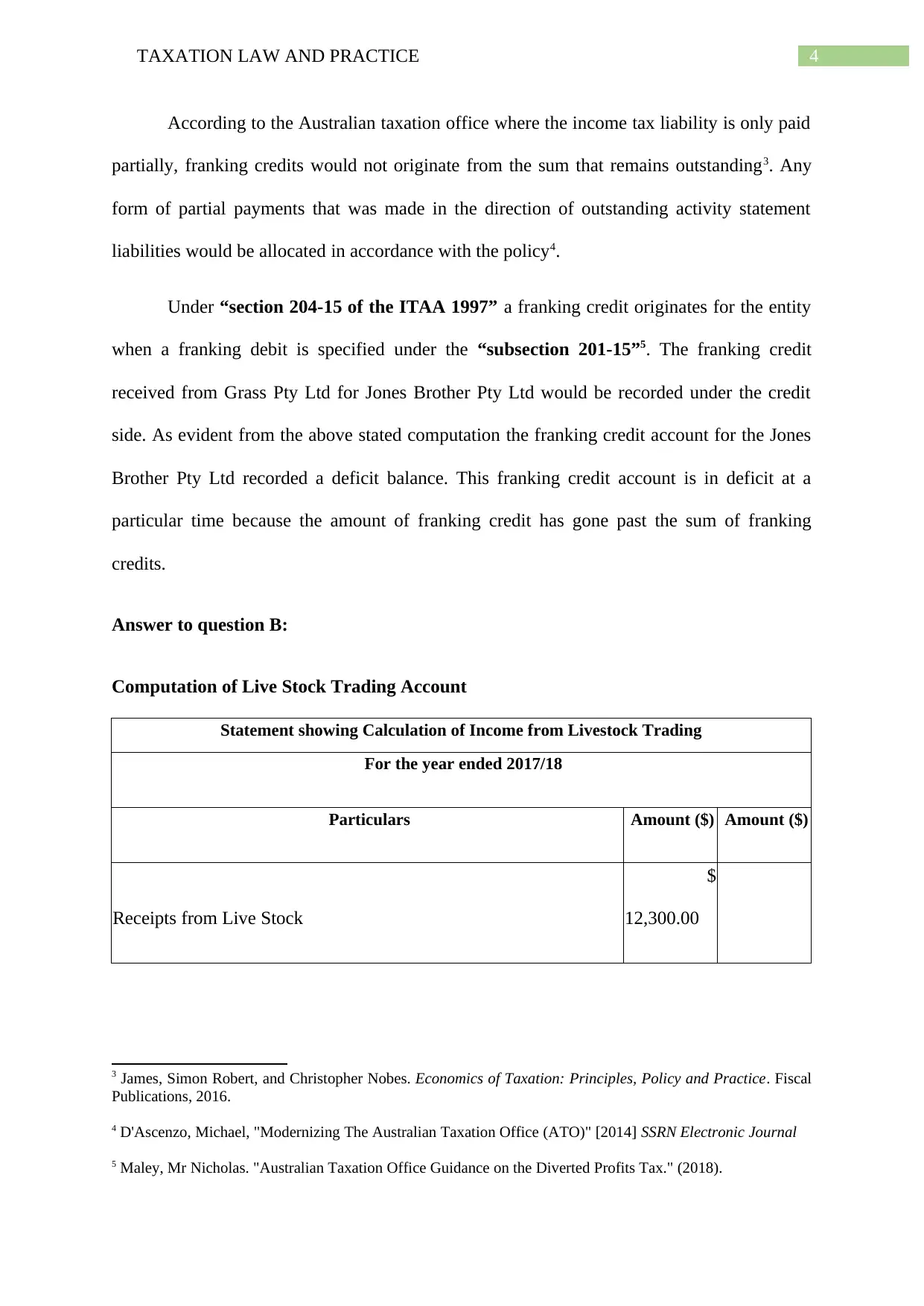
Answer to question B:
Computation of Live Stock Trading Account
Statement showing Calculation of Income from Livestock Trading
For the year ended 2017/18
Particulars Amount ($) Amount ($)
Receipts from Live Stock
$
12,300.00
3 James, Simon Robert, and Christopher Nobes. Economics of Taxation: Principles, Policy and Practice. Fiscal
Publications, 2016.
4 D'Ascenzo, Michael, "Modernizing The Australian Taxation Office (ATO)" [2014] SSRN Electronic Journal
5 Maley, Mr Nicholas. "Australian Taxation Office Guidance on the Diverted Profits Tax." (2018).
According to the Australian taxation office where the income tax liability is only paid
partially, franking credits would not originate from the sum that remains outstanding3. Any
form of partial payments that was made in the direction of outstanding activity statement
liabilities would be allocated in accordance with the policy4.
Under “section 204-15 of the ITAA 1997” a franking credit originates for the entity
when a franking debit is specified under the “subsection 201-15”5. The franking credit
received from Grass Pty Ltd for Jones Brother Pty Ltd would be recorded under the credit
side. As evident from the above stated computation the franking credit account for the Jones
Brother Pty Ltd recorded a deficit balance. This franking credit account is in deficit at a
particular time because the amount of franking credit has gone past the sum of franking
credits.
Answer to question B:
Computation of Live Stock Trading Account
Statement showing Calculation of Income from Livestock Trading
For the year ended 2017/18
Particulars Amount ($) Amount ($)
Receipts from Live Stock
$
12,300.00
3 James, Simon Robert, and Christopher Nobes. Economics of Taxation: Principles, Policy and Practice. Fiscal
Publications, 2016.
4 D'Ascenzo, Michael, "Modernizing The Australian Taxation Office (ATO)" [2014] SSRN Electronic Journal
5 Maley, Mr Nicholas. "Australian Taxation Office Guidance on the Diverted Profits Tax." (2018).
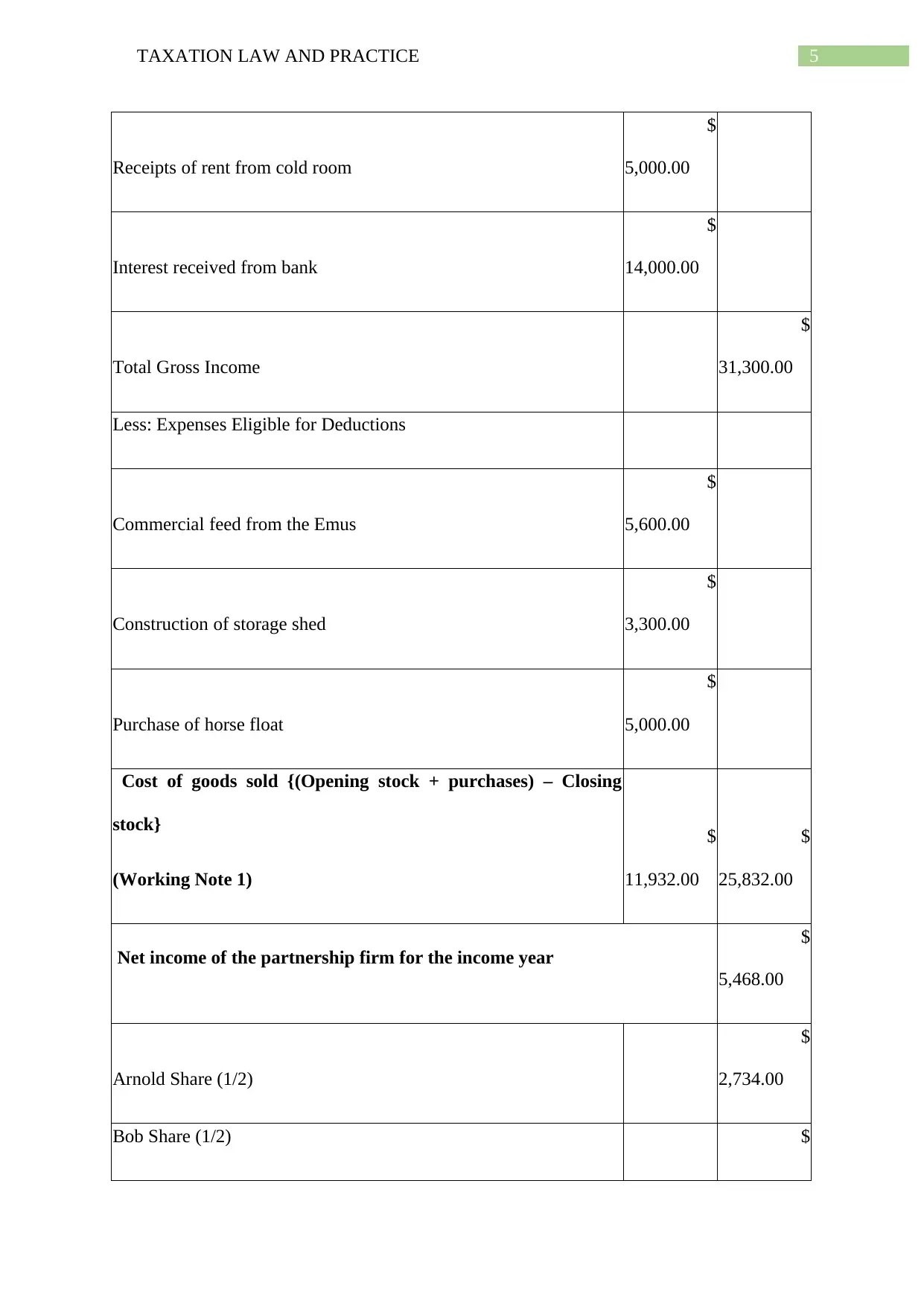
5TAXATION LAW AND PRACTICE
Receipts of rent from cold room
$
5,000.00
Interest received from bank
$
14,000.00
Total Gross Income
$
31,300.00
Less: Expenses Eligible for Deductions
Commercial feed from the Emus
$
5,600.00
Construction of storage shed
$
3,300.00
Purchase of horse float
$
5,000.00
Cost of goods sold {(Opening stock + purchases) – Closing
stock}
(Working Note 1)
$
11,932.00
$
25,832.00
Net income of the partnership firm for the income year
$
5,468.00
Arnold Share (1/2)
$
2,734.00
Bob Share (1/2) $
Receipts of rent from cold room
$
5,000.00
Interest received from bank
$
14,000.00
Total Gross Income
$
31,300.00
Less: Expenses Eligible for Deductions
Commercial feed from the Emus
$
5,600.00
Construction of storage shed
$
3,300.00
Purchase of horse float
$
5,000.00
Cost of goods sold {(Opening stock + purchases) – Closing
stock}
(Working Note 1)
$
11,932.00
$
25,832.00
Net income of the partnership firm for the income year
$
5,468.00
Arnold Share (1/2)
$
2,734.00
Bob Share (1/2) $
⊘ This is a preview!⊘
Do you want full access?
Subscribe today to unlock all pages.
Trusted by 1+ million students worldwide
6TAXATION LAW AND PRACTICE
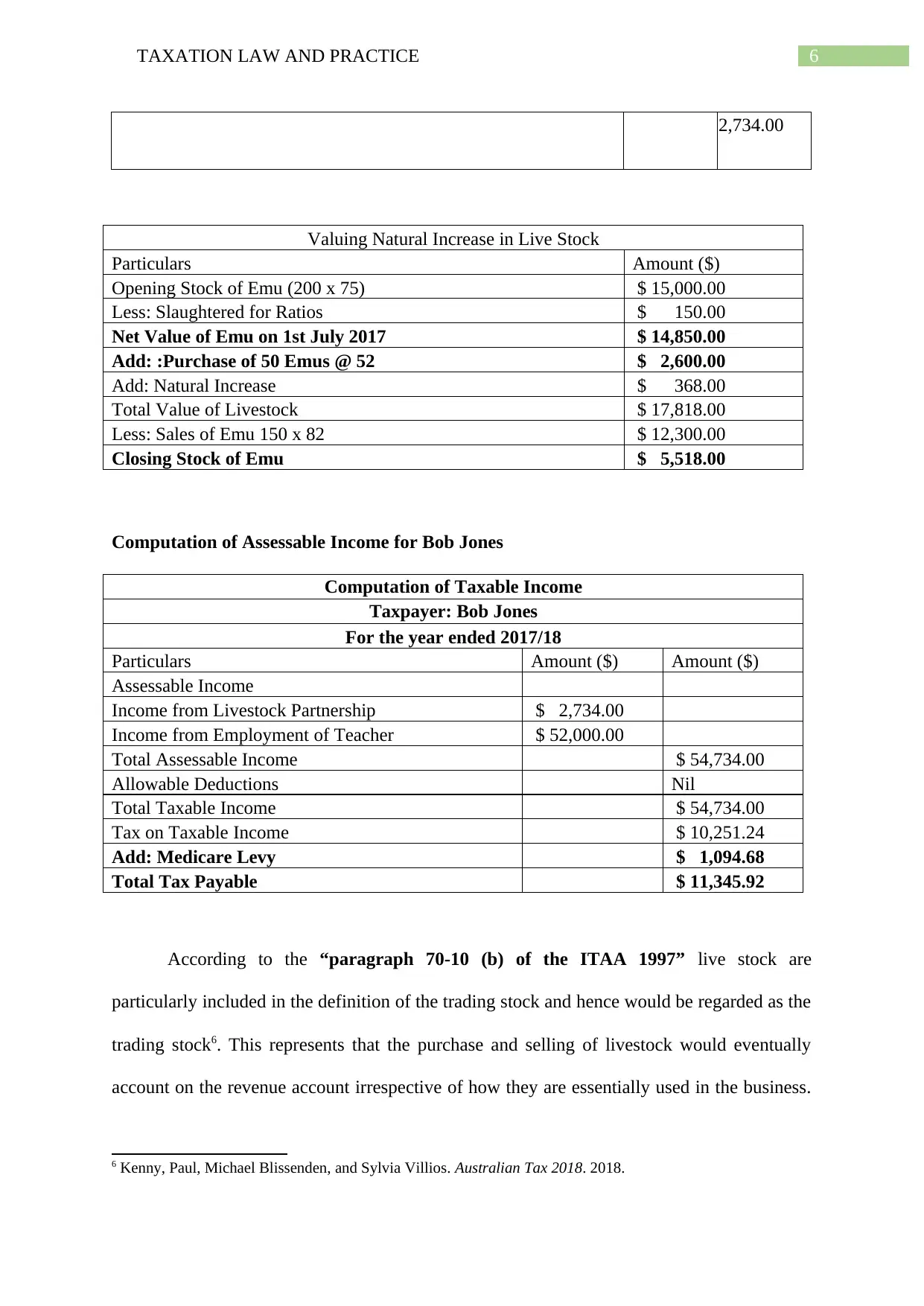
2,734.00
Valuing Natural Increase in Live Stock
Particulars Amount ($)
Opening Stock of Emu (200 x 75) $ 15,000.00
Less: Slaughtered for Ratios $ 150.00
Net Value of Emu on 1st July 2017 $ 14,850.00
Add: :Purchase of 50 Emus @ 52 $ 2,600.00
Add: Natural Increase $ 368.00
Total Value of Livestock $ 17,818.00
Less: Sales of Emu 150 x 82 $ 12,300.00
Closing Stock of Emu $ 5,518.00
Computation of Assessable Income for Bob Jones
Computation of Taxable Income
Taxpayer: Bob Jones
For the year ended 2017/18
Particulars Amount ($) Amount ($)
Assessable Income
Income from Livestock Partnership $ 2,734.00
Income from Employment of Teacher $ 52,000.00
Total Assessable Income $ 54,734.00
Allowable Deductions Nil
Total Taxable Income $ 54,734.00
Tax on Taxable Income $ 10,251.24
Add: Medicare Levy $ 1,094.68
Total Tax Payable $ 11,345.92
According to the “paragraph 70-10 (b) of the ITAA 1997” live stock are
particularly included in the definition of the trading stock and hence would be regarded as the
trading stock6. This represents that the purchase and selling of livestock would eventually
account on the revenue account irrespective of how they are essentially used in the business.
6 Kenny, Paul, Michael Blissenden, and Sylvia Villios. Australian Tax 2018. 2018.
2,734.00
Valuing Natural Increase in Live Stock
Particulars Amount ($)
Opening Stock of Emu (200 x 75) $ 15,000.00
Less: Slaughtered for Ratios $ 150.00
Net Value of Emu on 1st July 2017 $ 14,850.00
Add: :Purchase of 50 Emus @ 52 $ 2,600.00
Add: Natural Increase $ 368.00
Total Value of Livestock $ 17,818.00
Less: Sales of Emu 150 x 82 $ 12,300.00
Closing Stock of Emu $ 5,518.00
Computation of Assessable Income for Bob Jones
Computation of Taxable Income
Taxpayer: Bob Jones
For the year ended 2017/18
Particulars Amount ($) Amount ($)
Assessable Income
Income from Livestock Partnership $ 2,734.00
Income from Employment of Teacher $ 52,000.00
Total Assessable Income $ 54,734.00
Allowable Deductions Nil
Total Taxable Income $ 54,734.00
Tax on Taxable Income $ 10,251.24
Add: Medicare Levy $ 1,094.68
Total Tax Payable $ 11,345.92
According to the “paragraph 70-10 (b) of the ITAA 1997” live stock are
particularly included in the definition of the trading stock and hence would be regarded as the
trading stock6. This represents that the purchase and selling of livestock would eventually
account on the revenue account irrespective of how they are essentially used in the business.
6 Kenny, Paul, Michael Blissenden, and Sylvia Villios. Australian Tax 2018. 2018.
Paraphrase This Document
Need a fresh take? Get an instant paraphrase of this document with our AI Paraphraser
7TAXATION LAW AND PRACTICE
The high court of law in “Federal Commissioner of Taxation v Wade (1951)” held that the
definition of livestock comprise of all the animals that are used in the primary production7.
According to the Australian taxation office an individual is required to value the
livestock at the end of every year for the ascertaining the net income from the primary
production8. An individual would be allowed to choose the valuation of livestock at the cost,
at market price or at the replacement value. According to the “section 6-5 of the ITAA
1997” any receipts derived from business are treated as revenue and are considered as
assessable income9. The receipts from the sale of livestock by Jones Brother Pty Ltd would
be treated as the taxable income and forms the part of the net income from the primary
production. Other receipts such as rent received from the cold room on farm and bank interest
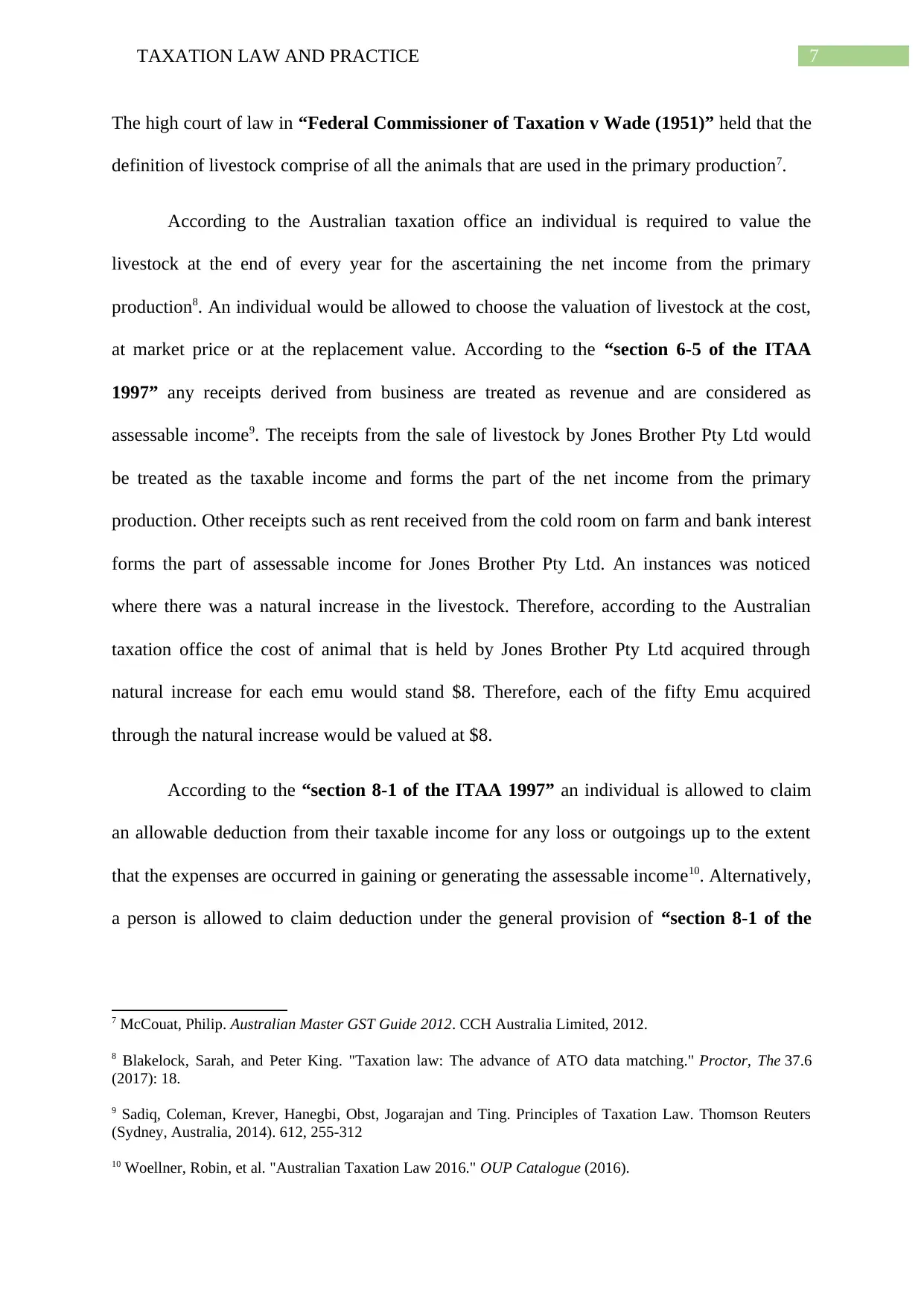
forms the part of assessable income for Jones Brother Pty Ltd. An instances was noticed
where there was a natural increase in the livestock. Therefore, according to the Australian
taxation office the cost of animal that is held by Jones Brother Pty Ltd acquired through
natural increase for each emu would stand $8. Therefore, each of the fifty Emu acquired
through the natural increase would be valued at $8.
According to the “section 8-1 of the ITAA 1997” an individual is allowed to claim
an allowable deduction from their taxable income for any loss or outgoings up to the extent
that the expenses are occurred in gaining or generating the assessable income10. Alternatively,
a person is allowed to claim deduction under the general provision of “section 8-1 of the
7 McCouat, Philip. Australian Master GST Guide 2012. CCH Australia Limited, 2012.
8 Blakelock, Sarah, and Peter King. "Taxation law: The advance of ATO data matching." Proctor, The 37.6
(2017): 18.
9 Sadiq, Coleman, Krever, Hanegbi, Obst, Jogarajan and Ting. Principles of Taxation Law. Thomson Reuters
(Sydney, Australia, 2014). 612, 255-312
10 Woellner, Robin, et al. "Australian Taxation Law 2016." OUP Catalogue (2016).
The high court of law in “Federal Commissioner of Taxation v Wade (1951)” held that the
definition of livestock comprise of all the animals that are used in the primary production7.
According to the Australian taxation office an individual is required to value the
livestock at the end of every year for the ascertaining the net income from the primary
production8. An individual would be allowed to choose the valuation of livestock at the cost,
at market price or at the replacement value. According to the “section 6-5 of the ITAA
1997” any receipts derived from business are treated as revenue and are considered as
assessable income9. The receipts from the sale of livestock by Jones Brother Pty Ltd would
be treated as the taxable income and forms the part of the net income from the primary
production. Other receipts such as rent received from the cold room on farm and bank interest
forms the part of assessable income for Jones Brother Pty Ltd. An instances was noticed
where there was a natural increase in the livestock. Therefore, according to the Australian
taxation office the cost of animal that is held by Jones Brother Pty Ltd acquired through
natural increase for each emu would stand $8. Therefore, each of the fifty Emu acquired
through the natural increase would be valued at $8.
According to the “section 8-1 of the ITAA 1997” an individual is allowed to claim
an allowable deduction from their taxable income for any loss or outgoings up to the extent
that the expenses are occurred in gaining or generating the assessable income10. Alternatively,
a person is allowed to claim deduction under the general provision of “section 8-1 of the
7 McCouat, Philip. Australian Master GST Guide 2012. CCH Australia Limited, 2012.
8 Blakelock, Sarah, and Peter King. "Taxation law: The advance of ATO data matching." Proctor, The 37.6
(2017): 18.
9 Sadiq, Coleman, Krever, Hanegbi, Obst, Jogarajan and Ting. Principles of Taxation Law. Thomson Reuters
(Sydney, Australia, 2014). 612, 255-312
10 Woellner, Robin, et al. "Australian Taxation Law 2016." OUP Catalogue (2016).
8TAXATION LAW AND PRACTICE
ITAA 1997” if the expenses are necessarily incurred in executing the business activity with
the objective of deriving assessable income11.
Similarly for Jones Brother Pty Ltd expenses on commercial feed for Emus constitute
a business expenses and hence the sum of $5,600 would be allowed for deduction under the
general provision of “section 8-1 of the ITAA 1997”. Jones Brother Pty Ltd also reports
expenses for the construction of new dam. Expenses that are incurred in the construction are
held as capital in nature. Referring the judgement of “Western Suburbs Cinemas v FCT”
capital expenses are not allowed for deduction under the general provision of “section 8-1 of
the ITAA 1997”12. Therefore, cost incurred in the construction of new dam is a capital
expenditure and no deduction is allowable.
Answer to question C:
As evident from the situation of Arnold and Bob they have decided to dispose the
farm assets in the coming income year to the unit trust. According to the Australian taxation
office the small business restructure rollover allows the small business to transfer the active
asset from one entity to another or more entities without occurring any form of income tax
liability13. The taxation office of Australia defines that the small business rollover is
application to the transfer of active assets that are CGT assets, trading stocks or the
depreciating assets. For a business to be held eligible for the rollover, the transaction should
not lead to change in the ultimate ownership of the transferred assets14. The ultimate
11 Devos, Ken. "The impact of tax professionals upon the compliance behaviour of Australian individual
taxpayers." Revenue Law Journal 22.1 (2012): 31.
12 Woellner, Robin, et al. "Australian Taxation Law 2016." OUP Catalogue (2016).
13 Saad, Natrah. "Tax knowledge, tax complexity and tax compliance: Taxpayers’ view." Procedia-Social and
Behavioral Sciences 109 (2014): 1069-1075.
14 Basu, Subhajit, Global Perspectives On E-Commerce Taxation Law (Routledge, 2016)
ITAA 1997” if the expenses are necessarily incurred in executing the business activity with
the objective of deriving assessable income11.
Similarly for Jones Brother Pty Ltd expenses on commercial feed for Emus constitute
a business expenses and hence the sum of $5,600 would be allowed for deduction under the
general provision of “section 8-1 of the ITAA 1997”. Jones Brother Pty Ltd also reports
expenses for the construction of new dam. Expenses that are incurred in the construction are
held as capital in nature. Referring the judgement of “Western Suburbs Cinemas v FCT”
capital expenses are not allowed for deduction under the general provision of “section 8-1 of
the ITAA 1997”12. Therefore, cost incurred in the construction of new dam is a capital
expenditure and no deduction is allowable.
Answer to question C:
As evident from the situation of Arnold and Bob they have decided to dispose the
farm assets in the coming income year to the unit trust. According to the Australian taxation
office the small business restructure rollover allows the small business to transfer the active
asset from one entity to another or more entities without occurring any form of income tax
liability13. The taxation office of Australia defines that the small business rollover is
application to the transfer of active assets that are CGT assets, trading stocks or the
depreciating assets. For a business to be held eligible for the rollover, the transaction should
not lead to change in the ultimate ownership of the transferred assets14. The ultimate
11 Devos, Ken. "The impact of tax professionals upon the compliance behaviour of Australian individual
taxpayers." Revenue Law Journal 22.1 (2012): 31.
12 Woellner, Robin, et al. "Australian Taxation Law 2016." OUP Catalogue (2016).
13 Saad, Natrah. "Tax knowledge, tax complexity and tax compliance: Taxpayers’ view." Procedia-Social and
Behavioral Sciences 109 (2014): 1069-1075.
14 Basu, Subhajit, Global Perspectives On E-Commerce Taxation Law (Routledge, 2016)
⊘ This is a preview!⊘
Do you want full access?
Subscribe today to unlock all pages.
Trusted by 1+ million students worldwide
9TAXATION LAW AND PRACTICE
economic owners of the assets are the person that is individuals who either directly or
indirectly owns the asset.
Similarly, in the current situation of Jones Brothers Pty Ltd the rollover relief is
available since the transfer of assets to the unit trust genuinely forms part of restructure. The
rollover relief is applicable to the rollover transfer of assets active CGT assets held by the
Arnold and Bob. The transaction by Bob and Arnold does not lead to change in the economic
ownership of the transferred assets. In the present situation of Jones Brothers Pty Ltd the
ultimate economic owners of the asset are the Arnold and Bob as they directly own the assets.
The assets that are eligible for the roll-over restructuring are the active assets that are CGT
assets. They assets forms the portion of the genuine restructure of the ongoing business.
According to the Australian taxation office, assets that are generally transferred would
not result in the income tax liability originating for either of the party when conducting the
transfer15. Similarly in the situation of Arnold and Bob Jones the transfer of farm capital
assets during the process of restructure rollover would not attract any income tax liability for
either of the party at the time of transfer.
Answer to question D:
Trust are largely used for investment and for business purpose. According to the
Australian taxation office trust is referred as the obligations that are applied on the person or
the other entity to hold the property in the benefit of the beneficiaries16. The beneficiaries are
required to include in their assessable income the share of the trust income while filing tax
returns. The net income that is derived from the trust is held for assessment for the year after
taking into the consideration the allowable deductions. As evident in the current situation of
15 Braithwaite, Valerie. Taxing democracy: Understanding tax avoidance and evasion. Routledge, 2017.
16 Blakelock, Sarah, and Peter King. "Taxation law: The advance of ATO data matching." Proctor, The 37.6
(2017): 18.
economic owners of the assets are the person that is individuals who either directly or
indirectly owns the asset.
Similarly, in the current situation of Jones Brothers Pty Ltd the rollover relief is
available since the transfer of assets to the unit trust genuinely forms part of restructure. The
rollover relief is applicable to the rollover transfer of assets active CGT assets held by the
Arnold and Bob. The transaction by Bob and Arnold does not lead to change in the economic
ownership of the transferred assets. In the present situation of Jones Brothers Pty Ltd the
ultimate economic owners of the asset are the Arnold and Bob as they directly own the assets.
The assets that are eligible for the roll-over restructuring are the active assets that are CGT
assets. They assets forms the portion of the genuine restructure of the ongoing business.
According to the Australian taxation office, assets that are generally transferred would
not result in the income tax liability originating for either of the party when conducting the
transfer15. Similarly in the situation of Arnold and Bob Jones the transfer of farm capital
assets during the process of restructure rollover would not attract any income tax liability for
either of the party at the time of transfer.
Answer to question D:
Trust are largely used for investment and for business purpose. According to the
Australian taxation office trust is referred as the obligations that are applied on the person or
the other entity to hold the property in the benefit of the beneficiaries16. The beneficiaries are
required to include in their assessable income the share of the trust income while filing tax
returns. The net income that is derived from the trust is held for assessment for the year after
taking into the consideration the allowable deductions. As evident in the current situation of
15 Braithwaite, Valerie. Taxing democracy: Understanding tax avoidance and evasion. Routledge, 2017.
16 Blakelock, Sarah, and Peter King. "Taxation law: The advance of ATO data matching." Proctor, The 37.6
(2017): 18.
Paraphrase This Document
Need a fresh take? Get an instant paraphrase of this document with our AI Paraphraser
10TAXATION LAW AND PRACTICE
Arnold he intends to set up the trust for their two sons. The taxation office of Australia
defines that an individual is required to pay the tax relating to the share of the trust’s net
income based on the applicable tax rates17. Furthermore, the trustee is also required to pay the
tax on behalf of their minors depending upon the share of the trust net income. The
beneficiaries are under the obligations of declaring the income in their own income tax.
The present situation of Arnold highlights that he intends to set up the trust for his two
sons therefore the beneficiaries in this circumstances are the minors would be receiving the
benefit from the trust. The minors form the part of the trustee and would be taxed at the
highest marginal tax rate18. Taking into the consideration of Arnold Jones an advice can be
made in regard to setting up of trust is that the trustee would be paying the tax for the minor
son who aged below the age of 18 years, While the other trust members such as his wife and
his son Benjamin would be liable for taxation based on the applicable individual tax rates.
17 Maley, Mr Nicholas. "Australian Taxation Office Guidance on the Diverted Profits Tax." (2018).
18 Fry, Martin. "Australian taxation of offshore hubs: an examination of the law on the ability of Australia to tax
economic activity in offshore hubs and the position of the Australian Taxation Office." The APPEA
Journal 57.1 (2017): 49-63.
Arnold he intends to set up the trust for their two sons. The taxation office of Australia
defines that an individual is required to pay the tax relating to the share of the trust’s net
income based on the applicable tax rates17. Furthermore, the trustee is also required to pay the
tax on behalf of their minors depending upon the share of the trust net income. The
beneficiaries are under the obligations of declaring the income in their own income tax.
The present situation of Arnold highlights that he intends to set up the trust for his two
sons therefore the beneficiaries in this circumstances are the minors would be receiving the
benefit from the trust. The minors form the part of the trustee and would be taxed at the
highest marginal tax rate18. Taking into the consideration of Arnold Jones an advice can be
made in regard to setting up of trust is that the trustee would be paying the tax for the minor
son who aged below the age of 18 years, While the other trust members such as his wife and
his son Benjamin would be liable for taxation based on the applicable individual tax rates.
17 Maley, Mr Nicholas. "Australian Taxation Office Guidance on the Diverted Profits Tax." (2018).
18 Fry, Martin. "Australian taxation of offshore hubs: an examination of the law on the ability of Australia to tax
economic activity in offshore hubs and the position of the Australian Taxation Office." The APPEA
Journal 57.1 (2017): 49-63.

1 out of 11


Related Documents


Your All-in-One AI-Powered Toolkit for Academic Success.
+13062052269
info@desklib.com
Available 24*7 on WhatsApp / Email
![[object Object]](/_next/static/media/star-bottom.7253800d.svg)
Unlock your academic potential
Copyright © 2020–2026 A2Z Services. All Rights Reserved. Developed and managed by ZUCOL.