Taxation Law Assignment: Taxation of Gifts - Case Analysis

Verified

Added on  2023/03/23

|5
|715
|33
Homework Assignment
AI Summary
This taxation law assignment analyzes the tax implications of a gift received by an individual, Julie, from her husband, Cameron. The assignment focuses on whether the antique table constitutes taxable income. Drawing upon case law, specifically Scott v FCT (1966) and Hayes v FCT (1956), the assignment establishes the distinction between personal gifts and income derived from services or employment. It argues that the antique table should be considered a personal gift, not taxable income, as it stems from a personal relationship rather than any service rendered. The assignment references relevant sections of the ITAA 1936 and provides a clear rationale for the non-taxable status of the gift, supporting its conclusions with legal precedents and definitions.
Document Page
Running head: TAXATION LAW
Taxation Law
Name of the Student
Name of the University
Authors Note
Course ID
tabler-icon-diamond-filled.svg

Paraphrase This Document

Need a fresh take? Get an instant paraphrase of this document with our AI Paraphraser
Document Page
1TAXATION LAW
Table of Contents
Answer to question C:................................................................................................................2
References:.................................................................................................................................4
Document Page
2TAXATION LAW
Answer to question C:
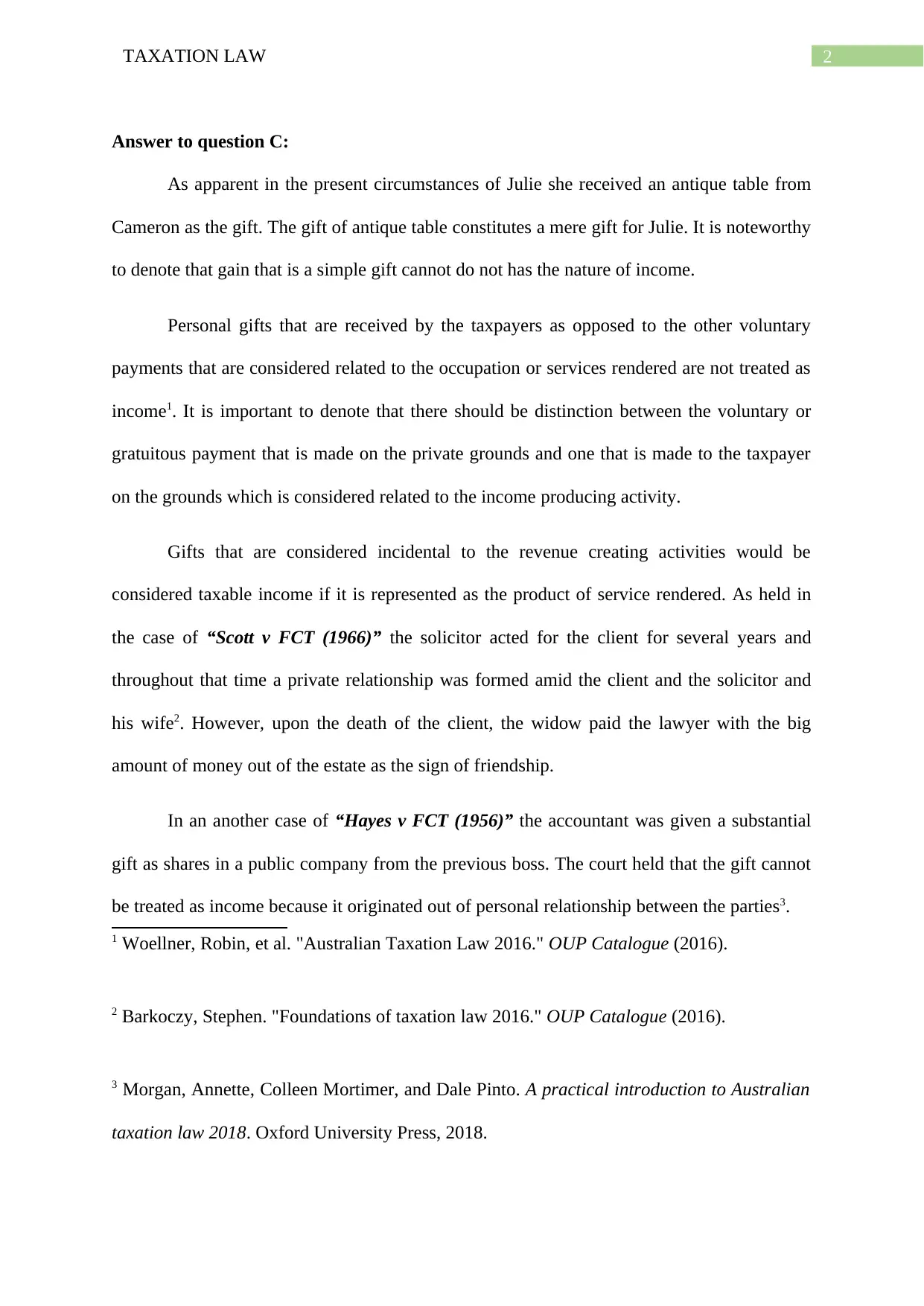
As apparent in the present circumstances of Julie she received an antique table from
Cameron as the gift. The gift of antique table constitutes a mere gift for Julie. It is noteworthy
to denote that gain that is a simple gift cannot do not has the nature of income.
Personal gifts that are received by the taxpayers as opposed to the other voluntary
payments that are considered related to the occupation or services rendered are not treated as
income1. It is important to denote that there should be distinction between the voluntary or
gratuitous payment that is made on the private grounds and one that is made to the taxpayer
on the grounds which is considered related to the income producing activity.
Gifts that are considered incidental to the revenue creating activities would be
considered taxable income if it is represented as the product of service rendered. As held in
the case of “Scott v FCT (1966)” the solicitor acted for the client for several years and
throughout that time a private relationship was formed amid the client and the solicitor and
his wife2. However, upon the death of the client, the widow paid the lawyer with the big
amount of money out of the estate as the sign of friendship.
In an another case of “Hayes v FCT (1956)” the accountant was given a substantial
gift as shares in a public company from the previous boss. The court held that the gift cannot
be treated as income because it originated out of personal relationship between the parties3.
1 Woellner, Robin, et al. "Australian Taxation Law 2016." OUP Catalogue (2016).
2 Barkoczy, Stephen. "Foundations of taxation law 2016." OUP Catalogue (2016).
3 Morgan, Annette, Colleen Mortimer, and Dale Pinto. A practical introduction to Australian
taxation law 2018. Oxford University Press, 2018.
Document Page
3TAXATION LAW
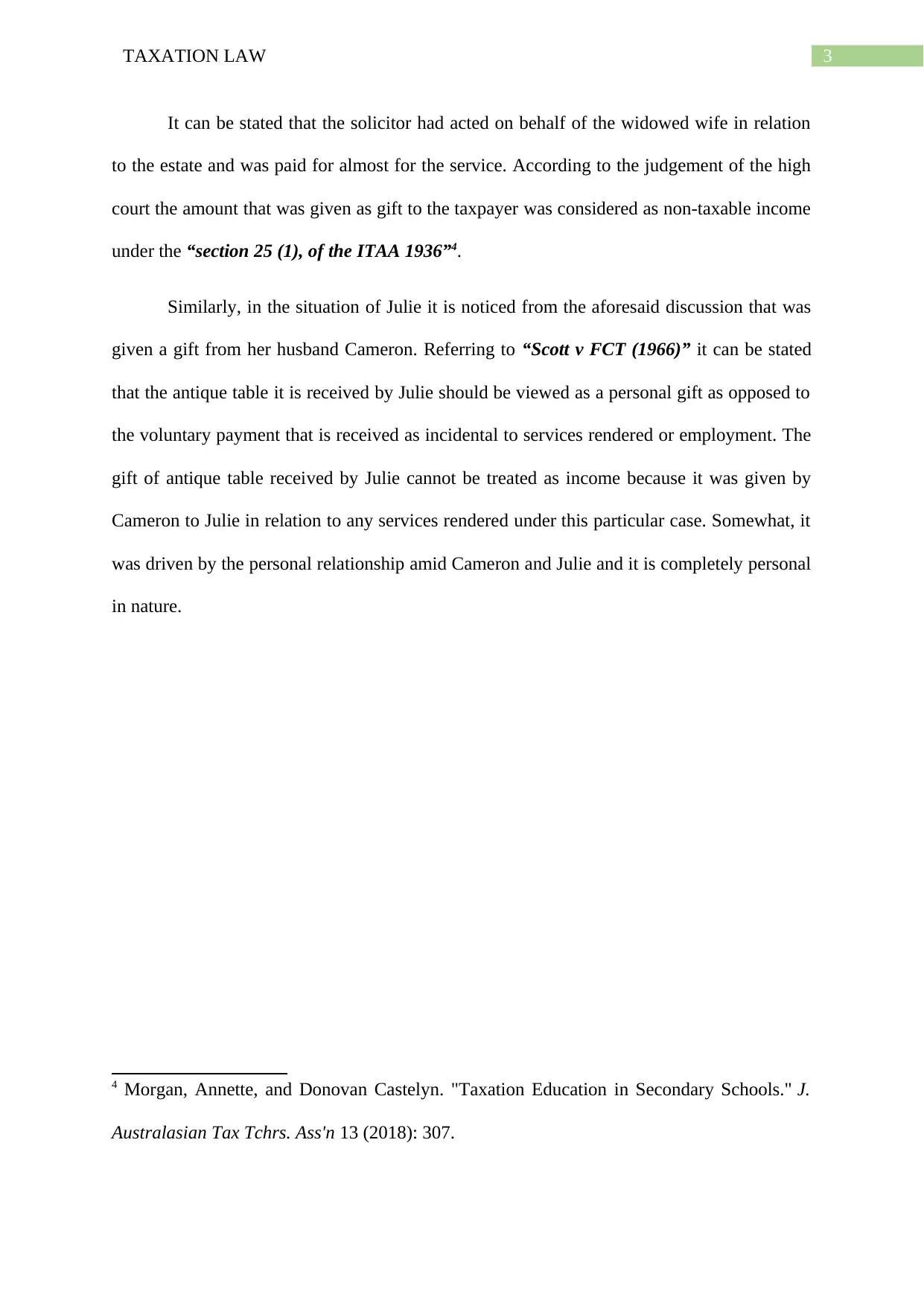
It can be stated that the solicitor had acted on behalf of the widowed wife in relation
to the estate and was paid for almost for the service. According to the judgement of the high
court the amount that was given as gift to the taxpayer was considered as non-taxable income
under the “section 25 (1), of the ITAA 1936”4.
Similarly, in the situation of Julie it is noticed from the aforesaid discussion that was
given a gift from her husband Cameron. Referring to “Scott v FCT (1966)” it can be stated
that the antique table it is received by Julie should be viewed as a personal gift as opposed to
the voluntary payment that is received as incidental to services rendered or employment. The
gift of antique table received by Julie cannot be treated as income because it was given by
Cameron to Julie in relation to any services rendered under this particular case. Somewhat, it
was driven by the personal relationship amid Cameron and Julie and it is completely personal
in nature.
4 Morgan, Annette, and Donovan Castelyn. "Taxation Education in Secondary Schools." J.
Australasian Tax Tchrs. Ass'n 13 (2018): 307.
tabler-icon-diamond-filled.svg

Paraphrase This Document

Need a fresh take? Get an instant paraphrase of this document with our AI Paraphraser
Document Page
4TAXATION LAW
References:
Barkoczy, Stephen. "Foundations of taxation law 2016." OUP Catalogue (2016).
Morgan, Annette, and Donovan Castelyn. "Taxation Education in Secondary Schools." J.
Australasian Tax Tchrs. Ass'n 13 (2018): 307.
Morgan, Annette, Colleen Mortimer, and Dale Pinto. A practical introduction to Australian
taxation law 2018. Oxford University Press, 2018.
Woellner, Robin, et al. "Australian Taxation Law 2016." OUP Catalogue (2016).
chevron_up_icon
1 out of 5
circle_padding
hide_on_mobile
zoom_out_icon
[object Object]