AC50029E Taxation: UK Self-Assessment, National Insurance, and Equity

Verified

Added on  2023/06/16

|7
|1900
|281
Essay
AI Summary
This essay provides a comprehensive overview of the UK taxation system, with a specific focus on self-assessment and National Insurance contributions (NIC). It evaluates the self-assessment system in the UK for 2021-22, explaining the operation and scope of income tax, filing obligations, and the implications of non-compliance. The essay also examines the National Insurance system, detailing the different classes of contributions and their respective scopes. Furthermore, it compares and contrasts the inter-generational equity of National Insurance versus income tax as methods of funding. The analysis covers the importance of tax compliance, the role of NIC in social security benefits, and the potential for merging income tax and NIC to enhance transparency and efficiency. The essay concludes by underscoring the essential role of taxation as a source of government income and the need for businesses and individuals to comply with tax regulations, with resources available on Desklib.
Document Page
Taxation
tabler-icon-diamond-filled.svg

Paraphrase This Document

Need a fresh take? Get an instant paraphrase of this document with our AI Paraphraser
Document Page
Document Page
INTRODUCTION
Taxation is being defined as the system through which the taxing authority which is
generally the government charges taxes from the companies and citizen on their income. This tax
is the income for the government and is used in the development and growth of the company
itself. The present essay will outline different aspect relating to tax like self- assessment,
National Insurance and other classes of contribution in tax. In the end, the comparison of the
inter- generational equity of national insurance will be compared with the tax for means of
funding.
Evaluating the system of self- assessment in UK for 2021- 22 and explaining the operation and
scope of income tax, filing obligation and implication of non- compliance
Self- assessment is being defined as the system which HMRC that is HM Revenue and
Customs uses to collect the tax. The tax is being deducted from the wages, pension and savings
automatically and this is reported in the tax return. This self- assessment is being defined as the
balance tax which the assesse needs to pay over the income which has been assessed (Liu, 2018).
This tax is being arrived by reducing the advance tax and TDS being deducted from the total
liability. The use of self- assessment is very important for the effective analysis of the tax
requirement. This is particularly because of the reason that when the working tax requirement
will not be assessed in proper and effective manner then this will be impacting the working of
the government and its income. Hence, the system of self- assessment involves the various
regulations and other related aspect that need to be considered and followed while calculating the
tax.
The operation of the income tax is very important as it undertakes charging the tax to the
company and citizens of the country. The operation of income tax is important for the reason that
this is a source of income for the government and as a result of this income of the country will
increase. Hence, the operation and scope of income tax is very wider. This is particularly because
of the reason that when the income tax will be charged then this will improve the income of the
government and as a result of this the working of whole country will be improved (Bretscher and
Grieg, 2020). The scope of income tax involves the charging of different types of the taxes like
NIC, consumption tax, excise on alcohol, corporation tax and many other different types of the
taxes.
Document Page
The filing obligation is being defined as the duty or the obligation which the person need
to be pay relating to the tax on the income being earned by the person (Buckton and et.al., 2018).
This is necessary because in case the tax obligation will not be analysed then this will affect the
level of income for the government. Hence, it is necessary that the filing obligation is being
maintained so that person knows how much tax they need to pay.
Complying with all the laws and legislation is very important for getting successful. This
is generally because of the reason that in case the tax rates and other things are not being
followed then this will impact the working of both the individual and the government. The non-
compliance with nay of the law or rate will result in the unethical working. The non- compliance
can be done in many different ways and most common is the tax avoidance, tax evasion.
Evaluating system of National Insurance in UK and scope of different classes of contribution
The national insurance contribution (NIC) is the type of UK’s second biggest tax which is
being charged by the government which is being charged. This is the tax which generate large
amount of money for the government and is about 20 % of the total of tax revenue. This tax is
being paid by the employees and the people who are self- employed and also by the employers
over the earning on the people whom they employ. To a certain limit of threshold, the earning is
free on the NIC but after the limit is crossed then they have to pay the NIC. The NIC is not be
being charged on income from other sources like pension, savings or property like the income
tax is charged on these incomes as well.
With respect to NIC it is levied on the earning relating to individual who are 16 of age or
more. In case the person is over the age of state pension then they are not liable for the employee
or self- employed NIC. But in case the employer NIC then they still are liable for paying NIC on
their earnings. These earnings are taxable that is earning from employment and earnings from
self- employment. Further, in case of NIC purpose the work related expenses can be deducted
and this is much stricter in case of employees as compared to the self- employed people
(National Insurance contributions explained, 2021). Further the benefits which are paid in kind
are treated in varied manner depending on the nature of the product. Some of the products are
subject to full for NIC and some are subject to employer and not the employee.
There are different classes on basis of which the tax is being charged for the NIC. In case
the person or the individual is employed and self- employed the they have to pay the class 1
tabler-icon-diamond-filled.svg

Paraphrase This Document

Need a fresh take? Get an instant paraphrase of this document with our AI Paraphraser
Document Page
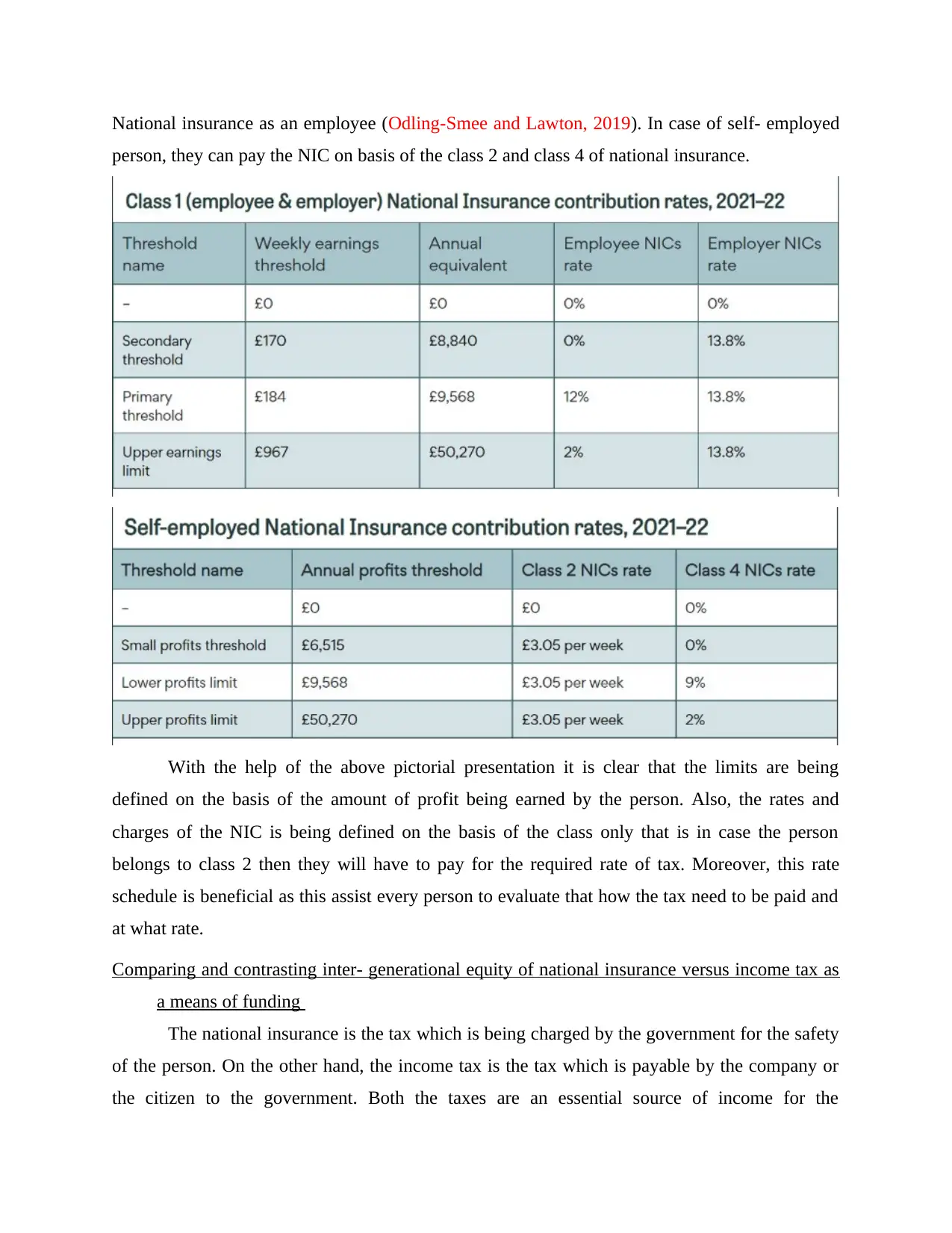
National insurance as an employee (Odling-Smee and Lawton, 2019). In case of self- employed
person, they can pay the NIC on basis of the class 2 and class 4 of national insurance.
With the help of the above pictorial presentation it is clear that the limits are being
defined on the basis of the amount of profit being earned by the person. Also, the rates and
charges of the NIC is being defined on the basis of the class only that is in case the person
belongs to class 2 then they will have to pay for the required rate of tax. Moreover, this rate
schedule is beneficial as this assist every person to evaluate that how the tax need to be paid and
at what rate.
Comparing and contrasting inter- generational equity of national insurance versus income tax as
a means of funding
The national insurance is the tax which is being charged by the government for the safety
of the person. On the other hand, the income tax is the tax which is payable by the company or
the citizen to the government. Both the taxes are an essential source of income for the
Document Page
government and this improves the working of the overall country (Eriksson, Gunnarsson and
Mumford, 2020). This is pertaining to the fact that when the government will have income then it
will use that for the benefit of the country only. Hence, from side of government there is no
difference within both the taxes as it is a source of income for the government. Further the major
difference between the income tax and national insurance is not charged on the income but the
income tax is charged on the total income. This total income involves the pension, saving and
property but these are not included at time of charging the NIC.
Further, another crucial difference between the income tax and national insurance
corporation is that the payment of NIC qualifies the individual in receiving some type of social
security benefits which is generally known as state pension. But this kind of thing is not provided
in case of income tax. Also, the NIC is payable in case the person is either having job or is self-
employed and this is being charged to only the salary which the person is receiving. But in
against of this the income tax is being charged to the overall income which the company. This
overall income here involves the salary, pension, selling of asset or any other sort of income
which the person is earning.
Even against these differences, the government can try to merge both these taxes. The
reason pertaining to the fact that these two taxes are the largest and highest source of income tax.
Thus, it is very important for the government to try to merge these two taxes as this will provide
more transparent working and will reduce the work of government as well (Beenstock, ed.,
2018). the reason pertaining to the fact is that in case there will only be one tax then they have to
do work in calculation of single tax rather than two. Hence, this will save cost and time of the
government in assessing the tax obligation.
CONCLUSION
The above report evaluated the fact that taxation is very essential to be charged by the
government of the country. This is necessary because the taxation is a source of income for the
government and it is very crucial for the business to pay the taxes at the desired rate of tax. The
above essay concluded that self- assessment is very important at time of charging the tax.
Further, it was also analysed the NIC that is National Insurance Corporation is also a major
source of tax which is being charged by the government of the country. In the end it was
concluded that the NIC and income tax are different from one another.
Document Page
REFERENCES
Books and Journals
Beenstock, M. ed., 2018. Work, welfare and taxation: A study of labour supply incentives in the
UK (Vol. 4). Routledge.
Bretscher, L. and Grieg, E., 2020. Exiting the fossil world: The effects of fuel taxation in the
UK. Economics Working Paper Series. 20.
Buckton, C.H., and et.al., 2018. The palatability of sugar-sweetened beverage taxation: A content
analysis of newspaper coverage of the UK sugar debate. Plos one. 13(12). p.e0207576.
Eriksson, M., Gunnarsson, A. and Mumford, A., 2020. Capital on the moral continuum: the UK,
Sweden, and the taxation of inherited wealth. Intergenerational Justice Review. 6(2).
Liu, M.L., 2018. Where does multinational investment go with territorial taxation? Evidence
from the UK. International Monetary Fund.
Odling-Smee, J. and Lawton, D., 2019. Reforming capital income taxation: the UK experience.
In Reforming Capital Income Taxation (pp. 231-257). Routledge.
Online
National Insurance contributions explained. 2021. [Online]. Available through: <
https://ifs.org.uk/taxlab/taxes-explained/national-insurance-contributions-explained >
chevron_up_icon
1 out of 7
circle_padding
hide_on_mobile
zoom_out_icon
[object Object]