Interactive Learning: Theories & Applications in Early Childhood Ed

Verified

Added on  2023/05/30

|4
|677
|208
Essay
AI Summary
This essay discusses the benefits of interactive learning for young children, particularly in the context of early childhood education. It emphasizes the importance of combining learning with play to foster engagement and interest in children, especially those in the infant category where brain development is crucial. The essay highlights how interactive learning can be applied to various domains, such as mathematics, and how creating a culturally rich learning environment can further enhance knowledge acquisition. It suggests that learning should be a step-by-step process that avoids forced instruction, promoting a positive attitude towards education. The author's observations indicate that interactive learning can simplify complex concepts and increase engagement, making it a crucial aspect of a child's development.
Document Page
Running head: THEORY OF TEACHING AND LEARNING
THEORY OF TEACHING AND LEARNING
Name of the Student
Name of the University
Author’s Note
tabler-icon-diamond-filled.svg

Paraphrase This Document

Need a fresh take? Get an instant paraphrase of this document with our AI Paraphraser
Document Page
2THEORY OF TEACHING AND LEARNING
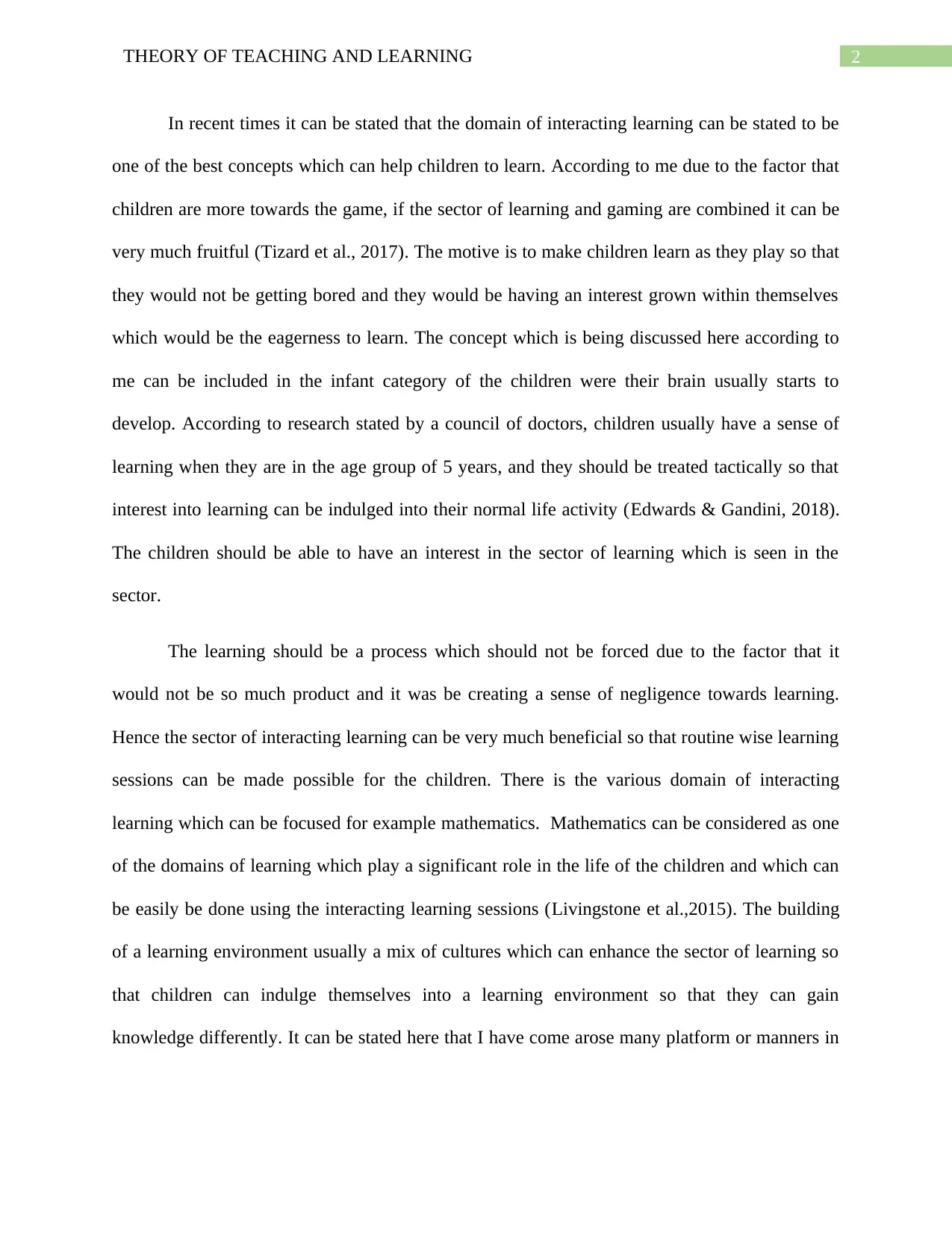
In recent times it can be stated that the domain of interacting learning can be stated to be
one of the best concepts which can help children to learn. According to me due to the factor that
children are more towards the game, if the sector of learning and gaming are combined it can be
very much fruitful (Tizard et al., 2017). The motive is to make children learn as they play so that
they would not be getting bored and they would be having an interest grown within themselves
which would be the eagerness to learn. The concept which is being discussed here according to
me can be included in the infant category of the children were their brain usually starts to
develop. According to research stated by a council of doctors, children usually have a sense of
learning when they are in the age group of 5 years, and they should be treated tactically so that
interest into learning can be indulged into their normal life activity (Edwards & Gandini, 2018).
The children should be able to have an interest in the sector of learning which is seen in the
sector.
The learning should be a process which should not be forced due to the factor that it
would not be so much product and it was be creating a sense of negligence towards learning.
Hence the sector of interacting learning can be very much beneficial so that routine wise learning
sessions can be made possible for the children. There is the various domain of interacting
learning which can be focused for example mathematics. Mathematics can be considered as one
of the domains of learning which play a significant role in the life of the children and which can
be easily be done using the interacting learning sessions (Livingstone et al.,2015). The building
of a learning environment usually a mix of cultures which can enhance the sector of learning so
that children can indulge themselves into a learning environment so that they can gain
knowledge differently. It can be stated here that I have come arose many platform or manners in
Document Page
3THEORY OF TEACHING AND LEARNING
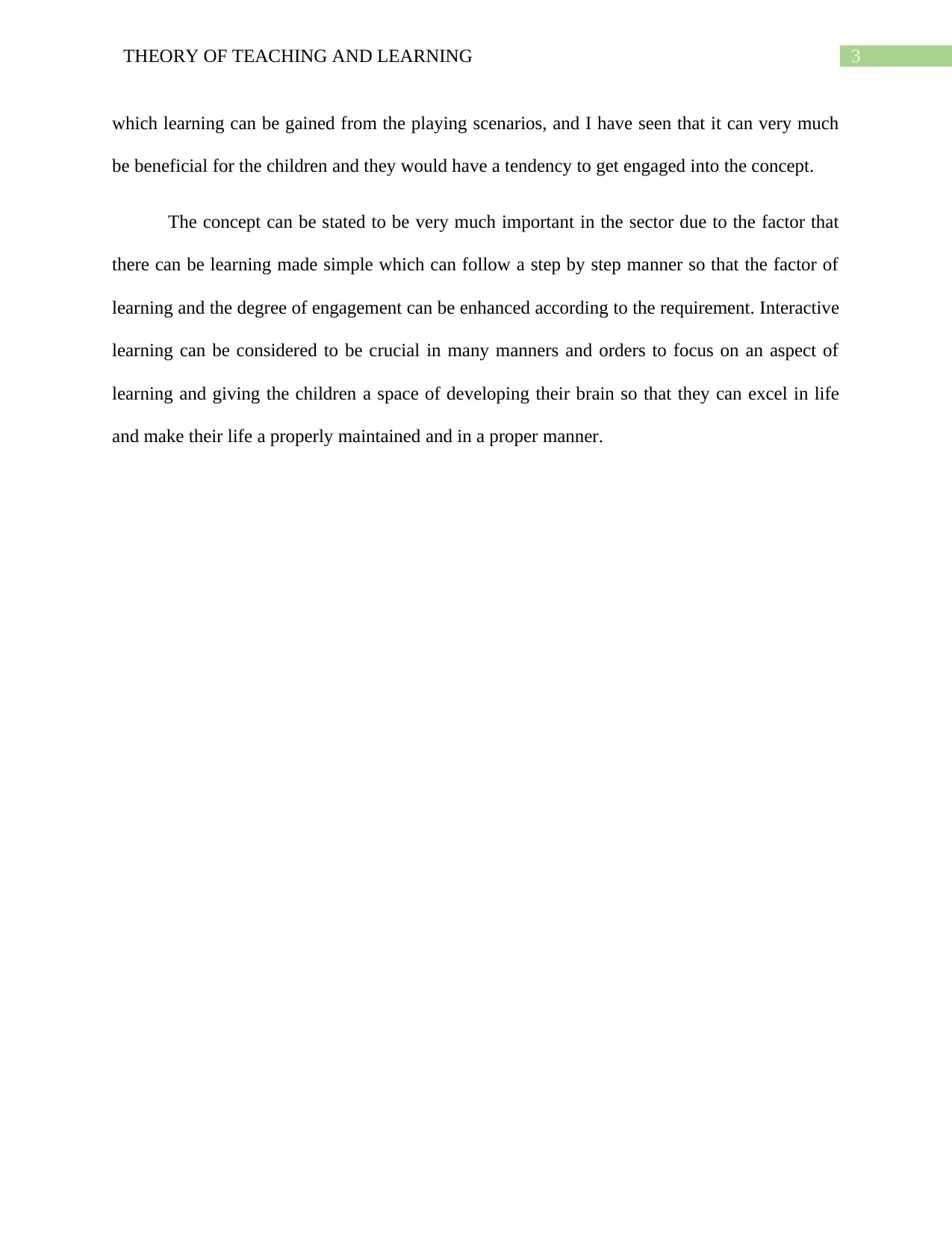
which learning can be gained from the playing scenarios, and I have seen that it can very much
be beneficial for the children and they would have a tendency to get engaged into the concept.
The concept can be stated to be very much important in the sector due to the factor that
there can be learning made simple which can follow a step by step manner so that the factor of
learning and the degree of engagement can be enhanced according to the requirement. Interactive
learning can be considered to be crucial in many manners and orders to focus on an aspect of
learning and giving the children a space of developing their brain so that they can excel in life
and make their life a properly maintained and in a proper manner.
Document Page
4THEORY OF TEACHING AND LEARNING
References
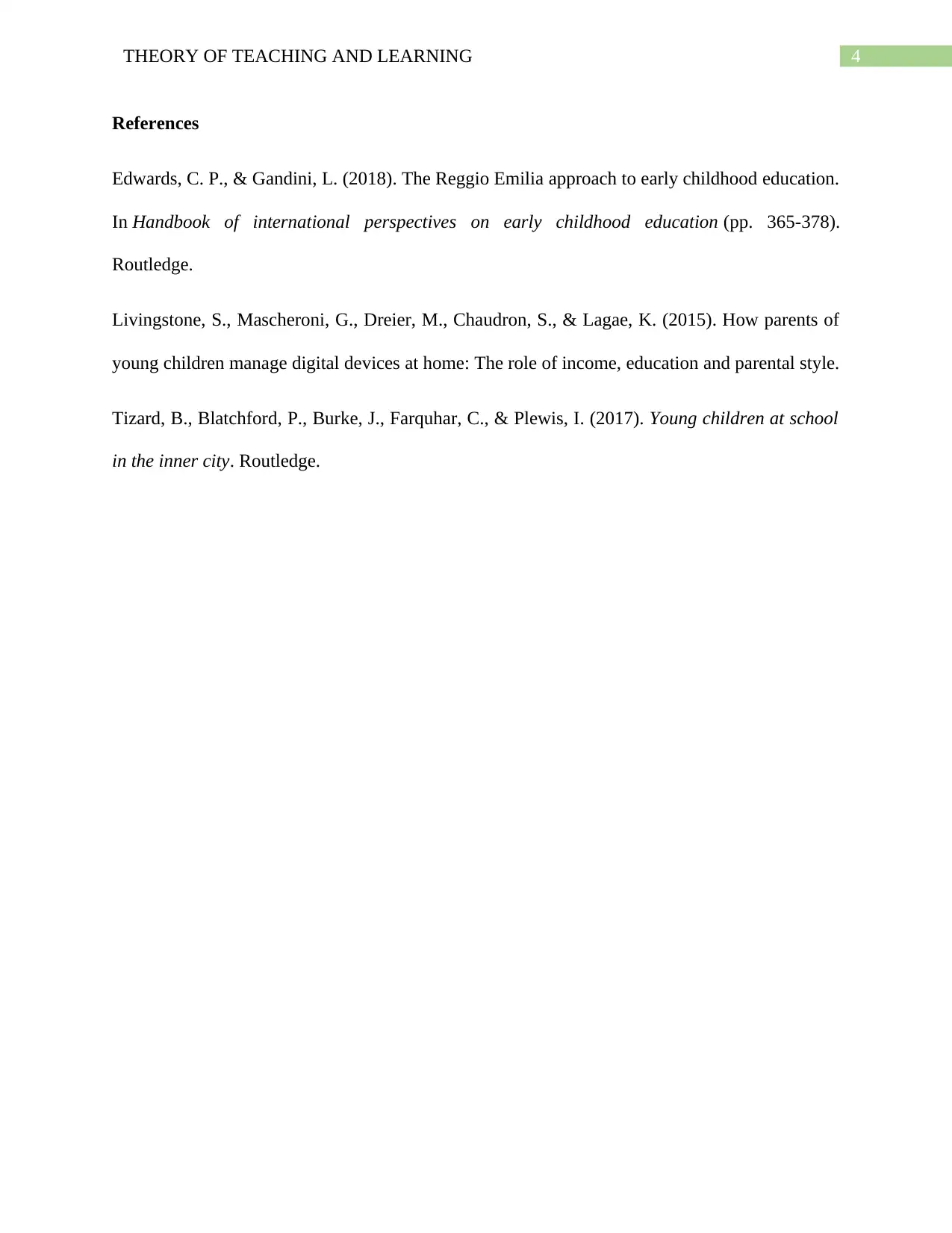
Edwards, C. P., & Gandini, L. (2018). The Reggio Emilia approach to early childhood education.
In Handbook of international perspectives on early childhood education (pp. 365-378).
Routledge.
Livingstone, S., Mascheroni, G., Dreier, M., Chaudron, S., & Lagae, K. (2015). How parents of
young children manage digital devices at home: The role of income, education and parental style.
Tizard, B., Blatchford, P., Burke, J., Farquhar, C., & Plewis, I. (2017). Young children at school
in the inner city. Routledge.
chevron_up_icon
1 out of 4
circle_padding
hide_on_mobile
zoom_out_icon
[object Object]