ICT80415 Telecommunication Network Management - Assessment Report
VerifiedAdded on 2023/06/11
|18
|3123
|50
Report
AI Summary
This report provides a detailed overview of telecommunication network management, covering essential aspects such as performance, fault, configuration, security, and accounting management. It explores different types of network management, principles, and a case study of the Indian telecommunication market. The practical activity section delves into TMN architecture, fault management techniques, QoS agreements, document analysis focusing on survivability and reliability, and various telecommunication business models. The report further discusses the main features and functions of QoS arguments, highlighting the importance of automation and effective management processes in ensuring network reliability and performance. The document also references international telecommunication standards and protocols, underlining the critical role of effective communication and management in the telecommunications industry. Desklib provides access to similar solved assignments and study resources for students.
Telecommunication network management

Paraphrase This Document
Need a fresh take? Get an instant paraphrase of this document with our AI Paraphraser
Table of Contents
1. Introduction.......................................................................................................................................2
2. Telecommunication network management......................................................................................2
2.1 Types of network management.....................................................................................................4
2.2 Principles of network management..............................................................................................4
2.3 Case study of telecommunication network..................................................................................5
3 Practical activity................................................................................................................................6
3.1 TMN architecture................................................................................................................................7
3.2 Fault management techniques............................................................................................................8
3.3 Functions of Qos agreements..............................................................................................................9
3.4 Document analysis.............................................................................................................................10
3.5 Telecommunication business models................................................................................................11
3.6 Main features and functions of Qos arguments...............................................................................13
4. Conclusion............................................................................................................................................14
References............................................................................................................................................16
1
1. Introduction.......................................................................................................................................2
2. Telecommunication network management......................................................................................2
2.1 Types of network management.....................................................................................................4
2.2 Principles of network management..............................................................................................4
2.3 Case study of telecommunication network..................................................................................5
3 Practical activity................................................................................................................................6
3.1 TMN architecture................................................................................................................................7
3.2 Fault management techniques............................................................................................................8
3.3 Functions of Qos agreements..............................................................................................................9
3.4 Document analysis.............................................................................................................................10
3.5 Telecommunication business models................................................................................................11
3.6 Main features and functions of Qos arguments...............................................................................13
4. Conclusion............................................................................................................................................14
References............................................................................................................................................16
1
1. Introduction
The telecommunication network works as the management to support the activities and it
had many management functions like performance, fault management, configuration
management and also the security management. And in the management it has also the quality of
service with the parameters. And this network is used to business model by these management.
And the management in the kind of business and service. And this network provides the services
to inventory management and industry features like oracle. In this telecommunication network it
had tools to perform the management operation and also it includes the solving methods for the
issues. And in the network the communication is improved by polices and principles and the
relationship activity helps to the information for directly. And in the telecommunication the
industries development is essential for the country growth (Al Dianty, Shukri Yahaya & Ahmad,
2014). And it had many security issues. And in the industry it used as political, social and
technology.
2. Telecommunication network management
The telecommunication network management is used to support all the activities. The
telecommunication networks are associated by these activities. Different types of components are
used in management function.
Basically the management functions are classified into five categories:
Performance management- all the necessary activities are included in this category. The
QoS is used for maintain the short term view. QoS stands for quality of service
Fault management- it is used to handle many resources like system alarms, test and
correct the failing equipment’s, response the customer complaints.
Configuration management- In this category the equipment are installed, provi9de the
necessary network, change or edit the parameters, and check the behavior of the network
elements (Christine & Prinsloo, 2015).
2
The telecommunication network works as the management to support the activities and it
had many management functions like performance, fault management, configuration
management and also the security management. And in the management it has also the quality of
service with the parameters. And this network is used to business model by these management.
And the management in the kind of business and service. And this network provides the services
to inventory management and industry features like oracle. In this telecommunication network it
had tools to perform the management operation and also it includes the solving methods for the
issues. And in the network the communication is improved by polices and principles and the
relationship activity helps to the information for directly. And in the telecommunication the
industries development is essential for the country growth (Al Dianty, Shukri Yahaya & Ahmad,
2014). And it had many security issues. And in the industry it used as political, social and
technology.
2. Telecommunication network management
The telecommunication network management is used to support all the activities. The
telecommunication networks are associated by these activities. Different types of components are
used in management function.
Basically the management functions are classified into five categories:
Performance management- all the necessary activities are included in this category. The
QoS is used for maintain the short term view. QoS stands for quality of service
Fault management- it is used to handle many resources like system alarms, test and
correct the failing equipment’s, response the customer complaints.
Configuration management- In this category the equipment are installed, provi9de the
necessary network, change or edit the parameters, and check the behavior of the network
elements (Christine & Prinsloo, 2015).
2
⊘ This is a preview!⊘
Do you want full access?
Subscribe today to unlock all pages.

Trusted by 1+ million students worldwide
Security management- it is used tom provide the control access of the customer, data, and
network resources.
Accounting management- it includes the customer billing, measurements, and cost
control.
The business models are used to specify the set of management layers. So the
management layer construction is fully based on the business model. Each management space
has different addresses. In the system those layers are practically merged, they are used to
implement the business model functionalities (Dachyar & Risky, 2014). According to the
business model in the telecommunication network management they are classified into five
different types of layers.
Business management
Service management
Network management
Element management
Network element
Telecommunication solution use some key features
BRM- Billing: global communications, media, cloud, and digital markets are used.
OSM- Order Management: it is used to create the customer management system. All the
customer requirements are fulfilled.
UIM- Inventory Management: it is a standard telecommunication application, used to
manage the customers, products, services, and resources.
ASAP- Provisioning: oracle communications are applicable, it provides multi-play
services.
3
network resources.
Accounting management- it includes the customer billing, measurements, and cost
control.
The business models are used to specify the set of management layers. So the
management layer construction is fully based on the business model. Each management space
has different addresses. In the system those layers are practically merged, they are used to
implement the business model functionalities (Dachyar & Risky, 2014). According to the
business model in the telecommunication network management they are classified into five
different types of layers.
Business management
Service management
Network management
Element management
Network element
Telecommunication solution use some key features
BRM- Billing: global communications, media, cloud, and digital markets are used.
OSM- Order Management: it is used to create the customer management system. All the
customer requirements are fulfilled.
UIM- Inventory Management: it is a standard telecommunication application, used to
manage the customers, products, services, and resources.
ASAP- Provisioning: oracle communications are applicable, it provides multi-play
services.
3
Paraphrase This Document
Need a fresh take? Get an instant paraphrase of this document with our AI Paraphraser
Oracle Hyperion EPM: in this category two methods are used one is Hyperion Financial
Management and another one is Hyperion Planning.
2.1Types of network management
The process of managing the network is known as network management. In
network management, the network faults and performance are managed by various tools and
techniques. Most of the business requirements use the network management. The error free
network is the type of network, most effective and also popular network.
The only way for achieving the error free network is using network management.
Different types of network management tools are used, but these tools are making our whole
process in complex. Four critical aspects are used in network management system:
Fault identification
Performance management
Network provision
Maintaining QoS
2.2Principles of network management
The organizational policies are used to improve the communication. To determine
the organizational policies it provide some basic principles like courtesy, friendliness, etc. the
system of actors, an domain action, some economic specification, technical and also political
details are provided.
4
Management and another one is Hyperion Planning.
2.1Types of network management
The process of managing the network is known as network management. In
network management, the network faults and performance are managed by various tools and
techniques. Most of the business requirements use the network management. The error free
network is the type of network, most effective and also popular network.
The only way for achieving the error free network is using network management.
Different types of network management tools are used, but these tools are making our whole
process in complex. Four critical aspects are used in network management system:
Fault identification
Performance management
Network provision
Maintaining QoS
2.2Principles of network management
The organizational policies are used to improve the communication. To determine
the organizational policies it provide some basic principles like courtesy, friendliness, etc. the
system of actors, an domain action, some economic specification, technical and also political
details are provided.
4
The public relationship activities are used to handle the information directly, and
also the organizational frame works are created. A regulatory political issue means weight of the
political actors, in various locations such as media domain, customer policy domain, etc.
2.3Case study of telecommunication network
India is the most popular country in telecommunication market. All over world
India in second place for telecommunication market. In 2018 upcoming national
telecommunication policies are introduced. To develop the socio- economic factor the
telecommunication sector is the most important tool. Telecommunication means the message
will be transfer in secure manner. The industries are used to develop the economy. Different
type’s functional jobs are used to develop the economy, such as telephony, wireless
communication, GPRS, GSM, CDMA, and VoIP.
In industry environment for telecommunication management system are used in
several factors
Political factor
Economic factor
Social factor
Technology factor
Legal factor
Environment factor
5
also the organizational frame works are created. A regulatory political issue means weight of the
political actors, in various locations such as media domain, customer policy domain, etc.
2.3Case study of telecommunication network
India is the most popular country in telecommunication market. All over world
India in second place for telecommunication market. In 2018 upcoming national
telecommunication policies are introduced. To develop the socio- economic factor the
telecommunication sector is the most important tool. Telecommunication means the message
will be transfer in secure manner. The industries are used to develop the economy. Different
type’s functional jobs are used to develop the economy, such as telephony, wireless
communication, GPRS, GSM, CDMA, and VoIP.
In industry environment for telecommunication management system are used in
several factors
Political factor
Economic factor
Social factor
Technology factor
Legal factor
Environment factor
5
⊘ This is a preview!⊘
Do you want full access?
Subscribe today to unlock all pages.
Trusted by 1+ million students worldwide
3 Practical activity
The practical activity contains research, documentation, and architectural features of the
network management. It uses both common carrier and extended models. For example follow the
questions and answers.
In telecommunication network it has various management like planning, Installation,
operation and administrations of telecommunication networks. The development of the
functionality supports the management as carrier levels. Management areas cover five important
steps and they are,
Performance management
Fault management
Configuration management
Accounting management
Security management
Tele communication methodology has the management services to identify the functional
components. Management has service components and also the application functions and the
operating systems management capability to provide management functions. And the application
function has the systems like transport like movement of data and the storage like provides keep
the data safely and retrieval like get the data.
6
The practical activity contains research, documentation, and architectural features of the
network management. It uses both common carrier and extended models. For example follow the
questions and answers.
In telecommunication network it has various management like planning, Installation,
operation and administrations of telecommunication networks. The development of the
functionality supports the management as carrier levels. Management areas cover five important
steps and they are,
Performance management
Fault management
Configuration management
Accounting management
Security management
Tele communication methodology has the management services to identify the functional
components. Management has service components and also the application functions and the
operating systems management capability to provide management functions. And the application
function has the systems like transport like movement of data and the storage like provides keep
the data safely and retrieval like get the data.
6
Paraphrase This Document
Need a fresh take? Get an instant paraphrase of this document with our AI Paraphraser
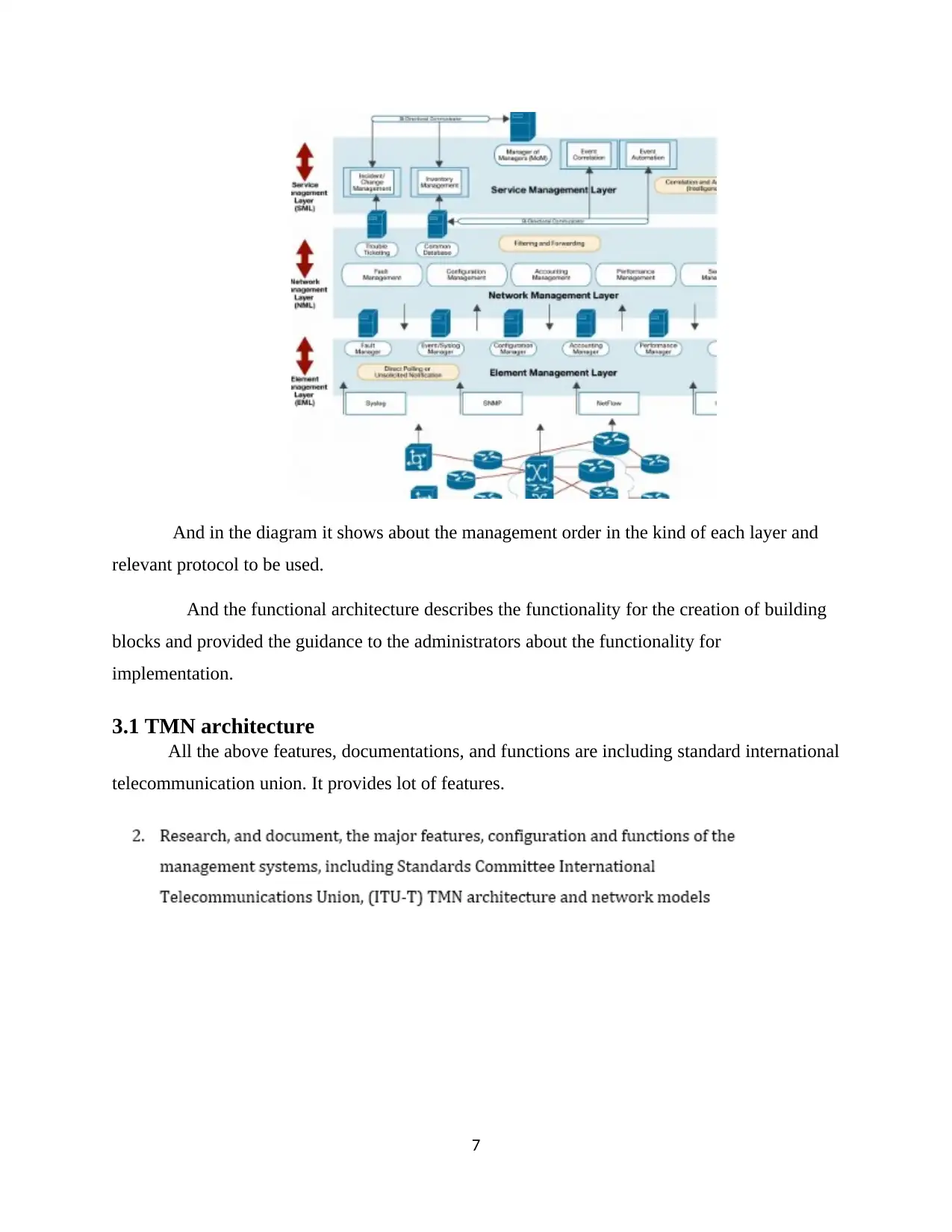
And in the diagram it shows about the management order in the kind of each layer and
relevant protocol to be used.
And the functional architecture describes the functionality for the creation of building
blocks and provided the guidance to the administrators about the functionality for
implementation.
3.1 TMN architecture
All the above features, documentations, and functions are including standard international
telecommunication union. It provides lot of features.
7
relevant protocol to be used.
And the functional architecture describes the functionality for the creation of building
blocks and provided the guidance to the administrators about the functionality for
implementation.
3.1 TMN architecture
All the above features, documentations, and functions are including standard international
telecommunication union. It provides lot of features.
7
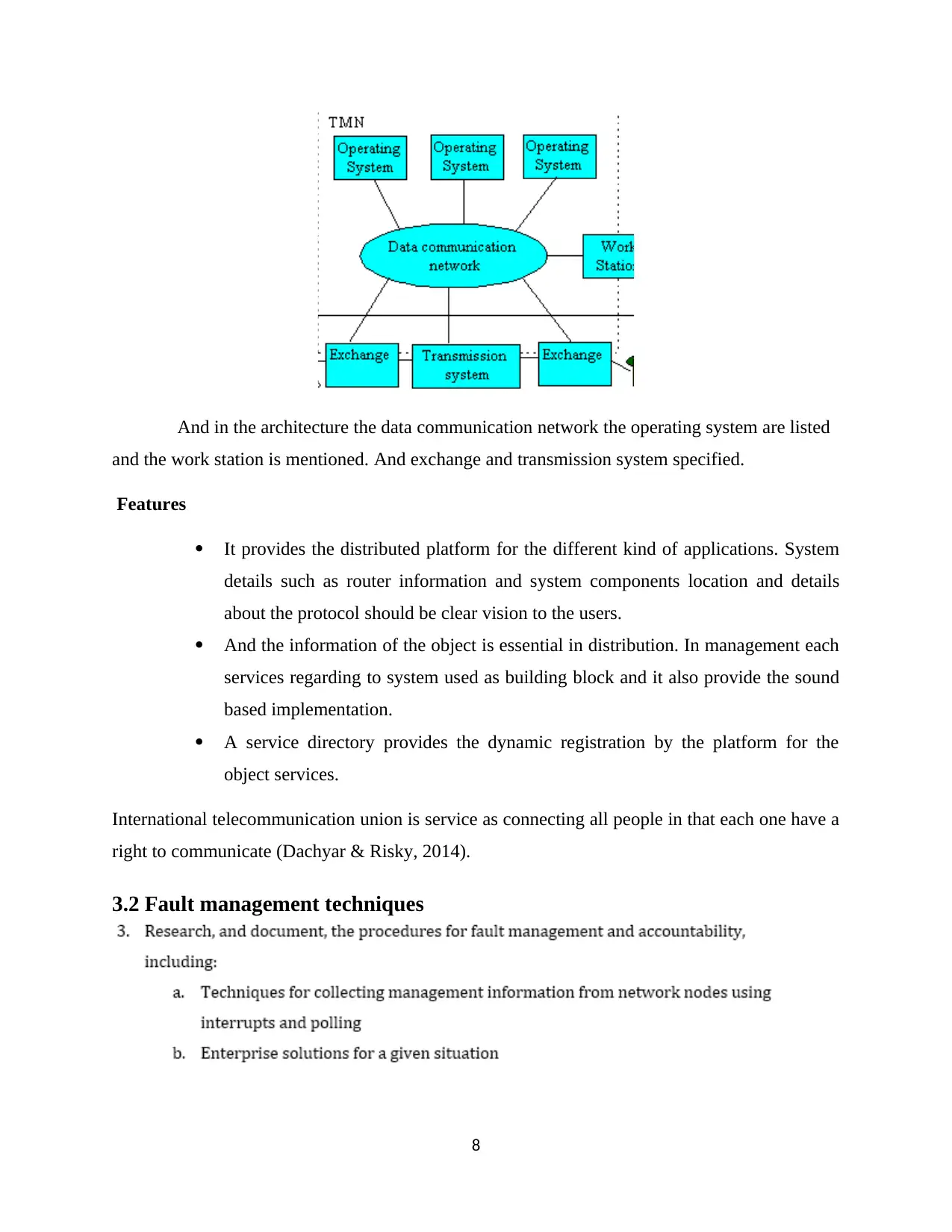
And in the architecture the data communication network the operating system are listed
and the work station is mentioned. And exchange and transmission system specified.
Features
It provides the distributed platform for the different kind of applications. System
details such as router information and system components location and details
about the protocol should be clear vision to the users.
And the information of the object is essential in distribution. In management each
services regarding to system used as building block and it also provide the sound
based implementation.
A service directory provides the dynamic registration by the platform for the
object services.
International telecommunication union is service as connecting all people in that each one have a
right to communicate (Dachyar & Risky, 2014).
3.2 Fault management techniques
8
and the work station is mentioned. And exchange and transmission system specified.
Features
It provides the distributed platform for the different kind of applications. System
details such as router information and system components location and details
about the protocol should be clear vision to the users.
And the information of the object is essential in distribution. In management each
services regarding to system used as building block and it also provide the sound
based implementation.
A service directory provides the dynamic registration by the platform for the
object services.
International telecommunication union is service as connecting all people in that each one have a
right to communicate (Dachyar & Risky, 2014).
3.2 Fault management techniques
8
⊘ This is a preview!⊘
Do you want full access?
Subscribe today to unlock all pages.
Trusted by 1+ million students worldwide
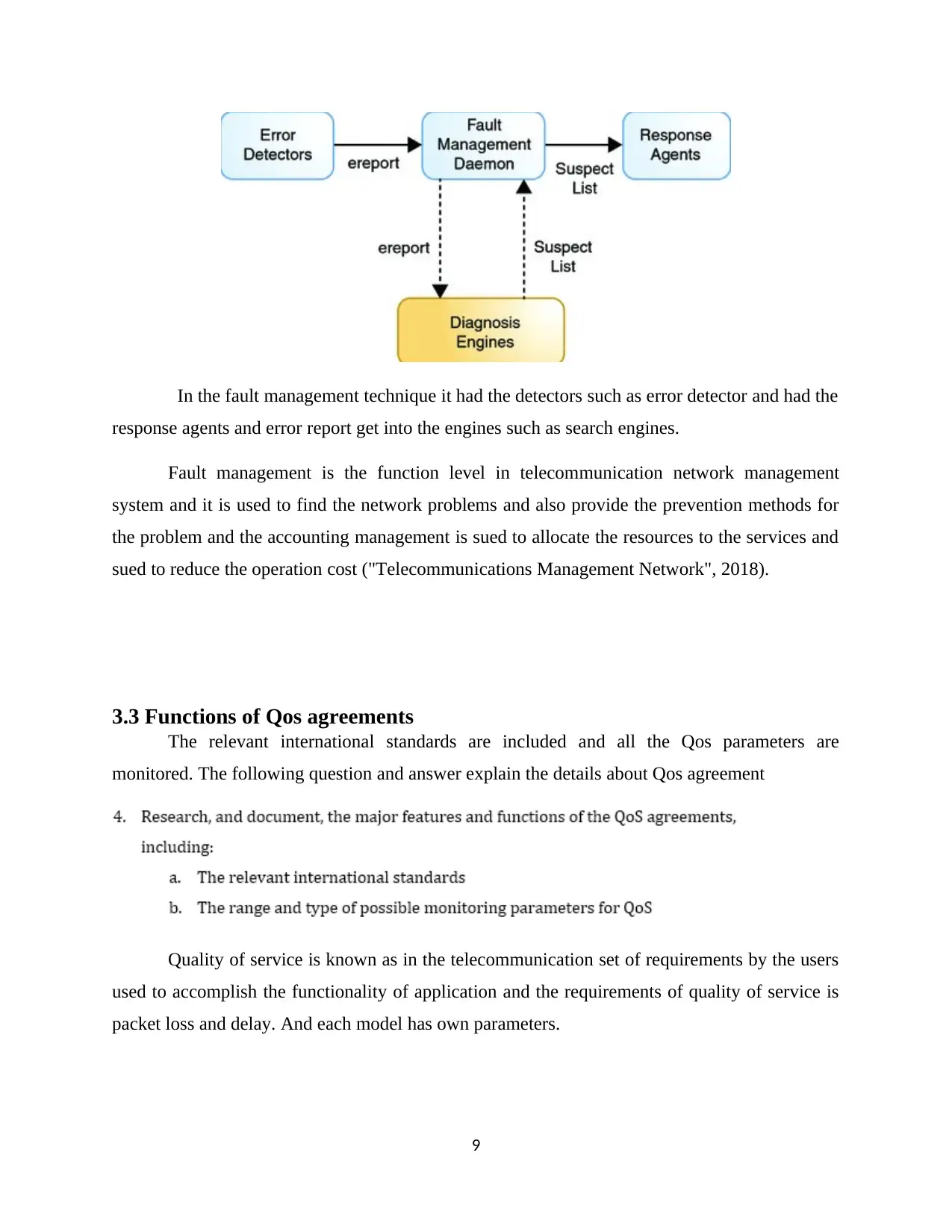
In the fault management technique it had the detectors such as error detector and had the
response agents and error report get into the engines such as search engines.
Fault management is the function level in telecommunication network management
system and it is used to find the network problems and also provide the prevention methods for
the problem and the accounting management is sued to allocate the resources to the services and
sued to reduce the operation cost ("Telecommunications Management Network", 2018).
3.3 Functions of Qos agreements
The relevant international standards are included and all the Qos parameters are
monitored. The following question and answer explain the details about Qos agreement
Quality of service is known as in the telecommunication set of requirements by the users
used to accomplish the functionality of application and the requirements of quality of service is
packet loss and delay. And each model has own parameters.
9
response agents and error report get into the engines such as search engines.
Fault management is the function level in telecommunication network management
system and it is used to find the network problems and also provide the prevention methods for
the problem and the accounting management is sued to allocate the resources to the services and
sued to reduce the operation cost ("Telecommunications Management Network", 2018).
3.3 Functions of Qos agreements
The relevant international standards are included and all the Qos parameters are
monitored. The following question and answer explain the details about Qos agreement
Quality of service is known as in the telecommunication set of requirements by the users
used to accomplish the functionality of application and the requirements of quality of service is
packet loss and delay. And each model has own parameters.
9
Paraphrase This Document
Need a fresh take? Get an instant paraphrase of this document with our AI Paraphraser
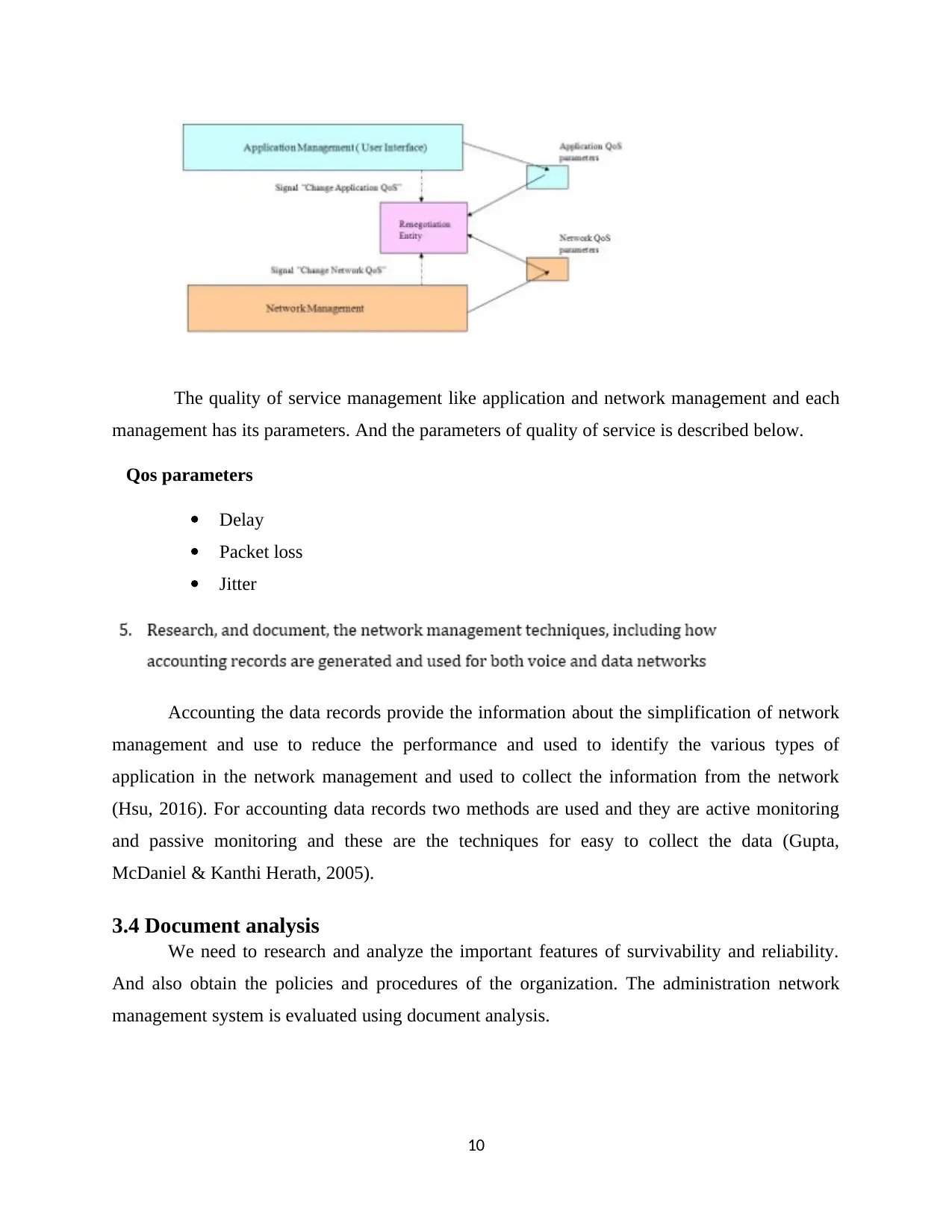
The quality of service management like application and network management and each
management has its parameters. And the parameters of quality of service is described below.
Qos parameters
Delay
Packet loss
Jitter
Accounting the data records provide the information about the simplification of network
management and use to reduce the performance and used to identify the various types of
application in the network management and used to collect the information from the network
(Hsu, 2016). For accounting data records two methods are used and they are active monitoring
and passive monitoring and these are the techniques for easy to collect the data (Gupta,
McDaniel & Kanthi Herath, 2005).
3.4 Document analysis
We need to research and analyze the important features of survivability and reliability.
And also obtain the policies and procedures of the organization. The administration network
management system is evaluated using document analysis.
10
management has its parameters. And the parameters of quality of service is described below.
Qos parameters
Delay
Packet loss
Jitter
Accounting the data records provide the information about the simplification of network
management and use to reduce the performance and used to identify the various types of
application in the network management and used to collect the information from the network
(Hsu, 2016). For accounting data records two methods are used and they are active monitoring
and passive monitoring and these are the techniques for easy to collect the data (Gupta,
McDaniel & Kanthi Herath, 2005).
3.4 Document analysis
We need to research and analyze the important features of survivability and reliability.
And also obtain the policies and procedures of the organization. The administration network
management system is evaluated using document analysis.
10
In the telecommunication network the network survivability has many sectors. And it is used to
provide the recovery and time measurements and it is used to reduce the control information.
In the telecommunication network rules are followed to the effective access in they
access approval it is related to get the access of communication and the computer facilities and
must have the user responsibilities and need to be the privacy of telecommunication network.
In the network management system security for administrative management is difficult and time
redundancy and in this not able to perform the testing for security (Hsu, 2016).
3.5 Telecommunication business models
In telecommunication management system use no of business models and business
procedures. And also design the plan for reliability and survivability. Use some techniques for
analyze the network telecommunication.
In the network management security is essential to all process and the use of encryption and
secure the secret data and assure the connection in data transmission and for authentication
system.
11
provide the recovery and time measurements and it is used to reduce the control information.
In the telecommunication network rules are followed to the effective access in they
access approval it is related to get the access of communication and the computer facilities and
must have the user responsibilities and need to be the privacy of telecommunication network.
In the network management system security for administrative management is difficult and time
redundancy and in this not able to perform the testing for security (Hsu, 2016).
3.5 Telecommunication business models
In telecommunication management system use no of business models and business
procedures. And also design the plan for reliability and survivability. Use some techniques for
analyze the network telecommunication.
In the network management security is essential to all process and the use of encryption and
secure the secret data and assure the connection in data transmission and for authentication
system.
11
⊘ This is a preview!⊘
Do you want full access?
Subscribe today to unlock all pages.
Trusted by 1+ million students worldwide

1 out of 18


Related Documents


Your All-in-One AI-Powered Toolkit for Academic Success.
+13062052269
info@desklib.com
Available 24*7 on WhatsApp / Email
![[object Object]](/_next/static/media/star-bottom.7253800d.svg)
Unlock your academic potential
Copyright © 2020–2026 A2Z Services. All Rights Reserved. Developed and managed by ZUCOL.