A Comprehensive Report on Tesco's Digital Transformation Strategy
VerifiedAdded on 2023/06/18
|12
|3546
|138
Report
AI Summary
This report provides an executive summary and a detailed analysis of Tesco's digital transformation strategy. It begins with an overview of digital transformation, highlighting its importance in meeting evolving market demands and customer expectations. The report then delves into Tesco's organizational structure and its strategic adoption of digital technologies to enhance customer experience and build a robust online presence. It explores the use of technologies like click-and-collect, in-store digital initiatives such as self-checkout stations, electronic shelf labels, and smart badges for employees. Furthermore, the report discusses the future implications of digital technology for Tesco, including the opportunities presented by big data analytics and the challenges posed by cybersecurity threats. The report concludes with recommendations for Tesco to strengthen its digital security measures and fully leverage big data for improved customer relationships and competitive advantage. Desklib provides access to this and other solved assignments.
Digital transformation

Paraphrase This Document
Need a fresh take? Get an instant paraphrase of this document with our AI Paraphraser
Executive summary
Digital transformation is the process of making use of digital based technologies in order
to create a new one or to even modify them. It is done to meet the standards of changing business
and evolve according to the market requirements. Updating the business in this digital era is
digital transformation. This report is based on the digital transformation of the Tesco, which is a
large supermarket chain running in UK.
Digital transformation is the process of making use of digital based technologies in order
to create a new one or to even modify them. It is done to meet the standards of changing business
and evolve according to the market requirements. Updating the business in this digital era is
digital transformation. This report is based on the digital transformation of the Tesco, which is a
large supermarket chain running in UK.
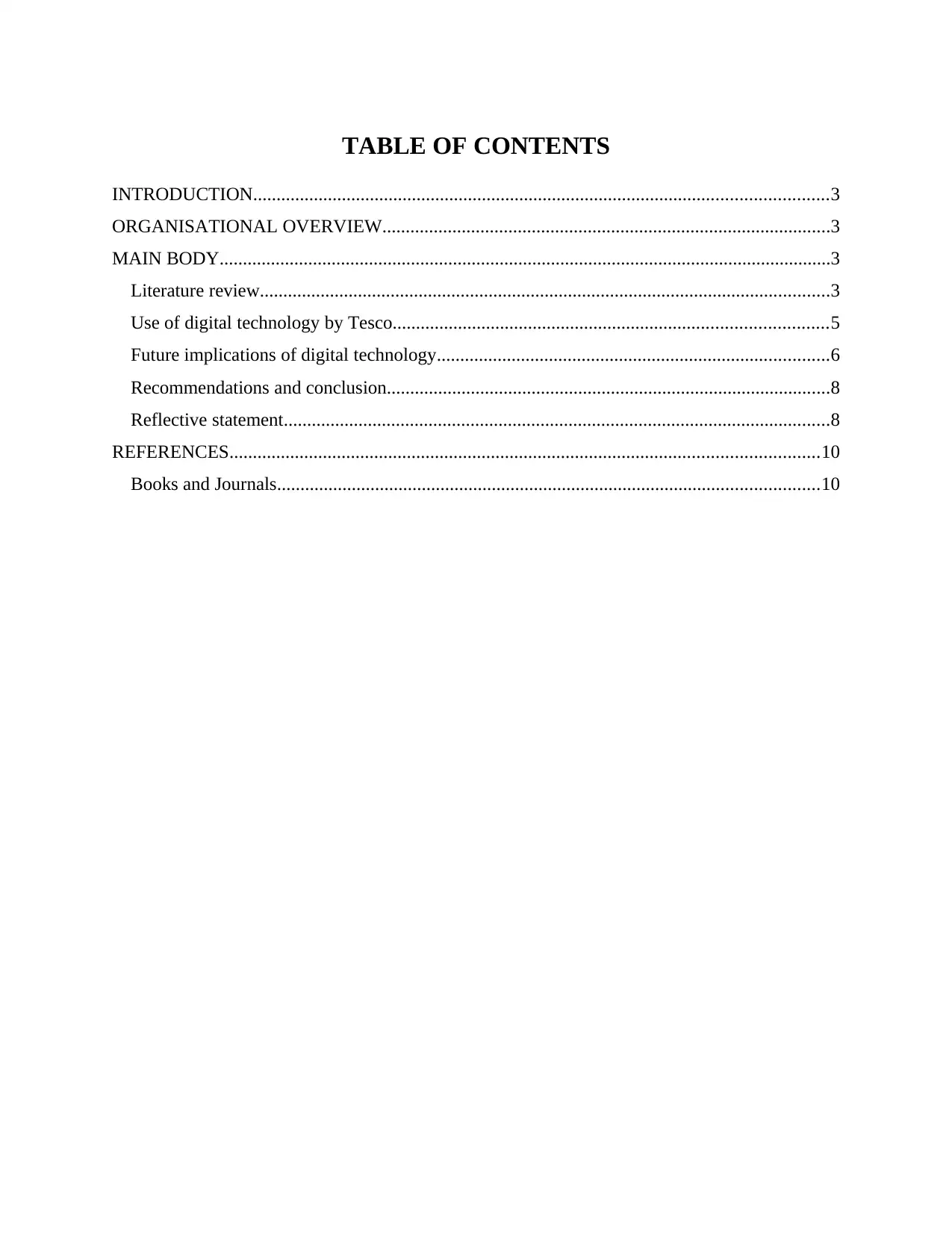
TABLE OF CONTENTS
INTRODUCTION...........................................................................................................................3
ORGANISATIONAL OVERVIEW................................................................................................3
MAIN BODY...................................................................................................................................3
Literature review..........................................................................................................................3
Use of digital technology by Tesco.............................................................................................5
Future implications of digital technology....................................................................................6
Recommendations and conclusion...............................................................................................8
Reflective statement.....................................................................................................................8
REFERENCES..............................................................................................................................10
Books and Journals....................................................................................................................10
INTRODUCTION...........................................................................................................................3
ORGANISATIONAL OVERVIEW................................................................................................3
MAIN BODY...................................................................................................................................3
Literature review..........................................................................................................................3
Use of digital technology by Tesco.............................................................................................5
Future implications of digital technology....................................................................................6
Recommendations and conclusion...............................................................................................8
Reflective statement.....................................................................................................................8
REFERENCES..............................................................................................................................10
Books and Journals....................................................................................................................10
⊘ This is a preview!⊘
Do you want full access?
Subscribe today to unlock all pages.

Trusted by 1+ million students worldwide
INTRODUCTION
Digital transformation is the process of making use of digital technology. It helps in
transforming the already existing traditional business process and non digital processes into
creating a new ones. This helps in meeting with the evolving market and fulfilling customer
expectations therefore, altering the way of businesses while managing how the value is being
delivered to the customers (Albukhitan, 2020). Digital transformation is all about developing a
digital enterprise where the organisation will use the technology to evolve in all the aspects of
business. With the advancements in technology there is no option to choose to transform but
deciding the ways to transform. Tesco is a British multinational groceries which retails general
merchandise. This report deals with the digital transformation strategy of Tesco and the different
ways to use the digital technology. There is a detailed discussion on the future digital challenges
faced by Tesco.
ORGANISATIONAL OVERVIEW
Tesco works in the retailing industry and specialises in the groceries products. The
company is headquartered in Welwyn garden city in England, UK. Tesco is one of the largest
retailer company based on the overall revenue generated (Chanias, 2017). It serves many
countries across Europe and is leading the market. It is also looking to expand its business
rapidly and on the global basis while diversifying the product line. Tesco has digitally
transformed the customer experience and business model while operating the decided business
model giving its users a digitalised in store experience and increasing the loyalty points. This
traditionally working grocery store is now building the base or the online customers.
MAIN BODY
Literature review
According to Goerzig, D. and Bauernhansl, T., 2018, Digital transformation is the
process of using digital technology for creating a new business or to make a modification in the
already existing one. These modifications are done in the processes of business, culture and the
customer experience in order to meet the changing needs and demands from the business. On the
other hand, Yucel, 2018 said that this re-imagining of the business is very necessary in the digital
age. It is related to the thinking and engagement with the customers. Every digital transformation
Digital transformation is the process of making use of digital technology. It helps in
transforming the already existing traditional business process and non digital processes into
creating a new ones. This helps in meeting with the evolving market and fulfilling customer
expectations therefore, altering the way of businesses while managing how the value is being
delivered to the customers (Albukhitan, 2020). Digital transformation is all about developing a
digital enterprise where the organisation will use the technology to evolve in all the aspects of
business. With the advancements in technology there is no option to choose to transform but
deciding the ways to transform. Tesco is a British multinational groceries which retails general
merchandise. This report deals with the digital transformation strategy of Tesco and the different
ways to use the digital technology. There is a detailed discussion on the future digital challenges
faced by Tesco.
ORGANISATIONAL OVERVIEW
Tesco works in the retailing industry and specialises in the groceries products. The
company is headquartered in Welwyn garden city in England, UK. Tesco is one of the largest
retailer company based on the overall revenue generated (Chanias, 2017). It serves many
countries across Europe and is leading the market. It is also looking to expand its business
rapidly and on the global basis while diversifying the product line. Tesco has digitally
transformed the customer experience and business model while operating the decided business
model giving its users a digitalised in store experience and increasing the loyalty points. This
traditionally working grocery store is now building the base or the online customers.
MAIN BODY
Literature review
According to Goerzig, D. and Bauernhansl, T., 2018, Digital transformation is the
process of using digital technology for creating a new business or to make a modification in the
already existing one. These modifications are done in the processes of business, culture and the
customer experience in order to meet the changing needs and demands from the business. On the
other hand, Yucel, 2018 said that this re-imagining of the business is very necessary in the digital
age. It is related to the thinking and engagement with the customers. Every digital transformation
Paraphrase This Document
Need a fresh take? Get an instant paraphrase of this document with our AI Paraphraser
is started and end with the customers. It was not very long ago where the business data was
based on being analog, there were physical documents like papers, binders and faxes. Van
Tonder, and et.al., 2020 stated that, Then came the era of using computers and lead the business
to convert all their inked paper documents into digital computer files. This made the sharing and
finding of the files easy in the digitalised way. Digital data is more efficient when compared to
the traditional ways.
Digital technology is implementing the modern use of technology which will spark a
radical change in the organisation. Wang and et.al., 2020 said that the main aim behind this
process is to make leaders rethink the business strategies and related operations which will help
the company grow. Digitally transformed organisation can see a growth in the employee
satisfaction, customer engagement and innovation in the business. They develop a unique
position and benefits from the launch of new and digital initiative. However, according to
Caliskan, Özen and Ozturkoglu, 2020, Digital business helps in offering exceptional and
personalised experience to its customers as well as employees. This is turn will lead to the
improved loyalty of the firm, gaining more customer retention and increasing the revenue. A
successful digital transformation includes well defined strategy which is prioritise by new
initiatives and setting new criteria for success. Fletcher, G., Fenton, A. and Griffiths, M.,
2019...... Digital transforming strategy is the plan of action which is describes the ways in which
business reposition in a strategical way resulting in digital economy. It requires bringing in
innovation, changing the operations and business models while leveraging the merging
technology.
Aiello and et.al., 2020 believed the value generated by the digital transformation of the
business which is dependent on both the advancements in technology as well as the human
decision making process. Ethics is a very important factor in the an organisation as it also helps
in being a differentiating factor in the market place where the reputation of the company is and
the values it hold are equally important as like the products and services. Digitalisation has been
a topic of debate since a very long time for the policy makers, economists and leaders of the
industry related to its impact on society. Khin and Ho, 2019 argued that with the increase in
digitalisation, society in getting more con concerned about growing and affecting jobs, wages
and other resources with efficiency and security. It enables the automation of operation within
the business and receiving more operational efficiency with reduce costs and more productivity.
based on being analog, there were physical documents like papers, binders and faxes. Van
Tonder, and et.al., 2020 stated that, Then came the era of using computers and lead the business
to convert all their inked paper documents into digital computer files. This made the sharing and
finding of the files easy in the digitalised way. Digital data is more efficient when compared to
the traditional ways.
Digital technology is implementing the modern use of technology which will spark a
radical change in the organisation. Wang and et.al., 2020 said that the main aim behind this
process is to make leaders rethink the business strategies and related operations which will help
the company grow. Digitally transformed organisation can see a growth in the employee
satisfaction, customer engagement and innovation in the business. They develop a unique
position and benefits from the launch of new and digital initiative. However, according to
Caliskan, Özen and Ozturkoglu, 2020, Digital business helps in offering exceptional and
personalised experience to its customers as well as employees. This is turn will lead to the
improved loyalty of the firm, gaining more customer retention and increasing the revenue. A
successful digital transformation includes well defined strategy which is prioritise by new
initiatives and setting new criteria for success. Fletcher, G., Fenton, A. and Griffiths, M.,
2019...... Digital transforming strategy is the plan of action which is describes the ways in which
business reposition in a strategical way resulting in digital economy. It requires bringing in
innovation, changing the operations and business models while leveraging the merging
technology.
Aiello and et.al., 2020 believed the value generated by the digital transformation of the
business which is dependent on both the advancements in technology as well as the human
decision making process. Ethics is a very important factor in the an organisation as it also helps
in being a differentiating factor in the market place where the reputation of the company is and
the values it hold are equally important as like the products and services. Digitalisation has been
a topic of debate since a very long time for the policy makers, economists and leaders of the
industry related to its impact on society. Khin and Ho, 2019 argued that with the increase in
digitalisation, society in getting more con concerned about growing and affecting jobs, wages
and other resources with efficiency and security. It enables the automation of operation within
the business and receiving more operational efficiency with reduce costs and more productivity.
The different types of digital transformation includes customer experience which is
working to understand the customers in more detail with the help of using technology which will
fuel up the growth of customers and create more touchpoints for the customers. According to
Garaus, Wagner, and Rainer, 2021, another is the operational processes which helps in
increasing the internal processes with the help of leveraging digitalisation and automation which
will help the employees in using digital tools and collecting different data which can be used in
monitoring the performance into being a more strategic business decision. Last is the business
model which will help in transforming the business by augmenting the physical offering with the
help of digital tools and services. It is also done by introducing more and more digital products
and using the modern technology to provide services.
Use of digital technology by Tesco
Tesco is one of the leading brand in retailing grocery within UK. It has transformed itself
in having a customer experience and developing business model with a company's website
having click and collect feature which takes to the digitalised in store experience to the
customers which is data goaded in the commitment level (Aleshkovski, Bondarenko. and Ilyin,
2020). Tesco is investing in the technology which is used to develop and create an omni channel
experience for its users and thus being successful in gaining the competitive advantage with the
increase in digitised grocery landscape. It is using technology to differentiate its business and
developing and operating model. UK has always been a prime spot for the online grocery and
home delivery options which are accessible due to the high technology adoption. Tesco
responded quickly to grasp this opportunity and adapt the business model on the online channels.
The online sales of the company are rapidly growing while fulfilling the needs and
demands of the company (Ziyadin, Suieubayeva, and Utegenova, 2019). This made Tesco
augment their operating model and invest more in the dot come centres for grocery. There is a
warehouse which is solely for the online orders whose purpose is filled with innovative goods to
person picking technology. In the click and collect feature on the website, customers can place
their orders online and collect the bags at the grocery stores and the collection point of their
choice. This eliminated the complaints due to the home delivery costs. Another technology used
by the company are some digital in store initiatives. Scan as you shop and self checkout stations
are supposedly placed adjacent to employees which are manned at the checkout stations. This
working to understand the customers in more detail with the help of using technology which will
fuel up the growth of customers and create more touchpoints for the customers. According to
Garaus, Wagner, and Rainer, 2021, another is the operational processes which helps in
increasing the internal processes with the help of leveraging digitalisation and automation which
will help the employees in using digital tools and collecting different data which can be used in
monitoring the performance into being a more strategic business decision. Last is the business
model which will help in transforming the business by augmenting the physical offering with the
help of digital tools and services. It is also done by introducing more and more digital products
and using the modern technology to provide services.
Use of digital technology by Tesco
Tesco is one of the leading brand in retailing grocery within UK. It has transformed itself
in having a customer experience and developing business model with a company's website
having click and collect feature which takes to the digitalised in store experience to the
customers which is data goaded in the commitment level (Aleshkovski, Bondarenko. and Ilyin,
2020). Tesco is investing in the technology which is used to develop and create an omni channel
experience for its users and thus being successful in gaining the competitive advantage with the
increase in digitised grocery landscape. It is using technology to differentiate its business and
developing and operating model. UK has always been a prime spot for the online grocery and
home delivery options which are accessible due to the high technology adoption. Tesco
responded quickly to grasp this opportunity and adapt the business model on the online channels.
The online sales of the company are rapidly growing while fulfilling the needs and
demands of the company (Ziyadin, Suieubayeva, and Utegenova, 2019). This made Tesco
augment their operating model and invest more in the dot come centres for grocery. There is a
warehouse which is solely for the online orders whose purpose is filled with innovative goods to
person picking technology. In the click and collect feature on the website, customers can place
their orders online and collect the bags at the grocery stores and the collection point of their
choice. This eliminated the complaints due to the home delivery costs. Another technology used
by the company are some digital in store initiatives. Scan as you shop and self checkout stations
are supposedly placed adjacent to employees which are manned at the checkout stations. This
⊘ This is a preview!⊘
Do you want full access?
Subscribe today to unlock all pages.
Trusted by 1+ million students worldwide
offers the customers with the technology useful in performing the checkout function with no
involvement from the employees working at Tesco. It helped in efficient cost saving as the
company required few employees to perform the manual check out tasks.
In addition to this, the video cameras in the store working on technology have the ability
to detect when the fruits and vegetables kept in fresh aisles are depleted. It also sends message to
the employees for the need of immediate replenishments. The electronic shelf edge labels have
eliminated the changing of many paper labels on the monthly basis while also freeing the time of
employees into focusing more in serving the customers (Saarikko, Westergren, and Blomquist,
2020). These electronic shelf edge labels also allows having the instantaneous changes in price in
the whole day which helps Tesco to apply promotional price changes in a single moment of
notice. Moreover, employees working in the Tesco are equipped with the smart badges which
helps when scanned on an item in proving necessary information like stock levels and more
details of the product. This also helps in allowing them to answer the queries of the customers
instantly.
Moving forward, Tesco is planning to leverage the smart phone technology which can be
used to digitally innovate the in store experience of the customers having the desired level of
knowledge and personalisation within the physical store(Loonam,and et.al., 2018). The
application of Tesco helps the customers in finding the locations of some specific items from
within the super store. The payment options are not limited to just the cash but also giving digital
experience using the digital wallets. This creates an opportunity to decrease the in store head
count and expenses.
Future implications of digital technology
Digital technology has provided huge growth and development opportunities to Tesco in
terms of business expansion throughout the world and improved communication with its
stakeholders. However, with each opportunity there exists some threats and challenges, some of
which are discussed as follows:
Big data analytics:
The use of big data and related algorithms to understand the preferences of customers is
one of the most significant opportunity provided by digital technology. These technologies allow
organisation to continuously monitor the actions and choices of consumers and to provide them
involvement from the employees working at Tesco. It helped in efficient cost saving as the
company required few employees to perform the manual check out tasks.
In addition to this, the video cameras in the store working on technology have the ability
to detect when the fruits and vegetables kept in fresh aisles are depleted. It also sends message to
the employees for the need of immediate replenishments. The electronic shelf edge labels have
eliminated the changing of many paper labels on the monthly basis while also freeing the time of
employees into focusing more in serving the customers (Saarikko, Westergren, and Blomquist,
2020). These electronic shelf edge labels also allows having the instantaneous changes in price in
the whole day which helps Tesco to apply promotional price changes in a single moment of
notice. Moreover, employees working in the Tesco are equipped with the smart badges which
helps when scanned on an item in proving necessary information like stock levels and more
details of the product. This also helps in allowing them to answer the queries of the customers
instantly.
Moving forward, Tesco is planning to leverage the smart phone technology which can be
used to digitally innovate the in store experience of the customers having the desired level of
knowledge and personalisation within the physical store(Loonam,and et.al., 2018). The
application of Tesco helps the customers in finding the locations of some specific items from
within the super store. The payment options are not limited to just the cash but also giving digital
experience using the digital wallets. This creates an opportunity to decrease the in store head
count and expenses.
Future implications of digital technology
Digital technology has provided huge growth and development opportunities to Tesco in
terms of business expansion throughout the world and improved communication with its
stakeholders. However, with each opportunity there exists some threats and challenges, some of
which are discussed as follows:
Big data analytics:
The use of big data and related algorithms to understand the preferences of customers is
one of the most significant opportunity provided by digital technology. These technologies allow
organisation to continuously monitor the actions and choices of consumers and to provide them
Paraphrase This Document
Need a fresh take? Get an instant paraphrase of this document with our AI Paraphraser
solutions or products which increases purchasing decisions (Bulturbayevich and Jurayevich,
2020). The improved analytics also help company to develop a better and strong relationship
with customers. This is one of the criteria which has helped companies to increase their sales and
to accomplish marketing objectives across the world. When working internationally it is
necessary for organisations to understand and consider the different needs and culture of
individual’s big data analytics is helpful in improving the segmentations and individual demands
of consumers. Big data analytics has become one of the primary function of Tesco and other
organisations which uses digital platforms. Using this data companies are also able to perform a
better evaluation of competitive advantage and their position in the market. Thus it acts as an
opportunity for the companies to monitor and track the performance records and to incorporate
more effective development and improvement strategies for their business.
Cyber security: One of the most important and threatening challenge of digital technology is
cyber security issues. Though every aspect of business such as inventory, marketing and
customer management is digitalised by Tesco but still only a limited emphasis is given to digital
security. Most of the customers who uses organisational website are not aware with the security
policies. The lack of knowledge and understanding of security measures often invites to data
breach activities and cyber-attacks which causes information and financial losses (Basu, 2019).
The easy transmission of fake and negative information about any brand or lack of authentic data
circulating around digital users is also major concern for the companies to manage.
With advancing technologies and increasing awareness about networking it is becoming
more convenient for hackers to attack on sensitive organisational data and to cause damage to
organisational brand value. Various legislations such as data protection act and privacy
regulations are imposed to control the data breach and security issues but still it acts as major
threat. The use of cloud technology by organisation always make a third party or external watch
on personal information of employees or customers or organisation (Reinartz, Wiegand and
Imschloss, 2019). Thus there is need of improved and controlled mechanisms so that security
threats related to data can be addressed.
Risk of widening inequalities:
Digitalisation has contributed in both risk and opportunities. The evolving digital
economies are using sustainable growth models which have greater emphasis on human
empowerment instead of profit. Tesco along with other retail service providers may benefit by
2020). The improved analytics also help company to develop a better and strong relationship
with customers. This is one of the criteria which has helped companies to increase their sales and
to accomplish marketing objectives across the world. When working internationally it is
necessary for organisations to understand and consider the different needs and culture of
individual’s big data analytics is helpful in improving the segmentations and individual demands
of consumers. Big data analytics has become one of the primary function of Tesco and other
organisations which uses digital platforms. Using this data companies are also able to perform a
better evaluation of competitive advantage and their position in the market. Thus it acts as an
opportunity for the companies to monitor and track the performance records and to incorporate
more effective development and improvement strategies for their business.
Cyber security: One of the most important and threatening challenge of digital technology is
cyber security issues. Though every aspect of business such as inventory, marketing and
customer management is digitalised by Tesco but still only a limited emphasis is given to digital
security. Most of the customers who uses organisational website are not aware with the security
policies. The lack of knowledge and understanding of security measures often invites to data
breach activities and cyber-attacks which causes information and financial losses (Basu, 2019).
The easy transmission of fake and negative information about any brand or lack of authentic data
circulating around digital users is also major concern for the companies to manage.
With advancing technologies and increasing awareness about networking it is becoming
more convenient for hackers to attack on sensitive organisational data and to cause damage to
organisational brand value. Various legislations such as data protection act and privacy
regulations are imposed to control the data breach and security issues but still it acts as major
threat. The use of cloud technology by organisation always make a third party or external watch
on personal information of employees or customers or organisation (Reinartz, Wiegand and
Imschloss, 2019). Thus there is need of improved and controlled mechanisms so that security
threats related to data can be addressed.
Risk of widening inequalities:
Digitalisation has contributed in both risk and opportunities. The evolving digital
economies are using sustainable growth models which have greater emphasis on human
empowerment instead of profit. Tesco along with other retail service providers may benefit by
using new business opportunities on digital platforms and can reduce market entry cost. Thus
digital technology is helping organisation to enhance their capability of economic development.
However, at the same time increasing role of robotics, artificial intelligence and data analytics is
also disrupting industries. The fierce price wars between Tesco and its global and local
competitors is leading to income inequalities and concentration of wealth and power (Ruggieri
and et.al., 2018). Tesco is now having greater scope of automation services and demand of
skilled labour force. With increasing use of technology in all operations it is possible that several
other occupations may disappear. Thus even if output productivity and investment returns are
higher it is required that for balancing social and economic development work force must be
developed to reframe their skills so that job security and inequalities does not affect the
profitability of organisation.
Recommendations and conclusion
From the above discussion of the literature it can be concluded that digital technologies
have shown a greater progress and is still progressing. The developments such as online
shopping, automation and prediction of buying behaviours play an important role encouraging
this transformation. It has been also analysed from the report that with multiple benefits digital
technology also has some disadvantages and challenge (Pandey and Pal, 2020). The negligence
to these challenges can cause company to experience severe implications in terms of financial
and brand value losses.
Thus it is recommended that firms such as Tesco must also focus on improving the
security of data and the way in which automation is controlled. Still there is considerable fraction
of people who prefer traditional shopping methods instead of online buying. Thus organisation is
recommended to keep a balance between its digital and social growth. Instead of taking a long
and quick jump to digital innovations Tesco must ensure that it takes various stakeholders into
consideration. It will help to meet need of even those customers or stakeholders which still
encourages conventional business functions (Pagani and Pardo, 2017). For meeting future
growth needs Tesco must also invest upon training and better resource allocation so that it has
more secure and efficient digital network and team to work within that network.
Reflective statement
The module learnings have proven to be very useful from the professional development
point of view. Though I am aware of the extent of use of digital technology and how it has
digital technology is helping organisation to enhance their capability of economic development.
However, at the same time increasing role of robotics, artificial intelligence and data analytics is
also disrupting industries. The fierce price wars between Tesco and its global and local
competitors is leading to income inequalities and concentration of wealth and power (Ruggieri
and et.al., 2018). Tesco is now having greater scope of automation services and demand of
skilled labour force. With increasing use of technology in all operations it is possible that several
other occupations may disappear. Thus even if output productivity and investment returns are
higher it is required that for balancing social and economic development work force must be
developed to reframe their skills so that job security and inequalities does not affect the
profitability of organisation.
Recommendations and conclusion
From the above discussion of the literature it can be concluded that digital technologies
have shown a greater progress and is still progressing. The developments such as online
shopping, automation and prediction of buying behaviours play an important role encouraging
this transformation. It has been also analysed from the report that with multiple benefits digital
technology also has some disadvantages and challenge (Pandey and Pal, 2020). The negligence
to these challenges can cause company to experience severe implications in terms of financial
and brand value losses.
Thus it is recommended that firms such as Tesco must also focus on improving the
security of data and the way in which automation is controlled. Still there is considerable fraction
of people who prefer traditional shopping methods instead of online buying. Thus organisation is
recommended to keep a balance between its digital and social growth. Instead of taking a long
and quick jump to digital innovations Tesco must ensure that it takes various stakeholders into
consideration. It will help to meet need of even those customers or stakeholders which still
encourages conventional business functions (Pagani and Pardo, 2017). For meeting future
growth needs Tesco must also invest upon training and better resource allocation so that it has
more secure and efficient digital network and team to work within that network.
Reflective statement
The module learnings have proven to be very useful from the professional development
point of view. Though I am aware of the extent of use of digital technology and how it has
⊘ This is a preview!⊘
Do you want full access?
Subscribe today to unlock all pages.
Trusted by 1+ million students worldwide
transformed the purchasing experience but module completion helped me to look at other side as
well. For instance, I never thought that technology dependency can impose a social challenge by
means of job losses due to automation in services. However, its solution exists in terms of skill
development. The module also helped me to critically analyse the digital transformation of
organisations from conventional organisational working to automated services. I can apply this
knowledge for my professional development by emphasising more on digital technology as they
serve as foundation of future. The learning will also help me to incorporate more secure
utilisation of digital technology.
well. For instance, I never thought that technology dependency can impose a social challenge by
means of job losses due to automation in services. However, its solution exists in terms of skill
development. The module also helped me to critically analyse the digital transformation of
organisations from conventional organisational working to automated services. I can apply this
knowledge for my professional development by emphasising more on digital technology as they
serve as foundation of future. The learning will also help me to incorporate more secure
utilisation of digital technology.
Paraphrase This Document
Need a fresh take? Get an instant paraphrase of this document with our AI Paraphraser
REFERENCES
Books and Journals
Aiello and et.al., 2020. Tesco Grocery 1.0, a large-scale dataset of grocery purchases in
London. Scientific data, 7(1), pp.1-11.
Albukhitan, S., 2020. Developing digital transformation strategy for manufacturing. Procedia
computer science, 170, pp.664-671.
Aleshkovski, I., Bondarenko, V. and Ilyin, I., 2020. Global values, digital transformation and
development strategy for global society: Conceptual framework. International Journal
of Foresight and Innovation Policy, 14(2-4), pp.120-134.
Basu, R., 2019. Impact of digital detox on individual performance of the employees. Int. J. Res.
Anal. Rev. 6(2). pp.378-381.
Bulturbayevich, M.B. and Jurayevich, M.B., 2020. The impact of the digital economy on
economic growth. International Journal of Business, Law, and Education. 1(1). pp.4-
7.
Caliskan, A., Özen, Y.D.Ö. and Ozturkoglu, Y., 2020. Digital transformation of traditional
marketing business model in new industry era. Journal of Enterprise Information
Management.
Chanias, S., 2017. Mastering digital transformation: the path of a financial services provider
towards a digital transformation strategy.
Fletcher, G., Fenton, A. and Griffiths, M., 2019. Why do strategic digital transformation?.
In Strategic Digital Transformation (pp. 3-15). Routledge.
Garaus, M., Wagner, U. and Rainer, R.C., 2021. Emotional targeting using digital signage
systems and facial recognition at the point-of-sale. Journal of Business Research, 131,
pp.747-762.
Goerzig, D. and Bauernhansl, T., 2018. Enterprise architectures for the digital transformation in
small and medium-sized enterprises. Procedia Cirp, 67, pp.540-545.
Khin, S. and Ho, T.C., 2019. Digital technology, digital capability and organizational
performance: A mediating role of digital innovation. International Journal of
Innovation Science.
Loonam,and et.al., 2018. Towards digital transformation: Lessons learned from traditional
organizations. Strategic Change, 27(2), pp.101-109.
Pagani, M. and Pardo, C., 2017. The impact of digital technology on relationships in a business
network. Industrial Marketing Management. 67. pp.185-192.
Pandey, N. and Pal, A., 2020. Impact of digital surge during Covid-19 pandemic: A viewpoint on
research and practice. International journal of information management. 55.
p.102171.
Reinartz, W., Wiegand, N. and Imschloss, M., 2019. The impact of digital transformation on the
retailing value chain. International Journal of Research in Marketing. 36(3). pp.350-
366.
Ruggieri, R., and et.al., 2018. The impact of digital platforms on business models: An empirical
investigation on innovative start-ups. Management & Marketing. 13(4).
Saarikko, T., Westergren, U.H. and Blomquist, T., 2020. Digital transformation: Five
recommendations for the digitally conscious firm. Business Horizons, 63(6), pp.825-
839.
Books and Journals
Aiello and et.al., 2020. Tesco Grocery 1.0, a large-scale dataset of grocery purchases in
London. Scientific data, 7(1), pp.1-11.
Albukhitan, S., 2020. Developing digital transformation strategy for manufacturing. Procedia
computer science, 170, pp.664-671.
Aleshkovski, I., Bondarenko, V. and Ilyin, I., 2020. Global values, digital transformation and
development strategy for global society: Conceptual framework. International Journal
of Foresight and Innovation Policy, 14(2-4), pp.120-134.
Basu, R., 2019. Impact of digital detox on individual performance of the employees. Int. J. Res.
Anal. Rev. 6(2). pp.378-381.
Bulturbayevich, M.B. and Jurayevich, M.B., 2020. The impact of the digital economy on
economic growth. International Journal of Business, Law, and Education. 1(1). pp.4-
7.
Caliskan, A., Özen, Y.D.Ö. and Ozturkoglu, Y., 2020. Digital transformation of traditional
marketing business model in new industry era. Journal of Enterprise Information
Management.
Chanias, S., 2017. Mastering digital transformation: the path of a financial services provider
towards a digital transformation strategy.
Fletcher, G., Fenton, A. and Griffiths, M., 2019. Why do strategic digital transformation?.
In Strategic Digital Transformation (pp. 3-15). Routledge.
Garaus, M., Wagner, U. and Rainer, R.C., 2021. Emotional targeting using digital signage
systems and facial recognition at the point-of-sale. Journal of Business Research, 131,
pp.747-762.
Goerzig, D. and Bauernhansl, T., 2018. Enterprise architectures for the digital transformation in
small and medium-sized enterprises. Procedia Cirp, 67, pp.540-545.
Khin, S. and Ho, T.C., 2019. Digital technology, digital capability and organizational
performance: A mediating role of digital innovation. International Journal of
Innovation Science.
Loonam,and et.al., 2018. Towards digital transformation: Lessons learned from traditional
organizations. Strategic Change, 27(2), pp.101-109.
Pagani, M. and Pardo, C., 2017. The impact of digital technology on relationships in a business
network. Industrial Marketing Management. 67. pp.185-192.
Pandey, N. and Pal, A., 2020. Impact of digital surge during Covid-19 pandemic: A viewpoint on
research and practice. International journal of information management. 55.
p.102171.
Reinartz, W., Wiegand, N. and Imschloss, M., 2019. The impact of digital transformation on the
retailing value chain. International Journal of Research in Marketing. 36(3). pp.350-
366.
Ruggieri, R., and et.al., 2018. The impact of digital platforms on business models: An empirical
investigation on innovative start-ups. Management & Marketing. 13(4).
Saarikko, T., Westergren, U.H. and Blomquist, T., 2020. Digital transformation: Five
recommendations for the digitally conscious firm. Business Horizons, 63(6), pp.825-
839.
van Tonder, and et.al., 2020. A framework for digital transformation and business model
innovation. Management: Journal of Contemporary Management Issues, 25(2),
pp.111-132.
Wang and et.al., 2020. The effect of digital transformation strategy on performance: The
moderating role of cognitive conflict. International Journal of Conflict Management.
Yucel, S., 2018, December. Modeling Digital Transformation Strategy. In 2018 International
Conference on Computational Science and Computational Intelligence (CSCI) (pp.
221-226). IEEE.
Ziyadin, S., Suieubayeva, S. and Utegenova, A., 2019, April. Digital transformation in business.
In International Scientific Conference “Digital Transformation of the Economy:
Challenges, Trends, New Opportunities” (pp. 408-415). Springer, Cham.
innovation. Management: Journal of Contemporary Management Issues, 25(2),
pp.111-132.
Wang and et.al., 2020. The effect of digital transformation strategy on performance: The
moderating role of cognitive conflict. International Journal of Conflict Management.
Yucel, S., 2018, December. Modeling Digital Transformation Strategy. In 2018 International
Conference on Computational Science and Computational Intelligence (CSCI) (pp.
221-226). IEEE.
Ziyadin, S., Suieubayeva, S. and Utegenova, A., 2019, April. Digital transformation in business.
In International Scientific Conference “Digital Transformation of the Economy:
Challenges, Trends, New Opportunities” (pp. 408-415). Springer, Cham.
⊘ This is a preview!⊘
Do you want full access?
Subscribe today to unlock all pages.
Trusted by 1+ million students worldwide

1 out of 12


Related Documents


Your All-in-One AI-Powered Toolkit for Academic Success.
+13062052269
info@desklib.com
Available 24*7 on WhatsApp / Email
![[object Object]](/_next/static/media/star-bottom.7253800d.svg)
Unlock your academic potential
Copyright © 2020–2026 A2Z Services. All Rights Reserved. Developed and managed by ZUCOL.