ELP 1203: Assessment Principles in Evaluating a Grade 7 English Test
VerifiedAdded on 2023/06/10
|9
|2240
|443
Report
AI Summary
This report provides a detailed evaluation of a Mid-Year English Language test for Grade 7 students, conducted by a Provincial Council Education Department. It begins by outlining the key principles of assessment, including validity, reliability, transparency, inclusivity, integration with program design, manageability, formative and summative components, timely feedback, and staff development. The report then assesses the Grade 7 English test against these principles, evaluating each question and the overall structure of the paper. While acknowledging the test's strengths in areas like validity and manageability, the report also identifies shortcomings such as the absence of a specific test date and time, limited alternative questions, and a lack of clearly defined learning outcomes. The report concludes with recommendations for improvement, including adding the test date/time and incorporating more alternative questions to ensure equitable assessment. The analysis is supported by references to relevant academic literature on assessment and evaluation.
Running head: TESTING AND EVALUATION
Testing and Evaluation
Name of the Student:
Author Note
Testing and Evaluation
Name of the Student:
Author Note
Paraphrase This Document
Need a fresh take? Get an instant paraphrase of this document with our AI Paraphraser

1
TESTING AND EVALUATION
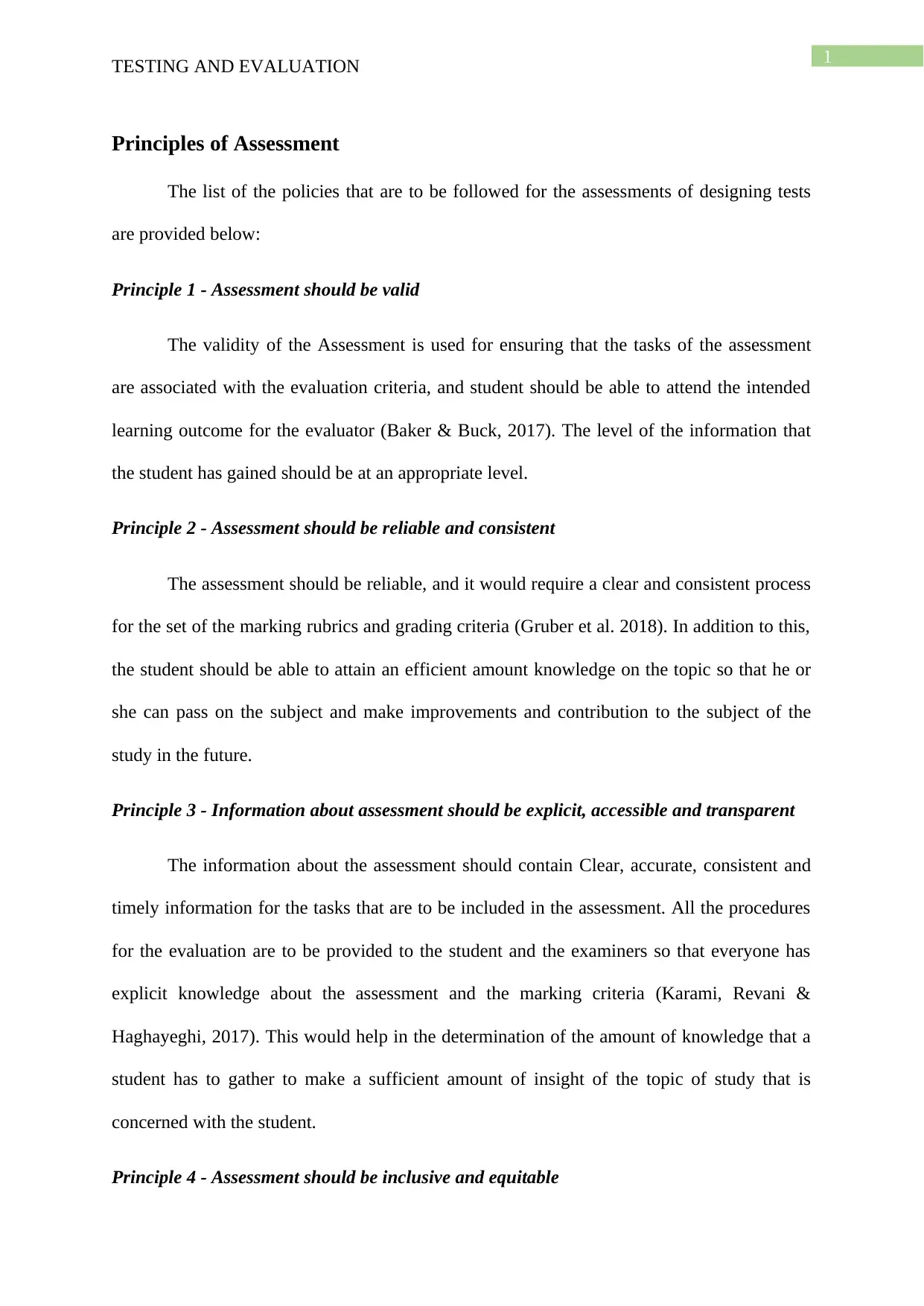
Principles of Assessment
The list of the policies that are to be followed for the assessments of designing tests
are provided below:
Principle 1 - Assessment should be valid
The validity of the Assessment is used for ensuring that the tasks of the assessment
are associated with the evaluation criteria, and student should be able to attend the intended
learning outcome for the evaluator (Baker & Buck, 2017). The level of the information that
the student has gained should be at an appropriate level.
Principle 2 - Assessment should be reliable and consistent
The assessment should be reliable, and it would require a clear and consistent process
for the set of the marking rubrics and grading criteria (Gruber et al. 2018). In addition to this,
the student should be able to attain an efficient amount knowledge on the topic so that he or
she can pass on the subject and make improvements and contribution to the subject of the
study in the future.
Principle 3 - Information about assessment should be explicit, accessible and transparent
The information about the assessment should contain Clear, accurate, consistent and
timely information for the tasks that are to be included in the assessment. All the procedures
for the evaluation are to be provided to the student and the examiners so that everyone has
explicit knowledge about the assessment and the marking criteria (Karami, Revani &
Haghayeghi, 2017). This would help in the determination of the amount of knowledge that a
student has to gather to make a sufficient amount of insight of the topic of study that is
concerned with the student.
Principle 4 - Assessment should be inclusive and equitable
TESTING AND EVALUATION
Principles of Assessment
The list of the policies that are to be followed for the assessments of designing tests
are provided below:
Principle 1 - Assessment should be valid
The validity of the Assessment is used for ensuring that the tasks of the assessment
are associated with the evaluation criteria, and student should be able to attend the intended
learning outcome for the evaluator (Baker & Buck, 2017). The level of the information that
the student has gained should be at an appropriate level.
Principle 2 - Assessment should be reliable and consistent
The assessment should be reliable, and it would require a clear and consistent process
for the set of the marking rubrics and grading criteria (Gruber et al. 2018). In addition to this,
the student should be able to attain an efficient amount knowledge on the topic so that he or
she can pass on the subject and make improvements and contribution to the subject of the
study in the future.
Principle 3 - Information about assessment should be explicit, accessible and transparent
The information about the assessment should contain Clear, accurate, consistent and
timely information for the tasks that are to be included in the assessment. All the procedures
for the evaluation are to be provided to the student and the examiners so that everyone has
explicit knowledge about the assessment and the marking criteria (Karami, Revani &
Haghayeghi, 2017). This would help in the determination of the amount of knowledge that a
student has to gather to make a sufficient amount of insight of the topic of study that is
concerned with the student.
Principle 4 - Assessment should be inclusive and equitable

2
TESTING AND EVALUATION
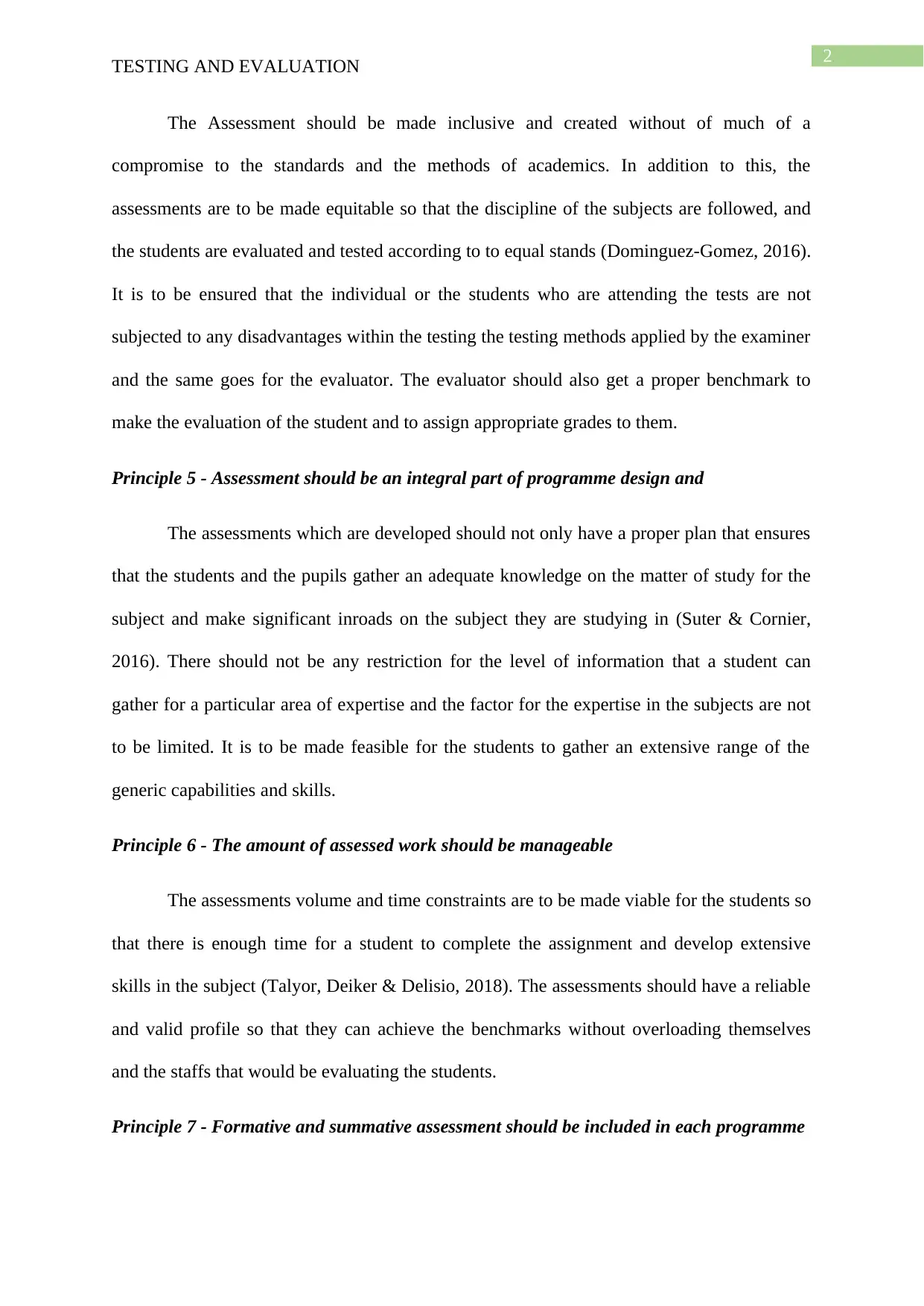
The Assessment should be made inclusive and created without of much of a
compromise to the standards and the methods of academics. In addition to this, the
assessments are to be made equitable so that the discipline of the subjects are followed, and
the students are evaluated and tested according to to equal stands (Dominguez-Gomez, 2016).
It is to be ensured that the individual or the students who are attending the tests are not
subjected to any disadvantages within the testing the testing methods applied by the examiner
and the same goes for the evaluator. The evaluator should also get a proper benchmark to
make the evaluation of the student and to assign appropriate grades to them.
Principle 5 - Assessment should be an integral part of programme design and
The assessments which are developed should not only have a proper plan that ensures
that the students and the pupils gather an adequate knowledge on the matter of study for the
subject and make significant inroads on the subject they are studying in (Suter & Cornier,
2016). There should not be any restriction for the level of information that a student can
gather for a particular area of expertise and the factor for the expertise in the subjects are not
to be limited. It is to be made feasible for the students to gather an extensive range of the
generic capabilities and skills.
Principle 6 - The amount of assessed work should be manageable
The assessments volume and time constraints are to be made viable for the students so
that there is enough time for a student to complete the assignment and develop extensive
skills in the subject (Talyor, Deiker & Delisio, 2018). The assessments should have a reliable
and valid profile so that they can achieve the benchmarks without overloading themselves
and the staffs that would be evaluating the students.
Principle 7 - Formative and summative assessment should be included in each programme
TESTING AND EVALUATION
The Assessment should be made inclusive and created without of much of a
compromise to the standards and the methods of academics. In addition to this, the
assessments are to be made equitable so that the discipline of the subjects are followed, and
the students are evaluated and tested according to to equal stands (Dominguez-Gomez, 2016).
It is to be ensured that the individual or the students who are attending the tests are not
subjected to any disadvantages within the testing the testing methods applied by the examiner
and the same goes for the evaluator. The evaluator should also get a proper benchmark to
make the evaluation of the student and to assign appropriate grades to them.
Principle 5 - Assessment should be an integral part of programme design and
The assessments which are developed should not only have a proper plan that ensures
that the students and the pupils gather an adequate knowledge on the matter of study for the
subject and make significant inroads on the subject they are studying in (Suter & Cornier,
2016). There should not be any restriction for the level of information that a student can
gather for a particular area of expertise and the factor for the expertise in the subjects are not
to be limited. It is to be made feasible for the students to gather an extensive range of the
generic capabilities and skills.
Principle 6 - The amount of assessed work should be manageable
The assessments volume and time constraints are to be made viable for the students so
that there is enough time for a student to complete the assignment and develop extensive
skills in the subject (Talyor, Deiker & Delisio, 2018). The assessments should have a reliable
and valid profile so that they can achieve the benchmarks without overloading themselves
and the staffs that would be evaluating the students.
Principle 7 - Formative and summative assessment should be included in each programme
⊘ This is a preview!⊘
Do you want full access?
Subscribe today to unlock all pages.

Trusted by 1+ million students worldwide

3
TESTING AND EVALUATION
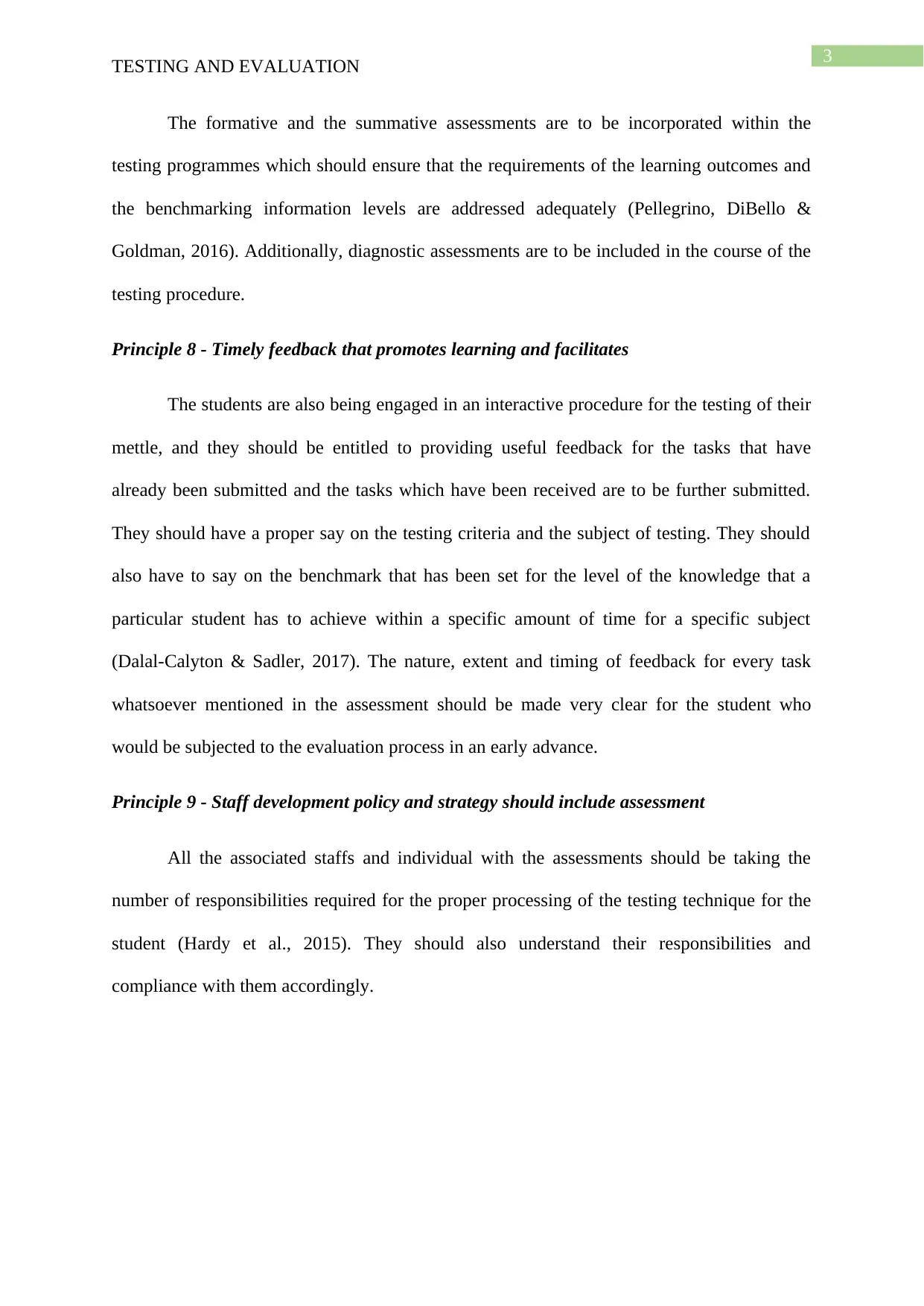
The formative and the summative assessments are to be incorporated within the
testing programmes which should ensure that the requirements of the learning outcomes and
the benchmarking information levels are addressed adequately (Pellegrino, DiBello &
Goldman, 2016). Additionally, diagnostic assessments are to be included in the course of the
testing procedure.
Principle 8 - Timely feedback that promotes learning and facilitates
The students are also being engaged in an interactive procedure for the testing of their
mettle, and they should be entitled to providing useful feedback for the tasks that have
already been submitted and the tasks which have been received are to be further submitted.
They should have a proper say on the testing criteria and the subject of testing. They should
also have to say on the benchmark that has been set for the level of the knowledge that a
particular student has to achieve within a specific amount of time for a specific subject
(Dalal-Calyton & Sadler, 2017). The nature, extent and timing of feedback for every task
whatsoever mentioned in the assessment should be made very clear for the student who
would be subjected to the evaluation process in an early advance.
Principle 9 - Staff development policy and strategy should include assessment
All the associated staffs and individual with the assessments should be taking the
number of responsibilities required for the proper processing of the testing technique for the
student (Hardy et al., 2015). They should also understand their responsibilities and
compliance with them accordingly.
TESTING AND EVALUATION
The formative and the summative assessments are to be incorporated within the
testing programmes which should ensure that the requirements of the learning outcomes and
the benchmarking information levels are addressed adequately (Pellegrino, DiBello &
Goldman, 2016). Additionally, diagnostic assessments are to be included in the course of the
testing procedure.
Principle 8 - Timely feedback that promotes learning and facilitates
The students are also being engaged in an interactive procedure for the testing of their
mettle, and they should be entitled to providing useful feedback for the tasks that have
already been submitted and the tasks which have been received are to be further submitted.
They should have a proper say on the testing criteria and the subject of testing. They should
also have to say on the benchmark that has been set for the level of the knowledge that a
particular student has to achieve within a specific amount of time for a specific subject
(Dalal-Calyton & Sadler, 2017). The nature, extent and timing of feedback for every task
whatsoever mentioned in the assessment should be made very clear for the student who
would be subjected to the evaluation process in an early advance.
Principle 9 - Staff development policy and strategy should include assessment
All the associated staffs and individual with the assessments should be taking the
number of responsibilities required for the proper processing of the testing technique for the
student (Hardy et al., 2015). They should also understand their responsibilities and
compliance with them accordingly.
Paraphrase This Document
Need a fresh take? Get an instant paraphrase of this document with our AI Paraphraser

4
TESTING AND EVALUATION
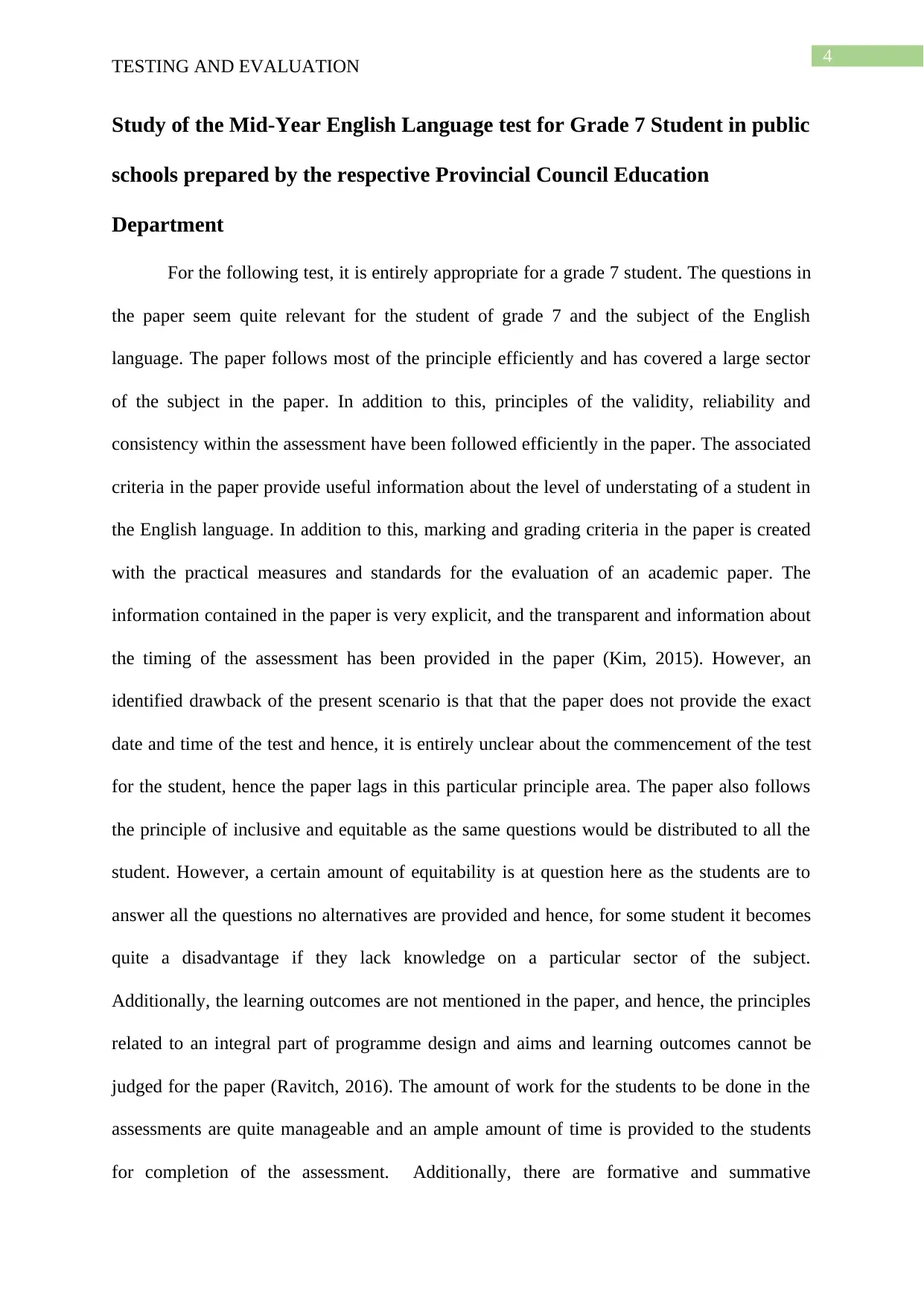
Study of the Mid-Year English Language test for Grade 7 Student in public
schools prepared by the respective Provincial Council Education
Department
For the following test, it is entirely appropriate for a grade 7 student. The questions in
the paper seem quite relevant for the student of grade 7 and the subject of the English
language. The paper follows most of the principle efficiently and has covered a large sector
of the subject in the paper. In addition to this, principles of the validity, reliability and
consistency within the assessment have been followed efficiently in the paper. The associated
criteria in the paper provide useful information about the level of understating of a student in
the English language. In addition to this, marking and grading criteria in the paper is created
with the practical measures and standards for the evaluation of an academic paper. The
information contained in the paper is very explicit, and the transparent and information about
the timing of the assessment has been provided in the paper (Kim, 2015). However, an
identified drawback of the present scenario is that that the paper does not provide the exact
date and time of the test and hence, it is entirely unclear about the commencement of the test
for the student, hence the paper lags in this particular principle area. The paper also follows
the principle of inclusive and equitable as the same questions would be distributed to all the
student. However, a certain amount of equitability is at question here as the students are to
answer all the questions no alternatives are provided and hence, for some student it becomes
quite a disadvantage if they lack knowledge on a particular sector of the subject.
Additionally, the learning outcomes are not mentioned in the paper, and hence, the principles
related to an integral part of programme design and aims and learning outcomes cannot be
judged for the paper (Ravitch, 2016). The amount of work for the students to be done in the
assessments are quite manageable and an ample amount of time is provided to the students
for completion of the assessment. Additionally, there are formative and summative
TESTING AND EVALUATION
Study of the Mid-Year English Language test for Grade 7 Student in public
schools prepared by the respective Provincial Council Education
Department
For the following test, it is entirely appropriate for a grade 7 student. The questions in
the paper seem quite relevant for the student of grade 7 and the subject of the English
language. The paper follows most of the principle efficiently and has covered a large sector
of the subject in the paper. In addition to this, principles of the validity, reliability and
consistency within the assessment have been followed efficiently in the paper. The associated
criteria in the paper provide useful information about the level of understating of a student in
the English language. In addition to this, marking and grading criteria in the paper is created
with the practical measures and standards for the evaluation of an academic paper. The
information contained in the paper is very explicit, and the transparent and information about
the timing of the assessment has been provided in the paper (Kim, 2015). However, an
identified drawback of the present scenario is that that the paper does not provide the exact
date and time of the test and hence, it is entirely unclear about the commencement of the test
for the student, hence the paper lags in this particular principle area. The paper also follows
the principle of inclusive and equitable as the same questions would be distributed to all the
student. However, a certain amount of equitability is at question here as the students are to
answer all the questions no alternatives are provided and hence, for some student it becomes
quite a disadvantage if they lack knowledge on a particular sector of the subject.
Additionally, the learning outcomes are not mentioned in the paper, and hence, the principles
related to an integral part of programme design and aims and learning outcomes cannot be
judged for the paper (Ravitch, 2016). The amount of work for the students to be done in the
assessments are quite manageable and an ample amount of time is provided to the students
for completion of the assessment. Additionally, there are formative and summative

5
TESTING AND EVALUATION
assessments that have been included in the paper, and this helps the paper in the realisation of
the principle of the Formative and summative evaluation which is involved in this
programmes of English language. Additionally, the staff development policy and strategy
principle can-not be discussed just by studying the paper as other factors relating to the
university are to be considered are not available here (Lane, Raymond & Haladyna, 2015).
All the question in the paper is related to the topic.
Question 1
The first question provides the students and the evaluators to the evaluate the
knowledge of the student based on their ability to recognise words that would enhance their
vocabulary.
Question 2
In the second question, the students are tested on their merit of collective norms. The
fill in the blanks category has been selected that would assist the student on of the course of
recognition of the words.
Question 3
Question three also involves the fill in the blanks process and with the corrective
collective nouns.
Question 4
Question four evaluated the knowledge of the students on the tenses.
Question 5
TESTING AND EVALUATION
assessments that have been included in the paper, and this helps the paper in the realisation of
the principle of the Formative and summative evaluation which is involved in this
programmes of English language. Additionally, the staff development policy and strategy
principle can-not be discussed just by studying the paper as other factors relating to the
university are to be considered are not available here (Lane, Raymond & Haladyna, 2015).
All the question in the paper is related to the topic.
Question 1
The first question provides the students and the evaluators to the evaluate the
knowledge of the student based on their ability to recognise words that would enhance their
vocabulary.
Question 2
In the second question, the students are tested on their merit of collective norms. The
fill in the blanks category has been selected that would assist the student on of the course of
recognition of the words.
Question 3
Question three also involves the fill in the blanks process and with the corrective
collective nouns.
Question 4
Question four evaluated the knowledge of the students on the tenses.
Question 5
⊘ This is a preview!⊘
Do you want full access?
Subscribe today to unlock all pages.

Trusted by 1+ million students worldwide

6
TESTING AND EVALUATION
Question five uses logical methods, and this can be used for the student to their IQ
level, and this question applies the principle of Formative and summative assessment for the
paper.
Question 6
Question number six test the punctuation skills of the students and capitals.
Question 7
The next question has been used for the identification of the knowledge for the
students on the area of past tense verbs and the corrected verbs in the next question.
Question 8
The next question provides some opportunities for the students and asks them to
select one among them.
Question 9
This question is the application of the principle of inclusive and equitable in the
paper.
Recommendations
In addition to there are few recommendations that can improve the paper:
The date and the time of the test are to be mentioned in the paper.
The paper should be containing some more numbers of alternative questions, so every
student gets an equal chance.
TESTING AND EVALUATION
Question five uses logical methods, and this can be used for the student to their IQ
level, and this question applies the principle of Formative and summative assessment for the
paper.
Question 6
Question number six test the punctuation skills of the students and capitals.
Question 7
The next question has been used for the identification of the knowledge for the
students on the area of past tense verbs and the corrected verbs in the next question.
Question 8
The next question provides some opportunities for the students and asks them to
select one among them.
Question 9
This question is the application of the principle of inclusive and equitable in the
paper.
Recommendations
In addition to there are few recommendations that can improve the paper:
The date and the time of the test are to be mentioned in the paper.
The paper should be containing some more numbers of alternative questions, so every
student gets an equal chance.
Paraphrase This Document
Need a fresh take? Get an instant paraphrase of this document with our AI Paraphraser

7
TESTING AND EVALUATION
References
Baker, N. L., & Buck, E. H. (2017). Conducting Programmatic Assessments of Online
Writing Instruction: CCCC's OWI Principles in Practice. In Handbook of Research on
Writing and Composing in the Age of MOOCs (pp. 385-405). IGI Global.
Domínguez-Gómez, J. A. (2016). Four conceptual issues to consider in integrating social and
environmental factors in risk and impact assessments. Environmental Impact
Assessment Review, 56, 113-119.
Gruber, J. B., Wang, W., Quittner, A., Salyakina, D., & McCafferty-Fernandez, J. (2018).
Utilizing Community Health Needs Assessments (CHNAs) in Nonprofit Hospitals to
Guide Population-Centered Outcomes Research for Pediatric Patients: New
Recommendations for CHNA Reporting. Population Health Management.
Hardy, A., Dorne, J. L. C. M., Aiassa, E., Alexander, J., Bottex, B., Chaudhry, Q., ... &
Robinson, T. (2015). Increasing robustness, transparency and openness of scientific
assessments. EFSA Journal, 13(3), e13031.
Karami, M., Saeidi Rezvani, T., & Haghayeghi, M. (2017). FACTOR STRUCTURE AND
PSYCHOMETRIC PROPERTIES OF THE INDEX OF ETHICS IN
EDUCATIONAL ASSESSMENTS PROCESS OF COLLEGE STUDENTS. CEPAL
Review, 1.
Kim, B. (2015). Playing with Gameful Activities and Assessments: Avatars and Experience
Points in a Graduate Course. International Society of the Learning Sciences, Inc.
[ISLS]...
Lane, S., Raymond, M. R., & Haladyna, T. M. (Eds.). (2015). Handbook of test development.
Routledge.
TESTING AND EVALUATION
References
Baker, N. L., & Buck, E. H. (2017). Conducting Programmatic Assessments of Online
Writing Instruction: CCCC's OWI Principles in Practice. In Handbook of Research on
Writing and Composing in the Age of MOOCs (pp. 385-405). IGI Global.
Domínguez-Gómez, J. A. (2016). Four conceptual issues to consider in integrating social and
environmental factors in risk and impact assessments. Environmental Impact
Assessment Review, 56, 113-119.
Gruber, J. B., Wang, W., Quittner, A., Salyakina, D., & McCafferty-Fernandez, J. (2018).
Utilizing Community Health Needs Assessments (CHNAs) in Nonprofit Hospitals to
Guide Population-Centered Outcomes Research for Pediatric Patients: New
Recommendations for CHNA Reporting. Population Health Management.
Hardy, A., Dorne, J. L. C. M., Aiassa, E., Alexander, J., Bottex, B., Chaudhry, Q., ... &
Robinson, T. (2015). Increasing robustness, transparency and openness of scientific
assessments. EFSA Journal, 13(3), e13031.
Karami, M., Saeidi Rezvani, T., & Haghayeghi, M. (2017). FACTOR STRUCTURE AND
PSYCHOMETRIC PROPERTIES OF THE INDEX OF ETHICS IN
EDUCATIONAL ASSESSMENTS PROCESS OF COLLEGE STUDENTS. CEPAL
Review, 1.
Kim, B. (2015). Playing with Gameful Activities and Assessments: Avatars and Experience
Points in a Graduate Course. International Society of the Learning Sciences, Inc.
[ISLS]...
Lane, S., Raymond, M. R., & Haladyna, T. M. (Eds.). (2015). Handbook of test development.
Routledge.

8
TESTING AND EVALUATION
Pellegrino, J. W., DiBello, L. V., & Goldman, S. R. (2016). A framework for conceptualising
and evaluating the validity of instructional relevant assessments. Educational
Psychologist, 51(1), 59-81.
Pellegrino, J. W., DiBello, L. V., & Goldman, S. R. (2016). A framework for conceptualising
and evaluating the validity of instructional relevant assessments. Educational
Psychologist, 51(1), 59-81.
Ravitch, D. (2016). The death and life of the great American school system: How testing and
choice are undermining education. Basic Books.
Suter, G. W., & Cormier, S. M. (2016). Bias in the development of health and ecological
assessments and potential solutions. Human and Ecological Risk Assessment: An
International Journal, 22(1), 99-115.
Taylor, M., Dieker, L., & Delisio, L. (2018). Exhibiting What is Learned: Using Exhibition
Assessments and Universal Design for Learning in College Teaching. Innovative
Practice in Higher Education, 3(2).
TESTING AND EVALUATION
Pellegrino, J. W., DiBello, L. V., & Goldman, S. R. (2016). A framework for conceptualising
and evaluating the validity of instructional relevant assessments. Educational
Psychologist, 51(1), 59-81.
Pellegrino, J. W., DiBello, L. V., & Goldman, S. R. (2016). A framework for conceptualising
and evaluating the validity of instructional relevant assessments. Educational
Psychologist, 51(1), 59-81.
Ravitch, D. (2016). The death and life of the great American school system: How testing and
choice are undermining education. Basic Books.
Suter, G. W., & Cormier, S. M. (2016). Bias in the development of health and ecological
assessments and potential solutions. Human and Ecological Risk Assessment: An
International Journal, 22(1), 99-115.
Taylor, M., Dieker, L., & Delisio, L. (2018). Exhibiting What is Learned: Using Exhibition
Assessments and Universal Design for Learning in College Teaching. Innovative
Practice in Higher Education, 3(2).
⊘ This is a preview!⊘
Do you want full access?
Subscribe today to unlock all pages.

Trusted by 1+ million students worldwide
1 out of 9
Related Documents
Your All-in-One AI-Powered Toolkit for Academic Success.
+13062052269
info@desklib.com
Available 24*7 on WhatsApp / Email
Unlock your academic potential
Copyright © 2020–2026 A2Z Services. All Rights Reserved. Developed and managed by ZUCOL.