Reflection on Criminal Justice System Reform in Canada: Analysis

Verified

Added on  2023/04/23

|5
|1147
|450
Report
AI Summary
This report is a reflection paper analyzing a news article concerning the Canadian criminal justice system, specifically addressing the issue of child offenders and the lack of justice when a child commits a crime. The student summarizes the main arguments of the article, which highlights the inadequacy of current laws and the need for reform in the treatment of young offenders. The article discusses the legal responses to child offenders, contrasting Canadian law with those of other countries, and expresses frustration with the current age limits and legal processes. The student reflects on the article's arguments, discussing the author's perspective, the implications of the current system, and the need for changes to ensure public safety and provide appropriate justice for victims and offenders. The paper emphasizes the importance of early intervention and the potential consequences of the current legal framework, advocating for a reconsideration of the minimum age for criminal responsibility and the need for more effective responses to juvenile crime.
Document Page
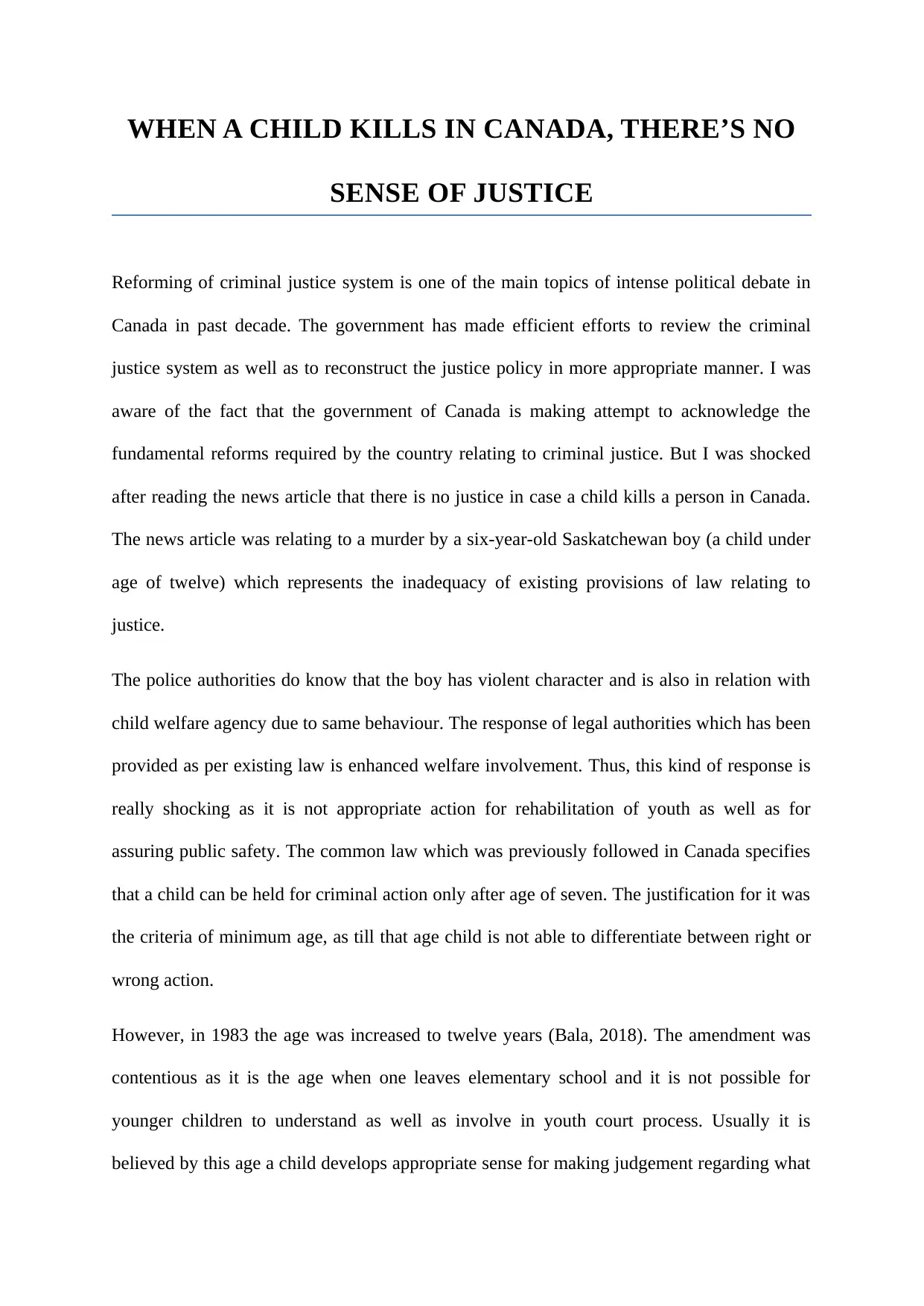
WHEN A CHILD KILLS IN CANADA, THERE’S NO
SENSE OF JUSTICE
Reforming of criminal justice system is one of the main topics of intense political debate in
Canada in past decade. The government has made efficient efforts to review the criminal
justice system as well as to reconstruct the justice policy in more appropriate manner. I was
aware of the fact that the government of Canada is making attempt to acknowledge the
fundamental reforms required by the country relating to criminal justice. But I was shocked
after reading the news article that there is no justice in case a child kills a person in Canada.
The news article was relating to a murder by a six-year-old Saskatchewan boy (a child under
age of twelve) which represents the inadequacy of existing provisions of law relating to
justice.
The police authorities do know that the boy has violent character and is also in relation with
child welfare agency due to same behaviour. The response of legal authorities which has been
provided as per existing law is enhanced welfare involvement. Thus, this kind of response is
really shocking as it is not appropriate action for rehabilitation of youth as well as for
assuring public safety. The common law which was previously followed in Canada specifies
that a child can be held for criminal action only after age of seven. The justification for it was
the criteria of minimum age, as till that age child is not able to differentiate between right or
wrong action.
However, in 1983 the age was increased to twelve years (Bala, 2018). The amendment was
contentious as it is the age when one leaves elementary school and it is not possible for
younger children to understand as well as involve in youth court process. Usually it is
believed by this age a child develops appropriate sense for making judgement regarding what
tabler-icon-diamond-filled.svg

Paraphrase This Document

Need a fresh take? Get an instant paraphrase of this document with our AI Paraphraser
Document Page
is right and what is wrong; except in situation where they are mentally disabled. I believe that
the concern relating to involvement of younger children in youth court procedures have been
overstated.
The article also provided details of provision of other countries in order to compare and judge
the efficiency of criminal justice of Canada. It was stated that as in England the minimum age
is 12, however it is ten for most serious cases. However in some American states, minimum
age criteria of seven years is still effective (Bala, 2018). Thus, it could be assessed that
Canada requires reconstructing the provision relating to age of the children whose violent
acts are considered under justice system.
I was frustrated with the fact that the age was increased only because a child of seven years
could not judge what is wrong and right. Moreover he or she can’t be involved in court
procedure. The reasons provided are totally unjustified. They do not make appropriate sense
as a child under twelve have already executed small offences which comprise arson,
occasionally homicide and involvement in younger children as victims. It means law will
consider a child able of doing criminal act when he can conduct the same with ease and in all
senses. The response of legal authorities and court is required to be reconstructed in order to
provide justice as well as for making the lesson learned to the youth.
Law of Provincial child welfare is responsible for management of the severe cases of violent
conduct by children having age of twelve years (Roberts, 2018). However, this law is
applicable with substantial restrictions. Even legal constraints and institutional priorities limit
the ability and willingness of agencies in order to respond to offending behaviour, unless the
same has transformed into a serious situation. I think it is really an awful situation for the
authorities. It might result into a missing opportunity at early stage or more appropriate
Document Page
intervention as it leads to wait for a child to grow enough till twelve years and then presented
in youth justice system.
I believe the existing provisions will lead the more complex situation. As in many situations
the child welfare approach having restricted emphasis on child offender is not sufficient. The
thought or view of an experienced child offender that no legal restrictions are available
relating to violent act conducted by him could provoke him to do similar act. Even the same
situation has been already experienced by police authorities in case of Toronto relating to
sexual assault committed by eleven year old boy against a girl who was a thirteen year old. In
this case the boy was acknowledged with the fact that he could not be charged due to his age.
Moreover, he told the police officer who arrested him, “You got me. So what are you going
to do” (Bala, 2018). This kind of behaviour is really not acceptable and same increase the
frustration of parents of child offenders due to lack of response.
It would not be incorrect to state author as an alarmist, it is because a sincere attempt has
been made by him to open the eyes of general public relating to criminal actions of a child.
The author has presented the other side of criminal justice of Canada which requires to be
reconstructed in order to provide appropriate justice to general public. The other initiatives
which were taken for reconstructing the age limit have been specified in the article. It is
stated that in year 1997, a House of Common committee, recommended for decreasing the
criteria for minimum age relating to illegitimate actions to ten so that youth court could
response in appropriate manner. Further, in year 2006, justice minister Vic Toews proposed
for decreasing the criteria for minimum age to ten but same proposal was not accepted. These
initiatives are proof that the matter is very important and required to be resolved as soon as
possible. It could be concluded that this type of articles works as eye opener. Further, same
Document Page
can be improved through providing the measures which can be adopted by general public for
facing criminal injustice and for attaining required justice due to offenders.
tabler-icon-diamond-filled.svg

Paraphrase This Document

Need a fresh take? Get an instant paraphrase of this document with our AI Paraphraser
Document Page
References
Bala N. (2018). When a child kills in Canada, there’s no sense of justice. Retrieved through
<https://www.theglobeandmail.com/opinion/when-a-child-kills-in-canada-theres-no-
sense-of-justice/article14119129/> 28th February 2019.
Roberts, J. (2018). Public opinion, crime, and criminal justice. Routledge.
chevron_up_icon
1 out of 5
circle_padding
hide_on_mobile
zoom_out_icon
[object Object]