Analysis of the Cross City Tunnel Project Failure: A Case Study

Verified

Added on  2022/08/23

|9
|1525
|24
Report
AI Summary
This report provides a comprehensive analysis of the Cross City Tunnel project in Sydney, Australia, examining its failure despite being completed ahead of schedule. The project, a 2.1km twin tunnel, aimed to ease traffic congestion and enhance environmental amenity. The report highlights key issues contributing to the project's failure, including inaccurate traffic forecasts, high toll prices, surface road closures, errors in the concession agreement, public-private disputes, lack of government contribution, and inadequate risk allocation. The initial traffic forecasts were significantly overestimated, leading to substantial financial losses. The high toll prices and road closures further deterred motorists. The report also discusses errors in the concession agreement and the lack of government support, which exacerbated the project's challenges. By examining the causes of the Cross City Tunnel's failure, the report offers valuable insights into project management, risk assessment, and the importance of accurate forecasting and stakeholder collaboration.
Document Page
PROJECT FAILURE
By Name
Course
Instructor
Institution
Location
Date
tabler-icon-diamond-filled.svg

Paraphrase This Document

Need a fresh take? Get an instant paraphrase of this document with our AI Paraphraser
Document Page
SYDNEY CROSS CITY TUNNEL FAILURE
Background of the Project
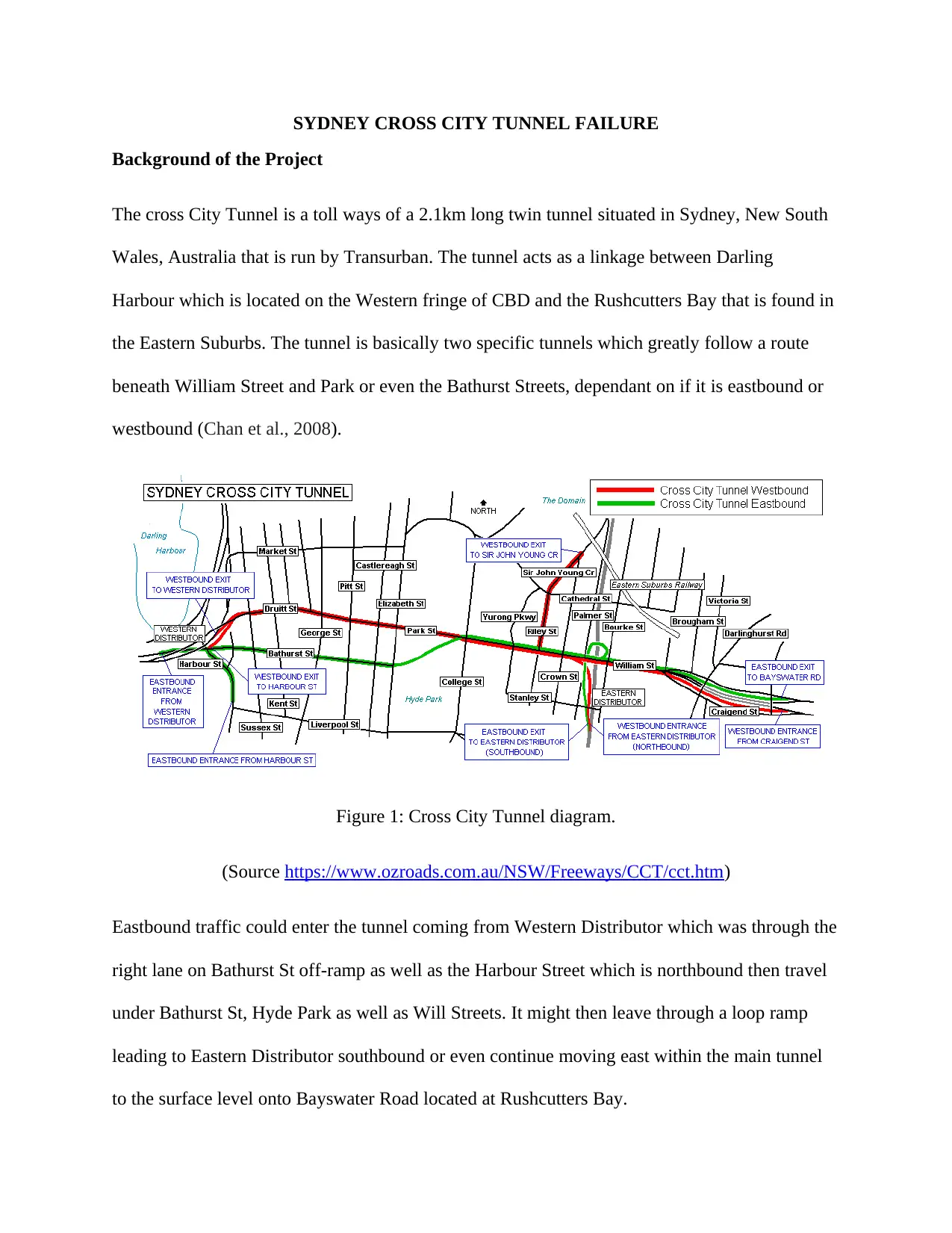
The cross City Tunnel is a toll ways of a 2.1km long twin tunnel situated in Sydney, New South
Wales, Australia that is run by Transurban. The tunnel acts as a linkage between Darling
Harbour which is located on the Western fringe of CBD and the Rushcutters Bay that is found in
the Eastern Suburbs. The tunnel is basically two specific tunnels which greatly follow a route
beneath William Street and Park or even the Bathurst Streets, dependant on if it is eastbound or
westbound (Chan et al., 2008).
Figure 1: Cross City Tunnel diagram.
(Source https://www.ozroads.com.au/NSW/Freeways/CCT/cct.htm)
Eastbound traffic could enter the tunnel coming from Western Distributor which was through the
right lane on Bathurst St off-ramp as well as the Harbour Street which is northbound then travel
under Bathurst St, Hyde Park as well as Will Streets. It might then leave through a loop ramp
leading to Eastern Distributor southbound or even continue moving east within the main tunnel
to the surface level onto Bayswater Road located at Rushcutters Bay.
Document Page
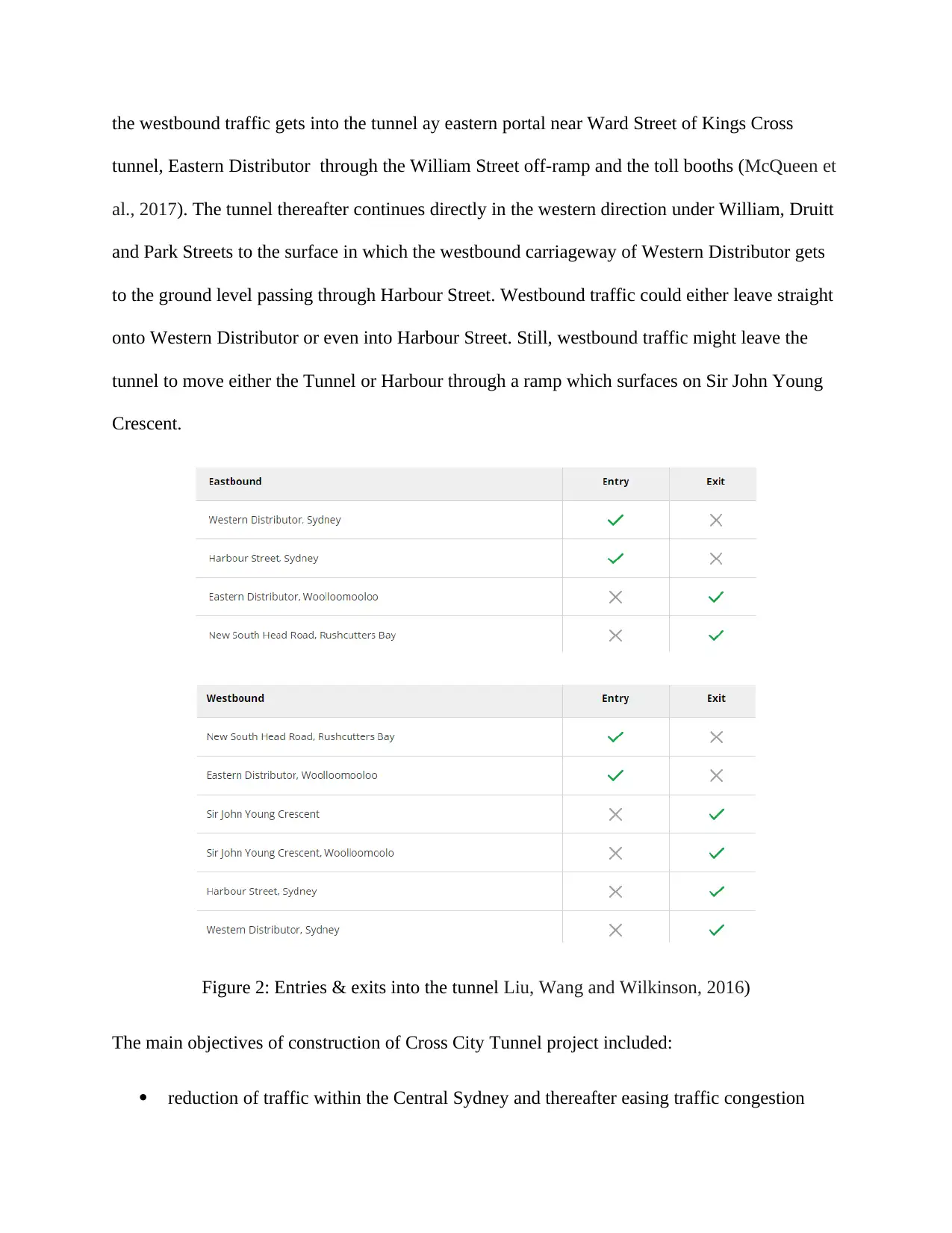
the westbound traffic gets into the tunnel ay eastern portal near Ward Street of Kings Cross
tunnel, Eastern Distributor through the William Street off-ramp and the toll booths (McQueen et
al., 2017). The tunnel thereafter continues directly in the western direction under William, Druitt
and Park Streets to the surface in which the westbound carriageway of Western Distributor gets
to the ground level passing through Harbour Street. Westbound traffic could either leave straight
onto Western Distributor or even into Harbour Street. Still, westbound traffic might leave the
tunnel to move either the Tunnel or Harbour through a ramp which surfaces on Sir John Young
Crescent.
Figure 2: Entries & exits into the tunnel Liu, Wang and Wilkinson, 2016)
The main objectives of construction of Cross City Tunnel project included:
reduction of traffic within the Central Sydney and thereafter easing traffic congestion
Document Page
enhancing environmental amenity within the CBD and on streets leading to the CBD; and
enhancing the east as well as west traffic flow
The project settled on a design-build-operate plan under a concession agreement of 30 years.
This project was one of segments of a network of a new transportation plan of infrastructure by
the Roads and Traffic Authority of government of New South Wales.
The original idea of tunnel was halted in 1998 and after a number of sophisticated consultations
modifications, exhibitions and approvals an interested was finally expressed in the project upon
request of a private sector (Mandiartha, Duffield and Ismail, 2017). The construction of project
started in 2003 and delivery was done before schedule in which the construction lasted 31
months. The construction and completion of cross City Tunnel was claimed to be associated with
numerous benefits including:
Avoidance of 34 traffic signals
A great reduction in the traffic across the central business district
Enhanced quality of life for cyclists as well as pedestrians within the central business
district
Enhanced access as well as movement within the city for pedestrians, taxis as well as
delivery vehicles
Enhanced reliability of bus services within the central business district
Reduced trips across the city to about two minutes from the high 20 minutes through
avoiding traffic lights (Duffield and Wilson, 2017)
Rendering cities safer as well as more pleasant for residents, business people as well as
pedestrians through the removal of intrusive via traffic as well as offering more footpath
space in some of streets (Scales, 2017)
tabler-icon-diamond-filled.svg

Paraphrase This Document

Need a fresh take? Get an instant paraphrase of this document with our AI Paraphraser
Document Page
Reduction of levels of noise; and
Enhanced quality of air by removing cars from the surface streets
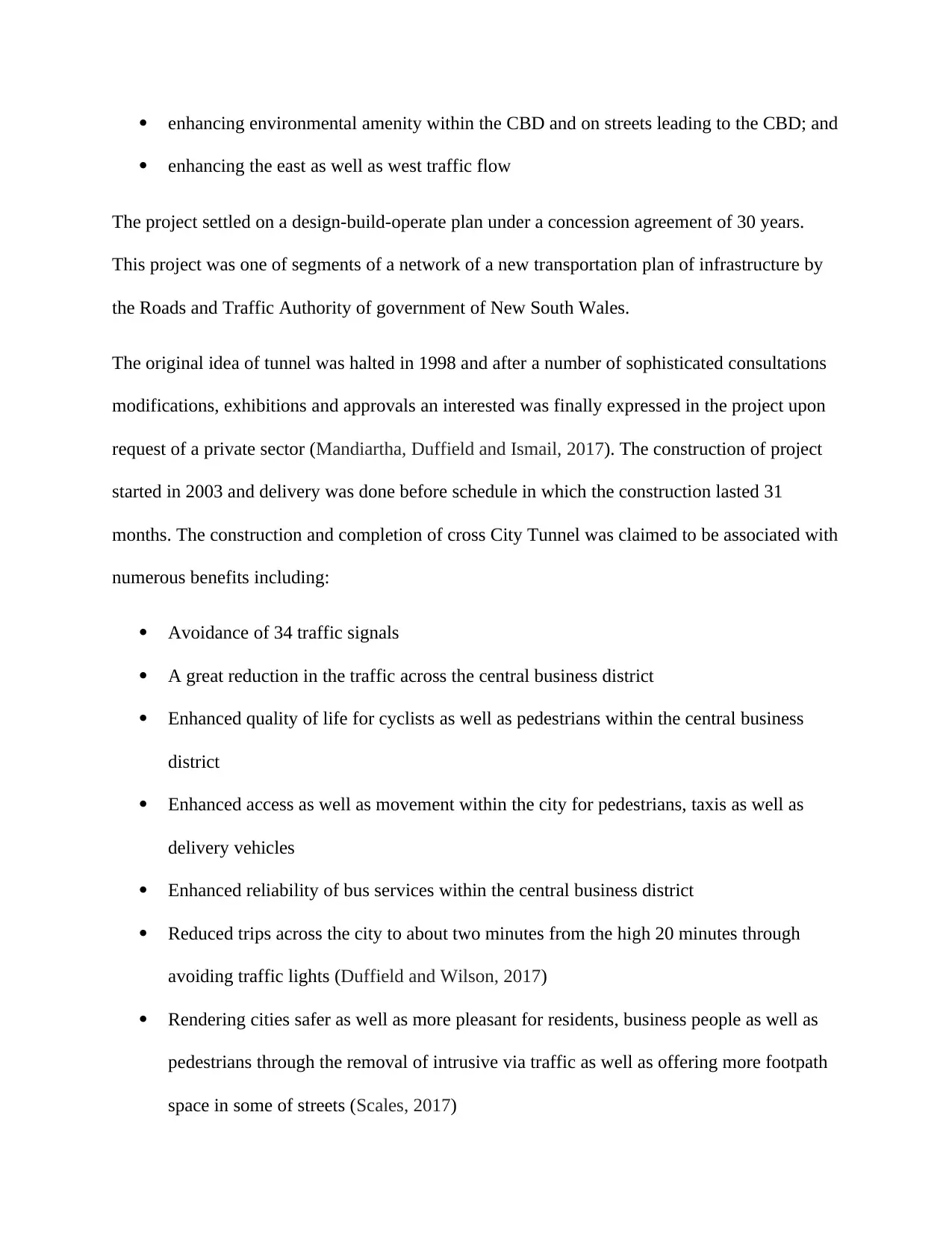
Table 1: Assessment of Cross City Tunnel against sustainable development principles (Duffield
and Wilson, 2017)
Despite numerous benefits associated with cross City Tunnel that have extensively been
publicized, project was associated with numerous failures as discussed below
Failure of cross City Tunnel and the causes
The city cross city tunnel project has been regarded as majorly a failure even though construction
was completed way ahead of schedule and within provided budget as a result of some major
reasons including:
Inaccurate tunnel traffic forecast: The initial figures of traffic forecast was ninety thousand
automobiles every day despite real traffic was just about thirty thousand per day that led to loss
of toll which would be gathered from remaining vehicles owners of sixty thousand suppose they
Document Page
travelled via tunnel resulting in losses for company that sponsored them (Burman, Kotze and
Chan, 2018).
High levels of toll: The established toll prices were found to be quite heavy and least affordable
more so to the motorists to resisted their use
Surface Road closures: The residents of city were upset by closure of roads that operated on
surface for diversion of traffic to Cross City Tunnel
Error in concession agreement: There were numerous errors in concession agreement that was
made between government and private consortium since there was no clarity on participation of
government on management of operations and risks
Public-Private Argument: There turned out an open argument within public domain which
transpired between private sponsors consortium and public client
No contribution of government: There was no compensation or even subsidy offered by
government for project neither was there open government body that was be used for purposes of
sharing toll levels or even any other kinds of financial risks.
Inadequate allocation of risks: Every construction project is often linked with nine various
kinds of risks among them revenue, technical, financial, operational, construction, political,
environmental, force majeure as well as project defaults (Liu, Wang and Wilkinson, 2016). Such
risks can be properly managed in cases where party tasked with their management of risks is in a
position to foresee risk, evaluate possible effects, regulate probability of them taking place,
tolerate their consequences, get benefits associated with bearing risks as well as charging a
relatively considerable as well as affordable premium against eventualities.
Document Page
For Cross City Tunnel construction project, among noted and conceded risks were among them
risks linked with designing, maintenance, construction, financing, operations as well as repairs,
risks associated with income tax, volume of traffics as well as risks as a result of political or even
government interventions (Medimagh and Triki, 2019). The government only agreed to take
risks involving native titles, uninsurable risks, force majeure along well risks associated with
legislative policies.
Conclusion
The report was generated to comprehend success or even failure of project by taking case study
of Cross City Tunnel. It has been established the project which encompassed construction as well
as maintenance of two tunnels turned out to be a great failure as initially done traffic estimation
by stakeholders ended up being incorrect resulting in debts to the tune of half a billion US
dollars.
tabler-icon-diamond-filled.svg

Paraphrase This Document

Need a fresh take? Get an instant paraphrase of this document with our AI Paraphraser
Document Page
References
Burman, B.C., Kotze, G.P. and Chan, L., 2018. Lane Cove Tunnel Collapse and Sinkhole A
Forensic Review-1: The Collapse. Australian Geomechanics
Chan, A.P.C., Lam, P.T.I., Chan, D.W.M. and Cheung, E., 2008. Risk-sharing mechanism for
PPP Projects–the case study of Sydney Cross City Tunnel. Surveying and Built
Environment, 19(1), pp.67-80
Duffield, D.C. and Wilson, D., 2017. Chapter Eleven Delivering Australian Roads with PPP’s?
Global Management of Business Risks. People and Places in Project Management Research,
p.145
Liu, T., Wang, Y. and Wilkinson, S., 2016. Identifying critical factors affecting the effectiveness
and efficiency of tendering processes in Public–Private Partnerships (PPPs): A comparative
analysis of Australia and China. International Journal of Project Management, 34(4), pp.701-
716
Mandiartha, P., Duffield, C. and Ismail, I.S.R.A., 2017. Risk Management, Governance and
Financing Issues in Public-Private Partnership Transportation Projects. In FGIC 1st Conference
on Governance & Integrity (pp. 378-395)
Document Page
McQueen, L.B., Bewick, R.P., Sutton, J. and Morrow, A., 2017, October. Stress-induced brittle
failure of the Hawkesbury Sandstone–Case study from crack initiation to tunnel support. In 16th
Australasian Tunnelling Conference
Medimagh, S. and Triki, A., 2019. The PPP performance based on the co-creation with
customers. Built Environment Project and Asset Management
Scales, R., 2017. Chapter Seven Developing Valid and Reliable Scales to Predict Success of
Large Complex Projects Dr. Roxanne Zolin. People and Places in Project Management
Research, p.87
chevron_up_icon
1 out of 9
circle_padding
hide_on_mobile
zoom_out_icon
[object Object]