The Danger of a Single Story: BMCC Analysis of Adichie's Perspective

Verified

Added on  2023/05/28

|3
|749
|93
Essay
AI Summary
This essay explores Chimamanda Ngozi Adichie's perspective on the danger of a single story, highlighting how single narratives can create misconceptions and stereotypes. The author reflects on personal experiences and Adichie's insights, emphasizing the vulnerability of individuals, especially children, to these limited perspectives. Adichie's analysis reveals how power dynamics influence the perpetuation of single stories, shaping perceptions of cultures and people. The essay concludes that overcoming single stories allows for a more comprehensive and nuanced understanding of the world, fostering exploration and clear thinking. Desklib offers a platform to explore similar essays and academic resources for students.
Document Page
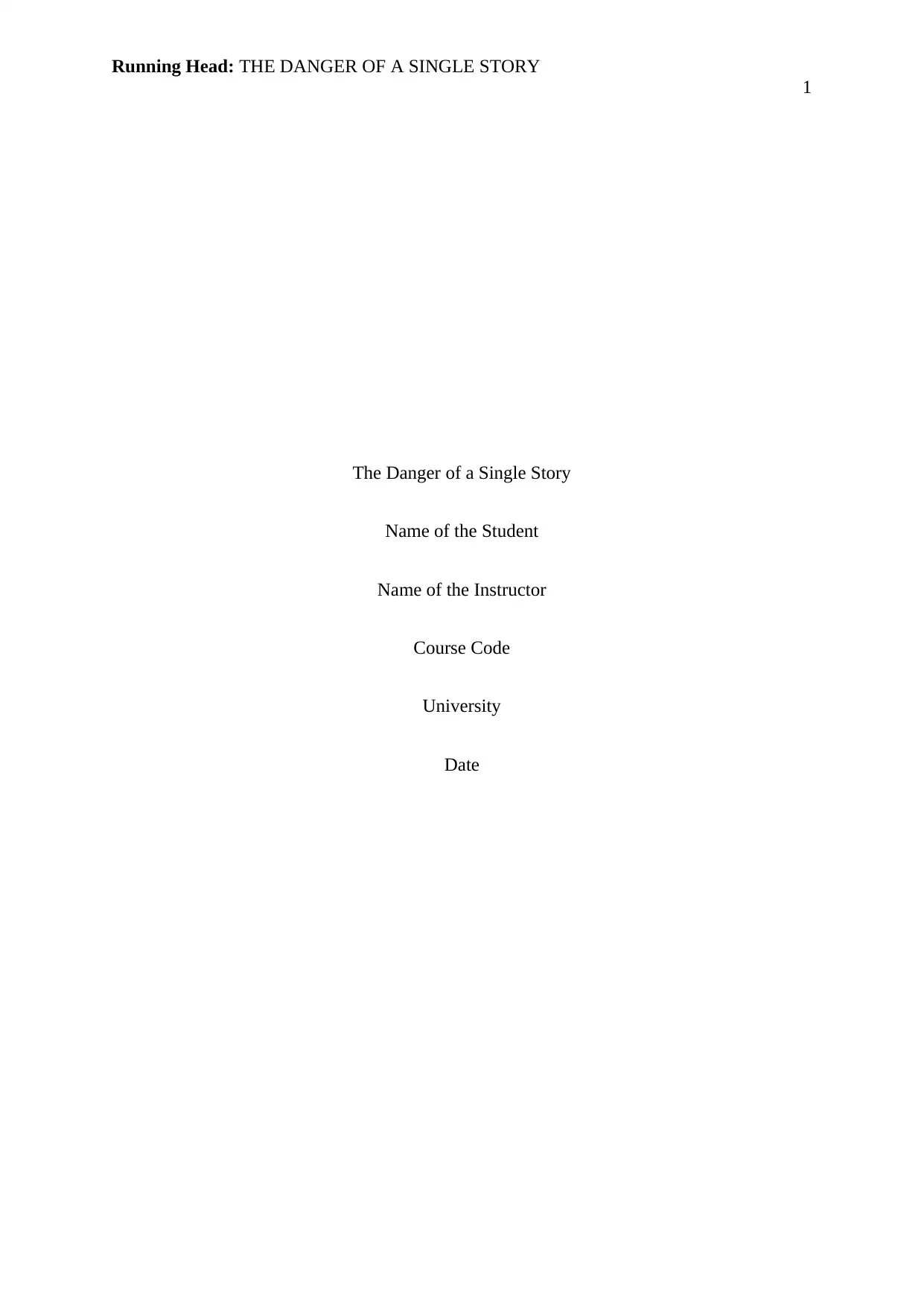
Running Head: THE DANGER OF A SINGLE STORY
1
The Danger of a Single Story
Name of the Student
Name of the Instructor
Course Code
University
Date
tabler-icon-diamond-filled.svg

Paraphrase This Document

Need a fresh take? Get an instant paraphrase of this document with our AI Paraphraser
Document Page
THE DANGER OF A SINGLE STORY 2
Introduction
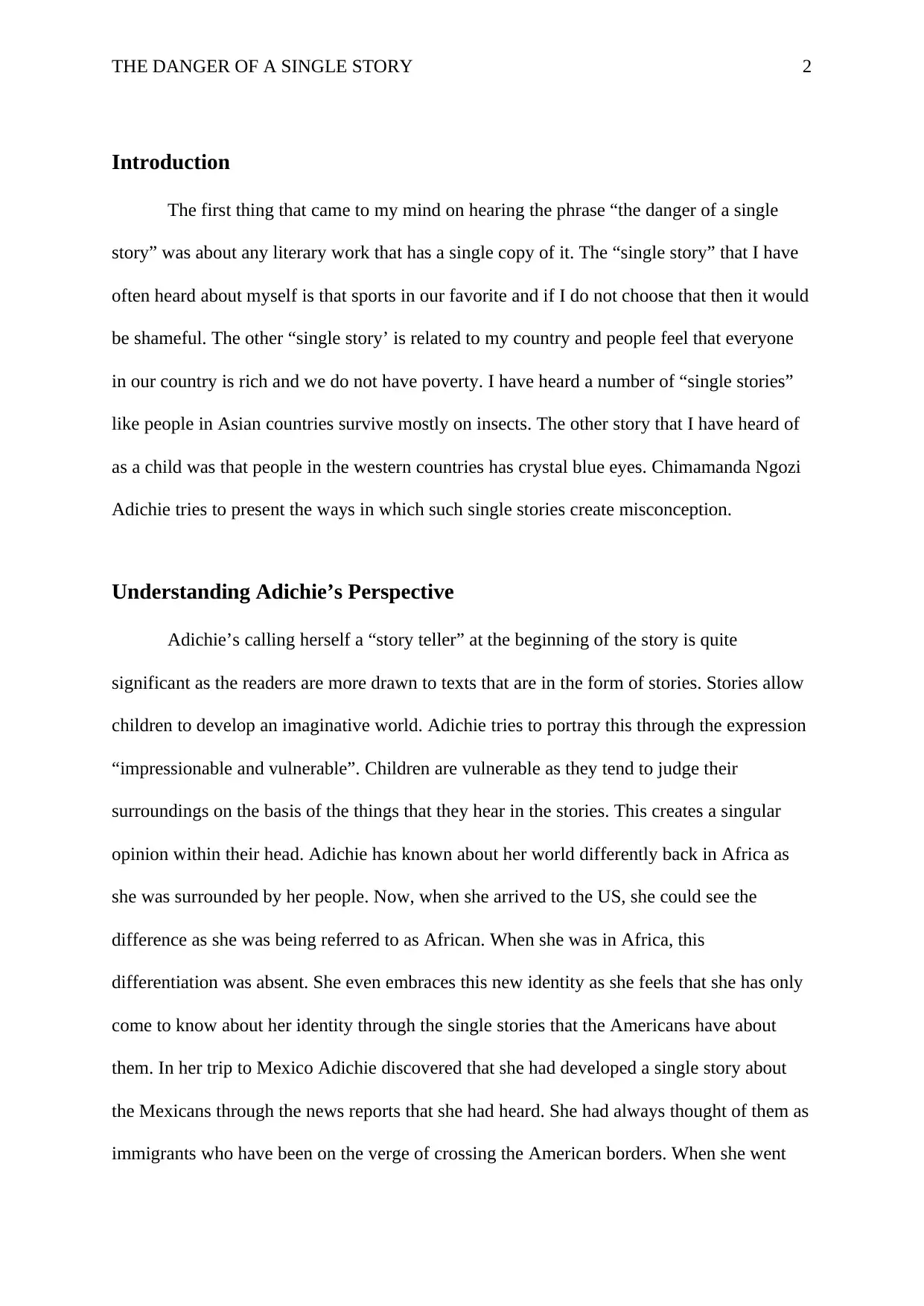
The first thing that came to my mind on hearing the phrase “the danger of a single
story” was about any literary work that has a single copy of it. The “single story” that I have
often heard about myself is that sports in our favorite and if I do not choose that then it would
be shameful. The other “single story’ is related to my country and people feel that everyone
in our country is rich and we do not have poverty. I have heard a number of “single stories”
like people in Asian countries survive mostly on insects. The other story that I have heard of
as a child was that people in the western countries has crystal blue eyes. Chimamanda Ngozi
Adichie tries to present the ways in which such single stories create misconception.
Understanding Adichie’s Perspective
Adichie’s calling herself a “story teller” at the beginning of the story is quite
significant as the readers are more drawn to texts that are in the form of stories. Stories allow
children to develop an imaginative world. Adichie tries to portray this through the expression
“impressionable and vulnerable”. Children are vulnerable as they tend to judge their
surroundings on the basis of the things that they hear in the stories. This creates a singular
opinion within their head. Adichie has known about her world differently back in Africa as
she was surrounded by her people. Now, when she arrived to the US, she could see the
difference as she was being referred to as African. When she was in Africa, this
differentiation was absent. She even embraces this new identity as she feels that she has only
come to know about her identity through the single stories that the Americans have about
them. In her trip to Mexico Adichie discovered that she had developed a single story about
the Mexicans through the news reports that she had heard. She had always thought of them as
immigrants who have been on the verge of crossing the American borders. When she went
Document Page
THE DANGER OF A SINGLE STORY 3
close to them, she realized that they were quite similar to every other population. It created a
feeling of shame within her. She realized that single stories presented people in a particular
form and this repeated representation forced others to believe that it was the truest
impression. Adichie tells that every single story is associated with power. A story is
dependent on a number of things in order to have a lasting impression. She tells that a story is
retained as truth depending on the power and position of the person who tells the story, how
the story is depicted, the time when the story has been said and the number of stories that
have been said. It is power that has dominated every form of “single story” as power becomes
the ruling factor.
Conclusion
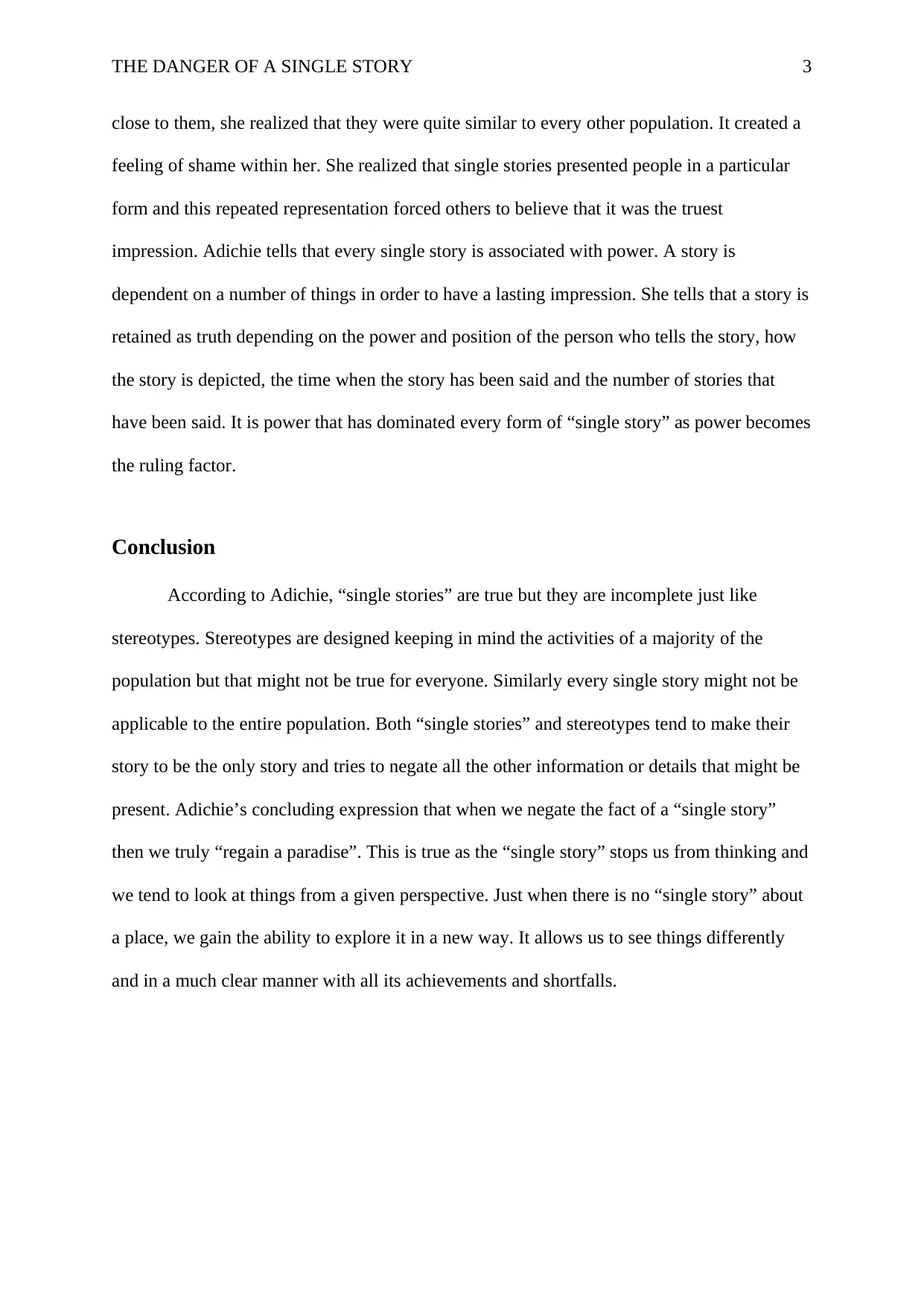
According to Adichie, “single stories” are true but they are incomplete just like
stereotypes. Stereotypes are designed keeping in mind the activities of a majority of the
population but that might not be true for everyone. Similarly every single story might not be
applicable to the entire population. Both “single stories” and stereotypes tend to make their
story to be the only story and tries to negate all the other information or details that might be
present. Adichie’s concluding expression that when we negate the fact of a “single story”
then we truly “regain a paradise”. This is true as the “single story” stops us from thinking and
we tend to look at things from a given perspective. Just when there is no “single story” about
a place, we gain the ability to explore it in a new way. It allows us to see things differently
and in a much clear manner with all its achievements and shortfalls.
chevron_up_icon
1 out of 3
circle_padding
hide_on_mobile
zoom_out_icon
[object Object]