Critical Analysis: Barthes' Perspective on the 'Death of the Author'
VerifiedAdded on 2023/04/25
|5
|1255
|197
Essay
AI Summary
This essay delves into Roland Barthes' influential essay, 'The Death of the Author,' which argues that the author's identity and intentions are irrelevant to the interpretation of a text. Barthes suggests that readers should focus on their own impressions and the play of language within the text rather than attempting to discern the author's intended meaning. The essay examines Barthes' criticisms of traditional literary analysis, his concept of the 'scriptor,' and his use of literary examples, such as Balzac's Sarrasine, to illustrate the ambiguity of meaning. It also touches upon the influence of structuralism, Derrida, and Foucault on Barthes' ideas. While acknowledging the essay's significance, the analysis also presents a counterargument, suggesting that authors' unique ideas and language choices can indeed shape readers' experiences and interpretations. The essay concludes by linking Barthes' concept to the 'death of God' and emphasizing the role of the reader in completing the text, ultimately leading to the 'pleasure of the text.'
Running Head: THE DEATH OF THE AUTHOR
The Death of The Author
Name of Student
Name of University
Author note
The Death of The Author
Name of Student
Name of University
Author note
Paraphrase This Document
Need a fresh take? Get an instant paraphrase of this document with our AI Paraphraser

1THE DEATH OF THE AUTHOR
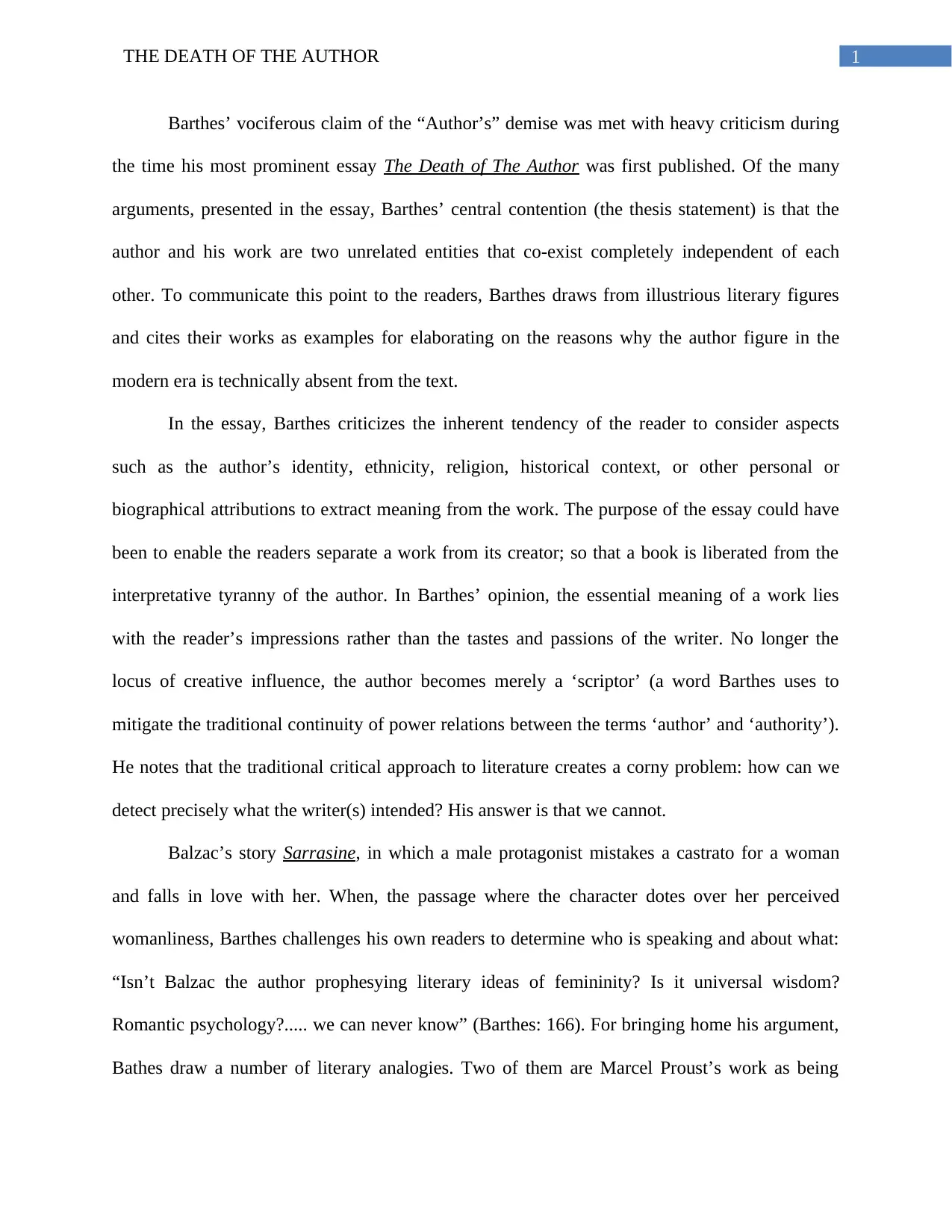
Barthes’ vociferous claim of the “Author’s” demise was met with heavy criticism during
the time his most prominent essay The Death of The Author was first published. Of the many
arguments, presented in the essay, Barthes’ central contention (the thesis statement) is that the
author and his work are two unrelated entities that co-exist completely independent of each
other. To communicate this point to the readers, Barthes draws from illustrious literary figures
and cites their works as examples for elaborating on the reasons why the author figure in the
modern era is technically absent from the text.
In the essay, Barthes criticizes the inherent tendency of the reader to consider aspects
such as the author’s identity, ethnicity, religion, historical context, or other personal or
biographical attributions to extract meaning from the work. The purpose of the essay could have
been to enable the readers separate a work from its creator; so that a book is liberated from the
interpretative tyranny of the author. In Barthes’ opinion, the essential meaning of a work lies
with the reader’s impressions rather than the tastes and passions of the writer. No longer the
locus of creative influence, the author becomes merely a ‘scriptor’ (a word Barthes uses to
mitigate the traditional continuity of power relations between the terms ‘author’ and ‘authority’).
He notes that the traditional critical approach to literature creates a corny problem: how can we
detect precisely what the writer(s) intended? His answer is that we cannot.
Balzac’s story Sarrasine, in which a male protagonist mistakes a castrato for a woman
and falls in love with her. When, the passage where the character dotes over her perceived
womanliness, Barthes challenges his own readers to determine who is speaking and about what:
“Isn’t Balzac the author prophesying literary ideas of femininity? Is it universal wisdom?
Romantic psychology?..... we can never know” (Barthes: 166). For bringing home his argument,
Bathes draw a number of literary analogies. Two of them are Marcel Proust’s work as being
Barthes’ vociferous claim of the “Author’s” demise was met with heavy criticism during
the time his most prominent essay The Death of The Author was first published. Of the many
arguments, presented in the essay, Barthes’ central contention (the thesis statement) is that the
author and his work are two unrelated entities that co-exist completely independent of each
other. To communicate this point to the readers, Barthes draws from illustrious literary figures
and cites their works as examples for elaborating on the reasons why the author figure in the
modern era is technically absent from the text.
In the essay, Barthes criticizes the inherent tendency of the reader to consider aspects
such as the author’s identity, ethnicity, religion, historical context, or other personal or
biographical attributions to extract meaning from the work. The purpose of the essay could have
been to enable the readers separate a work from its creator; so that a book is liberated from the
interpretative tyranny of the author. In Barthes’ opinion, the essential meaning of a work lies
with the reader’s impressions rather than the tastes and passions of the writer. No longer the
locus of creative influence, the author becomes merely a ‘scriptor’ (a word Barthes uses to
mitigate the traditional continuity of power relations between the terms ‘author’ and ‘authority’).
He notes that the traditional critical approach to literature creates a corny problem: how can we
detect precisely what the writer(s) intended? His answer is that we cannot.
Balzac’s story Sarrasine, in which a male protagonist mistakes a castrato for a woman
and falls in love with her. When, the passage where the character dotes over her perceived
womanliness, Barthes challenges his own readers to determine who is speaking and about what:
“Isn’t Balzac the author prophesying literary ideas of femininity? Is it universal wisdom?
Romantic psychology?..... we can never know” (Barthes: 166). For bringing home his argument,
Bathes draw a number of literary analogies. Two of them are Marcel Proust’s work as being

2THE DEATH OF THE AUTHOR
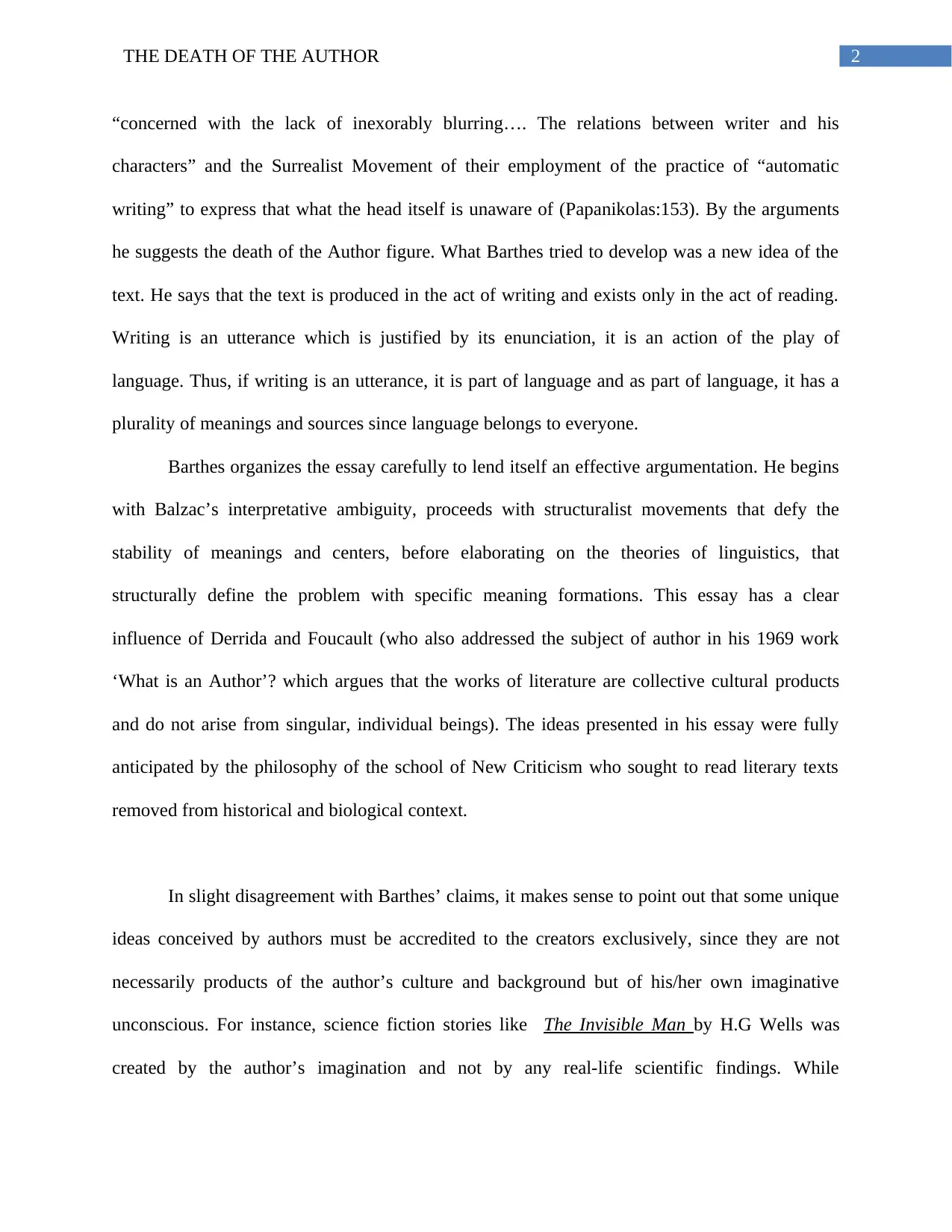
“concerned with the lack of inexorably blurring…. The relations between writer and his
characters” and the Surrealist Movement of their employment of the practice of “automatic
writing” to express that what the head itself is unaware of (Papanikolas:153). By the arguments
he suggests the death of the Author figure. What Barthes tried to develop was a new idea of the
text. He says that the text is produced in the act of writing and exists only in the act of reading.
Writing is an utterance which is justified by its enunciation, it is an action of the play of
language. Thus, if writing is an utterance, it is part of language and as part of language, it has a
plurality of meanings and sources since language belongs to everyone.
Barthes organizes the essay carefully to lend itself an effective argumentation. He begins
with Balzac’s interpretative ambiguity, proceeds with structuralist movements that defy the
stability of meanings and centers, before elaborating on the theories of linguistics, that
structurally define the problem with specific meaning formations. This essay has a clear
influence of Derrida and Foucault (who also addressed the subject of author in his 1969 work
‘What is an Author’? which argues that the works of literature are collective cultural products
and do not arise from singular, individual beings). The ideas presented in his essay were fully
anticipated by the philosophy of the school of New Criticism who sought to read literary texts
removed from historical and biological context.
In slight disagreement with Barthes’ claims, it makes sense to point out that some unique
ideas conceived by authors must be accredited to the creators exclusively, since they are not
necessarily products of the author’s culture and background but of his/her own imaginative
unconscious. For instance, science fiction stories like The Invisible Man by H.G Wells was
created by the author’s imagination and not by any real-life scientific findings. While
“concerned with the lack of inexorably blurring…. The relations between writer and his
characters” and the Surrealist Movement of their employment of the practice of “automatic
writing” to express that what the head itself is unaware of (Papanikolas:153). By the arguments
he suggests the death of the Author figure. What Barthes tried to develop was a new idea of the
text. He says that the text is produced in the act of writing and exists only in the act of reading.
Writing is an utterance which is justified by its enunciation, it is an action of the play of
language. Thus, if writing is an utterance, it is part of language and as part of language, it has a
plurality of meanings and sources since language belongs to everyone.
Barthes organizes the essay carefully to lend itself an effective argumentation. He begins
with Balzac’s interpretative ambiguity, proceeds with structuralist movements that defy the
stability of meanings and centers, before elaborating on the theories of linguistics, that
structurally define the problem with specific meaning formations. This essay has a clear
influence of Derrida and Foucault (who also addressed the subject of author in his 1969 work
‘What is an Author’? which argues that the works of literature are collective cultural products
and do not arise from singular, individual beings). The ideas presented in his essay were fully
anticipated by the philosophy of the school of New Criticism who sought to read literary texts
removed from historical and biological context.
In slight disagreement with Barthes’ claims, it makes sense to point out that some unique
ideas conceived by authors must be accredited to the creators exclusively, since they are not
necessarily products of the author’s culture and background but of his/her own imaginative
unconscious. For instance, science fiction stories like The Invisible Man by H.G Wells was
created by the author’s imagination and not by any real-life scientific findings. While
⊘ This is a preview!⊘
Do you want full access?
Subscribe today to unlock all pages.

Trusted by 1+ million students worldwide

3THE DEATH OF THE AUTHOR
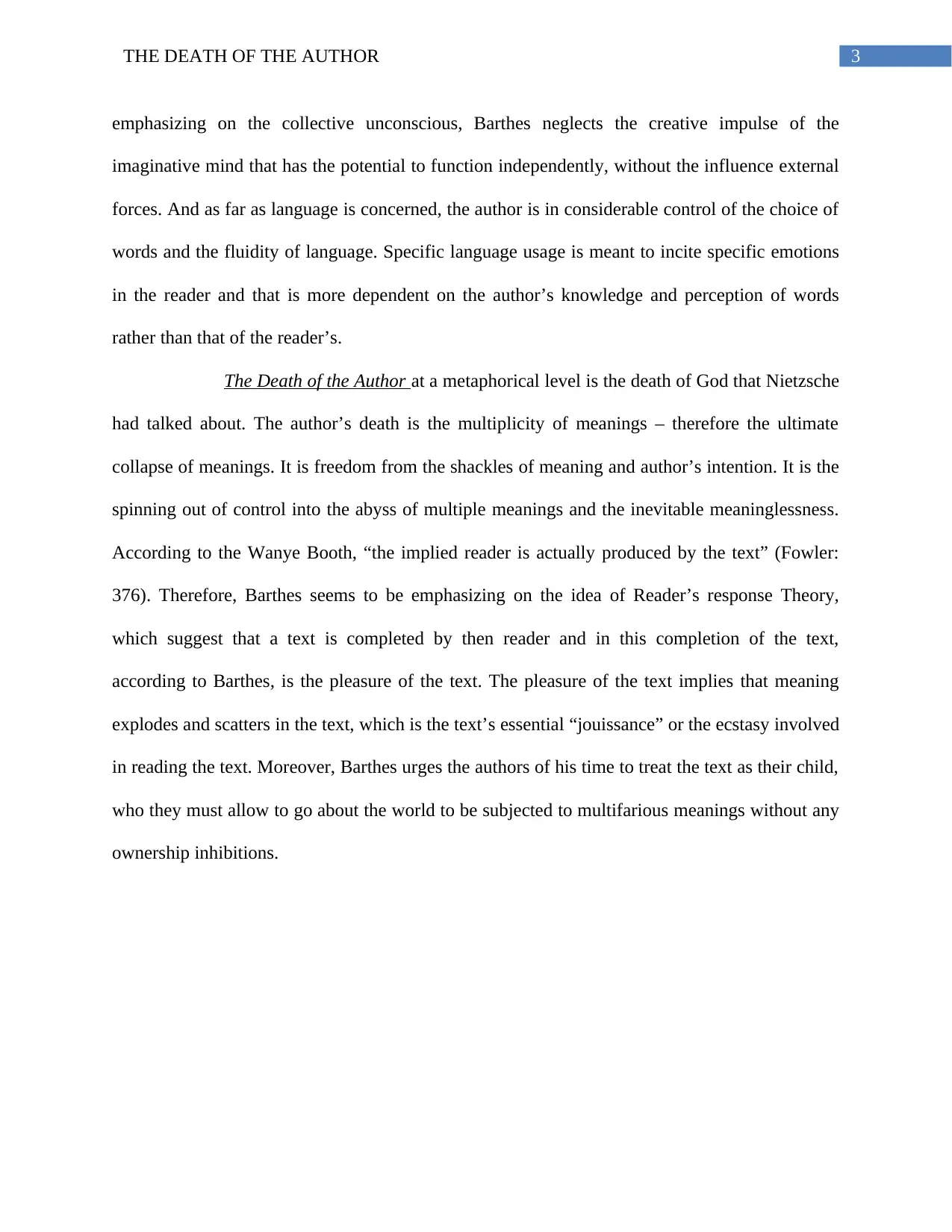
emphasizing on the collective unconscious, Barthes neglects the creative impulse of the
imaginative mind that has the potential to function independently, without the influence external
forces. And as far as language is concerned, the author is in considerable control of the choice of
words and the fluidity of language. Specific language usage is meant to incite specific emotions
in the reader and that is more dependent on the author’s knowledge and perception of words
rather than that of the reader’s.
The Death of the Author at a metaphorical level is the death of God that Nietzsche
had talked about. The author’s death is the multiplicity of meanings – therefore the ultimate
collapse of meanings. It is freedom from the shackles of meaning and author’s intention. It is the
spinning out of control into the abyss of multiple meanings and the inevitable meaninglessness.
According to the Wanye Booth, “the implied reader is actually produced by the text” (Fowler:
376). Therefore, Barthes seems to be emphasizing on the idea of Reader’s response Theory,
which suggest that a text is completed by then reader and in this completion of the text,
according to Barthes, is the pleasure of the text. The pleasure of the text implies that meaning
explodes and scatters in the text, which is the text’s essential “jouissance” or the ecstasy involved
in reading the text. Moreover, Barthes urges the authors of his time to treat the text as their child,
who they must allow to go about the world to be subjected to multifarious meanings without any
ownership inhibitions.
emphasizing on the collective unconscious, Barthes neglects the creative impulse of the
imaginative mind that has the potential to function independently, without the influence external
forces. And as far as language is concerned, the author is in considerable control of the choice of
words and the fluidity of language. Specific language usage is meant to incite specific emotions
in the reader and that is more dependent on the author’s knowledge and perception of words
rather than that of the reader’s.
The Death of the Author at a metaphorical level is the death of God that Nietzsche
had talked about. The author’s death is the multiplicity of meanings – therefore the ultimate
collapse of meanings. It is freedom from the shackles of meaning and author’s intention. It is the
spinning out of control into the abyss of multiple meanings and the inevitable meaninglessness.
According to the Wanye Booth, “the implied reader is actually produced by the text” (Fowler:
376). Therefore, Barthes seems to be emphasizing on the idea of Reader’s response Theory,
which suggest that a text is completed by then reader and in this completion of the text,
according to Barthes, is the pleasure of the text. The pleasure of the text implies that meaning
explodes and scatters in the text, which is the text’s essential “jouissance” or the ecstasy involved
in reading the text. Moreover, Barthes urges the authors of his time to treat the text as their child,
who they must allow to go about the world to be subjected to multifarious meanings without any
ownership inhibitions.
Paraphrase This Document
Need a fresh take? Get an instant paraphrase of this document with our AI Paraphraser

4THE DEATH OF THE AUTHOR
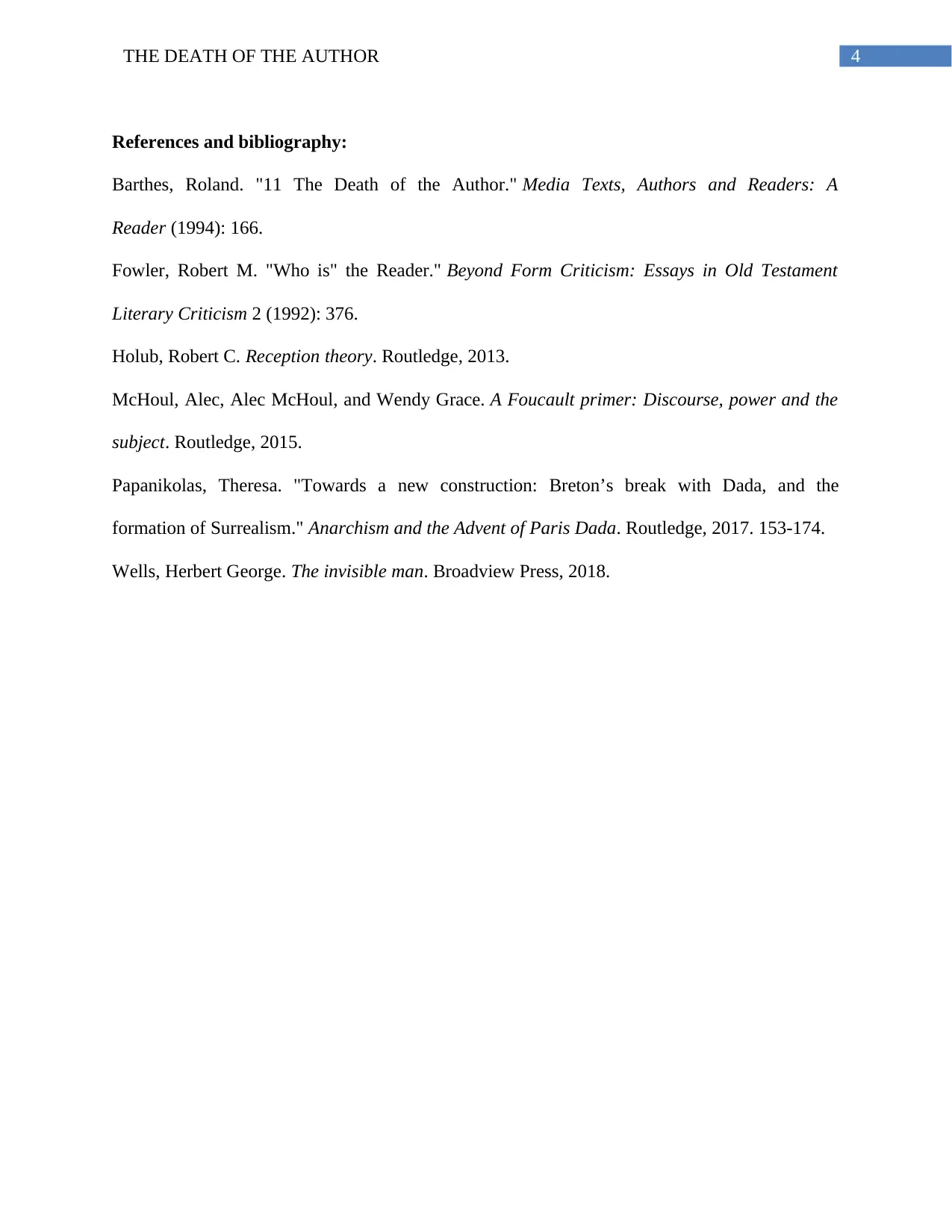
References and bibliography:
Barthes, Roland. "11 The Death of the Author." Media Texts, Authors and Readers: A
Reader (1994): 166.
Fowler, Robert M. "Who is" the Reader." Beyond Form Criticism: Essays in Old Testament
Literary Criticism 2 (1992): 376.
Holub, Robert C. Reception theory. Routledge, 2013.
McHoul, Alec, Alec McHoul, and Wendy Grace. A Foucault primer: Discourse, power and the
subject. Routledge, 2015.
Papanikolas, Theresa. "Towards a new construction: Breton’s break with Dada, and the
formation of Surrealism." Anarchism and the Advent of Paris Dada. Routledge, 2017. 153-174.
Wells, Herbert George. The invisible man. Broadview Press, 2018.
References and bibliography:
Barthes, Roland. "11 The Death of the Author." Media Texts, Authors and Readers: A
Reader (1994): 166.
Fowler, Robert M. "Who is" the Reader." Beyond Form Criticism: Essays in Old Testament
Literary Criticism 2 (1992): 376.
Holub, Robert C. Reception theory. Routledge, 2013.
McHoul, Alec, Alec McHoul, and Wendy Grace. A Foucault primer: Discourse, power and the
subject. Routledge, 2015.
Papanikolas, Theresa. "Towards a new construction: Breton’s break with Dada, and the
formation of Surrealism." Anarchism and the Advent of Paris Dada. Routledge, 2017. 153-174.
Wells, Herbert George. The invisible man. Broadview Press, 2018.
1 out of 5
Related Documents
Your All-in-One AI-Powered Toolkit for Academic Success.
+13062052269
info@desklib.com
Available 24*7 on WhatsApp / Email
Unlock your academic potential
Copyright © 2020–2026 A2Z Services. All Rights Reserved. Developed and managed by ZUCOL.