Research Management: Prospectus on Children Exposure to Content

Verified

Added on  2023/04/25

|4
|567
|102
Report
AI Summary
This report is a research prospectus that addresses the issue of children's exposure to explicit content. It begins by acknowledging the limited research on the actual effects of such exposure, while identifying sources of explicit content, including media, television, movies, and music. The problem statement highlights how children are exposed to explicit content both intentionally (through curiosity) and accidentally. The research aims to identify the ways in which children are exposed to explicit content, the risks involved, and how to prevent them. It assumes that early exposure to sexual content leads to multiple partners below adulthood, parental monitoring is crucial, and children tend to imitate violent or sexual content they consume. The prospectus references existing literature to support its claims and establish the context for further investigation.
Document Page
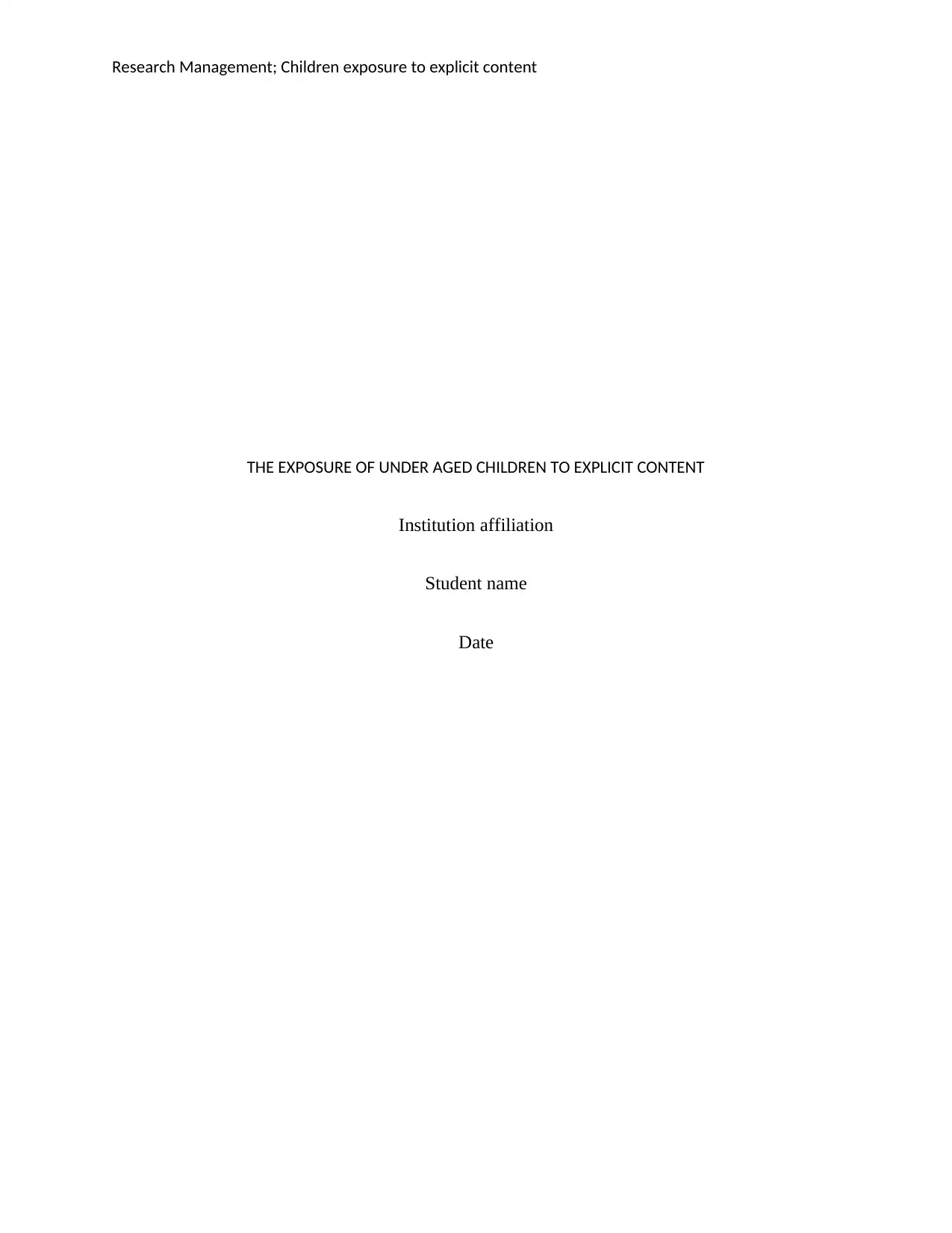
Research Management; Children exposure to explicit content
THE EXPOSURE OF UNDER AGED CHILDREN TO EXPLICIT CONTENT
Institution affiliation
Student name
Date
tabler-icon-diamond-filled.svg

Paraphrase This Document

Need a fresh take? Get an instant paraphrase of this document with our AI Paraphraser
Document Page
Research Management; Children exposure to explicit content
The exposure of under aged children to explicit content
Introduction
There is not enough research available to show the actual effects of childhood exposure to
explicit content. However, we can identify some of the explicit content as but not limited to materials
that portray drugs as good, inciting lyrics (that promote racism, ethnicity, and hate speech), vulgar
artwork, sexual content, and violence(Bleakley, Jamieson & Romer, 2012).
Problem statement
The sources of childhood exposure to explicit content include print media, television, movies,
and music lyrics(Bleakley, Jamieson & Romer, 2012). The images children are exposed to as they visit
internet, watch movies, television, films, peruse print media, and listen to music leave lasting impression
even as they do not understand sex or its role in the relationship(Wilson, Dalberth, Koo, & Gard, 2010).
Children get exposed to explicit through two ways; through being curious hence intentionally get
exposed and accidental exposure (Wilson, Dalberth, Koo, & Gard, 2010). This happens in as early as 8 or
9 years. Although studies have not focused so much on the effects of explicit exposure of children, we
can believe it may have consequences such as irresponsible sex, drug abuse, violence towards people
and animals and nature, and discrimination against other people among other effects (Bleakley,
Jamieson & Romer, 2012).
Significance of research
This study aims at identifying ways in which children are exposed to explicit content, the risks
involved and how to prevent them. This study will help the parent to monitor what their children watch
as well as help the government to ensure censorship of all media content that is believed to be adult
content is carried out.
Document Page
Research Management; Children exposure to explicit content
Assumptions
This study adopts the following assumption concerning children exposure to explicit content;
That, children, who are exposed to sexual content at their very early ages have multiple partners when
they are way below adulthood.
A parent who does not monitor what their children are watching are the ones to blame since they are
once to guide their children on what they get exposed to.
Children who watch violent movies, read vulgar contents and watch sexual content tends to imitate the
characters and find themselves practicing what they saw.
Document Page
Research Management; Children exposure to explicit content
Refrences
Bleakley, A., Jamieson, P. E., & Romer, D. (2012). Trends of sexual and violent content by gender in top-
grossing US films, 1950–2006. Journal of Adolescent Health, 51(1), 73-79.
Wilson, E. K., Dalberth, B. T., Koo, H. P., & Gard, J. C. (2010). Parents' perspectives on talking to
preteenage children about sex. Perspectives on Sexual and Reproductive health, 42(1), 56-63.
chevron_up_icon
1 out of 4
circle_padding
hide_on_mobile
zoom_out_icon
[object Object]