Robot Control Systems Design: Kinematics, Dynamics, and Control

Verified

Added on  2022/08/27

|7
|702
|21
Homework Assignment
AI Summary
This document presents solutions for two assignments focused on robot control systems. Assignment 1 delves into the kinematics and dynamics of a two-link planar manipulator, deriving equations and analyzing the robot's behavior using MATLAB and Simulink, including the effects of motor input voltages and joint torques. Assignment 2 addresses trajectory tracking, a crucial aspect of robot control, and explores various control strategies such as PD control, decentralized PD control, feedforward, and computed torque control. The document highlights the effectiveness of PD control in achieving accurate trajectory following and presents relevant parameters and equations for the manipulator's dynamics. References to key research papers on robot control are also included.
Document Page
Assignment-1
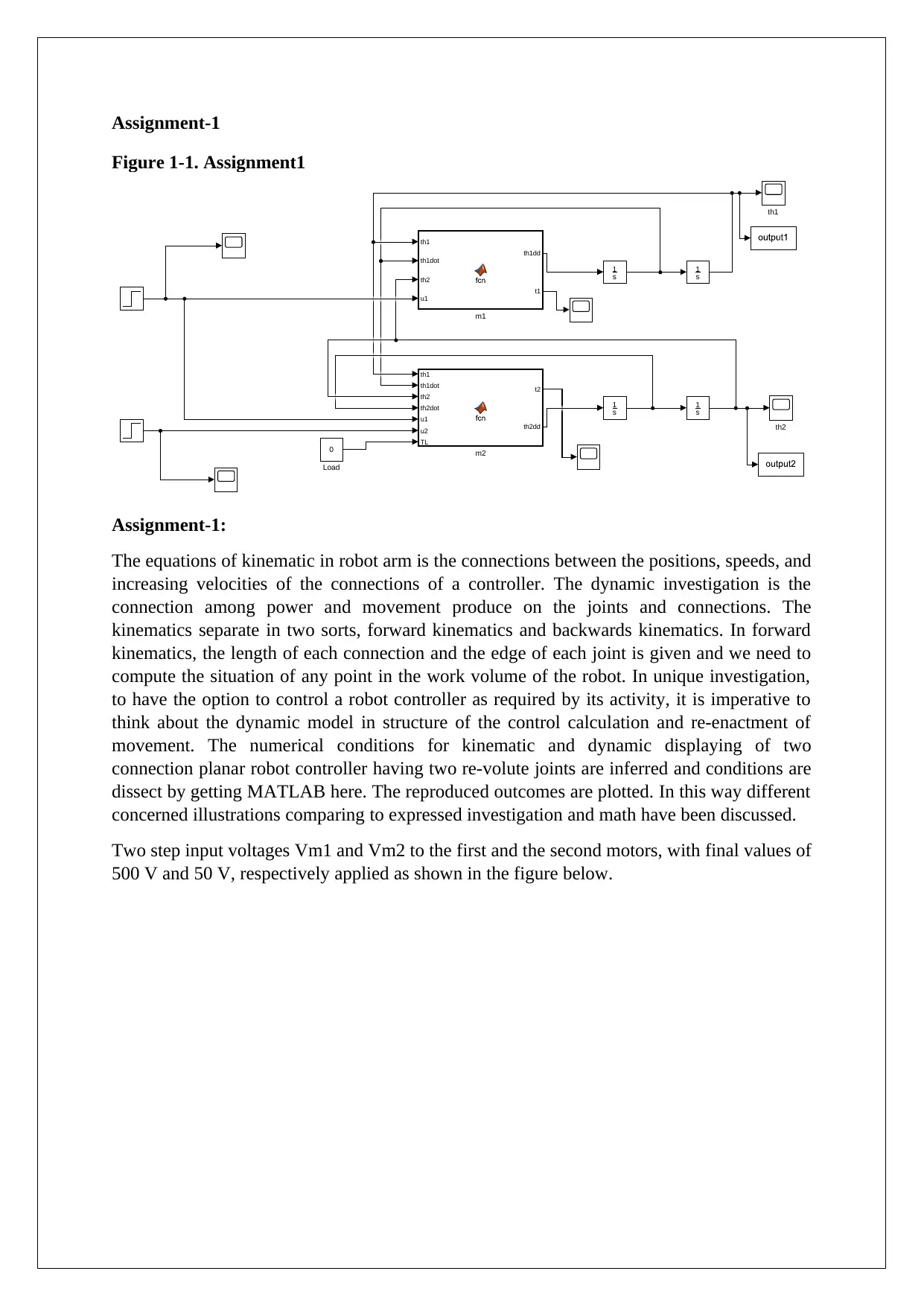
Figure 1-1. Assignment1
1
s
1
s
1
s
1
s
th1
th1dot
th2
th2dot
u1
u2
TL
t2
th2dd
m2
th1
th1dot
th2
u1
th1dd
t1
m1
0
Load
th2
th1
Assignment-1:
The equations of kinematic in robot arm is the connections between the positions, speeds, and
increasing velocities of the connections of a controller. The dynamic investigation is the
connection among power and movement produce on the joints and connections. The
kinematics separate in two sorts, forward kinematics and backwards kinematics. In forward
kinematics, the length of each connection and the edge of each joint is given and we need to
compute the situation of any point in the work volume of the robot. In unique investigation,
to have the option to control a robot controller as required by its activity, it is imperative to
think about the dynamic model in structure of the control calculation and re-enactment of
movement. The numerical conditions for kinematic and dynamic displaying of two
connection planar robot controller having two re-volute joints are inferred and conditions are
dissect by getting MATLAB here. The reproduced outcomes are plotted. In this way different
concerned illustrations comparing to expressed investigation and math have been discussed.
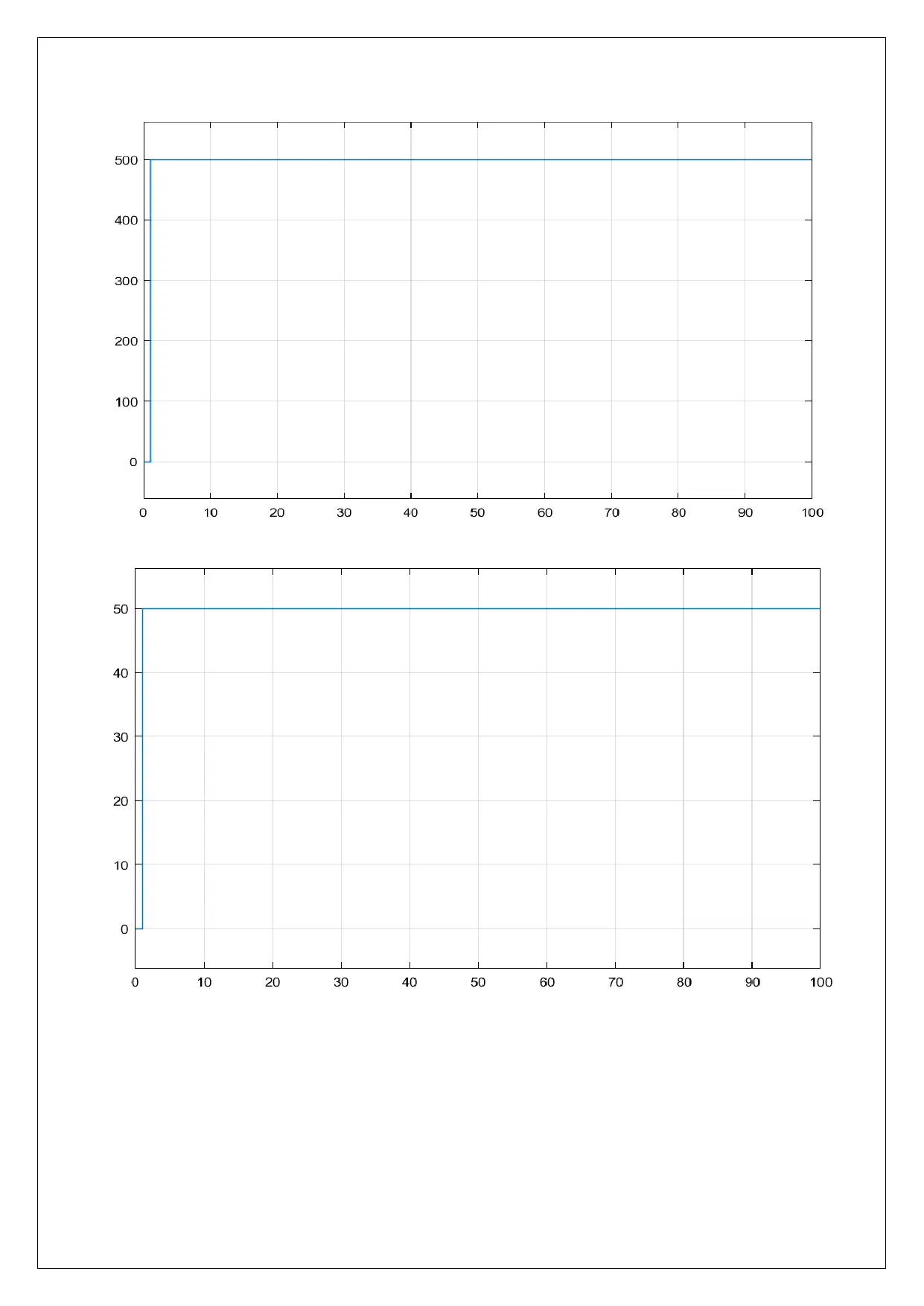
Two step input voltages Vm1 and Vm2 to the first and the second motors, with final values of
500 V and 50 V, respectively applied as shown in the figure below.
tabler-icon-diamond-filled.svg

Paraphrase This Document

Need a fresh take? Get an instant paraphrase of this document with our AI Paraphraser
Document Page
Document Page
Document Page
0 10 20 30 40 50 60 70 80 90 100
Time
98.4
98.6
98.8
99
99.2
99.4
99.6
99.8
100
Tout
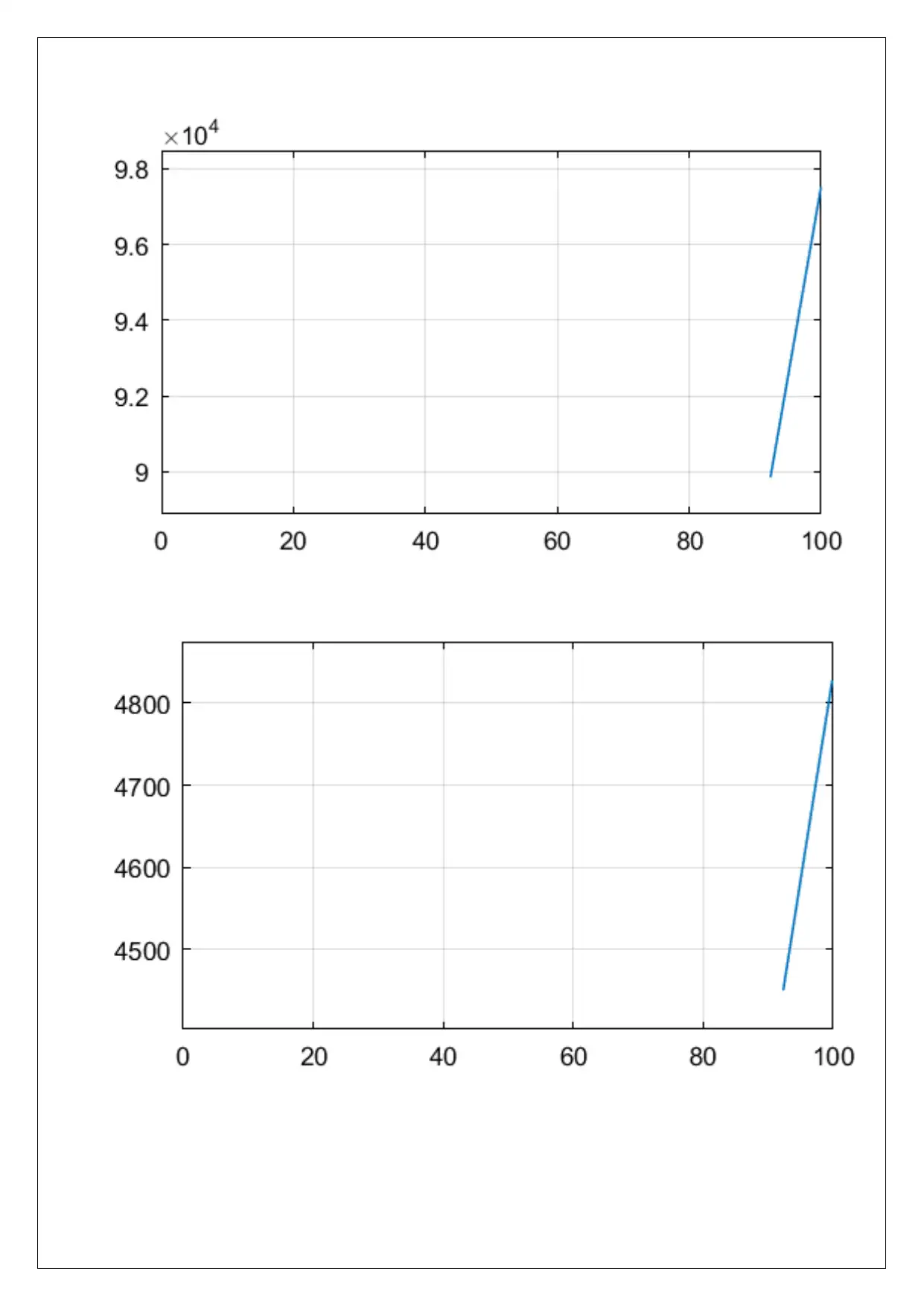
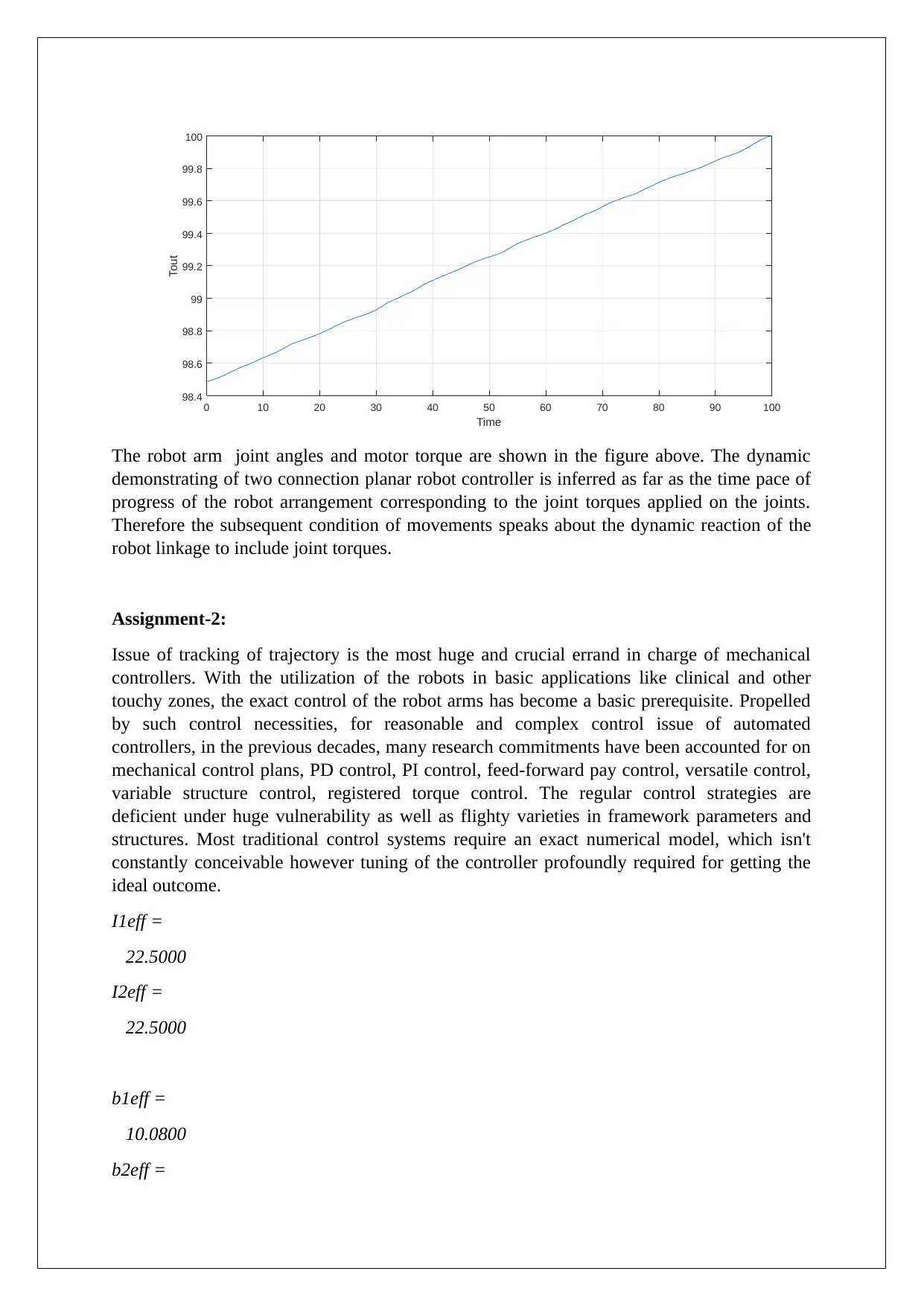
The robot arm joint angles and motor torque are shown in the figure above. The dynamic
demonstrating of two connection planar robot controller is inferred as far as the time pace of
progress of the robot arrangement corresponding to the joint torques applied on the joints.
Therefore the subsequent condition of movements speaks about the dynamic reaction of the
robot linkage to include joint torques.
Assignment-2:
Issue of tracking of trajectory is the most huge and crucial errand in charge of mechanical
controllers. With the utilization of the robots in basic applications like clinical and other
touchy zones, the exact control of the robot arms has become a basic prerequisite. Propelled
by such control necessities, for reasonable and complex control issue of automated
controllers, in the previous decades, many research commitments have been accounted for on
mechanical control plans, PD control, PI control, feed-forward pay control, versatile control,
variable structure control, registered torque control. The regular control strategies are
deficient under huge vulnerability as well as flighty varieties in framework parameters and
structures. Most traditional control systems require an exact numerical model, which isn't
constantly conceivable however tuning of the controller profoundly required for getting the
ideal outcome.
I1eff =
22.5000
I2eff =
22.5000
b1eff =
10.0800
b2eff =
tabler-icon-diamond-filled.svg

Paraphrase This Document

Need a fresh take? Get an instant paraphrase of this document with our AI Paraphraser
Document Page
10.0800
Document Page
The position control of robot controllers is the least complex point in robot control, at similar
occasions, it is one of the most important issues in down to earth controllers. Numerous
methodologies have been acquainted with treat this control issue. It is notable that an
inflexible robot arm can be internationally asymptotically balanced out around a given joint
setup by means of a PD controller on the joint mistakes, given that gravity is dropped by
criticism. Under a gentle condition on the relative addition, this plan can be streamlined by
performing just consistent gravity pay at the ideal design.
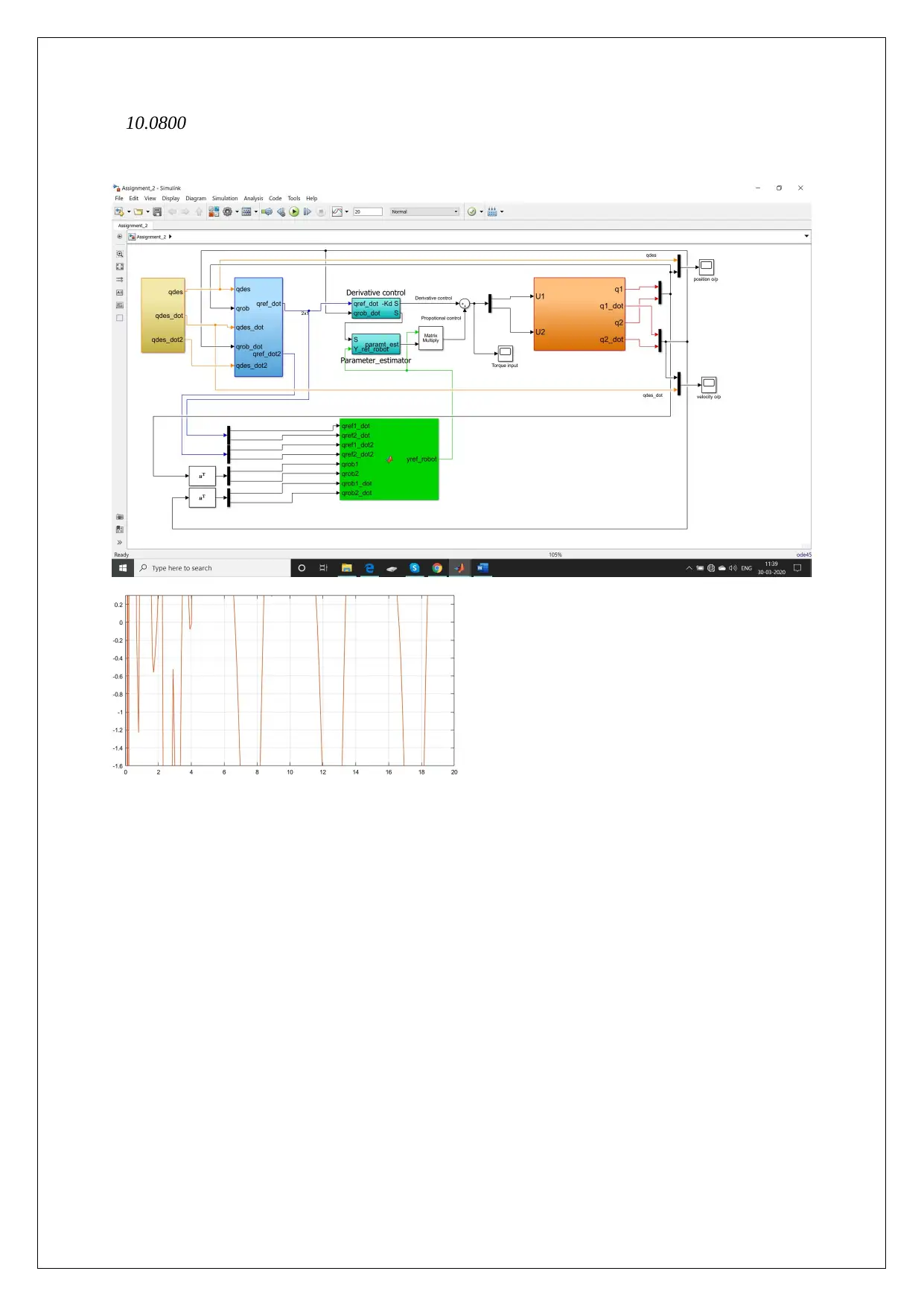
The presentation of two-interface mechanical controller is explored with Decentralized PD,
Decentralized PD controller, Feed forward and Computed torque control. The PD controller
brought about the best execution and viable and exact direction following ability when
contrasted with PD controller. Likewise the reaction with PD controller was having
diminished motions about the ideal direction when contrasted with PD controller.
Document Page
REFERENCES
P. Tomei: “Adaptive PD controller for robot manipulators”, IEEE Trans. Robotics Automat.,
Vol. 7, pp. 565-570,1991.
L. Sciavicco, B. Siciliano, Modelling and control of robot manipulators (2nd ed.), London:
Springer.
Rafael Kelly: “PD Control with Desired Gravity Compensation of Robotic Manipulator: A
Review”, The International Journal of Robotics Research 1997; 16; 660
chevron_up_icon
1 out of 7
circle_padding
hide_on_mobile
zoom_out_icon
[object Object]