The Impossible Trinity and Taylor Rule for Singapore's Monetary Policy
VerifiedAdded on 2020/06/06
|19
|6037
|47
Essay
AI Summary
This essay critically investigates the effectiveness of the Taylor Rule in Singapore's open economy, addressing the challenges posed by the impossible trinity. It examines the Monetary Authority of Singapore's (MAS) current monetary policy framework, which focuses on maintaining the Singapore dollar's effective exchange rate (S$NEER). The study explores the trilemma, highlighting the trade-offs between exchange rate stability, independent monetary policy, and free capital flows. Applying the Taylor rule in Singapore, the paper assesses whether the MAS should utilize interest rates as an instrument instead of the exchange rate. The research considers the impact of productivity and foreign price shocks, concluding that the Taylor rule may be more effective in certain scenarios. The essay emphasizes that the MAS can leverage high exchange rates to manage interest rates and benefit from foreign capital flows, ensuring an appreciating exchange rate. The study concludes that there is no floating fear for Singapore with the Taylor rule.
The Impossible Trinity
(Will Taylor Rule be better for Singapore?)
(Will Taylor Rule be better for Singapore?)

Paraphrase This Document
Need a fresh take? Get an instant paraphrase of this document with our AI Paraphraser
Abstract
Monetary policy is regarded as macroeconomic policy wherein the monetary authority
means central bank of the nation makes policies, rules and regulations to control the supply of
money in the country. Monetary Authority of Singapore (MAS) aims at keeping appreciation rate
of Singapore’s dollar effective exchange (S$NEER) rate at 0%. It follows inflation-targeting &
exchange rate focused monetary policy with free flow of capital and domestic interest rate is
determined through foreign interest rate comprising time-varying risk premium. Given an
impossible trinity, MAS can either choose exchange rate or interest rate as an instrument for the
monetary control. Applying the Taylor’s rule in Singapore, MAS needs to charge high rate of
interest so as to control money supply or vice-versa. Thus, the target of the study is to critically
investigate the Taylor’s rule in Singapore’s open economy through secondary analysis. The
finding of the thesis presented that in dominant productivity shocks Taylor’s interest rate rule is
considered as more effective, however, in case of dominant foreign price shocks, exchange rate
rule is preferable. Moreover, inflation significantly response to the import-price inflation shocks
in comparison to the exchange rate. The results concluded that there is no floating fear for the
Singapore with the Taylor rule because with the high exchange rate, MAS can improve policy
rates in order to derive benefits from the foreign flow of capital and assures appreciating
exchange rate in the future.
Monetary policy is regarded as macroeconomic policy wherein the monetary authority
means central bank of the nation makes policies, rules and regulations to control the supply of
money in the country. Monetary Authority of Singapore (MAS) aims at keeping appreciation rate
of Singapore’s dollar effective exchange (S$NEER) rate at 0%. It follows inflation-targeting &
exchange rate focused monetary policy with free flow of capital and domestic interest rate is
determined through foreign interest rate comprising time-varying risk premium. Given an
impossible trinity, MAS can either choose exchange rate or interest rate as an instrument for the
monetary control. Applying the Taylor’s rule in Singapore, MAS needs to charge high rate of
interest so as to control money supply or vice-versa. Thus, the target of the study is to critically
investigate the Taylor’s rule in Singapore’s open economy through secondary analysis. The
finding of the thesis presented that in dominant productivity shocks Taylor’s interest rate rule is
considered as more effective, however, in case of dominant foreign price shocks, exchange rate
rule is preferable. Moreover, inflation significantly response to the import-price inflation shocks
in comparison to the exchange rate. The results concluded that there is no floating fear for the
Singapore with the Taylor rule because with the high exchange rate, MAS can improve policy
rates in order to derive benefits from the foreign flow of capital and assures appreciating
exchange rate in the future.
Table of Contents
PART- I INTRODUCTION............................................................................................................1
Overview of the study..................................................................................................................1
Research aims and objectives......................................................................................................3
Research question........................................................................................................................3
Rationale of the study..................................................................................................................3
Structure of the dissertation.........................................................................................................4
PART – II LITERATURE REVIEW..............................................................................................4
1. Current monetary policy framework of Singapore and impossible trinity concept.................4
2. Application of Taylor’s rule in the monetary policy................................................................6
PART III: CONCLUSION............................................................................................................11
PART –IV REFERENCES............................................................................................................13
PART- I INTRODUCTION............................................................................................................1
Overview of the study..................................................................................................................1
Research aims and objectives......................................................................................................3
Research question........................................................................................................................3
Rationale of the study..................................................................................................................3
Structure of the dissertation.........................................................................................................4
PART – II LITERATURE REVIEW..............................................................................................4
1. Current monetary policy framework of Singapore and impossible trinity concept.................4
2. Application of Taylor’s rule in the monetary policy................................................................6
PART III: CONCLUSION............................................................................................................11
PART –IV REFERENCES............................................................................................................13
⊘ This is a preview!⊘
Do you want full access?
Subscribe today to unlock all pages.

Trusted by 1+ million students worldwide
Table of Figures
Figure 1 Impossible Trinity........................................................................................................... 2
Figure 2 Mundell’s Impossible Trinity..........................................................................................6
Figure 1 Impossible Trinity........................................................................................................... 2
Figure 2 Mundell’s Impossible Trinity..........................................................................................6
Paraphrase This Document
Need a fresh take? Get an instant paraphrase of this document with our AI Paraphraser
PART- I INTRODUCTION
Overview of the study
Monetary policy is a part of macroeconomic strategies wherein the monetary authority
means central bank of the nation makes policies, rules and regulations to control the supply of
money in the country. The target of this is to control high rate of inflation and interest so as to
stabilize price & build trust in economy (Chen and et.al, 2016). In Singapore, central Bank is
responsible to make policies and regulations in regards to control the inflation rate by altering the
interest rate or exchange rate. Its monetary policy covers several aspects i.e. control foreign
exchange rate, open market operations, inflation rate and others. Monetary Authority of
Singapore (MAS) aims at keeping appreciation rate of Singapore’s dollar effective exchange
(S$NEER) rate at 0%. The authority also intervenes in keeping foreign exchange rate stabilized
so as to prevent the possibility of excessive volatility in the exchange rate. The policy considers
domestic rate of interest and monetary supply as an endogenous variables and therefore, money
market operations are carried out in order to ensure sufficient liquid availability. Thus, its
monetary policy is an inflation targeted strategy, in which, policy-makers make policies in order
to control the inflation (Mohan, Patra and Kapur, 2013).
Applying the international economics concept of impossible Trinity, it presents that it is
impossible for every nation to have a fixed FOREX, free movement of capital and independent
monetary policy. Here, free capital flow is regarded as monetary movement for trade &
investment purpose, fixed FOREX rate indicates fixed exchange rate of one currency against the
value of other currency and last one sovereign monetary policy is the process wherein central
bank design policies so as to control the money supply in the nation (Cai and Pitsch, 2014). The
trilemma is also called Unholy Trinity and became popular as Mundell-Fleming model examine
the effectiveness of monetary policy of the country in an open economy with distinctive
exchange rate (Schularick and Taylor, 2012). Considering it in Singapore’s open economy, the
concept believes that it is impossible for the MSA to consider all of these three factors while
designing the monetary policy therefore; there are three choices available to the policymakers
presented below:
1. Stable rate of exchange & free capital flows but not an independent policy
1
Overview of the study
Monetary policy is a part of macroeconomic strategies wherein the monetary authority
means central bank of the nation makes policies, rules and regulations to control the supply of
money in the country. The target of this is to control high rate of inflation and interest so as to
stabilize price & build trust in economy (Chen and et.al, 2016). In Singapore, central Bank is
responsible to make policies and regulations in regards to control the inflation rate by altering the
interest rate or exchange rate. Its monetary policy covers several aspects i.e. control foreign
exchange rate, open market operations, inflation rate and others. Monetary Authority of
Singapore (MAS) aims at keeping appreciation rate of Singapore’s dollar effective exchange
(S$NEER) rate at 0%. The authority also intervenes in keeping foreign exchange rate stabilized
so as to prevent the possibility of excessive volatility in the exchange rate. The policy considers
domestic rate of interest and monetary supply as an endogenous variables and therefore, money
market operations are carried out in order to ensure sufficient liquid availability. Thus, its
monetary policy is an inflation targeted strategy, in which, policy-makers make policies in order
to control the inflation (Mohan, Patra and Kapur, 2013).
Applying the international economics concept of impossible Trinity, it presents that it is
impossible for every nation to have a fixed FOREX, free movement of capital and independent
monetary policy. Here, free capital flow is regarded as monetary movement for trade &
investment purpose, fixed FOREX rate indicates fixed exchange rate of one currency against the
value of other currency and last one sovereign monetary policy is the process wherein central
bank design policies so as to control the money supply in the nation (Cai and Pitsch, 2014). The
trilemma is also called Unholy Trinity and became popular as Mundell-Fleming model examine
the effectiveness of monetary policy of the country in an open economy with distinctive
exchange rate (Schularick and Taylor, 2012). Considering it in Singapore’s open economy, the
concept believes that it is impossible for the MSA to consider all of these three factors while
designing the monetary policy therefore; there are three choices available to the policymakers
presented below:
1. Stable rate of exchange & free capital flows but not an independent policy
1
2. Independent monetary policy & free movement of capital with volatile foreign exchange
rate (Takagawa, 2013)
3. Stable and fixed rate of exchange & independent monetary policy
Being a major financial centre, Singapore’s MSA selected free mobility of the capital &
targeted one monetary variable either exchange rate or other but not both. Unsurprisingly,
exchange rate can be used as an effective tool in order to manage an open economy (Moin and
Ahmed, 2012).
Figure 1 Impossible Trinity
[Source: Stein, 2012]
Taylor has developed a rule that presents decisions on interest rate of Federal Open
Market Committee (FOMC). It is based on altering either increasing or decreasing the interest
rate, at which commercial banks can grant loans to each other, decided using following equation:
r = p + 0.5y + 0.5(p-2) +2
r= Interest rate
p – Inflation rate
y – Output gap (excess of potential GDP over actual output)
Referring Singapore, MAS follows inflation-targeting & exchange rate focused monetary
policy with free flow of capital and domestic interest rate is determined through foreign interest
rate comprising time-varying risk premium (Bruno and Shin, 2015). Thus, according to the rule,
in order to control inflationary pressure, MAS needs to charge high rate of interest so as to
control money supply or vice-versa. Lack of credibility of the statutory monetary authority has
been recognized as a key reason behind avoiding & adopting Taylor’s rule, however, for an
open-independent economy like Singapore there may be some other reasons (Galí, 2015).
Evidencing from the empirical researches, implementation of Taylor rule in the closed
economies like US and UK founded a significant impact on the economic performance.
2
rate (Takagawa, 2013)
3. Stable and fixed rate of exchange & independent monetary policy
Being a major financial centre, Singapore’s MSA selected free mobility of the capital &
targeted one monetary variable either exchange rate or other but not both. Unsurprisingly,
exchange rate can be used as an effective tool in order to manage an open economy (Moin and
Ahmed, 2012).
Figure 1 Impossible Trinity
[Source: Stein, 2012]
Taylor has developed a rule that presents decisions on interest rate of Federal Open
Market Committee (FOMC). It is based on altering either increasing or decreasing the interest
rate, at which commercial banks can grant loans to each other, decided using following equation:
r = p + 0.5y + 0.5(p-2) +2
r= Interest rate
p – Inflation rate
y – Output gap (excess of potential GDP over actual output)
Referring Singapore, MAS follows inflation-targeting & exchange rate focused monetary
policy with free flow of capital and domestic interest rate is determined through foreign interest
rate comprising time-varying risk premium (Bruno and Shin, 2015). Thus, according to the rule,
in order to control inflationary pressure, MAS needs to charge high rate of interest so as to
control money supply or vice-versa. Lack of credibility of the statutory monetary authority has
been recognized as a key reason behind avoiding & adopting Taylor’s rule, however, for an
open-independent economy like Singapore there may be some other reasons (Galí, 2015).
Evidencing from the empirical researches, implementation of Taylor rule in the closed
economies like US and UK founded a significant impact on the economic performance.
2
⊘ This is a preview!⊘
Do you want full access?
Subscribe today to unlock all pages.
Trusted by 1+ million students worldwide
However, in the open economies, it is still a contrasting discussion. Therefore, the current
research paper investigates that whether Taylor rule will be prove effective or not for the
Singapore. It will make a counter-factual analysis to assess that whether the monetary policy
framework would be more effective by using interest rate as an instrument instead of exchange
rate.
Research aims and objectives
Aim: To critically evaluate the effectiveness of Taylor’s rule in Singapore’s open economy
Objectives:
To explore the current monetary policy framework of Singapore
To examine the complexity of impossible trinity (trilemma) in designing monetary policy
To critical investigate the application of Taylor rule in the Singapore’s monetary policy
To suggest that whether Taylor rule will be better for the Singapore’s open economy or
not
Research question
Q. Will Taylor Rule will be effective or not in designing monetary policy of Singapore?
Rationale of the study
Singapore’s exchange rate targeted monetary policy aims at managing the exchange rate
with the focus on promoting price stability. The policy regime has three characteristics i.e.
managing against currency basket of major trading partners, allowing exchange rate movement
within policy band and reviewing policy with the underlying economic fundamentals (Sanders
and Houghton, 2016). However, given an economic trilemma, Mundell prescribe that MAS can
use any of two, but not all of 3 objectives (stated above) of monetary policy. However,
Aizenman stated that all these follows linear relationship therefore, it make it essential for the
policy makers to make a trade-off in selection two variables out of 3 set of objectives. An
alternative available to the authority is that MAS can utilize interest rate as an instrument
whereas exchange rate can be adjusted to market forces (Moreno, 2012). Thus the main question
is that should Singapore adopts Taylor’s rule and float its currency? Thus, the paper investigated
the characteristic of different policy choices and also examines the application of Taylor rule in
monetary policy of Singapore.
3
research paper investigates that whether Taylor rule will be prove effective or not for the
Singapore. It will make a counter-factual analysis to assess that whether the monetary policy
framework would be more effective by using interest rate as an instrument instead of exchange
rate.
Research aims and objectives
Aim: To critically evaluate the effectiveness of Taylor’s rule in Singapore’s open economy
Objectives:
To explore the current monetary policy framework of Singapore
To examine the complexity of impossible trinity (trilemma) in designing monetary policy
To critical investigate the application of Taylor rule in the Singapore’s monetary policy
To suggest that whether Taylor rule will be better for the Singapore’s open economy or
not
Research question
Q. Will Taylor Rule will be effective or not in designing monetary policy of Singapore?
Rationale of the study
Singapore’s exchange rate targeted monetary policy aims at managing the exchange rate
with the focus on promoting price stability. The policy regime has three characteristics i.e.
managing against currency basket of major trading partners, allowing exchange rate movement
within policy band and reviewing policy with the underlying economic fundamentals (Sanders
and Houghton, 2016). However, given an economic trilemma, Mundell prescribe that MAS can
use any of two, but not all of 3 objectives (stated above) of monetary policy. However,
Aizenman stated that all these follows linear relationship therefore, it make it essential for the
policy makers to make a trade-off in selection two variables out of 3 set of objectives. An
alternative available to the authority is that MAS can utilize interest rate as an instrument
whereas exchange rate can be adjusted to market forces (Moreno, 2012). Thus the main question
is that should Singapore adopts Taylor’s rule and float its currency? Thus, the paper investigated
the characteristic of different policy choices and also examines the application of Taylor rule in
monetary policy of Singapore.
3
Paraphrase This Document
Need a fresh take? Get an instant paraphrase of this document with our AI Paraphraser
Structure of the dissertation
The dissertation has followed structure outlined here below:
Introduction: This section briefly introduced the subject matter or overview of the
research problem along with the aims and objectives. It also presents the potential
contribution of the investigation and rationale why the current area needs to be
investigated by the scholar.
Literature review: Literature review is a process wherein scholar critically evaluates the
existing knowledge, methodological and theoretical contribution & substantive findings
regarding the research topic. In this regards, researchers uses only the secondary material
sources without conducting any original investigation or experimental work in the chosen
field to gain conceptual knowledge in detail.
Conclusion: It will conclude the findings of the research in summary format to overcome
the research issue investigated by the scholar.
PART – II LITERATURE REVIEW
1. Current monetary policy framework of Singapore and impossible trinity concept
In Singapore, Monetary Authority of Singapore (MAS) is the central bank who carries
out central banking functions regarding monetary policy formulation & its successful
implementation. The core focus of the monetary policy is to ensure price stability through
managing trade-weighted rate of exchange. In this regards, it is targeted at maintaining rate under
the policy band (Aziakpono, Kleimeier and Sander, 2012). Moreover, it also carries out money
market operations in order to have sufficient quantum of liquidity for ensuring effective
functionality of the banking system. MAS managed its exchange rate through following aspects:
4
Monetary Policy
Implementation framework
Money market operationsIntervention operations
Liquidity managementExchange rate management
Liquidity facilities
The dissertation has followed structure outlined here below:
Introduction: This section briefly introduced the subject matter or overview of the
research problem along with the aims and objectives. It also presents the potential
contribution of the investigation and rationale why the current area needs to be
investigated by the scholar.
Literature review: Literature review is a process wherein scholar critically evaluates the
existing knowledge, methodological and theoretical contribution & substantive findings
regarding the research topic. In this regards, researchers uses only the secondary material
sources without conducting any original investigation or experimental work in the chosen
field to gain conceptual knowledge in detail.
Conclusion: It will conclude the findings of the research in summary format to overcome
the research issue investigated by the scholar.
PART – II LITERATURE REVIEW
1. Current monetary policy framework of Singapore and impossible trinity concept
In Singapore, Monetary Authority of Singapore (MAS) is the central bank who carries
out central banking functions regarding monetary policy formulation & its successful
implementation. The core focus of the monetary policy is to ensure price stability through
managing trade-weighted rate of exchange. In this regards, it is targeted at maintaining rate under
the policy band (Aziakpono, Kleimeier and Sander, 2012). Moreover, it also carries out money
market operations in order to have sufficient quantum of liquidity for ensuring effective
functionality of the banking system. MAS managed its exchange rate through following aspects:
4
Monetary Policy
Implementation framework
Money market operationsIntervention operations
Liquidity managementExchange rate management
Liquidity facilities
1. Singapore dollar is managed by taking into consideration the currencies of its major
partners in trade & competitors. In this, currencies are assigned with the weights
according to their importance in Singapore’s trade function (Singapore’s Exchange-rate
based monetary policy, 2017).
2. Under the managed floating regime, trade weighted rate of exchange is allowed to
fluctuate but within the limit of policy band that works as a mechanism to accommodate
little fluctuations in the FOREX markets.
3. Regular review of the policy band assures that the policy is going forward in line with the
underlying economic fundamentals (Subbarao, 2013).
Current statistical data reported that in Jan-Feb, 2017, Singapore’s core inflation
excluding the cost of transport & accommodation has been averaged to 1.3% YOY which was
1.2% in the last quarter of preceding year 2016. Exceeding oil prices i.e. electricity, petrol and
other is the main reason behind pickup in inflation. The economy is projected to continues to
expand at the modest pace in the year 2017 and inflation rate has been forecasted to increase
gradually mainly due to exceeding prices of oil (Monetary policy, 2017). On the other hand,
demand-driven inflationary pressure is predicted to restrain and core inflation rate is supposed to
retain at average rate slightly below 2%. MAS targeted at controlling inflationary pressure in the
country through using exchange rate as an instrument. However, applying the Taylor rule,
authority can use interest rate as an alternative means instead of current instrumental exchange
rate.
5
partners in trade & competitors. In this, currencies are assigned with the weights
according to their importance in Singapore’s trade function (Singapore’s Exchange-rate
based monetary policy, 2017).
2. Under the managed floating regime, trade weighted rate of exchange is allowed to
fluctuate but within the limit of policy band that works as a mechanism to accommodate
little fluctuations in the FOREX markets.
3. Regular review of the policy band assures that the policy is going forward in line with the
underlying economic fundamentals (Subbarao, 2013).
Current statistical data reported that in Jan-Feb, 2017, Singapore’s core inflation
excluding the cost of transport & accommodation has been averaged to 1.3% YOY which was
1.2% in the last quarter of preceding year 2016. Exceeding oil prices i.e. electricity, petrol and
other is the main reason behind pickup in inflation. The economy is projected to continues to
expand at the modest pace in the year 2017 and inflation rate has been forecasted to increase
gradually mainly due to exceeding prices of oil (Monetary policy, 2017). On the other hand,
demand-driven inflationary pressure is predicted to restrain and core inflation rate is supposed to
retain at average rate slightly below 2%. MAS targeted at controlling inflationary pressure in the
country through using exchange rate as an instrument. However, applying the Taylor rule,
authority can use interest rate as an alternative means instead of current instrumental exchange
rate.
5
⊘ This is a preview!⊘
Do you want full access?
Subscribe today to unlock all pages.
Trusted by 1+ million students worldwide
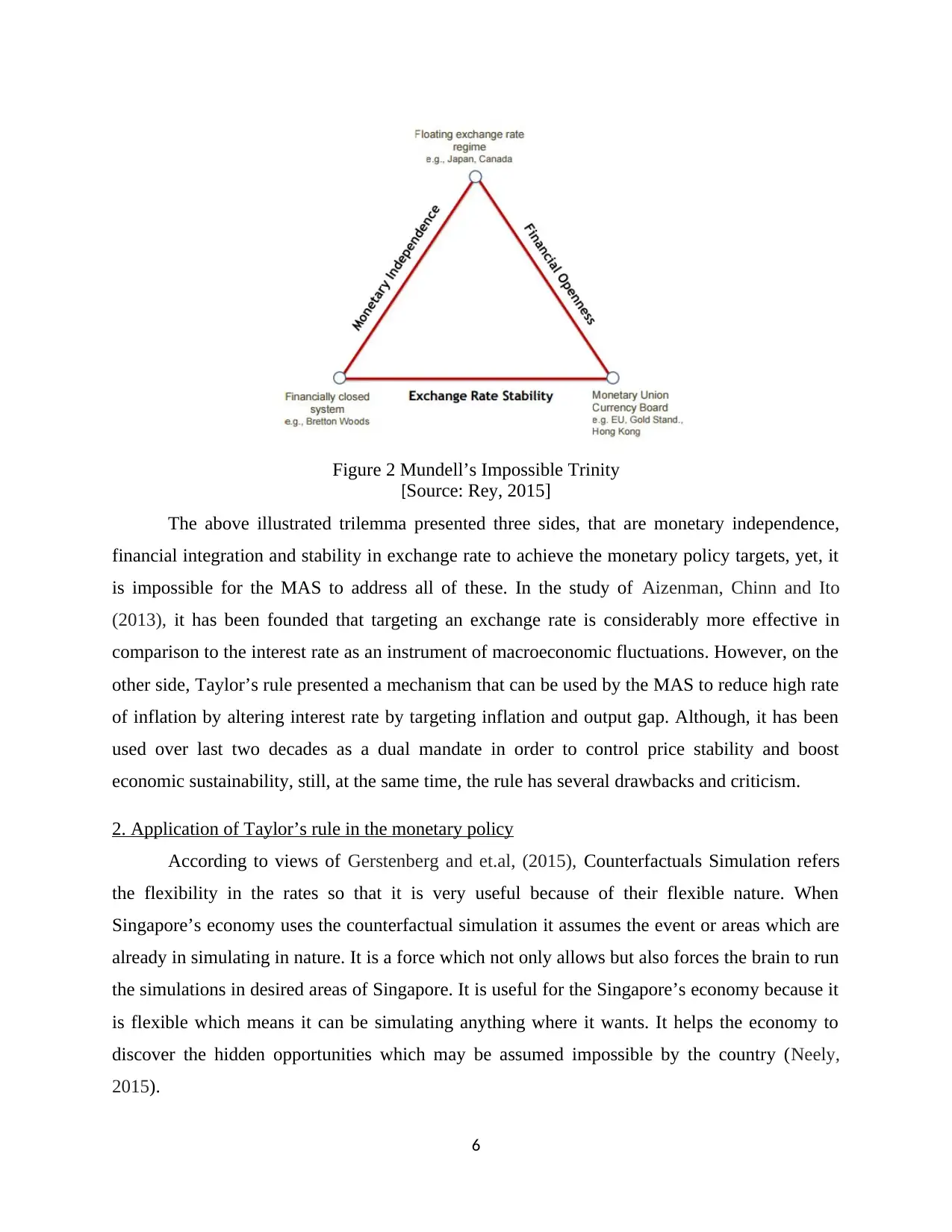
Figure 2 Mundell’s Impossible Trinity
[Source: Rey, 2015]
The above illustrated trilemma presented three sides, that are monetary independence,
financial integration and stability in exchange rate to achieve the monetary policy targets, yet, it
is impossible for the MAS to address all of these. In the study of Aizenman, Chinn and Ito
(2013), it has been founded that targeting an exchange rate is considerably more effective in
comparison to the interest rate as an instrument of macroeconomic fluctuations. However, on the
other side, Taylor’s rule presented a mechanism that can be used by the MAS to reduce high rate
of inflation by altering interest rate by targeting inflation and output gap. Although, it has been
used over last two decades as a dual mandate in order to control price stability and boost
economic sustainability, still, at the same time, the rule has several drawbacks and criticism.
2. Application of Taylor’s rule in the monetary policy
According to views of Gerstenberg and et.al, (2015), Counterfactuals Simulation refers
the flexibility in the rates so that it is very useful because of their flexible nature. When
Singapore’s economy uses the counterfactual simulation it assumes the event or areas which are
already in simulating in nature. It is a force which not only allows but also forces the brain to run
the simulations in desired areas of Singapore. It is useful for the Singapore’s economy because it
is flexible which means it can be simulating anything where it wants. It helps the economy to
discover the hidden opportunities which may be assumed impossible by the country (Neely,
2015).
6
[Source: Rey, 2015]
The above illustrated trilemma presented three sides, that are monetary independence,
financial integration and stability in exchange rate to achieve the monetary policy targets, yet, it
is impossible for the MAS to address all of these. In the study of Aizenman, Chinn and Ito
(2013), it has been founded that targeting an exchange rate is considerably more effective in
comparison to the interest rate as an instrument of macroeconomic fluctuations. However, on the
other side, Taylor’s rule presented a mechanism that can be used by the MAS to reduce high rate
of inflation by altering interest rate by targeting inflation and output gap. Although, it has been
used over last two decades as a dual mandate in order to control price stability and boost
economic sustainability, still, at the same time, the rule has several drawbacks and criticism.
2. Application of Taylor’s rule in the monetary policy
According to views of Gerstenberg and et.al, (2015), Counterfactuals Simulation refers
the flexibility in the rates so that it is very useful because of their flexible nature. When
Singapore’s economy uses the counterfactual simulation it assumes the event or areas which are
already in simulating in nature. It is a force which not only allows but also forces the brain to run
the simulations in desired areas of Singapore. It is useful for the Singapore’s economy because it
is flexible which means it can be simulating anything where it wants. It helps the economy to
discover the hidden opportunities which may be assumed impossible by the country (Neely,
2015).
6
Paraphrase This Document
Need a fresh take? Get an instant paraphrase of this document with our AI Paraphraser
As per Bärgman and et.al, (2015), Counterfactual simulations help the economy and
allow finding out the actual figure which is real in nature. It is a concept which is related to
human psychology and tendency to create possible alternative. It also includes all those things
which could never happen in reality. According to He and et.al, (2013), Counterfactual
simulation helps the Singapore’s economy to identify the risk aversion, intention of behaviour. It
also include the goal directed activity and collective action which is beneficial for the economy.
By using the downward counterfactual simulation it could be worst result and people feel a sense
of relief. On the other hand, upward counterfactual thinking, create negative thinking of people
like disappointment which is related to the situation. As per the research in Singapore’s
economy, there are various kinds of effects are contributions are investigated which make great
impact in counterfactual simulation of the economy. As per the Hutchison, Sengupta and Singh
(2012), the result showed that in a last past events people are more concerned and generated with
downward counterfactual. They also examined that manipulating social distance; negative
responses make wrong impact in the country's growth.
Recent research by Aizenman and Ito (2012), looked to determine the given power in the
situation which affect the thought of counterfactual by which such views help to understanding
the future performance. This research also determine that how manipulating the power given a
chance to reflect differently by making effective personal control. According to Federico, Vegh
and Vuletin (2014), counterfactual simulation includes various theories like Norm theory,
rational imagination theory, functional theory and rational counterfactual. By using all these
theories, it helps the Singapore’s economy to achieve their pre-determined target and achieve
their growth. By using the norm theory, Singapore’s economy determines the different outcome
with imaginative manner. On the other hand, functional theory is focus to check the perspectives
of human and their activity by which people can avoid their past blunders. By using rational
imaginative theory, people think alternative possible ways and rational counterfactual theory
helps to maximize the attainment of the desired consequent. As per Pisani-Ferry (2012), norms
and functional theory is taken by the Singapore’s economy so that it will be fruitful to the growth
of the country. It also help to stabilise the monetary policy by accomplishing their pre-determine
targets. As per the given by Taylor's view counterfactual simulation make moderate impact in
their monetary policy which need more improvement so that country can achieve their desire
target in future (Zagst, 2013).
7
allow finding out the actual figure which is real in nature. It is a concept which is related to
human psychology and tendency to create possible alternative. It also includes all those things
which could never happen in reality. According to He and et.al, (2013), Counterfactual
simulation helps the Singapore’s economy to identify the risk aversion, intention of behaviour. It
also include the goal directed activity and collective action which is beneficial for the economy.
By using the downward counterfactual simulation it could be worst result and people feel a sense
of relief. On the other hand, upward counterfactual thinking, create negative thinking of people
like disappointment which is related to the situation. As per the research in Singapore’s
economy, there are various kinds of effects are contributions are investigated which make great
impact in counterfactual simulation of the economy. As per the Hutchison, Sengupta and Singh
(2012), the result showed that in a last past events people are more concerned and generated with
downward counterfactual. They also examined that manipulating social distance; negative
responses make wrong impact in the country's growth.
Recent research by Aizenman and Ito (2012), looked to determine the given power in the
situation which affect the thought of counterfactual by which such views help to understanding
the future performance. This research also determine that how manipulating the power given a
chance to reflect differently by making effective personal control. According to Federico, Vegh
and Vuletin (2014), counterfactual simulation includes various theories like Norm theory,
rational imagination theory, functional theory and rational counterfactual. By using all these
theories, it helps the Singapore’s economy to achieve their pre-determined target and achieve
their growth. By using the norm theory, Singapore’s economy determines the different outcome
with imaginative manner. On the other hand, functional theory is focus to check the perspectives
of human and their activity by which people can avoid their past blunders. By using rational
imaginative theory, people think alternative possible ways and rational counterfactual theory
helps to maximize the attainment of the desired consequent. As per Pisani-Ferry (2012), norms
and functional theory is taken by the Singapore’s economy so that it will be fruitful to the growth
of the country. It also help to stabilise the monetary policy by accomplishing their pre-determine
targets. As per the given by Taylor's view counterfactual simulation make moderate impact in
their monetary policy which need more improvement so that country can achieve their desire
target in future (Zagst, 2013).
7
A recent study conducted by Manogaran and Sek (2016), had investigated Taylor rule in
context to ASEAN5 (Thailand, Singapore, Indonesia, Philippines and Malaysia) using NARDL
(nonlinear augmented distributed lags model & Pooled Mean Group (PMG) method. The
findings of the study presented that in the ASEAN countries, policy reacts asymmetrically to the
exchange rates in the different time period such as short-term and long-term. Still, on the other
side, policy may also react differently from the country to country. Evidencing from the results
of the study, in Thailand, monetary policy framework is designed in such a manner to keep the
exchange rate depreciated as policy shows decline in the interest rate with response to
depreciated exchange rate in the long-run. Unlike this, the other four nations, , Singapore,
Indonesia, Philippines and Malaysia do not reflect any change with the increase or decline in
exchange rate but response with the decrease or increase in long-run period. Referring Malaysia,
the research founded out that there is fear floating exists because it reflects declined in the policy
rate with the appreciated exchange rate therefore; central bank has to implement expansionary
policy so as to boost & promote economic growth. In contrast, other three nations Indonesia,
Singapore and Philippines had founded comfortable without any fear floating behaviour with the
appreciating exchange rate behaviour by improving policy rates in order to derive benefits from
the foreign flow of capital and assures appreciating exchange rate in future.
Besides this, policy behaved differently in response to the output gap & inflation gap
across distinctive countries. Countries with exceeding rate of inflation i.e. Thailand and
Indonesia significantly react with the inflation gap in the long-run whereas Philippines and
Malaysia shows high response with the output gap. It is because their actual output goes beyond
the potential or targeted level. Therefore, central bank keeps down the rate to maintain their
actual output in line with the targeted output to abstain high rate of inflation in long-run. Thus,
the policy reacts asymmetrically hence consider Taylor’s rule as an augmented rule it is because,
all the ASEAN5 reflected effective response with the volatile exchange rate by increasing or
decreasing the policy rates. Majority of the countries monetary policy regime focuses on the
inflation control still they are skeptical to allow fluctuations in the exchange rates due to the
intervention of fear of floating.
However, on the critical note, Basilio (2013), argued that before using Taylor rule,
interest rate sensitiveness of the economy must be checked. In Singapore, its extensive network
of trade relationship with the rapid flow of capital with the liberal policy regime towards FDI
8
context to ASEAN5 (Thailand, Singapore, Indonesia, Philippines and Malaysia) using NARDL
(nonlinear augmented distributed lags model & Pooled Mean Group (PMG) method. The
findings of the study presented that in the ASEAN countries, policy reacts asymmetrically to the
exchange rates in the different time period such as short-term and long-term. Still, on the other
side, policy may also react differently from the country to country. Evidencing from the results
of the study, in Thailand, monetary policy framework is designed in such a manner to keep the
exchange rate depreciated as policy shows decline in the interest rate with response to
depreciated exchange rate in the long-run. Unlike this, the other four nations, , Singapore,
Indonesia, Philippines and Malaysia do not reflect any change with the increase or decline in
exchange rate but response with the decrease or increase in long-run period. Referring Malaysia,
the research founded out that there is fear floating exists because it reflects declined in the policy
rate with the appreciated exchange rate therefore; central bank has to implement expansionary
policy so as to boost & promote economic growth. In contrast, other three nations Indonesia,
Singapore and Philippines had founded comfortable without any fear floating behaviour with the
appreciating exchange rate behaviour by improving policy rates in order to derive benefits from
the foreign flow of capital and assures appreciating exchange rate in future.
Besides this, policy behaved differently in response to the output gap & inflation gap
across distinctive countries. Countries with exceeding rate of inflation i.e. Thailand and
Indonesia significantly react with the inflation gap in the long-run whereas Philippines and
Malaysia shows high response with the output gap. It is because their actual output goes beyond
the potential or targeted level. Therefore, central bank keeps down the rate to maintain their
actual output in line with the targeted output to abstain high rate of inflation in long-run. Thus,
the policy reacts asymmetrically hence consider Taylor’s rule as an augmented rule it is because,
all the ASEAN5 reflected effective response with the volatile exchange rate by increasing or
decreasing the policy rates. Majority of the countries monetary policy regime focuses on the
inflation control still they are skeptical to allow fluctuations in the exchange rates due to the
intervention of fear of floating.
However, on the critical note, Basilio (2013), argued that before using Taylor rule,
interest rate sensitiveness of the economy must be checked. In Singapore, its extensive network
of trade relationship with the rapid flow of capital with the liberal policy regime towards FDI
8
⊘ This is a preview!⊘
Do you want full access?
Subscribe today to unlock all pages.
Trusted by 1+ million students worldwide

1 out of 19


Related Documents


Your All-in-One AI-Powered Toolkit for Academic Success.
+13062052269
info@desklib.com
Available 24*7 on WhatsApp / Email
![[object Object]](/_next/static/media/star-bottom.7253800d.svg)
Unlock your academic potential
Copyright © 2020–2026 A2Z Services. All Rights Reserved. Developed and managed by ZUCOL.