Inverted Face Effect: Cognitive Processing and Facial Recognition

Verified

Added on  2019/09/16

|5
|1355
|394
Report
AI Summary
This report delves into the inverted face effect, a phenomenon where recognizing an upside-down face is significantly more difficult than a right-side-up one. The study investigates how this effect relates to cognitive processing, particularly in individuals suspected of cognitive disorders. The report examines the underlying mechanisms of facial recognition, including the brain networks involved and the role of top-down processing. It presents a case study involving a student with potential cognitive issues and a healthy control, testing their performance on face recognition tasks, including the inverted face effect and the hollow mask illusion. The findings reveal differences in visual processing, information efficiency, and the reliance on stimulus-driven versus concept-driven processing between the two participants, with a focus on the cognitive abilities and facial changes. The study employs various experimental strategies and statistical analysis to highlight the impact of stimulus duration and inversion on face detection, particularly in relation to schizophrenia. Ultimately, the report aims to provide insights into the cognitive processes involved in face perception and the implications of these processes for individuals with cognitive disorders.
Document Page
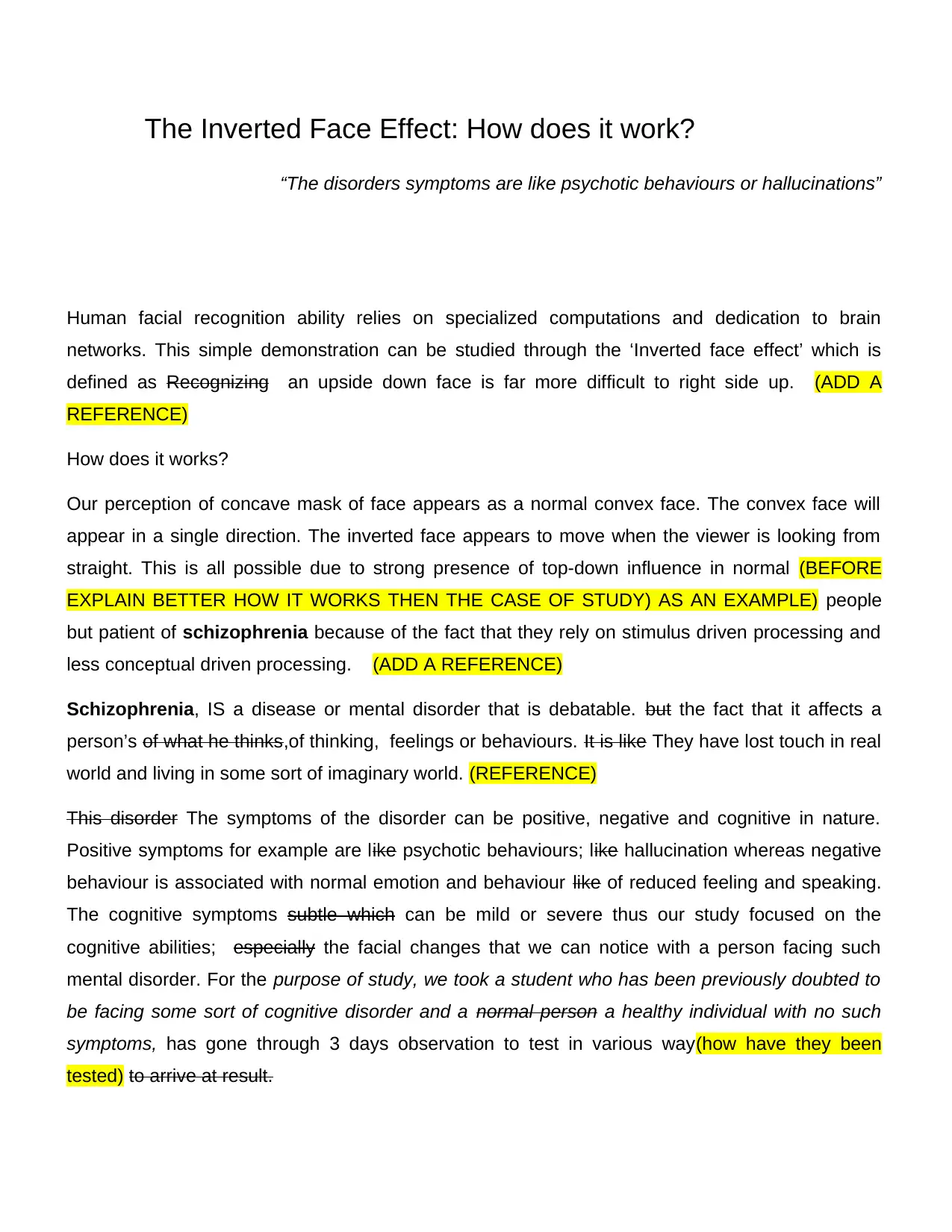
The Inverted Face Effect: How does it work?
“The disorders symptoms are like psychotic behaviours or hallucinations”
Human facial recognition ability relies on specialized computations and dedication to brain
networks. This simple demonstration can be studied through the ‘Inverted face effect’ which is
defined as Recognizing an upside down face is far more difficult to right side up. (ADD A
REFERENCE)
How does it works?
Our perception of concave mask of face appears as a normal convex face. The convex face will
appear in a single direction. The inverted face appears to move when the viewer is looking from
straight. This is all possible due to strong presence of top-down influence in normal (BEFORE
EXPLAIN BETTER HOW IT WORKS THEN THE CASE OF STUDY) AS AN EXAMPLE) people
but patient of schizophrenia because of the fact that they rely on stimulus driven processing and
less conceptual driven processing. (ADD A REFERENCE)
Schizophrenia, IS a disease or mental disorder that is debatable. but the fact that it affects a
person’s of what he thinks,of thinking, feelings or behaviours. It is like They have lost touch in real
world and living in some sort of imaginary world. (REFERENCE)
This disorder The symptoms of the disorder can be positive, negative and cognitive in nature.
Positive symptoms for example are like psychotic behaviours; like hallucination whereas negative
behaviour is associated with normal emotion and behaviour like of reduced feeling and speaking.
The cognitive symptoms subtle which can be mild or severe thus our study focused on the
cognitive abilities; especially the facial changes that we can notice with a person facing such
mental disorder. For the purpose of study, we took a student who has been previously doubted to
be facing some sort of cognitive disorder and a normal person a healthy individual with no such
symptoms, has gone through 3 days observation to test in various way(how have they been
tested) to arrive at result.
tabler-icon-diamond-filled.svg

Paraphrase This Document

Need a fresh take? Get an instant paraphrase of this document with our AI Paraphraser
Document Page
Inverted face effect is basically the loss of normal proficiency at face perception when faces are
inverted. Inverted face is not perceived or recognized using the same processes as upright face.
Inverted face are harder for normal objects to learn as measured to recognize the performance. In
a study it is found that inversion effect is nil in case of children. According to survey, it is gain
found that right hemisphere which is reported superior to left at recognizing face showed
significant difference in inversion face effect. THIS SHOULD BE IN THE INTRODUCTION??
Day-1 (participant 1)
On first day, we found that the person is having problems or alterations in several domains of
visual processing. This we came to know from the which was eye movement. Here We found that
the person is not able to concentrate on most of the informative regions like of the eyes. It is found
that there is lack of efficiency in finding information from inverse face. To find whether inverse face
has any effect on him the participant , we tried even with noise manipulation was used. Here we
found that The participant has an increased internal noise with coordinates with decreased
information efficiency resulting impair face discrimination and reduced face inversion effect.
Day-2- Experimental strategies
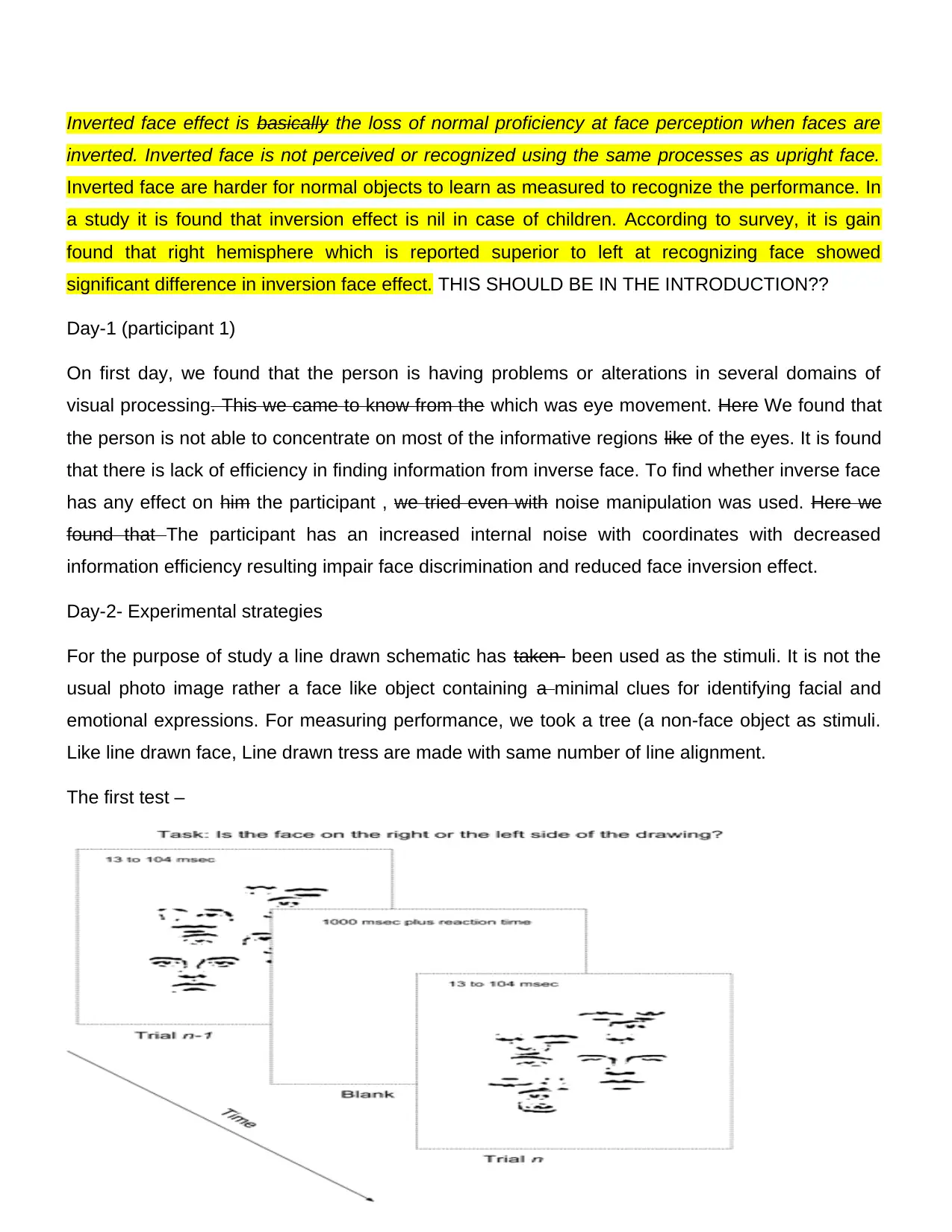
For the purpose of study a line drawn schematic has taken been used as the stimuli. It is not the
usual photo image rather a face like object containing a minimal clues for identifying facial and
emotional expressions. For measuring performance, we took a tree (a non-face object as stimuli.
Like line drawn face, Line drawn tress are made with same number of line alignment.
The first test –
Document Page
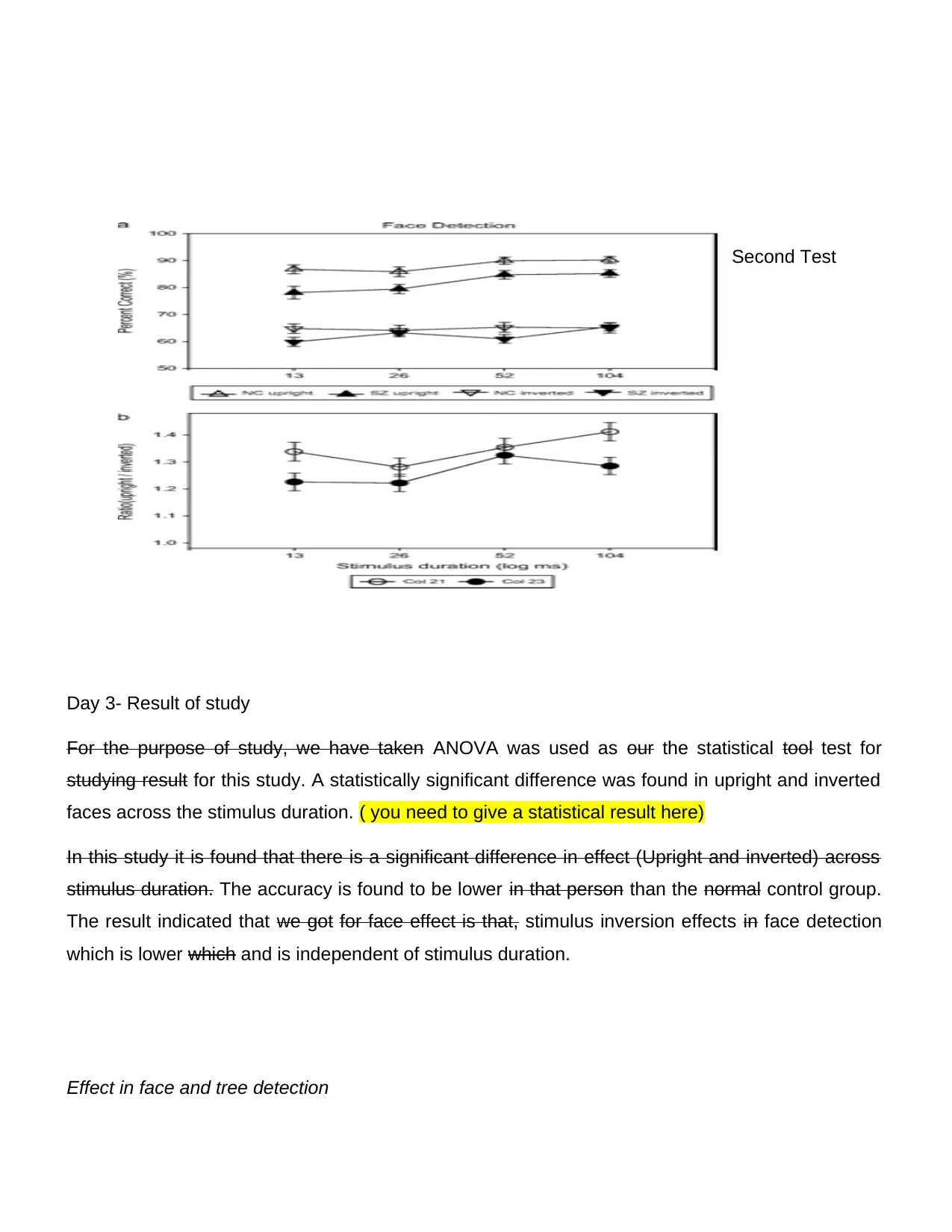
Second Test
Day 3- Result of study
For the purpose of study, we have taken ANOVA was used as our the statistical tool test for
studying result for this study. A statistically significant difference was found in upright and inverted
faces across the stimulus duration. ( you need to give a statistical result here)
In this study it is found that there is a significant difference in effect (Upright and inverted) across
stimulus duration. The accuracy is found to be lower in that person than the normal control group.
The result indicated that we got for face effect is that, stimulus inversion effects in face detection
which is lower which and is independent of stimulus duration.
Effect in face and tree detection
Document Page
In this case the result again came same but the fact we got here is that the face effect dependence
is on type of task i.e. primarily in tree not in face detection.
After repeating the study , the results showed that face effect dependence is for example primarily
in a tree not visible in face detection.
Hollow mask test-
In this case we try to find The connection that was being investigated of sensory and conceptual
areas of brain of that person which may not be working normal. functionally.
In this case a hollow mask is used one with no schizophrenic traits and other with the student
having symptoms of schizophrenia. The normal person is perceived as concave face as a normal
convex face.
Our top-down processing holds memories, like stock models," explains Danai Dima of Hannover
Medical University, in Germany (YEAR?), co-author of a study in Neuro Image. "All the models in
our head have a face coming out, so whenever we see a face, of course it has to come out."
This powerful expectation and analysis that the brain does, taking cues that lead to contrary
results.
But in case of patients with schizophrenia who have implausibility regards to hollow face. In our
case the Student found the face what it is ( what does this mean …? Explain yourself ….)
According to psychologists (YOU HAVE TO GIVE STUDIES AND REFERENCES) it is due to
misbalancing of bottom up and top down processing (WHAT IS DUE TO MISBALANCING ..?)
. In case of normal (you are not allowed to say normal people) people, bottom up approach comes
what he actually see and then top down comes when he uses the past experience.
In case of students that process doesn’t work and brain does not even do such complex analyses ,
so they don’t find any inverse change in face.
tabler-icon-diamond-filled.svg

Paraphrase This Document

Need a fresh take? Get an instant paraphrase of this document with our AI Paraphraser
Document Page
Reference.
1- Chen, Y., Norton, D., Ongur, D., & Heckers, S. (2007). Inefficient face detection in
schizophrenia. Schizophrenia bulletin, 34(2), 367-374.
2- Norton, D., McBain, R., Holt, D. J., Ongur, D., & Chen, Y. (2009). Association of impaired facial
affect recognition with basic facial and visual processing deficits in schizophrenia. Biological
psychiatry, 65(12), 1094-1098.
3- Li, H., Chan, R. C., McAlonan, G. M., & Gong, Q. Y. (2009). Facial emotion processing in
schizophrenia: a meta-analysis of functional neuroimaging data. Schizophrenia bulletin, 36(5),
1029-1039.
4- Butler, P. D., Tambini, A., Yovel, G., Jalbrzikowski, M., Ziwich, R., Silipo, G., ... & Javitt, D. C.
(2008). What's in a face? Effects of stimulus duration and inversion on face processing in
schizophrenia. Schizophrenia research, 103(1), 283-292.
chevron_up_icon
1 out of 5
circle_padding
hide_on_mobile
zoom_out_icon
[object Object]