Delving into the History and Origin of L'Hospital Rule

Verified

Added on  2023/01/10

|8
|2385
|70
Essay
AI Summary
This document delves into the historical origins of L'Hospital's Rule, a fundamental concept in calculus used for evaluating limits of indeterminate forms. It traces the rule's development, highlighting the contributions of mathematicians like Marquis de L'Hospital and Johann Bernoulli, and their interactions. The essay discusses the evolution of the rule, the controversies surrounding its authorship, and its significance in the broader context of mathematical analysis. It explores how L'Hospital's Rule provides a method for determining limits of functions where direct substitution fails, particularly in cases involving indeterminate forms such as 0/0 or ∞/∞. The paper also touches upon the broader historical context of calculus development, including the shift towards symbolic manipulation and the importance of graphical and numerical perspectives. The document draws upon various sources, including historical texts and academic publications, to provide a comprehensive overview of the rule's origins and its impact on the field of mathematics. The essay concludes by emphasizing the enduring importance of L'Hospital's Rule in calculus and the value of understanding its historical roots.
Document Page
The Origin of L’Hospital Rule 1
The Origin of LHospital Rule
Student
Course
Tutor
Institutional Affiliations
State
Date
tabler-icon-diamond-filled.svg

Paraphrase This Document

Need a fresh take? Get an instant paraphrase of this document with our AI Paraphraser
Document Page
The Origin of L’Hospital Rule 2
The Origin of LHospital Rule
One of the core values of the development calculus in the course of recent decades has
been the idea of moving towards all concepts and techniques from graphical and numerical just
as emblematic perspectives. Be that as it may, the adoption of the principles always hit brick wall
when the calculus courses reaches a certain level where the only possible approach appear to be
algebraic expressions. During this occasions, presentations normally get devolved to exclusive
symbolic manipulations. The application of the L’Hospital’s rule in evaluation of the limits of
various intermediate forms especially 0/0, - , and 0/01 is one of the topic.
This rule always get proven in classroom, after which we present a number of direct
examples which involve 0/0 then followed by other several examples where the L’Hospital rule
is repeatedly applied then it get extended to various cases where g and f approaches as x a
(or, in many cases as x . This is then followed by illustrations with several examples how
certain exponential and logarithmic expressions allows us to further extend the rule in order to
also apply to various intermediate forms like - and 1 which were normally included in
traditional home assignments with the assignment full of problems that needs a lot of algebraic
expressions to work.
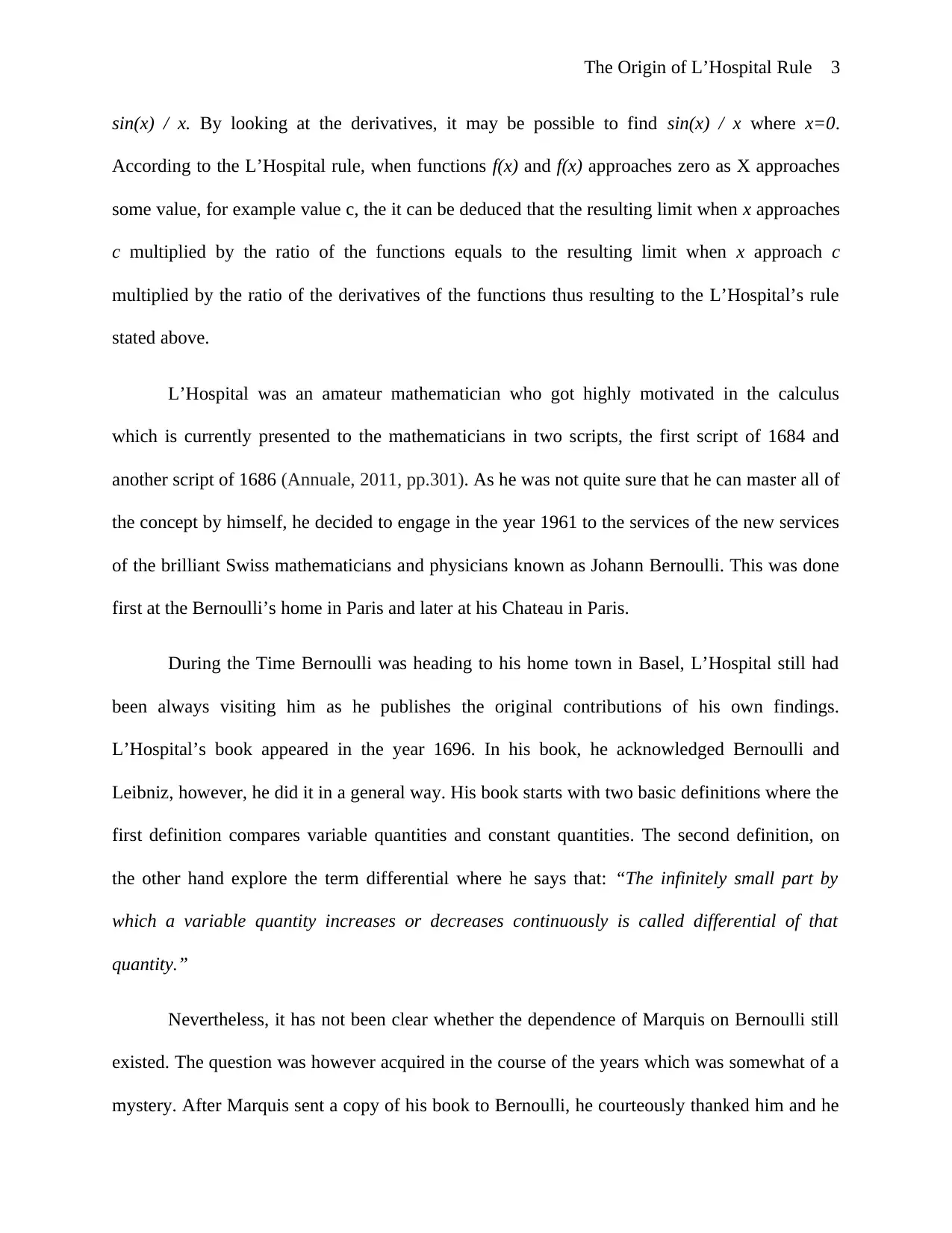
In this document, we look at the origin of the L’Hospital rule stating that:
given that f (a) = g(a), g’(a)≠0 got published for the first time by
Murquis De LHospital who was a French mathematician. In essence, this rule pushes that for two
functions that approaches zero, the values of the functions cannot be worked out at those points
to find the limits of the ratio. But we can find their derivative of zero (Pipes & Harvill, 2014,
pp.129). In that case, we will find the limits of the derivatives rather than finding the limit
Document Page
The Origin of L’Hospital Rule 3
sin(x) / x. By looking at the derivatives, it may be possible to find sin(x) / x where x=0.
According to the L’Hospital rule, when functions f(x) and f(x) approaches zero as X approaches
some value, for example value c, the it can be deduced that the resulting limit when x approaches
c multiplied by the ratio of the functions equals to the resulting limit when x approach c
multiplied by the ratio of the derivatives of the functions thus resulting to the L’Hospital’s rule
stated above.
L’Hospital was an amateur mathematician who got highly motivated in the calculus
which is currently presented to the mathematicians in two scripts, the first script of 1684 and
another script of 1686 (Annuale, 2011, pp.301). As he was not quite sure that he can master all of
the concept by himself, he decided to engage in the year 1961 to the services of the new services
of the brilliant Swiss mathematicians and physicians known as Johann Bernoulli. This was done
first at the Bernoulli’s home in Paris and later at his Chateau in Paris.
During the Time Bernoulli was heading to his home town in Basel, L’Hospital still had
been always visiting him as he publishes the original contributions of his own findings.
L’Hospital’s book appeared in the year 1696. In his book, he acknowledged Bernoulli and
Leibniz, however, he did it in a general way. His book starts with two basic definitions where the
first definition compares variable quantities and constant quantities. The second definition, on
the other hand explore the term differential where he says that: “The infinitely small part by
which a variable quantity increases or decreases continuously is called differential of that
quantity.”
Nevertheless, it has not been clear whether the dependence of Marquis on Bernoulli still
existed. The question was however acquired in the course of the years which was somewhat of a
mystery. After Marquis sent a copy of his book to Bernoulli, he courteously thanked him and he
Document Page
The Origin of L’Hospital Rule 4
praised the book. Though, in some of the private letters which got written during L’Hospital’s
lifetime, he claimed that much of the content in the book was his (Dumas, 2015, pp. 517-582).
After the death of L’hospital in the year 1704, Bernoulli made a public claim to that concern in
the section number 163, the section which contains the 0/0 rule.
Mathematicians who are inspired by such kind of priority baffles have been speculating
the alleged dependence of Marquis on Bernoulli from that point on, gaging the acknowledged
Bernoulli’s alongside his similarly acknowledged reputation for his viciousness. There was no
generally accepted conclusion up to the recent times.
But a noteworthy explanation regarding the issue came in the year 1922 when Bernoulli’s
work on differential calculus which was dating back from the year 1691 got published. A
manuscript of the same kind but on integral calculus which was published in the year 1742 had
gotten known from the author (Warner, 2016, pp. 47-69). A comparison between the Bernoulli’s
books and the L’Hospital’s suggested a considerable overlapping such that Bernoulli seemed to
have improved on the L’Hospital’s work. Be that as it may, the truth came to light during the
publication of the Bernoulli’s early correspondence. It was discovered that back in the year 1694,
there was a deal between L’Hospital and his former tutor Bernoulli where he offered his tutor a
yearly allowance on the given that Bernoulli agree to three conditions, the first condition was
that he was to work out all the mathematical problems sent by L’Hospital, and second, he had to
make all the discovery which were made to him and lastly to stop disseminating copies of notes
sent to him by L’Hospital (Scott, 2016, pp. 191-212). This addressed the question.
The response letter from Bernoulli has not been traced, however, according to the letter
of July 1694, it is obvious that Bernoulli had accepted the proposal. Many letters sent by
Bernoulli to his patron contacting answers to the questions are now published (Bussotti and
tabler-icon-diamond-filled.svg

Paraphrase This Document

Need a fresh take? Get an instant paraphrase of this document with our AI Paraphraser
Document Page
The Origin of L’Hospital Rule 5
Pisano, 2014, pp.413-445). The letter which is dating back to July 1694 is containing the
formulation rule, the rule is much similar to the one in the L’Hospital’s book and it is based on
geometrical thought. Shown as follows:
Y= f(x)/g(x);
All of the curves y = f (x) and y = g (x) passes through one point labelled ‘p’ on the x-axis where
if a coordinate of x = a + h, then it is shown that: (f (a + h)/ g (a + h) which is an approximate
value hf’(a + h) and hg’(a + h) when h is smaller than a. According to Bernoulli, in order to
determine ordinates in the curve y = f(x)/g(x), the differential of the numerator is divided by the
differential of the denominator. Bernoulli and L’Hospital’s workings are almost similar.
The situation has now been explained. On the appearance of the Marquis’s book, Johann
Bernoulli got bound not to make known the section of the book belonging to him, as such,
Bernoulli could not express himself to the public (Knecht, 2016, pp.42-56). He latter felt, after
the death of L’Hospital that he does not need to be silent any more. As a result, he claimed that
most of the content in the book are his including the 0/0 rule. Be that as it may, Bernoulli could
not prove his allegations, however, he felt vindicated at the present.
This paper does not conclude that the laws should therefore be called after Bernoulli.
Besides, there are a lot of rules that are already called after Bernoulli, may be due to three
Bernoulli’s family members including Daniel, Johann and Jacob. However, there is a more
important thought. When the names of the rules and theorems are changed to the rules of
priority, it can be seen that our science will start losing a lot of its familiar expressions
(Diefendorf, 2014, pp.58-61). Before the sage of Crotona lived, the Pythagoras theorem was
more popular in Babylonians compared to millennium (Desan, 2016, pp.04; Smoryński, 2017,
Document Page
The Origin of L’Hospital Rule 6
pp. 151-444). Additionally, Fourier’s equation was used by Daniel Bernoulli and Euler, Pascal’s
triangle was also known to Yang Hui the China mathematician in thirteenth century whose
contemporary Chin-Shao was proven to be working with Horner’s method in algebraic equation
theory like with an ancient tool among others.
As a conclusion, it can be noted that the names which are attached to mathematical
discoveries are in many occasions the names of individuals who made the results to get better
understood through their own workings. As a new historical innovation affect the balance of
nomenclature, L’Hospital deserves to keep his elegant rule, besides, he paid for the rule and
availed it to the public (Vilumara, 2014, pp.76). Moreover, L’Hospittal is worth some fame, this
is due to the reason that his book on calculus does not only contain contributions of his own but
was also the first book to be published. It was also good enough to hold its noticeable position
for centuries. L’Hospital’s book continued and will still be the best publication for introduction
to calculus in the face of the better text books appearing. There is a 1790 late edition of the book.
The book appears in both Latin and English translation. Some commentaries including L’Hospita
friends Varigon also exist. It should be accorded respect it deserves.
Document Page
The Origin of L’Hospital Rule 7
Reference list
“Guillaume Fracois Antoine Marquis de L’Hospital”. University of Andrews, Scotland, pp. 01.
Accessed on 8th May 2019 at:
<http://www-groups.dcs.st-and.ac.uk/~history/Biographies/De_LHopital.html>
Annuale, S.S.R., 2011. Abbott, Nabia.“A Ninth Century Fragment of the Thousand Nights: New
Light on the Early History of the Arabian Nights.” Journal of Near Eastern Studies 8, no. 3
(1949): 129–61. Adas, Michael. Machines as the Measure of Men: Science, Technology, and
Ideologies of Western Dominance. Ithaca, NY: Cornell University Press, 1989. Enlightenment
Orientalism: Resisting the Rise of the Novel, 61(3), p.301.
Bussotti, P. and Pisano, R., 2014. History of mathematics--Newton's philosophiae naturalis
principia mathematica" Jesuit" edition: the tenor of a huge work. Rendiconti Lincei-Matematica
e Applicazioni, 25(4), pp.413-445.
Desan, P. ed., 2016. The Oxford Handbook of Montaigne. Oxford University Press, pp.04.
Diefendorf, B.B., 2014. Paris City Councillors in the Sixteenth-Century: The Politics of
Patrimony (Vol. 981). Princeton University Press, pp.58-61.
Dumas, G., 2015. Sources et bibliographie. In Santé et société à Montpellier à la fin du Moyen
Âge (pp. 517-582). BRILL.
Pipes, L. A., & Harvill, L. R. (2014). Applied mathematics for engineers and physicists. Courier
Corporation, pp.129.
tabler-icon-diamond-filled.svg

Paraphrase This Document

Need a fresh take? Get an instant paraphrase of this document with our AI Paraphraser
Document Page
The Origin of L’Hospital Rule 8
Knecht, R.J., 2016. Hero or Tyrant? Henry III, King of France, 1574-89. Routledge, pp.42-56.
Scott, A.M., 2016. ‘comme bons citoyens’: Faith and Politics in the Poor Relief of Later
Sixteenth-Century Gap. In Experiences of Charity, 1250-1650 (pp. 191-212). Routledge.
Smoryński, C., 2017. The Mean Value Theorem. In MVT: A Most Valuable Theorem (pp. 151-
444). Springer, Cham.
Vilumara, P.G., 2014. LOS CURSOS DE CIENCIAS DE L’ÉCOLE NORMALE DEL AÑO III
(1795) VISTOS POR SUS ALUMNOS. In VII SIMPOSIO ENSEÑANZA E HISTORIA DE LAS
CIENCIAS Y DE LAS TÉCNICAS: ORIENTACIÓN, METODOLOGÍAS Y PERSPECTIVAS (p.
76).
Warner, L., 2016. The ideas of man and woman in Renaissance France: print, rhetoric, and law.
Routledge, pp. 47-69.
chevron_up_icon
1 out of 8
circle_padding
hide_on_mobile
zoom_out_icon
[object Object]