Analyzing Wealth Distribution: Political Economy of Development
VerifiedAdded on 2024/05/16
|14
|2716
|231
Essay
AI Summary
This essay examines the political economy of development, focusing on the crucial role of wealth distribution. It discusses how production and equitable resource allocation are vital for economic growth and societal welfare. The essay analyzes the importance of aligning economic and political environments to foster long-term prosperity, using examples like the UK and US. It delves into factors of production, labor allocation, and the impact of government policies on wealth creation and distribution. Furthermore, the essay evaluates the effectiveness of wealth distribution by considering income inequality, poverty levels, and access to resources like healthcare and education. It concludes by emphasizing the need for balanced wealth distribution to ensure economic stability and the welfare of all citizens, highlighting the role of political institutions in achieving this balance.
POLITICAL ECONOMY OF DEVELOPMENT
Student Name:
Student ID:
1
Student Name:
Student ID:
1

Paraphrase This Document
Need a fresh take? Get an instant paraphrase of this document with our AI Paraphraser
Executive Summary
Growth is essential in a society as human being have ever-expanding needs and demands.
Producing a greater amount of goods and services is important to affect this type of economic
growth. The political economy as the custodian of welfare for the people provides the different
measures and opportunities that can be used to increase growth and bring about beneficial gains
for the people.
It is also important that this growth is carried out in such a way that wealth is distributed equally
amongst the different citizens of the country. By analysing equitable wealth distribution, a
benchmark can be established for the proper gains that the political economy must effectively
generate for its people.
2
Growth is essential in a society as human being have ever-expanding needs and demands.
Producing a greater amount of goods and services is important to affect this type of economic
growth. The political economy as the custodian of welfare for the people provides the different
measures and opportunities that can be used to increase growth and bring about beneficial gains
for the people.
It is also important that this growth is carried out in such a way that wealth is distributed equally
amongst the different citizens of the country. By analysing equitable wealth distribution, a
benchmark can be established for the proper gains that the political economy must effectively
generate for its people.
2
Table of Contents
Introduction......................................................................................................................................4
What is the political economy?........................................................................................................5
How production matters in the political economy?.........................................................................5
How distribution matters in this economy?.....................................................................................7
How are productive resource allocated equitably?..........................................................................8
Distribution of wealth......................................................................................................................8
Appraising equal wealth distribution...............................................................................................9
Conclusion.....................................................................................................................................12
Reference List................................................................................................................................13
3
Introduction......................................................................................................................................4
What is the political economy?........................................................................................................5
How production matters in the political economy?.........................................................................5
How distribution matters in this economy?.....................................................................................7
How are productive resource allocated equitably?..........................................................................8
Distribution of wealth......................................................................................................................8
Appraising equal wealth distribution...............................................................................................9
Conclusion.....................................................................................................................................12
Reference List................................................................................................................................13
3
⊘ This is a preview!⊘
Do you want full access?
Subscribe today to unlock all pages.

Trusted by 1+ million students worldwide
Introduction
A robust relationship between the economic environment and the political environment is
integral for the growth and expansion of a country. The influence held by the government
influences wealth building and its distribution. The production of goods and services is important
as this leads to wealth building, which, once distributed amongst the citizens of a country
increases welfare and national stability.
Nation building is affected by a variety of factors and it is the government’s responsibility to
maintain these effectively. The effective maintenance of resources and wealth creation, when
done in a cohesive fashion wins the government the favour of the people and ensures political
stability.
A healthy relationship would ensure that the country has long-term viability in relationship to
growth and expansion. Countries such as the United States and the United Kingdom have been
able to manage this relationship in a very effective manner, which ensured that all their citizens
experienced prosperity and wealth building through several centuries of successful economic
processes.
4
A robust relationship between the economic environment and the political environment is
integral for the growth and expansion of a country. The influence held by the government
influences wealth building and its distribution. The production of goods and services is important
as this leads to wealth building, which, once distributed amongst the citizens of a country
increases welfare and national stability.
Nation building is affected by a variety of factors and it is the government’s responsibility to
maintain these effectively. The effective maintenance of resources and wealth creation, when
done in a cohesive fashion wins the government the favour of the people and ensures political
stability.
A healthy relationship would ensure that the country has long-term viability in relationship to
growth and expansion. Countries such as the United States and the United Kingdom have been
able to manage this relationship in a very effective manner, which ensured that all their citizens
experienced prosperity and wealth building through several centuries of successful economic
processes.
4
Paraphrase This Document
Need a fresh take? Get an instant paraphrase of this document with our AI Paraphraser
What is the political economy?
The unified nature of the world and the ways in which different governments interact with global
economics provides the basis for the political economy. Changes in the prices of oil, labour
market fluctuations and the ways in which global institutions interact with each other are all a
part of the political economy. The British political economy is a dynamic space where the
government is responsible for the ways in which people live and interact with the resources that
are presented to them.
Global finances, globalisation and BREXIT are just some of the results of an effective
relationship between the political and economic domains. For example, BREXIT had a huge
economic fallout as billions of pounds were wiped of the stock market, while the destabilised
pound reduced the earnings of British firms all over the world. Such is the effect of the political
economy that the world has become interconnected and countries all over the world depend on
each for economic and political stability. This is able to provide a sense economic safety and
security.
The bifurcation between politics and economics indicate that each variable is autonomous in
nature, but each should be sustained to ensure long-term growth and prosperity for the country.
How production matters in the political economy?
There are various factors of production, such as land, labour and capital. Countries and
economies cannot function without such resources and the political spheres of any country
require the effective handling of this. Production and resource handling are essential as these
affect welfare and value utilisation. By processing production effectively, all economic
resources can be used towards the satisfaction of human needs and wants. Market production is
essential in this sector as it leads to commodity extraction and by ensuring profit maximisation
leads to the increase in the flow of money in the country. Figure 1 shows the various types of
streams, where resources are used effectively for value creation.
5
The unified nature of the world and the ways in which different governments interact with global
economics provides the basis for the political economy. Changes in the prices of oil, labour
market fluctuations and the ways in which global institutions interact with each other are all a
part of the political economy. The British political economy is a dynamic space where the
government is responsible for the ways in which people live and interact with the resources that
are presented to them.
Global finances, globalisation and BREXIT are just some of the results of an effective
relationship between the political and economic domains. For example, BREXIT had a huge
economic fallout as billions of pounds were wiped of the stock market, while the destabilised
pound reduced the earnings of British firms all over the world. Such is the effect of the political
economy that the world has become interconnected and countries all over the world depend on
each for economic and political stability. This is able to provide a sense economic safety and
security.
The bifurcation between politics and economics indicate that each variable is autonomous in
nature, but each should be sustained to ensure long-term growth and prosperity for the country.
How production matters in the political economy?
There are various factors of production, such as land, labour and capital. Countries and
economies cannot function without such resources and the political spheres of any country
require the effective handling of this. Production and resource handling are essential as these
affect welfare and value utilisation. By processing production effectively, all economic
resources can be used towards the satisfaction of human needs and wants. Market production is
essential in this sector as it leads to commodity extraction and by ensuring profit maximisation
leads to the increase in the flow of money in the country. Figure 1 shows the various types of
streams, where resources are used effectively for value creation.
5
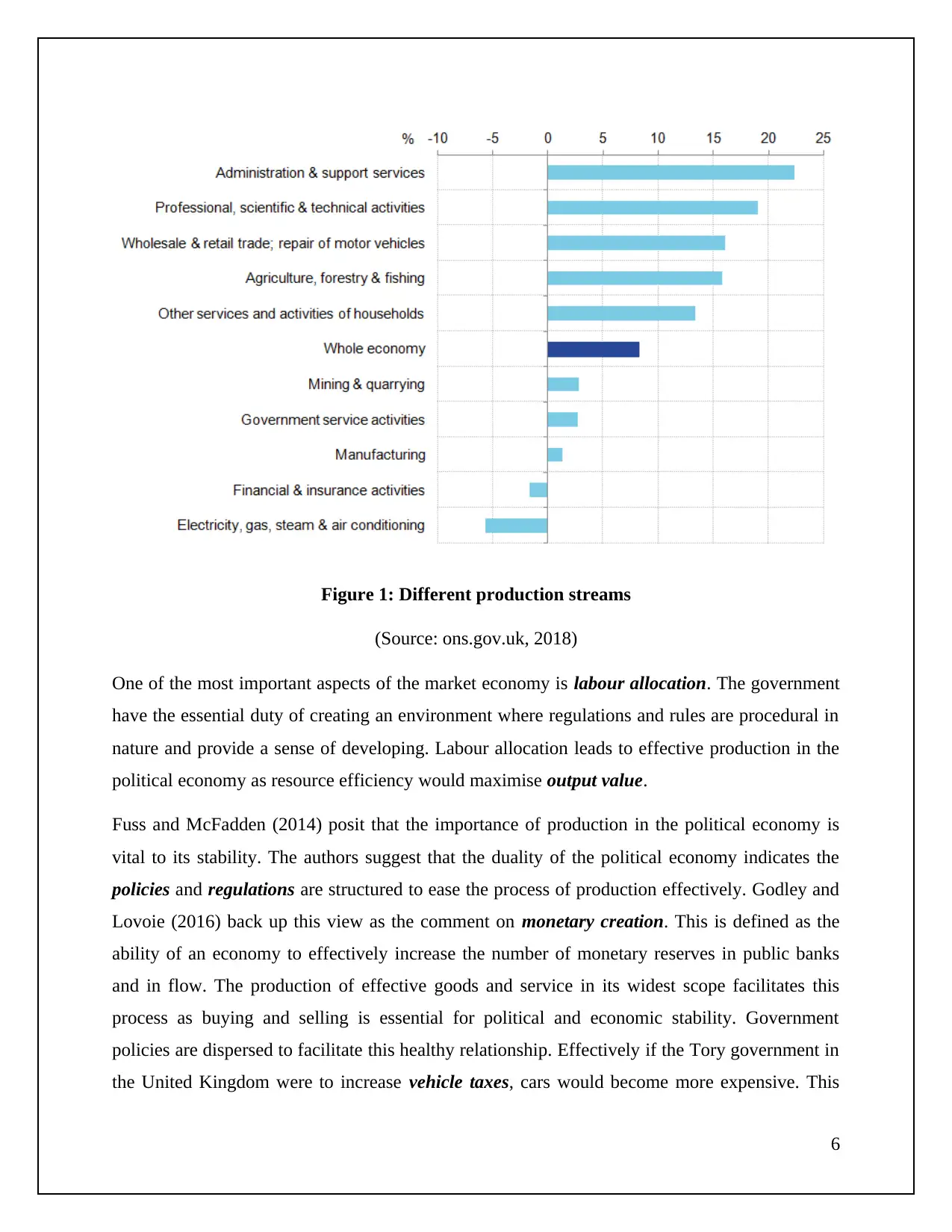
Figure 1: Different production streams
(Source: ons.gov.uk, 2018)
One of the most important aspects of the market economy is labour allocation. The government
have the essential duty of creating an environment where regulations and rules are procedural in
nature and provide a sense of developing. Labour allocation leads to effective production in the
political economy as resource efficiency would maximise output value.
Fuss and McFadden (2014) posit that the importance of production in the political economy is
vital to its stability. The authors suggest that the duality of the political economy indicates the
policies and regulations are structured to ease the process of production effectively. Godley and
Lovoie (2016) back up this view as the comment on monetary creation. This is defined as the
ability of an economy to effectively increase the number of monetary reserves in public banks
and in flow. The production of effective goods and service in its widest scope facilitates this
process as buying and selling is essential for political and economic stability. Government
policies are dispersed to facilitate this healthy relationship. Effectively if the Tory government in
the United Kingdom were to increase vehicle taxes, cars would become more expensive. This
6
(Source: ons.gov.uk, 2018)
One of the most important aspects of the market economy is labour allocation. The government
have the essential duty of creating an environment where regulations and rules are procedural in
nature and provide a sense of developing. Labour allocation leads to effective production in the
political economy as resource efficiency would maximise output value.
Fuss and McFadden (2014) posit that the importance of production in the political economy is
vital to its stability. The authors suggest that the duality of the political economy indicates the
policies and regulations are structured to ease the process of production effectively. Godley and
Lovoie (2016) back up this view as the comment on monetary creation. This is defined as the
ability of an economy to effectively increase the number of monetary reserves in public banks
and in flow. The production of effective goods and service in its widest scope facilitates this
process as buying and selling is essential for political and economic stability. Government
policies are dispersed to facilitate this healthy relationship. Effectively if the Tory government in
the United Kingdom were to increase vehicle taxes, cars would become more expensive. This
6
⊘ This is a preview!⊘
Do you want full access?
Subscribe today to unlock all pages.
Trusted by 1+ million students worldwide
would lead to a decrease in the demand for vehicles affecting the automobile industry and
production levels in the country subsequently.
How distribution matters in this economy?
Rees (2017) posits that the allocation of all resources, especially those of the natural kind are
essential for production processes of any company. Dahl (2017) backs up this view as the author
comments about the important of resource distribution as it effectually provides for wealth
creation and distribution. It is essential for the political economy to be able to divide and
distribute resource equally as the market hinterland needs to be covered comprehensively.
Economic activities such as mining, fishing, and farming were some of the earliest economic
phenomenon, where governments distributed resources equitably amongst different sectors to
extract the highest amount of efficient and product value. While production is essential for value
creation, the process can only be carried in an effectual manner if each production unit is
provided an equal opportunity to perform well. Equitable distribution and production are
essential for trade (Arrondel et al., 2015) The United Kingdom a country, which is not rich is
resources is one of the wealthiest countries in the world as they use these resources in the most
effective manner. The existence of several multinationals also means that the country has been
able use the monetary reserves to buy the resources that they need.
Distribution is important as it affects production in positive manners and ensures growth and
expansions of the productive capabilities of the political economy (Stiglitz, 2015). By controlling
these distributive features, the government will be able to have measured responses to any
economic shocks or dips. Stiglitz and Risengard (2015) comment on nature of welfare
economics, where such an equitable distribution would protect the economy from a market
failure and provide for continuous production and an increase in such capabilities. Distribution
incrementally facilitates the process of competitive markets, where the political economy
systematically works towards total efficiency and productive measures, which would
unfathomably trigger growth and welfare expansion.
7
production levels in the country subsequently.
How distribution matters in this economy?
Rees (2017) posits that the allocation of all resources, especially those of the natural kind are
essential for production processes of any company. Dahl (2017) backs up this view as the author
comments about the important of resource distribution as it effectually provides for wealth
creation and distribution. It is essential for the political economy to be able to divide and
distribute resource equally as the market hinterland needs to be covered comprehensively.
Economic activities such as mining, fishing, and farming were some of the earliest economic
phenomenon, where governments distributed resources equitably amongst different sectors to
extract the highest amount of efficient and product value. While production is essential for value
creation, the process can only be carried in an effectual manner if each production unit is
provided an equal opportunity to perform well. Equitable distribution and production are
essential for trade (Arrondel et al., 2015) The United Kingdom a country, which is not rich is
resources is one of the wealthiest countries in the world as they use these resources in the most
effective manner. The existence of several multinationals also means that the country has been
able use the monetary reserves to buy the resources that they need.
Distribution is important as it affects production in positive manners and ensures growth and
expansions of the productive capabilities of the political economy (Stiglitz, 2015). By controlling
these distributive features, the government will be able to have measured responses to any
economic shocks or dips. Stiglitz and Risengard (2015) comment on nature of welfare
economics, where such an equitable distribution would protect the economy from a market
failure and provide for continuous production and an increase in such capabilities. Distribution
incrementally facilitates the process of competitive markets, where the political economy
systematically works towards total efficiency and productive measures, which would
unfathomably trigger growth and welfare expansion.
7
Paraphrase This Document
Need a fresh take? Get an instant paraphrase of this document with our AI Paraphraser
How are productive resource allocated equitably?
John Rawls (a philosopher born in 1921) posited that equity and justice are essential in the
political economy, as equal distribution is important for measured growth and a sense of a
competitive advantage. Once the process of production has been undertaken, measuring growth
in the form of resource allocation, provide the views of fairer opportunity, where all productive
units work towards wholesome growth (Weedon, 2017).
Other than distributing features such as the right to healthcare or education, government, such as
the British institution would concentrate on providing a fair access to different companies to use
resource efficiently and increase their production levels incrementally. Anti-competition laws
governed by the British government is proof of the framework that the government puts in place
to ensure that is able to allocate resources in an equitable manner. By using such measures, a
strong sense of competition is maintained, which then allows the British economy and different
political establishments to preserve this productive environment.
Distribution of wealth
The creation of a sense of equality in wealth distribution is essential and is an effective yardstick
to measure the productive nature of the economic and political environment. However, the
political economy in all its sincerity and earnest economic measures has not been able to ensure
this equality effectively (Jones, 2015). This can be measured in terms of the increasing levels of
poverty that can be observed in the United Kingdom or the rising levels of homelessness that
provides for a sense of overwhelming economic disparity.
The very high levels of income inequality measured in the United Kingdom indicate that there is
a failing in the political economy. Household incomes and disposable incomes are effective
yardsticks to measure how equally resources are allocated amongst the British population. There
is a huge disparity in terms of what the top 1 per cent in the country earns as compared to the rest
of the population. (Hendricks, 2015).
8
John Rawls (a philosopher born in 1921) posited that equity and justice are essential in the
political economy, as equal distribution is important for measured growth and a sense of a
competitive advantage. Once the process of production has been undertaken, measuring growth
in the form of resource allocation, provide the views of fairer opportunity, where all productive
units work towards wholesome growth (Weedon, 2017).
Other than distributing features such as the right to healthcare or education, government, such as
the British institution would concentrate on providing a fair access to different companies to use
resource efficiently and increase their production levels incrementally. Anti-competition laws
governed by the British government is proof of the framework that the government puts in place
to ensure that is able to allocate resources in an equitable manner. By using such measures, a
strong sense of competition is maintained, which then allows the British economy and different
political establishments to preserve this productive environment.
Distribution of wealth
The creation of a sense of equality in wealth distribution is essential and is an effective yardstick
to measure the productive nature of the economic and political environment. However, the
political economy in all its sincerity and earnest economic measures has not been able to ensure
this equality effectively (Jones, 2015). This can be measured in terms of the increasing levels of
poverty that can be observed in the United Kingdom or the rising levels of homelessness that
provides for a sense of overwhelming economic disparity.
The very high levels of income inequality measured in the United Kingdom indicate that there is
a failing in the political economy. Household incomes and disposable incomes are effective
yardsticks to measure how equally resources are allocated amongst the British population. There
is a huge disparity in terms of what the top 1 per cent in the country earns as compared to the rest
of the population. (Hendricks, 2015).
8
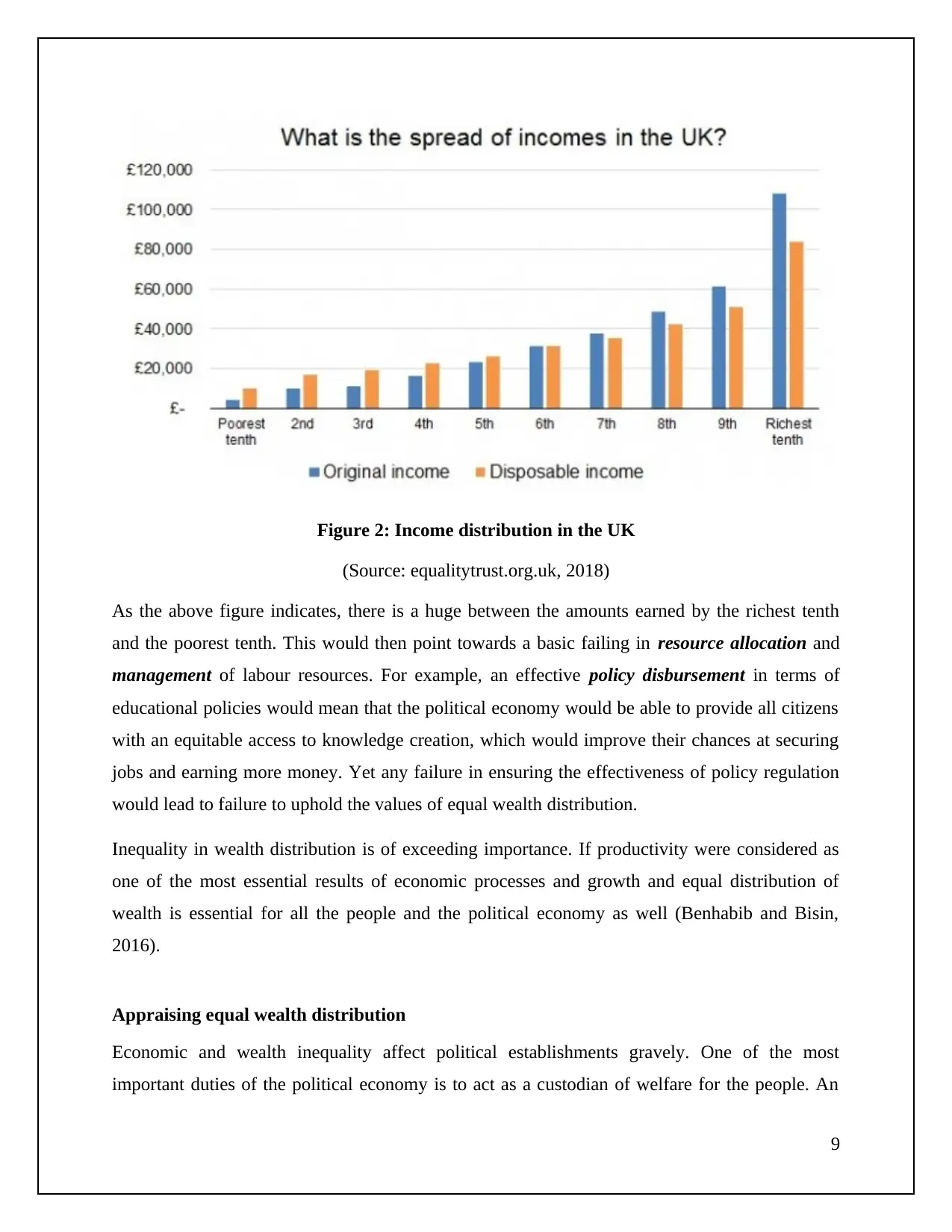
Figure 2: Income distribution in the UK
(Source: equalitytrust.org.uk, 2018)
As the above figure indicates, there is a huge between the amounts earned by the richest tenth
and the poorest tenth. This would then point towards a basic failing in resource allocation and
management of labour resources. For example, an effective policy disbursement in terms of
educational policies would mean that the political economy would be able to provide all citizens
with an equitable access to knowledge creation, which would improve their chances at securing
jobs and earning more money. Yet any failure in ensuring the effectiveness of policy regulation
would lead to failure to uphold the values of equal wealth distribution.
Inequality in wealth distribution is of exceeding importance. If productivity were considered as
one of the most essential results of economic processes and growth and equal distribution of
wealth is essential for all the people and the political economy as well (Benhabib and Bisin,
2016).
Appraising equal wealth distribution
Economic and wealth inequality affect political establishments gravely. One of the most
important duties of the political economy is to act as a custodian of welfare for the people. An
9
(Source: equalitytrust.org.uk, 2018)
As the above figure indicates, there is a huge between the amounts earned by the richest tenth
and the poorest tenth. This would then point towards a basic failing in resource allocation and
management of labour resources. For example, an effective policy disbursement in terms of
educational policies would mean that the political economy would be able to provide all citizens
with an equitable access to knowledge creation, which would improve their chances at securing
jobs and earning more money. Yet any failure in ensuring the effectiveness of policy regulation
would lead to failure to uphold the values of equal wealth distribution.
Inequality in wealth distribution is of exceeding importance. If productivity were considered as
one of the most essential results of economic processes and growth and equal distribution of
wealth is essential for all the people and the political economy as well (Benhabib and Bisin,
2016).
Appraising equal wealth distribution
Economic and wealth inequality affect political establishments gravely. One of the most
important duties of the political economy is to act as a custodian of welfare for the people. An
9
⊘ This is a preview!⊘
Do you want full access?
Subscribe today to unlock all pages.
Trusted by 1+ million students worldwide
unequal distribution of wealth would provide for an imbalance of powers. If the government
were acting in the interest of the wealthier few by reducing tax margins on higher incomes, then
discrepancies in distribution would lead to economic uncertainty (Roine and Waldenström, 2
015). Yet, it is important to analyse that the main power of the economy that lies in the hands of
political institutions, which are voted in by the people themselves. The capabilities of these
institutions affect the decision making capabilities in the country and mean that there must be
consolidated decisions made in terms of how to make more effectual and equitable decisions.
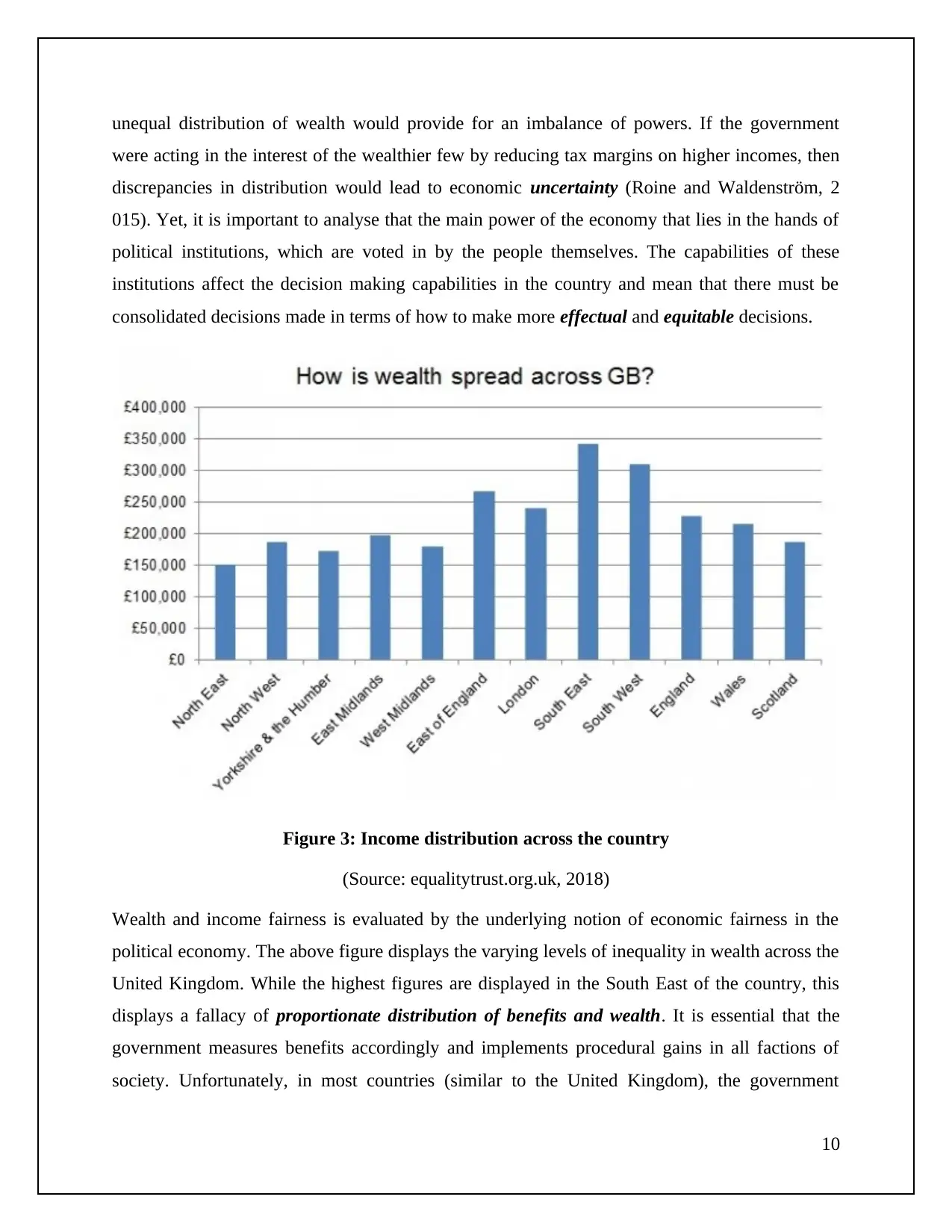
Figure 3: Income distribution across the country
(Source: equalitytrust.org.uk, 2018)
Wealth and income fairness is evaluated by the underlying notion of economic fairness in the
political economy. The above figure displays the varying levels of inequality in wealth across the
United Kingdom. While the highest figures are displayed in the South East of the country, this
displays a fallacy of proportionate distribution of benefits and wealth. It is essential that the
government measures benefits accordingly and implements procedural gains in all factions of
society. Unfortunately, in most countries (similar to the United Kingdom), the government
10
were acting in the interest of the wealthier few by reducing tax margins on higher incomes, then
discrepancies in distribution would lead to economic uncertainty (Roine and Waldenström, 2
015). Yet, it is important to analyse that the main power of the economy that lies in the hands of
political institutions, which are voted in by the people themselves. The capabilities of these
institutions affect the decision making capabilities in the country and mean that there must be
consolidated decisions made in terms of how to make more effectual and equitable decisions.
Figure 3: Income distribution across the country
(Source: equalitytrust.org.uk, 2018)
Wealth and income fairness is evaluated by the underlying notion of economic fairness in the
political economy. The above figure displays the varying levels of inequality in wealth across the
United Kingdom. While the highest figures are displayed in the South East of the country, this
displays a fallacy of proportionate distribution of benefits and wealth. It is essential that the
government measures benefits accordingly and implements procedural gains in all factions of
society. Unfortunately, in most countries (similar to the United Kingdom), the government
10
Paraphrase This Document
Need a fresh take? Get an instant paraphrase of this document with our AI Paraphraser
operates in a dynamic political and economic background, which means that benefits cannot be
distributed unless all aspects of the population are considered in a standardised manner.
Appraising the need for equitable income and wealth distribution backs up the productivity and
resource processing capabilities of the country. By providing opportunities to all the factions in
the country there is a chance that people will be able to contribute in a collective manner towards
economic sustainability and growth (Kleinert and Wendner, 2016).
11
distributed unless all aspects of the population are considered in a standardised manner.
Appraising the need for equitable income and wealth distribution backs up the productivity and
resource processing capabilities of the country. By providing opportunities to all the factions in
the country there is a chance that people will be able to contribute in a collective manner towards
economic sustainability and growth (Kleinert and Wendner, 2016).
11
Conclusion
By analysing equitable wealth distribution and productivity of the political economy, the learner
has been able to provide an understanding of the different strategies that can be used to
proactively affect growth and expansion in a positive manner. Measuring growth is important
and provides for an understanding of how economic activities and expansion can lead an
increased incidence of equitable wealth distribution. An understanding of production in the
political economy satiates this need for growth and thus explains the different ways that can be
used to improve economic gains and distributive powers.
12
By analysing equitable wealth distribution and productivity of the political economy, the learner
has been able to provide an understanding of the different strategies that can be used to
proactively affect growth and expansion in a positive manner. Measuring growth is important
and provides for an understanding of how economic activities and expansion can lead an
increased incidence of equitable wealth distribution. An understanding of production in the
political economy satiates this need for growth and thus explains the different ways that can be
used to improve economic gains and distributive powers.
12
⊘ This is a preview!⊘
Do you want full access?
Subscribe today to unlock all pages.
Trusted by 1+ million students worldwide

1 out of 14


Related Documents


Your All-in-One AI-Powered Toolkit for Academic Success.
+13062052269
info@desklib.com
Available 24*7 on WhatsApp / Email
![[object Object]](/_next/static/media/star-bottom.7253800d.svg)
Unlock your academic potential
Copyright © 2020–2026 A2Z Services. All Rights Reserved. Developed and managed by ZUCOL.