The Food Act of 1906: Historical Context, Comparison, and Analysis

Verified

Added on  2022/08/09

|4
|729
|43
Essay
AI Summary
This essay delves into the Pure Food and Drug Act of 1906, examining its historical context, particularly the unhygienic conditions within the meatpacking industry and the public's response, as highlighted by Upton Sinclair's "The Jungle." The paper discusses the Act's role in establishing food inspection and legislation, addressing the poor working conditions and ill-treatment of meatpackers, especially in Chicago. It offers a comparative analysis of the Act's positive and negative impacts, highlighting its success in improving hygiene and working conditions while acknowledging ongoing health hazards for workers. The essay also references the impact of the Pure Food Act on the meat packing industry and the need for continued vigilance in protecting both workers and consumers. The essay concludes by summarizing the lasting impact of the Act on the meat packaging industry and the need for continued improvements.
Document Page
Running head: THE FOOD ACT OF 1906
THE FOOD ACT OF 1906
Name of the Student
Name of the University
Author Note
Course ID:
tabler-icon-diamond-filled.svg

Paraphrase This Document

Need a fresh take? Get an instant paraphrase of this document with our AI Paraphraser
Document Page
1THE FOOD ACT OF 1906
Introduction
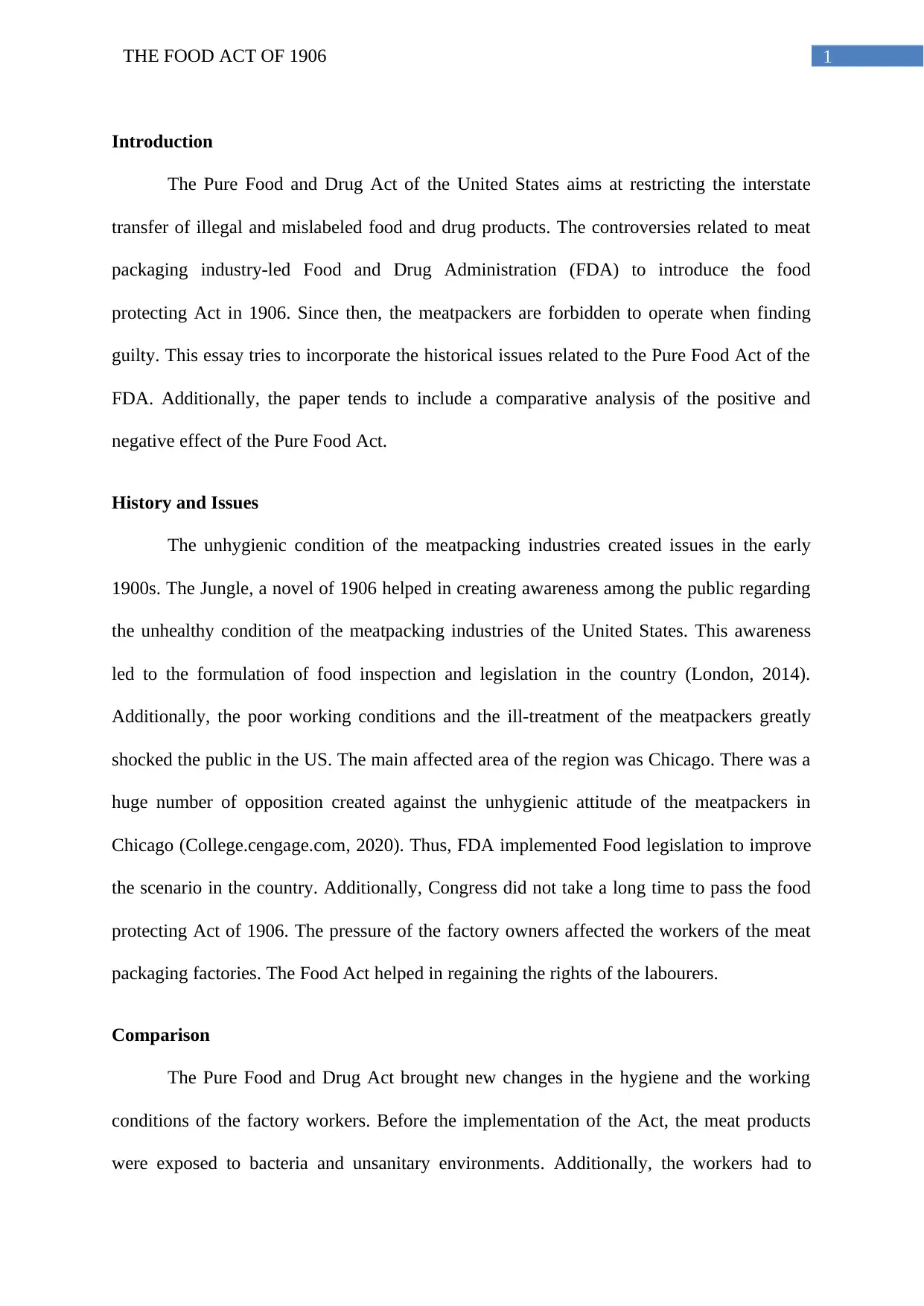
The Pure Food and Drug Act of the United States aims at restricting the interstate
transfer of illegal and mislabeled food and drug products. The controversies related to meat
packaging industry-led Food and Drug Administration (FDA) to introduce the food
protecting Act in 1906. Since then, the meatpackers are forbidden to operate when finding
guilty. This essay tries to incorporate the historical issues related to the Pure Food Act of the
FDA. Additionally, the paper tends to include a comparative analysis of the positive and
negative effect of the Pure Food Act.
History and Issues
The unhygienic condition of the meatpacking industries created issues in the early
1900s. The Jungle, a novel of 1906 helped in creating awareness among the public regarding
the unhealthy condition of the meatpacking industries of the United States. This awareness
led to the formulation of food inspection and legislation in the country (London, 2014).
Additionally, the poor working conditions and the ill-treatment of the meatpackers greatly
shocked the public in the US. The main affected area of the region was Chicago. There was a
huge number of opposition created against the unhygienic attitude of the meatpackers in
Chicago (College.cengage.com, 2020). Thus, FDA implemented Food legislation to improve
the scenario in the country. Additionally, Congress did not take a long time to pass the food
protecting Act of 1906. The pressure of the factory owners affected the workers of the meat
packaging factories. The Food Act helped in regaining the rights of the labourers.
Comparison
The Pure Food and Drug Act brought new changes in the hygiene and the working
conditions of the factory workers. Before the implementation of the Act, the meat products
were exposed to bacteria and unsanitary environments. Additionally, the workers had to
Document Page
2THE FOOD ACT OF 1906
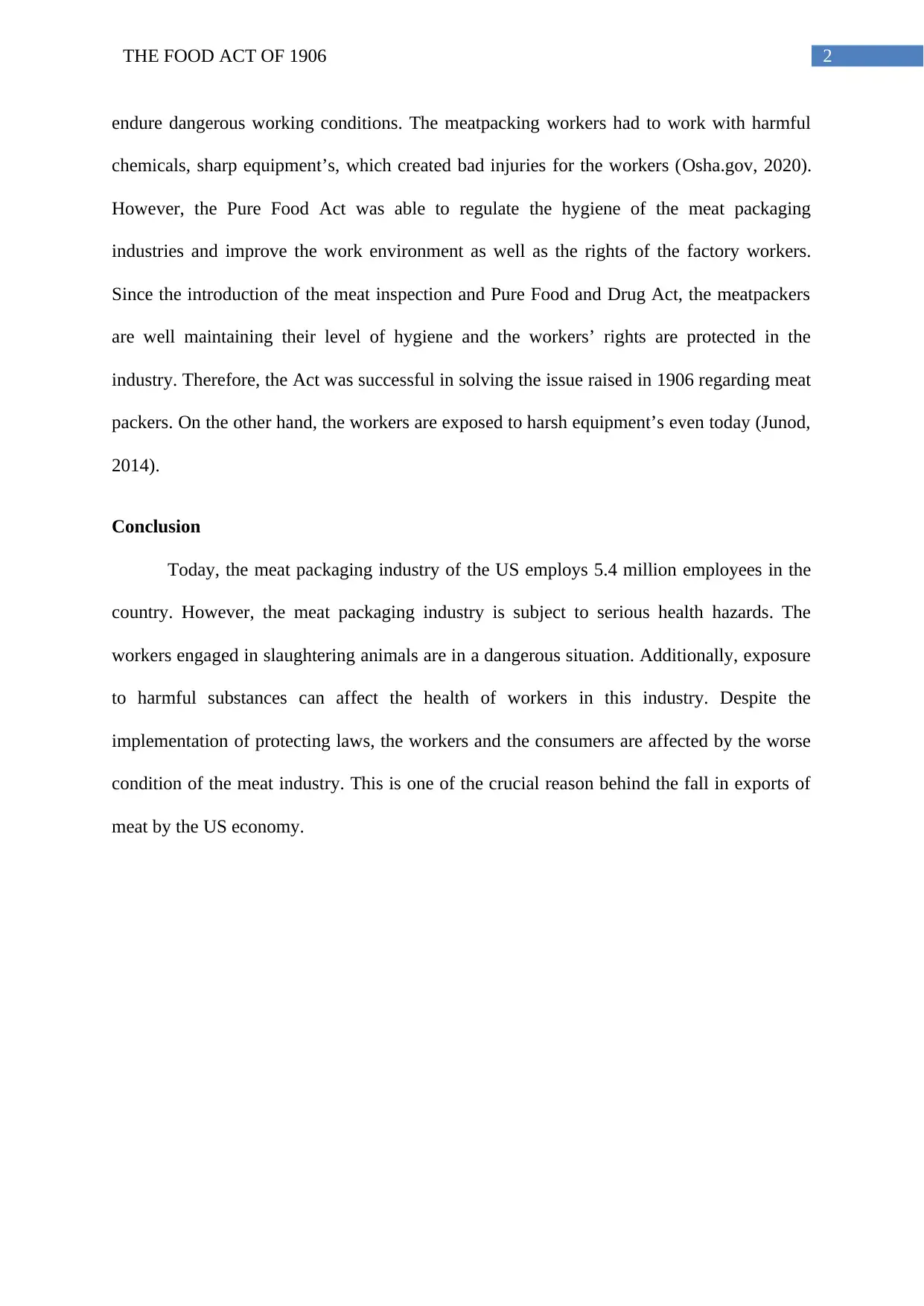
endure dangerous working conditions. The meatpacking workers had to work with harmful
chemicals, sharp equipment’s, which created bad injuries for the workers (Osha.gov, 2020).
However, the Pure Food Act was able to regulate the hygiene of the meat packaging
industries and improve the work environment as well as the rights of the factory workers.
Since the introduction of the meat inspection and Pure Food and Drug Act, the meatpackers
are well maintaining their level of hygiene and the workers’ rights are protected in the
industry. Therefore, the Act was successful in solving the issue raised in 1906 regarding meat
packers. On the other hand, the workers are exposed to harsh equipment’s even today (Junod,
2014).
Conclusion
Today, the meat packaging industry of the US employs 5.4 million employees in the
country. However, the meat packaging industry is subject to serious health hazards. The
workers engaged in slaughtering animals are in a dangerous situation. Additionally, exposure
to harmful substances can affect the health of workers in this industry. Despite the
implementation of protecting laws, the workers and the consumers are affected by the worse
condition of the meat industry. This is one of the crucial reason behind the fall in exports of
meat by the US economy.
Document Page
3THE FOOD ACT OF 1906
References
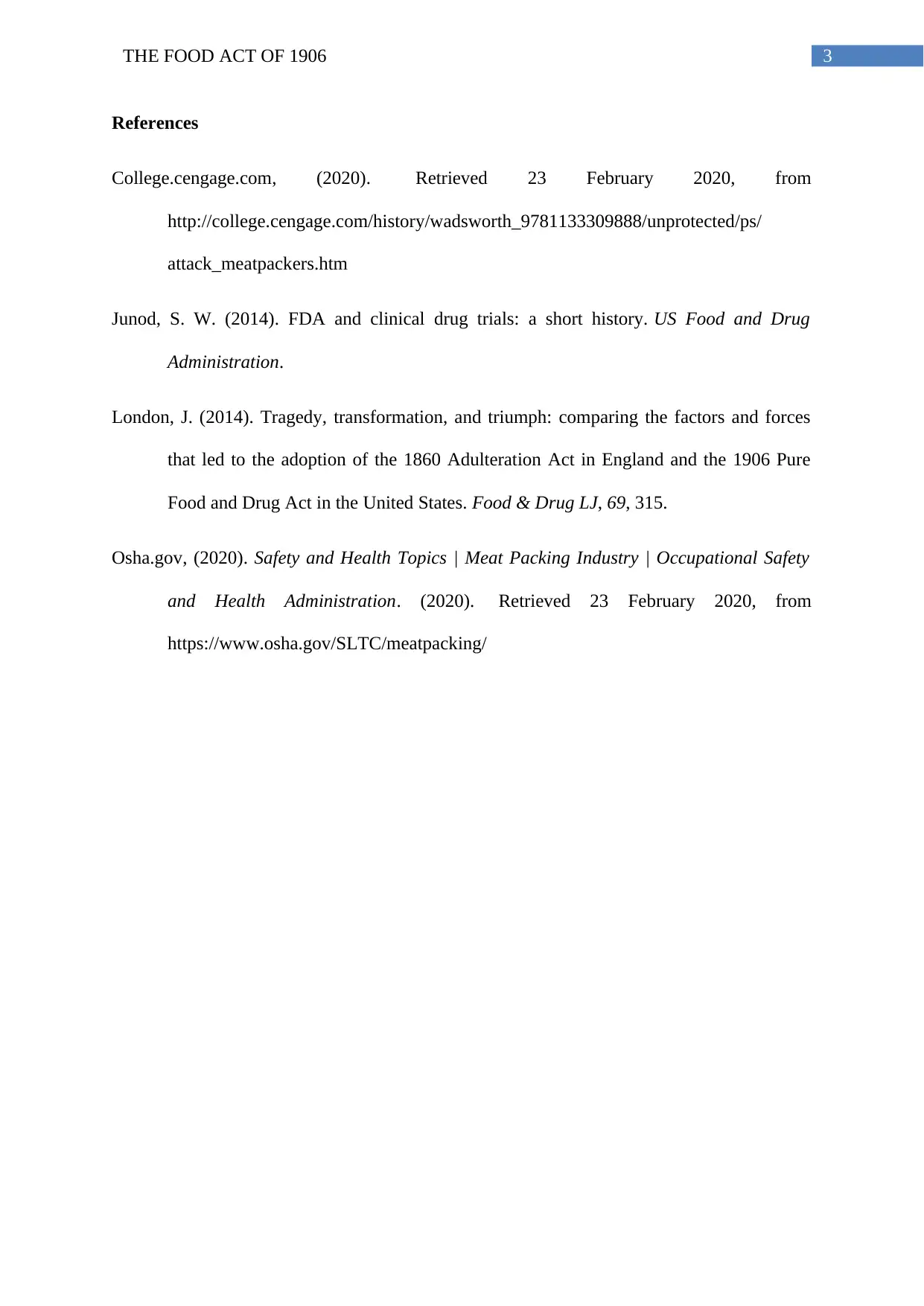
College.cengage.com, (2020). Retrieved 23 February 2020, from
http://college.cengage.com/history/wadsworth_9781133309888/unprotected/ps/
attack_meatpackers.htm
Junod, S. W. (2014). FDA and clinical drug trials: a short history. US Food and Drug
Administration.
London, J. (2014). Tragedy, transformation, and triumph: comparing the factors and forces
that led to the adoption of the 1860 Adulteration Act in England and the 1906 Pure
Food and Drug Act in the United States. Food & Drug LJ, 69, 315.
Osha.gov, (2020). Safety and Health Topics | Meat Packing Industry | Occupational Safety
and Health Administration. (2020). Retrieved 23 February 2020, from
https://www.osha.gov/SLTC/meatpacking/
chevron_up_icon
1 out of 4
circle_padding
hide_on_mobile
zoom_out_icon
[object Object]