Detailed Analysis of Financial Intermediaries in a Modern Economy
VerifiedAdded on 2023/01/03
|12
|3455
|31
Report
AI Summary
This report provides a comprehensive overview of the role of financial intermediaries in a modern economy. It begins with an introduction to financial intermediaries, defining their function as the link between service providers and customers, and the channels through which savings are invested. The report explores the various roles of financial intermediaries, including channeling funds from surplus to deficit units. It then delves into the specifics of different types of intermediaries, such as deposit-type institutions (banks), contractual savings institutions (insurance, pension funds), commercial banks, thrift institutions, and credit unions. Each type is described in detail, highlighting their specific functions, sources of funds, and impact on the financial system. The report emphasizes the importance of financial intermediaries in promoting economic growth and efficient capital allocation. The report also discusses the role of each financial intermediary and their specific functions. The report also mentions the different roles of commercial banks, thrift institutions, and credit unions. It also discusses the role of the Federal Deposit Insurance Corporation (FDIC) and the impact of the 2008 financial crises.

The role of financial intermediaries
1
1

Paraphrase This Document
Need a fresh take? Get an instant paraphrase of this document with our AI Paraphraser
INTRODUCTION.................3
MAIN BODY..................................................................................................................................3
CONCLUSION................................................................................................................................9
REFERENCES..............................................................................................................................11
2
MAIN BODY..................................................................................................................................3
CONCLUSION................................................................................................................................9
REFERENCES..............................................................................................................................11
2
Explain in detail the role of financial intermediaries in a modern economy.
INTRODUCTION
Financial terms in a country are the most important factor that regulates the improvement
and growth of economy. In this financial system, the essential role is played by financial
intermediaries. A financial intermediary can be explained as an institution or organization that is
acting as the middle party in two important segments of an economical setup. These segments
are service provider and ultimate customer. In other words, a financial intermediary can be
explained as the tool or route through which savings are channelized into the tunnel of
investment. Financial intermediaries basically exist in the financial market so as to render profits
for all participants in the financial system and sometimes they are acting as the regulating
authority of financial transactions also. Trends suggest that financial intermediaries role in
savings and investment functions can be used for an efficient market system or like the sub-
prime crisis shows, they can be a cause for concern as well. This report is focusing on discussion
of roles of different financial intermediaries in a modern economical setup.
MAIN BODY
This report will start from explaining different roles that a financial intermediary is taking
on in a financial system. The main role is to channelize excess funds from the surplus units to
those units which are facing the deficit. The main reason behind naming these institutions as
intermediaries is that they are acting as the middlemen in whole financial system. They are
taking up the responsibility for moving funds to deficit units from surplus units. They do not take
financial method in consideration and just concentrating on bringing different participants on the
same page and with the benefit of least possible cost and least inconvenience. If the economy
wants to climb the growth chart, than most factor is to ensure that financial system is working in
an efficient manner. This efficiency can be measured through availability of amount of capital in
the economy. Capital formation is an important aspect of growth of economy (Allen and et al.,
2018). Thus, if the financial system works properly, firms with the most promising investment
opportunities receive funds, and those with inferior opportunities receive no funding. In a similar
manner, consumers who can pay the current market rate of interest can purchase cars, boats,
vacations, and homes on credit − and thus have them now rather than waiting until they have the
3
INTRODUCTION
Financial terms in a country are the most important factor that regulates the improvement
and growth of economy. In this financial system, the essential role is played by financial
intermediaries. A financial intermediary can be explained as an institution or organization that is
acting as the middle party in two important segments of an economical setup. These segments
are service provider and ultimate customer. In other words, a financial intermediary can be
explained as the tool or route through which savings are channelized into the tunnel of
investment. Financial intermediaries basically exist in the financial market so as to render profits
for all participants in the financial system and sometimes they are acting as the regulating
authority of financial transactions also. Trends suggest that financial intermediaries role in
savings and investment functions can be used for an efficient market system or like the sub-
prime crisis shows, they can be a cause for concern as well. This report is focusing on discussion
of roles of different financial intermediaries in a modern economical setup.
MAIN BODY
This report will start from explaining different roles that a financial intermediary is taking
on in a financial system. The main role is to channelize excess funds from the surplus units to
those units which are facing the deficit. The main reason behind naming these institutions as
intermediaries is that they are acting as the middlemen in whole financial system. They are
taking up the responsibility for moving funds to deficit units from surplus units. They do not take
financial method in consideration and just concentrating on bringing different participants on the
same page and with the benefit of least possible cost and least inconvenience. If the economy
wants to climb the growth chart, than most factor is to ensure that financial system is working in
an efficient manner. This efficiency can be measured through availability of amount of capital in
the economy. Capital formation is an important aspect of growth of economy (Allen and et al.,
2018). Thus, if the financial system works properly, firms with the most promising investment
opportunities receive funds, and those with inferior opportunities receive no funding. In a similar
manner, consumers who can pay the current market rate of interest can purchase cars, boats,
vacations, and homes on credit − and thus have them now rather than waiting until they have the
3
⊘ This is a preview!⊘
Do you want full access?
Subscribe today to unlock all pages.

Trusted by 1+ million students worldwide
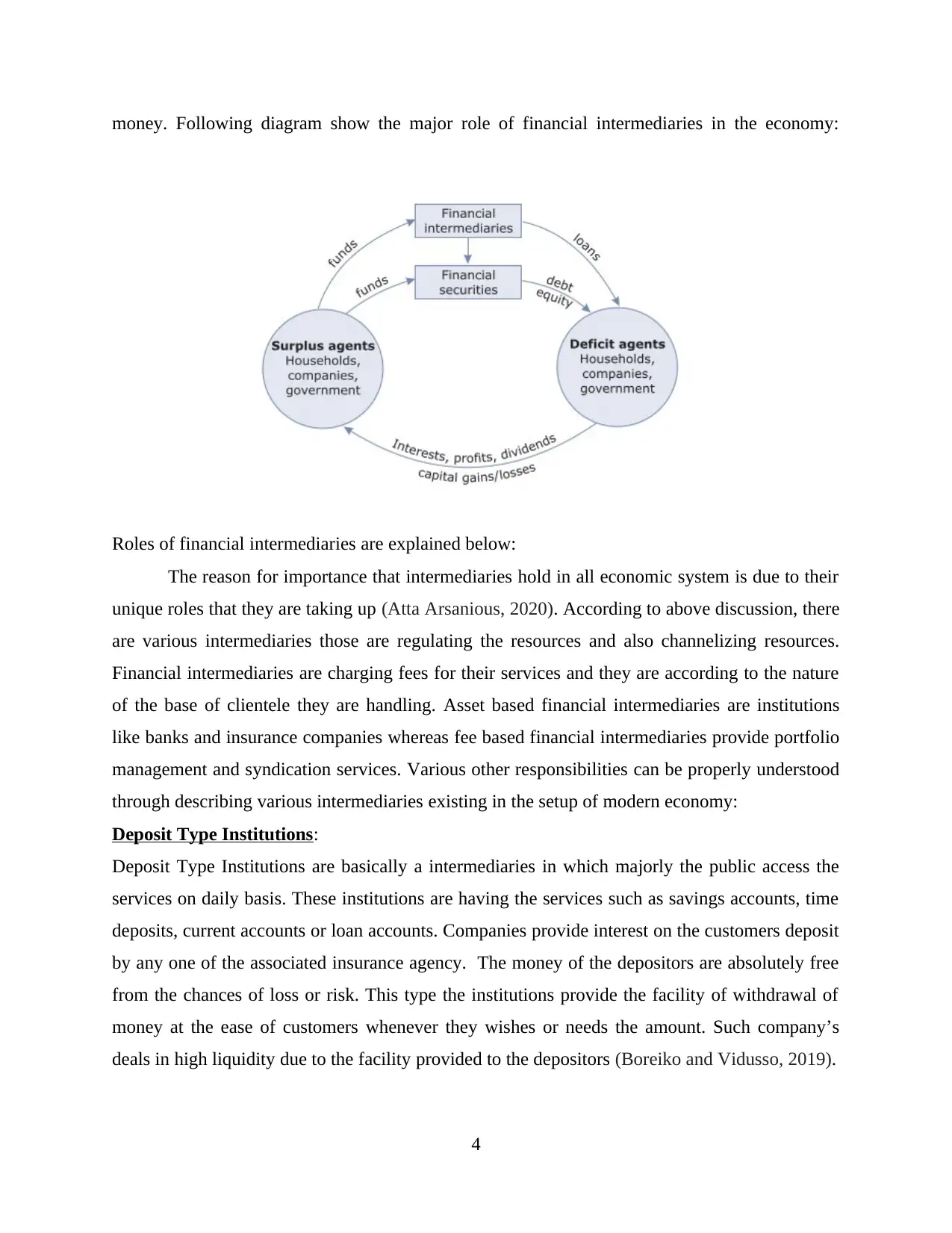
money. Following diagram show the major role of financial intermediaries in the economy:
Roles of financial intermediaries are explained below:
The reason for importance that intermediaries hold in all economic system is due to their
unique roles that they are taking up (Atta Arsanious, 2020). According to above discussion, there
are various intermediaries those are regulating the resources and also channelizing resources.
Financial intermediaries are charging fees for their services and they are according to the nature
of the base of clientele they are handling. Asset based financial intermediaries are institutions
like banks and insurance companies whereas fee based financial intermediaries provide portfolio
management and syndication services. Various other responsibilities can be properly understood
through describing various intermediaries existing in the setup of modern economy:
Deposit Type Institutions:
Deposit Type Institutions are basically a intermediaries in which majorly the public access the
services on daily basis. These institutions are having the services such as savings accounts, time
deposits, current accounts or loan accounts. Companies provide interest on the customers deposit
by any one of the associated insurance agency. The money of the depositors are absolutely free
from the chances of loss or risk. This type the institutions provide the facility of withdrawal of
money at the ease of customers whenever they wishes or needs the amount. Such company’s
deals in high liquidity due to the facility provided to the depositors (Boreiko and Vidusso, 2019).
4
Roles of financial intermediaries are explained below:
The reason for importance that intermediaries hold in all economic system is due to their
unique roles that they are taking up (Atta Arsanious, 2020). According to above discussion, there
are various intermediaries those are regulating the resources and also channelizing resources.
Financial intermediaries are charging fees for their services and they are according to the nature
of the base of clientele they are handling. Asset based financial intermediaries are institutions
like banks and insurance companies whereas fee based financial intermediaries provide portfolio
management and syndication services. Various other responsibilities can be properly understood
through describing various intermediaries existing in the setup of modern economy:
Deposit Type Institutions:
Deposit Type Institutions are basically a intermediaries in which majorly the public access the
services on daily basis. These institutions are having the services such as savings accounts, time
deposits, current accounts or loan accounts. Companies provide interest on the customers deposit
by any one of the associated insurance agency. The money of the depositors are absolutely free
from the chances of loss or risk. This type the institutions provide the facility of withdrawal of
money at the ease of customers whenever they wishes or needs the amount. Such company’s
deals in high liquidity due to the facility provided to the depositors (Boreiko and Vidusso, 2019).
4
Paraphrase This Document
Need a fresh take? Get an instant paraphrase of this document with our AI Paraphraser
The congress committee has raised the limit of federal deposit insurance from $100,000
to $250,000 due to the financial crises of year 2008. The aim of this action is to gain more trust
and confidence of the customers for the banking sector and to deposit in it. This happened
because multibillion dollar funds were taken out from the money market and liquidated the assets
for the same. In 1980 the limit in insurance agencies has increased (Chan, 2019). In year 1991 in
the banking sector the ratio of insured depositors from 82 per cent to 62 in year ending 2007.
Contractual Savings Institutions:
Contractual Savings Institution is an arrangement and investment of funds for a long
period of time on contractual basis through an institution. Investment such as in Pension Funds,
Insurance, Provident funds, etc. A contract is made for the investment from the customers to
their pension or insurance accounts. Such institutions deals in long term funds such as stocks or
bonds and does not concerns on liquidity as they have a stable cash flow. The main transaction of
these institutions is to obtain funds from long term contractual arrangements and then, further
investing these funds in capital markets. The major examples in this category are insurance
companies and pension funds. The main feature of these institutions is that there is a relatively
slow flow of funds those are coming from contractual commitments along with their
policyholders in insurance category and also in category of participants in pension fund.
Therefore, liquidity can never become a problem in administration of these organisations. Due to
the reason of their efficiency in operations and also because of the organizational structure, the
firm is capable to invest in long term securities, such as bonds and in some cases in common
stock also.
Life Insurance Companies:
Life Insurance Companies are those who provide the insurance policies to those who
want to protect their family from loss such as pre mature death or retirement. The company gets
funds from selling of such policies. In against of paying premium to the company the insured
family gets some monetary benefit from the company to reduce their losses. Some policies
provide only the risk protection whereas some policies provide savings along with risk protection
feature. Companies invest its funds generally in the high yield investments which are for long
term. This is done because the company has predictions on its inflows and outflows. Such
institutions are being governed by states having fewer restrictions (Corrado and Corrado, 2017).
Casualty Insurance Companies:
5
to $250,000 due to the financial crises of year 2008. The aim of this action is to gain more trust
and confidence of the customers for the banking sector and to deposit in it. This happened
because multibillion dollar funds were taken out from the money market and liquidated the assets
for the same. In 1980 the limit in insurance agencies has increased (Chan, 2019). In year 1991 in
the banking sector the ratio of insured depositors from 82 per cent to 62 in year ending 2007.
Contractual Savings Institutions:
Contractual Savings Institution is an arrangement and investment of funds for a long
period of time on contractual basis through an institution. Investment such as in Pension Funds,
Insurance, Provident funds, etc. A contract is made for the investment from the customers to
their pension or insurance accounts. Such institutions deals in long term funds such as stocks or
bonds and does not concerns on liquidity as they have a stable cash flow. The main transaction of
these institutions is to obtain funds from long term contractual arrangements and then, further
investing these funds in capital markets. The major examples in this category are insurance
companies and pension funds. The main feature of these institutions is that there is a relatively
slow flow of funds those are coming from contractual commitments along with their
policyholders in insurance category and also in category of participants in pension fund.
Therefore, liquidity can never become a problem in administration of these organisations. Due to
the reason of their efficiency in operations and also because of the organizational structure, the
firm is capable to invest in long term securities, such as bonds and in some cases in common
stock also.
Life Insurance Companies:
Life Insurance Companies are those who provide the insurance policies to those who
want to protect their family from loss such as pre mature death or retirement. The company gets
funds from selling of such policies. In against of paying premium to the company the insured
family gets some monetary benefit from the company to reduce their losses. Some policies
provide only the risk protection whereas some policies provide savings along with risk protection
feature. Companies invest its funds generally in the high yield investments which are for long
term. This is done because the company has predictions on its inflows and outflows. Such
institutions are being governed by states having fewer restrictions (Corrado and Corrado, 2017).
Casualty Insurance Companies:
5
These companies are opposite to Life Insurance as it provides policies to those who want
protection for incidents such as fire, theft, accidents, for their assets. Such policies do not provide
any liquidity and any surrender value to its customers as it is pure risk protection insurance. The
companies have the predictions on their inflows but do not have any on its outflows. They deal in
highly marketable securities generally short term due to the presence of non projection of cash
outflows. Companies generally take holdings on equity securities in order to offset their lower
returns. To reduce the taxes of the institution they hold their position in some municipal bonds.
Pension Funds:
The fund from the combined contribution of an employer and a employee during the job
in a particular company is termed as pension funds. The employees get this payment back during
his retirement period on monthly basis (Ferrarini, 2017). The aim of this fund is to secure the
employees retirement as after retirement he will not be able to earn regular salary from the
company. The institutions invest these funds in equity obligation funds or in corporate bonds.
The requirement of retirement income and the success of labours has in getting their pension
funds increased has proven a growth factor for the institutions. This growth is to private sector as
well as to the state and local government bodies since world War II. The inflows in such funds
are for a long period and the institutions are having forecasts for the outflow. Therefore the
companies use to invest the funds into long term securities having the feature of high yield.
Commercial banks:
These are considered as most diversified middle firm on the basis of amount of holding in
categories of assets and liabilities. These are also the largest intermediary on the same basis of
numbers. According to different surveys, it is visible that at the end of year 2003, the holding of
commercial banks in figures was $7.8 trillion. This holding was in the category of financial
assets. Banks are creating liabilities in the name of savings account, checking accounts and
various other type of time deposits. The institution which is responsible for issuing insurance for
bank deposits, famously known as Federal Deposit Insurance Corporation has issued a total of
insurance for bank deposits for $250,000 to the maximum limit. In the other side of balance
sheet, which is covering all the assets of the bank, they are issuing a variety of loans that are
covering various categories. These categories can be named as loans rendered to consumers,
businesses and state and local government. Furthermore, various commercial banks are having
some important departments; those are responsible for handling operations like leasing and trust.
6
protection for incidents such as fire, theft, accidents, for their assets. Such policies do not provide
any liquidity and any surrender value to its customers as it is pure risk protection insurance. The
companies have the predictions on their inflows but do not have any on its outflows. They deal in
highly marketable securities generally short term due to the presence of non projection of cash
outflows. Companies generally take holdings on equity securities in order to offset their lower
returns. To reduce the taxes of the institution they hold their position in some municipal bonds.
Pension Funds:
The fund from the combined contribution of an employer and a employee during the job
in a particular company is termed as pension funds. The employees get this payment back during
his retirement period on monthly basis (Ferrarini, 2017). The aim of this fund is to secure the
employees retirement as after retirement he will not be able to earn regular salary from the
company. The institutions invest these funds in equity obligation funds or in corporate bonds.
The requirement of retirement income and the success of labours has in getting their pension
funds increased has proven a growth factor for the institutions. This growth is to private sector as
well as to the state and local government bodies since world War II. The inflows in such funds
are for a long period and the institutions are having forecasts for the outflow. Therefore the
companies use to invest the funds into long term securities having the feature of high yield.
Commercial banks:
These are considered as most diversified middle firm on the basis of amount of holding in
categories of assets and liabilities. These are also the largest intermediary on the same basis of
numbers. According to different surveys, it is visible that at the end of year 2003, the holding of
commercial banks in figures was $7.8 trillion. This holding was in the category of financial
assets. Banks are creating liabilities in the name of savings account, checking accounts and
various other type of time deposits. The institution which is responsible for issuing insurance for
bank deposits, famously known as Federal Deposit Insurance Corporation has issued a total of
insurance for bank deposits for $250,000 to the maximum limit. In the other side of balance
sheet, which is covering all the assets of the bank, they are issuing a variety of loans that are
covering various categories. These categories can be named as loans rendered to consumers,
businesses and state and local government. Furthermore, various commercial banks are having
some important departments; those are responsible for handling operations like leasing and trust.
6
⊘ This is a preview!⊘
Do you want full access?
Subscribe today to unlock all pages.
Trusted by 1+ million students worldwide
These departments are known as trust departments and leasing governments. Commercial banks
are holding a high value of importance in modern economic system, due to the reason that they
play a vital role in the monetary system of country and also they are affecting the well being of
economic situations in the country. They are having the most significant role in the area of their
location in which they are situated. In addition to this, they are the highest impacting regulation
in category of whole system of financial institutions in the system (Marini and et al., 2018).
Thrift institution:
Thrift institutions are basically the common name for institutions that are handling the
business of savings and loan businesses, and mutual savings banks are the main organisations
those are coming under this category (McLeod and et al., 2018). The main source of funds for
these organizations is issuance of checking accounts, often called as NOW accounts, savings
accounts and various other types of time deposits that are made in these institutions from general
public. These organizations are further using these funds so as to purchase loans in real estate
area. The major types of these loans come under the category of mortgages in long term time
period. According to different surveys and figures, it is very evident that these organizations are
the biggest providers in the category of mortgage loans. They provide a great help to consumers
and hence, play a vital role in channelizing the movement of fund in the right direction in an
economical setup. At the present time, these organizations are specialised in providing the
intermediation service in the sector of maturity and denomination funds. This is due to the reason
that they are acquiring funds through borrowing process of money for a very short term period.
This borrowing is done through two major forms of accounts and they are checking and savings
account. They are lending money on long term in exchange of collateral of real estate. In the case
of thrift institutions, the FDIC insurance amount comes up the maximum limit of $250,000.
Credit unions
These are institutions which are operating on a small scale. These organisations are non
profit and working on cooperative organisational structure. These firms are consumer oriented
and are owned and operated completely by the members and customers of the firm (Mimir,
2016). The company has two major heads in the liabilities section and they are checking
accounts, often called as share drafts and second is savings account, called as share accounts.
These liabilities are basically devoted to only one thing and it is short term consumer loans.
These share accounts issued by the credit union are insured by the federal institution to the
7
are holding a high value of importance in modern economic system, due to the reason that they
play a vital role in the monetary system of country and also they are affecting the well being of
economic situations in the country. They are having the most significant role in the area of their
location in which they are situated. In addition to this, they are the highest impacting regulation
in category of whole system of financial institutions in the system (Marini and et al., 2018).
Thrift institution:
Thrift institutions are basically the common name for institutions that are handling the
business of savings and loan businesses, and mutual savings banks are the main organisations
those are coming under this category (McLeod and et al., 2018). The main source of funds for
these organizations is issuance of checking accounts, often called as NOW accounts, savings
accounts and various other types of time deposits that are made in these institutions from general
public. These organizations are further using these funds so as to purchase loans in real estate
area. The major types of these loans come under the category of mortgages in long term time
period. According to different surveys and figures, it is very evident that these organizations are
the biggest providers in the category of mortgage loans. They provide a great help to consumers
and hence, play a vital role in channelizing the movement of fund in the right direction in an
economical setup. At the present time, these organizations are specialised in providing the
intermediation service in the sector of maturity and denomination funds. This is due to the reason
that they are acquiring funds through borrowing process of money for a very short term period.
This borrowing is done through two major forms of accounts and they are checking and savings
account. They are lending money on long term in exchange of collateral of real estate. In the case
of thrift institutions, the FDIC insurance amount comes up the maximum limit of $250,000.
Credit unions
These are institutions which are operating on a small scale. These organisations are non
profit and working on cooperative organisational structure. These firms are consumer oriented
and are owned and operated completely by the members and customers of the firm (Mimir,
2016). The company has two major heads in the liabilities section and they are checking
accounts, often called as share drafts and second is savings account, called as share accounts.
These liabilities are basically devoted to only one thing and it is short term consumer loans.
These share accounts issued by the credit union are insured by the federal institution to the
7
Paraphrase This Document
Need a fresh take? Get an instant paraphrase of this document with our AI Paraphraser
maximum amount of $250,000. Credit unions are the organisations those are formed by
consumers having the value of common bond. To illustrate, common example of credit unions is
employees of a same firm, company or a firm. The main feature of this institution is that, to avail
services offered by them, it is essential to take membership (Santandrea and et al., 2018). The
evident difference between credit unions and every other institution in category of financial
intermediary is that members of credit unions should have common bond requirement, the
restriction that most loans are to consumers, and their exemption from federal income tax
because of their cooperative nature.
Investment funds
The main line of transaction of this intermediary is to sell shares to present investors in
the market and the funds received from the receipt of these sales is further used by the institution
to buy direct financial claims available in the market. The main feature of these institutions is
that they are offering the advantage of both facilities to investors, which are denomination
flexibility and default risk intermediation. Various types of investment funds are explained
below:
Mutual funds: These are the type of funds in which equity shares are sold out to investors
and the received fund is used to further purchase stocks and bonds. The benefit of these
institutions in comparison of direct investments is that they are attempting to provide
access to small investors for investment risk at low level. This benefit is resulted from
diversification, economies of scale in transaction cost and also professional managers.
The evident feature of these mutual funds is that the value of per share is usually not
fixed and it is fluctuating in response to change in price of the stock in the portfolio of
related investment. Mutual funds are specialized in the particular related sector of the
market place. To illustrate, perfect example is that some people are investing in equities
or debt, whereas, on the other hand, some are interested to invest in a particular industry,
example can be energy or electronics, others are seeking in growth or income stocks and
yet there are some who are interested only in foreign investments (Shahbazand et al.,
2018).
Money market mutual funds: It is a simply mutual fund that is taking active role in
investments in money market securities. The main feature of these securities is that they
are for short term and have very low default risk. These securities sell in denominations
8
consumers having the value of common bond. To illustrate, common example of credit unions is
employees of a same firm, company or a firm. The main feature of this institution is that, to avail
services offered by them, it is essential to take membership (Santandrea and et al., 2018). The
evident difference between credit unions and every other institution in category of financial
intermediary is that members of credit unions should have common bond requirement, the
restriction that most loans are to consumers, and their exemption from federal income tax
because of their cooperative nature.
Investment funds
The main line of transaction of this intermediary is to sell shares to present investors in
the market and the funds received from the receipt of these sales is further used by the institution
to buy direct financial claims available in the market. The main feature of these institutions is
that they are offering the advantage of both facilities to investors, which are denomination
flexibility and default risk intermediation. Various types of investment funds are explained
below:
Mutual funds: These are the type of funds in which equity shares are sold out to investors
and the received fund is used to further purchase stocks and bonds. The benefit of these
institutions in comparison of direct investments is that they are attempting to provide
access to small investors for investment risk at low level. This benefit is resulted from
diversification, economies of scale in transaction cost and also professional managers.
The evident feature of these mutual funds is that the value of per share is usually not
fixed and it is fluctuating in response to change in price of the stock in the portfolio of
related investment. Mutual funds are specialized in the particular related sector of the
market place. To illustrate, perfect example is that some people are investing in equities
or debt, whereas, on the other hand, some are interested to invest in a particular industry,
example can be energy or electronics, others are seeking in growth or income stocks and
yet there are some who are interested only in foreign investments (Shahbazand et al.,
2018).
Money market mutual funds: It is a simply mutual fund that is taking active role in
investments in money market securities. The main feature of these securities is that they
are for short term and have very low default risk. These securities sell in denominations
8
of $1 million or more, so most investors are unable to purchase them. Thus, MMMFs
provide investors with small money balances the opportunity to earn the market rate of
interest without incurring a great deal of financial risk (Agrawal and et al., 2016).
Finance corporations
They are defined as to make the loans for the customers and nominal enterprise. They
don’t allow saving amounts from customers, they looking forward for the majority of their
monetary value by selling short term tactics which is called as commercial documents to
shareholders or investors. The amount of their funds which is come from the sales equity and
long term debenture norms. There are various types of finance corporation which are consumer
finance organisation which specialized in instalment, taxes and household, enterprises finance
organisation which willing to acquire loan, property on lease to enterprises and sales finance
organisation that finance goods sold through the retailers. Finance companies are operated by the
states so in this they originate are also inform to many central guidelines. These terms and
conditions are focus on primarily on customer dealings and deal with loan relations, situations,
rates, and assortment practices.
Federal agencies
The government of United States act as a highly financial intermediary by the carrying
and lending activities of its companies, these agencies are highly growing of all financial
institutions. The main work of federal agencies to reduce the cost and it also enhances the
availability of amounts which support the organisation in financial aspects.
CONCLUSION
From the above report, it can be inferred that financial intermediaries are playing the very
important role in modern economy setup. They are acting as Lubricants that will help the
economy to keep going in the growth graph. The main role of financial intermediaries comes in
front when they have to reinvent every possible area so as to cater to every investor according to
their diverse portfolios and in alignment of their needs and wants. These financial institutions
have the responsibility of satisfying the needs of both borrowers and lenders so that there is a
proper balance stroke in the economy. The very term intermediary would suggest that these
institutions are pivotal to the working of the economy and they along with the monetary
authorities have to ensure that credit reaches to the needy without jeopardizing the interests of
the investors. This is one of the main challenges before them.
9
provide investors with small money balances the opportunity to earn the market rate of
interest without incurring a great deal of financial risk (Agrawal and et al., 2016).
Finance corporations
They are defined as to make the loans for the customers and nominal enterprise. They
don’t allow saving amounts from customers, they looking forward for the majority of their
monetary value by selling short term tactics which is called as commercial documents to
shareholders or investors. The amount of their funds which is come from the sales equity and
long term debenture norms. There are various types of finance corporation which are consumer
finance organisation which specialized in instalment, taxes and household, enterprises finance
organisation which willing to acquire loan, property on lease to enterprises and sales finance
organisation that finance goods sold through the retailers. Finance companies are operated by the
states so in this they originate are also inform to many central guidelines. These terms and
conditions are focus on primarily on customer dealings and deal with loan relations, situations,
rates, and assortment practices.
Federal agencies
The government of United States act as a highly financial intermediary by the carrying
and lending activities of its companies, these agencies are highly growing of all financial
institutions. The main work of federal agencies to reduce the cost and it also enhances the
availability of amounts which support the organisation in financial aspects.
CONCLUSION
From the above report, it can be inferred that financial intermediaries are playing the very
important role in modern economy setup. They are acting as Lubricants that will help the
economy to keep going in the growth graph. The main role of financial intermediaries comes in
front when they have to reinvent every possible area so as to cater to every investor according to
their diverse portfolios and in alignment of their needs and wants. These financial institutions
have the responsibility of satisfying the needs of both borrowers and lenders so that there is a
proper balance stroke in the economy. The very term intermediary would suggest that these
institutions are pivotal to the working of the economy and they along with the monetary
authorities have to ensure that credit reaches to the needy without jeopardizing the interests of
the investors. This is one of the main challenges before them.
9
⊘ This is a preview!⊘
Do you want full access?
Subscribe today to unlock all pages.
Trusted by 1+ million students worldwide

10
Paraphrase This Document
Need a fresh take? Get an instant paraphrase of this document with our AI Paraphraser
REFERENCES
Books and Journals
Agrawal, and et al., 2016. Cost‐reducing innovation and the role of patent intermediaries in
increasing market efficiency. Production and Operations Management. 25(2). pp.173-
191.
Allen, and et al., 2018. Financial structure, economic growth and development. In Handbook of
finance and development. Edward Elgar Publishing.
Atta Arsanious, E., 2020. Investigating the Role of the Financial Intermediaries on Sustainable
Development in Egypt: An Empirical Evidence. Available at SSRN 3636281.
Boreiko, D. and Vidusso, G., 2019. New blockchain intermediaries: do ICO rating websites do
their job well? The Journal of Alternative Investments. 21(4). pp.67-79.
Chan, J.M., 2019. Financial frictions and trade intermediation: Theory and evidence. European
Economic Review. 119, pp.567-593.
Corrado, G. and Corrado, L., 2017. Inclusive finance for inclusive growth and development.
Current opinion in environmental sustainability. 24, pp.19-23.
Ferrarini, G., 2017. Understanding the role of corporate governance in financial institutions: A
research agenda. European Corporate Governance Institute (ECGI)-Law Working
Paper, (347).
Marini, and et al., 2018. Accountability practices in microfinance: cultural translation and the
role of intermediaries. Accounting, Auditing & Accountability Journal.
McLeod, and et al., 2018. Organizational virtue and stakeholder interdependence: An empirical
examination of financial intermediaries and IPO firms. Journal of Business Ethics.
149(4). pp.785-798.
Mimir, Y., 2016. Financial intermediaries, credit shocks and business cycles. Oxford Bulletin of
Economics and Statistics. 78(1). pp.42-74.
Santandrea, M., Agasisti, T., Giorgino, M. and Patrucco, A.S., 2018. Business models in the
search for efficiency: the case of public financial intermediaries. Public Money &
Management. 38(3), pp.234-243.
Shahbaz, and et al., 2018. Financial development, industrialization, the role of institutions and
government: a comparative analysis between India and China. Applied Economics.
50(17). pp.1952-1977.
11
Books and Journals
Agrawal, and et al., 2016. Cost‐reducing innovation and the role of patent intermediaries in
increasing market efficiency. Production and Operations Management. 25(2). pp.173-
191.
Allen, and et al., 2018. Financial structure, economic growth and development. In Handbook of
finance and development. Edward Elgar Publishing.
Atta Arsanious, E., 2020. Investigating the Role of the Financial Intermediaries on Sustainable
Development in Egypt: An Empirical Evidence. Available at SSRN 3636281.
Boreiko, D. and Vidusso, G., 2019. New blockchain intermediaries: do ICO rating websites do
their job well? The Journal of Alternative Investments. 21(4). pp.67-79.
Chan, J.M., 2019. Financial frictions and trade intermediation: Theory and evidence. European
Economic Review. 119, pp.567-593.
Corrado, G. and Corrado, L., 2017. Inclusive finance for inclusive growth and development.
Current opinion in environmental sustainability. 24, pp.19-23.
Ferrarini, G., 2017. Understanding the role of corporate governance in financial institutions: A
research agenda. European Corporate Governance Institute (ECGI)-Law Working
Paper, (347).
Marini, and et al., 2018. Accountability practices in microfinance: cultural translation and the
role of intermediaries. Accounting, Auditing & Accountability Journal.
McLeod, and et al., 2018. Organizational virtue and stakeholder interdependence: An empirical
examination of financial intermediaries and IPO firms. Journal of Business Ethics.
149(4). pp.785-798.
Mimir, Y., 2016. Financial intermediaries, credit shocks and business cycles. Oxford Bulletin of
Economics and Statistics. 78(1). pp.42-74.
Santandrea, M., Agasisti, T., Giorgino, M. and Patrucco, A.S., 2018. Business models in the
search for efficiency: the case of public financial intermediaries. Public Money &
Management. 38(3), pp.234-243.
Shahbaz, and et al., 2018. Financial development, industrialization, the role of institutions and
government: a comparative analysis between India and China. Applied Economics.
50(17). pp.1952-1977.
11

12
⊘ This is a preview!⊘
Do you want full access?
Subscribe today to unlock all pages.
Trusted by 1+ million students worldwide

1 out of 12


Related Documents


Your All-in-One AI-Powered Toolkit for Academic Success.
+13062052269
info@desklib.com
Available 24*7 on WhatsApp / Email
![[object Object]](/_next/static/media/star-bottom.7253800d.svg)
Unlock your academic potential
Copyright © 2020–2026 A2Z Services. All Rights Reserved. Developed and managed by ZUCOL.