Exploring the Role of TVET within the Broader Humanistic Perspective
VerifiedAdded on 2023/04/21
|8
|2211
|381
Essay
AI Summary
This essay explores the role of Technical and Vocational Education and Training (TVET) within the broader perspective of humanism. It discusses how TVET aligns with humanistic theories that emphasize growth, self-actualization, and the importance of individual agency in learning. The essay highlights TVET's focus on developing practical skills and knowledge for employment, its integration of emotional and personal learning processes, and its adaptability to modern teaching methods. It also addresses how TVET bridges the gap in humanistic principles by considering the impact of social and cultural factors on student development, and it emphasizes the importance of combining traditional and modern teaching techniques to cater to diverse student needs, fostering creativity, and enabling individuals to realize their full potential. The essay concludes by advocating for TVET's role in promoting innovation in pedagogy and addressing the evolving needs of both individuals and society.
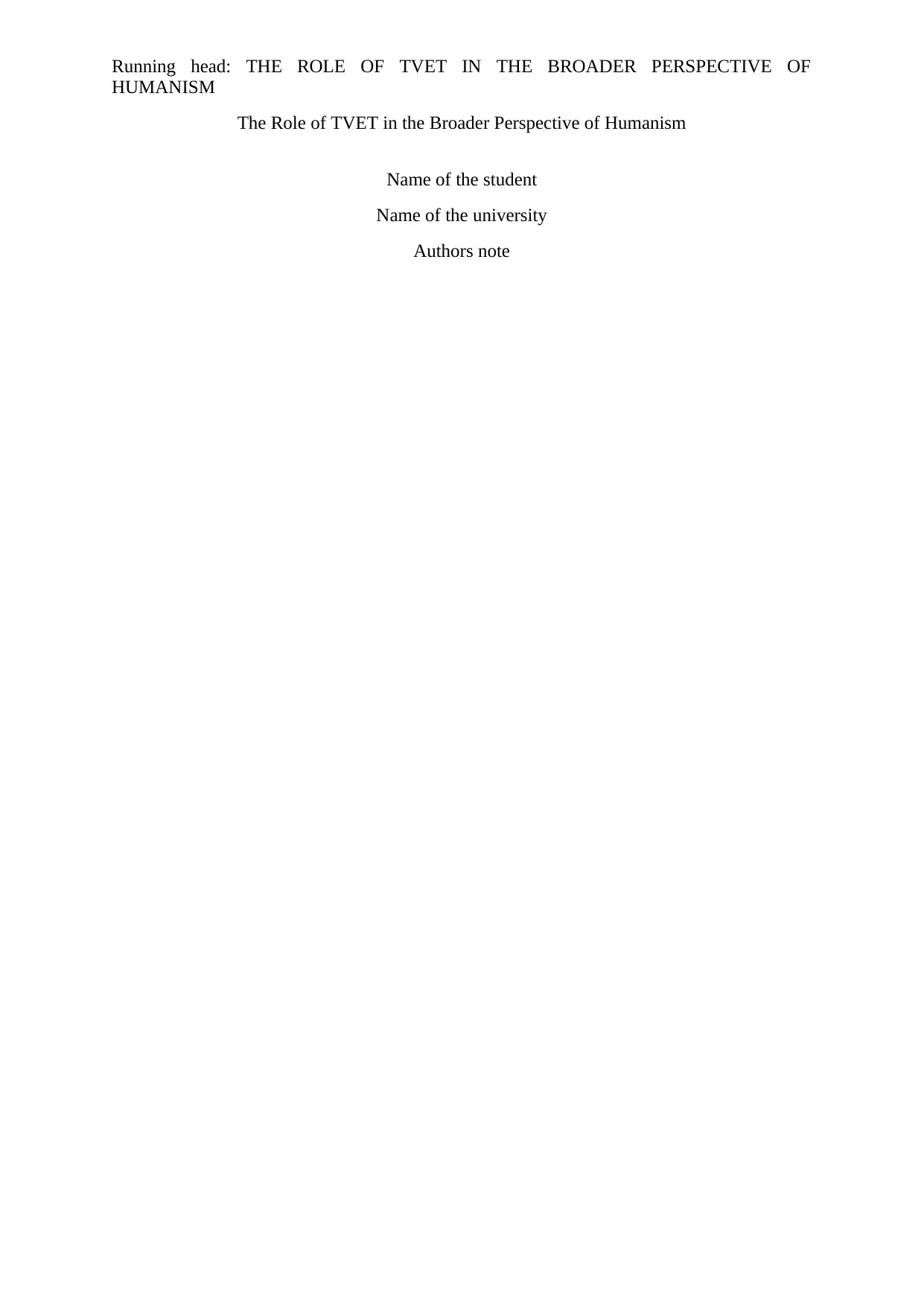
Running head: THE ROLE OF TVET IN THE BROADER PERSPECTIVE OF
HUMANISM
The Role of TVET in the Broader Perspective of Humanism
Name of the student
Name of the university
Authors note
HUMANISM
The Role of TVET in the Broader Perspective of Humanism
Name of the student
Name of the university
Authors note
Paraphrase This Document
Need a fresh take? Get an instant paraphrase of this document with our AI Paraphraser

Running head: The role of TVET in the broader perspective of Humanism
Humanistic theories emerged from humanistic psychological perspective that rose
into prominence in 1950s against the notion of behaviourism and psychoanalysis. Both
behaviourism and psychoanalysis focused on the unconscious motivations and conditioning
processes that motivate and produce behaviour (Nzembe, 2017). Humanistic theory focuses
on the importance of growth and self-actualization of the individual. It also believes that
people are innately virtuous and they exercise the agency to motivate themselves. Thus, they
look for avenues to improvise their mental physical conditions. Technical and vocational
education and training is one of the most practical avenues for an individual to exercise the
situational agency (Adams 2018). . Under this program, one not only learns the skills but also
learns the knowledge needed to seek employment. It is an integral part of sustainable
development because of its focus on social equity and inclusive approach. TVET along with
the macro aspect also assumes great responsibilities for personal development. Owing to the
humanistic theory, TVET engages the student and the teacher in the emotional and personal
process of learning and sharing (Connolly et al., 2016). It can encourage the teacher to think
about its learners in specific and individualistic way. Thus, it can ensure enthusiasm and
interest among its learners. As humanism in self-actualization, process of a potential leaner it
also takes into account of the cognitive and emotional aspect of the learner (Ahmad et al.,
2015). . This essay is going to show that how TVET method of learning helps the student in
learning with the broader framework of Humanistic theory of learning and motivation (Hayes
et al., 2016).
With the onset of globalization and increased urbanization, the classrooms are
changing and so is the methods of teaching. Traditional methods of pedagogy are undergoing
change and the effectively replaced by modern methods of audio-visual learning (Ahmad et
al., 2015). However, TVET has not only improvised on the methods of teaching but also it
tries to engage the students to be updated with recent political or social movements. It
Humanistic theories emerged from humanistic psychological perspective that rose
into prominence in 1950s against the notion of behaviourism and psychoanalysis. Both
behaviourism and psychoanalysis focused on the unconscious motivations and conditioning
processes that motivate and produce behaviour (Nzembe, 2017). Humanistic theory focuses
on the importance of growth and self-actualization of the individual. It also believes that
people are innately virtuous and they exercise the agency to motivate themselves. Thus, they
look for avenues to improvise their mental physical conditions. Technical and vocational
education and training is one of the most practical avenues for an individual to exercise the
situational agency (Adams 2018). . Under this program, one not only learns the skills but also
learns the knowledge needed to seek employment. It is an integral part of sustainable
development because of its focus on social equity and inclusive approach. TVET along with
the macro aspect also assumes great responsibilities for personal development. Owing to the
humanistic theory, TVET engages the student and the teacher in the emotional and personal
process of learning and sharing (Connolly et al., 2016). It can encourage the teacher to think
about its learners in specific and individualistic way. Thus, it can ensure enthusiasm and
interest among its learners. As humanism in self-actualization, process of a potential leaner it
also takes into account of the cognitive and emotional aspect of the learner (Ahmad et al.,
2015). . This essay is going to show that how TVET method of learning helps the student in
learning with the broader framework of Humanistic theory of learning and motivation (Hayes
et al., 2016).
With the onset of globalization and increased urbanization, the classrooms are
changing and so is the methods of teaching. Traditional methods of pedagogy are undergoing
change and the effectively replaced by modern methods of audio-visual learning (Ahmad et
al., 2015). However, TVET has not only improvised on the methods of teaching but also it
tries to engage the students to be updated with recent political or social movements. It

Running head: The role of TVET in the broader perspective of Humanism
provides insights of the job market and assist to develop the right skills for obtaining them. It
also encourages the student to be productive as well as innovative. Hence, the person
becomes marketable with his or her respective skills. The humanistic paradigm allows the
savour the full potential of the person employs (Hodge 2018). Owing to the principle of
humanism, TVET also caters to unique elements of individual and administer them according
their level of skill and potential.
Technical vocational training is best suited for secondary learning thus; it is more
convenient when employment concerning job-related-knowledge is generated. Studies have
showed that students perform well when traditional method of teaching is combined with
technical methods of teaching. Moreover, it can play a pivotal role in enhancing the skill of
the workforce of the country. Traditionally, the methods applied in TVET identified with
secondary educational provision. However, with the changing time the scenario of labour
market in concern with TVET has also changed. TVET is now recognised to be an important
part of sustainable development program, where it also serves as a medium to enhance human
capital development for industrialization. It is not just catering to train the low skilled
workers but it also helps to generate high skilled workers. In this way, it becomes the
pathway to diminish the gap within and across the economy. Thus, TVET under the broader
horizon of humanism does way with one of the major drawback of humanism principle.
According to the humanitarian principle the sole bearer of pioneering the educational career,
depend upon the student’s connatural potential. In keeping with the fact of emplacing the
student’s potential, humanitarian principle ignores the role of the environment or any other
factors responsible for the growth or development of the student. Thus, TVET helps to
minimize the gap by addressing the multilateral development process of the student where
proper regards to the vital effect of society and culture is also taken into account. TVET not
only focuses on the overall development of the learners but it also keeps them updated with
provides insights of the job market and assist to develop the right skills for obtaining them. It
also encourages the student to be productive as well as innovative. Hence, the person
becomes marketable with his or her respective skills. The humanistic paradigm allows the
savour the full potential of the person employs (Hodge 2018). Owing to the principle of
humanism, TVET also caters to unique elements of individual and administer them according
their level of skill and potential.
Technical vocational training is best suited for secondary learning thus; it is more
convenient when employment concerning job-related-knowledge is generated. Studies have
showed that students perform well when traditional method of teaching is combined with
technical methods of teaching. Moreover, it can play a pivotal role in enhancing the skill of
the workforce of the country. Traditionally, the methods applied in TVET identified with
secondary educational provision. However, with the changing time the scenario of labour
market in concern with TVET has also changed. TVET is now recognised to be an important
part of sustainable development program, where it also serves as a medium to enhance human
capital development for industrialization. It is not just catering to train the low skilled
workers but it also helps to generate high skilled workers. In this way, it becomes the
pathway to diminish the gap within and across the economy. Thus, TVET under the broader
horizon of humanism does way with one of the major drawback of humanism principle.
According to the humanitarian principle the sole bearer of pioneering the educational career,
depend upon the student’s connatural potential. In keeping with the fact of emplacing the
student’s potential, humanitarian principle ignores the role of the environment or any other
factors responsible for the growth or development of the student. Thus, TVET helps to
minimize the gap by addressing the multilateral development process of the student where
proper regards to the vital effect of society and culture is also taken into account. TVET not
only focuses on the overall development of the learners but it also keeps them updated with
⊘ This is a preview!⊘
Do you want full access?
Subscribe today to unlock all pages.

Trusted by 1+ million students worldwide

Running head: The role of TVET in the broader perspective of Humanism
the current political, social, economic need of the country. It provides a vantage point for
developing the community, attracting investors, and driving the economy. In Malaysia, the
government desires to encourage more schools that enrol themselves into the TVET training
program (Awang et al., 2015). The government also want to increase the enrolment of TVET
from 10 percent to 20 percent (Gamble 2013). The role played by TVET is so important that
even United Nations Educational, Scientific and Cultural Organization (UNESCO), World
Bank and many other bilateral agencies have given attention to it, because of its capacity to
develop the human capital needed for growing industrialization.
However, studies have showed that TVET with its technically modified methods such
as audio, video aid has been quite successful in improving the intellectual and manual skills
of the labour. It is important to note that teachers have not always relied themselves on using
single method. In approaching to students, teachers use various methods to make their
teaching more effective and engaging. Traditional way of teaching is not completely
overthrown by the modern technical innovative strategies. Studies have showed that teachers
in order to be more apprehensive combine the methods of teaching so that the can cater to
every students needs and requirement. For instance in the introductory phase teacher relies
more class demonstration, usage of whiteboard and interacts with student. These methods
enables the teacher to communicate with each students and it help them to identify the nature
of student. After the introductory phase teacher prefers to employ the vocational and
technical techniques so that with the use of audio and visual aid they not only learn but also
be able to memorize instantly. Thus, it is advisable that both the traditional and modern
techniques be combined for a successful pedagogy training. This is because it only
encouraged systematic earing but it also caters to the wider context of learning. Under this
learning strategies attention is not on the knowledge of book but on the techniques and
strategies of how students can learn. This it ensure a friendly and cooperative relation
the current political, social, economic need of the country. It provides a vantage point for
developing the community, attracting investors, and driving the economy. In Malaysia, the
government desires to encourage more schools that enrol themselves into the TVET training
program (Awang et al., 2015). The government also want to increase the enrolment of TVET
from 10 percent to 20 percent (Gamble 2013). The role played by TVET is so important that
even United Nations Educational, Scientific and Cultural Organization (UNESCO), World
Bank and many other bilateral agencies have given attention to it, because of its capacity to
develop the human capital needed for growing industrialization.
However, studies have showed that TVET with its technically modified methods such
as audio, video aid has been quite successful in improving the intellectual and manual skills
of the labour. It is important to note that teachers have not always relied themselves on using
single method. In approaching to students, teachers use various methods to make their
teaching more effective and engaging. Traditional way of teaching is not completely
overthrown by the modern technical innovative strategies. Studies have showed that teachers
in order to be more apprehensive combine the methods of teaching so that the can cater to
every students needs and requirement. For instance in the introductory phase teacher relies
more class demonstration, usage of whiteboard and interacts with student. These methods
enables the teacher to communicate with each students and it help them to identify the nature
of student. After the introductory phase teacher prefers to employ the vocational and
technical techniques so that with the use of audio and visual aid they not only learn but also
be able to memorize instantly. Thus, it is advisable that both the traditional and modern
techniques be combined for a successful pedagogy training. This is because it only
encouraged systematic earing but it also caters to the wider context of learning. Under this
learning strategies attention is not on the knowledge of book but on the techniques and
strategies of how students can learn. This it ensure a friendly and cooperative relation
Paraphrase This Document
Need a fresh take? Get an instant paraphrase of this document with our AI Paraphraser

Running head: The role of TVET in the broader perspective of Humanism
between the teacher and the student. As a result, the student will develop their imaginative
and creative skills which are vital for the overall development of the person. Thus, the self-
actualization of the person gets accomplished where the material, as well as the social
environment allows the person to realise the full potential of the person. In this way
humanism addresses each and every thought and motive of the person while at the same time
provides the space where the person can address his or her individual will (Biddulph et al.,
2017). The differences of interest or experiences of the person is moulded to make every
person, the manufacturer of the newer things rather than acting as the deposit of knowledge.
In this way TVET under the broader perspective of the humanitarian psychology generates
better understand from the teacher’s as well as students perspective (Amin et al., 2012). For
example, the teacher uses class demonstration or sketching in whiteboard for initial
proceeding. Then, for accelerating the understanding-ability of the student, the teacher uses
vocational training methods where the teacher introduces visual aid or shows how relevant or
important the topic is in relation to the wider scenario. Thus, it focuses on developing the
potential of the student but it does not underestimate the social and or any other platform of
learning. In this way the humanist methods of working along with the methods of TVET
serves complimentary to each other.
Thus, it can be concluded that humanism as a branch of psychology views human can
exercise the full potential due to the innate nature of human to better themselves. According
to this view, human plays the essential role in conditioning and producing their behaviour.
Under this major framework the pedagogy style are changing and trying to address the needs
of the changing time. Traditional method of teaching emphasised more on the systematic
knowledge generation and acquisition of the student and teacher. With the changing notion of
time, students are seen as the major driving force to enhance development. Student are no
longer seen as depositor knowledge but they are seen more as the creator of newer thing.
between the teacher and the student. As a result, the student will develop their imaginative
and creative skills which are vital for the overall development of the person. Thus, the self-
actualization of the person gets accomplished where the material, as well as the social
environment allows the person to realise the full potential of the person. In this way
humanism addresses each and every thought and motive of the person while at the same time
provides the space where the person can address his or her individual will (Biddulph et al.,
2017). The differences of interest or experiences of the person is moulded to make every
person, the manufacturer of the newer things rather than acting as the deposit of knowledge.
In this way TVET under the broader perspective of the humanitarian psychology generates
better understand from the teacher’s as well as students perspective (Amin et al., 2012). For
example, the teacher uses class demonstration or sketching in whiteboard for initial
proceeding. Then, for accelerating the understanding-ability of the student, the teacher uses
vocational training methods where the teacher introduces visual aid or shows how relevant or
important the topic is in relation to the wider scenario. Thus, it focuses on developing the
potential of the student but it does not underestimate the social and or any other platform of
learning. In this way the humanist methods of working along with the methods of TVET
serves complimentary to each other.
Thus, it can be concluded that humanism as a branch of psychology views human can
exercise the full potential due to the innate nature of human to better themselves. According
to this view, human plays the essential role in conditioning and producing their behaviour.
Under this major framework the pedagogy style are changing and trying to address the needs
of the changing time. Traditional method of teaching emphasised more on the systematic
knowledge generation and acquisition of the student and teacher. With the changing notion of
time, students are seen as the major driving force to enhance development. Student are no
longer seen as depositor knowledge but they are seen more as the creator of newer thing.

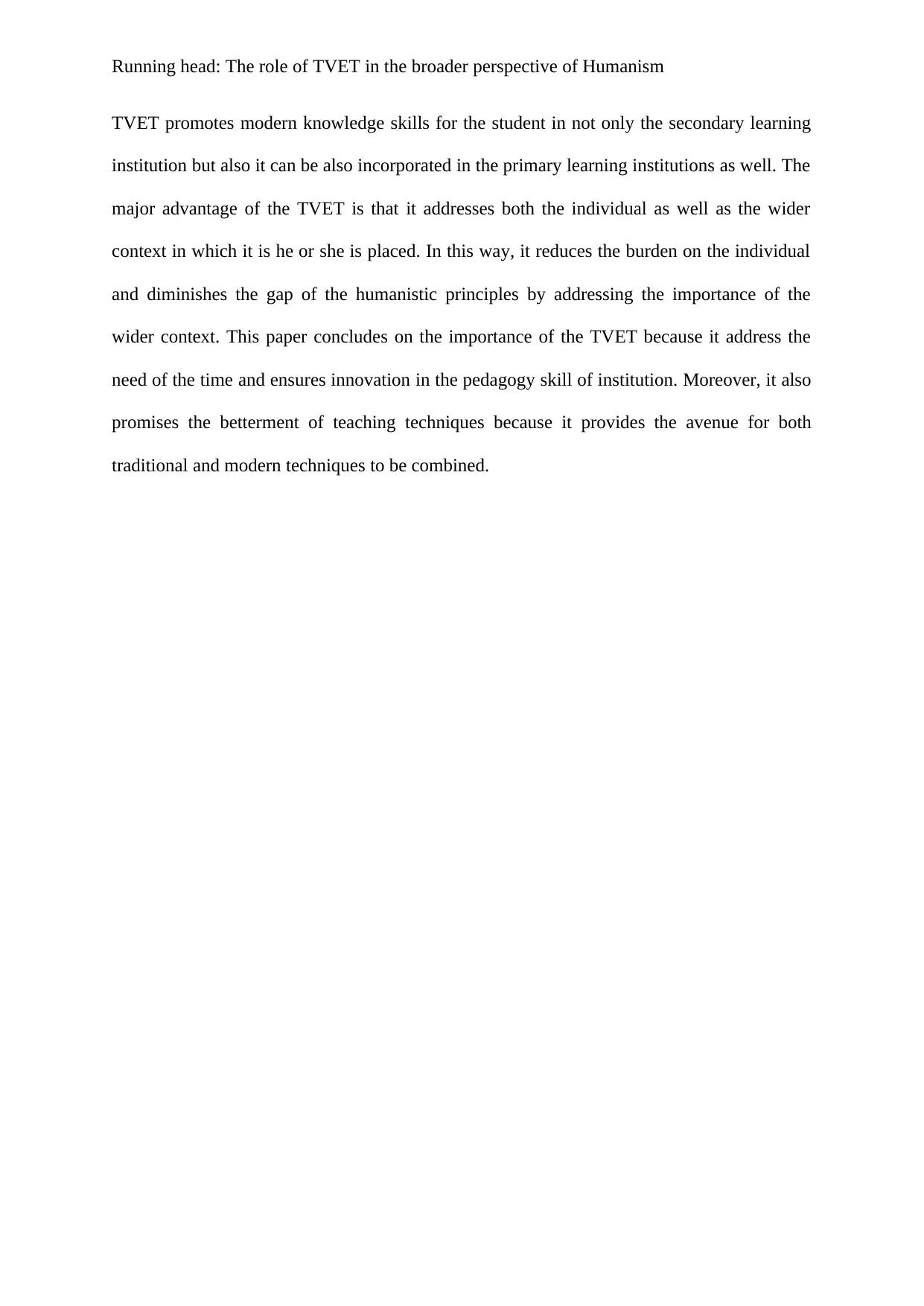
Running head: The role of TVET in the broader perspective of Humanism
TVET promotes modern knowledge skills for the student in not only the secondary learning
institution but also it can be also incorporated in the primary learning institutions as well. The
major advantage of the TVET is that it addresses both the individual as well as the wider
context in which it is he or she is placed. In this way, it reduces the burden on the individual
and diminishes the gap of the humanistic principles by addressing the importance of the
wider context. This paper concludes on the importance of the TVET because it address the
need of the time and ensures innovation in the pedagogy skill of institution. Moreover, it also
promises the betterment of teaching techniques because it provides the avenue for both
traditional and modern techniques to be combined.
TVET promotes modern knowledge skills for the student in not only the secondary learning
institution but also it can be also incorporated in the primary learning institutions as well. The
major advantage of the TVET is that it addresses both the individual as well as the wider
context in which it is he or she is placed. In this way, it reduces the burden on the individual
and diminishes the gap of the humanistic principles by addressing the importance of the
wider context. This paper concludes on the importance of the TVET because it address the
need of the time and ensures innovation in the pedagogy skill of institution. Moreover, it also
promises the betterment of teaching techniques because it provides the avenue for both
traditional and modern techniques to be combined.
⊘ This is a preview!⊘
Do you want full access?
Subscribe today to unlock all pages.

Trusted by 1+ million students worldwide

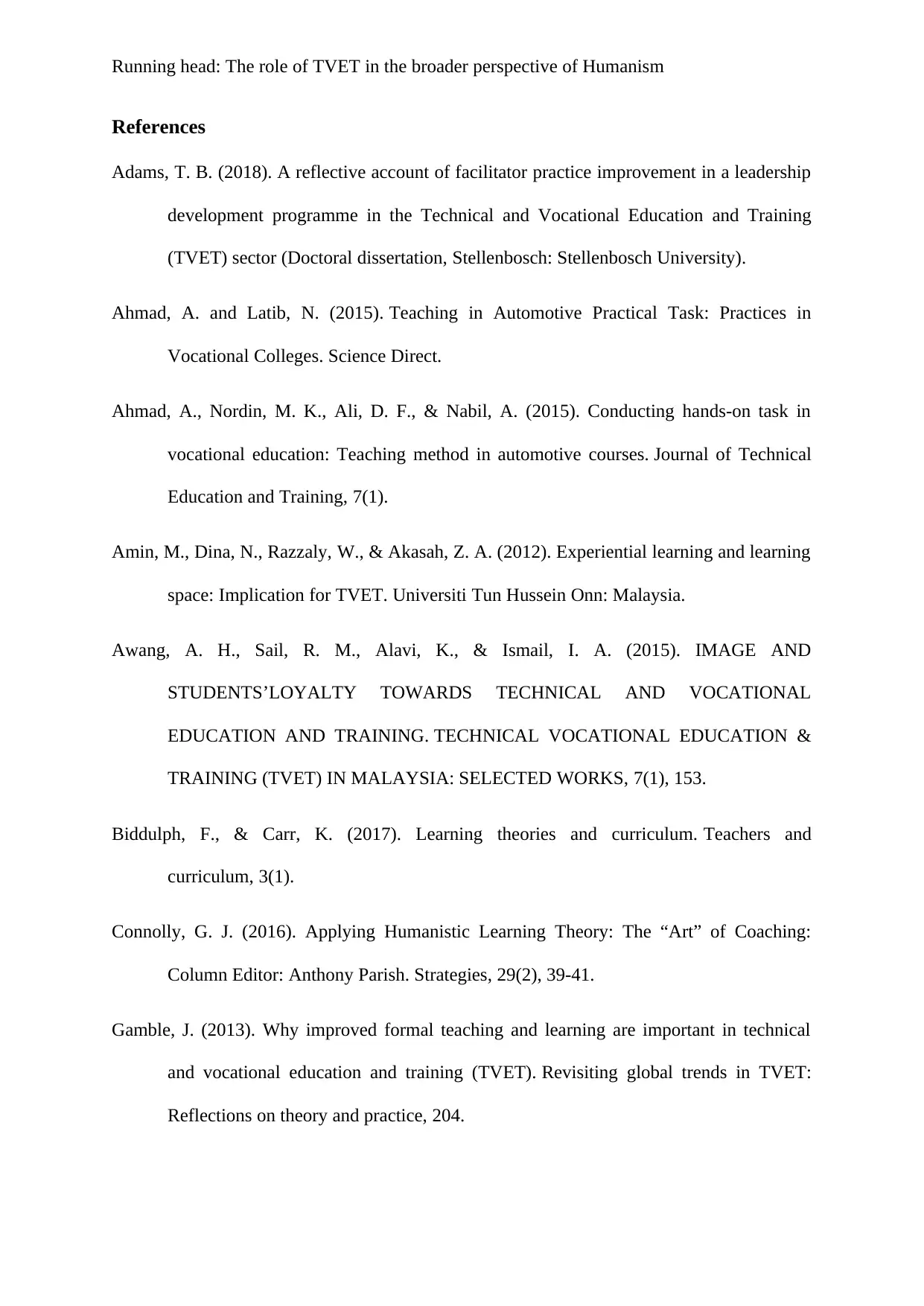
Running head: The role of TVET in the broader perspective of Humanism
References
Adams, T. B. (2018). A reflective account of facilitator practice improvement in a leadership
development programme in the Technical and Vocational Education and Training
(TVET) sector (Doctoral dissertation, Stellenbosch: Stellenbosch University).
Ahmad, A. and Latib, N. (2015). Teaching in Automotive Practical Task: Practices in
Vocational Colleges. Science Direct.
Ahmad, A., Nordin, M. K., Ali, D. F., & Nabil, A. (2015). Conducting hands-on task in
vocational education: Teaching method in automotive courses. Journal of Technical
Education and Training, 7(1).
Amin, M., Dina, N., Razzaly, W., & Akasah, Z. A. (2012). Experiential learning and learning
space: Implication for TVET. Universiti Tun Hussein Onn: Malaysia.
Awang, A. H., Sail, R. M., Alavi, K., & Ismail, I. A. (2015). IMAGE AND
STUDENTS’LOYALTY TOWARDS TECHNICAL AND VOCATIONAL
EDUCATION AND TRAINING. TECHNICAL VOCATIONAL EDUCATION &
TRAINING (TVET) IN MALAYSIA: SELECTED WORKS, 7(1), 153.
Biddulph, F., & Carr, K. (2017). Learning theories and curriculum. Teachers and
curriculum, 3(1).
Connolly, G. J. (2016). Applying Humanistic Learning Theory: The “Art” of Coaching:
Column Editor: Anthony Parish. Strategies, 29(2), 39-41.
Gamble, J. (2013). Why improved formal teaching and learning are important in technical
and vocational education and training (TVET). Revisiting global trends in TVET:
Reflections on theory and practice, 204.
References
Adams, T. B. (2018). A reflective account of facilitator practice improvement in a leadership
development programme in the Technical and Vocational Education and Training
(TVET) sector (Doctoral dissertation, Stellenbosch: Stellenbosch University).
Ahmad, A. and Latib, N. (2015). Teaching in Automotive Practical Task: Practices in
Vocational Colleges. Science Direct.
Ahmad, A., Nordin, M. K., Ali, D. F., & Nabil, A. (2015). Conducting hands-on task in
vocational education: Teaching method in automotive courses. Journal of Technical
Education and Training, 7(1).
Amin, M., Dina, N., Razzaly, W., & Akasah, Z. A. (2012). Experiential learning and learning
space: Implication for TVET. Universiti Tun Hussein Onn: Malaysia.
Awang, A. H., Sail, R. M., Alavi, K., & Ismail, I. A. (2015). IMAGE AND
STUDENTS’LOYALTY TOWARDS TECHNICAL AND VOCATIONAL
EDUCATION AND TRAINING. TECHNICAL VOCATIONAL EDUCATION &
TRAINING (TVET) IN MALAYSIA: SELECTED WORKS, 7(1), 153.
Biddulph, F., & Carr, K. (2017). Learning theories and curriculum. Teachers and
curriculum, 3(1).
Connolly, G. J. (2016). Applying Humanistic Learning Theory: The “Art” of Coaching:
Column Editor: Anthony Parish. Strategies, 29(2), 39-41.
Gamble, J. (2013). Why improved formal teaching and learning are important in technical
and vocational education and training (TVET). Revisiting global trends in TVET:
Reflections on theory and practice, 204.
Paraphrase This Document
Need a fresh take? Get an instant paraphrase of this document with our AI Paraphraser

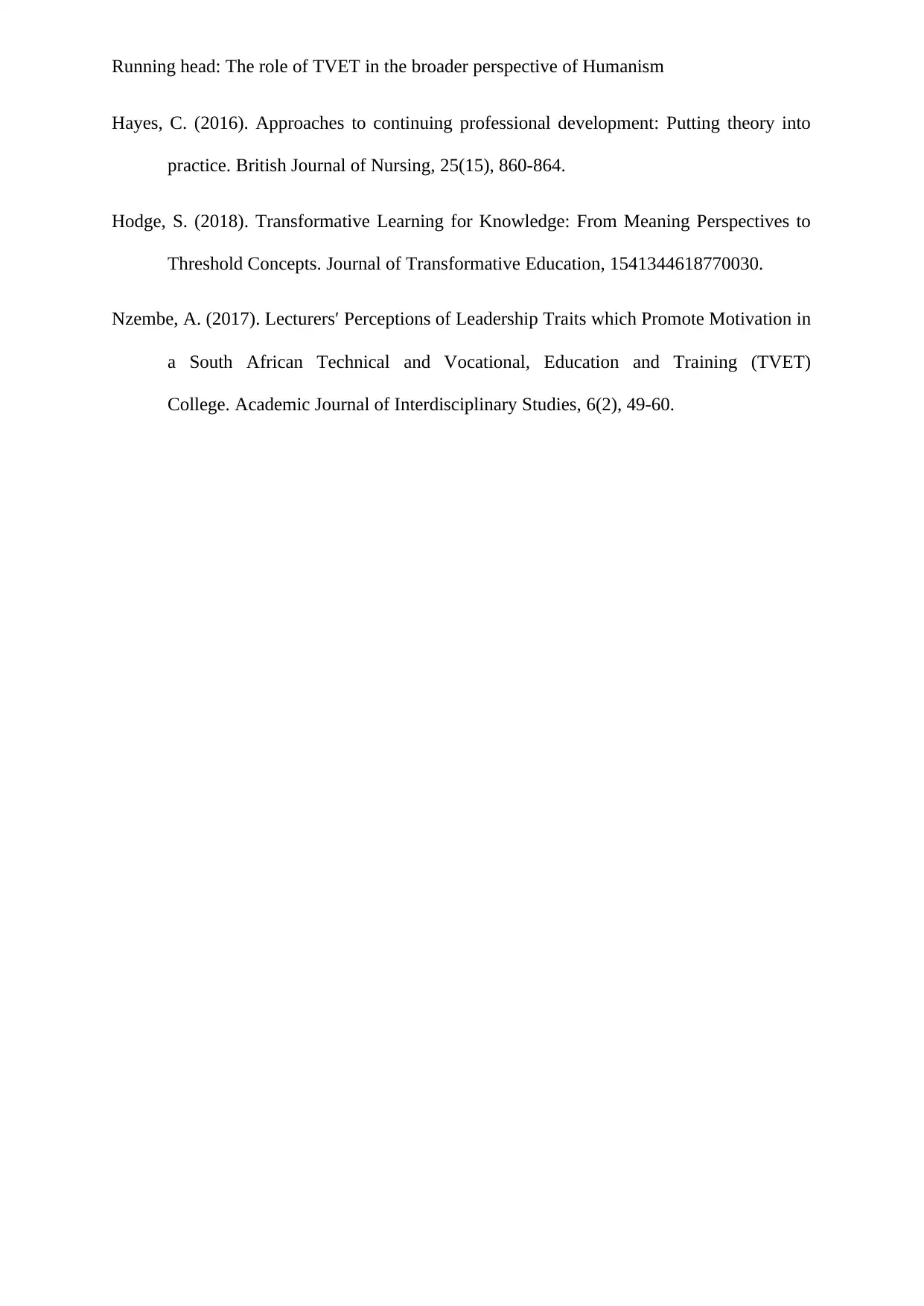
Running head: The role of TVET in the broader perspective of Humanism
Hayes, C. (2016). Approaches to continuing professional development: Putting theory into
practice. British Journal of Nursing, 25(15), 860-864.
Hodge, S. (2018). Transformative Learning for Knowledge: From Meaning Perspectives to
Threshold Concepts. Journal of Transformative Education, 1541344618770030.
Nzembe, A. (2017). Lecturers′ Perceptions of Leadership Traits which Promote Motivation in
a South African Technical and Vocational, Education and Training (TVET)
College. Academic Journal of Interdisciplinary Studies, 6(2), 49-60.
Hayes, C. (2016). Approaches to continuing professional development: Putting theory into
practice. British Journal of Nursing, 25(15), 860-864.
Hodge, S. (2018). Transformative Learning for Knowledge: From Meaning Perspectives to
Threshold Concepts. Journal of Transformative Education, 1541344618770030.
Nzembe, A. (2017). Lecturers′ Perceptions of Leadership Traits which Promote Motivation in
a South African Technical and Vocational, Education and Training (TVET)
College. Academic Journal of Interdisciplinary Studies, 6(2), 49-60.
1 out of 8
Related Documents
Your All-in-One AI-Powered Toolkit for Academic Success.
+13062052269
info@desklib.com
Available 24*7 on WhatsApp / Email
Unlock your academic potential
Copyright © 2020–2026 A2Z Services. All Rights Reserved. Developed and managed by ZUCOL.