Theories of Economy: A Comparison of 20th and 21st Century Views

Verified

Added on  2023/01/03

|7
|975
|81
Report
AI Summary
This report provides a comparative analysis of economic theories from the 20th and 21st centuries. It begins with an introduction to economics, defining its scope and relevance. The main body delves into two primary theories: Neoclassical Economics, prevalent in the 20th century, which emphasizes demand and supply; and the New Growth Theory, characteristic of the 21st century, which highlights the importance of innovation, entrepreneurship, and technology. The report compares and contrasts these theories, discussing their impact on modern business practices, such as adaptation to changing market conditions, investment in human capital, and the need for innovation. The conclusion summarizes the key findings, emphasizing the continued relevance of both theoretical frameworks. The report includes a list of references to academic journals and books used in the research.
Document Page
Theories of Economy
tabler-icon-diamond-filled.svg

Paraphrase This Document

Need a fresh take? Get an instant paraphrase of this document with our AI Paraphraser
Document Page
Table of Contents
INTRODUCTION...........................................................................................................................1
MAIN BODY...................................................................................................................................1
CONCLUSION................................................................................................................................4
REFERENCES................................................................................................................................5
Document Page
INTRODUCTION
Economics refers to a subject which studies the various types of relations between
production, distribution and consumption of goods and services (Henten and Windekilde, 2016).
The theories of Contemporary Economics in 21st Century and 20th Century differ from each
other. In this report, detailed focus will be made on comparison of Economics in 21st century and
20th century and its application to modern business practices.
MAIN BODY
Contemporary Economics Theories in 21st Century-
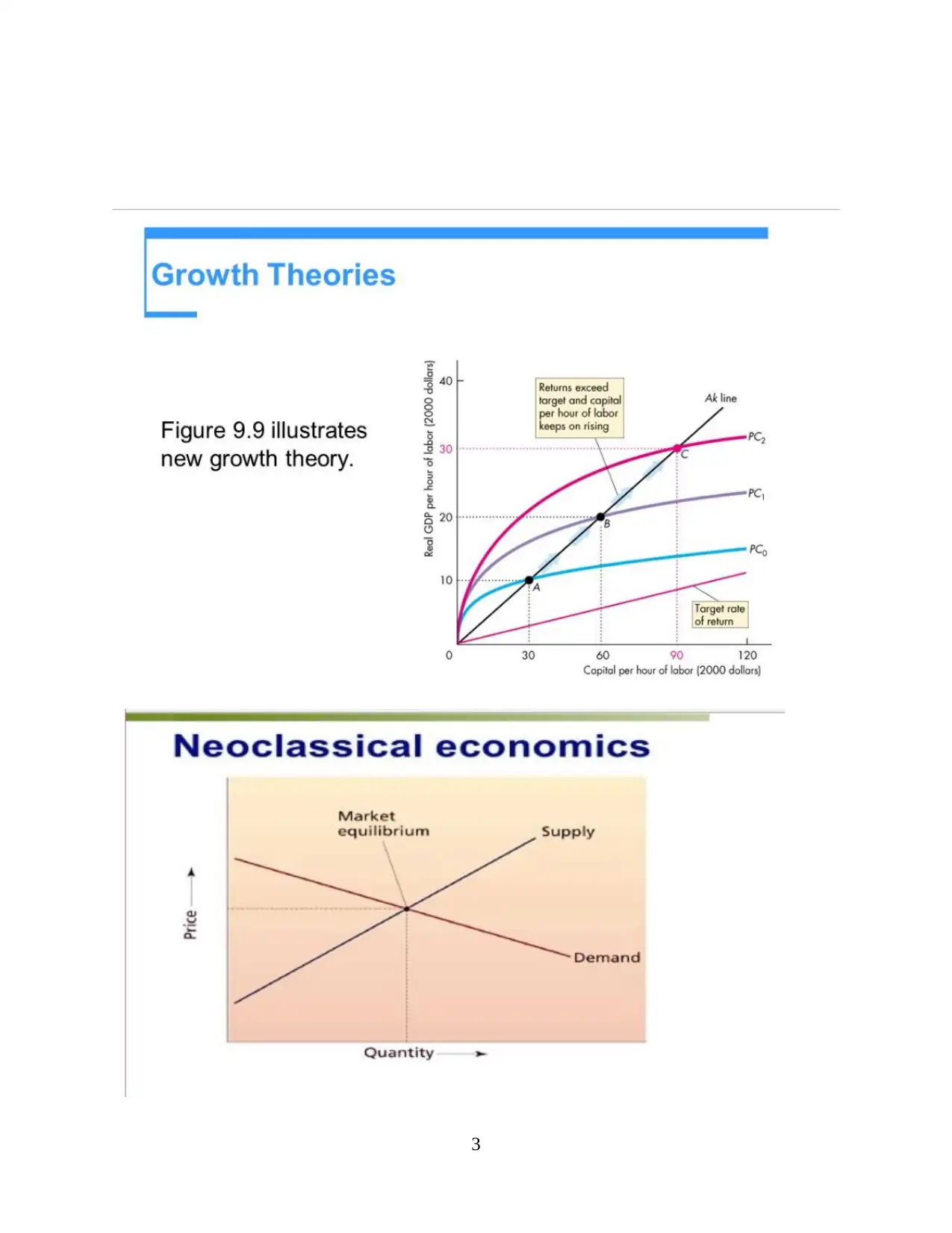
New Growth Theory-
According to the New Growth Theory, the human desires and unlimited wants can lead
towards an enhancement in the level of productivity and economic growth (Loiseau and et.al.,
2016). According to it, there is an importance of entrepreneurship, innovation and technology
because by these are required to identify the changing needs and requirements of various people
in a dynamic business environment and use different types of techniques and methods to meet
them.
The argument which is given by this theory is that innovation and new technology are not
brought to the market randomly. Instead, these are a result of deep understanding of the needs
and requirements of the people in the market. Thus this theory affects the modern business
practices because in a dynamic and constantly changing business environment adaptation is the
key to the achievement of sustainable level of success in the market by a business organization.
This theory states that due to the innovation needs there is a requirement for the
organizations to invest in human capital. In this way they are able to facilitate the development
of innovation effectively and efficiently.
Therefore the organizations are required to ensure that they allow their staff to work on
independent projects within their operations which will be helpful for them in developing new
innovations highly effectively and efficiently. Thus it can be said that this theory is very helpful
in the development of markets in the future.
Contemporary Economics Theories in 20th Century-
Neoclassical Economics-
1
Document Page
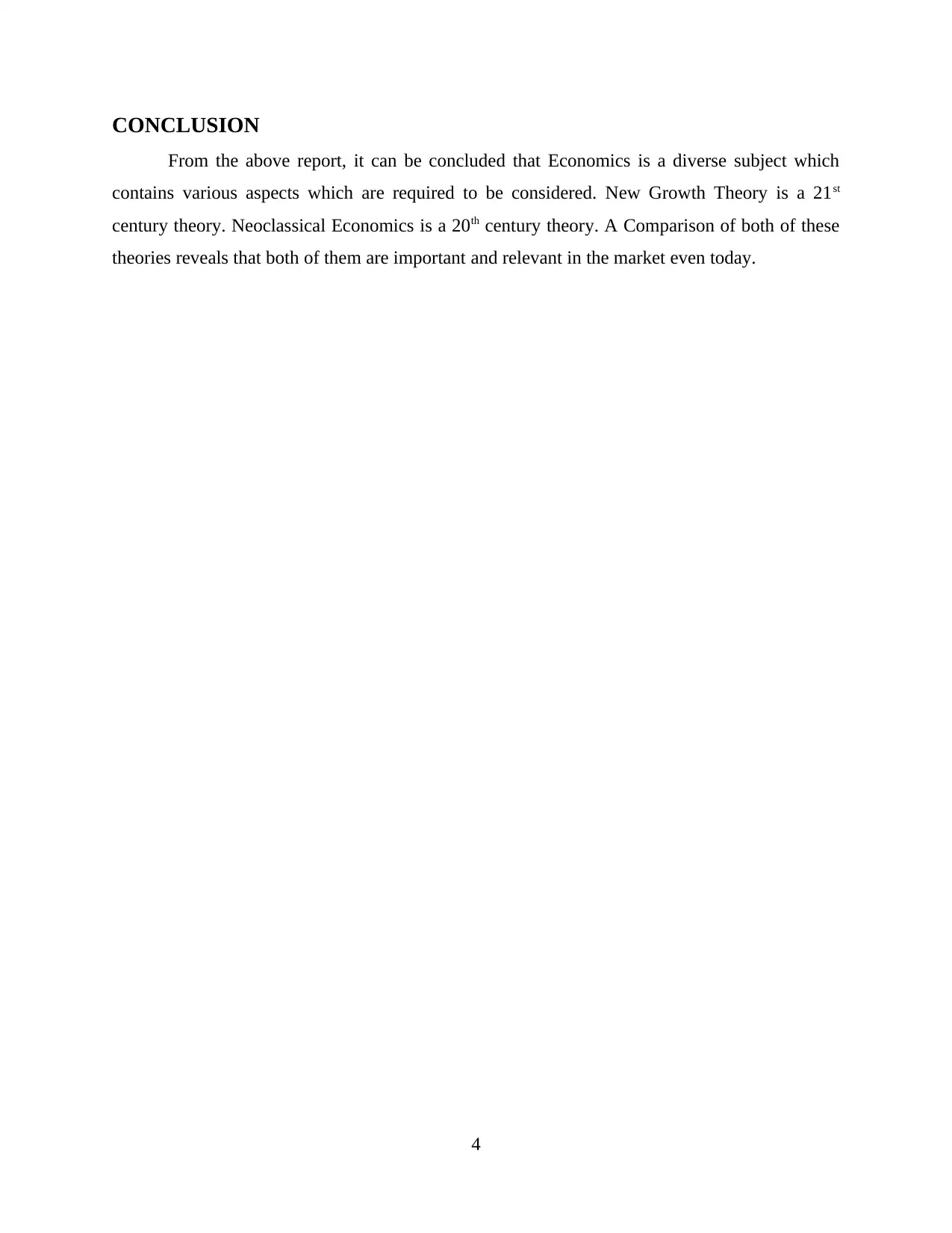
Neoclassical Economics is a broad theory in which the focus is put on Demand and
Supply as the factors which influence the production, pricing and consumption of goods and
services (Menger, Dekker and Kolev, 2016).
According to this theory, the utility of the customers is most important force which drives
the production of the goods and their supply in the market. It believes that with an increase in the
level of demand the prices of the commodities can increase as the businesses which are having
monopoly in the market will tend to dominate and set prices according to their will which will
create an impact in the market.
However a situation can happen in which the supply is more than the demand of goods
and services. In such a situation, the price which is set in the market tends to be low because the
suppliers have excess goods and the service providers have less customers to avail the services.
Thus in this situation the consumers tend to dominate in the market and can bargain hard for the
price which they want to pay for the products and services.
Therefore the businesses which are operating in the market are required to act according
to the needs and requirements of the customers in the market. This will be very helpful in the
attainment of the strategic advantage by the organizations and the achievement of goals and
objectives. Therefore acting in this way ensures that they are able to earn higher-level of profits
in the market. According to this theory, the market conditions are quite dynamic in nature and
thus due to these dynamic conditions the business organizations have to constantly bring a
change to their approach to sustain in the market.
Comparison of the theories-
In Comparison, it can be said that both of these theories are very helpful for the business
organizations and can be applied according to the prevailing situation in the market (Peng and
et.al., 2016). The use of New Growth Theory is essential nowadays because the business
organizations have to innovate and bring a change in their products to sustain in the market.
However, The use of Neoclassical Economics is also essential as it is set according to the old
model of Demand and Supply which is still relevant in the market and determines the actions to
be taken by the different types of organizations.
2
tabler-icon-diamond-filled.svg

Paraphrase This Document

Need a fresh take? Get an instant paraphrase of this document with our AI Paraphraser
Document Page
3
Document Page
CONCLUSION
From the above report, it can be concluded that Economics is a diverse subject which
contains various aspects which are required to be considered. New Growth Theory is a 21st
century theory. Neoclassical Economics is a 20th century theory. A Comparison of both of these
theories reveals that both of them are important and relevant in the market even today.
4
Document Page
REFERENCES
Books and Journals:
Henten, A. H. and Windekilde, I. M., 2016. Transaction costs and the sharing economy. info.
Loiseau, E. and et.al., 2016. Green economy and related concepts: An overview. Journal of
cleaner production. 139. pp.361-371.
Menger, C., Dekker, E. and Kolev, S., 2016. The social theories of classical political economy
and modern economic policy. Econ Journal Watch. 13(3). pp.473-489.
Peng, M. W. and et.al., 2016. Theories of the (state-owned) firm. Asia Pacific Journal of
Management. 33(2). pp.293-317.
5
chevron_up_icon
1 out of 7
circle_padding
hide_on_mobile
zoom_out_icon
[object Object]