Sociology Essay: Environmental Factors, Poverty, and Modernization
VerifiedAdded on 2020/05/01
|11
|2869
|190
Essay
AI Summary
This essay delves into the intricate relationship between poverty and ecological modernization, examining how environmental factors exacerbate poverty. It begins by introducing the theory of Ecological Modernization, exploring its origins and core concepts, particularly the role of technological advancements in addressing environmental issues. The essay then investigates how environmental degradation, such as air, soil, and water pollution, contributes to poverty by impacting food security, access to clean water, and overall health. It further analyzes poverty as a sociological problem, emphasizing the lack of resources and opportunities. The essay concludes by discussing strategies for poverty reduction, including improved governance, asset expansion, and trade reforms, advocating for eco-friendly practices to foster sustainable development and reduce the impact of poverty. The essay highlights the importance of a holistic approach that integrates environmental considerations into economic and social policies.
Running Head: SOCIOLOGY
Sociology
Student Name
Course Code
Sociology
Student Name
Course Code

Paraphrase This Document
Need a fresh take? Get an instant paraphrase of this document with our AI Paraphraser
1SOCIOLOGY
Introduction
Poverty has grown to become a world epidemic affecting environment and its factors and
negative way. In recent years many sociological scientist have opined that poverty has caused
great environmental damage. The following essay is comprised of at first ecological
modernization in which the changes in technology and their impact on the climate and
environment have been discussed in details. In the second part the factors of poverty which have
been caused by the change in environment have been discussed and examples have been
illustrated in support of the theory. Third part of the essay contains the sociological problem of
poverty caused due to different reasons and how it affects people all around the globe. To end of
the discussion in the essay reduction methods of poverty and how poverty can be dealt with
proper methods of mitigation have been discussed. The following essay is a holistic discussion
about poverty and its environmental causes.
Ecological Modernization
The theory of Ecological Modernization came into existence in 1980 and was coined by
number of sociological scientist of Netherlands, Germany and United Kingdom (Berkes, 2017).
The first definition of the Ecological Modernization Theory was stated to be the technological
modifications in the mode of production and the environmental changes (Ewing, 2017). There
was an attitude of criticism towards the bureaucracy of the state which has promoted this
modernization. It depended on the favorable attitude towards the environmental reforms and the
actors of market which supported the genesis of those reforms. But the actual concept of
Ecological Modernization is based to create a sustainable approach to tackle the environmental
issues with the key factors being the science and its technological advancements
(Chandrashekeranet at al., 2017).
Introduction
Poverty has grown to become a world epidemic affecting environment and its factors and
negative way. In recent years many sociological scientist have opined that poverty has caused
great environmental damage. The following essay is comprised of at first ecological
modernization in which the changes in technology and their impact on the climate and
environment have been discussed in details. In the second part the factors of poverty which have
been caused by the change in environment have been discussed and examples have been
illustrated in support of the theory. Third part of the essay contains the sociological problem of
poverty caused due to different reasons and how it affects people all around the globe. To end of
the discussion in the essay reduction methods of poverty and how poverty can be dealt with
proper methods of mitigation have been discussed. The following essay is a holistic discussion
about poverty and its environmental causes.
Ecological Modernization
The theory of Ecological Modernization came into existence in 1980 and was coined by
number of sociological scientist of Netherlands, Germany and United Kingdom (Berkes, 2017).
The first definition of the Ecological Modernization Theory was stated to be the technological
modifications in the mode of production and the environmental changes (Ewing, 2017). There
was an attitude of criticism towards the bureaucracy of the state which has promoted this
modernization. It depended on the favorable attitude towards the environmental reforms and the
actors of market which supported the genesis of those reforms. But the actual concept of
Ecological Modernization is based to create a sustainable approach to tackle the environmental
issues with the key factors being the science and its technological advancements
(Chandrashekeranet at al., 2017).
2SOCIOLOGY
The evolution of industrialized civilization concerning an environmentally balanced
society of manufacture, constructed upon the concept of a transformed connection between the
economy and ecosystem. In place of the strong ecological hold of fundamental reformation of
society, ecological modernization has more to do with “robust” varieties of sustainability in
which it contains a procedure of the advanced modernization of the establishments of
contemporary society, as differentiated to their annihilation or destruction (Ewing, 2017).There
are three main concepts which has brought the Ecological Modernization into limelight are
reformation of consumption and production to achieve the goals pf ecology (Chandrashekeran et
at., 2017). This will be achieved by diffusing and infusing the clean technological methods for
production and separating the economic development factors from the use of resources and
emissions caused by the industrial production. The second one is making the ecology
economically profitable. Stakeholders should need to understand the economic value of the
environment. And the last one is incorporating the policies of environmental goals into other
manufacturing policies (Garchitorenaet et al., 2017).
Environment Factors of Poverty
Environment plays a vital role in the lives of people located in any part of the world. It is
the major source of food and energy for people and without proper environmental balance in the
country there will be a state of poverty, depravity and malnourishment which many countries are
prone to For example, in Bangladesh there is a problem of drinking water caused by the textile
industrial waste which contains harmful chemicals. Their outlet is in the ponds and rivers from
which the entire Bangladesh gets its drinking water. Whereas Vietnam has been prone to war for
almost 50 years in which chemical weapons were used. This has destroyed the soil quality of the
Vietnamese forests and also the quality of air. People have been majorly affected due to lack of
The evolution of industrialized civilization concerning an environmentally balanced
society of manufacture, constructed upon the concept of a transformed connection between the
economy and ecosystem. In place of the strong ecological hold of fundamental reformation of
society, ecological modernization has more to do with “robust” varieties of sustainability in
which it contains a procedure of the advanced modernization of the establishments of
contemporary society, as differentiated to their annihilation or destruction (Ewing, 2017).There
are three main concepts which has brought the Ecological Modernization into limelight are
reformation of consumption and production to achieve the goals pf ecology (Chandrashekeran et
at., 2017). This will be achieved by diffusing and infusing the clean technological methods for
production and separating the economic development factors from the use of resources and
emissions caused by the industrial production. The second one is making the ecology
economically profitable. Stakeholders should need to understand the economic value of the
environment. And the last one is incorporating the policies of environmental goals into other
manufacturing policies (Garchitorenaet et al., 2017).
Environment Factors of Poverty
Environment plays a vital role in the lives of people located in any part of the world. It is
the major source of food and energy for people and without proper environmental balance in the
country there will be a state of poverty, depravity and malnourishment which many countries are
prone to For example, in Bangladesh there is a problem of drinking water caused by the textile
industrial waste which contains harmful chemicals. Their outlet is in the ponds and rivers from
which the entire Bangladesh gets its drinking water. Whereas Vietnam has been prone to war for
almost 50 years in which chemical weapons were used. This has destroyed the soil quality of the
Vietnamese forests and also the quality of air. People have been majorly affected due to lack of
⊘ This is a preview!⊘
Do you want full access?
Subscribe today to unlock all pages.

Trusted by 1+ million students worldwide
3SOCIOLOGY
resources of food which has made them poor. Indefinite use of natural resources and establishing
huge industries and factories harm the environment of a place actively and passively (Gibbs et
al., 2017). The industrial owners knowingly exploit these environmental fodder to maximize
their profits but they ignore the ecological consequences which the native people of that place
have to face (Kohler & Brondizio, 2017).
Industries who do not comply with the environmental standards of emission and use of
materials for their production tend to degrade the ecology of a country. It destroys the diversity
of ecology of a place which is the basic tool to produce food and fodder for the livestock.
Harmful gaseous emissions from the factories increase the pollution of a place which in turn
degrades the quality of air and negatively impact other ecological factors. In the African
countries where the land is not fertile to grow basic food items there is unfathomable state of
poverty and people do not have food to eat and clean water to drink (Isaksson, 2017). This state
has been a result of the environmental degradation caused by the industries for example, Burkina
Faso, Chad, Mali, Mauritania, and Niger. There are many environmental factors which leads to
poverty and those factors are discussed below.
Air Pollution: Presence of harmful gases in the atmosphere degrade the environment and
ecological health. Due to this reason there is no proper rainy season which is a dire need for
farming and agriculture which is required to grow staple food items to feed the people of a
country and the livestock. These problems are majorly seen in Afghanistan, Iran, Egypt and
Qatar. This creates a huge problem of poverty as the food items which they have to but are sold
at higher rates which they cannot afford (Kohler & Brondizio, 2017).
Soil Pollution: Due to degraded quality of soil, people are not able to produce items which can
be sold in the market and can be traded to different countries. The small amount of grains and
resources of food which has made them poor. Indefinite use of natural resources and establishing
huge industries and factories harm the environment of a place actively and passively (Gibbs et
al., 2017). The industrial owners knowingly exploit these environmental fodder to maximize
their profits but they ignore the ecological consequences which the native people of that place
have to face (Kohler & Brondizio, 2017).
Industries who do not comply with the environmental standards of emission and use of
materials for their production tend to degrade the ecology of a country. It destroys the diversity
of ecology of a place which is the basic tool to produce food and fodder for the livestock.
Harmful gaseous emissions from the factories increase the pollution of a place which in turn
degrades the quality of air and negatively impact other ecological factors. In the African
countries where the land is not fertile to grow basic food items there is unfathomable state of
poverty and people do not have food to eat and clean water to drink (Isaksson, 2017). This state
has been a result of the environmental degradation caused by the industries for example, Burkina
Faso, Chad, Mali, Mauritania, and Niger. There are many environmental factors which leads to
poverty and those factors are discussed below.
Air Pollution: Presence of harmful gases in the atmosphere degrade the environment and
ecological health. Due to this reason there is no proper rainy season which is a dire need for
farming and agriculture which is required to grow staple food items to feed the people of a
country and the livestock. These problems are majorly seen in Afghanistan, Iran, Egypt and
Qatar. This creates a huge problem of poverty as the food items which they have to but are sold
at higher rates which they cannot afford (Kohler & Brondizio, 2017).
Soil Pollution: Due to degraded quality of soil, people are not able to produce items which can
be sold in the market and can be traded to different countries. The small amount of grains and
Paraphrase This Document
Need a fresh take? Get an instant paraphrase of this document with our AI Paraphraser
4SOCIOLOGY
staple edible items are consumed by themselves. Sometimes the harvest is destroyed which leads
to more impoverished citizens (Isaksson, 2017). Due to insufficient energy requirements the
people are vulnerable to a number of diseases. For example countries of Africa are the hotspot of
new endemic diseases which have virtually no cure (Gibbs et al., 2017).
Water Pollution: Water is the elixir of life. If African countries, most of them are deserted areas
have a huge scarcity of water which is caused by toxic industrial waste which have polluted the
rivers and lakes which were the main secures of drinking water for example China, Ukraine,
Kyrgyzstan, Peru, Zambia and Dominican Republic. To stay alive people have to buy water at
raised prices and from distant places which has made them poor (Ling Guo et al., 2017).
Problem of Poverty
For all countries the most basic agenda in context of the economy is to eradicate poverty.
The Theory of Ecological Modernization can help people to come out of their impoverished
lifestyles. The Ecological Modernization Theory has started a new global environment discourse.
In this system, the emphasis is given on the nations where poverty is at its peak and the causes
for it are directly related to the ecological modernization.
Poverty is a social problem which has its roots deeply embedded in the social and now
ecological status of a country. Poverty prevails to the lack of resources and low levels of incomes
and scope of economic development of people of a place (Longhofer & Jorgenson, 2017). The
reason behind this state of social health is the unchecked use of ecological and environmental
resources done by the capitalists. Poverty is caused by the lack of basic amenities to the people
which stops them from thinking beyond the basic needs for survival. The Theory of Ecological
Modernization appeals to the alterations in the global environmental practices which allows the
staple edible items are consumed by themselves. Sometimes the harvest is destroyed which leads
to more impoverished citizens (Isaksson, 2017). Due to insufficient energy requirements the
people are vulnerable to a number of diseases. For example countries of Africa are the hotspot of
new endemic diseases which have virtually no cure (Gibbs et al., 2017).
Water Pollution: Water is the elixir of life. If African countries, most of them are deserted areas
have a huge scarcity of water which is caused by toxic industrial waste which have polluted the
rivers and lakes which were the main secures of drinking water for example China, Ukraine,
Kyrgyzstan, Peru, Zambia and Dominican Republic. To stay alive people have to buy water at
raised prices and from distant places which has made them poor (Ling Guo et al., 2017).
Problem of Poverty
For all countries the most basic agenda in context of the economy is to eradicate poverty.
The Theory of Ecological Modernization can help people to come out of their impoverished
lifestyles. The Ecological Modernization Theory has started a new global environment discourse.
In this system, the emphasis is given on the nations where poverty is at its peak and the causes
for it are directly related to the ecological modernization.
Poverty is a social problem which has its roots deeply embedded in the social and now
ecological status of a country. Poverty prevails to the lack of resources and low levels of incomes
and scope of economic development of people of a place (Longhofer & Jorgenson, 2017). The
reason behind this state of social health is the unchecked use of ecological and environmental
resources done by the capitalists. Poverty is caused by the lack of basic amenities to the people
which stops them from thinking beyond the basic needs for survival. The Theory of Ecological
Modernization appeals to the alterations in the global environmental practices which allows the
5SOCIOLOGY
poor people to live their lives with dignity and without fear of dying due to the scarcity of food
and water.
Poor people are not able to make use of the natural resources which are remotely
available in their area as they do not have the means or the healthy man power which can make
things work (Peterson, 2017). The Theory of Ecological Modernization can help these people to
come out of their misery and do sustainable things to keep their environment healthy and even
benefit from it. In rural areas the problem of poverty is paramount. People living there do not
know the ways in which they can revive their ecology and reduce the problems and issues of
poverty which they face due to the depleted ecological system. New innovations and
developments in technology can help them in creating a sustainable life.
Health being the major factor for the lack of money and economic factors has restrained
many countries from developing. Disease prone citizens of a country cannot do hard work and
think beyond their survival (Raluto, 2017). Some of the basic points which form the foundation
stone of Ecological Modernization Theory and the way it explains poverty is discussed below.
Natural resources are not limited to sustaining life which aregood quality air, fresh drinking
water, productive soils and green trees which produces oxygen and takes in carbon dioxide. They
also make the elementary commercial assets of huge number of people. Soil degradation which
is done by erosion, misuse of chemical fertilizers, overgrazing and increase in salinity due to
poor water management cause decrease in income for minor farmers and lead them to poverty
(Sapinski, 2017).
Poverty makes people to cut forests and make incorrect use of wood and other options for
cooking, warming, building shelters and techniques, thus divesting weak groups from vital goods
and speed up towards the declining spiral of poverty and ecological degradation. Inadequate
poor people to live their lives with dignity and without fear of dying due to the scarcity of food
and water.
Poor people are not able to make use of the natural resources which are remotely
available in their area as they do not have the means or the healthy man power which can make
things work (Peterson, 2017). The Theory of Ecological Modernization can help these people to
come out of their misery and do sustainable things to keep their environment healthy and even
benefit from it. In rural areas the problem of poverty is paramount. People living there do not
know the ways in which they can revive their ecology and reduce the problems and issues of
poverty which they face due to the depleted ecological system. New innovations and
developments in technology can help them in creating a sustainable life.
Health being the major factor for the lack of money and economic factors has restrained
many countries from developing. Disease prone citizens of a country cannot do hard work and
think beyond their survival (Raluto, 2017). Some of the basic points which form the foundation
stone of Ecological Modernization Theory and the way it explains poverty is discussed below.
Natural resources are not limited to sustaining life which aregood quality air, fresh drinking
water, productive soils and green trees which produces oxygen and takes in carbon dioxide. They
also make the elementary commercial assets of huge number of people. Soil degradation which
is done by erosion, misuse of chemical fertilizers, overgrazing and increase in salinity due to
poor water management cause decrease in income for minor farmers and lead them to poverty
(Sapinski, 2017).
Poverty makes people to cut forests and make incorrect use of wood and other options for
cooking, warming, building shelters and techniques, thus divesting weak groups from vital goods
and speed up towards the declining spiral of poverty and ecological degradation. Inadequate
⊘ This is a preview!⊘
Do you want full access?
Subscribe today to unlock all pages.
Trusted by 1+ million students worldwide
6SOCIOLOGY
access to learning and to new methods of living makes it tough for underprivileged people to
procure accessible natural resources in an ecological and proper manner, thus generating damage
of livelihood chances and of natural diversity. Poverty keeps people at one place and spend a lot
of time in using the resources of that particular place which degrades the quality of land and soil
and damages the economic assets (Stretesky et al., 2017). Lack of resources increases the
chances of poor waste management which in turn creates health hazards.
Reduction or Dealing with Poverty
Poverty being a social disease can be handled and reduced by making amendments in the
government policies. Areas which needs reforms in the process of poverty reduction are:
Improving Governance: Countries where poverty is in large quantity and areas need to form
policies which are pro poor and cater to their basic needs of alleviation form their state of
impoverishment. There should be reduction in over-exploitation of natural resources so that the
ecological balance of the place can be maintained and proper use of that ecology can be done to
provide poor their basic amenities.
Expansion of asset base: There should be a tenure based regime for every agency in the
government to harness the natural resources. Women should be made in charge of these
environmental programs as they are seen to be more concerned towards the protection of ecology
(Yliskylä-Peuralahti, 2017). There should be expansion in social protection and better
availability of climatic data so that proper agricultural practices can be done.
Quality of Growth: To increase the quality of growth the environmental factors are ignored in
many countries. There should be economical growth but not at the price of ecology. Many
countries have seen to risk their environment to reach economic goals and after some years this
access to learning and to new methods of living makes it tough for underprivileged people to
procure accessible natural resources in an ecological and proper manner, thus generating damage
of livelihood chances and of natural diversity. Poverty keeps people at one place and spend a lot
of time in using the resources of that particular place which degrades the quality of land and soil
and damages the economic assets (Stretesky et al., 2017). Lack of resources increases the
chances of poor waste management which in turn creates health hazards.
Reduction or Dealing with Poverty
Poverty being a social disease can be handled and reduced by making amendments in the
government policies. Areas which needs reforms in the process of poverty reduction are:
Improving Governance: Countries where poverty is in large quantity and areas need to form
policies which are pro poor and cater to their basic needs of alleviation form their state of
impoverishment. There should be reduction in over-exploitation of natural resources so that the
ecological balance of the place can be maintained and proper use of that ecology can be done to
provide poor their basic amenities.
Expansion of asset base: There should be a tenure based regime for every agency in the
government to harness the natural resources. Women should be made in charge of these
environmental programs as they are seen to be more concerned towards the protection of ecology
(Yliskylä-Peuralahti, 2017). There should be expansion in social protection and better
availability of climatic data so that proper agricultural practices can be done.
Quality of Growth: To increase the quality of growth the environmental factors are ignored in
many countries. There should be economical growth but not at the price of ecology. Many
countries have seen to risk their environment to reach economic goals and after some years this
Paraphrase This Document
Need a fresh take? Get an instant paraphrase of this document with our AI Paraphraser
7SOCIOLOGY
degraded environment has proved to be catastrophic to their economies resulting in complete
failure due to resources exhaustion.
Reforms in Trade: There should be trade reforms which promotes the eco-friendly product
manufacture and trade so that the countries should pay more emphasis on practices of ecological
sustainability.
Conclusion
Thus it can be concluded from the above discussion that The Theory of Ecological
Modernization has changed the viewpoint of many developed and rich countries and has diverted
their focus from the prevalent capitalist mentality of production towards eco-friendly ways of
manufacture. There have been a lot of fuss on the global level to keep the environment clean and
there should be technological innovations and modernization which can provide better and clean
ways of production in the industries. These practices have been focused on reducing the poverty
which is prevalent in most part of the world. Identification of factors of poverty have been done
which are related to the negative ecological impacts of industrialization and its practices.
Countries have been looking forward to invent practices which prove to be sustainable in poverty
reduction as it poses to become a social disease and a threat to future development of a healthy
society.
degraded environment has proved to be catastrophic to their economies resulting in complete
failure due to resources exhaustion.
Reforms in Trade: There should be trade reforms which promotes the eco-friendly product
manufacture and trade so that the countries should pay more emphasis on practices of ecological
sustainability.
Conclusion
Thus it can be concluded from the above discussion that The Theory of Ecological
Modernization has changed the viewpoint of many developed and rich countries and has diverted
their focus from the prevalent capitalist mentality of production towards eco-friendly ways of
manufacture. There have been a lot of fuss on the global level to keep the environment clean and
there should be technological innovations and modernization which can provide better and clean
ways of production in the industries. These practices have been focused on reducing the poverty
which is prevalent in most part of the world. Identification of factors of poverty have been done
which are related to the negative ecological impacts of industrialization and its practices.
Countries have been looking forward to invent practices which prove to be sustainable in poverty
reduction as it poses to become a social disease and a threat to future development of a healthy
society.
8SOCIOLOGY
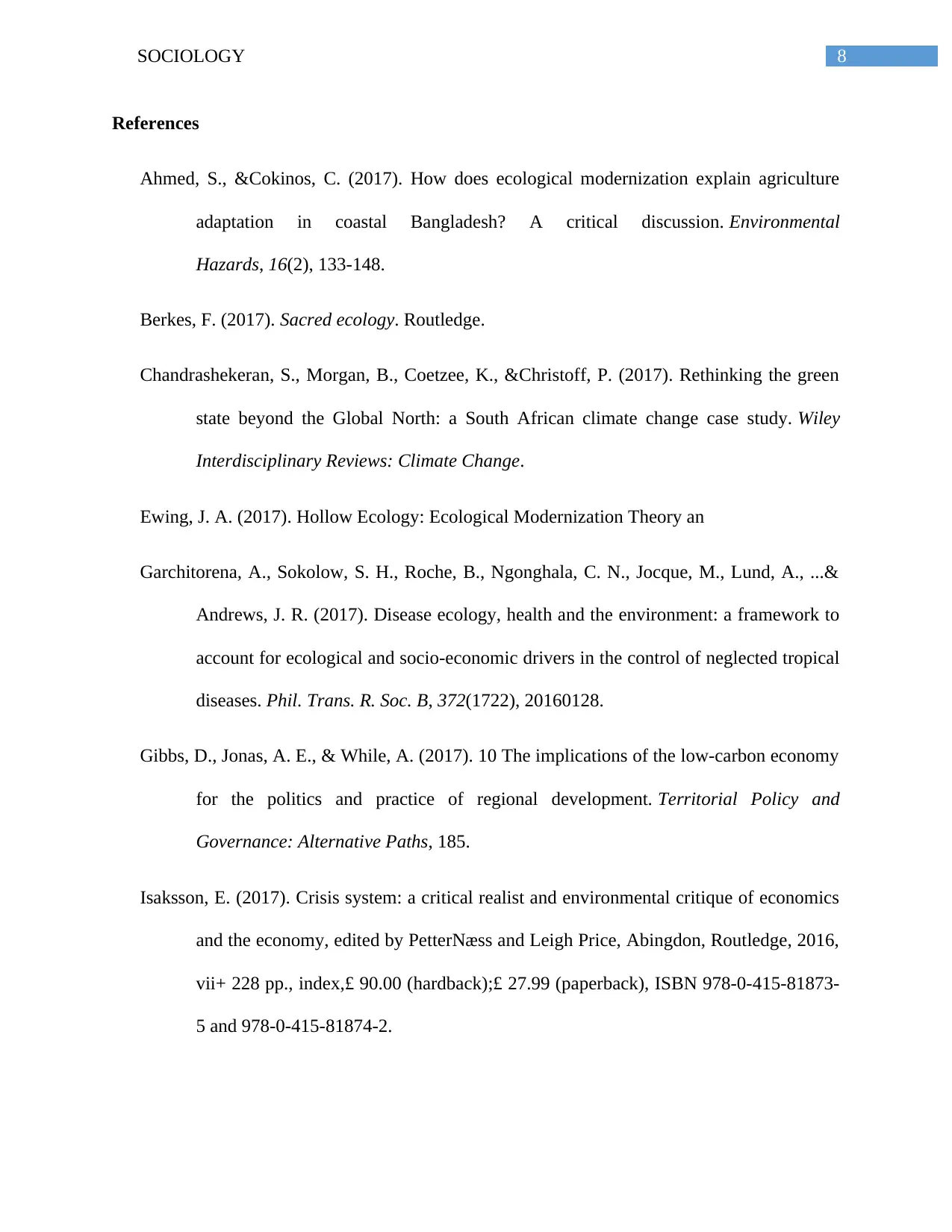
References
Ahmed, S., &Cokinos, C. (2017). How does ecological modernization explain agriculture
adaptation in coastal Bangladesh? A critical discussion. Environmental
Hazards, 16(2), 133-148.
Berkes, F. (2017). Sacred ecology. Routledge.
Chandrashekeran, S., Morgan, B., Coetzee, K., &Christoff, P. (2017). Rethinking the green
state beyond the Global North: a South African climate change case study. Wiley
Interdisciplinary Reviews: Climate Change.
Ewing, J. A. (2017). Hollow Ecology: Ecological Modernization Theory an
Garchitorena, A., Sokolow, S. H., Roche, B., Ngonghala, C. N., Jocque, M., Lund, A., ...&
Andrews, J. R. (2017). Disease ecology, health and the environment: a framework to
account for ecological and socio-economic drivers in the control of neglected tropical
diseases. Phil. Trans. R. Soc. B, 372(1722), 20160128.
Gibbs, D., Jonas, A. E., & While, A. (2017). 10 The implications of the low-carbon economy
for the politics and practice of regional development. Territorial Policy and
Governance: Alternative Paths, 185.
Isaksson, E. (2017). Crisis system: a critical realist and environmental critique of economics
and the economy, edited by PetterNæss and Leigh Price, Abingdon, Routledge, 2016,
vii+ 228 pp., index,£ 90.00 (hardback);£ 27.99 (paperback), ISBN 978-0-415-81873-
5 and 978-0-415-81874-2.
References
Ahmed, S., &Cokinos, C. (2017). How does ecological modernization explain agriculture
adaptation in coastal Bangladesh? A critical discussion. Environmental
Hazards, 16(2), 133-148.
Berkes, F. (2017). Sacred ecology. Routledge.
Chandrashekeran, S., Morgan, B., Coetzee, K., &Christoff, P. (2017). Rethinking the green
state beyond the Global North: a South African climate change case study. Wiley
Interdisciplinary Reviews: Climate Change.
Ewing, J. A. (2017). Hollow Ecology: Ecological Modernization Theory an
Garchitorena, A., Sokolow, S. H., Roche, B., Ngonghala, C. N., Jocque, M., Lund, A., ...&
Andrews, J. R. (2017). Disease ecology, health and the environment: a framework to
account for ecological and socio-economic drivers in the control of neglected tropical
diseases. Phil. Trans. R. Soc. B, 372(1722), 20160128.
Gibbs, D., Jonas, A. E., & While, A. (2017). 10 The implications of the low-carbon economy
for the politics and practice of regional development. Territorial Policy and
Governance: Alternative Paths, 185.
Isaksson, E. (2017). Crisis system: a critical realist and environmental critique of economics
and the economy, edited by PetterNæss and Leigh Price, Abingdon, Routledge, 2016,
vii+ 228 pp., index,£ 90.00 (hardback);£ 27.99 (paperback), ISBN 978-0-415-81873-
5 and 978-0-415-81874-2.
⊘ This is a preview!⊘
Do you want full access?
Subscribe today to unlock all pages.
Trusted by 1+ million students worldwide
9SOCIOLOGY
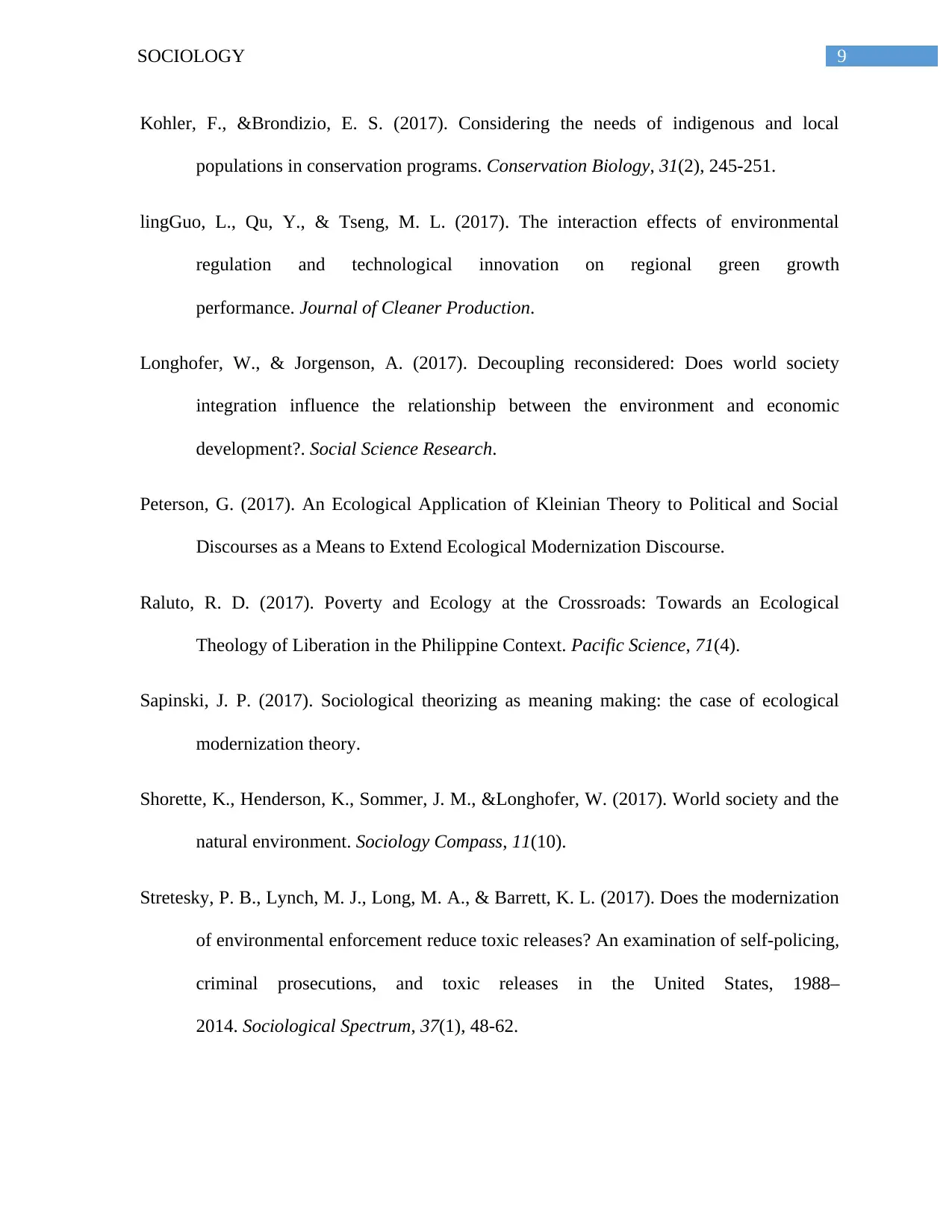
Kohler, F., &Brondizio, E. S. (2017). Considering the needs of indigenous and local
populations in conservation programs. Conservation Biology, 31(2), 245-251.
lingGuo, L., Qu, Y., & Tseng, M. L. (2017). The interaction effects of environmental
regulation and technological innovation on regional green growth
performance. Journal of Cleaner Production.
Longhofer, W., & Jorgenson, A. (2017). Decoupling reconsidered: Does world society
integration influence the relationship between the environment and economic
development?. Social Science Research.
Peterson, G. (2017). An Ecological Application of Kleinian Theory to Political and Social
Discourses as a Means to Extend Ecological Modernization Discourse.
Raluto, R. D. (2017). Poverty and Ecology at the Crossroads: Towards an Ecological
Theology of Liberation in the Philippine Context. Pacific Science, 71(4).
Sapinski, J. P. (2017). Sociological theorizing as meaning making: the case of ecological
modernization theory.
Shorette, K., Henderson, K., Sommer, J. M., &Longhofer, W. (2017). World society and the
natural environment. Sociology Compass, 11(10).
Stretesky, P. B., Lynch, M. J., Long, M. A., & Barrett, K. L. (2017). Does the modernization
of environmental enforcement reduce toxic releases? An examination of self-policing,
criminal prosecutions, and toxic releases in the United States, 1988–
2014. Sociological Spectrum, 37(1), 48-62.
Kohler, F., &Brondizio, E. S. (2017). Considering the needs of indigenous and local
populations in conservation programs. Conservation Biology, 31(2), 245-251.
lingGuo, L., Qu, Y., & Tseng, M. L. (2017). The interaction effects of environmental
regulation and technological innovation on regional green growth
performance. Journal of Cleaner Production.
Longhofer, W., & Jorgenson, A. (2017). Decoupling reconsidered: Does world society
integration influence the relationship between the environment and economic
development?. Social Science Research.
Peterson, G. (2017). An Ecological Application of Kleinian Theory to Political and Social
Discourses as a Means to Extend Ecological Modernization Discourse.
Raluto, R. D. (2017). Poverty and Ecology at the Crossroads: Towards an Ecological
Theology of Liberation in the Philippine Context. Pacific Science, 71(4).
Sapinski, J. P. (2017). Sociological theorizing as meaning making: the case of ecological
modernization theory.
Shorette, K., Henderson, K., Sommer, J. M., &Longhofer, W. (2017). World society and the
natural environment. Sociology Compass, 11(10).
Stretesky, P. B., Lynch, M. J., Long, M. A., & Barrett, K. L. (2017). Does the modernization
of environmental enforcement reduce toxic releases? An examination of self-policing,
criminal prosecutions, and toxic releases in the United States, 1988–
2014. Sociological Spectrum, 37(1), 48-62.
Paraphrase This Document
Need a fresh take? Get an instant paraphrase of this document with our AI Paraphraser

10SOCIOLOGY
Yliskylä-Peuralahti, J. (2017). Ecological modernization and the multi-scaled governance of
sustainability in maritime transport. GeografiskaAnnaler: Series B, Human
Geography, 99(1), 42-58.
Yliskylä-Peuralahti, J. (2017). Ecological modernization and the multi-scaled governance of
sustainability in maritime transport. GeografiskaAnnaler: Series B, Human
Geography, 99(1), 42-58.

1 out of 11


Related Documents


Your All-in-One AI-Powered Toolkit for Academic Success.
+13062052269
info@desklib.com
Available 24*7 on WhatsApp / Email
![[object Object]](/_next/static/media/star-bottom.7253800d.svg)
Unlock your academic potential
Copyright © 2020–2025 A2Z Services. All Rights Reserved. Developed and managed by ZUCOL.