COR165e Thinking Critically Tutor-Marked Assignment 01 Solution

Verified

Added on  2023/06/07

|6
|946
|118
Homework Assignment
AI Summary
This document presents a comprehensive solution to the COR165e Thinking Critically Tutor-Marked Assignment 01. The assignment covers a range of critical thinking concepts, including the identification of arguments, truth conditions for compound statements, and categorical syllogisms. The solution provides answers to multiple-choice questions, analyzes the validity of arguments, and applies Venn diagrams to assess the validity of syllogisms. The document also includes an analysis of convergent reasoning and the identification of premises and conclusions in given arguments. The content is structured to address the key learning outcomes of the course, emphasizing the rules of legitimate inference and the ability to distinguish between argumentative and descriptive writing. The solution also analyzes a given argument, identifies its components, and evaluates its validity using logical principles.
Document Page
CR CAITI L THINKING
Author ame s irst M ast mit itles and Degrees[ N ( ), F . L , O T ]
nstitutional Affiliation s[I ( )]
SECTION A: OVERVIEW OF BASIC CONCEPT
tabler-icon-diamond-filled.svg

Paraphrase This Document

Need a fresh take? Get an instant paraphrase of this document with our AI Paraphraser
Document Page
Question 1
‘If Mahathir wins the election, then if Najib does not leave the country, he will be prosecuted’
This is an argument.
A: False. There is no premise
Question 2
‘If both disjuncts in a disjunction are true, then the disjunction is false.’
A: False
Question 3
‘Every time I have gone on a holiday for the last 20 years, I have ended up losing some valuable
or the other. So, I should buy travel insurance for my next holiday.’ This is charitably read as an
inductive argument.
A: True. The premises of the argument are true and thus the conclusion is unlikely to be false
Question 4
'An unsound argument may have a true conclusion.'
A: True. An argument is unsound when it is not valid and not valid because the conclusion is not
in line with the premise.
Question 5
‘A weak argument must have a false conclusion.’
A: False. A weak argument does not offer the probable support for the conclusion it has made.
The conclusion may or may not be true, with the only challenge being offering probable and/or
conclude logical support for it. In this regard, the basis of declaring an argument weak or strong is
based on the ability to support the reasons for the conclusion (Poon 2017).
Question 6
'The TPP will be a success only if the US is a member. It follows that if the US is a member, the
TPP will be a success.' This is a valid argument.
A: True. The premise is valid and hence the conclusion is valid even though it not logic
Question 7
Document Page
'Emma is beautiful. And, Emma is rich. So, I should marry her.' This is an example of convergent
reasoning.
A: False. Marrying Emma does not necessarily make one reach
Question 8
'To be successful in life, one needs the right connections. And, Bob has the right connections. So,
Bob will be successful in life.' This is an example of convergent reasoning.
A: False. The premises of the argument are invalid hence the conclusion is false and weak.
Question 9
‘Some philosophers drink whisky. So, there is at least one philosopher who drinks whisky.’ This
is a valid argument.
A: False. The middle term is undistributed
Question 10
‘No politicians are truthful. So, there is at least one untruthful politician.’ This is an invalid
argument.
A: False. The middle term is undistributed
SECTION B: Truth condition for compound statements
Question 11
Either Mary does not have a little lamb or Humpty is sitting on a wall.
A: False: Mary does not have a little lamb is false, Humpty is sitting on a wall is true hence the
statement is false
Question 12
Mary has a little lamb and Jack did not go up the hill.
A: False. Mary has a little lamb is true, Jack did not go up the hill is false hence the compound
statement is false
Question 13
Only if Jack did not go up the hill, then Humpty is sitting on the wall.
A: False. Jack went up the hill, Humpty is sitting on the wall are both true and the conjunction
only if is contradictory
Question 14
If Mary does not have a little lamb, then jack went up the hill.
Document Page
A: True
Question 15
Either Jack did not go up the hill or, if Mary has a little lamb, then Humpty is sitting on a wall.
A: True
SECTION C: Categorical Syllogism
Question 16
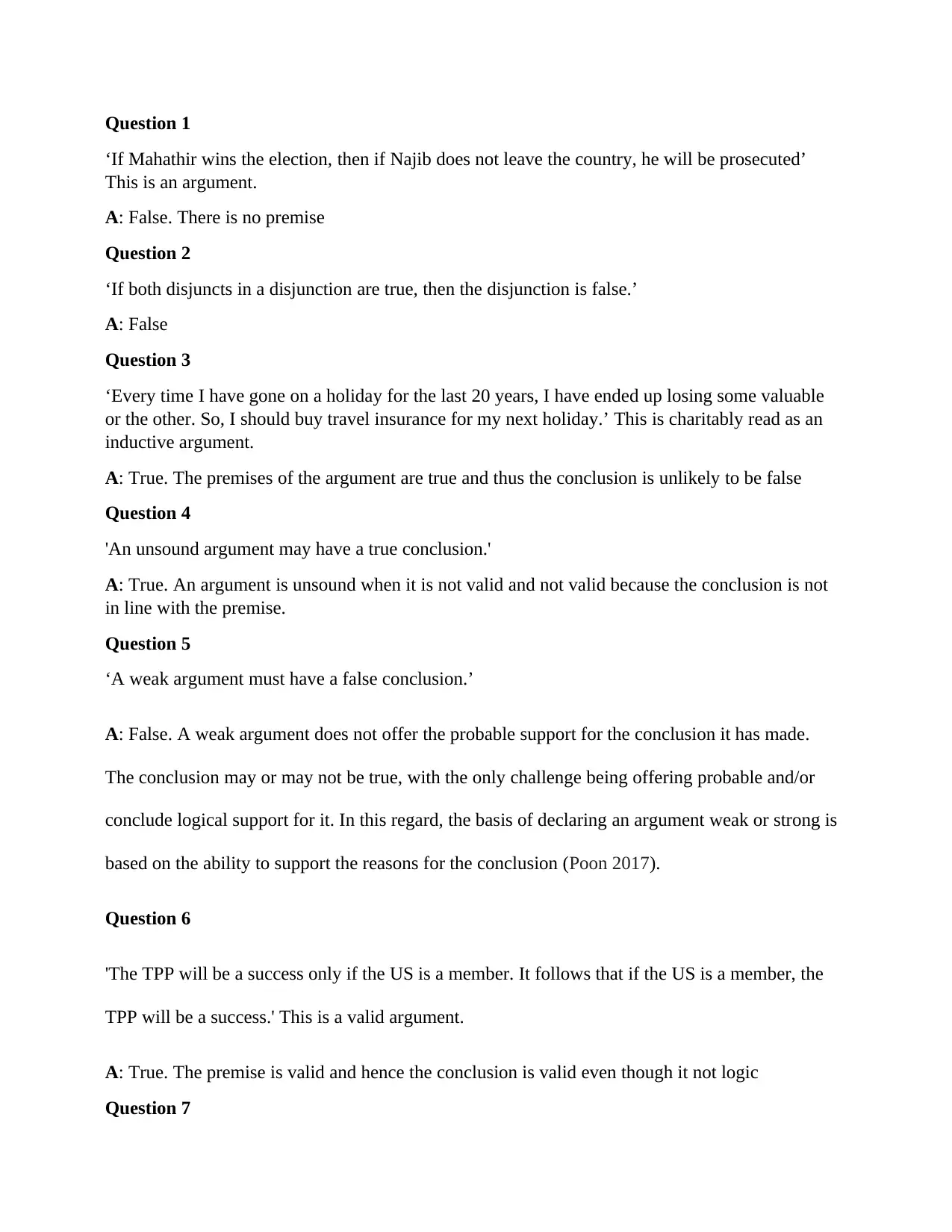
P1: All sexual attraction is transient
P2: All transient things are profane
C: All sexual attraction is profane
Venn Diagram
Sexual attraction P1 Transient
C P2
Profane
The argument is invalid. The middle term is undistributed.
Question 17
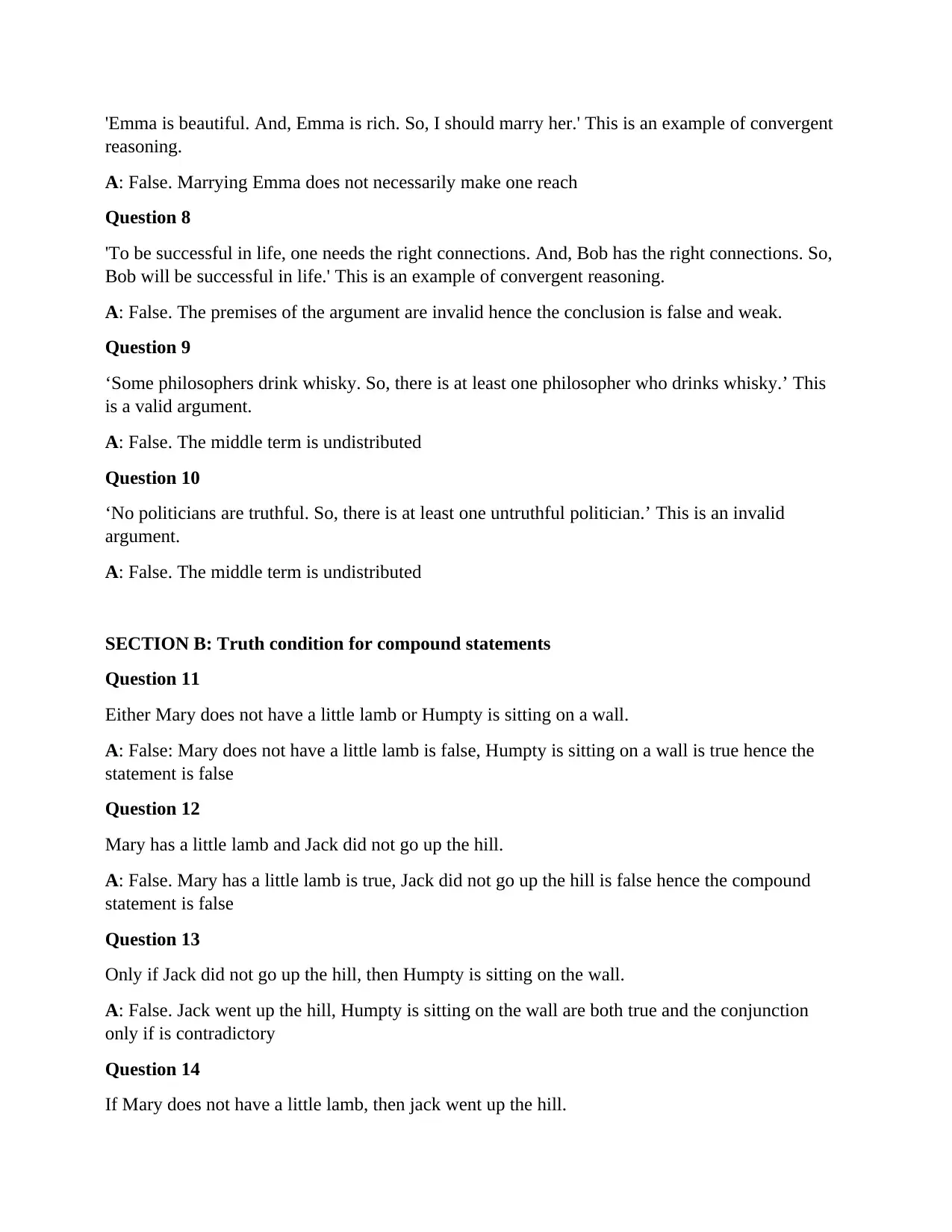
P1: No religious person is smart
P2: All smart people are happy
C: No religious person is happy
The argument is valid. The premises are false, and the conclusion is as well false but the logic is
valid. No rules have been broken (Rawlinson 2017).
tabler-icon-diamond-filled.svg

Paraphrase This Document

Need a fresh take? Get an instant paraphrase of this document with our AI Paraphraser
Document Page
Religious person P1 Smart people
C P2
Happy
Question 18
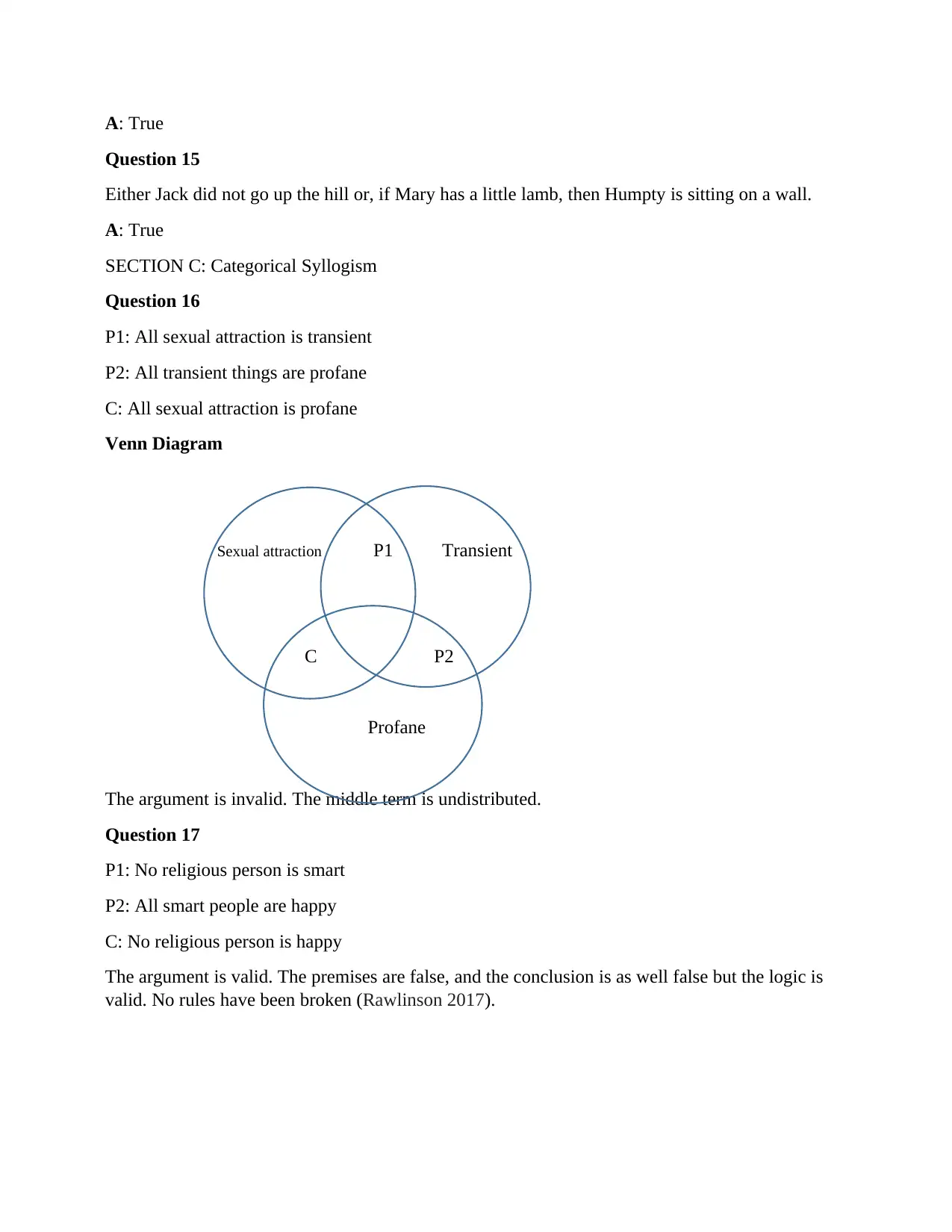
a) Premises: Universal moral standards may be found even if some moral practices and beliefs are
varied among various cultures
ECR does not acknowledge that some societies have better reasons for holding their perspectives
as compared to others
ECR claims there can be no absolute moral principles
Conclusion
ECR is contradictory
b) Arrow Diagram
References
There can be
no moral
principle
The conclusion
that there can
be no moral
principle is
contradictory ECR is
contradictory
Document Page
Rawlinson, J. G. (2017). Creative thinking and brainstorming. Routledge
Poon, S. T. (2017). Conceptual Gaps in the Issues to Resolve Visual Complexities: A Contextual
Evaluation of the Inspirations and Motivations in Enhancing Perceptions and Practices of
Creative Thinking. decision making, 50
chevron_up_icon
1 out of 6
circle_padding
hide_on_mobile
zoom_out_icon
[object Object]