RPL Process Report - CPPCLO3009
VerifiedAdded on 2020/07/22
|9
|3474
|55
Report
AI Summary
The report outlines the Recognition of Prior Learning (RPL) process for the unit CPPCLO3009, focusing on cleaning glass surfaces. It details the necessary steps, including element mapping, evidence collection, and assessment procedures. The document emphasizes the importance of adhering to health and safety regulations while performing cleaning tasks and provides guidance on how to prepare and submit the RPL application effectively.
CPPCLO3009
Clean glass surfaces
THIRD
PARTY
REPORT
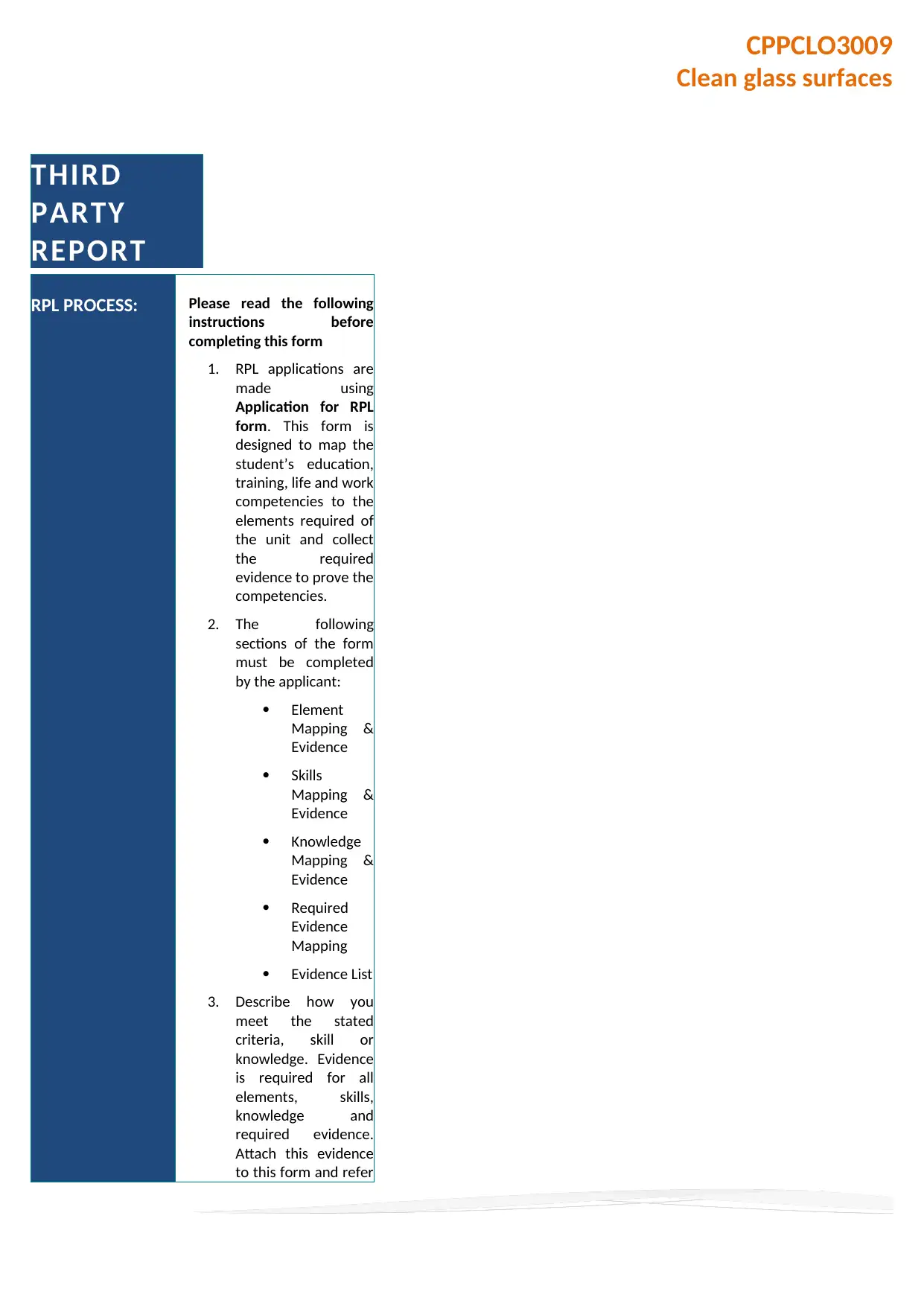
RPL PROCESS: Please read the following
instructions before
completing this form
1. RPL applications are
made using
Application for RPL
form. This form is
designed to map the
student’s education,
training, life and work
competencies to the
elements required of
the unit and collect
the required
evidence to prove the
competencies.
2. The following
sections of the form
must be completed
by the applicant:
Element
Mapping &
Evidence
Skills
Mapping &
Evidence
Knowledge
Mapping &
Evidence
Required
Evidence
Mapping
Evidence List
3. Describe how you
meet the stated
criteria, skill or
knowledge. Evidence
is required for all
elements, skills,
knowledge and
required evidence.
Attach this evidence
to this form and refer
Clean glass surfaces
THIRD
PARTY
REPORT
RPL PROCESS: Please read the following
instructions before
completing this form
1. RPL applications are
made using
Application for RPL
form. This form is
designed to map the
student’s education,
training, life and work
competencies to the
elements required of
the unit and collect
the required
evidence to prove the
competencies.
2. The following
sections of the form
must be completed
by the applicant:
Element
Mapping &
Evidence
Skills
Mapping &
Evidence
Knowledge
Mapping &
Evidence
Required
Evidence
Mapping
Evidence List
3. Describe how you
meet the stated
criteria, skill or
knowledge. Evidence
is required for all
elements, skills,
knowledge and
required evidence.
Attach this evidence
to this form and refer

Paraphrase This Document
Need a fresh take? Get an instant paraphrase of this document with our AI Paraphraser
CPPCLO3009
Clean glass surfaces
THIRD
PARTY
REPORT
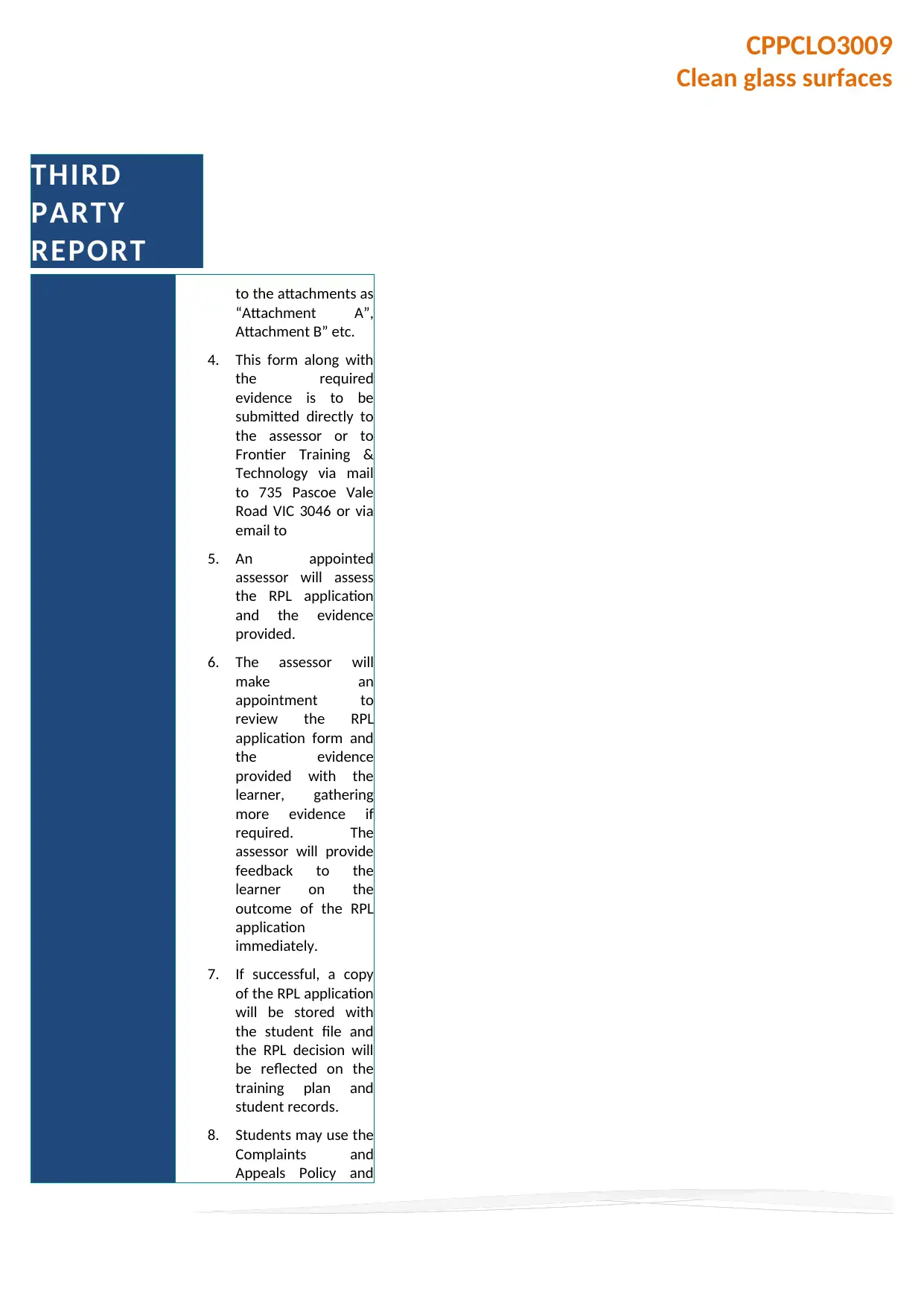
to the attachments as
“Attachment A”,
Attachment B” etc.
4. This form along with
the required
evidence is to be
submitted directly to
the assessor or to
Frontier Training &
Technology via mail
to 735 Pascoe Vale
Road VIC 3046 or via
email to
5. An appointed
assessor will assess
the RPL application
and the evidence
provided.
6. The assessor will
make an
appointment to
review the RPL
application form and
the evidence
provided with the
learner, gathering
more evidence if
required. The
assessor will provide
feedback to the
learner on the
outcome of the RPL
application
immediately.
7. If successful, a copy
of the RPL application
will be stored with
the student file and
the RPL decision will
be reflected on the
training plan and
student records.
8. Students may use the
Complaints and
Appeals Policy and
Clean glass surfaces
THIRD
PARTY
REPORT
to the attachments as
“Attachment A”,
Attachment B” etc.
4. This form along with
the required
evidence is to be
submitted directly to
the assessor or to
Frontier Training &
Technology via mail
to 735 Pascoe Vale
Road VIC 3046 or via
email to
5. An appointed
assessor will assess
the RPL application
and the evidence
provided.
6. The assessor will
make an
appointment to
review the RPL
application form and
the evidence
provided with the
learner, gathering
more evidence if
required. The
assessor will provide
feedback to the
learner on the
outcome of the RPL
application
immediately.
7. If successful, a copy
of the RPL application
will be stored with
the student file and
the RPL decision will
be reflected on the
training plan and
student records.
8. Students may use the
Complaints and
Appeals Policy and
CPPCLO3009
Clean glass surfaces
THIRD
PARTY
REPORT
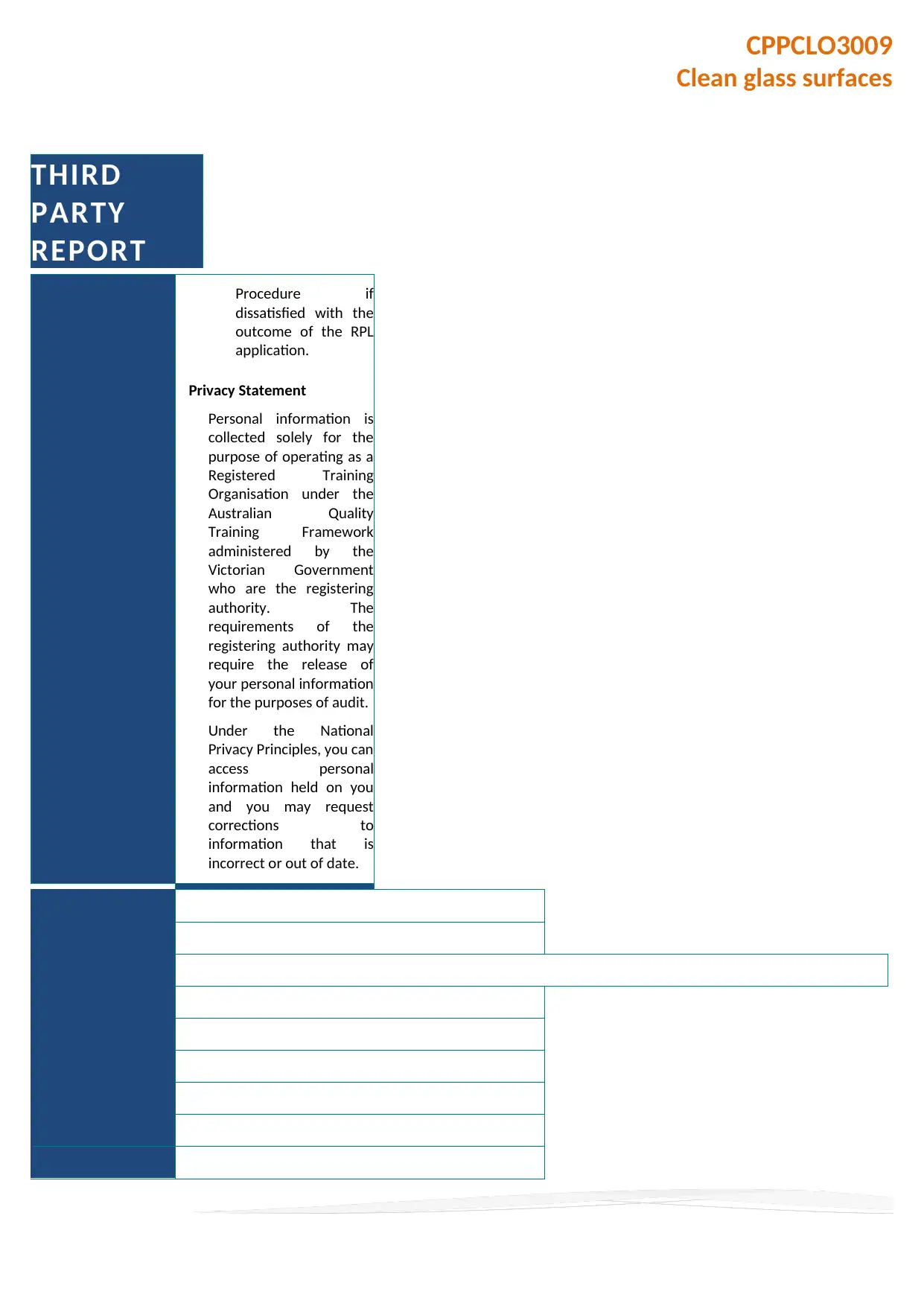
Procedure if
dissatisfied with the
outcome of the RPL
application.
Privacy Statement
Personal information is
collected solely for the
purpose of operating as a
Registered Training
Organisation under the
Australian Quality
Training Framework
administered by the
Victorian Government
who are the registering
authority. The
requirements of the
registering authority may
require the release of
your personal information
for the purposes of audit.
Under the National
Privacy Principles, you can
access personal
information held on you
and you may request
corrections to
information that is
incorrect or out of date.
Clean glass surfaces
THIRD
PARTY
REPORT
Procedure if
dissatisfied with the
outcome of the RPL
application.
Privacy Statement
Personal information is
collected solely for the
purpose of operating as a
Registered Training
Organisation under the
Australian Quality
Training Framework
administered by the
Victorian Government
who are the registering
authority. The
requirements of the
registering authority may
require the release of
your personal information
for the purposes of audit.
Under the National
Privacy Principles, you can
access personal
information held on you
and you may request
corrections to
information that is
incorrect or out of date.
⊘ This is a preview!⊘
Do you want full access?
Subscribe today to unlock all pages.

Trusted by 1+ million students worldwide
CPPCLO3009
Clean glass surfaces
THIRD
PARTY
REPORT
Unit: CPPCLO3009 - Clean glass surfaces
Clean glass surfaces
THIRD
PARTY
REPORT
Unit: CPPCLO3009 - Clean glass surfaces
Paraphrase This Document
Need a fresh take? Get an instant paraphrase of this document with our AI Paraphraser
CPPCLO3009
Clean glass surfaces
ELEMENT
MAPPING &
EVIDENCE: Element / Performance Criteria
Description
(Describe what you do to meet this criteria,
work, education, experiences etc.) (your
explanation must cover a situation, location,
job type and outcome of the action)
Third Party Report
(Please comment on
the student’s
description)
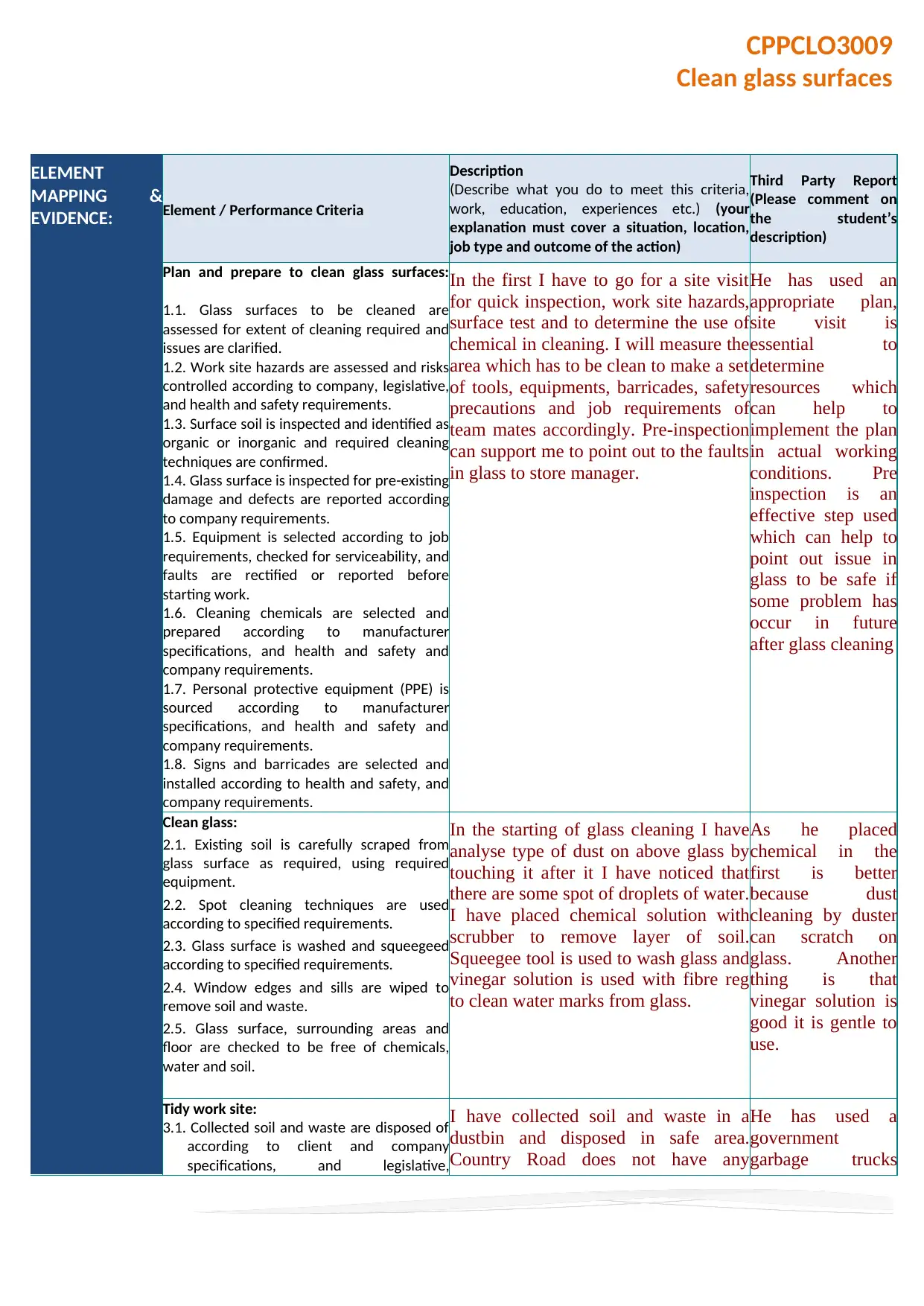
Plan and prepare to clean glass surfaces:
1.1. Glass surfaces to be cleaned are
assessed for extent of cleaning required and
issues are clarified.
1.2. Work site hazards are assessed and risks
controlled according to company, legislative,
and health and safety requirements.
1.3. Surface soil is inspected and identified as
organic or inorganic and required cleaning
techniques are confirmed.
1.4. Glass surface is inspected for pre-existing
damage and defects are reported according
to company requirements.
1.5. Equipment is selected according to job
requirements, checked for serviceability, and
faults are rectified or reported before
starting work.
1.6. Cleaning chemicals are selected and
prepared according to manufacturer
specifications, and health and safety and
company requirements.
1.7. Personal protective equipment (PPE) is
sourced according to manufacturer
specifications, and health and safety and
company requirements.
1.8. Signs and barricades are selected and
installed according to health and safety, and
company requirements.
In the first I have to go for a site visit
for quick inspection, work site hazards,
surface test and to determine the use of
chemical in cleaning. I will measure the
area which has to be clean to make a set
of tools, equipments, barricades, safety
precautions and job requirements of
team mates accordingly. Pre-inspection
can support me to point out to the faults
in glass to store manager.
He has used an
appropriate plan,
site visit is
essential to
determine
resources which
can help to
implement the plan
in actual working
conditions. Pre
inspection is an
effective step used
which can help to
point out issue in
glass to be safe if
some problem has
occur in future
after glass cleaning
Clean glass:
2.1. Existing soil is carefully scraped from
glass surface as required, using required
equipment.
2.2. Spot cleaning techniques are used
according to specified requirements.
2.3. Glass surface is washed and squeegeed
according to specified requirements.
2.4. Window edges and sills are wiped to
remove soil and waste.
2.5. Glass surface, surrounding areas and
floor are checked to be free of chemicals,
water and soil.
In the starting of glass cleaning I have
analyse type of dust on above glass by
touching it after it I have noticed that
there are some spot of droplets of water.
I have placed chemical solution with
scrubber to remove layer of soil.
Squeegee tool is used to wash glass and
vinegar solution is used with fibre reg
to clean water marks from glass.
As he placed
chemical in the
first is better
because dust
cleaning by duster
can scratch on
glass. Another
thing is that
vinegar solution is
good it is gentle to
use.
Tidy work site:
3.1. Collected soil and waste are disposed of
according to client and company
specifications, and legislative,
I have collected soil and waste in a
dustbin and disposed in safe area.
Country Road does not have any
He has used a
government
garbage trucks
Clean glass surfaces
ELEMENT
MAPPING &
EVIDENCE: Element / Performance Criteria
Description
(Describe what you do to meet this criteria,
work, education, experiences etc.) (your
explanation must cover a situation, location,
job type and outcome of the action)
Third Party Report
(Please comment on
the student’s
description)
Plan and prepare to clean glass surfaces:
1.1. Glass surfaces to be cleaned are
assessed for extent of cleaning required and
issues are clarified.
1.2. Work site hazards are assessed and risks
controlled according to company, legislative,
and health and safety requirements.
1.3. Surface soil is inspected and identified as
organic or inorganic and required cleaning
techniques are confirmed.
1.4. Glass surface is inspected for pre-existing
damage and defects are reported according
to company requirements.
1.5. Equipment is selected according to job
requirements, checked for serviceability, and
faults are rectified or reported before
starting work.
1.6. Cleaning chemicals are selected and
prepared according to manufacturer
specifications, and health and safety and
company requirements.
1.7. Personal protective equipment (PPE) is
sourced according to manufacturer
specifications, and health and safety and
company requirements.
1.8. Signs and barricades are selected and
installed according to health and safety, and
company requirements.
In the first I have to go for a site visit
for quick inspection, work site hazards,
surface test and to determine the use of
chemical in cleaning. I will measure the
area which has to be clean to make a set
of tools, equipments, barricades, safety
precautions and job requirements of
team mates accordingly. Pre-inspection
can support me to point out to the faults
in glass to store manager.
He has used an
appropriate plan,
site visit is
essential to
determine
resources which
can help to
implement the plan
in actual working
conditions. Pre
inspection is an
effective step used
which can help to
point out issue in
glass to be safe if
some problem has
occur in future
after glass cleaning
Clean glass:
2.1. Existing soil is carefully scraped from
glass surface as required, using required
equipment.
2.2. Spot cleaning techniques are used
according to specified requirements.
2.3. Glass surface is washed and squeegeed
according to specified requirements.
2.4. Window edges and sills are wiped to
remove soil and waste.
2.5. Glass surface, surrounding areas and
floor are checked to be free of chemicals,
water and soil.
In the starting of glass cleaning I have
analyse type of dust on above glass by
touching it after it I have noticed that
there are some spot of droplets of water.
I have placed chemical solution with
scrubber to remove layer of soil.
Squeegee tool is used to wash glass and
vinegar solution is used with fibre reg
to clean water marks from glass.
As he placed
chemical in the
first is better
because dust
cleaning by duster
can scratch on
glass. Another
thing is that
vinegar solution is
good it is gentle to
use.
Tidy work site:
3.1. Collected soil and waste are disposed of
according to client and company
specifications, and legislative,
I have collected soil and waste in a
dustbin and disposed in safe area.
Country Road does not have any
He has used a
government
garbage trucks
CPPCLO3009
Clean glass surfaces
environmental, and health and safety
requirements.
3.2. Signs and barricades are removed
according to health and safety, and
company requirements.
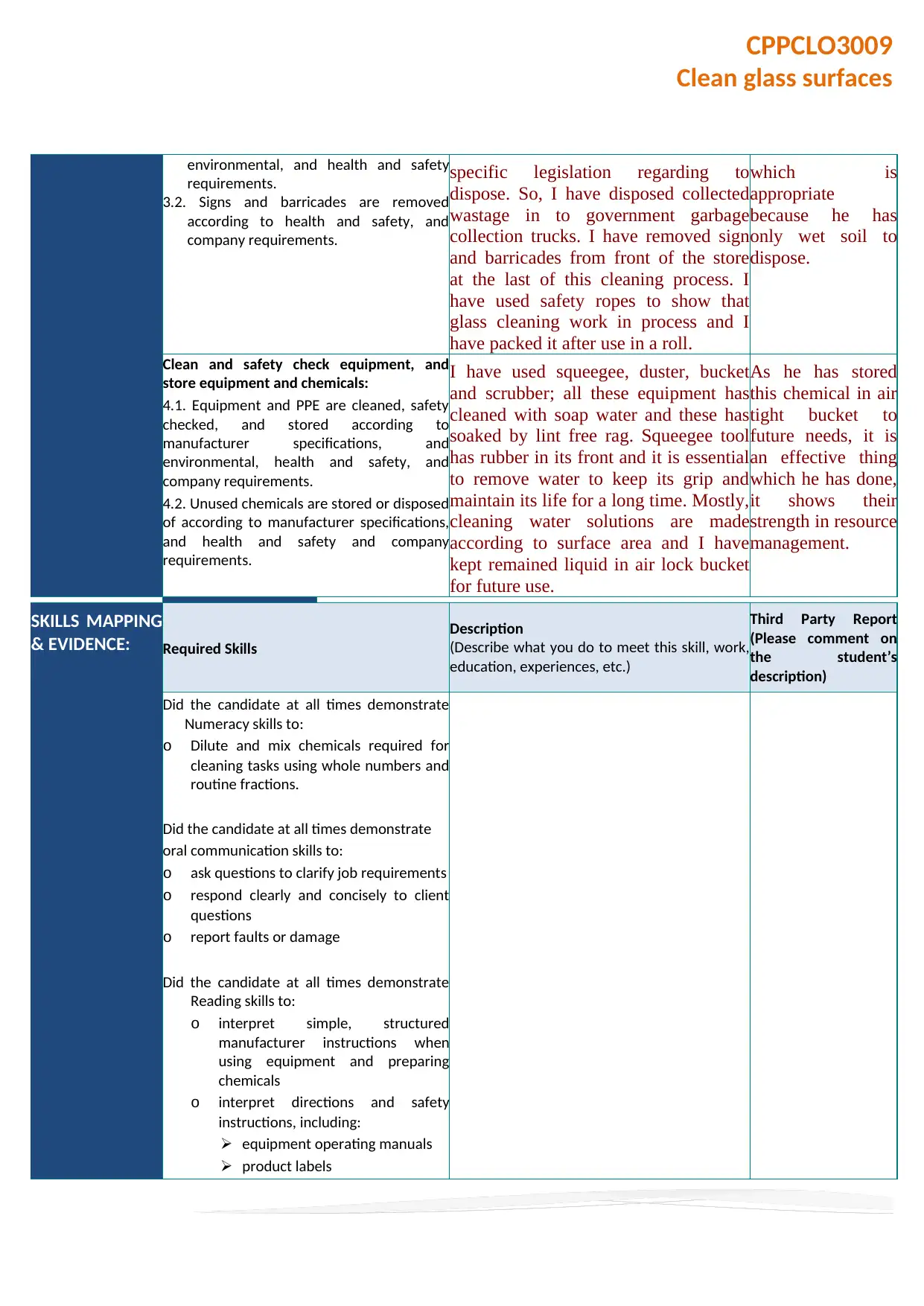
specific legislation regarding to
dispose. So, I have disposed collected
wastage in to government garbage
collection trucks. I have removed sign
and barricades from front of the store
at the last of this cleaning process. I
have used safety ropes to show that
glass cleaning work in process and I
have packed it after use in a roll.
which is
appropriate
because he has
only wet soil to
dispose.
Clean and safety check equipment, and
store equipment and chemicals:
4.1. Equipment and PPE are cleaned, safety
checked, and stored according to
manufacturer specifications, and
environmental, health and safety, and
company requirements.
4.2. Unused chemicals are stored or disposed
of according to manufacturer specifications,
and health and safety and company
requirements.
I have used squeegee, duster, bucket
and scrubber; all these equipment has
cleaned with soap water and these has
soaked by lint free rag. Squeegee tool
has rubber in its front and it is essential
to remove water to keep its grip and
maintain its life for a long time. Mostly,
cleaning water solutions are made
according to surface area and I have
kept remained liquid in air lock bucket
for future use.
As he has stored
this chemical in air
tight bucket to
future needs, it is
an effective thing
which he has done,
it shows their
strength in resource
management.
SKILLS MAPPING
& EVIDENCE: Required Skills
Description
(Describe what you do to meet this skill, work,
education, experiences, etc.)
Third Party Report
(Please comment on
the student’s
description)
Did the candidate at all times demonstrate
Numeracy skills to:
o Dilute and mix chemicals required for
cleaning tasks using whole numbers and
routine fractions.
Did the candidate at all times demonstrate
oral communication skills to:
o ask questions to clarify job requirements
o respond clearly and concisely to client
questions
o report faults or damage
Did the candidate at all times demonstrate
Reading skills to:
o interpret simple, structured
manufacturer instructions when
using equipment and preparing
chemicals
o interpret directions and safety
instructions, including:
equipment operating manuals
product labels
Clean glass surfaces
environmental, and health and safety
requirements.
3.2. Signs and barricades are removed
according to health and safety, and
company requirements.
specific legislation regarding to
dispose. So, I have disposed collected
wastage in to government garbage
collection trucks. I have removed sign
and barricades from front of the store
at the last of this cleaning process. I
have used safety ropes to show that
glass cleaning work in process and I
have packed it after use in a roll.
which is
appropriate
because he has
only wet soil to
dispose.
Clean and safety check equipment, and
store equipment and chemicals:
4.1. Equipment and PPE are cleaned, safety
checked, and stored according to
manufacturer specifications, and
environmental, health and safety, and
company requirements.
4.2. Unused chemicals are stored or disposed
of according to manufacturer specifications,
and health and safety and company
requirements.
I have used squeegee, duster, bucket
and scrubber; all these equipment has
cleaned with soap water and these has
soaked by lint free rag. Squeegee tool
has rubber in its front and it is essential
to remove water to keep its grip and
maintain its life for a long time. Mostly,
cleaning water solutions are made
according to surface area and I have
kept remained liquid in air lock bucket
for future use.
As he has stored
this chemical in air
tight bucket to
future needs, it is
an effective thing
which he has done,
it shows their
strength in resource
management.
SKILLS MAPPING
& EVIDENCE: Required Skills
Description
(Describe what you do to meet this skill, work,
education, experiences, etc.)
Third Party Report
(Please comment on
the student’s
description)
Did the candidate at all times demonstrate
Numeracy skills to:
o Dilute and mix chemicals required for
cleaning tasks using whole numbers and
routine fractions.
Did the candidate at all times demonstrate
oral communication skills to:
o ask questions to clarify job requirements
o respond clearly and concisely to client
questions
o report faults or damage
Did the candidate at all times demonstrate
Reading skills to:
o interpret simple, structured
manufacturer instructions when
using equipment and preparing
chemicals
o interpret directions and safety
instructions, including:
equipment operating manuals
product labels
⊘ This is a preview!⊘
Do you want full access?
Subscribe today to unlock all pages.
Trusted by 1+ million students worldwide
CPPCLO3009
Clean glass surfaces
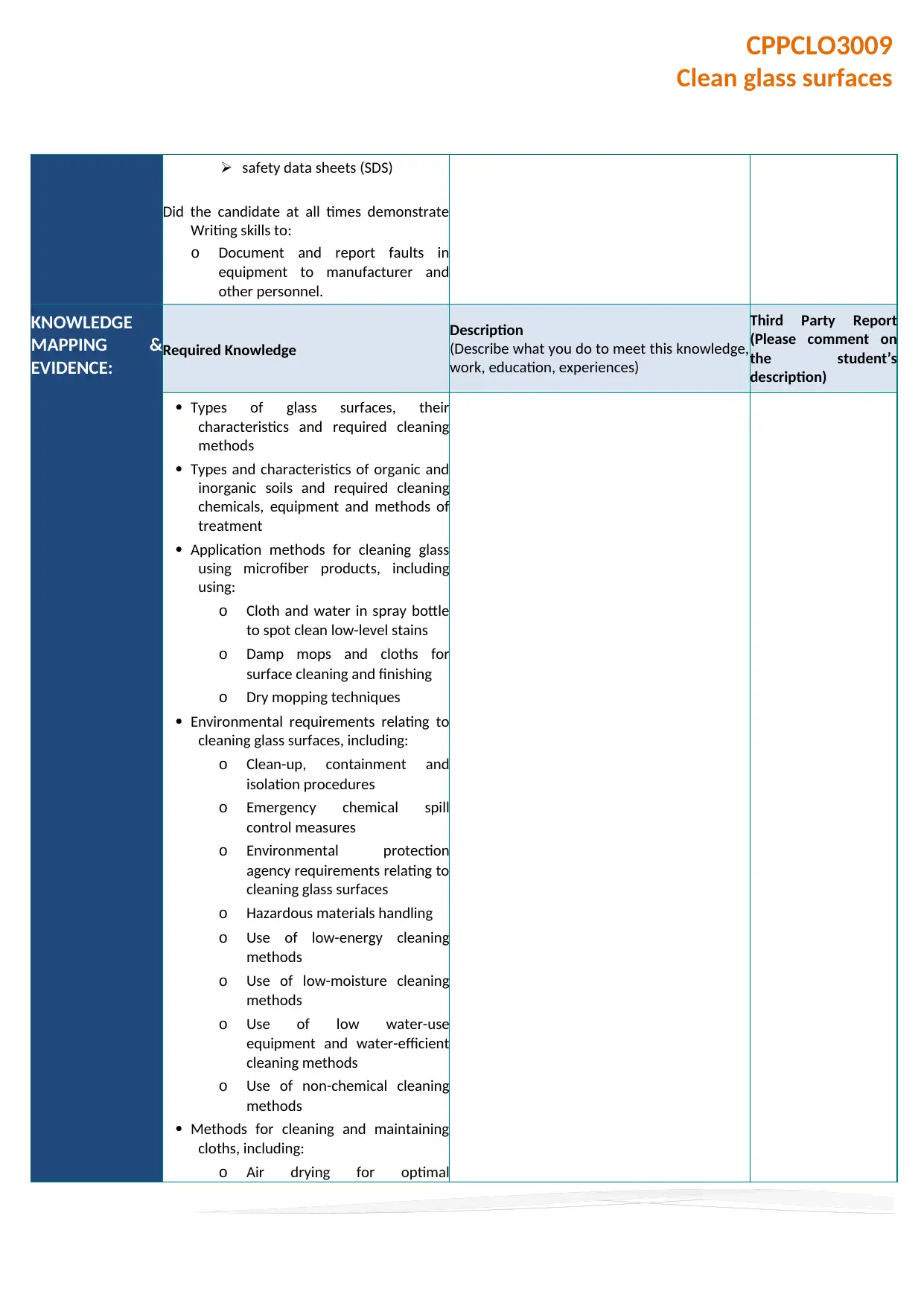
safety data sheets (SDS)
Did the candidate at all times demonstrate
Writing skills to:
o Document and report faults in
equipment to manufacturer and
other personnel.
KNOWLEDGE
MAPPING &
EVIDENCE: Required Knowledge
Description
(Describe what you do to meet this knowledge,
work, education, experiences)
Third Party Report
(Please comment on
the student’s
description)
Types of glass surfaces, their
characteristics and required cleaning
methods
Types and characteristics of organic and
inorganic soils and required cleaning
chemicals, equipment and methods of
treatment
Application methods for cleaning glass
using microfiber products, including
using:
o Cloth and water in spray bottle
to spot clean low-level stains
o Damp mops and cloths for
surface cleaning and finishing
o Dry mopping techniques
Environmental requirements relating to
cleaning glass surfaces, including:
o Clean-up, containment and
isolation procedures
o Emergency chemical spill
control measures
o Environmental protection
agency requirements relating to
cleaning glass surfaces
o Hazardous materials handling
o Use of low-energy cleaning
methods
o Use of low-moisture cleaning
methods
o Use of low water-use
equipment and water-efficient
cleaning methods
o Use of non-chemical cleaning
methods
Methods for cleaning and maintaining
cloths, including:
o Air drying for optimal
Clean glass surfaces
safety data sheets (SDS)
Did the candidate at all times demonstrate
Writing skills to:
o Document and report faults in
equipment to manufacturer and
other personnel.
KNOWLEDGE
MAPPING &
EVIDENCE: Required Knowledge
Description
(Describe what you do to meet this knowledge,
work, education, experiences)
Third Party Report
(Please comment on
the student’s
description)
Types of glass surfaces, their
characteristics and required cleaning
methods
Types and characteristics of organic and
inorganic soils and required cleaning
chemicals, equipment and methods of
treatment
Application methods for cleaning glass
using microfiber products, including
using:
o Cloth and water in spray bottle
to spot clean low-level stains
o Damp mops and cloths for
surface cleaning and finishing
o Dry mopping techniques
Environmental requirements relating to
cleaning glass surfaces, including:
o Clean-up, containment and
isolation procedures
o Emergency chemical spill
control measures
o Environmental protection
agency requirements relating to
cleaning glass surfaces
o Hazardous materials handling
o Use of low-energy cleaning
methods
o Use of low-moisture cleaning
methods
o Use of low water-use
equipment and water-efficient
cleaning methods
o Use of non-chemical cleaning
methods
Methods for cleaning and maintaining
cloths, including:
o Air drying for optimal
Paraphrase This Document
Need a fresh take? Get an instant paraphrase of this document with our AI Paraphraser
CPPCLO3009
Clean glass surfaces
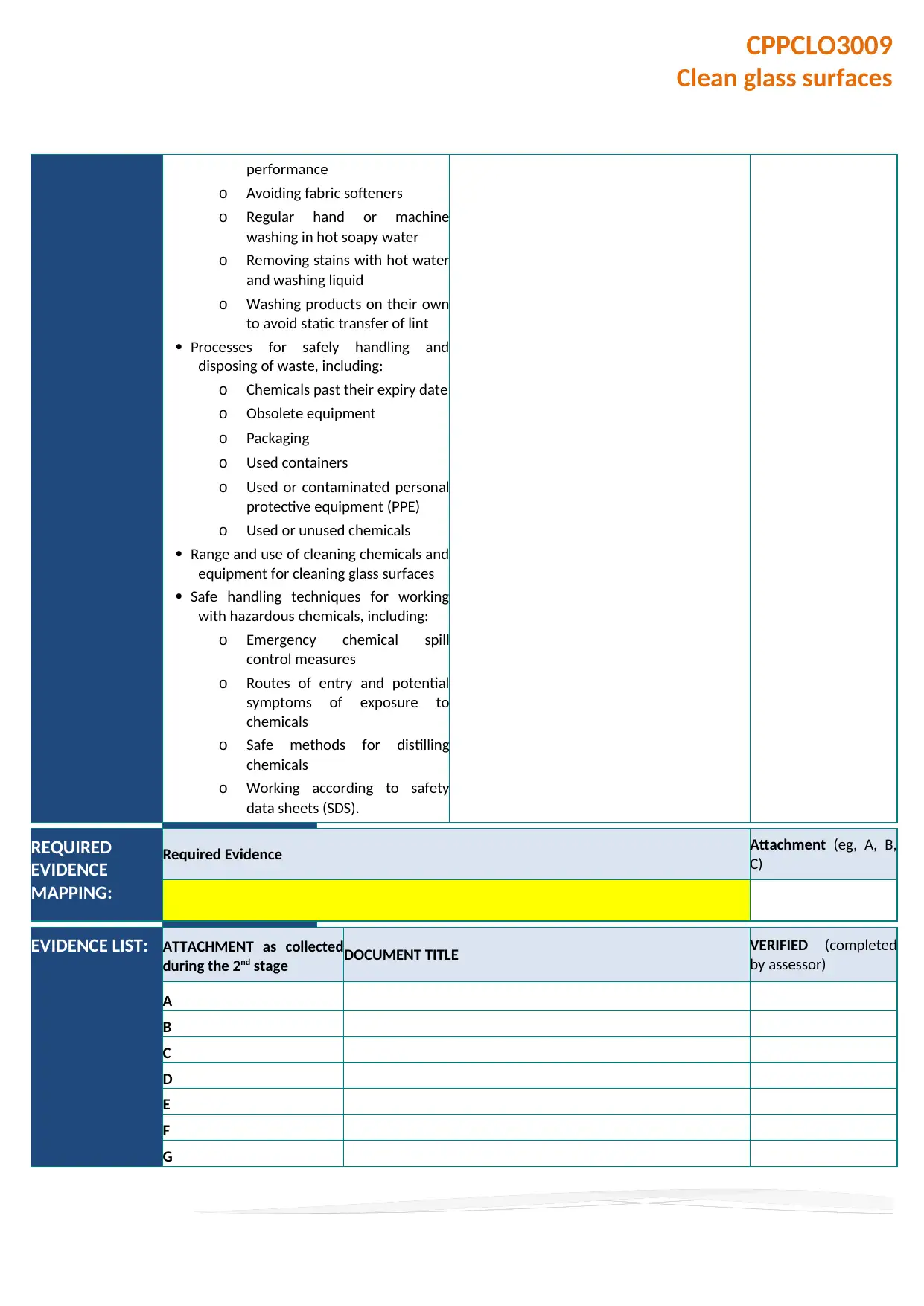
performance
o Avoiding fabric softeners
o Regular hand or machine
washing in hot soapy water
o Removing stains with hot water
and washing liquid
o Washing products on their own
to avoid static transfer of lint
Processes for safely handling and
disposing of waste, including:
o Chemicals past their expiry date
o Obsolete equipment
o Packaging
o Used containers
o Used or contaminated personal
protective equipment (PPE)
o Used or unused chemicals
Range and use of cleaning chemicals and
equipment for cleaning glass surfaces
Safe handling techniques for working
with hazardous chemicals, including:
o Emergency chemical spill
control measures
o Routes of entry and potential
symptoms of exposure to
chemicals
o Safe methods for distilling
chemicals
o Working according to safety
data sheets (SDS).
REQUIRED
EVIDENCE
MAPPING:
Required Evidence Attachment (eg, A, B,
C)
EVIDENCE LIST: ATTACHMENT as collected
during the 2nd stage DOCUMENT TITLE VERIFIED (completed
by assessor)
A
B
C
D
E
F
G
Clean glass surfaces
performance
o Avoiding fabric softeners
o Regular hand or machine
washing in hot soapy water
o Removing stains with hot water
and washing liquid
o Washing products on their own
to avoid static transfer of lint
Processes for safely handling and
disposing of waste, including:
o Chemicals past their expiry date
o Obsolete equipment
o Packaging
o Used containers
o Used or contaminated personal
protective equipment (PPE)
o Used or unused chemicals
Range and use of cleaning chemicals and
equipment for cleaning glass surfaces
Safe handling techniques for working
with hazardous chemicals, including:
o Emergency chemical spill
control measures
o Routes of entry and potential
symptoms of exposure to
chemicals
o Safe methods for distilling
chemicals
o Working according to safety
data sheets (SDS).
REQUIRED
EVIDENCE
MAPPING:
Required Evidence Attachment (eg, A, B,
C)
EVIDENCE LIST: ATTACHMENT as collected
during the 2nd stage DOCUMENT TITLE VERIFIED (completed
by assessor)
A
B
C
D
E
F
G
CPPCLO3009
Clean glass surfaces
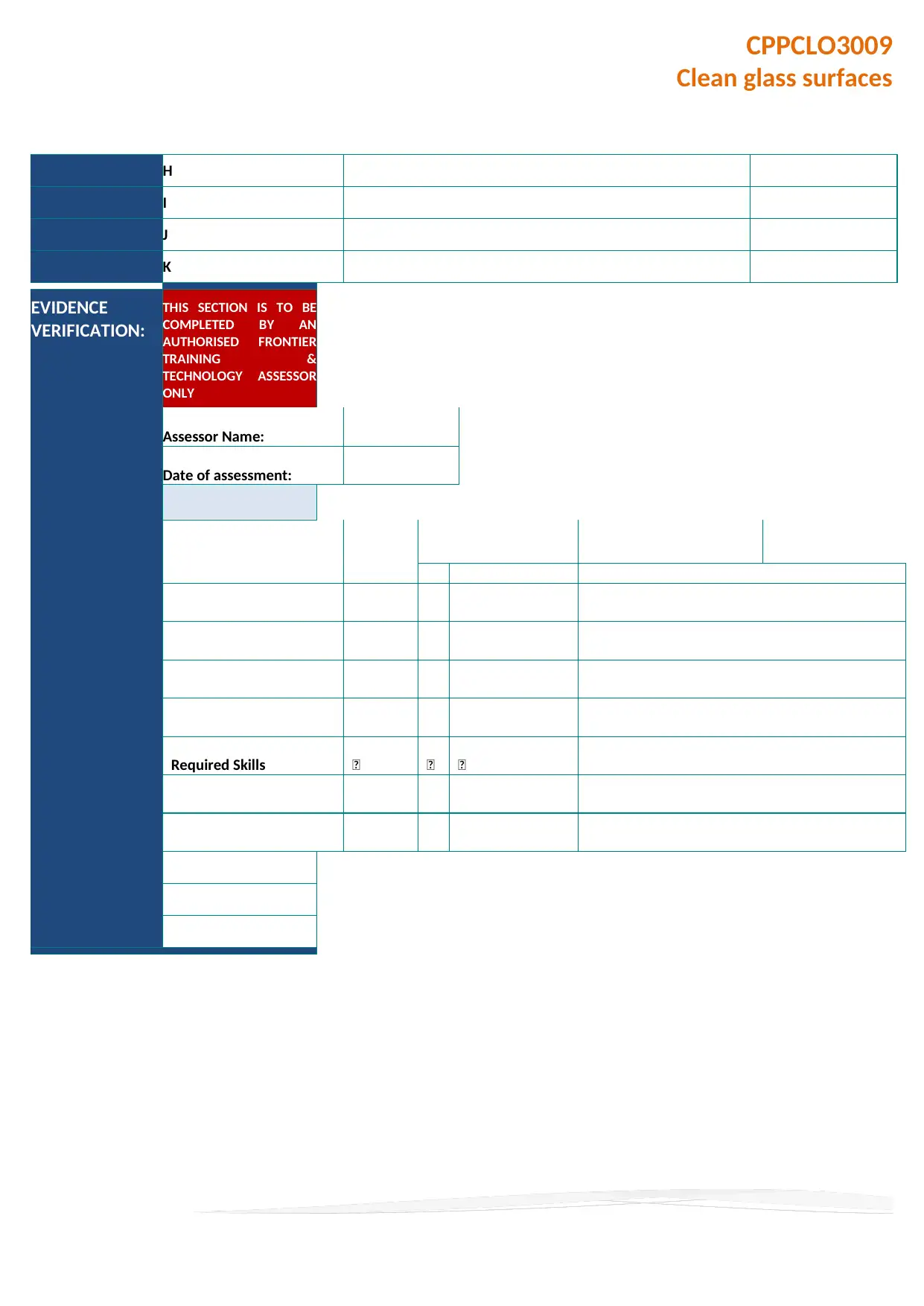
H
I
J
K
EVIDENCE
VERIFICATION:
THIS SECTION IS TO BE
COMPLETED BY AN
AUTHORISED FRONTIER
TRAINING &
TECHNOLOGY ASSESSOR
ONLY
Assessor Name:
Date of assessment:
Required Skills
Clean glass surfaces
H
I
J
K
EVIDENCE
VERIFICATION:
THIS SECTION IS TO BE
COMPLETED BY AN
AUTHORISED FRONTIER
TRAINING &
TECHNOLOGY ASSESSOR
ONLY
Assessor Name:
Date of assessment:
Required Skills
⊘ This is a preview!⊘
Do you want full access?
Subscribe today to unlock all pages.
Trusted by 1+ million students worldwide

1 out of 9


Related Documents


Your All-in-One AI-Powered Toolkit for Academic Success.
+13062052269
info@desklib.com
Available 24*7 on WhatsApp / Email
![[object Object]](/_next/static/media/star-bottom.7253800d.svg)
Unlock your academic potential
Copyright © 2020–2026 A2Z Services. All Rights Reserved. Developed and managed by ZUCOL.