Exploring the Thread of Violence Across Global Narratives
VerifiedAdded on 2020/05/04
|6
|1636
|467
Essay
AI Summary
The essay explores the treatment of violence through literary works by J.M. Coetzee, focusing on African colonialism, and Romesh Gunesekera, addressing Sri Lankan civil conflict. While Coetzee critically examines political oppression, Gunesekera conveys hope for future recovery. Both authors ultimately advocate for humanity's resilience against violence.
Running head: THREAD OF VIOLENCE ACROSS THE GLOBE
THREAD OF VIOLENCE ACROSS THE GLOBE
Name of the Student:
Name of the University:
Author note:
THREAD OF VIOLENCE ACROSS THE GLOBE
Name of the Student:
Name of the University:
Author note:

Paraphrase This Document
Need a fresh take? Get an instant paraphrase of this document with our AI Paraphraser
1THREAD OF VIOLENCE ACROSS THE GLOBE
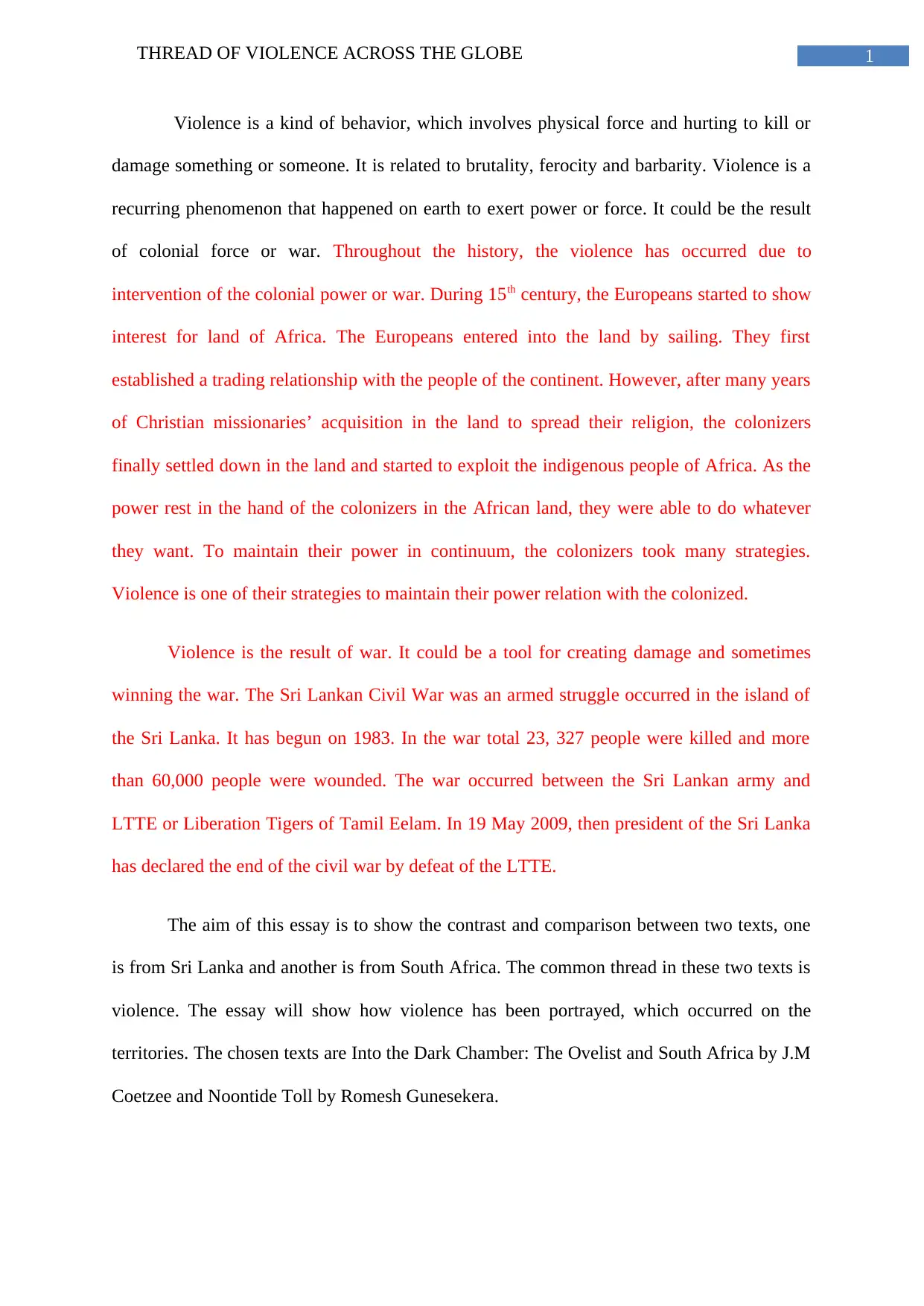
Violence is a kind of behavior, which involves physical force and hurting to kill or
damage something or someone. It is related to brutality, ferocity and barbarity. Violence is a
recurring phenomenon that happened on earth to exert power or force. It could be the result
of colonial force or war. Throughout the history, the violence has occurred due to
intervention of the colonial power or war. During 15th century, the Europeans started to show
interest for land of Africa. The Europeans entered into the land by sailing. They first
established a trading relationship with the people of the continent. However, after many years
of Christian missionaries’ acquisition in the land to spread their religion, the colonizers
finally settled down in the land and started to exploit the indigenous people of Africa. As the
power rest in the hand of the colonizers in the African land, they were able to do whatever
they want. To maintain their power in continuum, the colonizers took many strategies.
Violence is one of their strategies to maintain their power relation with the colonized.
Violence is the result of war. It could be a tool for creating damage and sometimes
winning the war. The Sri Lankan Civil War was an armed struggle occurred in the island of
the Sri Lanka. It has begun on 1983. In the war total 23, 327 people were killed and more
than 60,000 people were wounded. The war occurred between the Sri Lankan army and
LTTE or Liberation Tigers of Tamil Eelam. In 19 May 2009, then president of the Sri Lanka
has declared the end of the civil war by defeat of the LTTE.
The aim of this essay is to show the contrast and comparison between two texts, one
is from Sri Lanka and another is from South Africa. The common thread in these two texts is
violence. The essay will show how violence has been portrayed, which occurred on the
territories. The chosen texts are Into the Dark Chamber: The Ovelist and South Africa by J.M
Coetzee and Noontide Toll by Romesh Gunesekera.
Violence is a kind of behavior, which involves physical force and hurting to kill or
damage something or someone. It is related to brutality, ferocity and barbarity. Violence is a
recurring phenomenon that happened on earth to exert power or force. It could be the result
of colonial force or war. Throughout the history, the violence has occurred due to
intervention of the colonial power or war. During 15th century, the Europeans started to show
interest for land of Africa. The Europeans entered into the land by sailing. They first
established a trading relationship with the people of the continent. However, after many years
of Christian missionaries’ acquisition in the land to spread their religion, the colonizers
finally settled down in the land and started to exploit the indigenous people of Africa. As the
power rest in the hand of the colonizers in the African land, they were able to do whatever
they want. To maintain their power in continuum, the colonizers took many strategies.
Violence is one of their strategies to maintain their power relation with the colonized.
Violence is the result of war. It could be a tool for creating damage and sometimes
winning the war. The Sri Lankan Civil War was an armed struggle occurred in the island of
the Sri Lanka. It has begun on 1983. In the war total 23, 327 people were killed and more
than 60,000 people were wounded. The war occurred between the Sri Lankan army and
LTTE or Liberation Tigers of Tamil Eelam. In 19 May 2009, then president of the Sri Lanka
has declared the end of the civil war by defeat of the LTTE.
The aim of this essay is to show the contrast and comparison between two texts, one
is from Sri Lanka and another is from South Africa. The common thread in these two texts is
violence. The essay will show how violence has been portrayed, which occurred on the
territories. The chosen texts are Into the Dark Chamber: The Ovelist and South Africa by J.M
Coetzee and Noontide Toll by Romesh Gunesekera.
2THREAD OF VIOLENCE ACROSS THE GLOBE
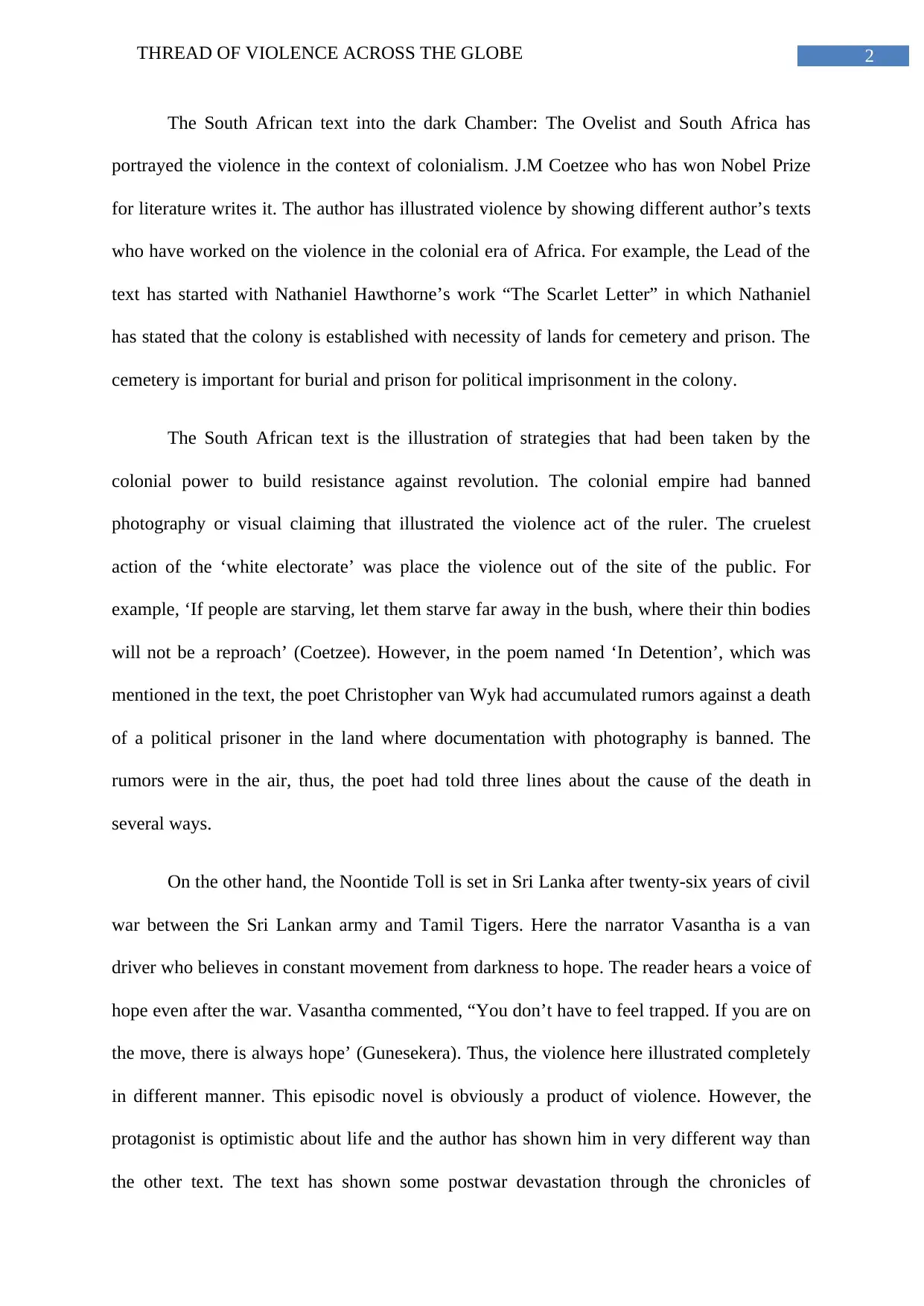
The South African text into the dark Chamber: The Ovelist and South Africa has
portrayed the violence in the context of colonialism. J.M Coetzee who has won Nobel Prize
for literature writes it. The author has illustrated violence by showing different author’s texts
who have worked on the violence in the colonial era of Africa. For example, the Lead of the
text has started with Nathaniel Hawthorne’s work “The Scarlet Letter” in which Nathaniel
has stated that the colony is established with necessity of lands for cemetery and prison. The
cemetery is important for burial and prison for political imprisonment in the colony.
The South African text is the illustration of strategies that had been taken by the
colonial power to build resistance against revolution. The colonial empire had banned
photography or visual claiming that illustrated the violence act of the ruler. The cruelest
action of the ‘white electorate’ was place the violence out of the site of the public. For
example, ‘If people are starving, let them starve far away in the bush, where their thin bodies
will not be a reproach’ (Coetzee). However, in the poem named ‘In Detention’, which was
mentioned in the text, the poet Christopher van Wyk had accumulated rumors against a death
of a political prisoner in the land where documentation with photography is banned. The
rumors were in the air, thus, the poet had told three lines about the cause of the death in
several ways.
On the other hand, the Noontide Toll is set in Sri Lanka after twenty-six years of civil
war between the Sri Lankan army and Tamil Tigers. Here the narrator Vasantha is a van
driver who believes in constant movement from darkness to hope. The reader hears a voice of
hope even after the war. Vasantha commented, “You don’t have to feel trapped. If you are on
the move, there is always hope’ (Gunesekera). Thus, the violence here illustrated completely
in different manner. This episodic novel is obviously a product of violence. However, the
protagonist is optimistic about life and the author has shown him in very different way than
the other text. The text has shown some postwar devastation through the chronicles of
The South African text into the dark Chamber: The Ovelist and South Africa has
portrayed the violence in the context of colonialism. J.M Coetzee who has won Nobel Prize
for literature writes it. The author has illustrated violence by showing different author’s texts
who have worked on the violence in the colonial era of Africa. For example, the Lead of the
text has started with Nathaniel Hawthorne’s work “The Scarlet Letter” in which Nathaniel
has stated that the colony is established with necessity of lands for cemetery and prison. The
cemetery is important for burial and prison for political imprisonment in the colony.
The South African text is the illustration of strategies that had been taken by the
colonial power to build resistance against revolution. The colonial empire had banned
photography or visual claiming that illustrated the violence act of the ruler. The cruelest
action of the ‘white electorate’ was place the violence out of the site of the public. For
example, ‘If people are starving, let them starve far away in the bush, where their thin bodies
will not be a reproach’ (Coetzee). However, in the poem named ‘In Detention’, which was
mentioned in the text, the poet Christopher van Wyk had accumulated rumors against a death
of a political prisoner in the land where documentation with photography is banned. The
rumors were in the air, thus, the poet had told three lines about the cause of the death in
several ways.
On the other hand, the Noontide Toll is set in Sri Lanka after twenty-six years of civil
war between the Sri Lankan army and Tamil Tigers. Here the narrator Vasantha is a van
driver who believes in constant movement from darkness to hope. The reader hears a voice of
hope even after the war. Vasantha commented, “You don’t have to feel trapped. If you are on
the move, there is always hope’ (Gunesekera). Thus, the violence here illustrated completely
in different manner. This episodic novel is obviously a product of violence. However, the
protagonist is optimistic about life and the author has shown him in very different way than
the other text. The text has shown some postwar devastation through the chronicles of
⊘ This is a preview!⊘
Do you want full access?
Subscribe today to unlock all pages.

Trusted by 1+ million students worldwide
3THREAD OF VIOLENCE ACROSS THE GLOBE
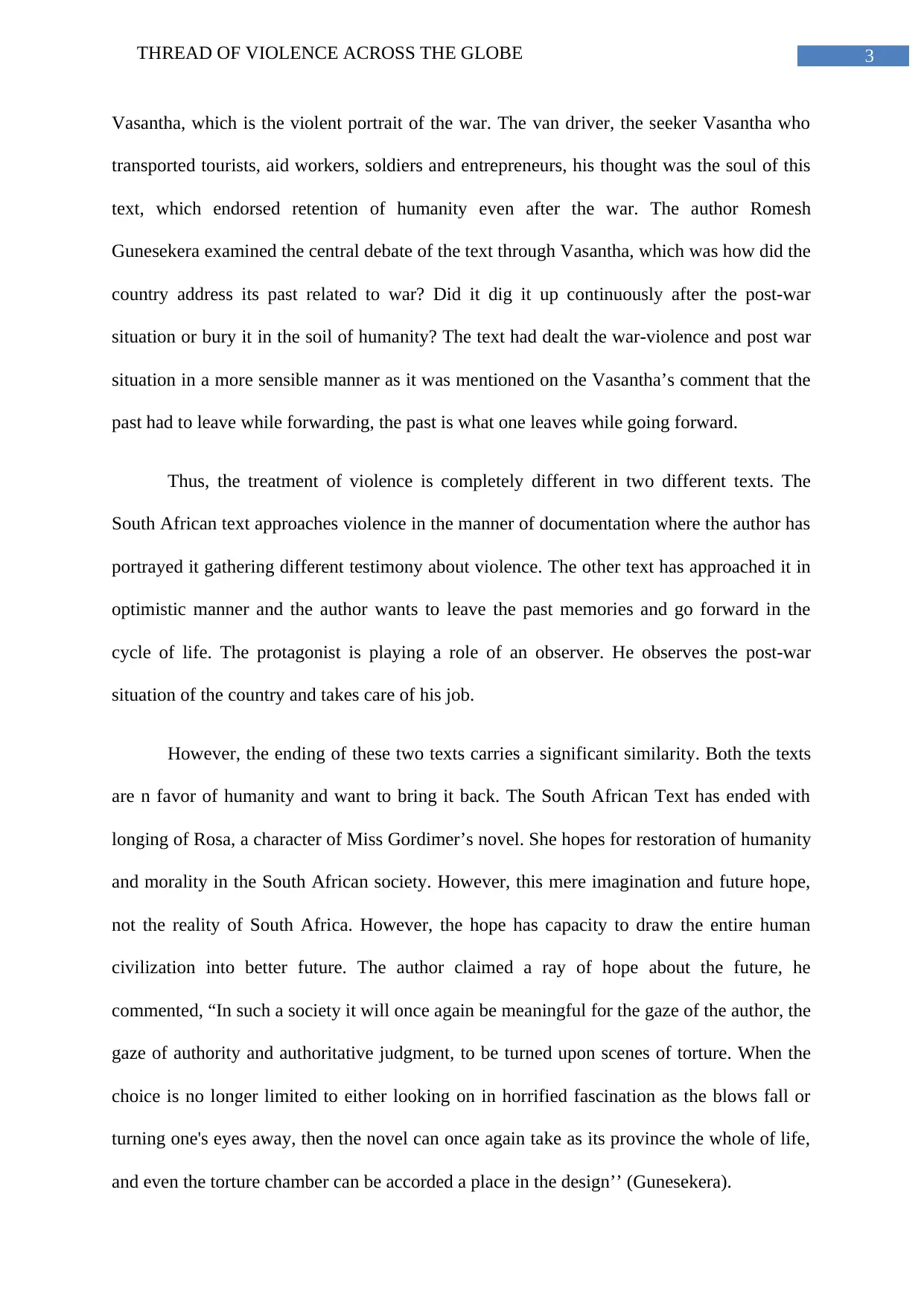
Vasantha, which is the violent portrait of the war. The van driver, the seeker Vasantha who
transported tourists, aid workers, soldiers and entrepreneurs, his thought was the soul of this
text, which endorsed retention of humanity even after the war. The author Romesh
Gunesekera examined the central debate of the text through Vasantha, which was how did the
country address its past related to war? Did it dig it up continuously after the post-war
situation or bury it in the soil of humanity? The text had dealt the war-violence and post war
situation in a more sensible manner as it was mentioned on the Vasantha’s comment that the
past had to leave while forwarding, the past is what one leaves while going forward.
Thus, the treatment of violence is completely different in two different texts. The
South African text approaches violence in the manner of documentation where the author has
portrayed it gathering different testimony about violence. The other text has approached it in
optimistic manner and the author wants to leave the past memories and go forward in the
cycle of life. The protagonist is playing a role of an observer. He observes the post-war
situation of the country and takes care of his job.
However, the ending of these two texts carries a significant similarity. Both the texts
are n favor of humanity and want to bring it back. The South African Text has ended with
longing of Rosa, a character of Miss Gordimer’s novel. She hopes for restoration of humanity
and morality in the South African society. However, this mere imagination and future hope,
not the reality of South Africa. However, the hope has capacity to draw the entire human
civilization into better future. The author claimed a ray of hope about the future, he
commented, “In such a society it will once again be meaningful for the gaze of the author, the
gaze of authority and authoritative judgment, to be turned upon scenes of torture. When the
choice is no longer limited to either looking on in horrified fascination as the blows fall or
turning one's eyes away, then the novel can once again take as its province the whole of life,
and even the torture chamber can be accorded a place in the design’’ (Gunesekera).
Vasantha, which is the violent portrait of the war. The van driver, the seeker Vasantha who
transported tourists, aid workers, soldiers and entrepreneurs, his thought was the soul of this
text, which endorsed retention of humanity even after the war. The author Romesh
Gunesekera examined the central debate of the text through Vasantha, which was how did the
country address its past related to war? Did it dig it up continuously after the post-war
situation or bury it in the soil of humanity? The text had dealt the war-violence and post war
situation in a more sensible manner as it was mentioned on the Vasantha’s comment that the
past had to leave while forwarding, the past is what one leaves while going forward.
Thus, the treatment of violence is completely different in two different texts. The
South African text approaches violence in the manner of documentation where the author has
portrayed it gathering different testimony about violence. The other text has approached it in
optimistic manner and the author wants to leave the past memories and go forward in the
cycle of life. The protagonist is playing a role of an observer. He observes the post-war
situation of the country and takes care of his job.
However, the ending of these two texts carries a significant similarity. Both the texts
are n favor of humanity and want to bring it back. The South African Text has ended with
longing of Rosa, a character of Miss Gordimer’s novel. She hopes for restoration of humanity
and morality in the South African society. However, this mere imagination and future hope,
not the reality of South Africa. However, the hope has capacity to draw the entire human
civilization into better future. The author claimed a ray of hope about the future, he
commented, “In such a society it will once again be meaningful for the gaze of the author, the
gaze of authority and authoritative judgment, to be turned upon scenes of torture. When the
choice is no longer limited to either looking on in horrified fascination as the blows fall or
turning one's eyes away, then the novel can once again take as its province the whole of life,
and even the torture chamber can be accorded a place in the design’’ (Gunesekera).
Paraphrase This Document
Need a fresh take? Get an instant paraphrase of this document with our AI Paraphraser
4THREAD OF VIOLENCE ACROSS THE GLOBE
The other novel shares same view of hope and optimism at the finishing domain. The
van of Vasantha is approaching forward as if it left the past and living in hopeful present.
Someone is cleaning the road and sweeping the war debris, burned-out buses and oil barrels.
However, the irony is that the scars of war remain silently in the mind of the victims who has
internalized the trauma of the war.
It can be concluded by stating that though violence is some recurring incident on the
face of the earth and civilization of humanity, it could be removed with hope for betterment
and then the society could be transformed. The illustration of violence occurred due to
colonial forces and civil war in Africa and Sri Lanka respectively was excellent and as real as
morning light. The two authors have explained violence in completely different manner.
Their treatment, tone and process of illustration are completely different. The African author
is impulsively responded to the colonial violence and through his words; the author has
explicitly explained the nature of the violence in the colonial era of Africa. He has shown the
politics of the colonizers behind maintaining the continuous force of the violence. However,
the author has seen alight of hope at the very end of his text. The author has dreamt for the
new society, which are free of exploitation or violence. On the other hand, the Sri Lankan
author is much hopeful in his attitude in the text. The protagonist’s approach is optimistic in
the text. He is hoping for the best though a long war happened in the land and the land has
carried the essence of the war. However, only the hope could be tool in forwarding positively
in the future. The two authors have anticipated for it.
The other novel shares same view of hope and optimism at the finishing domain. The
van of Vasantha is approaching forward as if it left the past and living in hopeful present.
Someone is cleaning the road and sweeping the war debris, burned-out buses and oil barrels.
However, the irony is that the scars of war remain silently in the mind of the victims who has
internalized the trauma of the war.
It can be concluded by stating that though violence is some recurring incident on the
face of the earth and civilization of humanity, it could be removed with hope for betterment
and then the society could be transformed. The illustration of violence occurred due to
colonial forces and civil war in Africa and Sri Lanka respectively was excellent and as real as
morning light. The two authors have explained violence in completely different manner.
Their treatment, tone and process of illustration are completely different. The African author
is impulsively responded to the colonial violence and through his words; the author has
explicitly explained the nature of the violence in the colonial era of Africa. He has shown the
politics of the colonizers behind maintaining the continuous force of the violence. However,
the author has seen alight of hope at the very end of his text. The author has dreamt for the
new society, which are free of exploitation or violence. On the other hand, the Sri Lankan
author is much hopeful in his attitude in the text. The protagonist’s approach is optimistic in
the text. He is hoping for the best though a long war happened in the land and the land has
carried the essence of the war. However, only the hope could be tool in forwarding positively
in the future. The two authors have anticipated for it.
5THREAD OF VIOLENCE ACROSS THE GLOBE
References
Coetzee, J.M. "The New York Times: Book Review Search Article." Nytimes.com. N.p.,
2017. Web. 31 Oct. 2017.
Gunesekera, Romesh. Noontide toll. Granta Books, 2014.
References
Coetzee, J.M. "The New York Times: Book Review Search Article." Nytimes.com. N.p.,
2017. Web. 31 Oct. 2017.
Gunesekera, Romesh. Noontide toll. Granta Books, 2014.
⊘ This is a preview!⊘
Do you want full access?
Subscribe today to unlock all pages.
Trusted by 1+ million students worldwide

1 out of 6


Your All-in-One AI-Powered Toolkit for Academic Success.
+13062052269
info@desklib.com
Available 24*7 on WhatsApp / Email
![[object Object]](/_next/static/media/star-bottom.7253800d.svg)
Unlock your academic potential
Copyright © 2020–2026 A2Z Services. All Rights Reserved. Developed and managed by ZUCOL.