Detailed Report on Timber and Concrete Floor Systems in Construction
VerifiedAdded on  2023/06/16
|10
|1440
|177
Report
AI Summary
This report provides a detailed analysis of timber and concrete floor systems used in construction. It begins by examining a two-floor platform system made of timber, focusing on joists, bearings, and insulation, emphasizing fire protection and the importance of joist spacing. The report then contrasts this with concrete floor systems, highlighting the differences between slabs on the ground and those not in direct contact with the ground, emphasizing the need for damp-proof membranes and considering soil conditions. The report also discusses prefabricated roof trusses, their advantages in terms of cost and span coverage, and the factors influencing truss design, such as loads, slope, and distance between trusses. Wind fasteners and different truss systems are also addressed, noting the importance of slope and span in overall design.
TIMBER CONSTRUCTION
Student’s Name:
Institutional Affiliation:
Student’s Name:
Institutional Affiliation:
Paraphrase This Document
Need a fresh take? Get an instant paraphrase of this document with our AI Paraphraser

Question 6
Floor type 1
In this question, the main focus is a two floor, platform system that incorporates joists and
bearings with a suitable insulation material. Basically the platform floor system is made of
timber and has been used extensively in the construction industry. In its simplest form, the floor
is made up of a platform that rests on joists which connect to the joist header and eventually the
bearing. As a matter of fact, the members that form this type of a floor include: joists, studs,
rafters, plates and framing. All these are the features that make a platform floor.\
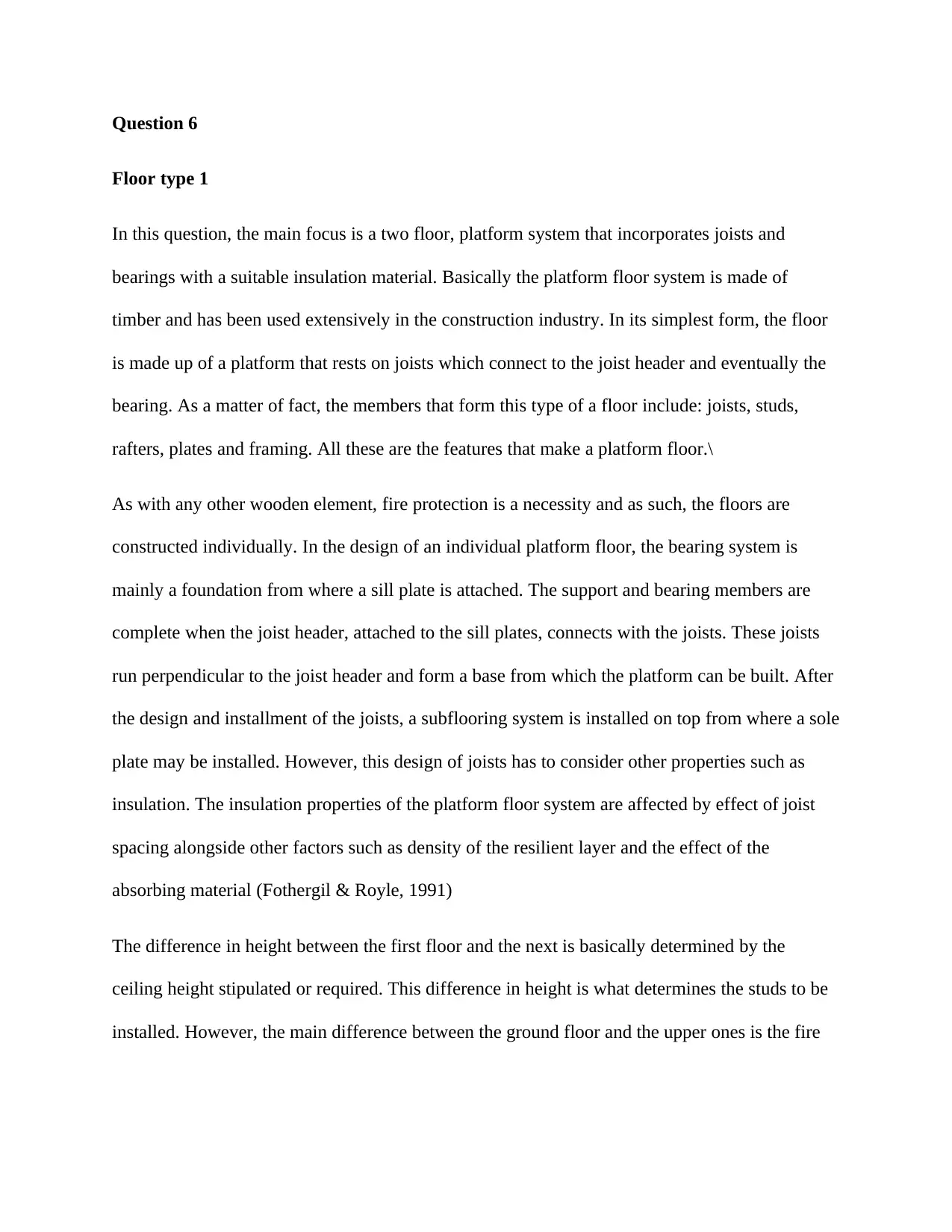
As with any other wooden element, fire protection is a necessity and as such, the floors are
constructed individually. In the design of an individual platform floor, the bearing system is
mainly a foundation from where a sill plate is attached. The support and bearing members are
complete when the joist header, attached to the sill plates, connects with the joists. These joists
run perpendicular to the joist header and form a base from which the platform can be built. After
the design and installment of the joists, a subflooring system is installed on top from where a sole
plate may be installed. However, this design of joists has to consider other properties such as
insulation. The insulation properties of the platform floor system are affected by effect of joist
spacing alongside other factors such as density of the resilient layer and the effect of the
absorbing material (Fothergil & Royle, 1991)
The difference in height between the first floor and the next is basically determined by the
ceiling height stipulated or required. This difference in height is what determines the studs to be
installed. However, the main difference between the ground floor and the upper ones is the fire
Floor type 1
In this question, the main focus is a two floor, platform system that incorporates joists and
bearings with a suitable insulation material. Basically the platform floor system is made of
timber and has been used extensively in the construction industry. In its simplest form, the floor
is made up of a platform that rests on joists which connect to the joist header and eventually the
bearing. As a matter of fact, the members that form this type of a floor include: joists, studs,
rafters, plates and framing. All these are the features that make a platform floor.\
As with any other wooden element, fire protection is a necessity and as such, the floors are
constructed individually. In the design of an individual platform floor, the bearing system is
mainly a foundation from where a sill plate is attached. The support and bearing members are
complete when the joist header, attached to the sill plates, connects with the joists. These joists
run perpendicular to the joist header and form a base from which the platform can be built. After
the design and installment of the joists, a subflooring system is installed on top from where a sole
plate may be installed. However, this design of joists has to consider other properties such as
insulation. The insulation properties of the platform floor system are affected by effect of joist
spacing alongside other factors such as density of the resilient layer and the effect of the
absorbing material (Fothergil & Royle, 1991)
The difference in height between the first floor and the next is basically determined by the
ceiling height stipulated or required. This difference in height is what determines the studs to be
installed. However, the main difference between the ground floor and the upper ones is the fire

stopping requirement of the upper floors whereby the joist hangers provide the necessary fire
stopping mechanism necessary.
Platform flooring system
Floor type 2
The second flooring system basically focuses on a concrete floor which can replicate the
qualities of the floor on ground. To begin with, there is a very huge difference between the slabs
on the ground and those that are not in direct contact with the ground. The former is subjected to
ground conditions such as alkalinity, abnormal moisture conditions etc. Therefore, the design of
this ground floor slab has to consider extreme soil as well as moisture conditions. Furthermore,
this system may be designed according to the type of footing present so as to increase the
durability and the ability to withstand aggressive soils.
In the design of the a ground slab, a damp proof membrane is necessary to prevent the soil
moisture from having a profound effect on the concrete.However,this may be determined by the
stopping mechanism necessary.
Platform flooring system
Floor type 2
The second flooring system basically focuses on a concrete floor which can replicate the
qualities of the floor on ground. To begin with, there is a very huge difference between the slabs
on the ground and those that are not in direct contact with the ground. The former is subjected to
ground conditions such as alkalinity, abnormal moisture conditions etc. Therefore, the design of
this ground floor slab has to consider extreme soil as well as moisture conditions. Furthermore,
this system may be designed according to the type of footing present so as to increase the
durability and the ability to withstand aggressive soils.
In the design of the a ground slab, a damp proof membrane is necessary to prevent the soil
moisture from having a profound effect on the concrete.However,this may be determined by the
⊘ This is a preview!⊘
Do you want full access?
Subscribe today to unlock all pages.

Trusted by 1+ million students worldwide

concrete strength chosen and as such, the slabs on the upper floors may require weaker concrete
in order to replicate these conditions.
Altering the basic construction principles used in house designs can be used in ensuring that the
floor slabs replicate the ground floor conditions. The basic method of construction of slabs is as
follows: filling, design of foundations, design of the sloping sites, retaining walls and fixing of
the reinforcement The procedure can be altered in a significant way to ensure that the ground
conditions are replicated. Finally, difference in curing and compaction of ground floor concrete
and the upper floor concrete can be used to relatively bridge the difference in conditions.
Question 7
One major component of a building is the roofing structure.Prefabticated roof trusses have been
extensively used in roof construction because of the relative cheapness and the extensive span
coverage. However, the main disadvantage is on the air duct ventilation system and the attic
room that can be obtained. In this, it is very difficult to install an air duct system and the attic
room is limited.
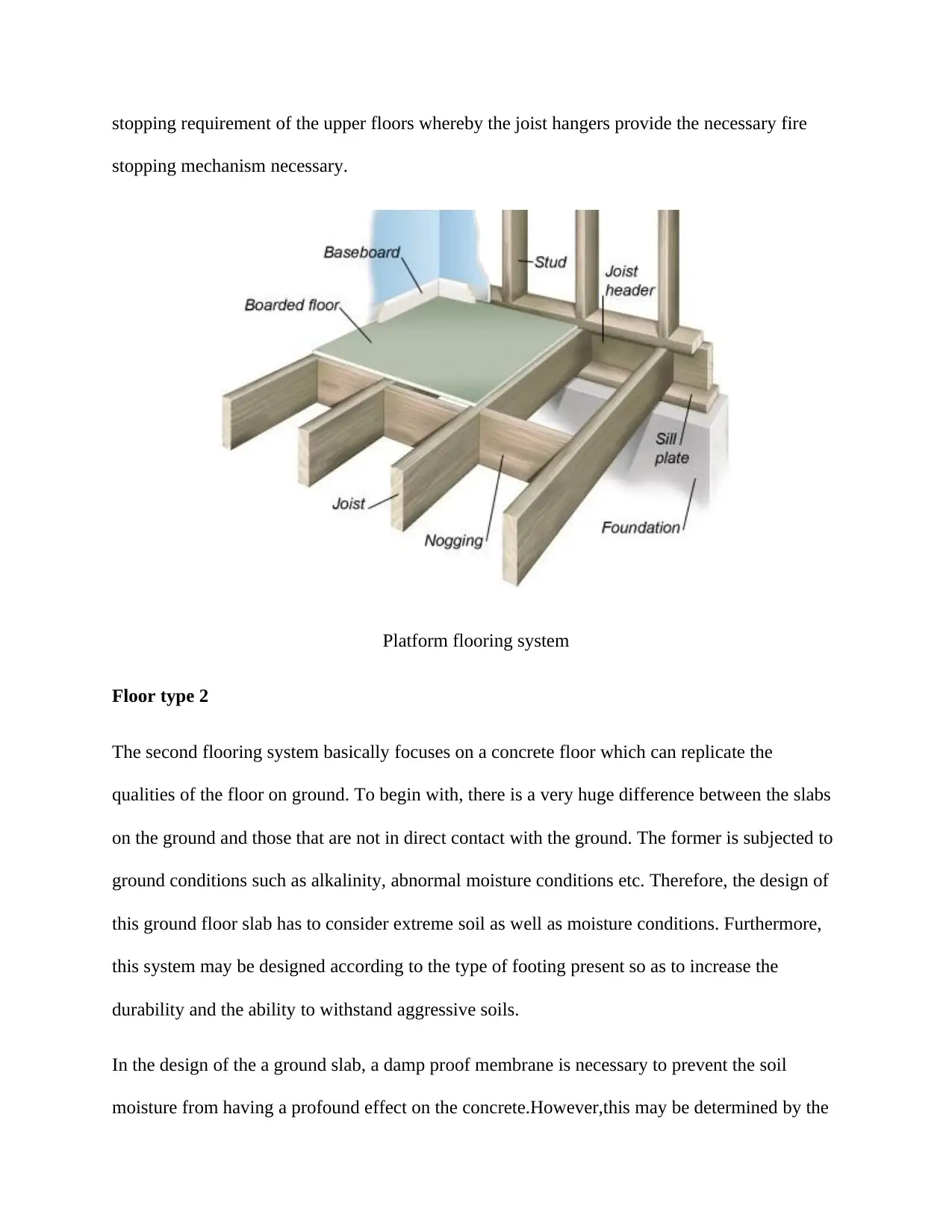
The basis of this design is based on the assumption that the cottage span is about 7.3152meters
and the make of the trusses is that of a 2 web design. Furthermore, the truss has plywood gussets
in order to replicate these conditions.
Altering the basic construction principles used in house designs can be used in ensuring that the
floor slabs replicate the ground floor conditions. The basic method of construction of slabs is as
follows: filling, design of foundations, design of the sloping sites, retaining walls and fixing of
the reinforcement The procedure can be altered in a significant way to ensure that the ground
conditions are replicated. Finally, difference in curing and compaction of ground floor concrete
and the upper floor concrete can be used to relatively bridge the difference in conditions.
Question 7
One major component of a building is the roofing structure.Prefabticated roof trusses have been
extensively used in roof construction because of the relative cheapness and the extensive span
coverage. However, the main disadvantage is on the air duct ventilation system and the attic
room that can be obtained. In this, it is very difficult to install an air duct system and the attic
room is limited.
The basis of this design is based on the assumption that the cottage span is about 7.3152meters
and the make of the trusses is that of a 2 web design. Furthermore, the truss has plywood gussets
Paraphrase This Document
Need a fresh take? Get an instant paraphrase of this document with our AI Paraphraser


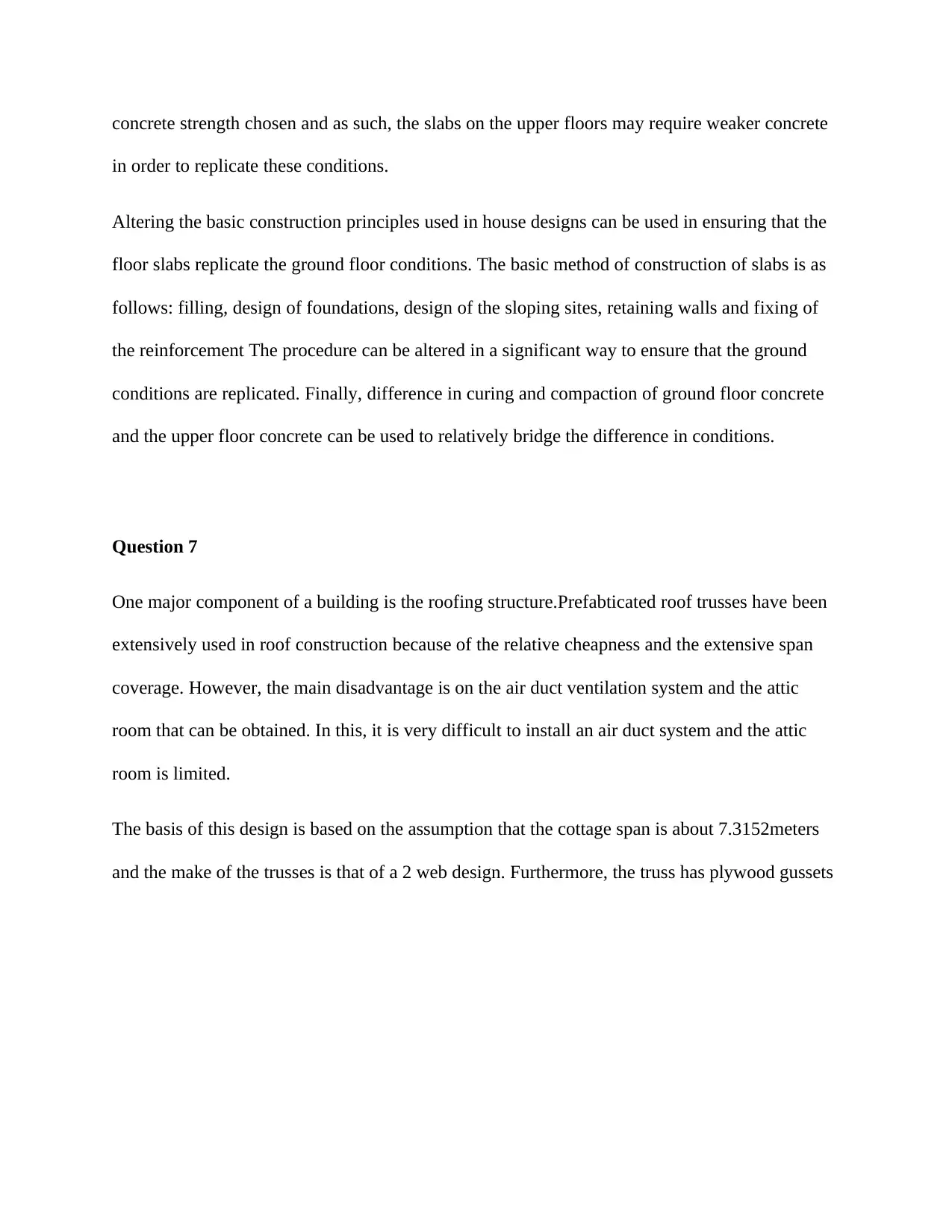
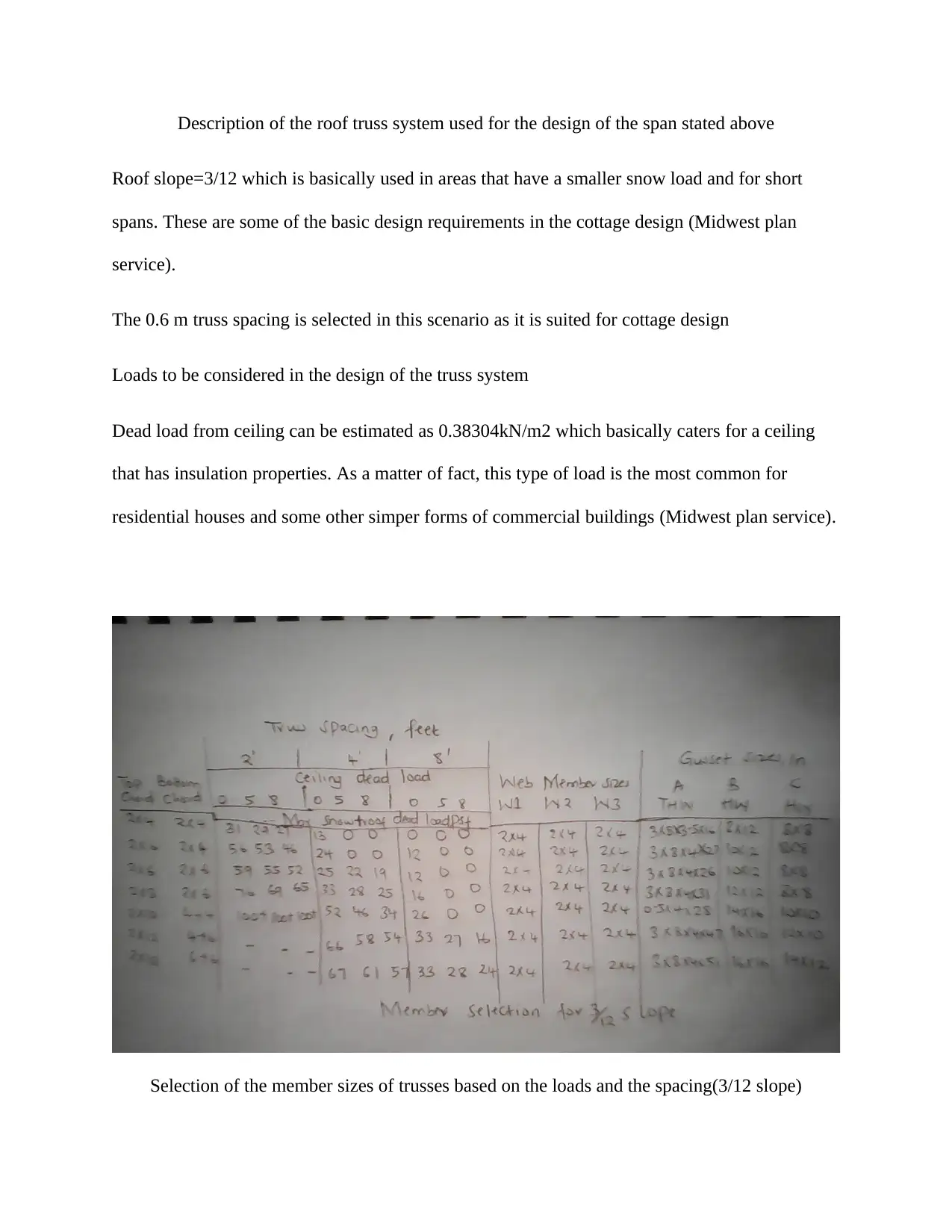
Description of the roof truss system used for the design of the span stated above
Roof slope=3/12 which is basically used in areas that have a smaller snow load and for short
spans. These are some of the basic design requirements in the cottage design (Midwest plan
service).
The 0.6 m truss spacing is selected in this scenario as it is suited for cottage design
Loads to be considered in the design of the truss system
Dead load from ceiling can be estimated as 0.38304kN/m2 which basically caters for a ceiling
that has insulation properties. As a matter of fact, this type of load is the most common for
residential houses and some other simper forms of commercial buildings (Midwest plan service).
Selection of the member sizes of trusses based on the loads and the spacing(3/12 slope)
Roof slope=3/12 which is basically used in areas that have a smaller snow load and for short
spans. These are some of the basic design requirements in the cottage design (Midwest plan
service).
The 0.6 m truss spacing is selected in this scenario as it is suited for cottage design
Loads to be considered in the design of the truss system
Dead load from ceiling can be estimated as 0.38304kN/m2 which basically caters for a ceiling
that has insulation properties. As a matter of fact, this type of load is the most common for
residential houses and some other simper forms of commercial buildings (Midwest plan service).
Selection of the member sizes of trusses based on the loads and the spacing(3/12 slope)
⊘ This is a preview!⊘
Do you want full access?
Subscribe today to unlock all pages.

Trusted by 1+ million students worldwide

The roof loads for the structure (ceiling and roofing)
In this design, the roof framing has been assumed to be made up of 2*4 purlins and as such,
imposes a dead load of 0.0336 kN/m2. On the other hand, the ceiling framing has been taken to
have the dimensions of 1 and 3 while the sheathing is that of galvanized steel. The total dead
load for the roofing structure can therefore be estimated by adding all the individual components
and as such, the total dead load that the structure has to accommodate=0.075kn/m2.
The wind fasteners required for the truss system can be estimated from the table below
In this design, the roof framing has been assumed to be made up of 2*4 purlins and as such,
imposes a dead load of 0.0336 kN/m2. On the other hand, the ceiling framing has been taken to
have the dimensions of 1 and 3 while the sheathing is that of galvanized steel. The total dead
load for the roofing structure can therefore be estimated by adding all the individual components
and as such, the total dead load that the structure has to accommodate=0.075kn/m2.
The wind fasteners required for the truss system can be estimated from the table below
Paraphrase This Document
Need a fresh take? Get an instant paraphrase of this document with our AI Paraphraser

Wind fasteners that caters for the wind loads subjected to the truss system.
As per our truss system which has a span of about 20-24 feet and a spacing of about 8 feet, the
wind bracing used is that of 2 metal framing anchors or 1 ,0.5 inches bolt.
In the design of a truss system, there are two basic systems: the cut off and the prefabricated
type. In this, the cut-off system is assembled on site while the prefabricated is delivered to the
site with the only work required the installation. Therefore, the prefabricated mode ensures that
the cost of labor are at a minimal.
The factors influencing the design of the truss system are: the loads, slope and the distance
between trusses. To begin with, the load influences the truss design because of the clear space
that can be provided by the trusses upon completion of the design. They are therefore suitable for
design of railroads, opera houses etc.Furthemore, they can accommodate a variety of loads such
as snow, dead loads wind loads etc. Most of the areas in the world require that that a slope of less
As per our truss system which has a span of about 20-24 feet and a spacing of about 8 feet, the
wind bracing used is that of 2 metal framing anchors or 1 ,0.5 inches bolt.
In the design of a truss system, there are two basic systems: the cut off and the prefabricated
type. In this, the cut-off system is assembled on site while the prefabricated is delivered to the
site with the only work required the installation. Therefore, the prefabricated mode ensures that
the cost of labor are at a minimal.
The factors influencing the design of the truss system are: the loads, slope and the distance
between trusses. To begin with, the load influences the truss design because of the clear space
that can be provided by the trusses upon completion of the design. They are therefore suitable for
design of railroads, opera houses etc.Furthemore, they can accommodate a variety of loads such
as snow, dead loads wind loads etc. Most of the areas in the world require that that a slope of less

than 25 degrees be used for loads that are greater than 50 ponds/square foot of roof area while
those that have a greater slope required to support larger loads (Midwest plan service). The slope
influences the stability and as such, decrease in the slope reduces the stability consequently
requiring lesser loads.
The slope of the roof basically influences the chord design and as such, some of the rules that
have been stipulated for the design of any truss system in relation to the truss slope is that, when
shingles are used, the slope should not be less than 50 %.However, this slope is suitable for slate
design. Finally, the span affects the design of any house because it basically affects the exterior
design. As in our case where the span is about 24 feet, the truss design may be as per the
architectural design or may have an effect on the exterior looks of the building
those that have a greater slope required to support larger loads (Midwest plan service). The slope
influences the stability and as such, decrease in the slope reduces the stability consequently
requiring lesser loads.
The slope of the roof basically influences the chord design and as such, some of the rules that
have been stipulated for the design of any truss system in relation to the truss slope is that, when
shingles are used, the slope should not be less than 50 %.However, this slope is suitable for slate
design. Finally, the span affects the design of any house because it basically affects the exterior
design. As in our case where the span is about 24 feet, the truss design may be as per the
architectural design or may have an effect on the exterior looks of the building
⊘ This is a preview!⊘
Do you want full access?
Subscribe today to unlock all pages.

Trusted by 1+ million students worldwide

References
Fothergil, L. C., & Royle, P. (1991). The sound insulation of timber platform floating floors in the
laboratory and field. Applied acoustics, 249-261.
Midwest plan service. (n.d.). MWPS truss 24.
Fothergil, L. C., & Royle, P. (1991). The sound insulation of timber platform floating floors in the
laboratory and field. Applied acoustics, 249-261.
Midwest plan service. (n.d.). MWPS truss 24.
1 out of 10
Your All-in-One AI-Powered Toolkit for Academic Success.
 +13062052269
info@desklib.com
Available 24*7 on WhatsApp / Email
Unlock your academic potential
Copyright © 2020–2026 A2Z Services. All Rights Reserved. Developed and managed by ZUCOL.