HCSC2001 Report: Analysis of TFI Scores for Tinnitus Patients
VerifiedAdded on 2023/06/06
|13
|2436
|277
Report
AI Summary
This report presents an analysis of a clinical study conducted by audiologist Harris, investigating the impact of different hearing aid devices on tinnitus severity, measured using the Tinnitus Functional Index (TFI) questionnaire. The study compared the effectiveness of combination hearing aids (amplification and sound enrichment) versus amplification alone on TFI scores over a six-month period. The analysis included normality checks using the One-Sample Kolmogorov-Smirnov Test, descriptive statistics to summarize the data, and inferential statistics, specifically an independent samples t-test, to compare the TFI scores between the two groups. The results indicated a significant difference in TFI scores between the combination hearing aid and amplification groups, with a lower mean TFI score observed in the combination group. The report concludes by discussing the implications of these findings for clinical practice, emphasizing the importance of considering different hearing aid types for tinnitus patients and the need for further research to optimize treatment outcomes. The study suggests that the choice of hearing aid can significantly affect the patient's experience and TFI score. The study also included a cross tabulation of TFI scores and groups.
Audiology

Paraphrase This Document
Need a fresh take? Get an instant paraphrase of this document with our AI Paraphraser
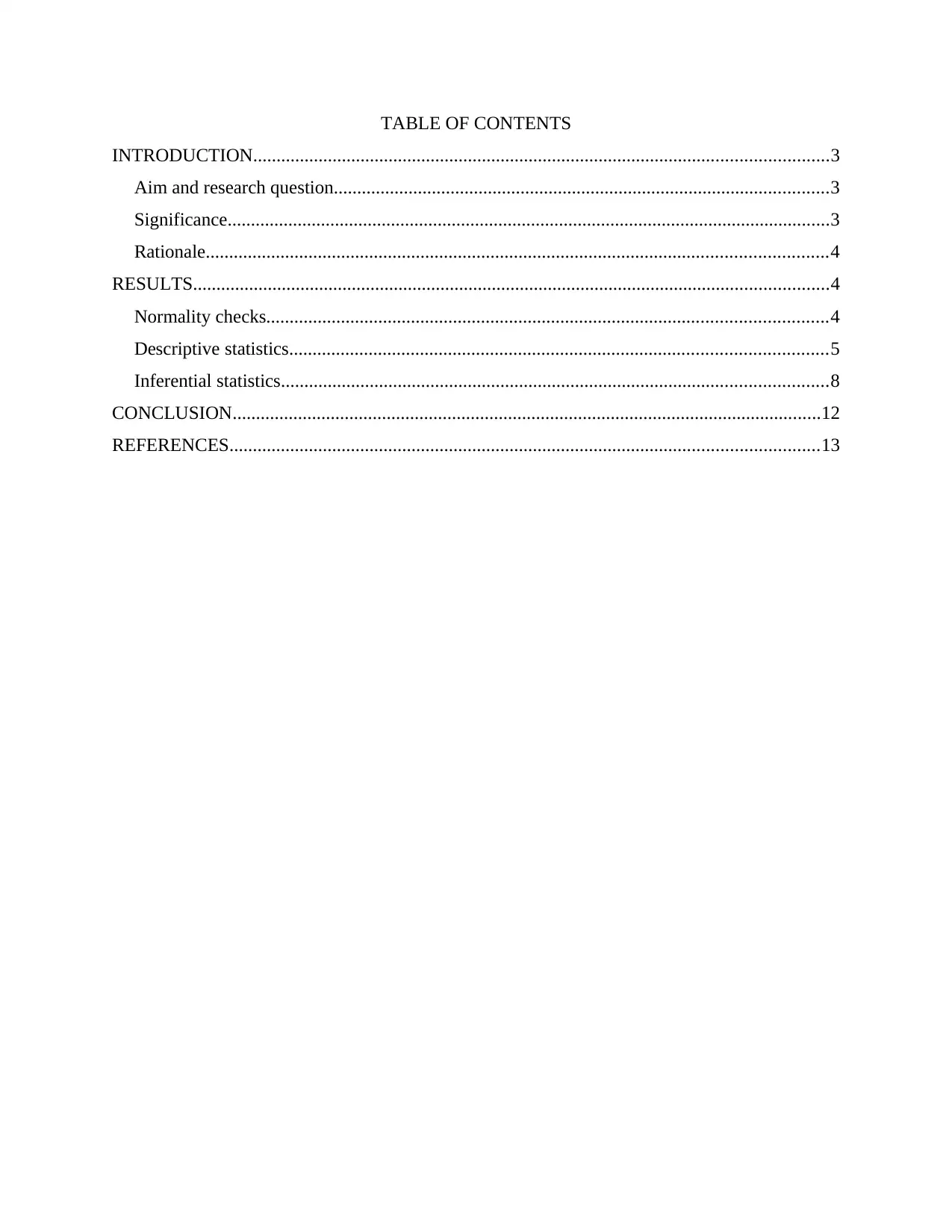
TABLE OF CONTENTS
INTRODUCTION...........................................................................................................................3
Aim and research question..........................................................................................................3
Significance.................................................................................................................................3
Rationale.....................................................................................................................................4
RESULTS........................................................................................................................................4
Normality checks........................................................................................................................4
Descriptive statistics...................................................................................................................5
Inferential statistics.....................................................................................................................8
CONCLUSION..............................................................................................................................12
REFERENCES..............................................................................................................................13
INTRODUCTION...........................................................................................................................3
Aim and research question..........................................................................................................3
Significance.................................................................................................................................3
Rationale.....................................................................................................................................4
RESULTS........................................................................................................................................4
Normality checks........................................................................................................................4
Descriptive statistics...................................................................................................................5
Inferential statistics.....................................................................................................................8
CONCLUSION..............................................................................................................................12
REFERENCES..............................................................................................................................13
INTRODUCTION
The audiology being referred to as the study of hearing and the present studies is based
on the analysis of the fact that whether the TFI school is being affected by the use of the device
or not. Any present scenario and audio Lodges is working with the tinnitus patient and want to
analyse the fact that whether them combination hearing aids are the amplification used affect the
tinnitus functional index score of the patient or not. Thus the whole study is being based on the
analysis of this fact only (Kutyba and et.al., 2022). The data within the study involve the group
to which the patients belong that is either the combination group or the amplification group.
Further another data set involves the TFI score which have been measured by the patients using
the combination hearing it for 6 months versus the people using the amplification for 6 months.
Moreover, the data has been gathered with two different patient groups that is patient with
bilateral then it is having use of combination hearing it for 6 months. On the other hand patient
with bilateral 10 it is using amplification for 6 months is being taken.
Aim and research question
The major aim of the study is to investigate the tinnitus functional index core of these 6
months of device use. The major name of the study is to prove that whether the combination
Hearing Aid or the amplification leads to lower tennis functional index school or not. The study
is being conducted by the audiologist in order to determine that which device is more useful for
the future patients to get rid of the problem. The research question of the whole study is that
‘Whether the use of the device affect the TFI score of the patient or not?’
Significance
In the current scenario there are many different people who are having issues relating to
the hearing problem. Thus it is not necessary that every person or patient is been treated with the
same Hearing Aid and it is helpful for them (Conlon and et.al., 2019). Hence for this it is very
necessary to evaluate that which device affects the person to treat the issue in better manner.
Thus the study will help the researcher evaluating the pact that whether hearing it or the
amplification is useful for the person to get rid of the problem of hearing.
The audiology being referred to as the study of hearing and the present studies is based
on the analysis of the fact that whether the TFI school is being affected by the use of the device
or not. Any present scenario and audio Lodges is working with the tinnitus patient and want to
analyse the fact that whether them combination hearing aids are the amplification used affect the
tinnitus functional index score of the patient or not. Thus the whole study is being based on the
analysis of this fact only (Kutyba and et.al., 2022). The data within the study involve the group
to which the patients belong that is either the combination group or the amplification group.
Further another data set involves the TFI score which have been measured by the patients using
the combination hearing it for 6 months versus the people using the amplification for 6 months.
Moreover, the data has been gathered with two different patient groups that is patient with
bilateral then it is having use of combination hearing it for 6 months. On the other hand patient
with bilateral 10 it is using amplification for 6 months is being taken.
Aim and research question
The major aim of the study is to investigate the tinnitus functional index core of these 6
months of device use. The major name of the study is to prove that whether the combination
Hearing Aid or the amplification leads to lower tennis functional index school or not. The study
is being conducted by the audiologist in order to determine that which device is more useful for
the future patients to get rid of the problem. The research question of the whole study is that
‘Whether the use of the device affect the TFI score of the patient or not?’
Significance
In the current scenario there are many different people who are having issues relating to
the hearing problem. Thus it is not necessary that every person or patient is been treated with the
same Hearing Aid and it is helpful for them (Conlon and et.al., 2019). Hence for this it is very
necessary to evaluate that which device affects the person to treat the issue in better manner.
Thus the study will help the researcher evaluating the pact that whether hearing it or the
amplification is useful for the person to get rid of the problem of hearing.
⊘ This is a preview!⊘
Do you want full access?
Subscribe today to unlock all pages.

Trusted by 1+ million students worldwide
Rationale
In the current modern environment there are many problem relating to health the being
affected by the person. The majority of the health issues are relating to help and hearing problem.
Hence this is the major problem which most commonly people of facing relating to the hearing
(Manning and et.al., 2019). Thus this was the reason for selecting the research topic relating to
investigating the change in TFI score due to changes in the use of device. Along with this
another reason was the personal and academic interest of the research initiated them to select this
topic.
RESULTS
Normality checks
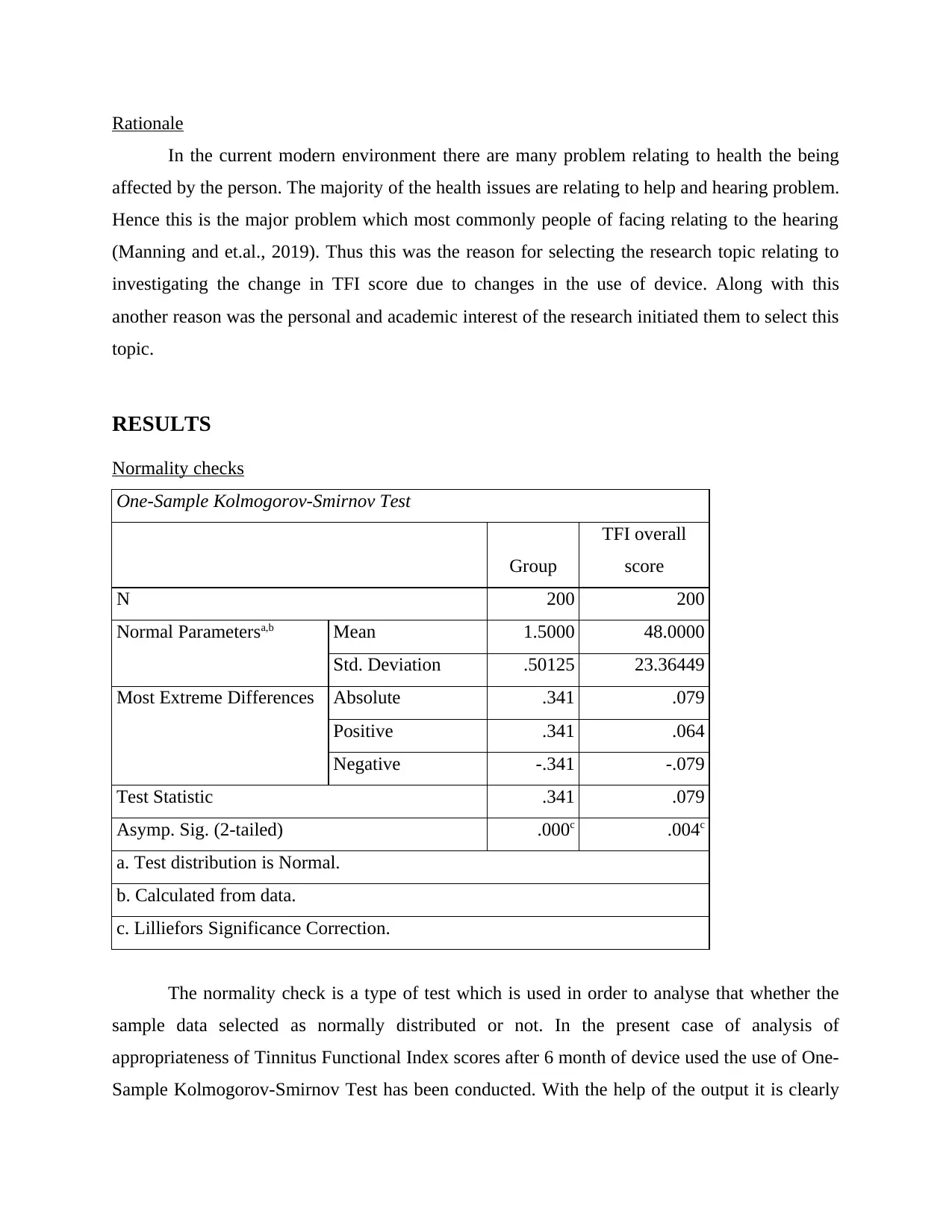
One-Sample Kolmogorov-Smirnov Test
Group
TFI overall
score
N 200 200
Normal Parametersa,b Mean 1.5000 48.0000
Std. Deviation .50125 23.36449
Most Extreme Differences Absolute .341 .079
Positive .341 .064
Negative -.341 -.079
Test Statistic .341 .079
Asymp. Sig. (2-tailed) .000c .004c
a. Test distribution is Normal.
b. Calculated from data.
c. Lilliefors Significance Correction.
The normality check is a type of test which is used in order to analyse that whether the
sample data selected as normally distributed or not. In the present case of analysis of
appropriateness of Tinnitus Functional Index scores after 6 month of device used the use of One-
Sample Kolmogorov-Smirnov Test has been conducted. With the help of the output it is clearly
In the current modern environment there are many problem relating to health the being
affected by the person. The majority of the health issues are relating to help and hearing problem.
Hence this is the major problem which most commonly people of facing relating to the hearing
(Manning and et.al., 2019). Thus this was the reason for selecting the research topic relating to
investigating the change in TFI score due to changes in the use of device. Along with this
another reason was the personal and academic interest of the research initiated them to select this
topic.
RESULTS
Normality checks
One-Sample Kolmogorov-Smirnov Test
Group
TFI overall
score
N 200 200
Normal Parametersa,b Mean 1.5000 48.0000
Std. Deviation .50125 23.36449
Most Extreme Differences Absolute .341 .079
Positive .341 .064
Negative -.341 -.079
Test Statistic .341 .079
Asymp. Sig. (2-tailed) .000c .004c
a. Test distribution is Normal.
b. Calculated from data.
c. Lilliefors Significance Correction.
The normality check is a type of test which is used in order to analyse that whether the
sample data selected as normally distributed or not. In the present case of analysis of
appropriateness of Tinnitus Functional Index scores after 6 month of device used the use of One-
Sample Kolmogorov-Smirnov Test has been conducted. With the help of the output it is clearly
Paraphrase This Document
Need a fresh take? Get an instant paraphrase of this document with our AI Paraphraser
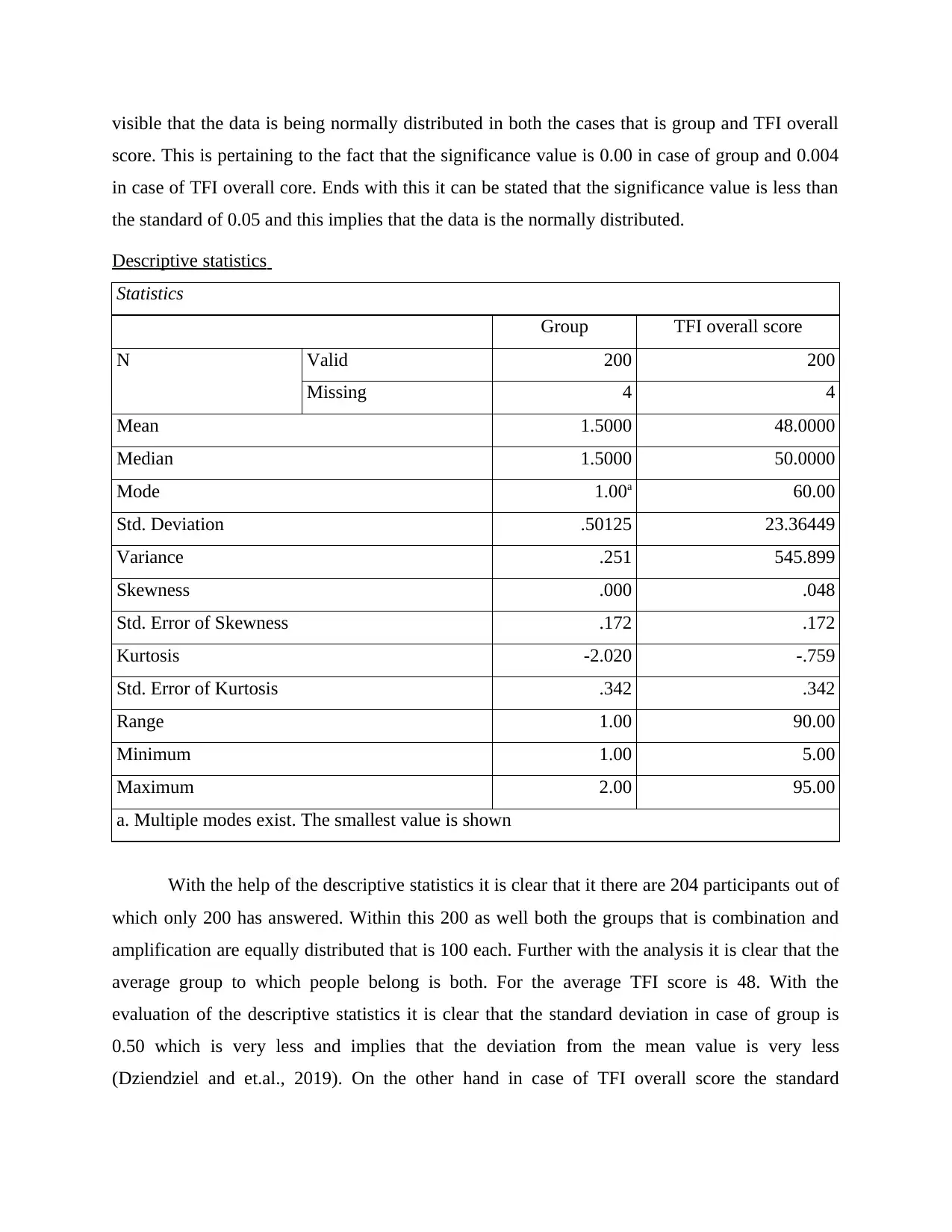
visible that the data is being normally distributed in both the cases that is group and TFI overall
score. This is pertaining to the fact that the significance value is 0.00 in case of group and 0.004
in case of TFI overall core. Ends with this it can be stated that the significance value is less than
the standard of 0.05 and this implies that the data is the normally distributed.
Descriptive statistics
Statistics
Group TFI overall score
N Valid 200 200
Missing 4 4
Mean 1.5000 48.0000
Median 1.5000 50.0000
Mode 1.00a 60.00
Std. Deviation .50125 23.36449
Variance .251 545.899
Skewness .000 .048
Std. Error of Skewness .172 .172
Kurtosis -2.020 -.759
Std. Error of Kurtosis .342 .342
Range 1.00 90.00
Minimum 1.00 5.00
Maximum 2.00 95.00
a. Multiple modes exist. The smallest value is shown
With the help of the descriptive statistics it is clear that it there are 204 participants out of
which only 200 has answered. Within this 200 as well both the groups that is combination and
amplification are equally distributed that is 100 each. Further with the analysis it is clear that the
average group to which people belong is both. For the average TFI score is 48. With the
evaluation of the descriptive statistics it is clear that the standard deviation in case of group is
0.50 which is very less and implies that the deviation from the mean value is very less
(Dziendziel and et.al., 2019). On the other hand in case of TFI overall score the standard
score. This is pertaining to the fact that the significance value is 0.00 in case of group and 0.004
in case of TFI overall core. Ends with this it can be stated that the significance value is less than
the standard of 0.05 and this implies that the data is the normally distributed.
Descriptive statistics
Statistics
Group TFI overall score
N Valid 200 200
Missing 4 4
Mean 1.5000 48.0000
Median 1.5000 50.0000
Mode 1.00a 60.00
Std. Deviation .50125 23.36449
Variance .251 545.899
Skewness .000 .048
Std. Error of Skewness .172 .172
Kurtosis -2.020 -.759
Std. Error of Kurtosis .342 .342
Range 1.00 90.00
Minimum 1.00 5.00
Maximum 2.00 95.00
a. Multiple modes exist. The smallest value is shown
With the help of the descriptive statistics it is clear that it there are 204 participants out of
which only 200 has answered. Within this 200 as well both the groups that is combination and
amplification are equally distributed that is 100 each. Further with the analysis it is clear that the
average group to which people belong is both. For the average TFI score is 48. With the
evaluation of the descriptive statistics it is clear that the standard deviation in case of group is
0.50 which is very less and implies that the deviation from the mean value is very less
(Dziendziel and et.al., 2019). On the other hand in case of TFI overall score the standard
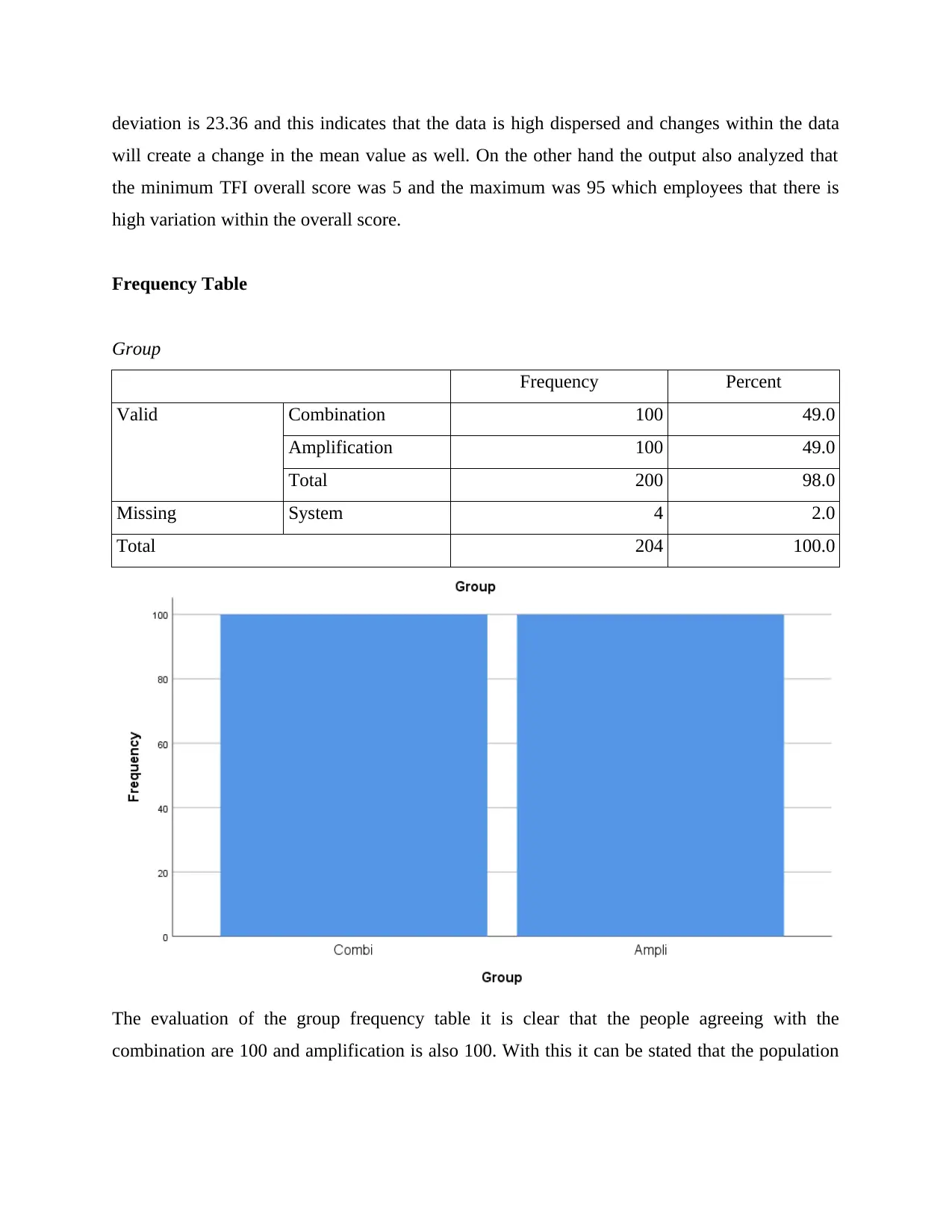
deviation is 23.36 and this indicates that the data is high dispersed and changes within the data
will create a change in the mean value as well. On the other hand the output also analyzed that
the minimum TFI overall score was 5 and the maximum was 95 which employees that there is
high variation within the overall score.
Frequency Table
Group
Frequency Percent
Valid Combination 100 49.0
Amplification 100 49.0
Total 200 98.0
Missing System 4 2.0
Total 204 100.0
The evaluation of the group frequency table it is clear that the people agreeing with the
combination are 100 and amplification is also 100. With this it can be stated that the population
will create a change in the mean value as well. On the other hand the output also analyzed that
the minimum TFI overall score was 5 and the maximum was 95 which employees that there is
high variation within the overall score.
Frequency Table
Group
Frequency Percent
Valid Combination 100 49.0
Amplification 100 49.0
Total 200 98.0
Missing System 4 2.0
Total 204 100.0
The evaluation of the group frequency table it is clear that the people agreeing with the
combination are 100 and amplification is also 100. With this it can be stated that the population
⊘ This is a preview!⊘
Do you want full access?
Subscribe today to unlock all pages.
Trusted by 1+ million students worldwide
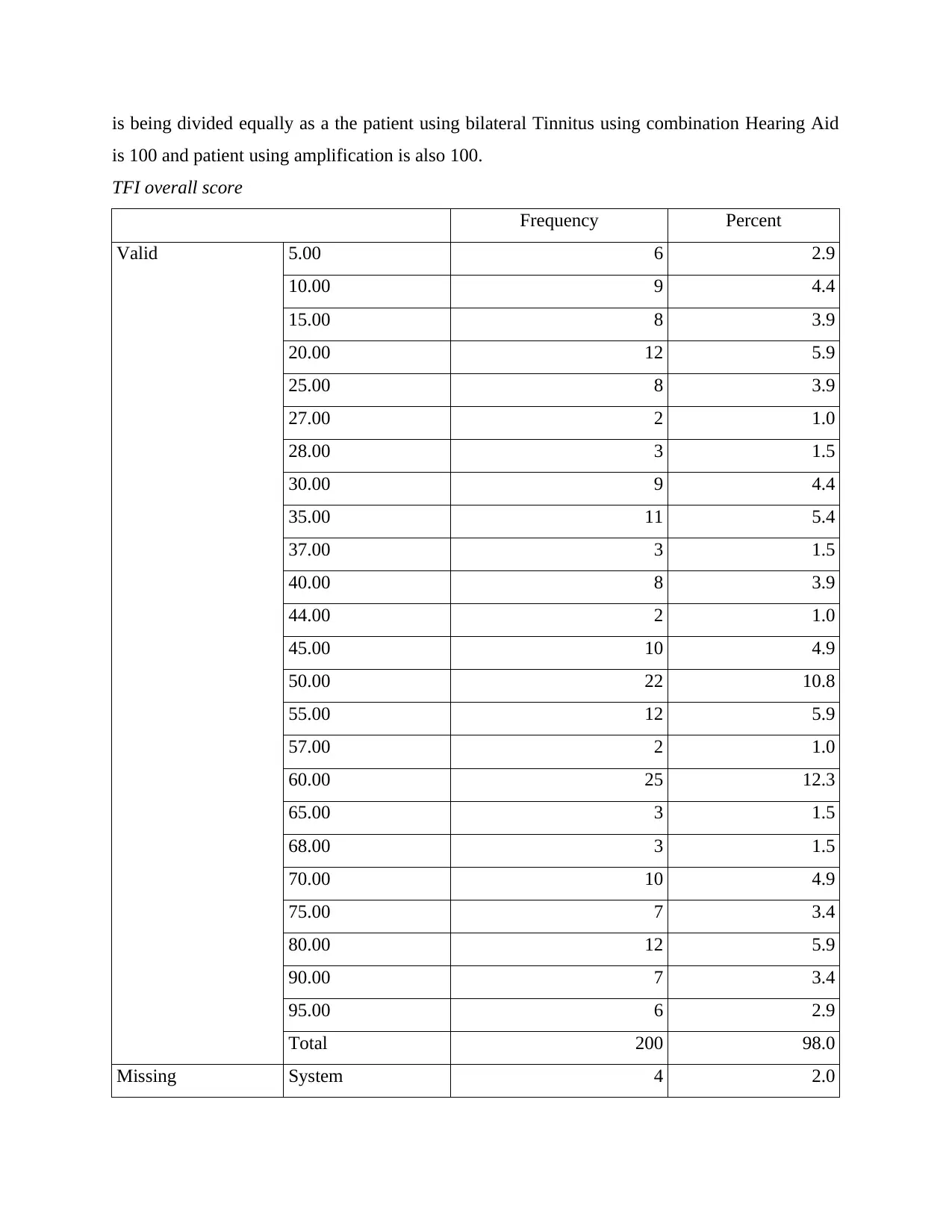
is being divided equally as a the patient using bilateral Tinnitus using combination Hearing Aid
is 100 and patient using amplification is also 100.
TFI overall score
Frequency Percent
Valid 5.00 6 2.9
10.00 9 4.4
15.00 8 3.9
20.00 12 5.9
25.00 8 3.9
27.00 2 1.0
28.00 3 1.5
30.00 9 4.4
35.00 11 5.4
37.00 3 1.5
40.00 8 3.9
44.00 2 1.0
45.00 10 4.9
50.00 22 10.8
55.00 12 5.9
57.00 2 1.0
60.00 25 12.3
65.00 3 1.5
68.00 3 1.5
70.00 10 4.9
75.00 7 3.4
80.00 12 5.9
90.00 7 3.4
95.00 6 2.9
Total 200 98.0
Missing System 4 2.0
is 100 and patient using amplification is also 100.
TFI overall score
Frequency Percent
Valid 5.00 6 2.9
10.00 9 4.4
15.00 8 3.9
20.00 12 5.9
25.00 8 3.9
27.00 2 1.0
28.00 3 1.5
30.00 9 4.4
35.00 11 5.4
37.00 3 1.5
40.00 8 3.9
44.00 2 1.0
45.00 10 4.9
50.00 22 10.8
55.00 12 5.9
57.00 2 1.0
60.00 25 12.3
65.00 3 1.5
68.00 3 1.5
70.00 10 4.9
75.00 7 3.4
80.00 12 5.9
90.00 7 3.4
95.00 6 2.9
Total 200 98.0
Missing System 4 2.0
Paraphrase This Document
Need a fresh take? Get an instant paraphrase of this document with our AI Paraphraser
Total 204 100.0
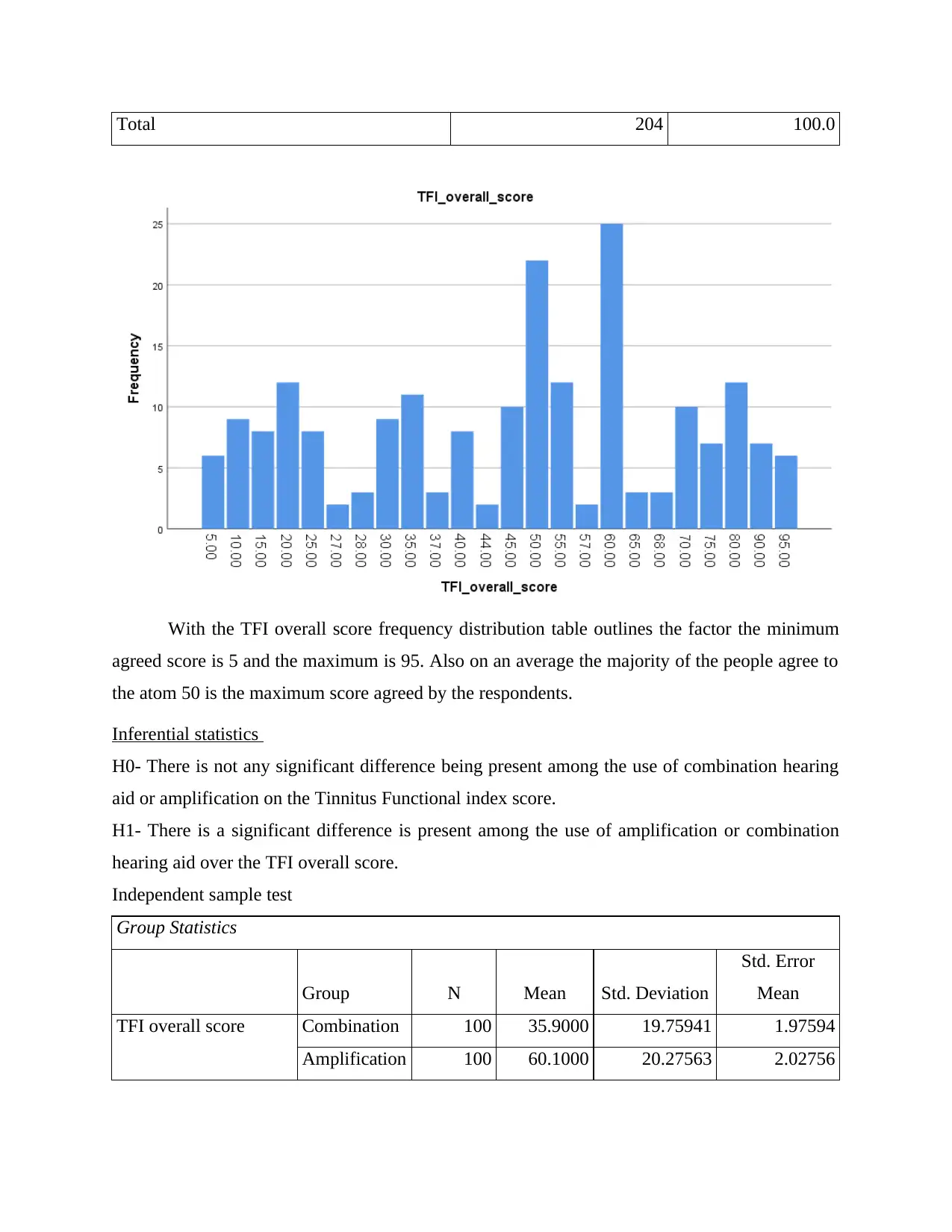
With the TFI overall score frequency distribution table outlines the factor the minimum
agreed score is 5 and the maximum is 95. Also on an average the majority of the people agree to
the atom 50 is the maximum score agreed by the respondents.
Inferential statistics
H0- There is not any significant difference being present among the use of combination hearing
aid or amplification on the Tinnitus Functional index score.
H1- There is a significant difference is present among the use of amplification or combination
hearing aid over the TFI overall score.
Independent sample test
Group Statistics
Group N Mean Std. Deviation
Std. Error
Mean
TFI overall score Combination 100 35.9000 19.75941 1.97594
Amplification 100 60.1000 20.27563 2.02756
With the TFI overall score frequency distribution table outlines the factor the minimum
agreed score is 5 and the maximum is 95. Also on an average the majority of the people agree to
the atom 50 is the maximum score agreed by the respondents.
Inferential statistics
H0- There is not any significant difference being present among the use of combination hearing
aid or amplification on the Tinnitus Functional index score.
H1- There is a significant difference is present among the use of amplification or combination
hearing aid over the TFI overall score.
Independent sample test
Group Statistics
Group N Mean Std. Deviation
Std. Error
Mean
TFI overall score Combination 100 35.9000 19.75941 1.97594
Amplification 100 60.1000 20.27563 2.02756
Independent Samples Test
Levene's
Test for
Equality
of
Variances t-test for Equality of Means
F Sig. t df
Sig.
(2-
tailed)
Mean
Difference
Std. Error
Difference
95% Confidence
Interval of the
Difference
Lower Upper
TFI overall
score
Equal
variances
assumed
.557 .456 -
8.548
198 .000 -24.20000 2.83114 -
29.78306
-
18.61694
Equal
variances
not
assumed
-
8.548
197.868 .000 -24.20000 2.83114 -
29.78308
-
18.61692
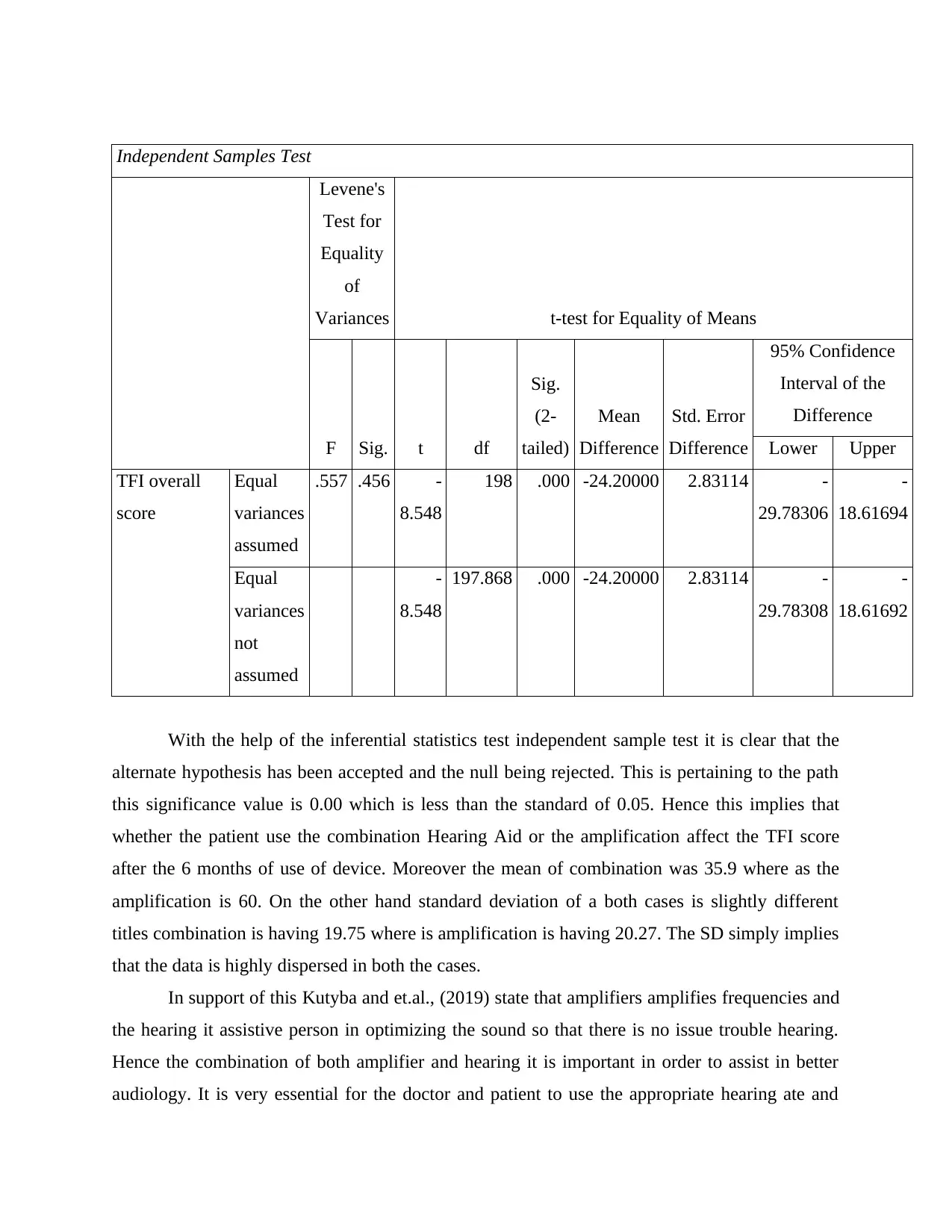
With the help of the inferential statistics test independent sample test it is clear that the
alternate hypothesis has been accepted and the null being rejected. This is pertaining to the path
this significance value is 0.00 which is less than the standard of 0.05. Hence this implies that
whether the patient use the combination Hearing Aid or the amplification affect the TFI score
after the 6 months of use of device. Moreover the mean of combination was 35.9 where as the
amplification is 60. On the other hand standard deviation of a both cases is slightly different
titles combination is having 19.75 where is amplification is having 20.27. The SD simply implies
that the data is highly dispersed in both the cases.
In support of this Kutyba and et.al., (2019) state that amplifiers amplifies frequencies and
the hearing it assistive person in optimizing the sound so that there is no issue trouble hearing.
Hence the combination of both amplifier and hearing it is important in order to assist in better
audiology. It is very essential for the doctor and patient to use the appropriate hearing ate and
Levene's
Test for
Equality
of
Variances t-test for Equality of Means
F Sig. t df
Sig.
(2-
tailed)
Mean
Difference
Std. Error
Difference
95% Confidence
Interval of the
Difference
Lower Upper
TFI overall
score
Equal
variances
assumed
.557 .456 -
8.548
198 .000 -24.20000 2.83114 -
29.78306
-
18.61694
Equal
variances
not
assumed
-
8.548
197.868 .000 -24.20000 2.83114 -
29.78308
-
18.61692
With the help of the inferential statistics test independent sample test it is clear that the
alternate hypothesis has been accepted and the null being rejected. This is pertaining to the path
this significance value is 0.00 which is less than the standard of 0.05. Hence this implies that
whether the patient use the combination Hearing Aid or the amplification affect the TFI score
after the 6 months of use of device. Moreover the mean of combination was 35.9 where as the
amplification is 60. On the other hand standard deviation of a both cases is slightly different
titles combination is having 19.75 where is amplification is having 20.27. The SD simply implies
that the data is highly dispersed in both the cases.
In support of this Kutyba and et.al., (2019) state that amplifiers amplifies frequencies and
the hearing it assistive person in optimizing the sound so that there is no issue trouble hearing.
Hence the combination of both amplifier and hearing it is important in order to assist in better
audiology. It is very essential for the doctor and patient to use the appropriate hearing ate and
⊘ This is a preview!⊘
Do you want full access?
Subscribe today to unlock all pages.
Trusted by 1+ million students worldwide
material so that the patient does not have any issue relating to hearing and their problem is being
solved. In case hearing machine or the amplifier is not in proper use them it will be affecting
them treatment of the patient. Hands it is very necessary for the hospital and doctors to evaluate
that which kind of tool is better in assisting and improving the persons wearing problem.
On the other hand Wang and et.al., (2020) argues that when the hearing instruments will
not be installed effectively then it will be affecting the treatment of the person to a great extent.
Therefore this it is necessary that the doctor and the Health Care practitioner first evaluate the
utility of all the instruments and their after improve the treatment in better and effective way.
Crosstabs
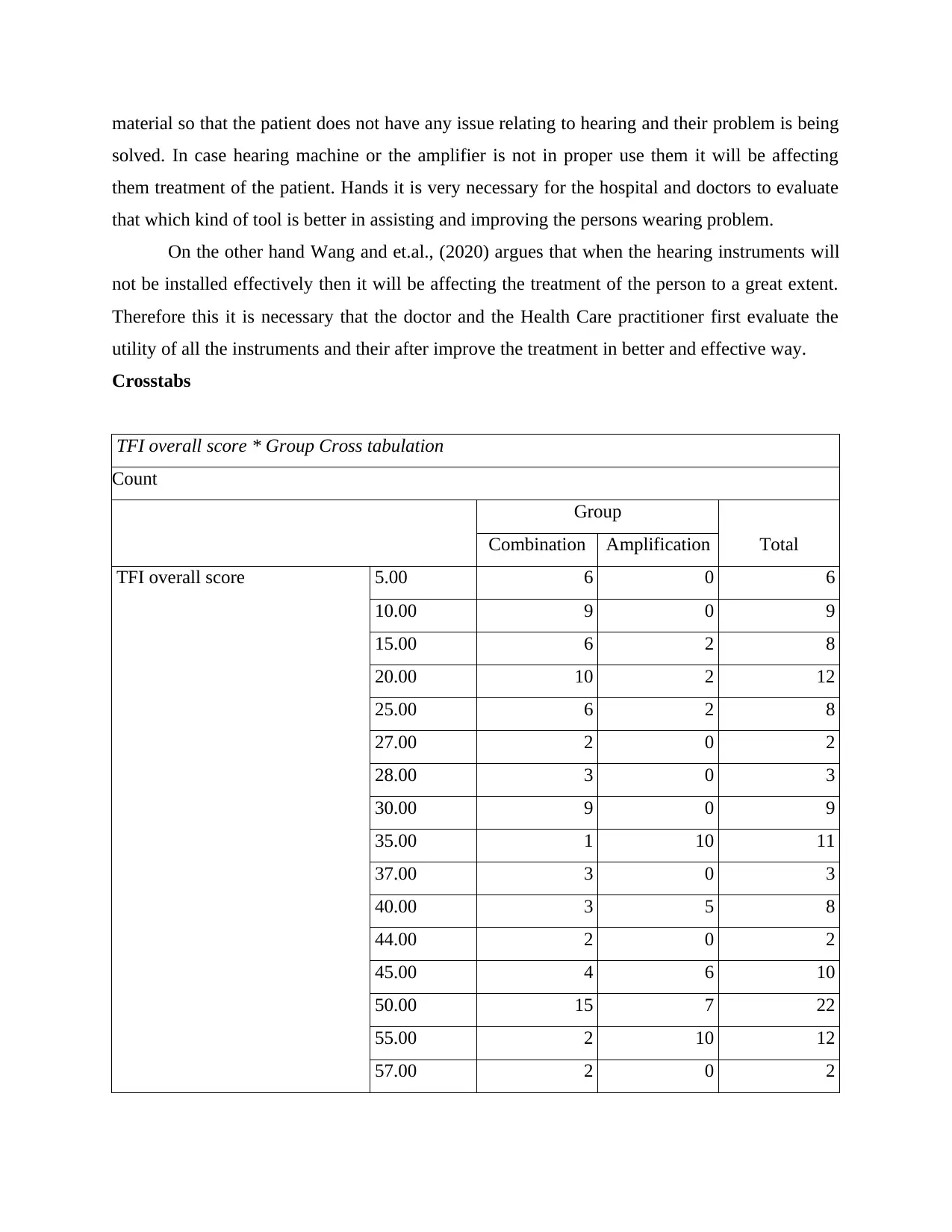
TFI overall score * Group Cross tabulation
Count
Group
TotalCombination Amplification
TFI overall score 5.00 6 0 6
10.00 9 0 9
15.00 6 2 8
20.00 10 2 12
25.00 6 2 8
27.00 2 0 2
28.00 3 0 3
30.00 9 0 9
35.00 1 10 11
37.00 3 0 3
40.00 3 5 8
44.00 2 0 2
45.00 4 6 10
50.00 15 7 22
55.00 2 10 12
57.00 2 0 2
solved. In case hearing machine or the amplifier is not in proper use them it will be affecting
them treatment of the patient. Hands it is very necessary for the hospital and doctors to evaluate
that which kind of tool is better in assisting and improving the persons wearing problem.
On the other hand Wang and et.al., (2020) argues that when the hearing instruments will
not be installed effectively then it will be affecting the treatment of the person to a great extent.
Therefore this it is necessary that the doctor and the Health Care practitioner first evaluate the
utility of all the instruments and their after improve the treatment in better and effective way.
Crosstabs
TFI overall score * Group Cross tabulation
Count
Group
TotalCombination Amplification
TFI overall score 5.00 6 0 6
10.00 9 0 9
15.00 6 2 8
20.00 10 2 12
25.00 6 2 8
27.00 2 0 2
28.00 3 0 3
30.00 9 0 9
35.00 1 10 11
37.00 3 0 3
40.00 3 5 8
44.00 2 0 2
45.00 4 6 10
50.00 15 7 22
55.00 2 10 12
57.00 2 0 2
Paraphrase This Document
Need a fresh take? Get an instant paraphrase of this document with our AI Paraphraser
60.00 6 19 25
65.00 2 1 3
68.00 3 0 3
70.00 6 4 10
75.00 0 7 7
80.00 0 12 12
90.00 0 7 7
95.00 0 6 6
Total 100 100 200
Chi-Square Tests
Value df
Asymptotic
Significance (2-
sided)
Pearson Chi-Square 104.333a 23 .000
Likelihood Ratio 134.535 23 .000
Linear-by-Linear Association 53.640 1 .000
N of Valid Cases 200
a. 32 cells (66.7%) have expected count less than 5. The minimum expected count is 1.00.
Symmetric Measures
Value
Approximate
Significance
Nominal by Nominal Phi .722 .000
Cramer's V .722 .000
N of Valid Cases 200
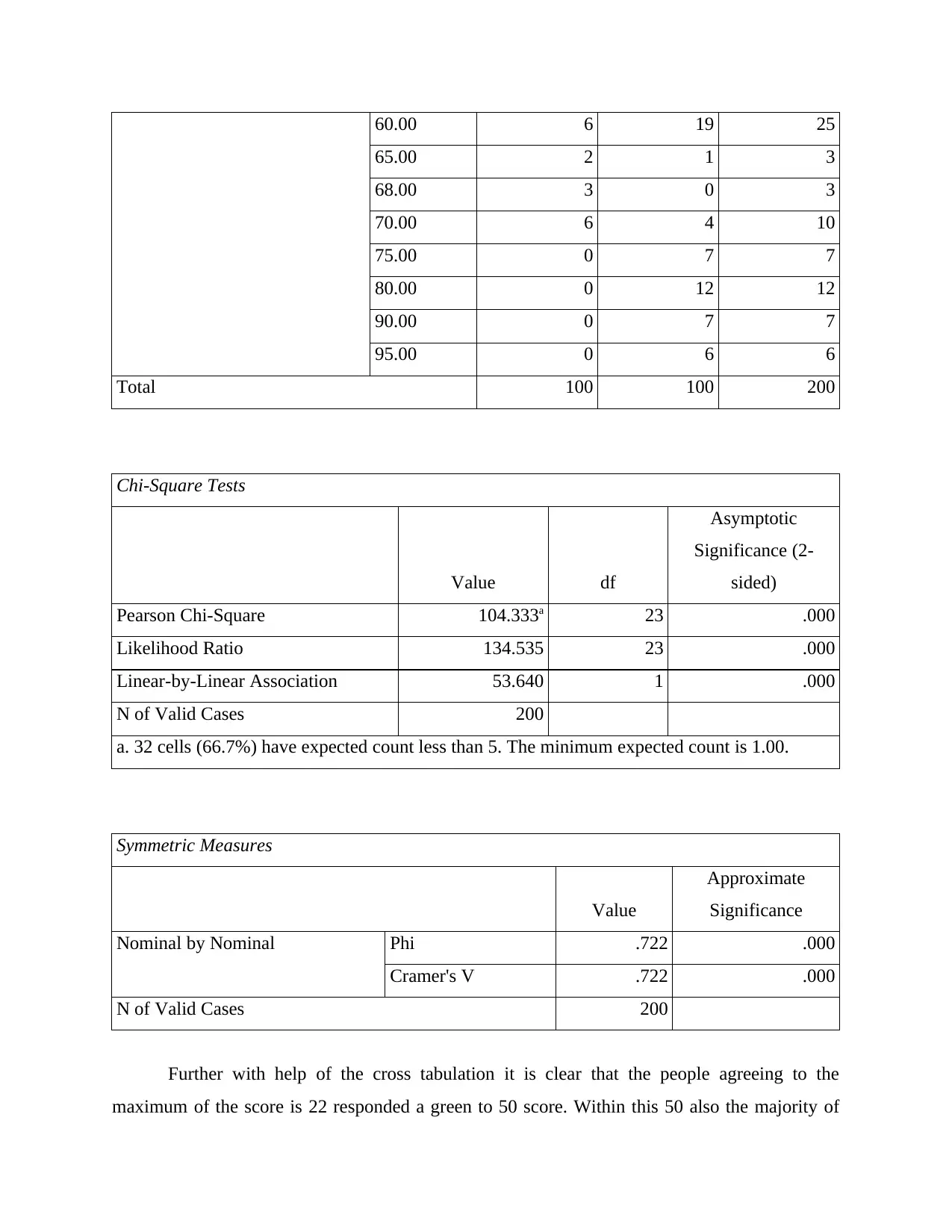
Further with help of the cross tabulation it is clear that the people agreeing to the
maximum of the score is 22 responded a green to 50 score. Within this 50 also the majority of
65.00 2 1 3
68.00 3 0 3
70.00 6 4 10
75.00 0 7 7
80.00 0 12 12
90.00 0 7 7
95.00 0 6 6
Total 100 100 200
Chi-Square Tests
Value df
Asymptotic
Significance (2-
sided)
Pearson Chi-Square 104.333a 23 .000
Likelihood Ratio 134.535 23 .000
Linear-by-Linear Association 53.640 1 .000
N of Valid Cases 200
a. 32 cells (66.7%) have expected count less than 5. The minimum expected count is 1.00.
Symmetric Measures
Value
Approximate
Significance
Nominal by Nominal Phi .722 .000
Cramer's V .722 .000
N of Valid Cases 200
Further with help of the cross tabulation it is clear that the people agreeing to the
maximum of the score is 22 responded a green to 50 score. Within this 50 also the majority of
people belong to combination group that is 15 and 7 with amplification group. Overall it can be
stated that the people green with the lowest score is 5 and the highest score is 95. This simply
implies that the range of the data is 90 that is maximum minus minimum which is 95 less 5 that
is 90. Also the significance value is 0.00 which employees that the alternate hypothesis is been
accepted and the null is being rejected (Fackrell and et.al., 2018). This simply implies that the
use of combination or amplification does not affect the TFI score of the person even after the use
of the device.
CONCLUSION
In the end it is concluded that analysis of the data is very important in order to take any
kind of decision. In the present case and audiologist Harris wanted to investigate that whether the
TFI score is being affected by the device used or not. This with the help of the output it was clear
the atom the use of device perfectly TFI score of the person with the difference of use of device
that is either combination hearing it for the amplification. Thus it can be stated that the TFI score
is being affected by the use of device for the enhancing the effective hearing among the patient.
stated that the people green with the lowest score is 5 and the highest score is 95. This simply
implies that the range of the data is 90 that is maximum minus minimum which is 95 less 5 that
is 90. Also the significance value is 0.00 which employees that the alternate hypothesis is been
accepted and the null is being rejected (Fackrell and et.al., 2018). This simply implies that the
use of combination or amplification does not affect the TFI score of the person even after the use
of the device.
CONCLUSION
In the end it is concluded that analysis of the data is very important in order to take any
kind of decision. In the present case and audiologist Harris wanted to investigate that whether the
TFI score is being affected by the device used or not. This with the help of the output it was clear
the atom the use of device perfectly TFI score of the person with the difference of use of device
that is either combination hearing it for the amplification. Thus it can be stated that the TFI score
is being affected by the use of device for the enhancing the effective hearing among the patient.
⊘ This is a preview!⊘
Do you want full access?
Subscribe today to unlock all pages.
Trusted by 1+ million students worldwide

1 out of 13


Your All-in-One AI-Powered Toolkit for Academic Success.
+13062052269
info@desklib.com
Available 24*7 on WhatsApp / Email
![[object Object]](/_next/static/media/star-bottom.7253800d.svg)
Unlock your academic potential
Copyright © 2020–2026 A2Z Services. All Rights Reserved. Developed and managed by ZUCOL.